Summer School Program | Three Exhibitions at The Prado
From H-ArtHist:
Escuela de Verano: Tres exposiciones temporales en el Prado, Concepción y organización
Museo Nacional del Prado, Madrid, 8–10 July 2019
Applications due by 24 May 2019
La Escuela de Verano del Museo del Prado es una nueva iniciativa académica de la Escuela del Prado cuyo objetivo principal es abarcar aquellos aspectos de la formación de jóvenes historiadores del arte, futuros conservadores y gestores de museos que las Universidades no pueden cubrir con su programación y que solo se pueden abordar desde una institución como el Prado. Los cursos profundizarán en diversos temas relacionados con el Museo del Prado, sus colecciones, la museografía y la museología, y en distintos aspectos relativos a la gestión de esta gran institución museística, desde la investigación a la exposición de obras de arte o a la conservación de sus colecciones.
Coincidiendo con el Bicentenario del Museo y partiendo de tres de las grandes exposiciones temporales organizadas por el Prado en 2019: Fra Angelico y los inicios del Renacimiento en Florencia; Velázquez, Rembrandt, Vermeer. Miradas afines; y Solo la voluntad me sobra. Dibujos de Goya, el objetivo de esta edición de la Escuela de Verano es acercar a los alumnos al proceso de creación de una exposición desde el momento mismo de su concepción. Esta edición de la Escuela estará dirigida por José Manuel Matilla (Jefe del Área de Dibujos y Estampas del MNP ) y Alejandro Vergara (Jefe del Área de Pintura Flamenca y Escuelas del Norte (hasta 1700) del MNP ). Los alumnos tendrán la oportunidad de recibir la información directamente de los profesionales de distintas disciplinas involucrados en el proceso de una exposición –diseñadores, restauradores, coordinadores de exposición, …- y de poder aprender a través del contacto directo con las obras de arte. El reducido número de alumnos permitirá un contacto directo con el claustro de profesores, y a la vez lograr una participación activa en un ambiente dinámico de recíproca colaboración entre profesores y alumnos.
La Escuela de Verano se desarrollará durante tres días consecutivos, en sesiones que combinarán clases teóricas y clases prácticas que consistirán en visitas a diversos espacios del Museo del Prado como las Salas de Exposiciones Temporales y Permanente, los Talleres de Restauración y los Almacenes de obras de arte, o el Gabinete de Dibujos y Estampas, entre otros.
La Escuela de Verano es una actividad gratuita gracias a la colaboración de la Fundación Banco Sabadell. El plazo de inscripción es de 30 de abril al 24 de mayo de 2019. El número máximo de alumnos admitidos en la Escuela de Verano será de 30 (en dos grupos de 15 participantes por grupo). Los aspirantes no deben superar los 30 años y deben estar en el último año del grado o ser estudiantes de postgrado. No se admitirán candidatos que posean una nota media inferior a notable en el grado. Consultas: escuela.prado@museodelprado.es.
Summer School | Rethinking the Baroque

From H-ArtHist:
Summer School | Rethinking the Baroque (Seventeenth and Eighteenth Centuries), New Historical and Critical Perspectives
Turin, 2–7 September 2019
Applications due by 31 May 2019
The Fondazione 1563 invites scholars who are younger than 40; active in the disciplines of history, art history, architecture, and literature; and who hold a PhD, a certificate of specialization, a 2nd-level master’s, or are enrolled in the second year of such study courses to apply to participate in the Summer School Rethinking the Baroque (XVII and XVIII Centuries): New Historical and Critical Perspectives. Candidates need to have a knowledge of Italian and English corresponding at least to a level B2. The courses of the Summer School will all be taught in Italian.
Participation in the Summer School is free. The Foundation will also cover the costs of the living expenses (accommodation and food) for the period running from the night of September 1 to the night of September 6 included, as identified by the Foundation. In addition, the Foundation will cover the costs of the guided tours, the transfer from/to the venue of the school. Travel expenses to and from Torino are, however, not covered by the Foundation.
Candidates must apply through the specific application form found here by 5.00pm of 31 May 2019. Candidates must upload their CV and an abstract of current or ongoing research. The research should present new critical perspectives relevant to the subject of the Summer School.
The Summer School will take place from September 2 to September 7, 2019 at the historical residency ‘Vigna di Madama Reale’, Strada Comunale San Vito Revigliasco 65, 10133 (Torino), or in a different venue in Torino that will be established by the Foundation.
The Summer School will address periods and turning points of cultural production in the field of art, architecture, literature, music, theatre, and history in Europe in the XVII and XVIII centuries, and it will further develop the critical reflection on the studies dedicated to the Baroque and its chronology.
The Summer School will be structured as follows:
• Lectures by experts in different disciplines, including Professor Franco Benigno (Professor of Modern History at the Scuola Normale Superiore, Pisa) and Professor Ingrid Rowland (Department of History, University of Notre Dame).
• Discussions in small seminar groups on cross-disciplinary issues related to historical criticism and methodologies, conducted with the support of scholars who won the scholarships of the Baroque.
Study Programme at the Foundation in the years 2013–17
• Formative sessions on digital humanities and digital tools applied to research
• Occasions to present and discuss participants’ research
• A presentation of the exhibition Roma, Torino, Parigi 1680–1750, a product of the project Antico e Moderno: Roma, Torino, Parigi 1680–1750, curated by Michela di Macco and Giuseppe Dardanello and developed by the Foundation. The exhibition will be on view at Venaria Reale in Spring 2020
• Guided tours to key art historical places in Torino, with particular attention to the Royal Museums and their collections
During the Summer School—and particularly during the workshop sessions—participants will have the opportunity to exchange critical and methodological points of view on the research they submitted when they applied for the summer school. The outcomes of these sessions might be included in papers for a future collective publication in an electronic version with ISBN, at the Foundation’s expense. A certificate of participation from the Foundation will be provided at the end of the Summer School.
More information is available here»
Seminar | Matthew Hargraves on Watercolor

J. M. W. Turner, The Pass at St. Gotthard, near Faido, 1843, watercolor over graphite
(New York: The Morgan Library & Museum, 2006.52)
◊ ◊ ◊ ◊ ◊
From the seminar flyer:
Seminar on Watercolor with Matthew Hargraves
The Morgan Library & Museum, New York, 15 March 2019
Applications due by 1 February 2019
The Morgan Library & Museum has an extensive collection of drawings from the Renaissance to the present, many of which feature the use of colored washes. Participants in this graduate seminar will look closely at the use of watercolor by artists of different schools, with a particular focus on the widespread use of the medium during the late eighteenth and early nineteenth centuries in Britain. From around 1750 to 1850, the period typically considered to be watercolor’s ‘golden age’, the medium came to be seen as a distinctively British art. In fact, however, watercolor had been used across Europe for centuries, and this seminar will examine the origins of watercolor, its adoption and development by British artists in the eighteenth century, and the spread of watercolor as a drawing medium in the Romanic period. Among the sheets examined will be examples by Albrecht Dürer, William Blake, Caspar David Friedrich, Eugène Delacroix, and J.M.W. Turner. The seminar will begin at 10am and last until 4pm.
Matthew Hargraves is Chief Curator of Art Collections at Yale Center for British Art in New Haven.
This seminar is open to graduate students in the history of art. Interested participants are kindly
invited to submit a one paragraph statement, which should include the following:
• Name and email
• Academic institution, class year, and field of study
• Interest in drawings
• Reason/s for wanting to participate in the seminar
A brief recommendation from the student’s advisor is welcome but not required. Applications should be submitted electronically by 1 February 2019 with the subject header ‘Watercolor Seminar’ to: drawinginstitute@themorgan.org. Participants will be notified by 11 February 2019.
Mary D. Sheriff Travel and Research Award for 2019
The Mary D. Sheriff Travel and Research Award
Applications due by 15 January 2019
The Mary D. Sheriff Travel and Research Award supports feminist topics in eighteenth-century art history and visual culture. The award will be given every other year, beginning in 2019 with $2000.
Doctoral candidates, early career scholars, and contingent faculty who are current members of the American Society for Eighteenth-Century Studies (ASECS) and the Historians of Eighteenth-Century Art and Architecture (HECAA) are eligible to apply. Applicants should submit a 750-word description of the proposed project and a CV (as a pdf or MS Word doc) to Melissa Hyde, mhyde@arts.ufl.edu by 15 January 2019. The award will be presented at the 2019 ASECS business meeting.
Award money will be drawn from an endowed account managed by ASECS. Donations to this account are tax-deductible.
PhD Research Residencies | Naples, 2019–20
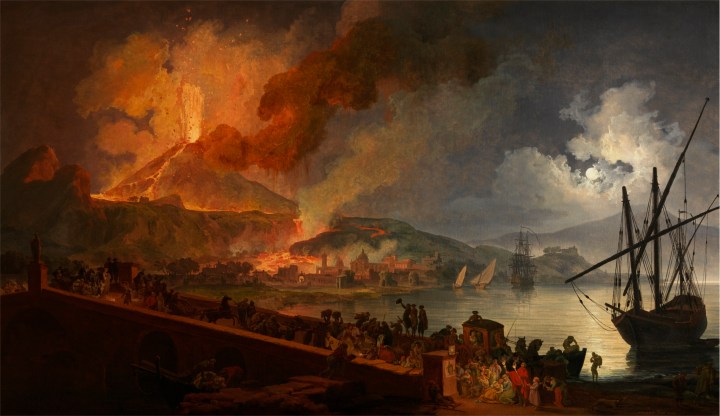
Pierre-Jacques Volaire, Eruption of Vesuvius, oil on canvas, 1769
(Naples: Museo di Capodimonte)
◊ ◊ ◊ ◊ ◊
For PhD students working on the cultural history of Naples who need access to materials in southern Italy including artworks, sites, archives, and libraries. From H-ArtHist:
Research Residencies, 2019–20
Center for the Art and Architectural History of Port Cities, Naples
Applications due by 15 February 2019
Opened in Fall 2018, the Center for the Art and Architectural History of Port Cities / Centro per la Storia dell’Arte e dell’Architettura delle Città Portuali is a collaboration between the Museo e Real Bosco di Capodimonte in Naples and the Edith O’Donnell Institute of Art History at the University of Texas at Dallas, with the participation of the Université Paris-Sorbonne.
Housed within the Capodimonte’s bosco in a rustic eighteenth-century agricultural building called La Capraia (the goat farm), the Center is a laboratory for new research in the cultural histories of port cities and the mobilities of artworks, people, technologies, and ideas. Research and programs at La Capraia are dedicated to exploring global histories of art, architecture, and cultural production, while grounded in direct study of artworks, sites, and materials in Naples as well as southern Italy. Through Research Residencies and regular site-based Research Workshops and Symposia, the Center at La Capraia supports scholarly access to Naples, fosters new research on Naples and on other port cities, and creates a network of students and scholars working on related projects.
The Advisory Committee of the Center for the Art and Architectural History of Port Cities invites applications for Research Residencies for PhD students in the earlier stages of their dissertations. Projects, which may be interdisciplinary, may focus on art and architectural history, music history, archeology, or related fields, from antiquity to the present. All projects must address the cultural histories of Naples as a center of exchange, encounter, and transformation, while making meaningful use of research materials in Naples and southern Italy including artworks, sites, archives, and libraries.
This year, Residencies will run for 9 months (2 September 2019 – 29 May 2020). Residents will be awarded free lodging and work space at La Capraia and, thanks to the logistical support of the Amici di Capodimonte, a modest award of 5,200 EUR to help defray the cost of living during the nine-month period. Residents will be granted privileged access to collections and research resources at the Capodimonte, and access to other sites, collections, and research materials will be arranged as needed. Residents will be responsible for obtaining appropriate visas (the Center will provide official letters of support) and for providing proof of health insurance. During their time in Naples, Residents are expected to share their research in a public lecture, gallery talk, or site visit, to participate fully in the Center’s organized activities, and before the end of the residency period to submit a written report on their progress.
We welcome applications from scholars of any nationality. Applicants are invited to submit a CV, a letter of intent, and a proposal of 1,000–1,500 words that outlines the research project and the resources that will be used in Naples. Materials should be sent in a single PDF file to the Center’s Research Coordinator, Dott.ssa Francesca Santamaria (francesca.santamaria@utdallas.edu). In addition, applicants must invite three recommenders to send letters of support directly to the same email address. All materials, including letters of recommendation, are due by Friday, February 15, 2019.
Call for Papers | The Art of Ugliness, Graduate Symposium
From H-ArtHist:
The Art of Ugliness, 29th Annual Art History Association Graduate Symposium
Indiana University, Bloomington, 13 April 2019
Proposals due by 10 January 2019
Keynote address: “The Use Value of Ugliness” by Dr. Andrei Pop (Associate Professor, Committee on Social Thought, Art History, and the College, The University of Chicago) and Dr. Mechtild Widrich (Assistant Professor, Art History, Theory and Criticism, School of the Art Institute of Chicago)
Is ugliness diametrically opposed to beauty? Or is ugliness simply another aspect of the same coin systematically constructed and cultivated over centuries? While beauty has been fruitfully examined in fields ranging from philosophy to aesthetics and art history, less attention has been given to discourses concerning ugliness. We consider it imperative to reconsider ugliness at this moment to flesh out the ways in which discourses surrounding the ‘ugly’ shape ideas surrounding acceptability. Why do we define, name, or think of something or someone as ‘ugly’? Is it a psychological reaction to what we perceive as gross or disgusting? Does it violate morality? The Art of Ugliness will explore the complex social, cultural, and political aspects embedded within notions of ugliness as well as the aesthetic and philosophical implications of ‘the ugly’.
Potential topics include, but are not limited to:
• Changing perceptions of the nude
• The geography of decay- the ruinous landscape
• Disease and the body
• Xenophobia
• Class and the representation of the profane and abject
• Ugliness and (pseudo)scientific visual culture: phrenology, physiognomy
• Technology and the body
• Evolutionary Theories and Aesthetics
• Relationships to the ‘exotic’/ ‘other’
• The Grotesque; the monstrous; the strange
We invite papers that address ideas of ugliness and aesthetics and greatly encourage the submission of papers engaging objects from a broad variety of periods, geographies, and social groups. Paper sessions, followed by a panel response and discussion, will occur on Saturday, April 13th followed by the keynote address. Current graduate students in art history and related disciplines are invited to submit an abstract (maximum 300 words) for a twenty-minute presentation and CV to ahasympo@gmail.com by January 10th, 2019. Honoraria will be awarded to all presenters who attend from outside Bloomington.
Call for Papers | Built Environments and Performances of Power
From H-ArtHist:
Built Environments and Performances of Power
44th Annual Cleveland Symposium
Cleveland Museum of Art, 26 October 2018
Proposals due by 15 July 2018
The Art History Department at Case Western Reserve University invites graduate students to submit abstracts for its 2018 Annual Symposium Built Environments and Performances of Power. We welcome innovative research papers that engage with the concept of built environments and their performative spaces, both within and without.
Architecture creates narratives, while simultaneously shaping the identities of builders and users. Monumental architecture conveys stability, which allows its patrons to emphasize authority. At the same time, occupants transform spaces through their physical presence and social dynamics. How do we engage with architectural locations and the objects found within them? How do patronage, artistic intent, and pre-existing power structures complicate the ways in which audiences connect with their environments? How does social performance vary within constructed spaces? How can architecture—and the spatial distribution of artifacts within it—complicate ideas of centrality and periphery?
Presentations may explore aspects of this theme across any time period, medium, or geographical region. Potential topics may include, but are not limited to:
• Social performance and movement within built environments
• Material spatiality
• Constructed spaces and ideas of comportment
• Interactions between loci memoriae, geography, and architecture
• Space as experienced by architects, engineers, institutions, and audiences
• Viewership, liminal spaces, or construction of memory within museums
• Reconstruction of space through (re)moveable objects and their functions
• Reception within a built environment
• Theatricality and performance
Current graduate students and recent graduates in art history and related disciplines are invited to submit a 350-word abstract and a CV for consideration to clevelandsymposium@gmail.com by the extended deadline of July 15, 2018. Selected participants will be notified by the end of July. Paper presentations will be 20 minutes in length. Please direct all questions to Angelica Verduci and Jacob Emmett at clevelandsymposium@gmail.com. The three most successful papers will be awarded prizes.
2016 Dissertation Listings from CAA
My apologies for not posting this much sooner (the listings used to come out in August, and I wasn’t looking for them in December). –CH
From caa.news (11 December 2017) . . .
Once a year, each institution granting the PhD in art history and/or visual studies submits dissertation titles to CAA for publication. caa.reviews has now published the authors and titles of doctoral dissertations in art history and visual studies—both completed and in progress—from American and Canadian institutions for calendar year 2016. You can browse by listing date or by subject matter. Each entry identifies the student’s name, dissertation title, school, and advisor.
The index for 2016 lists four ‘eighteenth-century art’ dissertations completed:
• Joshua D. Hainy, “John Flaxman: Beyond the Line” (Iowa, D. Johnson)
• Stephanie O’Rourke, “Bodies of Knowledge: Fuseli and Girodet at the Turn of the Nineteenth Century” (Columbia, J. Crary)
• Amanda K. Strasik, “Reconceiving Childhood: Women and Children in French Art, 1750–1814” (Iowa, D. Johnson)
• Aaron Wile, “Painting, Authority, and Experience at the Twilight of the Grand Siècle, 1688–1721” (Harvard, E. Lajer-Burcharth)
◊ ◊ ◊ ◊ ◊
and thirty-six ‘eighteenth-century art’ dissertations in progress, including:
• Daniella Berman, “Aesthetics of Contingency: History and the Unfinished Paintings of the French Revolution” (IFA/NYU, T. Crow)
• Christine Brandner, “Addressing another Body in Jean-Etienne Liotard’s Portraiture” (Yale, N. Suthor)
• Alexandra Cardon, “Circa 1700: Royal Retreats, Academic Unrest and the Roots of Rococo” (CUNY, J. Sund)
• Alicia Caticha, “Étienne-Maurice Falconet and the Matter of Sculpture: Marble, Porcelain, and Sugar in Eighteenth-Century Paris” (Virginia, S. Betzer)
• Elizabeth Gebauer, “The Art of Speech: Flemish Baroque Pulpits, 1627–1794” (Princeton, T. DaCosta Kaufmann)
• Sandra Gomez Todo, “Abandoned Schools of Pleasure: Unmasking Gender and Identity in the Visual Culture of the Georgian Masquerade” (Iowa, D. Johnson)
• Christine Griffiths, “From Garden to Toilette: Cultivating Perfume in Early Modern England” (Bard Graduate Center, D. Krohn)
• Rachel Harmeyer, “After Angelica Kauffman” (Rice, L. Costello)
• Julia K. McHugh, “Dressing Andean Spaces: Textiles, Painting, and Architecture in the Colonial Imagination” (UCLA, C. Villaseñor-Black)
• Isabel Oleas-Mogollón, “Jesuit Missionary and Visionary Experiences in Quito: La Compañía Prophet Paintings” (Delaware, M. Domínguez Torres)
• Emily Spratt, “Byzantium not Forgotten: Constructing the Artistic and Cultural Legacy of an Empire between East and West in the Early Modern Period” (Princeton, P. Brown)
• Amy Torbert, “Dissolving the Bonds: Sayer & Bennett, Print Publishers in an Age of Revolution” (Delaware, W. Bellion)
• Linda Zajac, “Miniature Worlds of Age and Masculinity in the Eighteenth-Century English Domestic Interior” (University of Victoria, E. Campbell)
Graduate Student Workshop | Asian Aesthetics and American Art
From the University of Delaware:
International Graduate Student Workshop
Global Impact of Asian Aesthetics on American Art and Material Culture
The University of Delaware and Winterthur Museum, Garden, and Library 11–12 October 2018
Proposals due by 8 June 2018
With the generous support of the Terra Foundation for American Art, the University of Delaware’s Department of Art History and the Winterthur Program of American Material Culture will host a two-day International Graduate Student workshop on October 11 and 12, 2018. This workshop is part of a series of events in October 2018 to launch the project In Search of Global Impact of Asian Aesthetics on American Art and Material Culture.
We invite graduate students from a variety of fields, from all regions of the world, to submit a short abstract of a dissertation in progress or a project that: 1) redefines the canon of art history, with a focus on the multidirectional impact of Asian aesthetics on American art and material culture, and/or 2) proposes new interpretations of the transcultural and transhistorical flow of aesthetics that not only redefine the geocultural boundaries of Asia and North America, but also rethink methodological formations of aesthetic emergence.
We strongly encourage proposals that consider the flow of global aesthetics beyond the circulation of objects, as well as those that examine ‘Asia’ and ‘North America’ as discursive structures or cultural constructs in connection with other world regions such as Africa, Europe, South America, among others. In sum: How do design ideas, patterns, and aesthetics travel across the globe, even when objects do not?
To apply, send a short abstract written in English (300–500 words) and a 2-page CV to global-aesthetics@udel.edu by 8 June 2018. Applicants will be notified of decisions by 8 July 2018. Successful applicants will be invited to submit a dissertation chapter or excerpt, or paper, (9000–10000 words), to be pre-circulated and read before the workshop.
Official respondents are: Partha Mitter (Sussex, emeritus), Dorothy Ko (Barnard/Columbia), Lee Glazer (Freer/Sackler Galleries), Marco Musillo (Kunsthistorisches Institut in Florenz), with the Terra Foundation’s guest critics: Zhang Gan and Chen Anying (Academy of Arts and Design, Tsinghua, Beijing), in addition to the faculty workshop advisors from the Department of Art History and the Winterthur Program of the University of Delaware.
Lodging and meals are provided for invited participants throughout the workshop. Applicants seeking travel support should include in the application a letter demonstrating the need and a budget plan.
In addition to the Terra Foundation, we thank the following organizations for their support: The University of Delaware’s Office of Graduate and Professional Education and the Center for Material Culture Studies, with grants from the Unidel Foundation, and National Endowment for the Humanities.
Decorative Arts Trust Curatorial Internship at The Met
The Decorative Arts Trust Curatorial Internship
The Metropolitan Museum of Art, New York, 2018–2020
Applications due by 9 March 2018
The Metropolitan Museum of Art is seeking eligible candidates for The Decorative Arts Trust Curatorial Internship/Research Scholarship for 2018–2020, a two-year position funded jointly by The Decorative Arts Trust and The Metropolitan Museum of Art. This partnership seeks to provide hands-on curatorial experience for students and young professionals interested in museum careers.
The Curatorial Intern/Research Scholar will participate in a range of curatorial activities in the American Wing of The Met over a two-year period, with their efforts divided primarily between an exhibition project and permanent-collection work. The majority of the time will be devoted to myriad aspects of developing the exhibition, Stories in Clay: Stoneware from Edgefield District, South Carolina, currently scheduled to open at The Met in the fall of 2020. The intern/research scholar will be involved with researching objects, including provenance and methods of production; organizing loan paperwork as well as conservation examinations and photography of exhibition objects; developing and maintaining exhibition files; and participating in catalogue production and label writing. The individual will also participate in other permanent-collection curatorial tasks, including assisting with acquisitions and deaccessions as well as collection management.
Eligible candidates will have an M.A. degree in a field related to Decorative Arts, American Art, and/or Museum Studies, or comparable experience. The ideal candidate will have strong research and writing skills, a familiarity with digital resources and research platforms, and strong organizational skills. A proficiency with Microsoft Office is required and familiarity with TMS database recommended.
The Internship/Research Scholarship stipend for the 2-year period will be $35,000/year with an additional stipend of $2,500 for research, educational, and professional development programs. The 2-year position will ideally begin in September 2018. The deadline for all applications is March 9, 2018. Interested applicants should submit their resume, a statement of interest, and a writing sample of no more than 1000 words to: Marcie Karp, Senior Managing Educator, Academic and Professional Programs, at Academic.Programs@metmuseum.org.










 Enfilade
leave a comment