Still Catching Up: The May Issue of ‘The Burlington Magazine’
In addition to various articles and reviews related to the eighteenth century from the May 2010 issue of The Burlington Magazine (focused on the theme of British art), the editorial usefully addresses the expansion of online art historical resources and the attendant challenges, particularly in light of a symposium held in Leuven this past spring (23 March 2010). Excerpts are provided below, and the symposium schedule is available as a PDF file.
◊ ◊ ◊ ◊ ◊
Articles
Adriano Aymonino, “Decorum and Celebration of the Family Line: Robert Adam’s Monuments to the 1st Duchess of Northumberland”
Annette Wickham, “Thomas Lawrence and the Royal Academy’s Cartoon of ‘Leda and the Swan’ after Michelangelo”
Art History Reviewed
John-Paul Stonard, “Kenneth Clark’s The Nude. A Study of Ideal Art, 1956″
Exhibition Review
Simon Swynfen Jervis, “Horace Walpole and Strawberry Hill”
Letter
Stephen Conrad, “Reynolds”
Book Reviews
Simon Watney, “A Biographical Dictionary of Sculptors In Britain 1660–1851 by I. Roscoe, E. Hardy and M.G, Sullivan”
Ann V. Gunn, “The Society of Dilettanti: Archaeology and Identity in the British Enlightenment by J.M. Kelly”
Martin Postle, “Johan Zoffany: Artist and Adventurer by P. Treadwell”
Brian Allen, “Empires of the Imagination: Politics, War, and the Arts in the British World, 1750–1850 by H. Hoock”
◊ ◊ ◊ ◊ ◊
Editorial: The Baroqueness of www
In August 2009 we reported on new online resources, prefacing the Editorial with the remark that ‘art historians have been relatively slow to adapt to the changes being wrought on their discipline by automation and to take full advantage of the benefits that it offers’. They may have been slow to adapt, but there is now certainly a steady stream of new initiatives. To name just three very recent examples: a few weeks ago CERES was launched, an online catalogue of Spanish museum collections; the Warburg Institute in London officially announced that it has put material from its archive, library and iconographic collections online; and the Getty has made it known that it has now made the Bibliography of the History of Art (BHA) freely available on its website, having already recently put online a database providing access to the Goupil Gallery stock books kept at the Museum, including high-resolution photographs of every page.
With so many new projects, one can be forgiven for not being able to see the wood for the trees, although Teutonic thoroughness has provided a helping hand in the form of the German internet portal Arthistoricum,while a similar portal can be found on the Getty website. But the abundance of initiatives is daunting and organising online material does not come without its problems; this led to a timely and very useful symposium held in March in Leuven to ponder what it called the Baroqueness of the Web. This online extravaganza certainly has its positive sides: there is now an enormous quantity of primary and secondary sources available in full text, often also allowing users to flip virtually through the pages of a book; online image databases are getting more comprehensive by the day; and there are a good many periodical archives, as well as newly established e-journals, published exclusively online.
But problems remain. . . . Most people agree that in an ideal world all art-historical databases should communicate with each other and be accessible through one single portal, although how best to approach this mammoth task is less than straightforward. Efforts in the late 1990s and early 2000s to realise such a system did not fare well; the Van Eyck Project (Visual Arts Network for the Exchange of Cultural Knowledge), which was funded by Brussels, has in fact been put on hold. The Europeana website, launched with much fanfare in November 2008 and also funded by European money, has, after some teething problems, at least materialised and currently brings together some six million digital items from European institutions, including images, texts, sound and videos, but its intellectual framework is very meagre, largely due to the fact that Europeana works entirely from the top down by requesting material from institutions and throwing it into a huge melting pot.
If there was one overriding conclusion to the Leuven symposium, it was that, as long as the many initiatives that have sprung up and will spring up in the future adhere to standard technical specifications for online databases, their integration can always be achieved at a later date. This is not to say that there should be no collaboration, but for now it will have to be mainly a matter of good communication and sensible choices. For instance, it is impossible for the RKD in The Hague to scan and properly index all its photographic material, but it knows that its strengths lie in Dutch and Flemish art and has wisely decided to concentrate on those, at least for the present. Should the embattled Witt and Conway Libraries come to the conclusion that they need to bring their collections online, they would do well to adopt a similar ad hoc system and concentrate first and foremost on what is not available elsewhere, thus avoiding the trap of the ‘blanket approach’.
The above examples are of necessity only a very small selection of the topics that were discussed in Leuven. The realisation that integration is a future goal, not a starting point, certainly gives hope for the continuing flowering of all sorts of new projects, making the internet an ever more Baroque church for ideas and initiatives, and perhaps one day that church will have a more streamlined Neo-classical design. For now the Burlington will do its bit by providing on its new website, to be launched in the near future, a comprehensive survey of online art-historical databases.
Recent Articles from ‘Art History’: Art and Theatre
The eighteenth century in a special issue of Art History on “Theatricality in Early Modern Visual Art and Architecture,” edited by Caroline van Eck and Stijn Bussels:
Sigrid de Jong, “Staging Ruins: Paestum and Theatricality,” Art History 33.2 (April 2010): 334-51.
Abstract: This article looks at the connection between architecture and theatre. By focusing on how eighteenth-century travellers experienced the Greek temples in Italian Paestum, it highlights the analogies between architectural experience and theatricality. Travellers at the time found it difficult to comprehend Paestum because the architecture of the temples was different from the classical architecture they had seen in Rome and illustrated in publications. Travellers, by using strategies of representation related to the theatre, tried to present this strange architecture of Paestum in an accessible way to their eighteenth-century public. It also shows how the various roles assumed by spectators or traveller-observers defined the way they experienced the architecture.
Bram van Oostveldt, “Ut pictura hortus / ut theatrum hortus: Theatricality and French Picturesque Garden Theory (1771-95),” Art History 33.2 (April 2010): 364-77.
Abstract: The picturesque vogue in French garden theory and practice from the second half of the eighteenth century drew on more than painterly examples. Theatrical strategies were equally important in attempts to stage the garden as a painting. However, in French theory and practice references to the theatre were often considered to be problematic. It was theatricality that posed the problem. The French followed a more general discourse on theatricality that, from the mid-eighteenth century on, was predominant in the arts and was constructed around questions of spectatorship. As the disapproved other of the natural, the theatrical in the arts referred to situations in which the beholder is made aware of the danger that the act of beholding threatened to destroy the imaginative and illusionistic power of art.
Stubbs and the Politics of Nature
Recently published in The Oxford Art Journal:
Douglas Fordham, “George Stubbs’s Zoon Politikon,” Oxford Art Journal 33 (March 2010): 1-23.
 Abstract: Returning to Alex Potts’s assertion that Georgian animal paintings were conceived ‘as extensions of the social world’, this essay examines two unprecedented canvases that George Stubbs painted for the Second Marquess of Rockingham in the 1760s. I argue that the massive Lion Attacking a Stag and Lion Attacking a Horse are richly coded allegories, in the sense articulated by Walter Benjamin in The Origin of German Tragic Drama, which combine iconographic codes from heraldry, the aristocratic menagerie, thoroughbred breeding, oppositional satire, and Enlightenment science to produce a unique form of ‘heraldic naturalism’. Through a reconstruction of Rockingham’s politics as well as the room in his London townhouse where the paintings were displayed, this article attempts to recover the political implications of George Stubbs’s ‘natural order’ as well as its relation to Edmund Burke’s sublime aesthetic ideology. Ultimately, this article argues that the Rockingham lions
naturalize the claims of landed authority through an innovative response
to immediate domestic and imperial pressures.
Assessing the Digital Burney Newspaper Collection
Last October, Gale made its Burney Collection of newspapers available for a free trial through Early Modern Online Bibliography. In a recent posting at EMOB, Eleanor Shevlin summarizes an article from The Papers of the Bibliographical Society of America on this digital resource:
◊ ◊ ◊ ◊ ◊
Ashley Marshall and Rob Hume, “The Joys, Possibilities, and Perils of the British Library’s Digital Burney Newspapers Collection,” PBSA 104:1 (2010): 5-52.
At forty-seven pages Ashley Marshall and Rob Hume’s article offers a substantive assessment of this relatively recent electronic resource for early modern studies. Early on the authors argue that “[d]igital Burney is amazing, but exploiting it fully is going to demand some serious rethinking and reorientation in both our research and our teaching (6-7). Their claim that this tool “will change the way we conduct our business” (7) possesses much merit; fulfilling digital Burney’s promise, however, will depend on far broader scholarly access than currently exists. Equally important, scholars need to acquire a firm understanding of its possible uses, search capabilities, and limitations. While Marshall and Hume’s piece cannot assist in matters of accessibility (though it could serve as support for the tool’s purchase), their essay does advance our knowledge of how this tool might be employed and how its features and limitations can best be navigated.
The article is usefully divided into five sections. . . .
The full review of the article is available here»
The Eighteenth Century in April’s ‘Burlington Magazine’
From last month’s issue of The Burlington Magazine 152 (April 2010):
- Ann V. Gunn, “Paul Sandby, William Pars and the Society of Dilettanti,” pp. 219-226.
- Owen Hopkins, review of Compass and Rule: Architecture as Mathematical Practice in England by A. Gerbino and S. Johnston, pp. 250-51.
- Robert J. Gemmett, review of William Beckford: A Bibliography by J. Millington, pp. 251-52.
- Vanessa Brett, review of British and Continental Gold and Silver in the Ashmolean Museum by T. Schroder, p. 252.
- Christoph Martin Vogtherr, review of the exhibition Jean Raoux, pp. 267-68.
New Online Art History Publication — ‘RIHA Journal’
RIHA, the International Association of Research Institutes in the History of Art, is pleased to announce the launch of RIHA Journal, the new international online-journal for the history of art, on April 14, 2010. A joint project of 27 institutes in 18 countries, the journal provides an excellent medium for fostering international discourse among scholars. Funding is provided by the German Federal Government Commissioner for Culture and the Media (Beauftragter der Bundesregierung für Kultur und Medien, BKM). RIHA Journal (ISSN 2190-3328) features research articles in either English, French, German, Italian, or Spanish, and invites submissions on the whole range of art historical topics and approaches. Manuscripts undergo a double blind peer review process and are published within few months from submission. A not-for-profit e-journal committed to the principles of Open Access, RIHA Journal makes all articles available free of charge. RIHA Journal welcomes submissions at any time; for details, please contact the RIHA institute in your country and/or field of expertise.
The Eighteenth Century in the Current Issue of ‘Art History’
Kate Retford, “A Death in the Family: Posthumous Portraiture in Eighteenth-Century England,” Art History 33 (February 2010): 74-97.
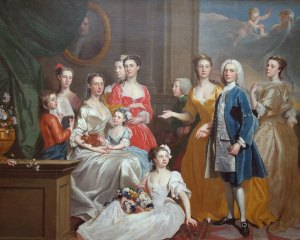
Joseph Highmore, "The Lee Family," 1736. Oil on canvas, 243.8 × 289.6 cm. (Wolverhampton Art Gallery)
Abstract: This article explores a number of unusual portraits produced in eighteenth-century England in which the realms of the posthumous and the living were mingled. In some cases, the dead were brought ‘back to life’ and restored to their rightful place in the family unit. In others, such as Joseph Highmore’s portrait of The Lee Family (1736), Thomas Gainsborough’s The Sloper Family (1787–88) or The Knatchbull Family by John Singleton Copley (1800–03), they were included in spiritualized form, hovering in a supernatural realm above the relatives they had left behind on terra firma. The article unpicks the particular circumstances that prompted these extraordinary commissions, exploring the personal and emotional histories of the sitters and artists. It also draws conclusions about the broader social, cultural, religious and artistic contexts that made these relatively rare, and frequently problematic images.
Kate Retford is Lecturer in History of Art at Birkbeck College, University of London. Her book, The Art of Domestic Life: Family Portraiture in Eighteenth-Century England, was published by Yale University Press in 2006. In addition, she has written a number of articles on topics relating to eighteenth-century portraiture, gender, and the country house art collection.
◊ ◊ ◊ ◊ ◊
Review of Ephemeral Bodies: Wax Sculpture and the Human Figure, with a translation of Julius von Schlosser’s “History of Portraiture in Wax,” edited by Roberta Panzanelli (Los Angeles: Getty Research Institute for the History of Art and the Humanities, 2008), pp. 170-72.
Reviewed by Matthew Bowman (lecturer at the University of Essex and co-founding editor of Rebus: Journal of Art History and Theory)
Most of the eight contributions in “Ephemeral Bodies” were originally presented in a workshop held at the Getty Research Institute in 2004. The texts examine the utilization of wax to depict the human body (in whole and in part, internally and externally) from a variety of methodological perspectives in accordance with the very different uses to which wax has been put. This includes considerations of wax sculpture from medical, anatomical, art-historical, philosophical, anthropological and political standpoints. From an art historian’s viewpoint, wax has not really figured in the discipline of art history. Indeed, it is curious that Julius von Schlosser’s stimulating “Geschichte der Porträtbildnerei in Wachs” (“History of Portraiture in Wax”), which originally came out in 1911 and which is published here for the first time in English, remains the central art-historical text on the production of wax sculptural objects. Ephemeral Bodies is, therefore, not only a useful scholarly collection on a neglected topic but also an opportunity to gauge and expand the theoretical presuppositions of art history as a discipline. . .
For additional contents, click here»
A New Model for Publishing Art History Articles
Kunstgeschichte: Open Peer Reviewed Journal — http://www.kunstgeschichte-ejournal.net/
Transparent Reviewing and Prompt Interaction
Following the motto “Democratization of scientific communication,” this international and cross-epochal scholarly journal for art history was launched in January 2009. Papers submitted to the e-journal are first put up as ‘Discussion Papers’ for public peer assessment over a period of six months. After this stage, the authors have the option of revising their work according to the public comments. Only then will the definitive papers be published as ‘Journal Articles’. By proceeding thus we capitalize on the specific possibilities of the internet: It allows scholars to interact immediately, and to contribute comments, criticism, and additional information online to the papers published in Kunstgeschichte: Open Peer Reviewed Journal.
Contributions for the period from October-December 2009
A) New Research
- Frank Zöllner, ‘Kanon und Hysterie: Primavera, Mona Lisa und die Sixtina im Chaos der Deutungen’
- Sylvia Diebner, ‘Kunst am Bau: Die Scuole centrali antincendi in Rom-Capannelle (1941)’
- Steffen Krämer, ‘Charles Jencks und das Prinzip der Doppel-, Mehr- und Überkodierung: Kommunikation und Interpretation der postmodernen Architektur’
- Jürgen Tabor, ‘Zur sozialen Logik der Kunstindustrie’
B) Reconsidered
- Hans Sedlmayr, ‘Die macchia Bruegels [1934]’
C) Comments
- Tanja Michalsky, Hans Sedlmayr, ‘Die macchia Bruegels [1934]’ (Kunstgeschichte. Texte zur Diskussion 2009-54)
- Lambert Wiesing, Kommentar zu Martina Sauer: Wahrnehmen von Sinn vor jeder sprachlichen oder gedanklichen Fassung? Frage an Ernst Cassirer (Kunstgeschichte. Texte zur Diskussion 2008-6)
- Renate Prochno, Bemerkungen zu Anastasia Dittmann: ‘Imitation is the means, not the end, of art: Peter Paul Rubens und Sir Joshua Reynolds über die Grammatik antiker Skulptur’ (Kunstgeschichte. Texte zur Diskussion 2009-35) (more…)
In the Latest ‘Art Bulletin’
The December issue of The Art Bulletin 91 (2009) includes the following items addressing the eighteenth century:
Emma Barker, “Imaging Childhood in Eighteenth-Century France: Greuze’s Little Girl with a Dog,” pp. 426-45.
Author’s Abstract: “During the artist’s lifetime, A Child Playing with a Dog was one of Jean-Baptiste Greuze’s most admired and best-known works. The painting represent the physical, instinctual nature of the child in a manner unprecedented in French art. The image of childhood that it offers has close parallels in the scientific and medical discourse of the later eighteenth century. Like many contemporary commentators, Greuze evokes not simply the innocence of children but also their vulnerability, above all, that of little girls. He thereby implicates the viewer in the child’s fate, both for good and ill.”
Meredith Martin, review of Diplomatic Tours in the Gardens of Versailles under Louis XVI by Robert Berger and Thomas Hedin (University of Pennsylvania Press, 2008)) and Carmontelle’s Landscape Transparencies: Cinema of the Enlightenment by Laurence Chatel de Brancion (J. Paul Getty Museum, 2008), pp. 511-15.

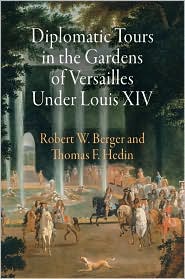 “Both Diplomatic Tours and Carmontelle’s Landscape Transparencies attempt to shed light on an underexplored aspect of French gardens and how they were portrayed in the ancien régime. As in a growing number of garden history books, the authors foreground questions of reception and use and treat these landscapes as a dynamic field of social relations — in other words, as a contested terrain. Both books also share an inclination to animate the garden as a kinetic experience by way of descriptive texts and visual images. . .” (512).
Finding the Perfect Gift
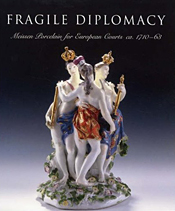
Edited by Maureen Cassidy-Geiger
Just Published
The Court Historian 14.2 (December 2009), published by The Society for Court Studies
Special Issue: Gift-Giving in Eighteenth-Century Courts — Papers from the conference Fragile Diplomacy: Meissen Porcelain for European Courts, c. 1710-1763, held at the Bard Graduate Center, New York, 17 November 2007, in conjunction with the eponymous exhibition (reviewed at artnet by N. F. Karlins).
◊ ◊ ◊ ◊ ◊
Table of Contents
 Andrew Morrall (Bard Graduate Center), Introduction
- Cordula Bischoff (State Art Collections, Dresden), Complicated Exchanges: The Handling of Authorised and Unathorised Gifts
- Christopher M. S. Johns (Vanderbilt University) The ‘Good Bishop’ of Catholic Enlightenment: Benedict XIV’s Gifts to the Metropolitan Cathedral of Bologna
- John Whitehead, Royal Riches and Parisian Trinkets: The Embassy of Saïd Mehmet Pacha to France in 1741-42 and Its Exchange of Gifts
- Michael Yonan (University of Missouri-Columbia), Portable Dynasties: Imperial Gift-Giving at the Court of Vienna in the Eighteenth Century
- Guy Walton, Emeritus (New York University), Ambassadorial Gifts: An Overview of Published Material
- Maureen Cassidy-Geiger (Cooper-Hewitt Museum/Parsons School of Design), Afterthoughts on Fragile Diplomacy: Meissen Porcelain for European Courts, c. 1710-1763
- Book Reviews / Exhibition Reviews











 Enfilade
leave a comment