Lecture | Wolf Burchard on Savonnerie Carpets: Stages of Power
From the BGC:
Wolf Burchard | Savonnerie Carpets: Stages of Power
Françoise and Georges Selz Lectures on Eighteenth- and Nineteenth-Century French Decorative Arts and Culture
Bard Graduate Center, New York, 6 February 2018
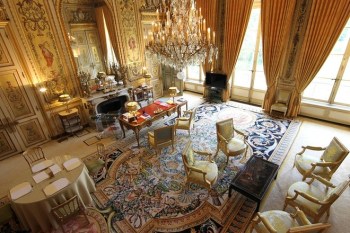
The Salon Doré: President Macron’s office at the Elysée Palace with one of Louis XIV’s Savonnerie carpets.
Wolf Burchard will deliver a Françoise and Georges Selz Lecture on Eighteenth- and Nineteenth-Century French Decorative Arts and Culture on Tuesday, February 6, at 6pm. His talk is entitled “Savonnerie Carpets: Stages of Power.”
Since the Second World War, every President of France has had one of Louis XIV’s famed Savonnerie carpets in his office at the Elysée Palace. Sumptuous stages on which key events of French history have unfolded, these spectacular weavings initially formed part of an unprecedented commission from the Sun King for no less than 93 carpets to cover the entire Long Gallery of the Louvre, spanning more than 442 meters. However, as Louis gradually lost interest in the Louvre Palace, instead choosing Versailles as the headquarters of the Bourbon monarchy, these magnificent carpets, originally intended to be laid out side to side, were largely separated and used singly as focal points in the lavishly decorated salons of Louis XIV and his successors.
Wolf Burchard’s lecture will revisit the history of the Savonnerie manufactory from its beginnings under Louis XIII to the present day, focusing on its major commissions for the Louvre, Versailles, and Notre Dame. His talk will also examine the dispersal of many of these weavings after the French Revolution in 1789, both through sale and as diplomatic gifts, as well as the rising British and American taste for Savonnerie carpets beginning around 1900.
Wolf Burchard is the Furniture Research Curator at Britain’s National Trust and the author of The Sovereign Artist: Charles Le Brun and the Image of Louis XIV (Paul Holberton Publishing, 2016). From 2009 to 2014 he was Curatorial Assistant at the Royal Collection Trust, where he co-curated The First Georgians: Art & Monarchy, 1714–1760, an exhibition held at The Queen’s Gallery, Buckingham Palace, to commemorate the tercentenary of George I’s accession to the British throne. He studied the history of art and architecture at the universities of Tübingen and Vienna as well as the Courtauld Institute of Art in London, from which he holds an MA and PhD. Wolf Burchard regularly writes and lectures about the art and architectural patronage at the British, French, and German courts. He has worked extensively on the Savonnerie manufactory and in 2012 published an update of Pierre Verlet’s catalogue of Louis XIV’s carpets for the Louvre’s Long Gallery, adding newly discovered carpets, carpet fragments and designs. He serves on the Executive Board of the Georgian Group and the Council of the Furniture History Society and was a member of the Committee of the Society for Court Studies from 2011 to 2017.
Colin Sheaf on Chinese Art for Western Interiors, 1650–1850
From the Society of Antiquaries:
Colin Sheaf | Chinese Art for Western Interiors, 1650–1850
Society of Antiquaries of London, 16 January 2018
Linking Asian craftsmanship with evolving Western tastes in interior decoration and passion for Chinoiserie, the ‘China Trade’ facilitated the arrival in London of principally Chinese artefacts and traditions like tea-drinking, which greatly enriched English polite society between about 1600 and 1850. This lecture will explore this exotic yet fundamentally commercial maritime relationship, illustrating some of the fine lacquers, ‘Export-taste’ ceramics, silks and wallpapers which the ‘Honourable East India Company’ regularly imported.
Colin Sheaf has enjoyed a distinguished 40-year career in the London art auction world after reading Modern History at Worcester College Oxford. A world authority on Asian ceramics and Chinese Art, as Chairman of Bonhams UK and Asia, and Global Head, he directs Asian Art specialist teams across four continents. He has lectured widely in the UK and Asia, and—besides publishing some 120 specialist articles—is co-author of a definitive study of Qing Dynasty Chinese ceramics. He was recently appointed Chairman of the world-famous Sir Percival David Foundation of Chinese Art, and chairs the Company running an award-winning historic London Square garden.
All lectures begin at 13.00. Doors open at 12.30 on the day of the lecture. Our Public Lectures are free and open to the public, but space is limited and reservations are strongly recommended to avoid disappointment. To book online, simply click the ‘Reserve Your Seat’ button at the Society of Antiquaries website.
Seminar Series | Art and the Senses

From the University of Cambridge:
Art and the Senses
Department of History of Art Graduate Research Seminar Series, University of Cambridge, Lent 2018
The work of art is more than a visual object. It has surface, texture that can be touched, and emits or evokes sounds, smells, and tastes. Recently, academic studies on the senses have flourished, especially in the context of the material approach to visual studies; meanwhile, museums and art institutions have been considering new ways to augment visitor experience through the senses, and better engage with visitors who have sensory impairments; and in contemporary art, performance, video, and sound can incorporate more than one sense at a time, and calls into question the primacy of the visual. This Graduate Seminar Series, Art and the Senses, seeks to appreciate the roles of the senses in visual culture, explore the senses’ problematic and pleasurable qualities, and ultimately offer participants the opportunity to engage with their own senses.
Wednesdays at 5pm
History of Art Graduate Centre
4a Trumpington Street, CB2 1QA
Refreshments provided, all welcome
Making
Wednesday 17 January
Nose-First: Rendering Visible the Humanist Smellscape
Kate McLean – Programme Director, Graphic Design Canterbury Christ Church University and Information Experience Design PhD Candidate RCA
Seeing
Wednesday 24 January
Investigating the Invisible: Optiques and Visual Culture in the French Merveilleux-Scientifique Genre (1880–1930)
Fleur Hopkins – History of Art PhD Candidate, Université Paris 1 Panthéon-Sorbonne and Assistant Researcher at the Bibliothèque Nationale de France, département des Sciences et Techniques
Tasting
Wednesday 31 January
Tasting Impressionism
Dr Allison Deutsch – Junior Research Fellow, Institute of Advanced Studies, University College London
Smelling
Wednesday 7 February
In Search of Lost Scents: (Re-)constructing the Aromatic Heritage of History of Art and How to Use the Nose as a Methodological Tool
Caro Verbeek – Curator and PhD Candidate, Vrije Universiteit, Amsterdam, Embedded Researcher Rijksmuseum and International Flavors & Fragrances
Hearing
Wednesday 14 February
Emergency Noises: Sound Art and Gender
Dr Irene Noy – Independent scholar
Touching
Wednesday 21 February
Touching the Renaissance: The Material Culture of Skin in Europe, 1450–1700
Professor Evelyn Welch FKC – Provost/Senior Vice President (Arts & Sciences) and Professor of Renaissance Studies in the Department of History, School of Arts & Humanities
Displaying
Wednesday 28 February
Sensory Experiences in the National Gallery
In Conversation with Dr Caroline Campbell – The Jacob Rothschild Head of the Curatorial Department, The National Gallery, London
Love Making
Wednesday 7 March
Illustration and the Erotics of Re-Use in Victorian Print Culture
Dr Sarah Bull – Wellcome Trust Research Fellow, History and Philosophy of Science, Cambridge
Convenors: Lizzie Marx and Lorraine de la Verpillière
Twitter: @ArtSensesCam | Facebook: ArtSenseCambridge
Research Lunch | Emily Knight on Portraiture as Remembrance
From the Paul Mellon Centre:
Emily Knight | ‘The Last Sad Testimony of Affection’:
Portraiture as Remembrance in Eighteenth-Century Britain
Paul Mellon Centre for Studies in British Art, London, 8 December 2017

George Romney, Ann Wilson with Her Daughter, Sybil, ca. 1776–77, oil on canvas, 124.5 × 100.3 cm (New Haven: Yale Center for British Art, Paul Mellon Fund, B1983.1).
In 1773, six year-old Sibyl Wilson died. Her grief-stricken parents George and Ann commissioned the artist George Romney to complete a portrait of Ann and Sibyl. This touching work shows the mother’s head cast downward but not quite touching the head of her now deceased daughter, her arms softly embracing the child’s delicate form. The young girl looks out to the viewer with a solemn expression, connected to her mother in space but not time.
Using Romney’s portrait as a starting point, this paper will examine the particularities of posthumous portraits of children in light of new ideas about childhood put forward by Jean-Jacques Rousseau and John Locke. I will analyse the resulting impact that this change had on artists who fulfilled the commissions of grieving parents and argue that the various ways in which artists attempted to capture a deep sense of loss reveals much about familial relationships during this period and provides a deeper understanding of overt expressions of emotion that emerged during the age of sentimentality.
Over the course of the paper, I will demonstrate how artists in the mid-eighteenth century assumed a varied yet interconnected mode of emotional expression in portraiture that was distinct from the symbolic devices used by previous generations, and compelled the viewer to unpick embedded artistic and cultural references.
8 December 2017, 12:30–2:00pm, Seminar Room, Paul Mellon Centre
Emily Knight is a DPhil candidate at the University of Oxford working on posthumous portraiture in the mid-eighteenth to early nineteenth centuries in Britain. She has undertaken research as a Visiting Scholar at the Yale Center for British and she has recently been awarded a Robert R. Wark Fellowship at The Huntington. She is also Curatorial Assistant at Historic Royal Palaces working on the current exhibition Enlightened Princesses: Caroline, Augusta, Charlotte and the Shaping of the Modern World and is the Paul Mellon Centre’s Doctoral Researchers Network Co-Convenor.
The Wallace’s History of Collecting Seminars, 2018
From the 2018 schedule:
History of Collecting Seminars
The Wallace Collection, London, 2018
The seminars, typically held on the last Monday of each month, act as a forum for the presentation and discussion of new research into the history of collecting. Seminars are free and open to curators, academics, historians, archivists, and all those with an interest in the subject. Papers are generally 45–60 minutes long and take place at the Wallace Collection between 5.30 and 7pm (except for December’s presentation as noted below). For inquiries, please contact: collection@wallacecollection.org.
29 January
Tessa Murdoch (Deputy Keeper of Sculpture, Metalwork, Ceramics and Glass, Victoria & Albert Museum) and Matthew Winterbottom (Curator of Sculpture and Decorative Arts, Ashmolean Museum, Oxford) , ‘This Jew of Taste’: Sir Ernest Cassel’s Collection of Silver
26 February
Alden Gordon (Paul E. Raether Distinguished Professor of Fine Arts, Trinity College, Hartford), ‘Heureux ceux qui ont un Coeur de bronze . . . “: The French Financial Crisis in the Late Reign of Louis XV and Its Impact on Royal Manufactures and Royal Patronage
26 March
Barbara Pezzini (PhD candidate, University of Manchester, and Editor-in-chief, Routledge-Taylor & Francis Journal), The Politics of Public Collecting: William Gladstone and the National Gallery
30 April
C. Tico Seifert (Senior Curator, Northern European Art, Scottish National Gallery), Collecting Rembrandt’s Art in Britain Please note that this event will take place in the Regatta Room in Durrants Hotel on George Street, located directly behind the Wallace Collection; the 60 available seats will be allocated on a first come first serve basis.
21 May
Kajal Meghani (Exhibition Assistant Curator, Royal Collection Trust), The Prince of Wales’s Indian Collection: The Circulation of Giften from the 1875–76 Tour of India
25 June
Caroline McCaffrey-Howarth (PhD Candidate and History of Art Tutor, University of Leeds), Sèvres Mania? The History of Collection Sèvres Porcelain in Britain in the Later Nineteenth Century
30 July
Elizabeth Pergam (Lecturer, Sotheby’s Institute of Art, New York), Paris over London: Victorian Curator J. C. Robinson’s Collection at Auction
24 September
Saskia van Altena (Cataloguer of prints, Rijksprentenkabinet, Rijksmuseum, Amsterdam), The Sale of Sir Peter Lely’s Paintings and Prints: A Breaking Point in the History of Collection in Britain?
29 October
Alexandre Tissot Demidoff (Independent scholar), The Last Great Demidoff Sale of Paintings
26 November
Catrin Jones (Curator of Decorative Arts, Holburne Museum, Bath), Piercing Together a Collection: Sir William Holburne’s Display Mounts
10 December (please note the 5:00pm start time)
Robert Wenley (Deputy Director, Head of Collections, Barber Institute of Fine Arts, University of Birmingham), ‘Rare and Most Magnificent’: The Picture Collection of Stephen Alers Hankey (1809–1878)
◊ ◊ ◊ ◊ ◊
Note (added 26 April 2018) — The venue change for the April 30 seminar was added.
Research Lunch | Helen Whiting on Duff House and the House of Duff
From the Paul Mellon Centre:
Helen Whiting, ‘Your Beautiful and Hopeful Family’: Dynasty, Duff House, and the House of Duff
Paul Mellon Centre for Studies in British Art, London, 24 November 2017

William Mosman, William Duff, Lord Braco (1697–1763) and His Son George, detail, signed and dated: ‘Gul Mosman Pingebat, 1741’.
This paper will consider the link between a set of family portraits and the house within which they were intended to hang. I will discuss the idea of the ‘family group portrait’ not simply existing in one frame but depicted across several canvases nevertheless conceived as a coherent whole. The focus will be a group of five portraits executed by William Mosman (c1700–1771) in 1741 for William Duff of Braco. The portraits were commissioned to hang in Duff House, the grand family seat designed for Braco by the architect William Adam and built between 1735 when its foundation stone was laid and 1741 when work came to halt due to a dispute between architect and patron. The connection between the portraits, those of other family members and worthies, and the place in which they were designed to hang, I will be argue, constituted a conscious, indeed ostentatious, act of dynastic establishment which was orchestrated by Braco and further developed by his son, James. The tools used in establishing ‘the house of Duff’ as a noble entity was, for both men, a partnership of paint and stone. The paper will offer a close reading of the featured portrait group along with consideration of archival material which highlights the changes in display patterns over time, family relations and dynastic concerns.
Friday, 24 November 2017, 12:30–2:00pm.
Nel Whiting is undertaking an AHRC funded inter-disciplinary PhD at the University of Dundee. She is using Scottish family group portraits from the second half of the eighteenth century along with archival sources to investigate gendered constructions of national and familial identity. She was awarded the Leah Leneman Essay Prize 2010 by Women’s History Scotland for new writing in Scottish gender history and is author of “Gender and National Identity in David Allan’s ‘Small, Domestic and Conversation’ Paintings,” in the Journal of Scottish Historical Studies 34 (May 2014), and “Depictions of Childhood in David Allan’s Family Group Portraiture,” in Childhood and Youth in Pre-Industrial Scotland, ed. Elizabeth Ewan and Janay Nugent (Boydell and Brewer, 2015).
As our events are free, not everyone who asks for tickets comes to our events. To make sure we have a full house we allocate more tickets than there are seats. We do our best to get the numbers right, but unfortunately we occasionally have to disappoint people. Admission is on a first come, first served basis, so please arrive in good time for the start of the event.
Research Seminar | Greg Smith on Thomas Girtin
From the Paul Mellon Centre:
Gregory Smith | Thomas Girtin: An Online Catalogue, Archive, and Introduction to the Artist
Paul Mellon Centre, London, 8 November 2017

Thomas Girtin, Lindisfarne Castle, Holy Island, Northumberland, 1796–97, watercolor, 38 × 52 cm (The Metropolitan Museum of Art).
I will begin by outlining the scope at the outset of a major project to produce an online catalogue covering the drawings, watercolours, and prints by, and after, the short lived but highly productive artist, Thomas Girtin (1775–1802). There are three categories of his works which pose a particular challenge to any cataloguer: the many hundreds of watercolours that he made in collaboration with fellow practitioners; the numerous copies or creative variations that Girtin produced after the works of contemporary artists, both professional and amateur, and after earlier landscape and topographical prints; and, finally, watercolours where the ostensible topographical subject has been lost or effaced as a result of Girtin’s ambitions to transcend the status of his chosen medium. Each of the three categories of problem works pose different challenges, which I will explore through a series of case studies before concluding that, despite the new research opportunities opened up by online searches and the mass digitisation of works on paper, a Girtin catalogue must, by necessity, admit a healthy degree of uncertainty and a fluidity at its margins. 8 November 2017, 6:00–8:00pm.
Greg Smith is an independent art historian who has published extensively on the history of British watercolours and watercolourists, as well as landscape artists working in Italy. He has also worked as a curator at the Whitworth Art Gallery, Manchester, the Design Museum, London, and the Barber Institute of Fine Art, Birmingham. He has organised exhibitions on the work of Thomas Girtin (Tate Britain), Thomas Jones (National Gallery of Wales), and Thomas Fearnley (Barber Institute of Fine Art). As Senior Research Fellow at the Paul Mellon Centre for Studies in British Art, Greg is developing a major online project: Thomas Girtin (1775–1802): An Online Catalogue, Archive and Introduction to the Artist.
Lecture | Iris Moon on the Late Shipwrecks of Jean Pillement
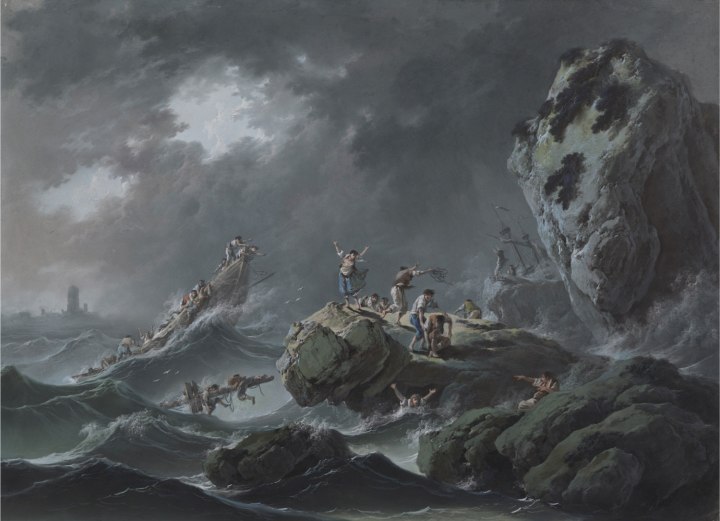
Jean Pillement, A Shipwreck, 1782, pastel on paper (Philadelphia Museum of Art).
◊ ◊ ◊ ◊ ◊
Iris Moon | Rococo Adrift: The Late Shipwrecks of Jean Pillement
University College London, 18 October 2017
Dr. Iris Moon (European Sculpture and Decorative Arts, Metropolitan Museum of Art, New York)
The lecture is part of UCL’s visual culture research seminar Past Imperfect, which aims to explore recent concerns with time: the unfinished past, the future present, the over investment in the contemporary. This year’s theme is Destruction and Demolition.
Seminar Room 6, 21 Gordon Square, London, 6:00–8:00pm
Lecture Series | L’art de l’Ancien Régime
From H-ArtHist:
Lecture Series: L’art de l’Ancien Régime
Deutsches Forum für Kunstgeschichte / Centre allemand d’histoire de l‘art, Hôtel Lully, Paris, 11 October — 4 December 2017
Le Centre allemand d’histoire de l’art organise des conférences publiques dans le cadre de son sujet annuel 2017/18 L’art de l’Ancien Régime – centres, acteurs, objets (Die Kunst des Ancien Régime – Zentren, Akteure, Objekte). Nous avons le plaisir d’accueillir au premier semestre:
11 October 2017, 18.00
Sophie Raux (Université Lumière Lyon 2), Explorer virtuellement un haut lieu du commerce d’art, à Paris, sous la Régence: Gersaint, Watteau et le Pont Notre-Dame
24 October 2017, 18.00
Hannah Williams (Queen Mary University of London), Inside a Parish Church: Art and Religion in 18th-Century Paris
7 November 2017, 18.00
Ulrike Gehring (Universität Trier), Land in Sicht. Verfahren der Landkartierung bei küstennaher Fahrt um 1600
4 December 2017, 18.00
Olivier Bonfait (Université de Bourgogne), Un enjeu national pour la peinture française aux XVIIe et XVIIIe siècles : le grand format
Lecture | Tracy Ehrlich on Carlo Marchionni and the Art of Conversation
From the flyer:
Tracy Ehrlich, Carlo Marchionni and the Art of Conversation:
Architectural Drawing and Social Space in Eighteenth-Century Rome
Cooper Hewitt, Smithsonian Design Museum, New York, 3 November 2017

Carlo Marchionni, Design for a Doorway in the Villa Albani, Rome, 1755–56; pen and brown ink, brush with brown and grey wash, graphite on cream laid paper, 417 × 289 mm (Cooper Hewitt, Smithsonian Museum; photo by Matt Flynn).
In the 1750s the Roman architect Carlo Marchionni (1702–1786) produced a set of highly finished drawings for the villa of the noted collector Cardinal Alessandro Albani. Marchionni’s renderings feature sophisticated figures in fashionable dress conversing and gesticulating at the thresholds of the grand gallery. The figures yield little if any technical information; yet in these drawings the bodies are as architectonic and expressive as the building itself, perhaps even more so. Marchionni’s work diverged from contemporary conventions for architectural drawings, offering his patron not simply a design for a pleasure casino but a distinctive cultural argument that may be traced to models of civility. An eloquence of the body, a sociable kind of living, in short, the art of civil conversation, marks the drawings of Carlo Marchionni.
Tracy Ehrlich, Faculty member, MA in the History of Design & Curatorial Studies Parsons School of Design, The New School, and Smithsonian Institution, Senior Fellow, 2016–17
3 November 2017 at 1:00pm, Lower Level Lecture Hall, Cooper Hewitt, Smithsonian Design Museum










 Enfilade
leave a comment