British Art Network (BAN) News
From the Paul Mellon Centre:
New British Art Network Convenor Appointed
The Paul Mellon Centre is delighted to announce that Dr Martin Myrone will be joining the staff at the Centre in the new role of Convenor of the British Art Network from 1 September 2020. The network, jointly led by Tate and the PMC, brings together over seven hundred specialists working on British art, including curators, researchers and academics, reflecting the combined strength of the UK’s public collections and curatorial expertise.
As Convenor, Martin will lead and develop the activities of this community in close collaboration with the British Art Network’s co-chairs Mark Hallett (Director of Studies at the Paul Mellon Centre) and Alex Farquharson (Director of Tate Britain).
Martin joins the PMC from his post as Senior Curator, Pre-1800 British Art at Tate Britain and is an art historian and curator of international standing. His many exhibitions at Tate Britain have included Gothic Nightmares in 2006, John Martin in 2011, British Folk Art in 2014, and most recently William Blake in 2019. His published work includes the 2005 monograph Bodybuilding: Reforming Masculinities in British Art 1750–1810 and the forthcoming Making the Modern Artist: Class, Culture and Art-Educational Opportunity.
British Art Networks Sub-Groups
British Art Network sub-groups focus on specific topics of British art. The programmes of activity are led and hosted by network members. Membership to the sub-groups is open to British Art Network members who have a professional research interest or specialism in the group subject area. The current sub-groups are:
• Black British Art
• British Art in Historic Houses
• British Drawings
• British Genre and Narrative Painting
• British Landscapes
• British Mural Painting, 1600–1750
• British Drawings
• British Genre and Narrative Painting
• British Landscapes
• British Mural Painting, 1600–1750
• British Women Artists, 1750–1950
• Contemporary Art in Scotland
• Group Work: Contemporary Art and Feminism
• Post-War Painting in Regional Collections
• Queer British Art
Join a Sub-Group here»
British Art Network Newsletter
The British Art Network circulates a newsletter three times a year, to keep members informed of upcoming events and opportunities relating to British art. The newsletter covers aspects of network activity alongside relevant external exhibitions and events, opportunities and scholarly articles.
Sign up here»
Sweden Nationalmuseum Acquires Two Drawings by Oudry
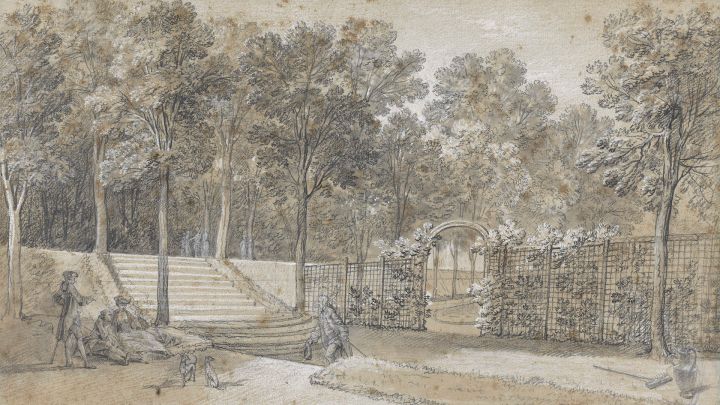
Jean-Baptiste Oudry, View of the Garden in Arcueil, Facing North with the Orangery Terrace and the Peak of the Forest Park or So-Called ‘Talus Cone’, 1744–47 (Stockholm: Nationalmuseum, NMH 55/2019).
◊ ◊ ◊ ◊ ◊
Press release (5 May 2020) from Sweden’s Nationalmuseum in Stockholm:
Nationalmuseum has acquired two drawings with views from the garden and park of Arcueil by the French Rococo master Jean-Baptiste Oudry. The drawings depict a geometrically landscaped garden with elements of a freer park in a state of picturesque decay. The artist presents both immediate visual impressions and more artfully elaborated ones. This type of landscape had previously been completely lacking from the museum’s large collection of works by Oudry.
Jean-Baptiste Oudry (1686–1755) has become known as one of the foremost artists of the French Rococo style. He began as a portrait painter but soon came to specialise in still life painting. His close friends and clients included the Swede Carl Gustaf Tessin, which is also why National museum has so many works by the artist in its collection. Oudry’s activities as a landscape painter are somewhat less known. At times, he is even said to have used a camera obscura in the production of his views.
Starting in 1740, Oudry began to make excursions to scenic Arcueil, located in the southern suburbs of Paris. The place was famous for its beautiful garden and park, which boasted a monumental aqueduct as a backdrop. Today, most of it has vanished or been rendered unrecognisable. The garden complex, which attracted artists such as Oudry, Boucher and Natoire, was created for the Prince of Guise between 1720 and 1730 by the architect Jean-Michel Chevotet. Among Chevotet’s fellow students at the French Academy of Architecture was the Swede Carl Hårleman, and both specialised in landscape architecture. Arcueil was transformed into an intimate formal garden in the spirit of Rococo, with geometric elements such as parterres, ponds and trellis works. The differences in terrain levels on the site created movement and vistas. It was thus also necessary to construct a variety of walls, terraces and stairs, which contributed to the special and complex character of the garden. There was also a wilder and more informal section with a picturesque touch.
It is therefore hardly surprising that Oudry was fascinated by Arcueil. He rented a house that was located directly adjacent to the property, which gave him many opportunities to draw various views. Most are believed to have been executed between 1744 and 1747. Many have an immediate character, revealing that they were drawn outdoors, on site. Others appear more elaborate. Over fifty such views are known to exist, two of which have now been acquired by Nationalmuseum. Of them, the view to the north with the orangery terrace and the peak of the forest park (or so-called ‘talus cone’), is among Oudry’s finest drawings from Arcueil. The artist has worked on a beige paper (which was probably originally blue) with black and white chalk, which he then smudged with a stump (an artist’s tool made of hard rolled paper or chamois leather). Then Oudry used a brush to add highlights in white gouache. In this way he managed to create fine contrasts between sunlit areas and other shady parts of the image. The figures are considered to have been drawn by another hand, perhaps Victoire Chenu or Jacques-Philippe Le Bas, who later (1776) engraved and published this view under the title Ancienne et première vue d’Arcueil.
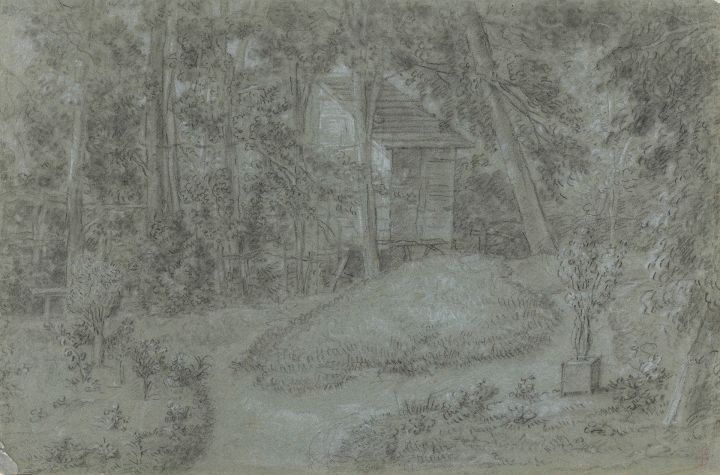
Jean-Baptiste Oudry, View of the Bosquet in the Garden of Arcueil with Promenade and Garden Shed, 1744–47
(Stockholm: Nationalmuseum, NMH 46/2018).
◊ ◊ ◊ ◊ ◊
While the view from the orangery terrace has the character of a completed drawing, or what Carl Gustaf Tessin called la manière très finie, Oudry’s second drawing is characterised by a seemingly immediate visual sensibility. It was create using chalk and faint white gouache highlights on a grey-blue paper, and reproduces a more informal part of the garden, a bosquet area with a promenade. In the background one can see a garden shed with a somewhat dilapidated fence. In this view, Oudry has depicted a pastoral scene which seems quite distant from the more formal environment of the previous drawing and thus appears to herald the parks of the late 18th century.
Nationalmuseum receives no state funding with which to acquire design, applied art, and artwork; instead, the collections are enriched through donations and gifts from private foundations and funds. The acquisitions have been made possible through a purchase using donations from the Wiros Foundation and the Hedda and Nils D. Qvist Memorial Fund.
On Television and Online | Opening Up The Soane
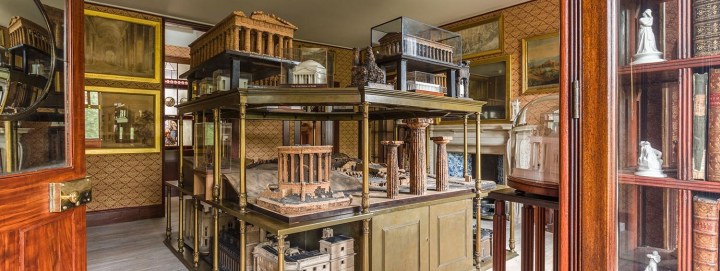
The three episodes of Opening Up The Soane will be uploaded to museum’s website a day after each episode airs on London Live.
• Episode 1, Restoring the Recesses — 20 April (airs 19 April, 8PM)
• Episode 2, Restoring the Private Apartments — 27 April (airs 26 April, 8PM)
• Episode 3, A Triumph of Restoration — 4 May (airs 3 May, 8PM)
You can watch the series live on London Live,Freeview 8 | Sky 117 | Virgin 159 | YouView 8
In the meantime, you can read about the Opening Up The Soane project, or explore the Museum online using Explore Soane. While the Soane Museum is temporarily closed, the institution is ever more reliant on your support to protect and maintain Sir John Soane’s house and collection.
Amanda Lahikainen Named Director of OMAA
Press release (2 April 2020) from the Ogunquit Museum of American Art in Maine (Lahikainen’s scholarship to date has focused on late eighteenth- and early nineteenth-century print culture, including the reception and representation of paper money in Britain, ‘imitation banknotes’ during the Romantic period, and British representations of the French Revolution in graphic satire). . .
 David Mallen, President of the Board of the Ogunquit Museum of American Art (OMAA) announced today that Amanda Lahikainen, PhD, has been appointed as the museum’s new Executive Director, effective May 1, 2020. The board unanimously approved the appointment on March 23, 2020.
Dr. Lahikainen is currently Chair of the Art Department and a tenured Associate Professor of Art History at Aquinas College in Grand Rapids, Michigan, where she oversees the art gallery. Mallen said, “After a nationwide search, we are delighted to have selected Amanda as our next Executive Director. She is a gifted administrator and scholar.”
Dr. Lahikainen holds a PhD in art history from Brown University and a BA from Wellesley College. She oversaw and co-curated exhibitions at her college gallery and the Bell Gallery at Brown University, and has worked with local museums in Grand Rapids including the Grand Rapids Art Museum and the Meijer Gardens and Sculpture Park. She held the Kluge Fellowship at the Library of Congress in 2012 and has attracted grants and fellowships from the Paul Mellon Centre and the Lewis Walpole Library at Yale University. She previously taught at Brown University, Rhode Island College, and Roger Williams University, and she has worked or studied in London and Athens. She is widely published and has lectured and participated on panels across the US and in Canada and Australia.
Mallen added, “Amanda’s credentials are exceptional and will further strengthen the OMAA as we aim to expand our audiences and make our museum even better known. Amanda will relocate to Maine with her family from Grand Rapids. She grew up in Salem and has a summer home in Maine, so she is eager to live year-round in a region she knows and loves.”
Dr. Lahikainen said, “I am honored to lead OMAA with its wonderful collection, its sculpture garden, and strong sense of place. The museum is an important and beloved asset of the region and has a wonderful record of recent growth and accomplishment under my predecessor Michael Mansfield. The commitment of the Board is inspiring. While I have been happy and successful at Aquinas College, this is an opportunity I could not resist when recruited. I look forward to working with the board, staff, volunteers, and the community of artists and donors in Ogunquit and beyond to lead the next exciting chapter in the museum’s life.”
Dr. Lahikainen will replace Interim Executive Director Richard D’Abate, who Mallen said, “has led the museum strongly through the transition, and we are very grateful for his service.” D’Abate was appointed following former Executive Director Michael Mansfield’s appointment as President of Maine Media Workshops and College in Rockport, Maine on December 15, 2019.
Mallen stated, “The OMAA maintains its momentum as a strong and innovative institution, and we are excited for its future. The museum recently rehung the permanent collection and continues with exhibitions, performances, and publications. Its lecture series set attendance records in 2019. The 2020 exhibition season, now tentatively scheduled to begin May 31st, is planned with exciting shows, performances and lectures, subject, of course, to the coronavirus situation.
The search committee was chaired by former board member Diana Joyner and included Board President David Mallen and board members Chris Caraviello, Ann Ramsey-Jenkins, Carol Leary, Robyn LeBuff, and Alan Shepard. The museum retained Principal Marilyn Hoffman and Senior Search Consultant Scott Stevens of Museum Search & Reference, an executive search firm in Manchester, New Hampshire and Boston to conduct the national search.
The Ogunquit Museum of American Art was founded by Lost Generation artist Henry Strater and opened in 1953. Closely tied to one of the earliest art colonies of the American modernist art movement, OMAA today houses a permanent collection of important paintings, sculpture, drawings, prints, and photographs from the late 1800s to the present. The museum honors Strater’s vision to preserve and showcase American art by mounting innovative modern and contemporary exhibition programs each year from May through October. OMAA and its three-acre seaside sculpture gardens overlook Narrow Cove and the Atlantic Ocean
YCBA’s Scott Wilcox Begins Phased Retirement
Press release (31 March 2020) from YCBA:
 The Yale Center for British Art announced that Scott Wilcox, Deputy Director for Collections, will begin a two-year phased retirement starting April 1, 2020. Wilcox, who has worked for the Center for his entire career, will immediately take on a new position as Senior Research Scholar. His full retirement will begin on March 1, 2022, concluding a career that spans more than three decades. A search for his successor is forthcoming.
“Scott has shaped the curatorial ambitions of the Center over the past 30 years by enriching our knowledge of and appreciation for works on paper and by bringing significant examples of photography into the collection,” Director Courtney J. Martin said. “As a student at Yale in the early 2000s, I knew of Scott’s great achievements as a curator and scholar. When I returned to the Center as director, I learned that he was also a stellar colleague. Over the next two years, we will have the opportunity to learn more from him as he turns to a research role that will certainly benefit staff, visiting scholars, and visitors to our exhibitions.”
Wilcox received his PhD in the history of art from Yale University in 1985, completing his doctoral dissertation on the nineteenth-century watercolor painter David Cox. He joined the Center as Assistant Curator of Prints and Drawings in 1982 and later held the positions of Associate Curator (1991), Curator (1998), Chief Curator of Art Collections, and Senior Curator of Prints and Drawings (2009).
“As I look back on nearly 38 years at the Center, I feel tremendously grateful that I’ve had such a long run in an institution with such great collections, great programs, and great colleagues,” Wilcox said. “I hope I’ve been able to make a positive contribution to what makes the Center special. At different moments I considered moving on, but I always concluded that there was no other place I’d rather be.”
From 1987 to 2014, Wilcox served as the Center’s in-house curator for photographic exhibitions and was instrumental in establishing a collection of photography within the Department of Prints and Drawings through the purchase or gift of works from Charles Isaacs and Carol Nigro and the gift of works from the Joy of Giving Something, Inc.
In 2014, Wilcox was promoted to Deputy Director for Collections, expanding his curatorial role to include all the Center’s collections. In this role, one of five senior leadership positions at the Center, he has overseen the intellectual framework in which the Center’s art is interpreted, as well as the care of the art and growth of the collections. Between 2009 and 2010, Wilcox directed the creation and development of the new Department for Collections Information and Access, which catalogues the Center’s collections electronically and serves as their online platform. Wilcox co-led a team of curators to develop Britain in the World, the reinstallation of the Center’s collections that coincided with its reopening in 2016, following a major building conservation project. This ongoing exhibition offers a new interpretation of the collections that focuses on British art, history, and culture in a global context.
Wilcox’s deep knowledge of works on paper has resulted in many significant exhibitions at the Center: Victorian Landscape Watercolors (also at the Cleveland Museum of Art and the Birmingham Museum and Art Gallery) in 1992–93; Lucian Freud Etchings from the Paine Webber Art Collection (Museum of Contemporary Art, San Diego; Seattle Art Museum; Blaffer Gallery, University of Houston; Iris & B. Gerald Cantor Center for Visual Arts at Stanford University; and Carnegie Museum of Art) in 1999–2000; Sun, Wind, and Rain: The Art of David Cox (Birmingham Museum and Art Gallery) in 2008–9; and The English Prize: The Capture of the ‘Westmorland’, an Episode of the Grand Tour (Ashmolean Museum of Art and Archaeology, University of Oxford) in 2012–13. These exhibitions were accompanied by major publications with scholarly essays and illustrated catalogues.
“I have known Scott Wilcox throughout his illustrious career at Yale,” said Jules D. Prown, Founding Director of the Yale Center for British Art and Professor Emeritus in the History of Art at Yale University. “Our initial acquaintance began when, as Scott’s professor, I directed his dissertation on the English artist David Cox. Since he knew a great deal about the artist and I did not, it did not require much effort on my part. When Scott applied for a position in the Department of Prints and Drawings at the Center, he distinguished himself quickly from the other candidates by the accuracy of his eye in making attributions and aesthetic judgments. Scott is deeply respected by his colleagues, not only for his curatorial and administrative ability but also for his intelligent analysis, conclusions, and leadership.”
In his new role as Senior Research Scholar, Wilcox will assist in the transition to his successor and will cocurate (with Antonella Pelizzari) Photographs of Italy and the British Imagination, 1840–1914, scheduled to open at the Center in fall 2021. The exhibition will showcase the work of British photographers in Italy and consider the ways in which photography shaped the British appreciation and understanding of Italian art, culture, and politics.
Conservation of The Blue Boy Completed
Press release from The Huntington (27 February 2020) . . .
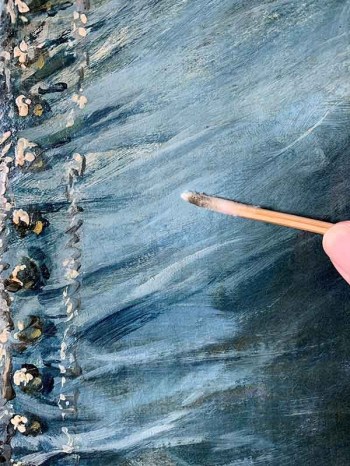
The conservator removed dirt trapped underneath the varnish (as seen on the cotton swab), which clouded the clarity of Gainsborough’s masterful brushwork (The Huntington Library, Art Museum, and Botanical Gardens).
The Huntington Library, Art Museum, and Botanical Gardens announced today that the extensive 18-month initiative to analyze, conserve, and restore The Blue Boy (ca. 1770) by Thomas Gainsborough (1727–1788) is complete, and the iconic painting will go back on view Thursday, March 26, in the Thornton Portrait Gallery. With much of the process carried out in public view during the Project Blue Boy exhibition (22 September 2018 — 30 September 2019), the major undertaking involved high-tech data gathering and analysis as well as more than 500 hours of expert conservation work to remove old overpaint and varnish, repair and reattach the lining and other structural materials, and inpaint areas of loss as a result of flaking and abrasion. Now, minute shades of color, fine brushstroke textures, and nuanced details of the famous figure of a young man in a blue satin costume, as well as the landscape in which he stands, are once again legible and closer to what Gainsborough intended.
“The Blue Boy has been a star of The Huntington’s collections since we opened as the first old masters museum in Los Angeles in 1928, when visitors flocked to see this magnificent work of 18th-century British portraiture,” said Huntington President Karen R. Lawrence. “Now the painting is again the center of a joyous occasion, as we celebrate the completion of a robust and thoughtful conservation project. A well-attended exhibition showcasing the conservator at work, more than 100 public talks, and the convening of experts in the field all helped to define Project Blue Boy as an ambitious and successful project with an educational focus.”
More than 217,000 people visited the Project Blue Boy exhibition. Christina O’Connell, The Huntington’s Mary Ann and John Sturgeon Senior Paintings Conservator and leader of the project, gave about 170 gallery talks, emphasizing the guidelines and code of ethics in the field of conservation as she responded to visitor questions on topics ranging from the history of the painting, to details of the technical study, to the structural elements of the work.
The conservation project involved slowly removing several uneven layers of dirt and discolored varnish with small cotton swabs to reveal Gainsborough’s original brilliant blues and other pigments. Then, with tiny brushes, the artist’s brushstrokes were reconnected across the voids of past damage as part of the inpainting process.
As O’Connell worked on the painting, she became intimately aware of Gainsborough’s every brushstroke. “It’s been an incredibly deep professional experience,” she said. “Conservation work is very much a process of discovery. I’ve not only had a view of the painting at the microscopic level, but I was also able to observe each stroke as the true colors of Gainsborough’s palette were revealed from underneath many layers of dirt and discolored varnish.” During the process, O’Connell discovered that although Gainsborough painted The Blue Boy on a recycled canvas (as revealed in earlier X-rays), he made considerable use of a complex network of paint layers and pigments to create a painting that truly showed off his skills.
“We have to remember that this painting wasn’t commissioned, but rather was produced by Gainsborough for the express purpose of showing off his prowess at the Royal Academy exhibition of 1770—where it would be seen next to the work of his rivals,” said Melinda McCurdy, The Huntington’s associate curator for British art and co-curator of Project Blue Boy. “Gainsborough intended it to grab attention, and conservation work has revealed the incredible technical skill he brought to this showpiece.”
Other discoveries made over the course of the project, which was supported by a grant from Bank of America as a part of its global Arts Conservation Project, include one relating to the painting’s lining. After observation and analysis, conservators determined that the lining adhesive for The Blue Boy correlated to a historic recipe for a paste made of rye flour and ale. O’Connell enlisted the help of a food historian to recreate the paste with modern ingredients to construct a mock-up in order to observe how the materials for the lining behaved. More discoveries should be forthcoming once the copious data that was collected during the project is analyzed. Information was gathered via X-radiography, infrared reflectography, cross-section microscopy, and macro X-ray fluorescence scanning. The results of the analysis will take several more months.
Conservation was funded by a grant from the Bank of America Art Conservation Project. Additional generous support for this project was provided by the Getty Foundation, Friends of Heritage Preservation, and Haag-Streit USA
AGO Acquires Portrait of a Lady Holding an Orange Blossom
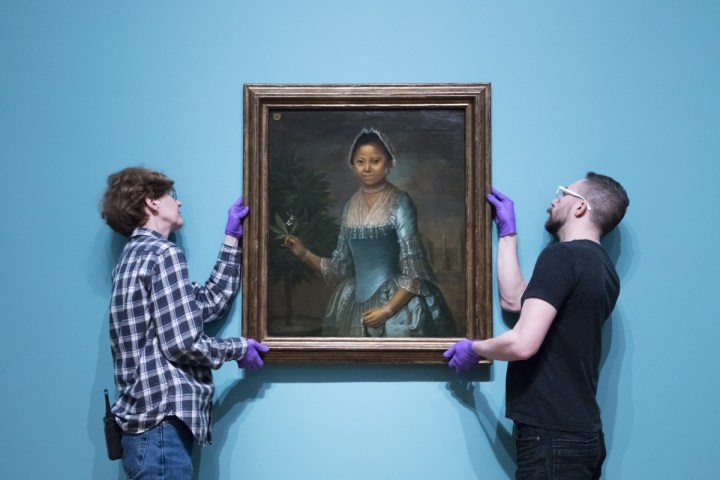
Unknown artist, Portrait of a Lady, Three Quarter Length, Holding an Orange Tree Flower, mid-18th century, oil on canvas, 80 × 56 cm
(Toronto: Art Gallery of Ontario, purchase, 2020, 2019/2437)
◊ ◊ ◊ ◊ ◊
Press release (25 February), from Toronto’s Art Gallery of Ontario:
If you’ve read about the AGO’s recent acquisitions, then you know it’s a top priority of ours to acquire dynamic and captivating works that will both strengthen and diversify our collection. With this in mind, we jumped at the opportunity to purchase the beauty you see pictured above. And what’s even more exciting is that it comes to us with a fascinating mystery to uncover.
Portrait of a Lady Holding an Orange Blossom is a striking and mysterious portrait that commands your attention. Its central figure is a young woman wearing a luxurious blue silk gown, woven with intricate lace trim. Around her neck and wrists are elegant pearls, which complement her bejewelled drop earrings. She is aware of her own radiance, smizing with piercing brown eyes and regal posture, clasping the front of her gown while presenting an orange tree blossom.
Though the subject’s presence is arresting and undeniable, her identity, as well as that of the artist who painted her, are currently unknown. Scholars agree that Portrait of a Lady is from the mid-1700s, painted by a male artist who was born and trained in Europe. With so many unanswered questions, we are left wondering: Who was this painter? What is the location of this painting and what brought him there? Who was his stunning subject?
Very few portraits of Black people by European artists survive from this time period. The painting raises important questions about the subject’s status within the transatlantic slave trade. While her opulent clothing and the mere existence of the portrait suggest that she was a free woman, her ancestors and even one of her parents may have been enslaved.
We continue to do research to find out more about her story. In the meantime, the presence of this figure in the European galleries reminds us that history is complex and diverse, composed of countless stories told from many perspectives. For the AGO, this acquisition is an important step toward acknowledging the rich and vital presence of people of colour in the history of Europe and its art. Portrait of a Lady Holding an Orange Blossom is currently on view on Level 1 in Frank P. Wood Gallery (Gallery 123).
Mei Mei Rado Named Costume & Textile Curator at LACMA
Starting this month at LACMA:
 Los Angeles County Museum of Art (LACMA) has appointed Mei Mei Rado as the new Associate Curator of Costume and Textiles. Dr. Rado received her M.A. from the University of Chicago and her Ph.D. from the Bard Graduate Center in New York. She specializes in the history of both Western and Eastern Asian textiles and dress from the eighteenth to the twentieth centuries, with a focus on intercultural exchanges. She is currently working on her book manuscript The Empire’s New Cloth: Western Textiles at the Eighteenth-Century Qing Court, which was supported by a postdoctoral grant from the American Council of Learned Societies.
Dr. Rado was awarded the J. S. Lee Memorial Fellowship for Chinese Art at The Palace Museum in Beijing, a Predoctoral Fellowship at The Metropolitan Museum of Art in the Department of European Sculpture and Decorative Arts, and a Postdoctoral Fellowship at the Freer/Sackler Galleries (now the National Museum of Asian Art, Smithsonian Institution). Her contributions to exhibitions and exhibition catalogues include Interwoven Globe: Worldwide Textile Trade, 1500–1800, and China: Through the Looking Glass (Metropolitan Museum of Art, New York); Shanghai Glamour: New Women, 1910s–40s (Museum of Chinese in America, New York); Performing Images: Opera in Chinese Visual Culture (The Smart Museum, The University of Chicago); The 1930s: Elegance in an Age of Crisis (Museum of Fashion Institute of Technology, New York); and Far-Reaching Elegance: Magnificent Chinese Export Silk (China National Silk Museum, Hangzhou). From 2017 to 2019, she taught at The School of Art and Design History and Theory at Parsons School of Design in New York.
A selection of Dr. Rado’s publications can be found on her Academia site. Her forthcoming article “Fabric of Light, Surface of Displacement: Lamé and Its Shine in Early Twentieth-Century Fashion” will appear in an edited volume Materials, Practices and Politics of Shine in Modern Art and Popular Culture (Bloomsbury).
Getty Acquires Wright’s ‘Two Boys with a Bladder’
Press release (17 January 2020) from The Getty, following the announcement of its intentions last June:

Joseph Wright of Derby, Two Boys with a Bladder, ca.1769–70 (Los Angeles: J. Paul Getty Museum).
The J. Paul Getty Museum announced today that the acquisition of Two Boys with a Bladder will proceed, following the granting of an export license by the Arts Council of England.
“We are very pleased that an export license for Two Boys with a Bladder by Joseph Wright of Derby has been granted. This important work has not been on public view since the 18th century and is therefore virtually unknown to scholars,” said Timothy Potts, director of the J. Paul Getty Museum. “We look forward to sharing this spectacular painting with our visitors and scholars in the context of our other 18th-century collections. Two Boys with a Bladder counts among Joseph Wright of Derby’s most accomplished nocturnal subjects and reflects the experimental interest of artists and scientists of the Enlightenment. It joins two other works by the artist at the Getty.”
The recently rediscovered painting depicts two young boys, boldly lit by a concealed candle, inflating a pig’s bladder. In the 18th century, animal bladders served as toys, either inflated and tossed like balloons or filled with dried peas and shaken like rattles. While bladders appeared frequently in 17th-century Dutch painting they were depicted less frequently in 18th-century Britain. It was a motif that Wright made his own; the elaborate costumes that the boys wear are of the artist’s own invention, in the style of British ‘fancy pictures’. The dramatic pictorial effect created by the concentrated candle light within a dark interior setting was in vogue in much of Europe in the late 16th and 17th centuries, but it was not until the 18th century that English artists picked up the theme, Wright being among the first to do so.
The previously unpublished masterpiece is Wright’s earliest known treatment of the subject. Unseen in public since the 18th century, the painting forms part of a sequence of dramatic nocturnal paintings that includes The Experiment on a Bird in the Air Pump (1768, National Gallery, London) and An Academy by Lamplight (1770, Yale Center for British Art, New Haven). It was painted as a pendant to Two Girls Dressing a Kitten by Candlelight, which is now at Kenwood House in London.
“Two Boys with a Bladder is a remarkable discovery that sheds new light on Wright’s work at the most important moment of his career,” said Davide Gasparotto, senior curator of paintings at the Getty Museum. “It is a compelling example from his most important and successful genre, candlelight paintings. Moreover, Wright’s innovative experimentation with the use of metal foil embodies a sense of technical and scientific exploration that typifies the intellectual milieu of the midlands on the eve of the industrial revolution. It is a major addition to the Getty’s holdings of art from the English golden age.”
◊ ◊ ◊ ◊ ◊
Note (added 22 January 2020, and slightly modified 23 January) — Another relevant painting by Wright not mentioned in the the announcement is The Huntington’s Two Boys by Candlelight, Blowing a Bladder, just twenty-five miles away. –CH
Nationalmuseum Acquires Two Self-portraits by Joseph Ducreux

Press release (8 November 2019) from Sweden’s Nationalmuseum:
Nationalmuseum has acquired two physiognomic self-portraits painted by the French artist, Joseph Ducreux, one of the foremost artists at the court of Louis XVI. Ducreux’s portraiture exhibits strong influences of naturalism and is characterized by the artist’s ability to capture a specific facial expression or emotional state. He shares this ability with the Austrian artist, Franz Xaver Messerschmidt.
Joseph Ducreux (1735–1802) was likely a student of Maurice Quentin de la Tour (1704–1788). The real launch of Ducreux’s career came when he was commissioned to paint a portrait of Marie Antoinette (1755–1793). In order to discover how the future French crown princess looked, the artist was sent to Vienna in 1769 with a commission to depict her. The result was so successful that Ducreux was subsequently made a baron and was given the title of ‘premier peintre de la reine‘.

Joseph Ducreux, ‘Self-Portrait, Silence’, 1790s, oil on canvas (Stockholm: Nationalmuseum, 7495; photo by Anna Danielsson).
Because of this closeness to the royal family, and more particularly, the queen, Ducreux found himself in a perilous situation in the years immediately following the start of the French Revolution in 1789. He therefore took up residence in London during a period some time in 1791. There are few facts about Ducreux’s activities during this brief period, but we know that he exhibited portraits and self-portraits at the Royal Academy of Arts, including two that were called Surprise mixte [sic] with Terror and Surprise, respectively. Most likely, one of the portraits that Nationalmuseum has now acquired was a later version of the first of the two aforementioned works that had been exhibited in London. The facial expression of the artist is permeated with exaggerated surprise mixed with terror, as shown in his large eyes, gaping mouth and dramatically extended right hand. There is no doubt that these works are self-portraits, but their titles, which describe emotions, such as surprise, show that they were also intended to focus on physiognomy as a phenomenon, in itself.
The fact that Ducreux could return to Paris so soon, was most likely due to his acquaintance with Jacques-Louis David (1748–1825), the foremost artist of the Revolution. By August 1791, he once again exhibited his work in the Salon in Paris. One example is a work that the catalogue calls Silence, which is currently in the collection of the Spencer Museum of Art in Kansas. Ducreux’s expressive oil portraits, however, were met with both praise and scorn, but regardless garnered a great deal of notoriety, which, in turn, increased the demand for additional works of this sort. Nationalmuseum’s Silence is probably a later version by Ducreux of the work exhibited at the Salon. The artist is portrayed with a powdered wig, a top hat and a brown coat. As often was the case, some of the powder is seen on the artist’s shoulders and coat collar. The portrait depicts his upper body in profile, but the head is turned to the viewer. His right index finger is lifted to his mouth to clearly communicate the need to keep silent.
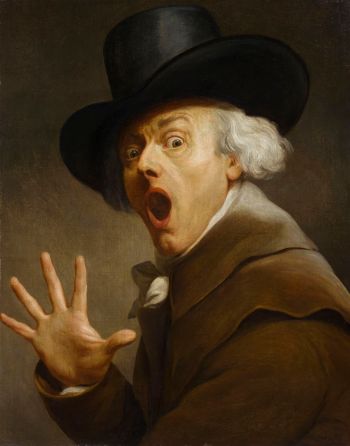
Joseph Ducreux, ‘Self-Portrait, Surprise’, 1790s, oil on canvas (Stockholm: Nationalmuseum, 7496; photo by Anna Danielsson).
Ducreux’s interest in physiognomy reflects his time and can more generally be indicative of the favourite scientific theme of the Enlightenment. By combining an expressly physiognomic perspective with a self-portrait, this work may well be viewed as having laid the foundation for new directions in portraiture. This is in no way any kind of caricature, but neither does it any longer have anything of the formal and serious nature of traditional portraiture. Ducreux has attempted to capture in himself, facial expressions that we can see every day, on people, in general. It is perhaps not at all surprising that one of Ducreux’s self-portraits of this type has now become a popular on-line meme, which, in itself, shows this artist’s timeless playfulness and desire to experiment
“Nationalmuseum is happy to have been able to acquire these exceptional works, which are so characteristic of Joseph Ducreux’s self-portraits,” declares Daniel Prytz, curator at Nationalmuseum.
The newly acquired portraits by Ducreux can now be viewed, in the Museum’s presentation of its collections in one of the recently remodelled small rooms with 18th-century art, which now includes portraits from the period of the French Revolution.
Nationalmuseum receives no state funding with which to acquire design, applied art and artwork; instead the collections are enriched through donations and gifts from private foundations and funds. The acquisition has been made possible through a contribution by the Sophia Giesecke Foundation.










leave a comment