Search for ‘Eighteenth-Century Studies’ Book Review Editor
Book Review Editor, Eighteenth-Century Studies
The Executive Board of ASECS seeks nominations and applications for a three-year (renewable) appointment as Book Review Editor for Eighteenth-Century Studies, beginning July 1, 2011. The Book Review Editor receives and requests books from U.S. and foreign publishers, decides which books will be reviewed, solicits reviews from appropriate scholars, enforces word limits and deadlines, edits reviews, organizes and solicits review essays, and works closely with the ECS editorial staff. Since ECS reviews books of importance in a variety of disciplines and of interest to ASECS members in general, the Book Review Editor must have wide familiarity with the field of eighteenth-century studies, extensive professional contacts, and demonstrated organizational skills. The search committee is especially interested in interdisciplinary teams of at least two people from the same institution or location. Teams of two or more people should designate one of their number as a chief editor. The Society currently provides $4,000 annually to help defray the cost of postage, telephone, and related operating expenses. In addition, travel support for the editor or a member of the editorial team to the annual meeting may be requested. Please submit nominations and applications (letter of interest that outlines the applicant’s qualifications and CV) by December 1, 2010 to:
Byron R. Wells, Executive Director, ASECS
PO Box 7867
Wake Forest University
Winston-Salem, NC 27109
Phone: 336-727-4694
E-mail: asecs@wfu.edu
Manuscript Prize Competition
From the University of Virginia Press:
2010 Walker Cowen Manuscript Prize Competition in Eighteenth-Century Studies
Proposals due by 1 November 2010
We invite submissions for the Walker Cowen Memorial Prize. The prize is awarded to the author of a scholarly book-length manuscript in eighteenth-century studies, including the Americas and the Atlantic world. Submissions may be in history (including history of science), literature, philosophy, or the arts. The competition is held annually. The winner of the Cowen Prize will receive a $5,000 award and will be offered an advance publishing contract by the University of Virginia Press. The prize honors the late Walker Cowen, second Director of the Press from 1969 until his death in 1987. Click here for an official application form
Request an application form or send queries to:
Angie Hogan
The University of Virginia Press
PO Box 400318
Charlottesville, VA 22904-4318
arh2h@virginia.edu
To be considered for the 2010 award, manuscripts should be submitted no later than November 1, 2010. Manuscripts will not be returned. Foreign-language works first published in Europe will also be considered for the prize and for translation into English. Announcement of the winning manuscript will be made in March 2011.
A Fine Time to Be in Belgium, Too
Open Monumentendag Vlaanderen / Heritage Days
Belgium, 12 September 2010
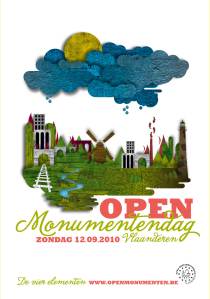 Open Monumentendag Vlaanderen (Heritage Day Flanders) is the holiday for the entire heritagein Dutch-speaking Belgium. It is held every second Sunday of September. On that day all the famous and not-so-famous patrimony of Flanders opens its doors for the general public. But it is not just monuments that are in the spotlights, also archaeological sites and landscapes occupy centre stage. Not only can you admire some of Flanders’ most exciting heritage, but there are also loads of activities, for young and old, presented to you as well (this includes exhibitions, walks, bicycle tours and much more). Every year we highlight one specific topic. This changes the wide variety of activities we offer you every year and it also makes sure that Open Monumentendag will never cease to amaze you. And what is more: all the visits and activities during Open Monumentendag are free of charge!
This year Open Monumentendag takes place on Sunday September 12. The theme of this year’s edition will be The Four Elements. So it will be earth, wind, water and fire that determine the programme. You can find the detailed schedule of the day here.
A Fine Time to Be in the Netherlands
This annual event (second weekend in September) includes sites all over the Netherlands; this year’s theme in Amsterdam is On the Map while the overall theme focuses on The Nineteenth Century. The following description comes from the Amsterdam pages:
Open Monumentendag / Heritage Days
The Netherlands, 11-12 September 2010
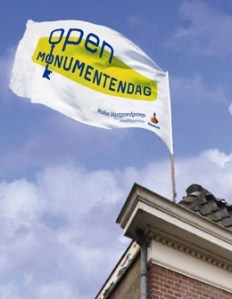 Open Monumentendag (Heritage Days) annually explores and celebrates architecture, both in Amsterdam and the country at large. It is aimed at bringing people into contact with their heritage, and to stir interest in and an understanding of preserving historical monuments. From 11 to 12 September, thousands of historical buildings and sites (about 4,000) are open to the public free of charge. This year’s theme is On the Map.
With a city like Amsterdam that’s partially built on sand, the event gives history lovers a golden opportunity to dip their toes into its architectural sandbox. From Gothic revival and Berlage to modern industrial, what’s not to stop and admire. The focal point this year is On the Map, referring to a variety of maps, topography and architectural plans of buildings that are particularly striking, and which form the subject of the city’s views, postcards and inspiration for drawings, paintings and poems.
 Buildings open to the public include listed (graded) churches and castles, monuments due for restoration and icons long gone from Amsterdam’s skyline. On the Map also highlights structure: the relationship between the monument and its surroundings; and the site of the building in relation to the growth of the city.
Besides opening their doors, many locations also organise on-site activities like exhibitions, music and guided tours. Each year around 80 to 85 percent of Dutch municipalities participate in the Open Monumentendag, organised by local committees. In recent years around 900,000 visitors have participated annually, making the Open Monumentendag one of the Netherlands’ premier cultural events.
Join a CAA Committee
Applications due by 15 October 2010
CAA invites you to join one of its nine diverse, active Professional Interests, Practices, and Standards Committees. These committees address crucial issues in the fields of art and art history and help to shape CAA’s activities and goals. Committees initiate projects to explore or improve professional practices, advocate on matters of interest to members by means of formal statements or positions, and develop and assemble professional guidelines that, once approved by the CAA Board of Directors, become authoritative documents for all art-related disciplines. Joining a committee is also an excellent way to network with other members and to provide service to the field.
Committee members serve three-year terms (2011–14), with at least one new member rotating onto a committee each year. Candidates must possess expertise appropriate to the committee’s work and be current CAA members. Members of all committees volunteer their services to CAA without compensation. CAA’s president and vice president for committees will review all candidates in late November and make appointments in early December, prior to the 2011 Centennial Conference in New York. All new members are introduced to their committees at their respective business meetings at the conference.
The following vacancies will be filled for terms beginning February 2011:
- Committee on Diversity Practices: 4 members
- Committee on Intellectual Property: 1–2 members
- Committee on Women in the Arts: 4 members
- Education Committee: 4–5 members
- International Committee: 5–6 members
- Museum Committee: 3–4 members
- Professional Practices Committee: 3–4 members
- Services to Artists Committee: 4 members
- Student and Emerging Professionals Committee: 4 members
Nominations and self-nominations for committee membership should include a brief statement (no more than 150 words) describing the individual’s qualifications and experience and an abbreviated CV (no more than two pages). Please send all materials to: Vice President for Committees, c/o Vanessa Jalet, Executive Assistant, CAA, 275 Seventh Ave., 18th Floor, New York, NY 10001. Materials may also be sent to vjalet@collegeart.org; email submissions must be sent as Word attachments. Deadline: October 15, 2010.
Interdisciplinary MA Program in London
The following notice was recently submitted for the attention of Enfilade readers; there’s also a link to the King’s College program in the sidebar to the right, along with links to other useful eighteenth-century studies programs:

 A new MA in 18th-Century Studies, offered under the joint auspices of King’s and the British Museum, is proving very successful, drawing upon the skills of scholars from eight departments in the School of Humanities, alongside those of senior staff at the Museum. The eighteenth century is a vital component of the School of Humanities’ research and teaching.
The new MA consists of a core module, a dissertation and four modules chosen from a wide range of options, including ones taught by the Departments of English Language & Literature, History, Music, American Studies, Philosophy and German. The core module is taught in part by experts from the British Museum, and enables students to engage with the unique, diverse and rich collections of cultural institutions in central London, including the British Museum, the National Portrait Gallery, the Royal Society and the Hunterian Museum.
The core module explores constructions of the Enlightenment, then and now, through frameworks such as race, gender, class, intellectual networks and material culture, and invites students to analyse ideas, objects, texts and arts of the eighteenth century. We particularly welcome applicants who may continue to a PhD, and those looking to deepen their understanding of the eighteenth century through creative interdisciplinarity.
This degree is offered jointly with the British Museum; do visit the museum’s Enlightenment Gallery website.
Innovative Course Design
How nice it would be to see an art history course included among this year’s three winners — and it comes with $500! So submit. . .
ASECS Innovative Course Design Competition
Proposals due by 1 October 2010
To encourage excellence in undergraduate teaching of the eighteenth century, the Society invites proposals from members in any of its constituent disciplines. Proposals should be for a new approach to teaching a unit within a course on the eighteenth century, covering perhaps one to four weeks of instruction, or for an entire new course. For example, participants may offer a new approach to a specific work or theme, a comparison of two related works from different fields (music and history, art and theology), an interdisciplinary approach to a particular social or historical event, new uses of instructional technology (e.g., web sites, internet resources and activities), or a new course that has never been taught or has been taught only very recently for the first time. Participants are encourage to include why books and topics were selected and how they worked. Applicants should submit five (5) copies of a 3-5 page proposal (double-spaced) and should focus sharply on the leading ideas distinguishing the unit to be developed. Where relevant, a syllabus draft of the course should also be provided. (more…)
European Architectural History Network
European Architectural History Network Conference
Brussels, 31 May — 3 June 2012
Proposals due by 19 December 2010
For those interested in architectural history and are based in Europe, do check out the European Architectural History Network, a sister counterpart to the more established Society of Architectural Historians. EAHN recently held its first international conference in Guimaraes, Portugal, and its second international conference will be in Brussels, Belgium on 31 May to 3 June 2012. One of the useful features of their website includes a searchable database of conferences, workshops, and seminars categorized by date, keyword, and country.
EAHN Mission Statement
The European Architectural History Network supports research and education by providing a public forum for the dissemination of knowledge about the histories of architecture. Based in Europe, it serves architectural historians and scholars in allied fields without restriction on their areas of study. The network seeks to overcome limitations imposed by national boundaries and institutional conventions through pursuit of the following aims:
- increasing the visibility of the discipline among scholars and the public
- promoting scholarly excellence and innovation
- fostering inclusive, transnational, interdisciplinary, and multicultural approaches to the history of the built environment
- encouraging communication among the disciplines that study space
- facilitating the open exchange of research results
- providing a clearinghouse for information related to the discipline
New Online Art History Publication — ‘RIHA Journal’
RIHA, the International Association of Research Institutes in the History of Art, is pleased to announce the launch of RIHA Journal, the new international online-journal for the history of art, on April 14, 2010. A joint project of 27 institutes in 18 countries, the journal provides an excellent medium for fostering international discourse among scholars. Funding is provided by the German Federal Government Commissioner for Culture and the Media (Beauftragter der Bundesregierung für Kultur und Medien, BKM). RIHA Journal (ISSN 2190-3328) features research articles in either English, French, German, Italian, or Spanish, and invites submissions on the whole range of art historical topics and approaches. Manuscripts undergo a double blind peer review process and are published within few months from submission. A not-for-profit e-journal committed to the principles of Open Access, RIHA Journal makes all articles available free of charge. RIHA Journal welcomes submissions at any time; for details, please contact the RIHA institute in your country and/or field of expertise.
Cultural Intermediaries: Seminar Participants
The ISECS site includes a PDF file with the following list of participants for this year’s Seminar for Junior Scholars, to be held at Queen’s University in Belfast, 16-20 August. The theme is Cultural Intermediaries.
- Danna Agmon (University of Michigan), “Professional intermediaries in eighteenth-century French India”
- Vanessa Alayric (Université de Lille), “Cultural transfers of exotica: material exchanges between China and Europe through trade, mission and art”
- Angela Byrne (Royal Irish Academy), “Irish-born British diplomats in Russia, 1733-1767”
- Florence Catherine (Université de Nancy), “Albert von Haller (1708-1777), intermédiaires culturels dans les espaces français et germaniques au XVIIIe siècle”
- Mariana D’Ezio (University of Rome), “Cultural intermediaries across Europe: cultural and literary intersections between British and Italian Women writers and salonnières in the age of the Grand Tour (1700-1799)”
- Sébastien Drouin (École pratique des Hautes Études, Sorbonne Paris-IV), “Journalistes, érudits et informateurs au Refuge : les réseaux intellectuels de l’Histoire critique de la République des Lettres (1712-1718)”
- Olivera Jokic (City University of New York), “The Death of a Beautiful Moor Woman: Obstinate Clerks and the Form of Evidence in the British Colonial Archive”
- Eszter Kovács (Université de Szeged, Hongrie), “Une catégorie à part du “voyageur par état” : la réflexion de Diderot sur les missionnaires”
- Diego Lucci (American University in Bulgaria), “American Political and Social Life in Luigi Castiglioni’s Travels in the United States of North America”
- Katrina O’Loughlin (University of Western Australia), “‘A smaller compass’: body and text as cultural intermediaries in eighteenth-century women’s travel”
- Maria Petrova (State University for Humanities, Moscow), ‘The diplomats of Catherine II as cultural intermediaries: the case of the Princes Golitsyn”
- Natalie Rothman (University of Toronto), “Dragomans in the Republic of letters: cultural mediation and the making of the Levant”
- Frederik Thomasson (European Institute, Florence), “Cultural intermediaries: another way of addressing or circumventing the centre-periphery dichotomy?”
- Ellen R. Welch (University of North Carolina), “Intermediaries and the Media: Ambassadors and Emissaries in the French Periodical Press, 1672-1763”
- Laurence Williams (Magdalen College Oxford), “Mediating the Oriental City through the Arabian Nights: British Tours of Constantinople, 1719-1797”










leave a comment