Continent Allegories in the Baroque Age: A Research Database

An introduction to the Erdteilallegorien im Barockzeitalter project and database:
Continent Allegories in the Baroque Age: A Research Database
By Marion Romberg, of the Austrian Research Project Erdteilallegorien im
Barockzeitalter in the University of Vienna’s Department of History
During the late Renaissance—around 1570—humanists developed a new ‘shorthand’ way of representing the world at a single glance: personifications of the four continents Europe, Asia, Africa and America. While the continent allegory as an iconic type had already been invented in antiquity, humanists and their artists adapted the concept by creating the four- continent scheme and standardized the attributes characterizing the continents. During the next 230 years until ca. 1800, this iconic scheme became a huge success story. All known media were employed to bring the four continent allegories into the public and into people’s homes. Within this prolonged history of personifications of the continents, the peak was reached in the Late Baroque, and especially the 18th century. As a pictorial language they were interwoven with texts, dogmas, narratives and stereotypes. Thus the project team find himself asking: What did continent allegories actually mean to people living in the Baroque age?
Notably—though not exclusively—this question is the topic of a research project on continent allegories carried out between 2012 and 2016. The project team approached the subject in a new and systematic fashion. First, a clearly defined geographic area consisting of the greater part of Southern Holy Roman Empire from Freiburg in the Breisgau to the eastern frontier of Lower Austria including Vienna was chosen; the northern limit of the study area is constituted by the Main River, the southern one by South Tyrol. Secondly, the project studied continent allegories in immovable media like fresco, stucco and sculptures within abbeys, palaces, parks and gardens, townhouses and—most importantly—in churches. The systematic survey conducted by the project team identified 407 instances of continent allegories in the south of the Holy Roman Empire. To facilitate the systematic and detailed analysis of all identified instances of continent allegories, a database was developed and is now open access: continentallegories.univie.ac.at. This database allows the use of the collection of sources for various research interests: iconography and iconology, reception of aesthetics, cultural history, social history, history of identity, history of science, etc.
Further results of this research project can be found in the in English published anthology The Language of Continent Allegories in Baroque Central Europe (Stuttgart, 2016) and in the doctoral thesis by Marion Romberg “Die Welt im Dienst der Konfession. Erdteilallegorien in Dorfkirchen auf dem Gebiet des Fürstbistums Augsburg im 18. Jahrhundert“ (Stuttgart, 2017).
Project Team, 2012–16
Prof. Dr. Wolfgang Schmale, University of Vienna, www.wolfgangschmale.eu
Dr. Marion Romberg, University of Vienna, www.marionromberg.eu
Dr. Josef Köstlbauer, University of Bremen, josef.koestlbauer@univie.ac.at
◊ ◊ ◊ ◊ ◊
Wolfgang Schmale, Marion Romberg, and Josef Kostlbauer, eds., The Language of Continent Allegories in Baroque Central Europe (Stuttgart, Franz Steiner Verlag, 2016), 240 pages, ISBN 978 3515 114578, 52€ / $78.
 The iconography of the four continents dates back to 16th and early 17th centuries, at a time when Europe’s vision of the world was changed dramatically by discovery and conquest of the New World. Its peak of dissemination was reached in the 18th century. The late Baroque claims a special role for two reasons: first is the large number of reproductions and applications during this period, and the second is the multifaceted significance these allegories enjoyed. They could be inserted into religious and liturgical settings as well as into political language or that of the history of civilization and mankind. ‘Language’ in this sense means that the continent allegories were less the object of an art historical interpretation than being considered a formative part of religious, liturgical, political, historical, and other discourses. As pictorial language they were interwoven with text, dogmas, narratives, and stereotypes. Thus the authors of this volume inquire what the allegories of the four continents actually meant to people living in the Baroque age.
Cover image: Continent Allegories by Johann Baptist Enderle in the parish church St. Martin in Schwabmühlhausen (Germany) of 1759 (detail).
The William Blake Archive Launches Updated Website

William Blake, The First Book of Urizen, Plate 14, Object 7 (Bentley 85.7, Butlin 262.7), from A Large Book of Designs, ca. 1796 (London: British Museum).
In collaboration with UNC Libraries and ITS Research Computing, The William Blake Archive launched on 12 December 2016 a complete and transformative redesign of its website. This new site, www.blakearchive.org, retains all of the features of the previous site, which had become so indispensable to Blake scholars, and offers vast improvements, making it easier than ever for educators and scholars to access and study Blake’s inimitable works.
The Blake Archive, one of the preeminent digital humanities sites in the world, is a hypermedia archive of Blake’s poetry and art that is sponsored by the Library of Congress and supported by the University of North Carolina at Chapel Hill and the University of Rochester. Past support came from the Getty Grant Program, the Paul Mellon Centre for Studies in British Art, and the National Endowment for the Humanities. The Archive integrates, for the first time, all of Blake’s visual and literary work. It comprises almost 7000 high-resolution digital images of Blake’s illuminated books, paintings, drawings, manuscripts, and engravings drawn from over 45 of the world’s great research libraries and museums.
UK Export Bar Placed on Hogarth’s ‘The Christening’

William Hogarth, The Christening, ca. 1728.
◊ ◊ ◊ ◊ ◊
Press release (16 November 2016) from Gov.UK’s Department for Culture, Media & Sport:
Culture Minister Matt Hancock has placed a temporary export bar on a satirical painting by William Hogarth to provide an opportunity to keep it in the country. The Christening by William Hogarth is at risk of being exported from the UK unless a buyer can be found to match the asking price of £1,223,100.
William Hogarth is considered to be one of the most important figures in eighteenth-century British art and culture. He was known for his satirical artwork, and The Christening was his first painted comical scene. It shows a christening taking place in a wealthy but disorderly home. From the little girl about to knock over the christening bowl, to the dog about to rip apart the hat on the ground, the painting is a satirical scene of contemporary life in the eighteenth century. The painting marks Hogarth’s beginning as a satirical artist and demonstrates his development into comical artwork.
Culture Minister Matt Hancock said: “Hogarth is known as one of our greatest ever satirists, and this is a significant early example of his work. The painting provides a valuable insight into eighteenth-century life. Satire is an important part of our cultural heritage, and as a fan of Hogarth’s work I hope it can remain in the UK for the public to enjoy.”
The decision to defer the export licence follows a recommendation by the Reviewing Committee on the Export of Works of Art and Objects of Cultural Interest (RCEWA), administered by The Arts Council. The RCEWA made its recommendation on the grounds of its outstanding significance for the study of William Hogarth, as well as for the study of the cultural, literary, and historical life of the eighteenth century.
RCEWA member Lowell Libson said: “Hogarth’s importance in imbuing art and artists with a sense of a national character at a time when England was consolidating its international position as the dominant economic and political power cannot be underestimated. This important painting demonstrates Hogarth’s concern with the effects that this new affluence had on all sectors of society. Hogarth himself noted that “my picture was my stage,” and The Christening, a small, beautifully executed painting, is a deceptively charming and significant early precursor of the great cycles of modern moral paintings and their related engravings. Its retention in this country would considerably add to the story we can tell of a painter who helped define our national identity.”
The decision on the export licence application for the painting will be deferred until February 15, 2017. This may be extended until May 15, 2017, if a serious intention to raise funds to purchase it is made at the recommended price of £1,223,100. Offers from public bodies for less than the recommended price through the private treaty sale arrangements, where appropriate, may also be considered by Matt Hancock. Such purchases frequently offer substantial financial benefit to a public institution wishing to acquire the item.
Online Resources from the National Portrait Gallery
From the newsletter of the Society of Antiquaries of London, Salon 375 (15 November 2016). . .
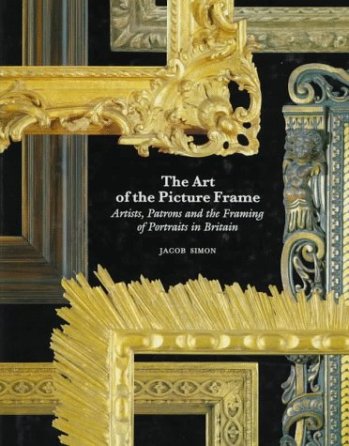 Jacob Simon FSA, Research Fellow at the National Portrait Gallery, notes that 2016 is the tenth anniversary of the launch of the Gallery’s online resource British Artists’ Suppliers, 1650–1950, in partnership with Cathy Proudlove. Three other resources have since been added: British Picture Framemakers, 1600–1950 (2007), British Picture Restorers, 1600–1950 (2009), and British Bronze Sculpture Founders and Plaster Figure Makers, 1800–1980 (2011). These four online resources are selectively updated twice a year and have doubled in size since launch. Further reviews and additions are planned, including to the features on picture framing; the Gallery’s exhibition, The Art of the Picture Frame, celebrated its 20th anniversary on 8 November. Karen Hearn FSA writes to commend these remarkable online resources and “the exceptional amount of research, work, and coordination that their originator, Jacob Simon, has put into making so much invaluable information available to a wide audience.”
UK Export Bar Placed on Mazarind Tapestry, ca. 1700

Michael Mazarind Workshop, Chinoiserie Tapestry with Courtly and Hunting Scenes, made in London,
ca. 1696–1702.
◊ ◊ ◊ ◊ ◊
Press release (20 October 2016) from Gov.UK’s Department for Culture, Media & Sport:
Culture Minister Matt Hancock has placed a temporary export bar on a rare tapestry by Michael Mazarind to provide an opportunity to keep it in the country. The tapestry is at risk of being exported from the UK unless a buyer can be found to match the asking price of £67,500. Inspired by Indian, Chinese, and Japanese design, it is the only surviving tapestry to feature Michael Mazarind’s workshop mark [lower right-hand corner]. Little is known of his workshop, but it is believed he was based in Portugal Street, London, between 1696 and 1702. Mazarind was relatively unknown, but is said to have connections to John Vanderbank, the Soho-based weaver. The tapestry includes small groups of oriental figures, buildings, exotic creatures, and plants. This combination of elements was described as ‘in the Indian manner’ and was one of the most popular decorative fashions of the period.
Minister of State for Digital and Culture Matt Hancock said: “This intricate design provides us with a unique opportunity to explore the tapestry workshops of 1600s London. I hope we are able to keep it in the country so we can learn more about our nation’s textile industry, and of the decorative fashions of the time.”
The decision to defer the export licence follows a recommendation by the Reviewing Committee on the Export of Works of Art and Objects of Cultural Interest (RCEWA), administered by The Arts Council. The RCEWA made its recommendation on the grounds of significance for the study of Mazarind’s work, English tapestry of the period, and London’s history.
RCEWA member Christopher Rowell said: “This beautiful blue ground tapestry, with an equally unusual border of Chinese inspiration, dates from the late 1600s and is the only one to bear the woven signature of the mysterious Michael Mazarind, who was a rival of the more well-known London tapestry weaver, John Vanderbank. This type of ‘Indian’ tapestry depicting a Chinoiserie fantasy paradise in Cathay, with courtly and hunting scenes, was devised for the court but soon became more broadly popular. Saving the tapestry for the nation will allow specialists to study it in detail and help to reconstruct Mazarind’s contribution to tapestry production in early-Georgian London.”
The decision on the export licence application for the tapestry will be deferred until 19 January 2017. This may be extended until 19 April 2017 if a serious intention to raise funds to purchase it is made at the recommended price of £67,500. Offers from public bodies for less than the recommended price through the private treaty sale arrangements, where appropriate, may also be considered by Matt Hancock. Such purchases frequently offer substantial financial benefit to a public institution wishing to acquire the item.
Nationalmuseum Releases 3,000 images on Wikimedia Commons

Jean-Baptiste Pater (1695–1736), A Company of Bathers in a Park, oil on canvas, 49 x 59 cm (Stockholm: Nationalmuseum, NM874, photograph by Cecilia Heisser).
◊ ◊ ◊ ◊ ◊
Press release (11 October 2016) from Sweden’s Nationalmuseum:
Nationalmuseum is making 3,000 high-resolution images of its most popular artworks available for free download on Wikimedia Commons. Zoomable images will also be added to the museum’s online database. The digitization project is a major advance in making Nationalmuseum’s collections more accessible.

David von Cöln, Pineapple Plant, 1729, oil on canvas, 112 x 91 cm (Stockholm: Nationalmuseum / Gripsholm Castle).
While the Nationalmuseum building is under renovation, only a small part of the collections is accessible to the public. To provide more opportunity for people to enjoy its artworks, the museum embarked last year on a joint project with Wikimedia Sweden. As a result, high-resolution images of some 3,000 paintings from the collections are now available for download on Wikimedia Commons as public domain. This means they are part of our shared cultural heritage and can be freely used for any purpose. The images are also now zoomable, but not currently downloadable, in Nationalmuseum’s online database.
“We are committed to fulfilling our mission to promote art, interest in art, and art history by making images from our collections an integral part of today’s digital environment,” said Berndt Arell, director general of Nationalmuseum. “We also want to make the point that these artworks belong to and are there for all of us, regardless of how the images are used. We hope our open collection will inspire creative new uses and interpretations of the artworks.”
Nationalmuseum will continue to make its collections more accessible as digitization gathers pace and digital infrastructure improves. The longer-term goal is to create a portal offering quick and easy access to all the museum’s fine art collections and archives. Nationalmuseum joins a growing number of museums that have released images of their collections, including The Royal Armoury and Skokloster Castle with the Hallwyl Museum Foundation in Sweden, the Rijksmuseum in Amsterdam, and the National Gallery of Denmark in Copenhagen. Data on the images in Wikipedia Commons, including links to the zoomable versions, is available on GitHub as raw material for coders taking part in Hack4Heritage—an event being organized by Digisam, the agency coordinating the digitization of Sweden’s cultural heritage, in partnership with the Stockholm City Archives, on 14–16 October.
Sean Moore Appointed Editor of ECS
Over the weekend (20 August 2016), the American Society for Eighteenth-Century Studies announced the appointment of the next editor of ECS. Starting next summer, Sean Moore will succeed Steven Pincus, who has filled the position since July 2012.
Sean Moore (University of New Hampshire) has been appointed as the next Editor of Eighteenth-Century Studies for a five-year term beginning July 1, 2017.
Sean Moore is Associate Professor of English at the University of New Hampshire, where he served as Director of the UNH Honors Program from 2011 to 2014. He has been a member of ASECS for 17 years, served for many years as the Chair of the Irish Studies Caucus of ASECS and as the North American Correspondent for the Eighteenth-Century Ireland Society, and has given papers at ASECS panels sponsored by the SHARP caucus and Race and Empire caucus. His first monograph, Swift, the Book, and the Irish Financial Revolution, won the Murphy Prize for Distinguished First Book from the American Conference for Irish Studies, and he edited a special issue of Eighteenth-Century Studies on the Irish Enlightenment in 2012. His new work, “Slavery and the Making of the Early American Library,” is in a transatlantic and early American direction, focusing on how slave capitalism financed the transatlantic book trade in British texts. He has been the recipient of fellowships from the NEH, American Antiquarian Society, Newport Mansions, New England Regional Fellowship Consortium, Library Company of Philadelphia/Historical Society of Pennsylvania, John Carter Brown Library, Folger Library, and Fulbright Scholarship Board.
Sotheby’s Museum Network to Launch in August
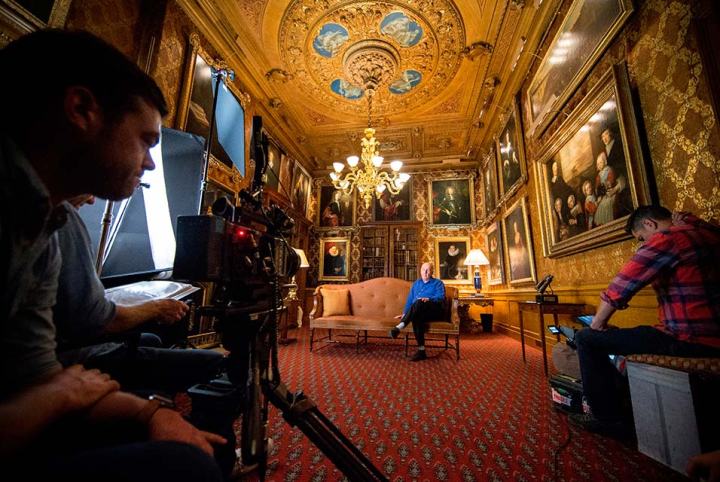
The 13-part series The Treasures of Chatsworth is currently in production and will debut in Autumn 2016
(Photo: Sotheby’s)
◊ ◊ ◊ ◊ ◊
Press release (5 August 2016) from Sotheby’s:
Sotheby’s announces the upcoming launch [scheduled for August 29] of an online destination to discover video content created by and about the world’s leading museums. The digital hub will be called Sotheby’s Museum Network, and it will be featured prominently on Sothebys.com as well as Sotheby’s Apple TV channel. The museums in this network will include internationally-renowned public institutions, such as The Metropolitan Museum of Art, Tate, and the National Palace Museum in Taiwan, as well as well as newer institutions founded by private collectors, including the Garage Museum of Contemporary Art in Moscow.
In addition to syndicating museums’ own content, the Sotheby’s Museum Network will be the home of original programming conceived and produced by Sotheby’s. The Treasures of Chatsworth, a 13-part series on one of Europe’s greatest private houses and most significant art collections, is currently in production and will debut this autumn. Further information will be shared in the coming months.
Recent years have seen the opening of numerous private museums by passionate patrons, as well as record attendance at major exhibitions worldwide, reflecting a seemingly insatiable public interest in great art and collections. Sotheby’s Museum Network will reach a global audience for whom museums and foundations are a new entry point into the world of art, as well as seasoned collectors and connoisseurs who look upon these institutions as the ultimate source of authority on art and culture. It will ultimately encompass thousands of existing museum videos, which have never before been aggregated into one channel, making it easier for people to discover what they love as well as introducing new audiences to the great work that these institutions are creating worldwide.
“We are thrilled to host the extraordinary videos produced by our museum partners around the world,” commented David Goodman, Executive Vice President, Digital Development & Marketing. “The Museum Network is a response to a growing global audience that wants to experience the world of art and collecting. The network is a natural evolution of the existing ties we have with museums through programs like Sotheby’s Preferred, and we can now deepen those relationships with institutions and their benefactors as we expose their outstanding collections to millions of art lovers who engage via digital channels. The Treasures of Chatsworth is the perfect way to launch our drive into original video content creation centered on the arts and will be the first of many original films that will reveal the wonder of art and collecting.”
Newly Redesigned Getty Research Portal Now Available

◊ ◊ ◊ ◊ ◊
The Getty Research Institute (GRI) is pleased to announce the launch of an updated version of its research tool, the Getty Research Portal. A virtual library of art history texts, the newly redesigned Getty Research Portal now offers more than 100,000 volumes available from more than 20 international partners.
Launched in 2012, and created in partnership with some of the world’s leading art libraries, the Getty Research Portal is a free online search gateway that aggregates the metadata of art history and cultural texts, with links to fully digitized copies that are free to download. There are no special requirements in order to use this resource and it is completely open to anyone with internet access.
“When we began this exceptional project we had eight founding institutions, all committed to sharing their digitized collections of rare books, foundational art historical literature, catalogues, periodicals, and other published resources with researchers without limit or impediment,” says Thomas W. Gaehtgens, director of the GRI. “On our 4th anniversary, we renew that commitment, with an improved user interface, more international partners, and now more than 100,000 volumes available for download. Thousands of people use this tool and our books have been viewed nearly 13 million times. This broad access is fundamental to the GRI’s mission to further the understanding of art and a core principal in our approach to art historical research.”
The re-launched Portal has been rebuilt and redesigned, marking it easier to explore digitized texts on art, architecture, material culture, and related fields from the Getty Research Library and international partners. The new user interface features several key improvements, including: new search filters that make results sortable by criteria such as date and language; a responsive design that allows for better use on phones and tablets; individual pages for each digitized text enabling users to easily share links; prominent display of edition details for books, when available; and new additions from participating libraries are more clearly highlighted.
The newest partners to join the Portal are the Bibliotheca Hertziana — Max-Planck-Institut für Kunstgeschichte in Rome, the Herzog August Bibliothek in Wolfenbüttel, the Menil Library Collection in Houston, the Ryerson & Burnham Libraries — Art Institute of Chicago, the Solomon R. Guggenheim Museum Library and Archives in New York, and the Warburg Institute Library in London.
To learn more about the recent updates to this project, see this post from the Getty’s online magazine, The Iris.
The Met Launches New Edition of the Heilbrunn Timeline of Art History
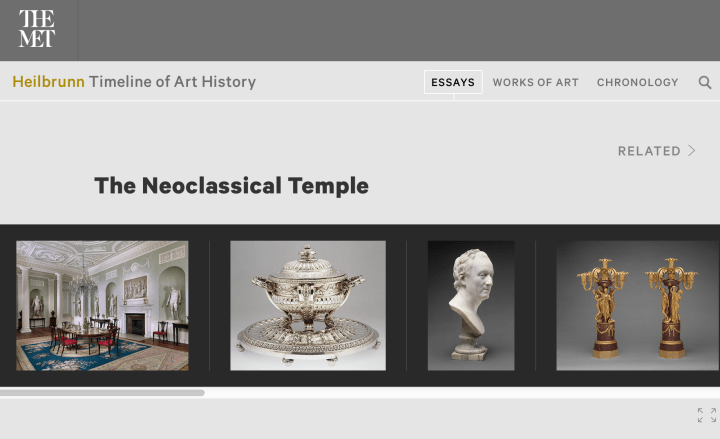
Screen shot (June 2016) of The Met’s Heilbrunn Timeline of Art History, with Cybele Gontar’s essay “The Neoclassical Temple” (October 2003).
◊ ◊ ◊ ◊ ◊
From H-ArtHist (13 June 2016). . .
Heilbrunn Timeline of Art History: The New Edition
The Heilbrunn Timeline of Art History is rethought with a new navigation and interface, updated images, and restructured editorial content. Still relational in nature, it allows a reader to find exactly what he or she needs while also encouraging total immersion through a seamless browsing experience. The new Timeline is fully optimized to be responsive on desktop and mobile devices, enabling easy access anywhere.
The Heilbrunn Timeline of Art History presents a chronological, geographical, and thematic exploration of global art history through The Met collection. It is a reference, research, and teaching tool conceived for students and scholars of art history. Authored by The Met’s experts, the Timeline comprises 300 chronologies, close to 1000 essays, and over 7000 works of art. It is regularly updated and enriched to provide new scholarship and insights on the collection, and draws 1 to 1.5 million visits per month during the academic year. The Met’s Heilbrunn Timeline of Art History is funded by the Heilbrunn Foundation, New Tamarind Foundation, and Zodiac Fund.
We would love to know what you think of the new site. For all questions and comments, please contact timeline@metmuseum.org.










leave a comment