Yale Center for British Art Refurbishment Project, 2013
Good news for anyone planning to make use of the YCBA in 2014, but for the summer and fall of 2013, a bit of extra planning is in order. -CH
◊ ◊ ◊ ◊ ◊

Summer and Fall 2013
The first phase of a refurbishment project at the Yale Center for British Art has been scheduled for summer and fall 2013, and there will be limited availability of some services and partial closures on the second and third floors, as noted below. The permanent collection on the fourth floor will remain on view throughout this period. It is expected that the project will be completed by early January 2014.
The Departments of Prints & Drawings and Rare Books & Manuscripts will be temporarily relocating their offices within the building, and the Study Room will be closed from June through December 2013. The collections will be transferred to other parts of the building over the summer of 2013.
As soon as these transfers are completed, staff will make every effort to accommodate the needs of faculty, students, and scholars. However, access to the collections will be limited during the fall term and by appointment only. Requests for materials will require at least two weeks advance notice (ycba.prints@yale.edu). The Center will continue to accommodate classes using works from the Prints & Drawings and Rare Books & Manuscripts collections by special arrangement with the staff; to discuss your requirements, please contact Gillian Forrester, Curator of Prints & Drawings, and Elisabeth Fairman, Senior Curator of Rare Books & Manuscripts.
The Center will be unable to host Visiting Scholars during the refurbishment project. Please note that during this period, the second- and third-floor galleries will be closed, as will the Library Court. The second-floor classroom will remain accessible for teaching; please contact Jane Nowosadko, Senior Manager of Programs, to check availablity. The Reference Library will keep normal hours, although there may be some disruptions over the summer. Details will be circulated as they become known. Tours of the collection will be offered as normal, although requests need to be made two weeks in advance (ycba.education@yale.edu).
There will be a regular roster of programs in the Center’s Lecture Hall throughout the refurbishment project. It is expected that normal services in the Study Room will resume by early January 2014.
Contact Details
• Requests for materials from Prints and Drawings and Rare Books and Manuscripts should be made at least two weeks in advance by e-mailing ycba.prints@yale.edu.
• To discuss requirements for classes contact the curators: Gillian Forrester, Curator of Prints & Drawings, gillian.forrester@yale.edu, Elisabeth Fairman, Senior Curator of Rare Books & Manuscripts, elisabeth.fairman@yale.edu
• Inquiries about the availability of the second-floor classroom and the Docent Room should be e-mailed to Jane Nowosadko, Senior Manager of Programs, jane.nowosadko@yale.edu
• Inquiries about the Reference Library can be addressed to Kraig Binkowski, Chief Librarian, kraig.binkowski@yale.edu
• For information about the Visiting Scholar program for 2013–14, please visit britishart.yale.edu/research/visiting-scholars, or contact Lisa Ford, Associate Head of Research, lisa.ford@yale.edu.
Attingham Offerings for 2013
In 2013 the Attingham Trust for the Study of Historic Houses and Collections will offer three courses: the three-week Summer School (5-22 July), the nine-day Royal Collection Studies (1-10 September), and the nine-day Study Programme (12-20 September). Whereas the first two courses follow similar itineraries each year, the Study Week is set in a different location each year, and its timing varies as well. 2013 will offer an in-depth study of the Norfolk Country House, corresponding with the upcoming William Kent exhibition (at the Bard Graduate Center in the fall of 2013 before appearing at the V&A in 2014) and taking advantage of the summer exhibition Houghton Revisited: The Walpole Masterpieces from Catherine the Great’s Hermitage, which will reassemble the collection of Sir Robert Walpole in its eighteenth-century home of Houghton Hall (it’s a safe bet that the course will include special, private viewing opportunities for a show that’s sure to be crowded much of the summer). The Study Week will be directed by Andrew Moore, the former Keeper of Art at Norwich Castle Museum and Art Gallery, and the co-editor of A Capital Collection: Houghton Hall and the Hermitage (Yale UP, 2002). -CH
◊ ◊ ◊ ◊ ◊
From the Attingham Trust:
Attingham Trust Course Offerings for 2013
Application due dates vary according to the programme, starting 31 January 2013

◊ ◊ ◊ ◊ ◊
Attingham Study Programme — The Norfolk Country House: Collections and Networks
THE ATTINGHAM STUDY PROGRAMME is a strenuous and stimulating nine-day course studying historic houses and their collections. Based in specific regions of Britain and often abroad, a wide range of houses, many of them private, are visited in the company of tutors. The architecture, gardens and interiors, including collections of paintings, furniture and other decorative arts, are studied within a context of social and cultural history. It is intended for museum curators, lecturers, architects, conservationists and others with a keen interest in the fine and decorative arts. Accommodation is in modest hotels where lectures are also given. Some full and partial scholarships are available.
The eastern wetlands and broad skies of Norfolk boast a landscape which was the inspiration behind the first regional School of painting in Britain, together with an array of classic country houses that few other English regions can equal. The county’s close proximity to London placed it in the pole position of England’s second city from the medieval period, until the coming of the railways reduced the centrality of its agrarian economy. The 15th-century origins of the moated manor house of OXBURGH HALL and the privately owned Tudor pile of EAST BARSHAM survive today as testimony of the earlier period.
The focus of the 2013 programme will be two great Palladian houses still in private hands, both with magnificent interiors and furnishings by William Kent. The quintessential Grand Tour house, HOLKHAM HALL will feature seminars on the library, archive, silver, textiles and sculpture. We also visit HOUGHTON HALL, the country palace that Sir Robert Walpole controversially built to house his great collection of European master paintings and classical sculpture while based at 10 Downing Street as first minister successively to both George I and George II. This visit will also include seminars on paintings and textiles, visits to the private Picture Gallery and the contemporary sculpture within the park, together with the newly established gardens in memory of Sybil Cholmondeley.
The programme, based in the heart of the medieval market town and seaport of KING’S LYNN in West Norfolk, will also visit the city of NORWICH, and will include tours of the historic built environment of both centres, with their merchant houses and guildhalls. Seminars in NORWICH CASTLE will focus on Norwich Silver and the redisplayed Colman galleries featuring the paintings of Norwich School of Artists. The course plans to feature significant private houses, including RAYNHAM HALL, seat of the Townshend family, which also features the work of William Kent, and NARFORD HALL, home to successive generations of the Fountaine family.
Additional information about all three courses is available here»
MetPublications
From MetPublications:

◊ ◊ ◊ ◊ ◊
About MetPublications
MetPublications is a portal to the Met’s comprehensive publishing program. Beginning with nearly 650 titles published from 1964 to the present, this resource will continue to expand and could eventually offer access to nearly all books, Bulletins, and Journals published by the Metropolitan Museum since the Met’s founding in 1870. It will also include online publications.
MetPublications includes a description and table of contents for almost every title, as well as information about the authors, reviews, awards, and links to related Met bibliographies by author, theme, or keyword. Current titles that are in-print may be previewed and fully searched online, with a link to purchase the book. The full contents of almost all other titles may be read online, searched, or downloaded as a PDF, at no cost. Books can be previewed or read and searched through the Google Books program. Many out-of-print books are available for purchase, when rights permit, through print-on-demand capabilities in association with Yale University Press.
Readers may also locate works of art from the Met’s collections that are included within each title and access the most recent information about these works in Collections. Readers are also directed to every title located in library catalogues on WATSONLINE and WorldCat. Please check back frequently for updates and new book titles. MetPublications is made possible by Hunt & Betsy Lawrence.
About the Met’s Publishing Program
From its founding in 1870, the Metropolitan Museum has published exhibition catalogues, collection catalogues, and guides to the collections. Today it is one of the leading museum publishers in the world, and its award-winning books consistently set the standard for scholarship, production values, and elegant design. Each year, the Met produces about thirty exhibition and collection catalogues and general-audience books, as well as informative periodicals such as the quarterly Metropolitan Museum of Art Bulletin and the annual Metropolitan Museum Journal.
Beginning in 2000, the Met developed two groundbreaking online publications: the Heilbrunn Timeline of Art History, with 300 chronologies, 900+ essays, and close to 7,000 works of art written by Museum specialists; and Connections, which offers personal perspectives on works in the collections.
The Met’s print and online publications program will continue to expand in scope in order to reach the broadest possible audience, thus fulfilling its mission to increase public awareness of and appreciation for art, presenting insightful scholarly discussions and diverse Museum voices on works of art, art history, and especially the Museum’s collections and exhibitions.
Showcasing Versaille’s Image Bank
As Hélène Bremer notes, the CRCV Image Bank will be of interest to many Enfilade readers, and perhaps some of you will even make it to Thursday’s event showcasing the collection. From the Centre de recherche du château de Versailles:
Patrimoine écrit et numérique avec Raphaël Masson, Isabelle Pluvieux, et Elisabeth Maisonnier
L’Atelier numérique, Versailles, 11 October 2012

Singe. Aquarelle extraite du Livre des oiseaux de la Ménagerie de Versailles, 1710 (MS F 930, folio 7). © Bib. Municipale de Versailles
Depuis 2005, le Centre de recherche du château de Versailles et la Bibliothèque municipale se sont engagés dans un partenariat visant à numériser les ressources concernant le château et la vie à la cour aux XVII et XVIIIe siècles ; au cours de deux campagnes successives de numérisation, ce sont près de 16 300 pages ou images qui ont été numérisées provenant des collections de la Bibliothèque (manuscrits, estampes et imprimés), complétant ainsi les 26 000 images issues des collections iconographiques ou des archives du château de Versailles.
Cette immense base de données permet de découvrir des images différentes et singulières du château de Versailles, de ses jardins, des fêtes, des personnages qui s’y côtoyaient… Quelques thèmes y sont plus particulièrement développés : la vie à la cour, les fêtes, le costume… On y trouve aussi bien des estampes, des dessins, des manuscrits que des plans, des documents d’archives ou des périodiques. On peut ainsi y découvrir les plus belles images du Carrousel de Louis XIV, l’un des plus magnifiques livres de fêtes jamais réalisé, que feuilleter l’un des Almanachs de Versailles, ces petits vade-mecum annuels où l’éditeur Blaizot résumait tout ce qu’il fallait savoir de la vie à Versailles, à la cour ou à la ville, à la fin de l’Ancien Régime. La banque d’images mise en œuvre par le CRCV est ainsi un outil précieux pour l’historien, l’éditeur, l’amateur ou le simple curieux.
◊ ◊ ◊ ◊ ◊
Soirée — Patrimoine écrit et numérique
Présentation des fonds numérisés de la Bibliothèque municipale de Versailles présents dans la banque d’images du Centre de recherche du château de Versailles avec :
• Raphaël MASSON, conservateur du patrimoine et adjoint au directeur du Centre de recherche du château de Versailles,
• Élisabeth MAISONNIER, conservateur en charge du pôle patrimoine de la Bibliothèque municipale de Versailles,
• Isabelle PLUVIEUX, responsable des sites web et des bases de données du Centre de recherche du château de Versailles.
Jeudi 11 octobre 2012 à 19 heures
Atelier numérique, 8, rue Saint Simon – 78 000 Versailles
Tél. : 01 39 24 19 85 – clotilde.despres@versailles.fr
Entrée libre dans la limite des places disponibles
Announcement | Steven Pincus Appointed Editor of ECS
Many of you will have seen this announcement (2 July 2012) regarding Eighteenth-Century Studies (I’ve inserted the links). -CH
◊ ◊ ◊ ◊ ◊
It is a pleasure to inform you that the Executive Board of the American Society for Eighteenth-Century Studies has appointed Steven Pincus, Yale University, as Editor of Eighteenth-Century Studies for a five-year term effective 1 July 2012. We want to thank the Yale University community for their willingness to assume this important responsibility and to provide support for this flag-ship journal.
Finally, the officers and Executive Board of ASECS wish to thank Julia Simon for her outstanding service as editor of ECS, and wish her the best of luck on her retirement from the journal.
Byron R. Wells
Executive Director, ASECS
Online Resource | Le Comte de Caylus
A cooperative project involving the Bibliothèque nationale de France (BnF), the Institut National d’Histoire de l’Art (INHA), and the Centre d’Anthropologie et d’Histoire des Mondes Anciens (Centre ANHIMA), this online resource provides a wealth of information on Caylus (biographical and bibliographical) as well as digital access to the seven volumes of the Recueil d’Antiquités. There is also a searchable catalogue of the collection of objects. Thanks to Hélène Bremer for noting such an important resource.

◊ ◊ ◊ ◊ ◊
From the website:
Le comte de Caylus (1692-1765) a été un personnage clé du XVIIIe siècle, à la fois homme de lettres aux talents multiples, dramaturge, romancier fin observateur des mœurs de son temps, conteur, traducteur, mais aussi antiquaire érudit, collectionneur, mécène, graveur, membre de l’Académie de peinture et de sculpture en 1731, de l’Académie des Inscriptions et Belles Lettres en 1742, de l’Académie de France à Rome, ardent défenseur de la grande peinture et du goût à l’antique.
Ce site explore une de ces multiples facettes, son rôle de pionnier de l’archéologie, par l’édition numérique commentée et enrichie de son œuvre majeure, le Recueil d’antiquités égyptiennes, étrusques, grecques, romaines et gauloises, publiée en sept volumes entre 1752 et 1767.
Dans ce recueil, Caylus a étudié et fait dessiner près de 2900 objets, provenant majoritairement de ses collections, offertes au roi au fur et à mesure de l’avancement de ses travaux. En effet, sa collection n’était pas un but en soi, mais un laboratoire d’étude et d’expérimentation, ainsi qu’il l’écrit : « Je ne fais point un cabinet, je fais un cours d’antiquité, et je cherche les usages, ce qui les prouve, les pratique, ce qui les démontre. » (lettre à Paciaudi, 1758). L’objet, si modeste soit-il, devient un moyen de connaissance du passé et la base d’une réflexion sur l’histoire des arts
L’exégèse et le dépouillement systématique du recueil ont pour but de mettre en lumière la démarche de Caylus, qui apparaît comme un précurseur de la méthode typologique, de proposer un panorama du savoir antiquaire au XVIIIe siècle et du réseau intellectuel européen.
Le site s’articule autour de trois axes :
• La personnalité du comte de Caylus, sa biographie, sa bibliographie ainsi qu’une bibliographie de ses œuvres relatives à l’art et à l’archéologie.
• Le Recueil d’Antiquités avec accès à la version numérisée – tout d’abord en mode image, puis, dans un futur proche, en mode texte ; une analyse du Recueil et de la méthode de Caylus ; le recensement des sources utilisées dans le Recueil, qui forment en quelque sorte la « bibliothèque » de Caylus.
• Le catalogue des objets(« base Caylus »), qui présente en vis-à-vis l’analyse de Caylus et celle que nous pouvons faire aujourd’hui. Cette confrontation de deux fiches , la fiche « ancienne » qui reprend en les synthétisant les notices de Caylus – qui peuvent s’étendre de quelques lignes à plusieurs pages – et classe le riche matériel fourni, et la fiche moderne qui propose datation, attribution et bibliographie, est complétée par la mise en regard de la gravure faite pour le Recueil et de la photographie de l’objet dans son état actuel. Les photographies, encore peu nombreuses, seront insérées peu à peu . 60% environ des œuvres ont été retrouvées, nous espérons que cette publication permettra de faire ressurgir de l’oubli celles qui ont été dispersées
Des enrichissements sont prévus :
• une base de données biographiques et bibliographiques sur les érudits mentionnés dans le Recueil, qui permettra de mieux appréhender le réseau intellectuel de Caylus
• l’accès direct à la numérisation des ouvrages utilisés par Caylus, de ses sources manuscrites et iconographiques
Le site est le fruit d’une coopération entre la Bibliothèque nationale de France (BnF), l’Institut National d’Histoire de l’Art (INHA) et le centre d’Anthropologie et d’Histoire des Mondes Anciens (ANHIMA).
Versailles 3D
Thanks to David Pullins for sharing news of this collaborative project between Versailles and Google:
◊ ◊ ◊ ◊ ◊
Palace History Gallery at Versailles
Château de Versailles, opened 14 June 2012
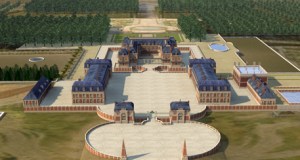 What did Versailles look like before Louis XIV? How did the small hunting lodge of Louis XIII become the largest Palace in Europe? What embellishments did the young Sun King want in his Palace of festivities and amusements? Did you know that the Hall of Mirrors was originally a terrace overlooking the gardens?
The palace of Versailles is a unique place, a royal residence, a history museum and a Republican palace. The complexity of the site needs to be explained to the over 6 million visitors from all over the world who come to Versailles each year. The Palace of Versailles, in partnership with Google, opens the Palace History Gallery on 14 June 2012. As a prologue to the visit to the State Apartments, eleven rooms explain to visitors the richly varied functions of the places they are about to explore. The visit combines the presentation of the collections of Versailles with physical scale models and striking 3D reconstructions.
Google / Versailles Partnership
The technological programme rolled out to accompany the opening of the Palace History Gallery is the fruit of close collaboration over more than a year between the teams of the Palace and those of Google. An ambitious technological policy has been implemented in Versailles for several years now to back up its scientific and cultural communication, disseminate knowledge about it more widely and develop new links with the visitors and with new audiences. From the origin of the project, the exhibition curators decided on the role and the scope of the multimedia in each exhibition and online. The partnership with Google provided the opportunity for a more in-depth approach to the use of technologies to develop, enliven and make more incisive its scientific and cultural communication. 3D technology, in particular, is used extensively in different media (in the rooms, on the Internet, on mobile terminals). Google’s Cultural Institute develops technological solutions for viewing, hosting and digitising materials to favour the creative presentation, protection and promotion of culture online.
Thanks to its dedicated team of engineers, Google’s Cultural Institute has already collaborated with organisations in several countries on different projects, notably for putting online thousands of artworks in the framework of the Art Project, the digitisation of the archives of Nelson Mandela and the Dead Sea Manuscripts.
Workshops on Sloane’s Treasures: A Plan for Reconstructing Sloane
I was lucky enough to attend the second workshop for the Sloane’s Treasures Project, held on 31 May at The British Museum, and I’m thrilled at the prospects of this massive research programme. The benefits will be enormous for a wide range of audiences. In addition to the following description from the BM’s website, see the advertisement for two collaborative doctoral awards. -CH
◊ ◊ ◊ ◊ ◊
Sloane’s Treasures
The Natural History Museum, The British Museum, The British Library, London, 2012
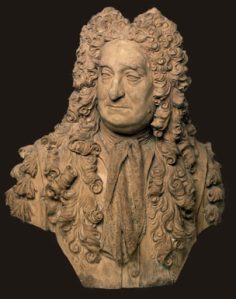 From the time of his voyage to Jamaica in the 1680s, Sir Hans Sloane (1660-1753), physician, natural historian and man of letters, began to gather together one of the largest and most comprehensive collections of ‘natural and artificial rarities’ ever formed. Sloane was later Physician to Queen Anne, George I and II, President of both the Royal College of Physicians and the Royal Society, and his manor in Chelsea included the Apothecaries’ Garden (now the Chelsea Physic Garden). At the centre of a worldwide network, he created an encyclopaedic collection of mineral, botanical, and zoological specimens, ethnographic objects, antiquities, prints, drawings, books and manuscripts, often inheriting or purchasing entire collections formed by others.
On his death in 1753 Sloane’s collection was acquired for the nation by an Act of Parliament which created the British Museum. But as the Museum re-organized its collections and acquired further objects, Sloane’s collection was dispersed among different departments and eventually also to the Natural History Museum in 1881 and to the British Library in 1973. This dispersal has hindered the study and understanding of ‘Sloane’s Treasures’, their sources, and their historical relationships with each other. This project will begin to address these problems.
Between February and September 2012, an Advisory group will be formed, workshops with invited attendees will be held (Natural History Museum, April, British Museum, May and British Library, July) and reports created, including recommendations for a larger project. The constitution of the Advisory group, summaries and videos of parts of the workshops, and updates on their outcomes will be made available, and news of project developments, including information on other research and public events related to Sloane and his collections, will be published here. If you are working on a Hans Sloane-related project or have an associated research or public engagement idea, contact a member of the project team.
Project Team
• Kim Sloan, Curator of British Drawings and Watercolours before 1880, The British Library, Department of Prints and drawings
• JD Hill, Research Manager
• Arnold Hunt, Curator of Modern Historical Manuscripts, The British Library
• Julie Harvey, Manager, Centre for Arts and Humanities Research, The Natural History Museum
Collaborative Doctoral Awards | Reconstructing Sloane
Collaborative Doctoral Award Studentships: Reconstructing Sloane
Applications due 29 June 2012; must be available for interview on 19 July 2012
 Applications are invited for two Collaborative Doctoral Award studentships, available under the rubric Reconnecting Sloane: Texts, Images, Objects, to commence in Autumn 2012. The first CDA will be at King’s College London/The British Library and will focus on the correspondence (i.e. ‘texts’) of Sir Hans Sloane. The second will be at Queen Mary University London/The Natural History Museum and will focus on Sloane’s vegetable substances (i.e. ‘objects’). A third has already been awarded and will be at King’s College London/The British Museum and will focus on Sloane’s natural history drawings (i.e. ‘images’).
Together the CDAs will explore and develop our understanding of Sir Hans Sloane and his contribution to eighteenth-century intellectual life through his activities as a physician, collector, natural philosopher and man of letters. The Research Programme aims to examine the role of a major early Enlightenment collection, and its collector, in the making of knowledge about nature. Sir Hans Sloane’s (1660-1753) extensive collection of texts (in print and manuscript), images (paintings, drawings and prints) and objects (including specimens and herbaria) formed the founding collection of the British Museum (BM) in 1753, but was subsequently dispersed, primarily to the British Library (BL) and the Natural History Museum (NHM). For Sloane and his contemporaries, the collection would have been understood as a whole, and its uses would have involved working between texts, images and objects. The programme’s three linked studentships – each of which will be conducted with the partner organization that now holds the part of Sloane’s collection that will be studied – will aim to ‘Reconnect Sloane’ by examining the making and use of this collection in terms of the specific material within it – texts, images and objects – and also the connections between materials. Working across the separate collections in the way this will provide new insight into Sloane’s role in the making of natural knowledge.
The deadline for applications is 29th June, and you must be available for interview on 19th July. For more information on how to apply, please see the attached documents included below. Please note, the AHRC has strict residential eligibility criteria governing the students that can be nominated for this award. If you are not a British citizen and/or not usually resident in the UK (and have not been for the past three years), please check your eligibility and discuss this with the project supervisors so that your eligibility can be determined.
Catalogue of Cleveland’s Portrait Miniatures Published Online
Press release from The Cleveland Museum of Art:
◊ ◊ ◊ ◊ ◊
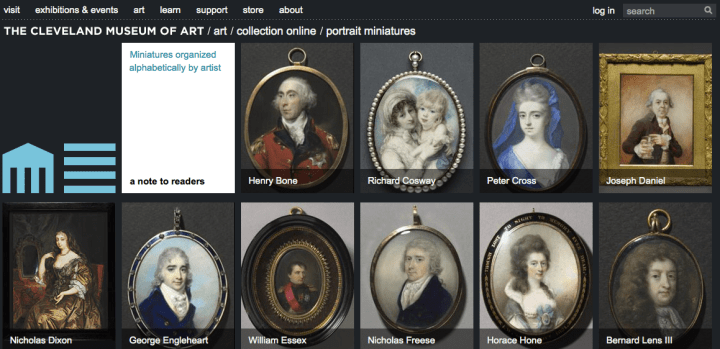
The Cleveland Museum of Art announces its pilot project in digital publishing, British Portrait Miniatures from the Cleveland Museum of Art. This catalogue showcases a substantial portion of the museum’s internationally known collection of around 170 portrait miniatures, one of the most significant in the country. The first stage of this searchable online catalogue includes 54 British portrait miniatures from the 17th, 18th, and 19th centuries, with publication of the remaining British works ongoing though out the year. The catalogue presents new research on the individual miniatures, explores the museum’s collection holistically and incorporates comparative images of works from other public and private collections. The miniatures catalogued online can be viewed at actual size, from the front and the back, and in unprecedented detail.
Authored by Cory Korkow, PhD, a Paintings and Drawings Society curatorial fellow whose initial research was funded by grants from the Samuel H. Kress Foundation, the catalogue includes new research about the artists, sitters, and successive owners of these miniatures, while incorporating conservation photographs and allowing the collection be studied in great detail for the first time. “This innovative project illustrates not only our deep commitment to original scholarly research on our collection, but our creativity in the presentation and dissemination of that knowledge,” said David Franklin, the Sarah S. and Alexander M. Cutler director.
Access to the British Portrait Miniatures catalogue is available here» (more…)










leave a comment