New Title | ‘Don’t Ask for the Mona Lisa’
This small book looks useful not only for those new to working on exhibitions but also as a model for how a conference session with real-world application could be shaped into a publication and made available to a larger audience through print-on-demand (POD) services like Lulu.com. –CH
◊ ◊ ◊ ◊ ◊
From the AAH:
Heather Birchall and Amelia Yeates, Don’t Ask for the Mona Lisa: Guidelines for Academics on How to Propose, Prepare, and Organise an Exhibition (London: Association of Art Historians, 2012), 36 pages, ISBN: 9780957147706, £5 (hardcopy) / £3 (PDF download), available at Lulu.com.
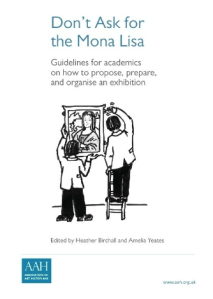
36 pages, ISBN: 9780957147706
The writing and publication of these guidelines was prompted by an event held by the Committee of the Museums & Exhibition Members Group of the Association of Art Historians (AAH), at the AAH Annual Conference at Manchester Metropolitan University in 2009. The session, entitled Curators Don’t Bite, attracted a large crowd of academics and museum professionals eager to hear about the experiences, both positive and negative, of other academics and curators who had organised exhibitions. Following the event, it was clear that there was a demand for some advice on how to propose exhibitions and, once a show had been agreed, the practicalities of working with curators and other museum staff. This publication therefore aims to provide an introduction to key aspects of exhibition curation, from the early planning stages to the design and opening of the show.
Of course, every exhibition is different and, whilst this document cannot cover every aspect of exhibition planning, it does provide assistance to those organising both small-scale and large exhibitions, as well as offering guidance on working with paintings, sculptures, and contemporary installations. Whether your exhibition is to be held at a large venue, such as Tate Britain, with a team of curators, conservators, and technicians, or a smaller institution with only one or two members of staff, the intention of the authors has been to outline the possible eventualities and responsibilities associated with exhibition planning.
The first part of this publication gives guidance on why and how to propose an exhibition, and offers general advice on exhibition planning and installation. It describes the roles performed by certain staff members in galleries and museums, and the responsibilities they carry when an exhibition is being put together. Some technical terms are highlighted in bold in the main text, and defined in the
margin.
The second part comprises case studies by academics who have worked on exhibitions for both large organisations, such as Birmingham Museum and Art Gallery, and small venues, including the Henry Moore Institute. This section also includes an interview with an exhibition designer that sets out some of the demands of fitting the design around the show’s theme, and sheds light on how to create a space that doesn’t overwhelm the exhibits.
At a time when museums and galleries are constantly tightening their budgets, a page at the end of this publication includes a list of funders to be approached if the museum’s budget cannot cover all the costs associated with the show, such as producing a catalogue or organising an associated study day or conference. Although the publication is primarily aimed at academics, and also freelances and students who may be considering putting together an exhibition proposal, we hope that it will also be useful for curators in the early stages of their careers working in a museum or gallery.
Information on ordering a copy is available here»
Trying to Think Seriously about Pinterest
From the editor

Edward Collier, “A Trompe l’Oeil of Newspapers, Letters and Writing Implements on a Wooden Board,” ca. 1699 (London: Tate Collection)
Last year I planned to run a piece on Pinterest — just before everyone seemed to know about it. Well, I put it off for a few weeks, which turned into a few months, and then suddenly there was no need. Now, however, with Pinterest recently in the news for raising $100 million, bringing its start-up value to $1.5 billion, I decided to weigh in. For although a good portion of people now know about Pinterest (its users having soared from 1 million in 2011 to 20 million last month), I’m not sure anyone has a handle on how varied uses of the site will be, even in the near future.
A recent Wall Street Journal article (17 May 2012) describes it as a “scrapbooking site,” but from my experience (I starting ‘pinning’ a few months ago), the characterization is inaccurate and disregards the metaphor altogether: it’s a pinboard, after all, not a scrapbook (how interesting are all of these metaphors for how we interact with computers, going back to files and the desktop — hardly anything new with Pinterest in that regard).
So why raise the issue on a site dedicated to the art and architecture of the eighteenth century? For two reasons: 1) to extend an invitation to brainstorm and 2) to suggest a few preliminary ideas.
On the first front, I’m eager to hear of scholarly or at least ‘cultural’ uses for Pinterest. Are there examples of academics already using the site in such a manner? And if Pinterest isn’t going to help you write your next book, might there be any pedagogical function? By all means feel free to weigh in with examples or ideas.
As for my own suggestions, it seems to me that a genuinely engaging Pinterest presence could particularly serve the interests of museums. By way of comparison, I’ve been fascinated to see how House Beautiful uses the site (full disclosure: I’m afraid one of my Pinterest boards is given over to an upcoming bathroom renovation). Realizing, I imagine, that Pinterest users are inevitably going to ‘pin’ images from the magazine, House Beautiful ‘pins’ images itself. If you ‘follow’ the magazine, a photograph or two will appear on your Pinterest site each day, and with one click, you’re able to add it to your own board. The advantages? First, the magazine controls the text under the image (it’s easy enough to make changes, but most people don’t take the time). Second, it provides a steady stream of contact between magazine and its followers. Rather than getting an issue once a month in the mail, you get updates each day (no matter that it’s mostly the same content). Third, and this seems crucial, the magazine is able to tell precisely what photos resonate most fully with users (in terms of which ones are ‘liked’ and ‘repinned’). Presumably (for better or worse), this can be mapped onto all sorts of analytic data about individual users’ preferences more generally, with huge marketing and advertising potential (hence the $1.5 billion start-up value).
It seems that these advantages would apply equally well in the case of museums; and indeed, major institutions are already well represented. But surely the possibilities have only begun to be tapped.
For instance, at House Beautiful, I’m able to choose from 22 different ‘boards’ to follow — from ‘mixing patterns’ to ‘living rooms’ to ‘bookshelves’ (or I can ‘follow all’). At The Met, there are currently just nine boards, and they tend to be arranged by silly themes — treating letters or dogs, for instance — rather than the kind of information people presumably want from The Met, i.e. upcoming exhibitions, lectures and scholarly events, children’s programming, new acquisitions, &c. (by contrast, The Met has invested considerably energy in its Facebook presence). In some ways, The Art Institute of Chicago is better with its generally more sensible eight boards, addressing topics like ‘News & Views’, but again a lot is missing. Remarkably, what gets posted all too often does look more like a scrap for a book than than a poster for a pinboard. On the other hand, both institutions look like models of progress in comparison to MoMA, which has a profile and 660 followers but not a single pin posted. The British Museum’s experimental approach is interesting. There are just three boards so far — ‘pattern and texture’, ‘jewelry’, and ‘architecture’ — but it’s easy to see how both the groupings and the things the’ve pinned so far would find a keen audience. I’ve no idea about the going rates for advertising in The New York Times or The Times Literary Supplement, but it must be astronomical compared to the 2-minutes it takes to add that same image to Pinterest. Museum goers have long covered their walls with exhibition posters, why wouldn’t they do the same to their Pinterest boards?
Just as blogs were long derided as being frivolous — because so much of the content was only frivolous — it’s easy to mock Pinterest (there’s far too much truth in this piece from The New Yorker). I’m not sure, however, it’s the medium that’s at fault. Who knows? A year from now, the world may have already abandoned Pinterest, in pursuit of the next new thing. But I doubt it. -CH
◊ ◊ ◊ ◊ ◊
Note (added 24 May 2012) — Along with the interesting comments submitted below, readers might be interested in Emile de Bruijn’s posting at Treasure Hunt, the blog he writes for the UK’s National Trust.
Note (added 8 June 2012) — Treasure Hunt pursues the subject with more interesting examples and, from Emile de Bruijn, questions about the relationships between viewers and objects.
New NEH Website: More Accessible, More Informative, More Lively
When there’s so much pressure on federal budgets, it’s exciting to see the NEH make the case for its importance, not only for scholars but also for the public more generally. Among academics, NEH Fellowships are the best known forms of support, but they’re also the most competitive. Have a look at the new site and see if your research projects might fit other funding opportunities. -CH
◊ ◊ ◊ ◊ ◊
The National Endowment for the Humanities launched a comprehensive new website Monday, April 9, giving the Endowment a more user-friendly, engaging, and transparent platform for people seeking grants and for the public interested in humanities research, scholarship, and public programs. After a complete overhaul of the site, grant guidelines and grant management information is clearer and more accessible. A new EXPLORE section allows users to access information about more than 200 documentaries, radio programs, and apps produced by broadcasters and others with NEH grants. A prominent new rotator will showcase news of NEH and books, seminars, and other projects growing out of Endowment funding. As the Endowment launched the site, the rotator featured:
- A lesson from the EDSITEment educational website for teachers, students, and parents about Sor Juana, a seventeenth century nun, feminist and poet, considered the first great poet of the Americas;
- A story about a Maryland State Humanities lecturer on the Oyster Wars, when Maryland had an “Oyster Navy” in the 1890s to drive out interloping oystermen;
- A compendium of Civil War programs funded by the NEH, including reading and discussion programs being put on in 213 community and other libraries using a new anthology of important Civil War stories and documents.
- A biographical sketch of Philip Lampi, the nation’s greatest expert on the election returns from the American political campaigns of 1789-1825 and recipient of the first Chairman’s Commendation for service to the humanities;
- A story about a new NEH-funded translation of the Topography of Algiers, written by Antonio da Sosa in 1612 after he had been imprisoned for five years by the Barbary Pirates ( at the same time as Miguel da Cervantes, author of Don Quixote.)
The new NEH site showcases the award-winning HUMANITIES Magazine, now in a richly illustrated magazine format.
Each NEH division and program will have its own series of pages to feature projects, news about grants and opportunities to meet program officers in the field. The stories include:
- How a small grant from the Mississippi Humanities Council led to a traveling exhibition on the murder of 14 year old Emmett Till, the creation of the Mississippi Civil Rights Trail, and NEH-funded summer sessions on the Mississippi Delta.
- How Helen Clay Frick’s vision of documenting every work of art in the western world echos in the New York Art Resources Consortium online catalog, Arcade.
- How Digital Humanities scholars who received “Start Up” grants to break new ground in the humanities describe their research in “Lightning Round” on the site.
- How knowledge, gleaned through NEH research grants, is freely available and shared through white papers on the site.
NEH.gov will highlight information about projects funded through collaboration with state humanities councils. Links to all 56 state and territorial humanities councils and their calendars of activities will be offered at a single location.
EDSITEment, the Endowment’s prize winning K-12 educational site funded by a partnership between NEH and the Verizon Foundation, will offer high quality internet resources in the subject areas of literature and language arts, foreign languages, art and culture, and history and social studies.
Users can link directly to Chronicling America, the joint project of the NEH and the Library of Congress to digitize historic American newspapers. They can also access information directly on NEH’s funded projects sorted by topics of interest, state by state and at particular universities.
The NEH.gov redesign is part of an administration effort to modernize and streamline web operations, to consolidate websites for ease of maintenance, clarity and cost savings over time, and to make the work of government more accessible to all Americans.
The new neh.gov was built in-house using Drupal, an open source content management system. It is hosted on cloud infrastructure. It replaces an 11 year old interim site that had become outmoded. The new back-end architecture makes it possible to alter and enlarge the website’s capabilities without costly new redesigns.
Digital Resources | History Working Papers Project & The Hellfire Club
Following up on yesterday’s postings on the digital humanities, I include two examples of how the web might be used for sharing original, in-progress research, both from Jason M. Kelly. It seems to me that they raise interesting questions related to process, transparency, and audience. As I regularly suggest to my students, I don’t think we yet know what the web is really for; the web experience of the 2020s will surely look quite different from that of 2012. My own expectations have changed substantially since the 90s, when the web seemed pretty terrific because it meant I didn’t have to make space in a small Chicago apartment for a phonebook and Yellow Pages! I would have simply had no way to comprehend the likes of Twitter or Pinterest. In the world of web analytics — a world in which web-users are, above all, consumers — I think there’s probably more at stake with the scholarly potential of the digital realm than we might like to acknowledge, whatever that future might hold. -CH
◊ ◊ ◊ ◊ ◊
History Working Papers Project: Open Peer Review for the Humanities
The creators of the History Working Papers Project are Jason M. Kelly and Tim Hitchcock. HWPP has one goal. To develop an open source platform that allows for continuous revision, review, and evaluation from the earliest draft of an academic conference presentation and article, through publication and beyond. It is designed to bring the process of exposing one’s work at a conference, and revising it for peer review publication, in to the digital age.
HWPP is an online space for scholars to share works-in-progress with their peers. After uploading a conference paper, essay, or article manuscript to the HWPP website, authors can invite others to read their work and make comments in the margins. As more people respond, writers get more feedback. But, unlike traditional comments done on paper, HWPP allows commenters and authors to interact with each other. They can read each other’s marginalia and engage in dialogue about it. In fact, entire threaded discussions can take place in the margins. Here’s what it looks like:
◊ ◊ ◊ ◊ ◊
Secrets of the Hellfire Club
The Hellfire Club, or, more appropriately, the Monks of Medmenham Abbey, was an association that met in Buckinghamshire between the 1740s and the 1760s. Controversy and mystery surrounds the group and has defined the histories written about them. Stories of sex, witchcraft, satanism, and spirits define the popular memory of the club. Misinformation abounds and has led to many misconceptions about the organization and its members. As part of my research on the history of eighteenth-century clubs and societies, I have studied the group and had a chance to access the surviving public and private manuscripts. This site is devoted to exposing the history of Monks of Medmenham Abbey. It will reveal new facts about the group while putting its activities into the context of its age. Using the surviving fragments of their activities, rare books, and even the odd film or television episode, this site tells a centuries-long tale of secret societies, ghost stories, illicit activities, rumor, and gossip.
Announcing: The 18th-Century Common
One aim of Enfilade has been to help bridge the divide between academics and a much larger world also interested in the eighteenth century. While the site is intended to serve scholars, I’ve always hoped to make others welcome here, too. With that spirit of inclusiveness in mind, I’m especially excited to hear about The 18-Century Common. The following announcement from Jessica Richard appeared on the C18-L listserv. -CH
◊ ◊ ◊ ◊ ◊
 I want to announce and solicit contributions to a new public humanities website called The 18th-Century Common which will debut at ASECS. The 18th-Century Common is a joint project of scholars and students of the long eighteenth century at Union College and Wake Forest University and is funded by the Wake Forest University Humanities Institute.
The aim of the website is to present the published work of eighteenth-century scholars to a general audience. Our initial focus is Richard Holmes’ popular book The Age of Wonder: How the Romantic Generation Discovered the Beauty and Terror of Science (2009). This book captured the imagination of the general reader, but it omits the more complex contexts that scholarly accounts offer. We hope to provide general readers an accessible view of those contexts, and to move beyond Holmes’ book to the wide range of eighteenth-century studies. The site will feature short versions of published scholarship written for a general audience, as well as links to related resources, texts, and images around the web for readers who want to explore further.
We think this is the beginning of an exciting opportunity to reach the interested nonacademic, nonstudent readers who made Holmes’ book a bestseller, to “translate” what we do and to reach out beyond the academy as digital platforms in the humanities make particularly possible. We’ll be demonstrating the site near the registration table at ASECS Thursday and Friday; please stop by and chat with us. We encourage you to contact us if you are interested in contributing to the site or have ideas about how it can develop.
–Jessica Richard: richarja@wfu.edu and Andrew Burkett: burketta@union.edu
New Resource at the Bard | Library of Theodore Dell
From the Bard Graduate Center:
BGC Acquires Unique Research Collection on Eighteenth-Century French Decorative Arts
 An extraordinary addition to the BGC’s research capacity will result from the recent acquisition of the private library and archive amassed by Theodore Dell, an art advisor and historian noted for his expertise in eighteenth-century French furniture, porcelain and decorative arts. Beginning in the 1960s while he was based in London, Dell set out to assemble a comprehensive yet highly specialized collection to benefit students and scholars working in the United States. Numbering more than 5,000 volumes, the collection consists of gallery, auction, and museum catalogues; and books, journals, and magazines, all focused on French decorative arts. There are some 1,700 French sales catalogues alone, beginning in 1748, with many rare examples from the eighteenth century. Dell’s own research, particularly in London and Paris, forms the basis for his thorough archives organized by such divisions as makers and their particular types of works. Indeed, the late Charles Ryskamp, former director of the Morgan Library and the Frick Collection, noted that Dell’s library is perhaps the most important of
its type in existence.
The first step in making this invaluable resource accessible for research is to inventory, clean and catalogue each volume. The BGC seeks to raise $60,000 for staff, archival enclosures, and conservation supplies for the initial phase of work commencing this summer. Thanks to the generosity of our lead donors, $13,000 has already been raised. Please consider making a gift to the BGC today in support of this project. Visit www.bgc.bard.edu/about/support-the-bgc/bgc-donation-form.html. Choose Other under Contribute and specify Ted Dell Library in the adjacent box. Your support will help fulfill Ted Dell’s vision of encouraging study in French art and culture and further the BGC’s place as a leading center for research and scholarship. Thank you.
2011 Edition of CAA’s ‘Graduate Programs in Art History’
From CAA:
 CAA has published new editions of Graduate Programs in Art History: The CAA Directory and Graduate Programs in the Visual Arts: The CAA Directory. As comprehensive resources of schools across the United States, Canada, the United Kingdom, Australia, and New Zealand, these guides list 650 programs in fine art and design, art and architectural history, curatorial studies, arts administration, and more.
The directories provide prospective graduate students with information they need prior to beginning the application process. The directories are also key professional references for career-services representatives, department chairs, graduate and undergraduate advisors, librarians, professional-practices educators, and professors interested in helping emerging generations of artists and scholars find success.
Graduate Programs in Art History covers four program types: History of Art and Architecture, Arts Administration, Curatorial and Museum Studies, and Library Science. This directory integrates programs in visual studies into History of Art and Architecture. . . .
More information is available here»
UK’s National Oil Painting Collection Online at the BBC Website
 Your Paintings is a project to put the UK’s entire national collection of oil paintings on one website. It is a partnership between the BBC, the Public Catalogue Foundation and 3,000 collections around the United Kingdom including museums, universities, civic collections, the Arts Council and the National Trust.
The purpose of the project is to open up the UK’s 200,000-strong oil painting collection for learning, research and public enjoyment. To this end, over the last nine years the PCF has been making a photographic record of all oil paintings in public ownership in the United Kingdom. 80% of these paintings are in storage. And at least two thirds of these paintings have not been photographed before.
When complete at the end of 2012 the website will show 200,000 paintings by some 40,000 artists.
Discover the website – Over 100,000 paintings are already online
New Resource for the History of Paper
Though especially concerned with issues of book production, this research and the resulting website have implications for all early modern print culture. Aimed at a wide range of audiences — “from the complete novice to the paper-conservation scientist” — the site might be especially helpful for teaching purposes.. –CH
◊ ◊ ◊ ◊ ◊
From a UICB press release (17 January 2012) . . .
Tim Barrett of the University of Iowa Center for the Book Launches Paper History Website

Research by a University of Iowa led team reveals new information about why paper made hundreds of years ago often holds up better over time than more modern paper. Led by Timothy Barrett, director of papermaking facilities at the UI Center for the Book, the team analyzed 1,578 historical papers made between the 14th and the 19th centuries. Barrett and his colleagues devised methods to determine their chemical composition without requiring a sample to be destroyed in the process, which had limited past research. The results of this three-year project show that the oldest papers were often in the best condition, in part, Barrett says, due to high levels of gelatin and calcium.
“This is news to many of us in the fields of papermaking history and rare book and art conservation,” says Barrett. “The research results will impact the manufacture of modern paper intended for archival applications, and the care and conservation of historical works on paper.”
Barrett says one possible explanation for the higher quality of the paper in the older samples is that papermakers at the time were attempting to compete with parchment, a tough enduring material normally made from animal skins. In doing so, they made their papers thick and white and dipped the finished sheets into a dilute warm gelatin solution to toughen it. . . .
◊ ◊ ◊ ◊ ◊
From the project website, Paper through Time . . .
This website is designed for use by a wide range of visitors, from the complete novice to the paper-conservation scientist. Newcomers to the site may want to begin with the PROJECT OVERVIEW & AUTHORS and CONCLUSIONS sections for a quick sense of our research and what we learned. Those unfamiliar with papermaking history and technique may wish to start with European Papermaking Techniques 1300-1800 (under BACKGROUND) for an introduction to the craft. Visitors with a strong interest in papermaking history, materials and processes, paper permanence, paper science, and paper conservation are advised to begin at the top of the menu to the left and click on each tab, reading as interest and time permit. The site will be updated regularly. Suggestions for changes are welcome via email messages . . .
Online Reviews from BSECS
 The British Society for Eighteenth-Century Studies launched its new online reviewing system at its annual conference in Oxford earlier this month. The site is designed to address Music, Media (of all sorts), Exhibitions, and Theatre, areas of performance which fall within the Society’s remit. The site’s remit is not limited; as can be seen from the reviews the system contained at its launch, it will include reviews world-wide. All those with interests in the 18th century are encouraged to contribute.
The site is under editorship of Matthew McCormack, reviews editor for the Journal of Eighteenth-century Studies; the area editors are Zak Ozmo (Music), Daniel Cook (Media), Alexander Marr (Exhibitons), and Michael Caines (Theatre).










1 comment