Print Quarterly, March 2017
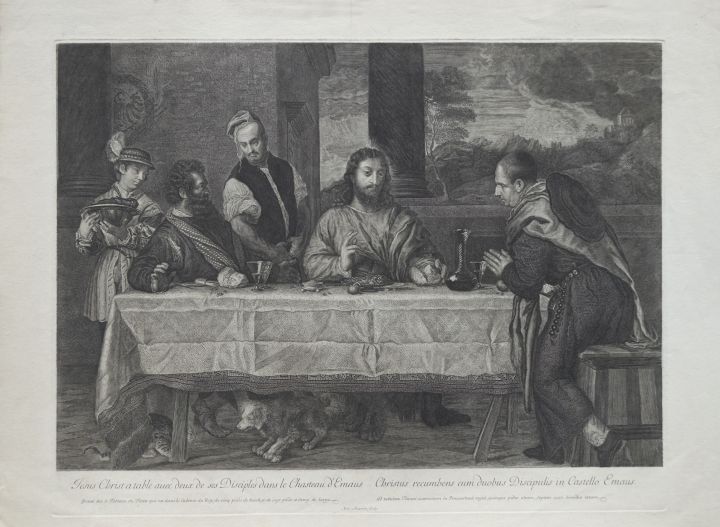
Antoine Masson, after Titian, Supper at Emmaus, second half of the seventeenth century, engraving, 452 x 586 mm
(London: The British Museum).
◊ ◊ ◊ ◊ ◊
Foremost among the several items in the current issue of Print Quarterly relevant to the eighteenth century is an article by Thomas Frangenberg addressing Franz Christoph von Scheyb (1704–77) on the art of engraving. Von Scheyb’s unusual detailed discussion of a print by Antoine Masson (1636–1700) after Titian demonstrates the sophistication with which aspects of reproductive prints could be articulated during this period, revealing prints’ merits and shortcomings, both as sources of art history and works of art in their own right. The issue also includes shorter reviews on books about Tiepolo, Piazzetta, and Novelli in the context of the eighteenth-century Venetian illustrated book; drawings and prints after the antique; and prints by Luigi Rossini (1790–1857).
Print Quarterly 34.1 (March 2017)
A R T I C L E S
• Thomas Frangenberg, “Franz Christoph von Scheyb on the Art of Engraving,” pp. 32–41
N O T E S
• Viccy Coltman, “Drawn from the Antique: Artists & the Classical Ideal,” pp. 70–72.
• Giorgio Marini, “Book Illustration in Eighteenth-Century Venice (Tiepolo, Piazzetta, Novelli: L’incanto del libro illustrato nel Settecento Veneto), pp. 73–76.
• David R. Marshall, “Luigi Rossini 1790–1857,” pp. 76–77.
A full contents list is available here»
The Burlington Magazine, December 2016
The eighteenth century in The Burlington (the issue is dedicated to ‘Art in Britain’):
 The Burlington Magazine 158 (December 2016)
A R T I C L E S
• Lydia Hamlett, “Pandora at Petworth House: New Light on the Work and Patronage of Louis Laguerre,” pp. 950–55.
• Jennifer Melville, “Lady Forbes of Monymusk: A Rediscovered Portrait by Joshua Reynolds,” pp. 956–60.
• Brendan Cassidy, “A Portrait by Gavin Hamilton: Sir John Henderson of Fordell,” pp. 961–63.
• Alex Kidson, “David Solkin’s Art in Britain, 1660–1815 (Paul Mellon Centre for Studies in British Art, 2015),” pp. 964–67.
L E T T E R S
• Peter Lindfield, “A Further Allusion to Strawberry Hill at Lee Priory, Kent,” p. 979.
• Nicholas Penny, “Hugh Honour,” p. 979.
R E V I E W S
• Susanna Avery-Quash, Review of Lucilla Burn, The Fitzwilliam Museum: A History (Philip Wilson Publishers, 2016), p. 980.
• Greg Smith, Review of the exhibition catalogue, Tim Barringer and Oliver Fairclough, Pastures Green & Dark Satanic Mills: The British Passion for Landscape (Giles, 2014), pp. 981–82.
• Barry Bergdoll, Review of Stefan Koppelkamm, The Imaginary Orient: Exotic Buildings of the 18th and 19th Centuries in Europe (Axel Munges, 2015), p. 982.
• Giles Waterfield, Review of the exhibition catalogue, Victoria Avery, Melissa Calaresu, and Mary Laven, eds., Treasured Possessions from the Renaissance to the Enlightenment (Philip Wilson Publishers, 2015), p. 988.
• Malcolm Bull, Review of the exhibition In the Light of Naples: The Art of Francesco de Mura (Cornell Fine Arts Museum, Rollins College, Winter Park, 2016; Chazen Museum, University of Wisconsin-Madison, 2017; The Frances Lehman Loeb Art Center, Vassar College, Poughkeepsie, 2017), pp. 1006–07.
S U P P L E M E N T
• Tim Knox, “Recent Acquisitions (2012–16) at the Fitzwilliam Museum, Cambridge,” pp. 1017–28.
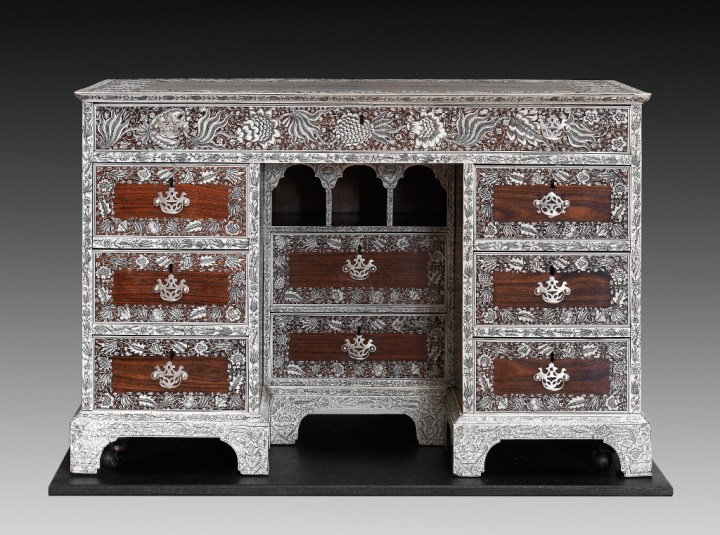
The Rumbold Desk, by an unknown craftsman from Vizagapatam, Southern India, ca. 1750–60, rosewood inlaid with ivory, silver handles, 76 × 113 × 62 cm. Accepted in Lieu of Inheritance Tax by HM Government and allocated to the Fitzwilliam Museum, 2016 (M.3–2016). This Anglo-Indian desk has been on loan to the Fitzwilliam Museum in Cambridge since 2012 and is one of the finest of a very small group of similar desks made for British patrons in India at Vizagapatam (near Madras), a centre for the manufacture of such luxurious ivory-inlaid furniture. It belonged to Sir Thomas Rumbold, 1st baronet (1736–91), a British administrator in India, who amassed a great fortune in the service of the East India Company and served as Governor of Madras from 1777 to 1780.
The Burlington Magazine, November 2016
The eighteenth century in The Burlington:
 The Burlington Magazine 158 (November 2016)
A R T I C L E S
• Lucia Simonato, “A New Work by Domenico Guidi: The Bust of Cardinal Gianfrancesco Albani,” pp. 885–90.
• Bent Sørensen, “The Parisian Career of Jacques François Saly, 1749–53,” pp. 891–99.
L E T T E R
• Kim Legate, “More on Chippendale at Hestercombe House,” p. 904.
R E V I E W S
• Anthony Geraghty, Review of Owen Hopkins, From the Shadows: The Architecture and Afterlife of Nicholas Hawksmoor (Rekation Books, 2015), p. 907–08.
• Tessa Murdoch, Review of Malcolm Baker, The Marble Index: Roubiliac and Sculptural Portraiture in Eighteenth-Century Britain (Paul Mellon Centre for Studies in British Art, 2015), p. 908.
• Martin Postle, Review of James Ayres, Art, Artisans, and Apprentices: Apprentice Painters and Sculptors in the Early Modern British Tradition (Oxbow Books, 2014), p. 909.
• Loyd Grossman, Review of Susan Rather, The American School: Artists and Status in the Late-Colonial and Early National Era (Yale University Press, 2016), pp. 909–10.
• François Quiviger, Review of Andrea Daninos, Una Rivoluzione di Cera: Francesco Orso e e i «cabinets de figures» in Francia (Officina Libraria, 2016), pp. 911–12.
• Philip Ward-Jackson, Review of Vanessa Brett, Bertrand’s Toyshop in Bath: Luxury Retailing, 1685–1765 (Oblong Creative, 2014), p. 912.
• Jamie Mulherron, Review of the exhibition Marseille au XVIIIe siècle: Les années de l’Académie, 1753–1793 (Le Musée des Beaux-Arts, Marseille, 2016), pp. 921–23.
• Jeremy Warren, Review of the exhibition Splendida Minima (Tesoro dei Granduchi, Palazzo Pitti, Florence, 2016), pp. 923–24. [Includes the eighteenth-century reception of these small-scale sculptures.]
Journal18, #1 Multilayered (Spring 2016)
The inaugural issue of J18 is now available!
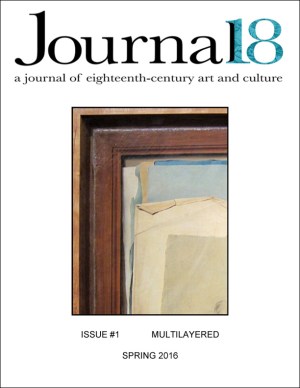 Journal18, #1 Multilayered (Spring 2016)
A R T I C L E S
• David Pullins, “Stubbs, Vernet & Boucher Share a Canvas: Workshops, Authorship & the Status of Painting”
• Charlotte Guichard, “Scratched Surfaces: Artists’ Graffiti in Eighteenth-Century Rome”
• Kristel Smentek, “China and Greco-Roman Antiquity: Overture to a Study of the Vase in Eighteenth-Century France”
• Dipti Khera, “Marginal, Mobile, Multilayered: Painted Invitation Letters as Bazaar Objects in Early Modern India”
Art history’s material turn, informed by anthropology, material culture, and consumption studies, has prompted new interest in both the physicality and the social lives of artworks. Examining the ways that eighteenth-century art objects were produced, transported, and transformed helps us to understand how they were perceived and reimagined in different cultural and temporal contexts. In the workshops and collective spaces of artistic design and manufacture, objects became the creative products of many minds and many hands, simultaneously and successively. Likewise in their afterlives as commodities and possessions, objects were continually altered through use and re-use, each transaction constituting a reframing—sometimes literal—as objects inhabited new settings or were subjected to damage, aging, or rejuvenation.
This inaugural issue of Journal18 explores the multilayered nature of eighteenth-century art. Our focus is on artworks that bear traces of multiple hands as a result of workshop production, cross-cultural exchange, re-use, restoration, vandalism, or other factors. Among the questions considered are: who were the many people involved in art’s production and reproduction (artists, collectors, scholars, dealers, handlers, and restorers)? How were eighteenth-century artworks made, re-purposed, transported, and conserved? How were they translated across media as well as across time, space, and culture? And what is the creative effect of non-creative acts like accidents or defacement? By taking a ‘multilayered’ approach, the articles in this issue not only reexamine traditional art-historical categories—such as style, originality, or authorship—but also encourage new methodological perspectives and find new meaning in the materiality of art objects.
N O T E S & Q U E R I E S
Woven Gold: Tapestries of Louis XIV – by Robert Wellington
Qing Encounters – by Craig Clunas
A Lacquered Past: The Making of Asian Art in the Americas – by Sylvia Houghteling
Castiglione and China: Marking Anniversaries – by Kristina Kleutghen
A Digitally Usable Period Room – by Anne Higonnet
Ornamenting Louis XIV – by Sarah Grant
Pastel will Travel. Liotard at the Royal Academy – by Francesca Whitlum-Cooper
Ceci n’est pas un portrait: A Curator’s Diary – by Melissa Percival
China in Wonderland – by Michelle Wang
Shock Dog! New Sculpture at the Met – by Paris Amanda Spies-Gans
Issue Editors
Noémie Etienne, Getty Research Institute, Los Angeles
Meredith Martin, NYU and Institute of Fine Arts
Hannah Williams, Queen Mary University of London
Cover image: Detail of Louis-Léopold Boilly, Trompe l’œil, ca. 1804–07. Source: Wikimedia Commons.
The Burlington Magazine, November 2015
The eighteenth century in The Burlington:
The Burlington Magazine 157 (November 2015)

Interior of the Church of Santiago de Surco, Lima, Peru, attributed by Gauvin Alexander Bailey to Johann Rehr and Santiago Rosales, before 1759–1773.
A R T I C L E S
• Gauvin Alexander Bailey, “The Fantastical Rococo Altarpieces of Santiago de Surco, Peru,” pp. 769–75.
R E V I E W S
• Simon Swynfen Jervis, Review of Giuseppe Beretti and Alvar González-Palacios, Giuseppe Maggiolini: Catalogo ragionato dei disegni (In Limine, 2014) and Michael Sulzbacher, Peter Atzig, Sabine Schneider, and Karsten Hommel, Friedrich Gottlob Hoffmann (Grassi Museum, 2014), pp. 790–91.
• David Bindman, Review of William Pressly, James Barry’s Murals at the Royal Society of Arts: Envisioning a New Public Art (Cork University Press, 2014), pp. 791–92.
• Richard Green, Review of Christopher Wright, The Schorr Collection of Old Master and Nineteenth-Century Paintings (The Schorr Collection, 2014), pp. 792–93.
• David Pullins, Review of Carolyn Weekley, Painters and Paintings in the Early American South (Yale University Press, 2013), p. 795.
New Book | Figures Publiques: L’invention de la Célébrité, 1750–1850
From Fayard:
Antoine Lilti, Figures Publiques: L’invention de la Célébrité, 1750–1850 (Paris: Fayard, 2014), 436 pages, ISBN: 978-2213682389, 24€.
 Bien avant le cinéma, la presse à scandale et la télévision, les mécanismes de la célébrité se sont développés dans l’Europe des Lumières, puis épanouis à l’époque romantique sur les deux rives de l’Atlantique. Des écrivains comme Voltaire, des comédiens comme Garrick, des musiciens comme Liszt furent de véritables célébrités, suscitant la curiosité et l’attachement passionné de leurs « fans ». À Paris comme à Londres, puis à Berlin et New York, l’essor de la presse, les nouvelles techniques publicitaires et la commercialisation des loisirs entraînèrent une profonde transformation de la visibilité des personnes célèbres. On pouvait désormais acheter le portrait de chanteurs d’opéra et la biographie de courtisanes, dont les vies privées devenaient un spectacle public. La politique ne resta pas à l’écart de ce bouleversement culturel : Marie-Antoinette comme George Washington ou Napoléon furent les témoins d’un monde politique transformé par les nouvelles exigences de la célébrité. Lorsque le peuple surgit sur la scène révolutionnaire, il ne suffit plus d’être légitime, il importe désormais d’être populaire.
À travers cette histoire de la célébrité, Antoine Lilti retrace les profondes mutations de la société des Lumières et révèle les ambivalences de l’espace public. La trajectoire de Jean-Jacques Rousseau en témoigne de façon exemplaire. Écrivain célèbre et adulé, celui-ci finit pourtant par maudire les effets de sa « funeste célébrité », miné par le sentiment d’être devenu une figure publique que chacun pouvait façonner à sa guise. À la fois désirée et dénoncée, la célébrité apparaît comme la forme moderne du prestige personnel, adaptée aux sociétés démocratiques et médiatiques, comme la gloire était celle des sociétés aristocratiques. C’est pourtant une grandeur toujours contestée, dont l’histoire éclaire les contradictions de notre modernité.
Antoine Lilti est directeur d’études à l’École des hautes études en sciences sociales. Ses travaux portent sur l’histoire sociale et culturelle des Lumières. Il a notamment publié Le Monde des salons. Sociabilité et mondanité à Paris au xviiie siècle (Fayard, 2005).
For a review of the book, see Jessica Goodman, French Studies 69 (2015): 535–36.
The Burlington Magazine, July 2015
The eighteenth century in The Burlington:
The Burlington Magazine 157 (July 2015)
 A R T I C L E S
• Peter Lindfield, “New Light on Chippendale at Hestercombe House,” pp. 452–56.
• Susan Owens, “A Note on Jonathan Richardson’s Working Methods,” pp. 457–59.
• Peter Moore and Hayley Flynn, “John Collett’s Temple Bar and the Discovery of a Preparatory Study,” pp. 460–64.
• Alycen Mitchell and Barbara Pezzini, “‘Blown into Glittering by the Popular Breath’: The Relationship between George Romney’s Critical Reputation and the Art Market,” pp. 465–73.
R E V I E W S
• Charles Truman, Review of Gerhard Röbbig, ed., Meissen Snuffboxes of the Eighteenth Century (Hirmer Verlag, 2013), p. 484.
• Maureen Cassidy-Geiger, Review of Haydn Williams, Turquerie: An Eighteenth-Century European Fantasy (Thames & Hudson, 2014), p. 487.
• J.V., Review of Ian Warrell, Turner’s Sketchbooks (Tate Publishing, 2014), p. 488.
• Robert O’Byrne, Review of the exhibition, Ireland: Crossroads of Art and Design, 1690–1840, p. 509–10.
The Art Bulletin, June 2015
The eighteenth century in The Art Bulletin:
The Art Bulletin 97 (June 2015)
A R T I C L E S
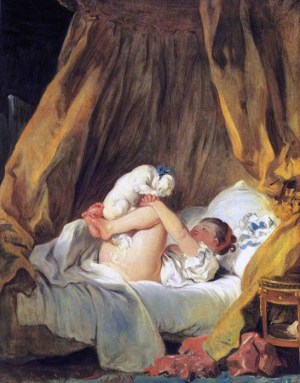
Jean-Honoré Fragonard, Young Girl in Bed Making Her Dog Dance, ca. 1768 (Munich: Alte Pinakothek)
• Jennifer Milam, “Rococo Representations of Interspecies Sensuality and the Pursuit of Volupté,” pp. 192–209.
Enlightenment writers proposed the existence of an animal soul, refuting the Cartesian beast-machine. Arguments credit the caresses of a dog to its master as direct visual evidence of the capacity of an animal to feel and show emotion. A focus on paintings by Jean-Honoré Fragonard sets the Rococo representation of lapdogs within the context of changing ideas about the relationship between animal and human. Eroticized images of lapdogs are related to radical materialist theories that assert the role of physical pleasure in human motivation.
Free access to the article is available here for the first fifty clicks (please don’t click if you already have access to the journal).
R E V I E W S
• Vittoria Di Palma, Review of Hanneke Grootenboer, Treasuring the Gaze: Intimate Vision in Late Eighteenth-Century Eye Miniatures (The University of Chicago Press,
2013), pp. 229–30.
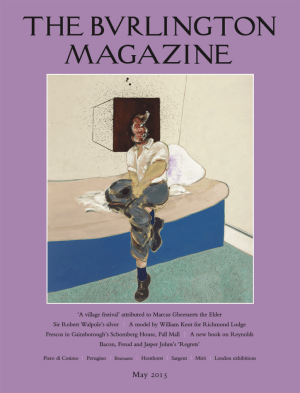
The Burlington Magazine, May 2015
The eighteenth century in The Burlington:
The Burlington Magazine 157 (April 2015)
 A R T I C L E S
• Tessa Murdoch, “Power and Plate: Sir Robert Walpole’s Silver,” pp. 318–24.
• Julius Bryant, “Queen Caroline’s Richmond Lodge by William Kent: An Architectural Model Unlocked,” pp. 325–30.
R E V I E W S
• Duncan Robinson, Review of Mark Hallet, Reynolds: Portraiture in Action (The Paul Mellon Centre for Studies in British Art, 2014), pp. 341–47. Available at The Burlington website for free.
• Stephen Lloyd, Review of Cory Korkow with Jon Seydl, British Portrait Miniatures: The Cleveland Museum of Art (D. Giles, Ltd., 2013), pp. 349–50.
• Richard Wolfe, Review of the exhibition Shifting Patterns: Pacific Barkcloth Clothing (British Museum, 2015), pp. 361–62.
• Jamie Mulherron, Review of two exhibitions: Charles de La Fosse: Le Triomphe de la Couleur (Versailles and Nantes, 2015) and Bon Boullogne (1649–1717): Un chef d’école au Grand Siècle (Dijon, 2014–15), pp. 365–67.
The Burlington Magazine, April 2015
The eighteenth century in The Burlington:
The Burlington Magazine 157 (April 2015)
 A R T I C L E S
• Marie-Anne Dupuy-Vachey, “Fragonard’s ‘Fantasy Figures’: Prelude to a New Understanding,” pp. 241–47.
• Yuriko Jackall, John K. Delaney, and Michael Swicklik, “Portrait of a Woman with a Book: A Newly Discovered ‘Fantasy Figure’ by Fragonard at the National Gallery of Art, Washington,” pp. 248–54.
R E V I E W S
• Richard Wrigley, “Reassessing François-André Vincent,” — Review of recent exhibitions of Vincent’s work at Montpellier, Tours, and Paris and two books: Jean-Pierre Cuzin, François-André Vincent, 1746–1816: Un Peintre entre Fragonard et David (Arthéna, 2013) and Elizabeth Mansfield, The Perfect Foil: François-André Vincent and the Revolution in French Painting (University of Minnesota Press, 2012), pp. 265–68.
• François Marandet, Review of Christian Michel, L’Académie Royale de Peinture et de Sculpture (Librairie Droz, 2012), p. 276.
• Julia Poole, Review of Joanna Gwilt, Vincennes and Early Sèvres Porcelain from the Belvedere Collection (V&A Publishing, 2014), pp. 276–77.
• Stephen Duffy, Review of France Nerlich and Alain Bonnet, eds., Apprendre à Peindre: Les ateliers Privés à Paris, 1780–1863 (Université Francois Rabelais, 2013), p. 277.
• Reinier Baarsen, Review of the exhibition Eighteenth Century, Birth of Design, Furniture Masterpieces, 1650–1789 / 18e, aux sources du design, chefs-d’œuvre du mobilier 1650 à 1790 (Château de Versailles, 2014–15), pp. 285–86.
• Gauvin Alexander Bailey, Review of the exhibition With Body and Soul / Mit Leib und Seele (Munich: Kunsthalle, 2014–15), pp. 286–88. Available at The Burlington website for free.
• Xavier Salomon, Review of the exhibition Goya’s Tapestry Cartoons in the Context of Court Painting / Goya en Madrid: Cartones para Tapices (Madrid: Prado, 2014–15), pp. 290–91.
• Catherine Whistler, Review of the exhibition, The Poetry of Light: Venetian Drawings from the National Gallery of Art, Washington / La Poesia della Luce: Disegni Veneziani dalla National Gallery of Art di Washington (Venice: Museo Correr, 2014–15), pp. 293–94.










leave a comment