New Book | The Beauty of the Flower
From Reaktion, with additional distribution by The University of Chicago Press:
Stephen Harris, The Beauty of the Flower: The Art and Science of Botanical Illustration (London: Reaktion Books, 2023), 336 pages, ISBN: 97-81789147803, £30 / $45.
 Featuring superb and rare images, this book reveals the fascinating stories behind botanical illustration.
In a world flooded with images designed to create memories, validate perceptions and influence others, botanical illustration is about creating technically accurate depictions of plants. Reproductions of centuries-old botanical illustrations frequently adorn greetings cards, pottery and advertising, to promote heritage or generate income, yet their art is scientific: its purpose is to record, display and transmit scientific data. The Beauty of the Flower shows us how scientific botanical illustrations are collaborations among artists, scientists and publishers. It explores the evolution and interchanges of these illustrations since the mid-fifteenth century, the ways in which they have been used to communicate scientific ideas about plants and how views of botanical imagery change. Featuring unique images rarely seen outside of specialist literature this book reveals the fascinating stories behind these remarkable illustrations.
Stephen A. Harris is an Associate Professor of Plant Sciences and curator of the herbarium at the University of Oxford. His books include Sunflowers (Reaktion, 2018) and Roots to Seeds: 400 Years of Oxford Botany (2021).
c o n t e n t s
Preface
1 Plant and Page
2 Themes and Trends
3 Science and Illustration
4 Blood and Treasure
5 Garden and Grove
6 Inside and Out
7 Habit and Habitat
8 Observe and Test
9 Sweat and Tears
Appendix: Plant Names
References
Further Reading
Acknowledgements
Photo Acknowledgements
Index
New Book | The Man Who Organized Nature
From Princeton UP:
Gunnar Broberg, The Man Who Organized Nature: The Life of Linnaeus, translated by Anna Paterson (Princeton: Princeton University Press, 2023), 512 pages, ISBN: 978-0691213422, £35 / $40.
 A new biography of Carl Linnaeus, offering a vivid portrait of Linnaeus’s life and work
Carl Linnaeus (1707–1778), known as the father of modern biological taxonomy, formalized and popularized the system of binomial nomenclature used to classify plants and animals. Linnaeus himself classified thousands of species; the simple and immediately recognizable abbreviation ‘L’ is used to mark classifications originally made by Linnaeus. This biography, by the leading authority on Linnaeus, offers a vivid portrait of Linnaeus’s life and work. Drawing on a wide range of previously unpublished sources—including diaries and personal correspondence—as well as new research, it presents revealing and original accounts of his family life, the political context in which he pursued his work, and his eccentric views on sexuality.
The Man Who Organized Nature describes Linnaeus’s childhood in a landscape of striking natural beauty and how this influenced his later work. Linnaeus’s Lutheran pastor father, knowledgeable about plants and an enthusiastic gardener, helped foster an early interest in botany. The book examines the political connections that helped Linnaeus secure patronage for his work, and untangles his ideas about sexuality. These were not, as often assumed, an attempt to naturalize gender categories but more likely reflected the laissez-faire attitudes of the era. Linnaeus, like many other brilliant scientists, could be moody and egotistical; the book describes his human failings as well as his medical and scientific achievements. Written in an engaging and accessible style, The Man Who Organized Nature—one of the only biographies of Linnaeus to appear in English—provides new and fascinating insights into the life of one of history’s most consequential and enigmatic scientists.
Gunnar Broberg (1942–2022) was professor emeritus of history of ideas and sciences at Lund University in Sweden. He was the author of numerous books, including Golden Apples, which won the August Prize for best Swedish nonfiction title of the year, and The History of the Night, which was nominated for Best Swedish History Book of the Year. Anna Paterson, a retired neuroscientist, is an award-winning translator and the author of Scotland’s Landscape: Endangered Icon.
Exhibition | The Botanical Library of Benjamin Delessert
Delessert assembled a massive herbarium and botanical library (along with a large shell collection). At his death, his 300,00 plant specimens went to Geneva’s Conservatoire botanique and his books to the Institut de France. A selection is now on view at the Bibliothèque Mazarine.
◊ ◊ ◊ ◊ ◊
Un herbier-monde: La bibliothèque botanique de Benjamin Delessert (1773–1847)
Bibliothèque Mazarine, Paris, 8 December 2023 — 2 March 2024
Curated by Sabrina Castandet-Le Bris with Dominique Drouin and Olivier Thomas
 La botanique gagna d’abord Benjamin Delessert comme une passion familiale. Né en 1773 à Lyon dans un milieu protestant d’origine genevoise acquis aux idées philanthropiques et progressistes, il fut appelé à présider, tout jeune homme encore, aux destinées de l’établissement bancaire paternel, puis de ses propres entreprises, et réunit une importante fortune personnelle qu’il consacra à l’oeuvre de sa vie : rassembler l’une des plus importantes collections botaniques au monde, et en faire bénéficier l’ensemble de la communauté des savants.
Alors que son herbier personnel s’enrichissait de pièces historiques provenant des pères fondateurs de la botanique (Linné, Plumier ou Hermann), son esprit curieux le portait dans le même temps vers l’innovation scientifique et le soutien aux disciplines nouvelles préfigurant l’écologie. Une adhésion enthousiaste aux recherches sur la classification naturelle développées par son ami Augustin-Pyramus de Candolle, et la place faite dans sa vaste bibliothèque à la géographie botanique naissante, l’engagent à soutenir des expéditions naturalistes et à contribuer à des entreprises majeures de l’édition botanique du XIXe siècle. L’intuition visionnaire de l’impérieuse nécessité de réunir les savoirs sur le monde végétal, explique à la fois sa pratique altruiste de la collection, ses engagements éditoriaux, et son intervention déterminante dans la communauté scientifique.
Léguée à l’Académie des sciences en 1869 et conservée depuis à la bibliothèque de l’Institut, cette collection de 8500 titres permet de retracer les contours et les usages d’un « musée botanique » exceptionnel, et d’interroger les fonctions de l’herbier—qu’il soit naturel ou figuré—à la lumière des enjeux actuels de préservation de la biodiversité.
New Book | A Delicate Matter
From The Pennsylvania State UP:
Oliver Wunsch, A Delicate Matter: Art, Fragility, and Consumption in Eighteenth-Century France (University Park: Penn State University Press, 2024), 192 pages, ISBN: 978-0271095288, $100.
 Eighteenth-century France witnessed an unprecedented proliferation of materially unstable art, from oil paintings that cracked within years of their creation to enormous pastel portraits vulnerable to the slightest touch or vibration. In A Delicate Matter, Oliver Wunsch traces these artistic practices to the economic and social conditions that enabled them: an ascendant class of art collectors who embraced fragile objects as a means of showcasing their disposable wealth. While studies of Rococo art have traditionally focused on style and subject matter, this book reveals how the physical construction of paintings and sculptures was central to the period’s reconceptualization of art. Drawing on sources ranging from eighteenth-century artists’ writings to twenty-first-century laboratory analyses, Wunsch demonstrates how the technical practices of eighteenth-century painters and sculptors provoked a broad transformation in the relationship between art, time, and money. Delicacy, which began the eighteenth century as a commodified extension of courtly sociability, was by century’s end reimagined as the irreducible essence of art’s autonomous value. Innovative and original, A Delicate Matter is an important intervention in the growing body of scholarship on durability and conservation in eighteenth-century French art. It challenges the art historical tendency to see decay as little more than an impediment to research, instead showing how physical instability played a critical role in establishing art’s meaning and purpose.
Oliver Wunsch is Assistant Professor of Art History at Boston College.
Exhibition | Pastels, between Line and Color
Now on view at the Cognacq-Jay:
Pastels, entre ligne et couleur
Musée Cognacq-Jay, Paris, 12 October 2023 — 11 February 2024
Curated by Pascal Faracci and Sixtine de Saint-Léger
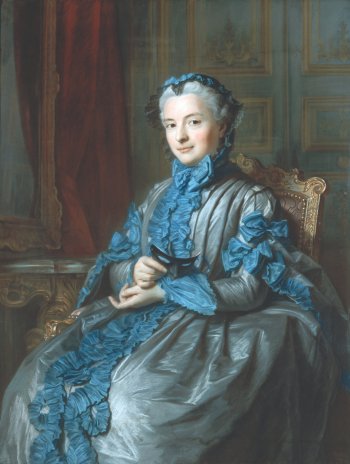
Maurice Quentin de La Tour, Portrait de Madame la présidente de Rieux, en habit de bal, tenant un masque, 1742 (Musée Cognacq-Jay).
Siècle d’or du pastel, le XVIIIe voit s’épanouir la virtuosité de dessinateurs tels que Maurice-Quentin de La Tour, le « prince des pastellistes », et son rival talentueux Jean-Baptiste Perronneau. Ils sont à l’honneur dans la collection Cognacq-Jay, avec des portraits qui comptent parmi leurs chefs-d’œuvre, comme celui de Madame la présidente de Rieux, en habit de bal, tenant un masque, aux dimensions monumentales. À ces œuvres françaises s’ajoutent celles de trois pastellistes anglais : Hugh Douglas Hamilton, John Russel et Daniel Gardner, témoins des échanges artistiques entre les deux pays autant que du goût singulier d’Ernest Cognacq pour l’école britannique.
La facture moelleuse, l’éclatante fraîcheur des coloris et l’expressivité des modèles de ces portraits témoignent du talent des artistes à manier le pastel, cette poudre de couleur aux nuances et aux dégradés variant à l’infini. À la fois ligne et couleur, le pastel offre une rapidité d’écriture, une transcription sensible de l’émotion et une intensité qui reste intacte au fil du temps.
Aux côtés des œuvres de la collection Cognacq-Jay, une sélection de pastels d’artistes du XVIIIe, tels que François Boucher ou Élisabeth Vigée Le Brun issus d’autres institutions de Paris Musées, complète ce panorama.
L’accrochage exceptionnel de ces œuvres fragiles, accompagné d’une médiation spécifique, permettra d’éclairer le goût pour le portrait intime, caractéristique du siècle des Lumières, et sera également l’occasion de dévoiler les dernières acquisitions du musée en arts graphiques.
New Book | Color Charts: A History
With the original French edition (Nuanciers: éloge du subtil) published in October, the English translation is due in February from Princeton UP:
Anne Varichon, Color Charts: A History, translated by Kate Deimling (Princeton: Princeton University Press, 2024), 284 pages, ISBN: 978-0691255170, £45 / $55.
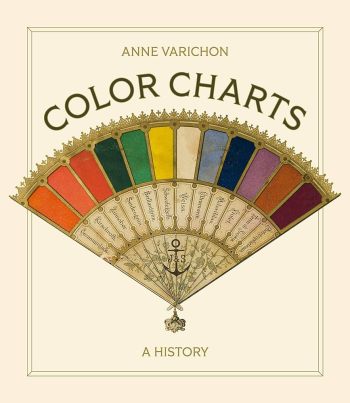 A beautifully illustrated history of the many inventive, poetic, and alluring ways in which color swatches have been selected and staged
The need to categorize and communicate color has mobilized practitioners and scholars for centuries. Color Charts describes the many different methods and ingenious devices developed since the fifteenth century by doctors, naturalists, dyers, and painters to catalog fragments of colors. With the advent of industrial society, manufacturers and merchants developed some of the most beautiful and varied tools ever designed to present all the available colors. Thanks to them, society has discovered the abundance of color embodied in a plethora of materials: cuts of fabric, leather, paper, and rubber; slats of wood and linoleum; delicate skeins of silk; careful deposits of paint and pastels; fragments of lipstick; and arrangements of flower petals. These samples shape a visual culture and a chromatic vocabulary and instill a deep desire for color.
Anne Varichon traces the emergence of modern color charts from a set of processes developed over the centuries in various contexts. She presents illuminating examples that bring this remarkable story to life, from ancient writings revealing attention to precise shade to contemporary designers’ color charts, dyers’ notebooks, and Werner’s famous color nomenclature. Varichon argues that color charts have linked generations of artists, artisans, scientists, industrialists, and merchants, and have played an essential and enduring role in the way societies think about color. Drawing on nearly two hundred documents from public and private collections, almost all of them previously unpublished, this wonderfully illustrated book shows how the color chart, in its many distinct forms and expressions, is a practical tool that has transcended its original purpose to become an educational aid and subject of contemplation worthy of being studied and admired.
Anne Varichon is an anthropologist specializing in material cultures and ideas about color. She is the author of Colors: What They Mean and How to Make Them.
Battle of New Orleans Historical Symposium, 2024
From Nunez Community College, with registration available at Eventbrite:
The 9th Annual Battle of New Orleans Historical Symposium
Nunez Community College, Chalmette (New Orleans), 5–6 January 2024
The 9th Annual Battle of New Orleans Historical Symposium will take place January 5th and 6th in Chalmette, Louisiana, at Nunez Community College (on Friday) and at the St. Bernard Council Chambers (on Saturday).
f r i d a y , 5 j a n u a r y
9.00 Coffee
9.30 Welcome and Opening Remarks — Tina Tinney
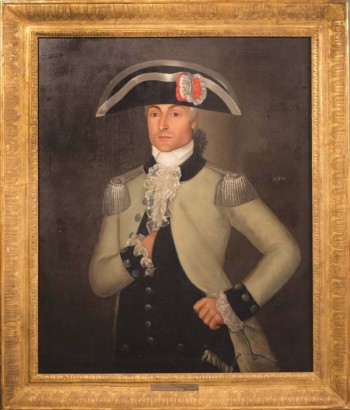
Attributed to José Francisco Xavier de Salazar y Mendoza, Portrait of Captain Joseph Bernard Vallière d’Hauterive, ca. 1791–95, oil on canvas (Little Rock: Historic Arkansas Museum). Vallière d’Hauterive was the Grenoble-born commandant of the Arkansas Post from 1787 to 1790; this portrait was likely painted upon his return to New Orleans.
9.45 Morning Talks
• Overview of Battle of New Orleans — William Hyland
• ‘Nothing Pleases Them So Much as the Uniform’: Martial Culture and Military Life in Early Louisiana — Philippe Halbert
• The Past as Prelude: The Impact of Spain and the Galvez Expedition on the American Victory in the Battle of New Orleans — Bradford Waters
12.15 Lunch
1.30 Afternoon Talks
• ‘Pirate City’: Tracing Property Records of Selected Members of Jean Laffite’s Baratarian Pirate Syndicate who Played Prominent Roles in the War Effort of the Winter of 1814–15 — Ina Fandrich
• What if New Orleans had been Taken by the British in 1815? — Harold Youmans
4.00 Wine and Cheese Reception
s a t u r d a y , 6 j a n u a r y
10.00 Welcome — Katherine Lemoine
10.05 Morning Talks
• A Reminiscence of the Battle of New Orleans by Bernard de Marigny — William Hyland
• Native American Influence in the Battle of New Orleans: Houma Indians in Louisiana — Colleen Billiot
• Scottish Heraldry: A Window into a Culture — Christen Raby Elliot
12.45 Closing Remarks — William Hyland
Attingham Courses in 2024
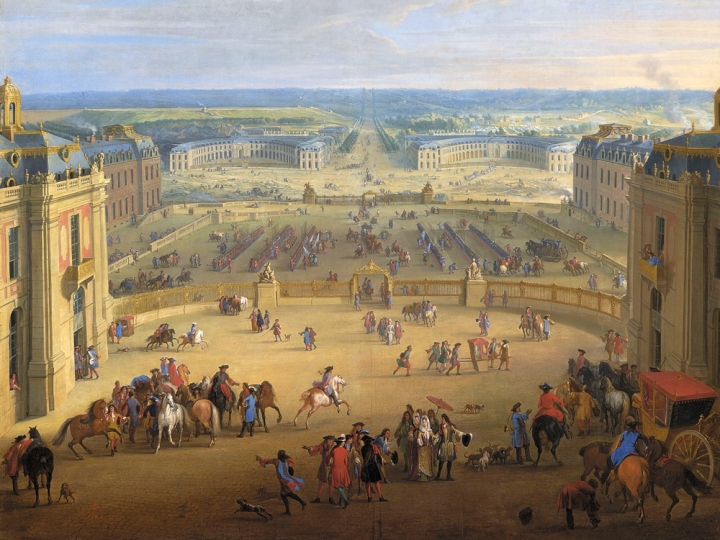
View of Versailles with the Royal Stables in the Foreground
(Versailles: Musée Lambinet)
◊ ◊ ◊ ◊ ◊
This year’s Attingham offerings:
The Attingham Summer School, 29 June — 14 July 2024
Applications due by 28 January
The 71st Attingham Summer School, a 16-day residential course directed by David Adshead and Tessa Wild, will visit country houses in Sussex, Buckinghamshire, Oxfordshire, Derbyshire, Northamptonshire, Wiltshire, and Dorset. From West Dean, our first base, we will study, amongst other houses and gardens: the complex overlays of Arundel Castle, the ancestral seat of the Dukes of Norfolk; Petworth House, where the patronage of great British artists such as Turner and Flaxman enrich its Baroque interiors; Parham, a fine Elizabethan house in an unrivalled setting and Standen, an Arts and Crafts reinterpretation of the country house.
In the Midlands a series of related houses will be examined: Hardwick Hall, unique amongst Elizabethan houses for its survival of late 16th-century decoration and contents; Bolsover Castle, a Jacobean masque setting frozen in stone and Chatsworth, where the collections and gardens of the Cavendishes and Dukes of Devonshires span more than four centuries. Other highlights include the superb collections and landscaped gardens at Boughton House, ‘the English Versailles’.
Based in Salisbury, the final part of the course will explore the estates and collections of Dorset and Wiltshire. Our itinerary will include Wilton House, the fine Palladian seat of the Earls of Pembroke, renowned for its state rooms and outstanding art collection; Henry Hoare II and Henry Flitcroft’s magnificent garden at Stourhead, the superlative example of the 18th-century English landscape garden style; and Kingston Lacey, home of the collector, traveller and pioneering Egyptologist William John Bankes, who spent the last fourteen years of his life in exile in Venice, from where he continued to embellish the interiors and add to his significant collections.
◊ ◊ ◊ ◊ ◊
Royal Collection Studies, 1–10 September 2024
Applications due by 11 February
The Royal Collection is one of the world’s leading collections of fine and decorative art, with over one million works from six continents, many of them masterpieces. Working in partnership with The Royal Collection Trust, this ten-day residential course offers participants the opportunity to study the magnificent holdings of paintings, furniture, metalwork, porcelain, jewellery, sculpture, arms and armour, books and works on paper and to examine the architecture and interiors of the palaces which house them.
Based near Windsor, the course also examines the history of the collection and the key roles played by monarchs and their consorts over the centuries. Combining a mixture of lectures and tutorials, visits to both the occupied and unoccupied palaces in and around London and close-up object study, Royal Collection Studies aims to give experienced professionals in the heritage sector a deeper understanding of this remarkable collection.
The course is intended to be interactive, with participants asked to contribute and participate in group discussions. As with all Attingham courses, the group is encouraged to engage with current curatorial debates, questions of display and interpretation and, in this instance, the issues surrounding a working collection. During the course, members find that they build an invaluable network for the ongoing exchange of ideas and expertise.
Royal Collection Studies is organised on broadly chronological principles, developing an understanding of the changing function and character of the British Royal Collection. The course is held when the Royal Family is not in residence and Windsor Castle is the central focus. The programme explores palaces past and present and five centuries of collecting and display, covering all aspects of the collection.
◊ ◊ ◊ ◊ ◊
Attingham Study Programme: Arts and Crafts Houses and Gardens, 16–22 September 2024
Applications due by 11 February
This seven-day study programme will explore the origins and evolution of the Arts and Crafts movement in England by studying the work of its leading architects and designers and considering its influence here and abroad. We will be based in Surrey and Gloucestershire and will examine houses, gardens and collections in Kent, Sussex, Surrey, Oxfordshire, Gloucestershire, Worcestershire, and Herefordshire.
The course will begin with the two influential houses which bookend the architect Philip Webb’s career: Red House, designed for William Morris in 1859–60, and Standen, his most complete surviving work, with its fine collection of original Morris & Co. furnishings, furniture, and decorative arts. We will explore the extraordinary creative partnership between Gertrude Jekyll and Edwin Lutyens at Munstead Wood, where Jekyll’s skill as a designer and horticulturist finds perfect expression in her own garden which clothes the house designed for her by Lutyens. We will also visit Vann, where the architect W D Caröe extended his 16th-century house and commissioned Jekyll to create a water garden in 1911. From Surrey, we will travel to Morris’s country home at Kelmscott Manor and on to Gloucestershire where we will spend time studying the pre-eminent Arts and Crafts collections of The Wilson in Cheltenham. Among the houses and gardens we will explore in this area, are Rodmarton Manor, designed by Ernest Gimson for Claud and Margaret Biddulph, and recognised as the last and greatest of the houses, entirely built and with its furniture made to Arts and Crafts ideals using local materials and craftspeople. At Owlpen Manor, which the architect, Norman Jewson, discovered in a state of near-dereliction and acquired in 1925, in order to repair it and ensure its survival, we will study the Mander family’s wonderful collection. We will then spend a day at two superb and highly contrasting houses near Malvern, the moated 19th-century Madresfield Court, home to the Lygon family for over 900 years, with its library by CR Ashbee and the Guild of Handicraft and exceptional chapel and Perrycroft, designed by CFA Voysey as a country retreat for JW Wilson MP in 1893–94, on a spectacular sloping site in the Malvern Hills.
◊ ◊ ◊ ◊ ◊
Court Culture and the Horse, 1700–1900: Versailles, Chantilly, and Compiègne, 6–11 October 2024
Applications due by 11 February
This intensive short course will explore the central role of horses, ceremonial carriages and grand stable complexes within French court culture during the long 18th century. By connecting these objects and spaces with their immediate surroundings, we hope to reach a more nuanced understanding of their importance in French aristocratic life and of how this is reflected in the architecture, interiors and art collections of the palaces and chateaux we will be visiting.
The programme is planned to coincide with a major new exhibition entitled Cheval en majesté, au coeur d’une civilisation to be held at the Château de Versailles. We will spend the first full day of the course visiting the palace, including the great and small stables, highly important spaces often overlooked by visitors. From our hotel in the 19th arrondissement, we will travel by coach to the Château de Chantilly to study the spectacular 18th-century stables (the largest princely stables in Europe), the newly redisplayed Musée du Cheval, and the interiors and collections of the château. A day will be spent at the Château de Compiègne, a palace built to indulge Louis XV’s passion for hunting and now also the home of the Musée Nationale de la Voiture, established in 1927, comprising the foremost collection of horse-drawn vehicles, harnesses and livery in France. Other visits in Paris will explore smaller spaces with equine connections, including the cavalry department of the Republican Guard who were responsible for protecting the Kings of France and who now play an important ceremonial role.
Frick Director Ian Wardropper to Retire in 2025
From the museum press release (3 January 2024) . . .
 The Frick Collection announced today that Ian Wardropper, the institution’s Anna-Maria and Stephen Kellen Director, will retire in 2025 following fourteen years of service to the Frick and a fifty-year museum career. During his tenure as the Frick’s director, Wardropper led the museum and library through a period of strategic and measured growth, which included the first comprehensive renovation and upgrade of the Frick’s historic buildings in nearly ninety years and a focused acquisitions program that has enhanced the institution’s art and library collections. He also prioritized accessibility and public outreach, spearheading innovative strategies and partnerships that enabled audiences to experience the museum and library in new ways. This has ranged from inventive online programs including Cocktails with a Curator to partnerships with the Ghetto Film School to the conceptualization and management of Frick Madison, which enabled the Frick’s collections and programs to be enjoyed throughout the institution’s renovation and enhancement project.
The Board of Trustees is working with an executive search firm to conduct an international search for the Frick’s next director. Wardropper will be honored for his innumerable contributions to the museum and the arts community at large at the institution’s fall 2024 gala, which precedes the public reopening of the museum and library in late 2024. . . .
The full press release is available here»
Robin Pogrebin covered the story yesterday for The New York Times.
The Furniture History Society’s Early Career Symposium

◊ ◊ ◊ ◊ ◊
From The Furniture History Society, with registration at Eventbrite:
The Furniture History Society Early Career Research Symposium
The Metropolitan Museum of Art, New York, 24 January 2024
The Furniture History Society is delighted to hold its seventh Early Career Research Symposium at The Metropolitan Museum of Art in New York on Wednesday, 24th January. The symposium is part of our Early Career Development (ECD) programme and presents current research by emerging scholars in the fields of furniture history, the decorative arts, and historic interiors. The wide range of papers reflects the variety of interests among young scholars with speakers from Britain, the Czech Republic, France, Italy, and the United States. We welcome curators, dealers, academics, members of the Furniture History Society, and anyone interested in the decorative arts and the history of interiors to join us for this symposium to enjoy the fascinating medley of topics, ranging from the 1650s to the 1950s. The event is free, but it is necessary to register here on Eventbrite by midnight Sunday, 21st January to secure a place. This event is neither being recorded nor livestreamed.
The day is made possible thanks to the generous support of the Oliver Ford Trust.
p r o g r a m m e
9.30 Welcome
9.45 Morning Session A
• Cynthia Kok (Rijksmuseum, Amsterdam) Ebonyworkers in 17th-Century Amsterdam
• Bridget Griffin (The Attingham Trust, London), Crafting Connections: Mapping the Lives and Trade Networks of British and Irish Immigrant Furniture Makers in North-Eastern Port Cities of Early America
• Grace Ford-Dirks (Philadelphia Museum of Art), Exploring the Lives and Meanings of an 18th-Century Caribbean Armoire
11.15 Break
11.45 Morning Session B
• Noah Dubay (Bard Graduate Center, New York), Comfort, Convenience, and Convalescence: How the Fauteuil de Malade Changed 18th-Century France
• Geoffrey Ripart (Bard Graduate Center, New York), The Road from Rome to Paris: Sourcing Rare Marbles at the End of the Ancien Regime and the Rise of French Taste for Objets d’Art Made from Stone, 1760–1810
12.45 Lunch Break
1.45 Afternoon Session A
• Romana Mastrella (University of La Sapienza, Rome), Collecting Fireplaces
• Justine Gain (École de Louvre, Paris), When the Furniture Matches the Architecture: The Birth of French Eclecticism through the Oeuvre of Jean-Baptiste Plantar (1790–1879)
• Laura Jenkins (Courtauld Institute of Art, London) From Galerie to Ballroom: Gilbert Cuel at 1 West 57th Street
3.15 Break
3.45 Afternoon Session B
• Karolina Kourilova (Masaryk University, Brno), Design behind the Iron Curtain: Furniture Industry Development in Post-War Czechoslovakia
• Melania Andronic (University of La Sapienza, Rome), Rational Furniture: A Chair Is Made for Sitting
4.45 Closing Remarks
◊ ◊ ◊ ◊ ◊










 Enfilade
leave a comment