Conference | Women in Architecture before 1800

From the conference website:
WoArch 2024: Women as Builders, Designers, and Critics of the Built Environment before 1800
Online and in-person, Palazzo Taverna, Rome, 25–27 January 2024
Organized by Shelley Roff, Consuelo Lollobrigida, and Francesca Riccardo
We are pleased to announce the first edition of the conference series WoArch (Women in Architecture) as an international symposium entitled Women as Builders, Designers, and Critics of the Built Environment before 1800, which will take place in Rome, 25–27 January 2024. Organized by the University of Arkansas Rome Center in collaboration with the School of Architecture + Planning at the University of Texas at San Antonio, this symposium is also supported by the Women in Architecture Affiliate Group of the Society of Architectural Historians. The event will be hosted in person at the Rome Center in Palazzo Taverna, Rome, and will be live-streamed on the Rome Center YouTube channels.
For almost 30 years, the literature investigating women and the built environment before the modern era has focused on women’s patronage of architecture. This symposium is designed to open a discussion about what is missing from this conversation and yet can be found in the historical record: the roles that women of various social classes played in shaping architecture, landscapes, and cities in diverse parts of the world and the cultural and political implications of their activities. In part, the symposium calls for a re-interpretation of patronizing activities by women; and, from another point of view, it directs the spotlight toward women engaging in socio-political urban reform, creating networks of design influence, managing and participating in construction, and serving as the designer of the built environment across a broad geographic scope before modern industrialization.
For program details and speakers’ abstracts, please visit our webpage. For other queries, please write to Shelley Roff, shelley.roff@utsa.edu.
2 5 j a n u a r y | w o m e n a s b u i l d e r s a n d d e s i g n e r s
9.00 Introduction by Shelley E. Roff, Consuelo Lollobrigida, and Francesca Riccardo
9.20 Session 1: A Passion for Design
Moderator: Francesca Riccardo
• Alba Carballeira (Private Foundation, Spain), Building Knowledge: Princesse des Ursins’ Gesamtkunstwerk for Philip the V
• Rebecca Shields (Virginia Commonwealth University), Frances Stewart, the Duchess of Lennox and Richmond, and Richmond House
• Consuelo Lollobrigida (University of Arkansas Rome Center), The Influence of Borromini in Bricci’s Architectural Apprenticeship and Background
• Laura Hindelang (University of Bern), Female Architectural Agency Pre-1900: Conceptualizing Cross-Cultural Perspectives
• Izabela Kopania (Institute of Art, Polish Academy of Sciences), Dutch-British Style for Cottage Architecture: Magdalena Morska’s Aesthetic Vision of Zarzecze Village
12.30 Archive Oratorio dei Filippini
14.20 Lunch
16.00 Session 2: Women Building the City
Moderator: María Elena Díez Jorge
• Mariana de Moura (Universidade Federal de Minas Gerais, Brazil), Women and Construction Know-How: Critical Fabulations from Self-Produced Sites
• Barry Stiefel (College of Charleston), To Carry Forty Pounds of Clay: Enslaved Black Women and Children Building Trades Workers in Early America
• Elizabeth Biggs (Trinity College Dublin) and Kirsty Wright (Historic Royal Palaces), Women Shaping the Palace of Westminster, ca. 1290–1700
• Nicoletta Marconi (Università degli Studi di Roma Tor Vergata), Unsuspected Presences: Women Workers on 16th–18th Century Roman Building Sites
• Gül Kale (Carleton University, Canada), Women as Shapers of Spatial Practices in Ottoman Istanbul
2 6 j a n u a r y | c o n n e c t i n g s p h e r e s o f i n f l u e n c e
9.00 Session 3: Critical Agents of Transformation
Moderator: Alba Carballeira
• Julie Beckers (University of Leuven), Rebuilding for Observance: Architectural Changes to Santa Maria di Monteluce in Perugia post Reform, ca. 1448–1485
• Sol Pérez Martinez (ETH Zürich), Nuns Reporting the City: Convents, Urban Life, and Female Experiences of 1700s Chile
• Elena Rieger (ETH Zürich), Urban Living: Emilie von Berlepsch and the Late 18th-Century City
• Christina Contandriopoulos and Étienne Morasse-Choquette (Université du Québec à Montréal), “Woman Writing on the Art and Architecture in 18th-Century Paris
• Anne Hultzsch (ETH Zürich), Conversations at the Tea Table: Eliza Haywood and the Sites of Criticism
11.50 San Giovanni dei Fiorentini, Galleria Spada, Palazzo Falconieri
13.45 Lunch
15.30 Session 4: The Politics of Gender in Building
Moderator: Consuelo Lollobrigida
• María Elena Díez Jorge (Universidad de Granada), The Prestige of Women through Architecture in 16th-Century Spain
• Ceren Göğüş (İstanbul Kültür University), Self-Representation of Ottoman Women through Public Projects
• Jaroslaw Pietrzak (University of the National Education Commission, Krakow), Polish Abbesses as Restorers of Churches and Monasteries in the 18th Century in the Light of Monastery Chronicles
• Konrad Niemira, (Museum of Literature / Polish Academy of Sciences, Warsaw)
• Sigrid de Jong (ETH Zürich), Women as Agents of Change: Female Interventions in Parisian Architecture
18.10 Keynote Address
• Anuradha Chatterjee (Dean of the School of Design and Innovation, RV University, India), Remembering (and Forgetting) Ahilya Bai Holkar’s Architectural Legacy
2 7 j a n u a r y | m a t r o n a g e i n a n e w l i g h t
9.30 Roundtable
Moderator: Shelley Roff
• Shelley Roff (University of Texas at San Antonio), Introduction: Matronage in a New Light
• Margaret Woodhull (University of Colorado, Denver), Women and Public Buildings around the Ancient Mediterranean: Some Thoughts on What and Why They Built
• Jyoti Pandey Sharma (School of Planning and Architecture, Delhi), Invisible Patrons and Stewardship of the Faith: The Begami Masjids (Mosques built by Mughal Ladies) of the Mughal Badshahi Shahar (Imperial City) Shahjanahabad
• Alper Metin (Università di Bologna ), Women Shaping the Ottoman Capital, from Saliha to Nakşıdil Sultan, 1730–1817
• Hannah Mawdsley and Eleanor Harding (National Trust, UK), Unpicking the Evidence of Elizabeth Murray’s Role in the Expansion of Ham House
• Mercedes Simal López (Universidad de Jaén), Elizabeth Farnese, Builder of the Majesty of Philip V
• Priscilla Sonnier (University College Dublin), ‘Noble Minded Sister’: Grizelda Steevens and Dublin’s Steevens’ Hospital, 1717–1733
• Danielle Willkens (Georgia Institute of Technology), Paper Patrons: Women of the Transatlantic Design Network
10.50 Discussion
11.30 Closing Remarks
Conference | York and the Georgian City
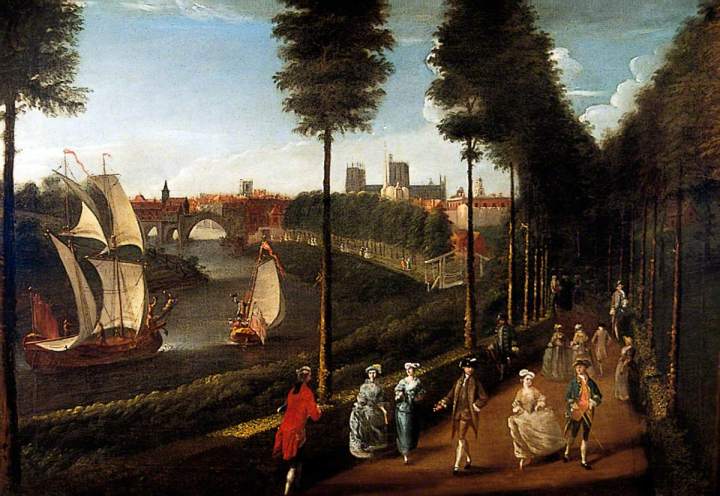
Nathan Drake, The New Terrace Walk, York, ca. 1756, oil on canvas, 76 × 107 cm
(York Art Gallery)
◊ ◊ ◊ ◊ ◊
From the York Georgian Society:
York and the Georgian City: Past, Present, and Future
King’s Manor, York, 18 May 2024
Joint conference presented by the York Georgian Society and the Centre for Eighteenth-Century Studies, University of York
The aim of this conference is to re-evaluate the notion of York as a Georgian city, which was one of the founding premises of the York Georgian Society in 1939. It will examine to what extent York can be described as a ‘Georgian’ city, and whether that label is relevant or meaningful in the present day. Why not a medieval, or a Victorian city? Is ‘Georgian’ merely a paradigm for good taste?
Keynote Presentations
• Rosemary Sweet (University of Leicester), When Did York Become Georgian?
• Madeleine Pelling (historian, writer, and broadcaster), Writing on the Wall: Graffiti, Rebellion and the Making of 18th-Century Britain
Other talks will include Constance Halstead on Anne Lister, Rachel Feldberg on Jane Ewbank, Matt Jenkins on whether York is an archetypical Georgian city, and John Mee on Manchester College, York. The full programme will be posted nearer the event.
Standard ticket prices (which include morning coffee, a light lunch, afternoon tea, and a reception) are £25; with discounted rates available to students (£5) and YGS members and University of York Staff (£15). Tickets can be booked here.
Exhibition | British Vision, 1700–1900, Selected Drawings and Prints

Joseph Farington, Dumbarton Rock from the South, 1788, pen and gray ink and watercolor; sheet: 38 × 68 cm
(New York: The Metropolitan Museum of Art, Purchase, Raymond Lifchez Living Trust Gift, 2014.148)
◊ ◊ ◊ ◊ ◊
Now on view at The Met:
British Vision, 1700–1900: Selections from the Department of Drawings and Prints
The Metropolitan Museum of Art, New York, 7 December 2023 — 5 March 2024
This rotation from the Department of Drawings and Prints celebrates recent additions to the collection by British artists who worked across two centuries, from 1700 to 1900. Landscape is a focus, with the genre becoming closely allied to the growing popularity of watercolor during this period. Around 1760, artists like Paul and Thomas Sandby, Francis Towne, and Thomas Jones began to explore the medium’s expressive potential. In the nineteenth century, dedicated watercolor societies were established and held regular exhibitions to promote their members’ work. Increasingly developed and poetically resonant compositions sought to challenge the preeminence of oil painting.
In this display, watercolors made rapidly out of doors by John Constable and Peter De Wint may be compared to finished compositions by John Brett, Samuel Palmer, and Alfred William Hunt. Travel’s ability to spur creativity is demonstrated by works that respond to sites in Britain, France, Italy, Caucasia, and North Africa. Nature studies, conversely, affirm how foreign flora became increasingly available at home. Finally, the sustained importance of the figure is represented by early chalk and pastel renderings by Joseph Wright of Derby and Allan Ramsay, vibrantly colored later portraits by David Wilkie and John Frederick Lewis, and representations of Black models by Lewis, William Henry Hunt, and Simeon Solomon.
Images of the works are available here»
Exhibition | James Gillray: Characters in Caricature
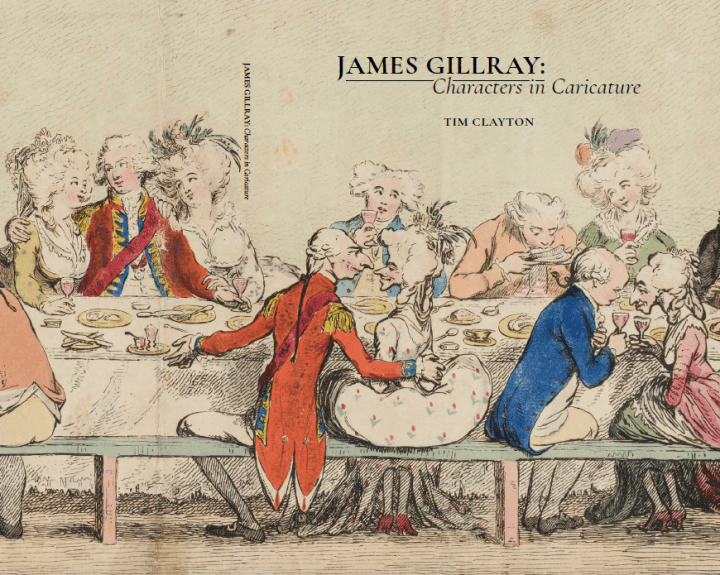
Now on view at Gainsborough’s House (which was just announced as the winner of The Georgian Group’s 2023 award for the ‘Restoration of a Georgian Building in an Urban Context’). . .
James Gillray: Characters in Caricature
Gainsborough’s House, Sudbury, 11 November 2023 — 10 March 2024
Curated by Tim Clayton
James Gillray (1756–1815) was Georgian Britain’s funniest, most inventive, and most celebrated graphic satirist. His work transcends his own time and has continued to influence his successors of the modern age, from David Low to Martin Rowson. Tim Clayton, author of 2022’s definitive biography of James Gillray, brings the master satirist to life in an astonishing, colourful, and at times salacious exhibition, James Gillray: Characters in Caricature. This lively and daring exhibition examines how Gillray exposed the most notorious scandals of his time by focusing on the artist’s principal characters—household names to which he returned to again and again, from Emma Hamilton to the Emperor Napoleon.
Tim Clayton, James Gillray: Characters in Caricature (Sudbury: Gainsborough’s House Society, 2023), ISBN: 978-0946511693, £20.
Print Quarterly, December 2023

J. J. Grandville, after Francisco de Goya, And So Was His Grandfather (‘Hasta su abuelo’), 1834, graphite, over stylus indentations, 79 × 119 mm
(Nancy: Musée des Beaux-Arts)
◊ ◊ ◊ ◊ ◊
The long eighteenth century in the latest issue of Print Quarterly:
Print Quarterly 40.4 (December 2023)
a r t i c l e s
• Thea Goldring, “Beyond Siberia: Drawings by Le Prince for the Histoire Générale des Voyages,” pp. 391–406.
This article examines two signed and dated drawings by Jean-Baptiste Le Prince (1734–1781) that were acquired by the Metropolitan Museum of Art in 2012 and identifies their origins and purpose, proving Le Prince’s hitherto unknown participation in the Histoire Générale des Voyages project. The author discusses their relationship with the commissioned illustrations to Voyage en Sibérie by Jean Chappe d’Auteroche (1728–1769), as well as Le Prince’s contribution to other illustrated books. Throughout the paper, there is a detailed analysis of his common practice to appropriate and modify visual information from earlier sources, reworking them for illustrated travel texts.

Jean-Baptiste Le Prince, Inuit Manner of Dress, 1769, pen and black ink, brush and grey wash, over black chalk, with additions in graphite, 170 × 120 mm (New York: The Metropolitan Museum of Art).
• Paula Fayos-Pérez, “La Fontaine, Goya, Grandville: A Study of Visual and Literary Sources,” pp. 406–419.
This article considers how J.J. Grandville (1803–1847) was deeply influenced by Francisco de Goya y Lucientes (1746–1828), particularly how the plates from the Caprichos inspired the former’s illustrations to Jean de la Fontaine’s Fables and other illustrated books. Incidentally, Goya had also previously derived his sources for the Caprichos and Desastres de la Guerra from earlier illustrations to La Fontaine’s 17th-century text. In doing so, the interconnection of literary and visual sources in both artists is revealed, highlighting their shared concern for public education and masked political undertones.
n o t e s a n d r e v i e w s
• Tim Clayton, Review of David Alexander, A Biographical Dictionary of British and Irish Engravers, 1714–1820 (Paul Mellon Centre for Studies in British Art and Yale University Press, 2021), pp. 442–43.
This review is just as much a praise of David Alexander’s research methods and resourcefulness as it is to the book’s groundbreaking contributions in this field. Clayton highlights the book’s revelations concerning invisible women engravers, who often worked alongside and carried on the business after their husbands had died. In keeping with Alexander’s wide area of focus, the book also includes native and foreign engravers in branches of the trade outside of fine art, leading to a far more expansive and representational dictionary than previous ones.
• Alexandra C. Axtmann, Review of Dominique Lerch, Kristina Mitalaité, Claire Rousseau and Isabelle Seruzier, eds., Les Images de Dévotion en Europe XVIe–XXIe Siècle. Une précieuse histoire (Bibliothèque Beauchesne, 2021), pp. 477–79.
This review summarises a copious book based on papers presented at a two-day conference in Paris in 2019 organized by the Dominican library of Le Saulchoir together with the Académie des Inscriptions et Belles-Lettres. The content offers a European-wide perspective on small printed devotional prints that are often considered ‘kitsch’, enabling them to be studied with a variety of approaches concerning their creation, function, and reception up to the present day.
Call for Papers | In Motion: La Serenissima, Abruzzo, and the Adriatic
From ArtHist.net, which include the Call for Papers in Italian:
Art, Culture, and Politics in Motion: La Serenissima, Abruzzo, and the Adriatic Regions of the Kingdom of Naples, 16th–18th Centuries
Arte, cultura e politica in movimento: La Serenissima, l’Abruzzo e le regioni adriatiche del Regno di Napoli, XVI–XVIII secolo
Università degli Studi di Teramo, 10–11 April 2024
Organized by Martina Leone and Chiara Di Carlo
Proposals due by 4 February 2024
This call for studies stems from the ongoing research of two art historians and PhD students at the University of Teramo. Given the wide historiographical gaps on the subject, they propose to the scientific community, particularly to young researchers, two study days dedicated to the cultural and artistic circulation and the political and economic relations between the Republic of Venice, Abruzzo, and the Adriatic regions of the Kingdom of Naples (16th–18th centuries). There will be special but not exclusive attention to the movement of people, goods, works of art, ideas, collections, and documents, including in relation to the other side of the Adriatic Sea.
The 20th-century historiography has partly neglected the correspondence between Abruzzo and the territories of the Serenissima, instead focusing on the flourishing and proven connections between the Florentine-Aquilan and Roman-Aquilan figurative culture. Since the early 15th century, however, numerous testimonies have been known that confirm the migrations of Venetian artists to the territories of central Italy. In Abruzzo, the work of Jacobello da Fiore in Teramo, the sculpture of Girolamo Pittoni from Vicenza, and valuable 18th-century works by the Venetian artist Vincenzo Damini, prompt us to reconsider the entire situation. To enrich even more the debate are the reverse routes. We are witnessing not only migrations from North to Central Italy, but also displacements from the territories of Abruzzo to those of the Serenissima, as proven by the case of the 17th-century painter of Campli, Giovanni Battista Boncori.
With a chronological arc extended from the 16th to the 18th century, scholars from various fields (art history, modern history, economic history, gender history, book history, etc.) are invited to present unpublished and original contributions that shed light on the scope of Venetian figurative culture in Abruzzo and vice versa; on the exchange of documents and books within the two contexts; on the circulation of people, objects, materials and ideas, such as, the presence of local craftsmen active in both geographical areas. Like the maritime routes, carpenters, goldsmiths, woodworkers, potters, and collectors, represent an excellent starting point of investigation to highlight, once again, the correspondence between economic and social phenomena with artistic practice.
The submission of each contribution must include an abstract of no more than 300 words and a short curriculum vitae et studiorum of the applicant. The proposal must be sent to mleone@unite.it and cdicarlo@unite.it no later than Sunday, 4 February 2024. Scientific contributions will be published after peer review. The organising committee will provide the speakers with food for the entire duration of the conference and special agreements at accommodation facilities of the city of Teramo. The round trip transfer Rome-Teramo is funded for speakers coming from territories outside of Italy.
Possible but not exclusive lines of studies:
• Artistic influences between the Republic of Venice, Abruzzo, and the Adriatic regions of the Kingdom of Naples
• Circulation of people, ideas, and knowledge, also in relation to the Balkan side
• Carpenters, goldsmiths, woodworkers, and potters: the minor arts and the processing of local materials
• Circulation of drawings, engravings, and models
• Circulation of books and texts and the role of printing works
• Transmission of information (political, economic, etc.): correspondence, inventories, and dispatches
• Political and religious propaganda between the Holy See, the Republic of Venice, and the Kingdom of Naples
• The formation of collections of naturalia and mirabilia
• The movement of the economy: trade and commercial routes along the Adriatic
• Circulation of cults and religious men
Scientific Committee
Prof. Massimo Carlo Giannini (University of Teramo – Complutense University of Madrid)
Prof. Luca Siracusano (University of Teramo)
Prof.ssa Francesca Fausta Gallo (University of Teramo)
Prof. Giorgio Fossaluzza (University of Verona)
Prof. Adriano Ghisetti Giavarina (University ‘G. d’Annunzio’ of Chieti-Pescara)
Prof. Michele Maccherini (University of L’Aquila)
Prof. Egidio Ivetic (University of Padua)
New Book | The Art of the Chinese Picture-Scroll
Published by Reaktion and also distributed by The University of Chicago Press:
Shane McCausland, The Art of the Chinese Picture-Scroll (London: Reaktion Books, 2023), 299 pages, ISBN: 978-1789147964, £35 / $50.
 The Chinese picture-scroll, a long painting or calligraphic work held within a horizontal scrolling mount, has been China’s pre-eminent aesthetic format for the last two millennia. This first extended history of the picture-scroll explores its extraordinary longevity, and its adaptability to social, political, and technological change. The book describes what the picture-scroll demands of a viewer, how China’s artists grappled with its cultural power, and how collectors and connoisseurs have left their marks on scrolls for later generations to judge. The return to mass appeal of scrolling—a media technology that seemed long outdated yet persists in our digital age—provides urgent and fascinating context to this book.
Shane McCausland is Percival David Professor of the History of Art at SOAS University of London. His many books include The Mongol Century: Visual Cultures of Yuan China, 1271–1368 (Reaktion Books, 2014), and he has curated numerous exhibitions in Europe, North America, and China.
c o n t e n t s
Introduction
1 On Origins and Uses over the First Millennium
2 Inscribing the Artist and the Collector: The Picture-Scroll in the Song–Liao–Jin Period
3 Handscrolls in Mongol Palaces
4 Musing on Shadows: Reading the Ming Picture-Scroll
5 Qing: Reading the ‘Baroque’ Handscroll
6 Modernist Uses of the Chinese Picture-Scroll
7 The Medium of Silent Poetry in the Late Modern World
References
Further Reading
Acknowledgements
List of Illustrations
Index
New Book | East Asian Aesthetics and the Space of Painting
Isabelle Tillerot’s Orient et ornement: l’espace à l’oeuvre ou le lieu de la peinture was published in 2018; an English edition will soon be available from The Getty:
Isabelle Tillerot, East Asian Aesthetics and the Space of Painting in Eighteenth-Century Europe, translated by Chris Miller (Los Angeles: Getty Research Institute, 2024), 272 pages, ISBN: 978-1606067970 (paperback), $70.
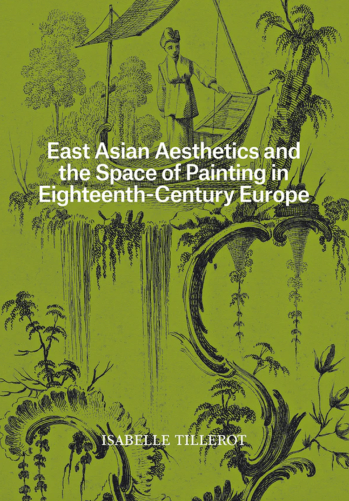 This volume offers the first critical account of how European imports of East Asian textiles, porcelain, and lacquers, along with newly published descriptions of the Chinese garden, inspired a revolution in the role of painting in early modern Europe. With particular focus on French interiors, Isabelle Tillerot reveals how a European enthusiasm for East Asian culture and a demand for novelty transformed the dynamic between painting and decor. Models of space, landscape, and horizon, as shown in Chinese and Japanese objects and their ornamentation, disrupted prevailing design concepts in Europe. With paintings no longer functioning as pictorial windows, they began to be viewed as discrete images displayed on a wall—and with that, their status changed from decorative device to autonomous work of art. This study presents a detailed history of this transformation, revealing how an aesthetic free from the constraints of symmetry and geometrized order upended paradigms of display, enabling European painting to come into its own.
Isabelle Tillerot is an independent scholar of eighteenth-century French art.
Exhibition | The Palace of Versailles and the Forbidden City
From the press release (6 March 2023), from the Château de Versailles:
The Palace of Versailles and the Forbidden City: French-Chinese Relations in the 18th Century
Palace Museum, Forbidden City, Beijing, 1 April — 30 June 2024
Hong Kong Palace Museum, 18 December 2024 — 4 May 2025

Fontaine à parfum, porcelaine à glaçure céladon craquelé et céramique brune, Jingdezhen, début de l’époque Qianlong (1736–1795), monture en bronze doré, Paris, vers 1743 (Château de Versailles).
Initially scheduled for 2020 and postponed due to the pandemic, the exhibition entitled The Palace of Versailles and the Forbidden City: French-Chinese Relations in the 18th Century will run from 1 April 2024 at the Forbidden City’s Palace Museum. On 6 April 2023, Palace of Versailles Chair Catherine Pégard and Xudong Wang, Chair of the Forbidden City’s Palace Museum, met at the Great Hall of the People in Beijing to reiterate their enthusiasm in seeing this joint project through to completion before Presidents Xi and Macron.
The Palace of Versailles is honoured to be working with the Forbidden City’s Palace Museum in Beijing in organising this exhibition surrounding the relationship between France and China in the 18th century and due to run from 1 April to 30 June 2024. The exhibition is a more in-depth version of the one that was rolled out at the Palace of Versailles in 2014 to mark fifty years of diplomatic relations between the two countries, initially sparked by General de Gaulle on 27 January 1964.
Louis XIV put in place in the context of his relations with Emperor Kangxi, which took the form of initiatives such as French Jesuits dispatched to China in 1685 to serve at the Chinese court as mathematicians to the King. This process paved the way for the two nations to begin forging a relationship built on mutual trust and admiration, one that remains unfamiliar to many, and lasted until the 18th century. This special diplomatic relationship and mutual respect helped usher in French appreciation for modern China and Chinese artistry.
In France, the court’s love affair with China and Chinese art shines through in a variety of different ways, and four key phenomena: importing Chinese artworks and pieces; altering certain imported artworks, notably by adding gilt-bronze frames to porcelain pieces and using lacquered panels on French furniture; imitating Chinese products, such as the frenzied quest to track down the secret to making kaolin porcelain; and Chinese art’s marked influence on French art, particularly in the field of decorative arts. The exhibition will illustrate how Chinese art served as a bottomless source of inspiration for French artists and intellectuals, in everything from painting, art objects, and interior design to architecture, landscape design, literature, music and the sciences.
Meanwhile, in the Chinese court, many French Jesuits also followed after the arrival of the ‘Mathematicians of the king’ sent by Louis XIV in China, some of whom served the court for a long time. With them as the intermediary, French culture had an important influence on many fields such as science, art, architecture, medicine, mapping and so on in the Qing court. Therefore, juxtaposed with French Exhibits in the Exhibition are also clocks, scientific instruments, prints, porcelain, bronzes, books, and other objects from the Palace Museum collection, directly reflecting the achievements of exchanges and cultural exchanges between the two sides.
The exhibition in Beijing will bring together a selection of pieces taken from the Palace of Versailles and Palace Museum collections, designed to serve as broader examples of the veritable fascination for Chinese art that took root at the court of Versailles and among French enthusiasts. It showcases the efforts and achievements made by China and France to achieve mutual understanding and cultural exchanges in the 18th century, and vividly restores the splendid cultural and artistic exchanges between the two countries for more than a century.
Exhibition commissioned by Marie-Laure de Rochebrune, Curator at the Palace of Versailles, and Guo Fuxiang, Curator at the Palace Museum.
◊ ◊ ◊ ◊ ◊
Note (added 18 December 2024) — The posting was updated to include the Hong Kong venue.
New Book | The Borders of Chinese Architecture
From Harvard UP:
Nancy Shatzman Steinhardt, The Borders of Chinese Architecture (Cambridge: Harvard University Press, 2022), 448 pages, ISBN: 978-0674241015, $57.
 An internationally acclaimed expert explains why Chinese-style architecture has remained so consistent for two thousand years, no matter where it is built.
For the last two millennia, an overwhelming number of Chinese buildings have been elevated on platforms, supported by pillars, and covered by ceramic-tile roofs. Less obvious features, like the brackets connecting the pillars to roof frames, also have been remarkably constant. What makes the shared features more significant, however, is that they are present in Buddhist, Daoist, Confucian, and Islamic milieus; residential, funerary, and garden structures; in Japan, Korea, Mongolia, and elsewhere. How did Chinese-style architecture maintain such standardization for so long, even beyond China’s borders?
Nancy Shatzman Steinhardt examines the essential features of Chinese architecture and its global transmission and translation from the predynastic age to the eighteenth century. Across myriad political, social, and cultural contexts within China and throughout East Asia, certain design and construction principles endured. Builders never abandoned perishable wood in favor of more permanent building materials, even though Chinese engineers knew how to make brick and stone structures in the last millennium BCE. Chinese architecture the world over is also distinctive in that it was invariably accomplished by anonymous craftsmen. And Chinese buildings held consistently to the plan of the four-sided enclosure, which both afforded privacy and differentiated sacred interior space from an exterior understood as the sphere of profane activity. Finally, Chinese-style buildings have always and everywhere been organized along straight lines. Taking note of these and other fascinating uniformities, The Borders of Chinese Architecture offers an accessible and authoritative overview of a tradition studiously preserved across time and space.
Nancy Shatzman Steinhardt is Professor of East Asian Art and Curator of Chinese Art at the University of Pennsylvania and the author of Chinese Architecture: A History (2019). Her work has been supported by the Guggenheim Foundation, Getty Foundation, National Endowment for the Humanities, and the American Philosophical Society.
c o n t e n t s
Preface
Introduction: The Borders Problem
1 Chinese Architecture before China
2 Han
3 Architecture before Reunification
4 Seeing the Sixth Century as the Seventh and Eighth
5 Tang Internationalism
6 Defining Chinse Architecture and Borders during Liao
7 Western Xia, Song, Japn, Jin
8 A Revisionist History of Yuan Architecture
9 Ming
10 The Long Eighteenth Century
Afterword










 Enfilade
leave a comment