Online Lecture | Susan Lahey on Chinese Porcelain in Canada
From Events in the Field:
Susan Lahey | Chinese Porcelain in Canada in the 18th and 19th Centuries: Examples in Nova Scotia and Quebec Collections
Online, Canadian Society of Decorative Arts, 3 April 2022, 3pm (EDT)
 Did you know there are more than 69,000 fragments of Chinese blue and white porcelain in the archaeological collection of Nova Scotia’s Fortress of Louisbourg? Or that Chinese famille rose porcelains were imported to Canada from the famous Imperial kilns of Jingdezhen? Join Asian art expert Susan Lahey, MA, ISA CAPP, for a visually engaging presentation exploring Chinese porcelain in museum collections from Quebec and Nova Scotia. Not only will she examine the history of when and how these pieces arrived in Canada, but also provide a brief background on the development of blue and white in China. The significance of these porcelain wares and the symbolism of decoration depicted on them will be discussed in a way that is entertaining to a broad audience of both Western and Chinese porcelain connoisseurs alike. Sunday, 3 April 2022, 3pm (EDT).
Register here»
Susan Lahey, MA, ISA CAPP, is a certified, professional appraiser with more than two decades of experience, specializing in Chinese decorative and fine art. Ms. Lahey holds an Honours BA in Chinese Studies from the University of Toronto; an MA in Classical Chinese Literature from the University of British Columbia; and a Post-Graduate Diploma with Distinction in Asian Art from the School of Oriental & African Studies/Sotheby’s in London, England.
CSDA/CCAD Sundays are regular online events hosted by the Canadian Society of Decorative Arts (csda-ccad.org) featuring a wide range of makers, collectors and other topics of interest to lovers of the decorative arts and crafts.
Conference | Fragile Splendour
From Haughton International:
Fragile Splendour: Prestige, Power, and Politics from the Medici to the Present Day
The British Academy, Carlton House Terrace, London, 29–30 June 2022
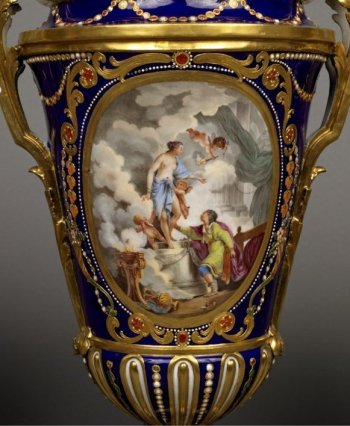
Vase ‘E de 1780’ Sèvres Porcelain Manufactory, 1781 (London: Wallace Collection C334 004).
We have great pleasure in announcing that this year’s Haughton International Seminar, entitled Fragile Splendour: Prestige, Power & Politics from the Medici’s to the Present Day, will again take place at The British Academy, 11 Carlton House Terrace, on Wednesday 29th and Thursday 30th June. Each year we draw together eminent international speakers to share their knowledge and passion with an appreciative audience. Information regarding this exciting seminar can be viewed on our website here. Tickets can be purchased online via this link. We look forward to welcoming you in June.
Cost of the two-day seminar: £110 (inc VAT). Cost of the two-day seminar including champagne reception and dinner at The Athenaeum on Wednesday, 29th June: £190 (inc VAT). Student tickets for the two-day seminar (on production of ID): £60 (inc VAT). Booking in advance through the website is essential due to limited numbers. The box office opens on Tuesday, 1st March. Below is a preliminary programme (subject to change).
W E D N E S D A Y , 2 9 J U N E 2 0 2 2
8.45 Registration
9.15 Welcome Address
9.30 Morning Session
• Gregory Irvine — The Art of War, the Arts of Peace: Patronage and Production of Luxury Crafts for the Samurai
• Timothy Schroder — Diplomatic Gifts in Gold
• Mathieu Deldicque — Prestige Despite Disfavour: The Prince de Condé and Chantilly Porcelain
• Helen Jacobson — The Art of Giving: Diplomacy at the Bourbon Court
1.00 Lunch Break
2.15 Afternoon Session
• Timothy Wilson — The Medici and Maiolica in the Time of the Florentine Republic
• Amin Jaffer — Attributes of Splendor: Jewels and the Projection of Power in Royal India
3.55 Face-to-Face: Rosalind Savill in Conversation with Brian Haughton
4.45 Q&A Session
6.30 Drinks Reception at The Athenaeum Club (for dinner guests only)
7.15 Dinner (dress code is smart with ties for gentlemen; no denim or training shoes)
T H U R S D A Y , 3 0 J U N E 2 0 2 2
9.00 Arrival
9.15 Morning Session
• Samuel Wittwer — Polishing the Crown: The Influence of Artists and Scholars on Royal Berlin Porcelain Orders
• Leslie Greene Bowman — Thomas Jefferson at Monticello: Prestige, Power, and the ‘Peculiar Institution’ of Slavery
• Eva Stroeber — For Sultans, Grand Dukes, and German Princes: Chinese Porcelain as Diplomatic Gift
• Rose Kerr — How Chinese Emperors Used Ceramics to Support their Power and Prestige
1.00 Lunch Break
2.15 Afternoon Session
• Johann Kräftner — Rebuilding a Collection: 20 Years of Working with Palaces, Paintings, Sculpture, Furniture, and Porcelain
• Julia Weber — Augustus the Strong and the ‘Red Porcelain’ from Saxony
• Judy Rudoe — Jewellery, Politics, and National Identity: Princess Alexandra and Her Wedding Gifts
4.30 Q&A Session
New Book | Chiswick House Gardens
From Liverpool UP:
David Jacques, Chiswick House Gardens: 300 Years of Creation and Re-creation (Liverpool: Liverpool University Press, 2022), 248 pages, ISBN: 978-1800856219, £40.
 The grounds at Chiswick House are amongst the most iconic of all the historic gardens of Europe. In the 1720s they reflected Lord Burlington’s innovative ideas on Palladianism and antique gardens, whilst the area transformed by William Kent to give a rustic appearance in the early 1730s has been recognised as one of, or perhaps the, birthplace of the landscape garden. The grounds were periodically brought to the forefront of taste, reaching another high point as the venue for spectacular garden parties under the 6th Duke of Devonshire. As a garden of many periods it has given rise to passionate national debates since World War II on the principles of restoration, and as a public park it has been an important project assisted by the National Lottery Heritage Fund. Its renewed high state of keeping and its tranquil beauty belies its ‘deep’ history of intellectual debate, social tensions and practical difficulties.
The book concentrates on the four main periods when Chiswick gardens were in the national spotlight, two when being in the forefront of taste and two concerning the restorations, the first being in the 1950s when the whole question of garden restoration was entirely new. The second restoration, on and off since 1988 intersects with the development of a philosophical stance and national policy on the restoration of parks and gardens. There is much of interest for art and architectural historians, garden historians, social historians and those local and international visitors who enjoy the finest public park in West London.
David Jacques is an independent scholar and part-time lecturer at the Institute for Historical Research.
C O N T E N T S
Foreword
Acknowledgements
Image Credits
About the Book
Abbreviations
1 ‘His Lordship’s Fine Genius’
2 ‘A Picture of Watteau’
3 English Palladianism
4 The Public Park Initiative
Appendix A: The Owners of Chiswick House Gardens
Appendix B: The Head Gardeners at Chiswick House
Appendix C: Chronology
Notes
Bibliography
Index
Print Quarterly, March 2022
The long eighteenth century in the latest issue of Print Quarterly:
Print Quarterly 39.1 (March 2022) . .
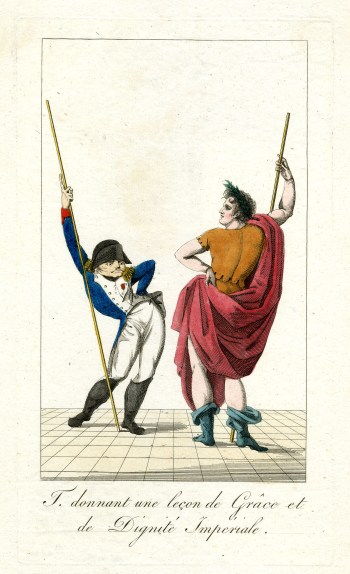
Charles Elie, T[alma] donnant une leçon de grâce et de dignité impériale (T[alma] giving a lesson in grace and imperial dignity), 1814, hand-coloured etching, 244 x 142 mm (London: British Museum).
A R T I C L E S
Antony Griffiths, “The Publication of Caricatures in Paris in 1814 and 1815, Part I: The Established Printsellers, Genty and Martinet,” pp. 31ff.
Two articles by Antony Griffiths on ‘The Publication of Caricatures in Paris in 1814 and 1815’—Part 1 in the March 2022 issue and Part 2 forthcoming—discuss the publication of caricatures in Paris during two years in which there were four regimes in power, and two occupations by foreign armies—a period which led to an unprecedented outpouring of social and political satire. Many works of great quality were produced, but most have only a title and do not reveal the names of the producers. The articles discuss how publishers and artists dealt with the political upheavals and identify some of the many participants who entered the field in these years. Part 1 deals with the caricatures published by members of the established print trade in Paris, and in particular Aaron Martinet and the newcomer Genty, who has previously been misidentified.
R E V I E W S
• Mark McDonald, Review of Juan Agustín Ceán Bermúdez, El Churriguerismo: discurso inédito (Alicante: Biblioteca Virtual Miguel de Cervantes, 2019), p. 79.
• Diana Greenwald, Review of Madeleine Viljoen, Nina Dubin and Meredith Martin, Meltdown! Picturing the World’s First Bubble Economy (Turnhout: Harvey Miller, 2020), p. 80.
• Ann V. Gunn, Review of John Bonehill, Anne Dulau Beveridge, and Nigel Leask, eds., Old Ways New Roads: Travels in Scotland 1720–1832 (Edinburgh: Birlinn, 2021), p. 81.
• Marcia Reed, Review of Troy Bickham, Eating the Empire: Food and Society in Eighteenth-Century Britain (London: Reaktion, 2020), p. 84.
• Nigel Tattersfield, Review of Graham Williams, Thomas Bewick Engraver & the Performance of Woodblocks (Kent: Florin Press, 2021), p. 86.
• Janis A. Tomlinson, Review of Mark McDonald et al., Goya’s Graphic Imagination (New York: The Metropolitan Museum of Art, 2021), p. 102.
Exhibition | A Shared Passion for Drawing
From:
Le partage d’une passion pour le dessin
Palais des Beaux-Arts, Paris, 22 March — 30 April 2022

Jean-Baptiste Greuze, Head of a Frightened Child, red chalk on beige paper (Beaux-Arts de Paris, acquired in 2013).
L’exposition dévoile un ensemble de 90 dessins, entrés dans les collections de l’École grâce à la générosité de l’association « Le Cabinet des amateurs de dessins des Beaux-Arts de Paris ». Le parcours, organisé à l’occasion des 15 ans de l’association, est présenté par écoles (italienne, nordique et française) à travers les siècles. Des œuvres d’Eugène Delacroix, Jean-Honoré Fragonard, Jean-Baptiste Greuze, Gerrit Van Honthorst, Giuseppe Penone ou encore Simone Peterzano sont ainsi à découvrir.
Les Beaux-Arts de Paris conservent la plus belle collection de dessins de France, après celle du musée du Louvre. Cette collection continue aujourd’hui encore de s’enrichir grâce à une politique d’acquisitions conçue à des fins pédagogiques ; ainsi que par des dons de professeurs, de jeunes artistes, et de l’association « Le Cabinet des amateurs de dessins des Beaux-Arts de Paris ».
Le partage d’une passion pour le dessin (ENSBA, 2017), 282 pages, ISBN: 978-2840565093, 39€.
5th Annual Ricciardi Prize from Master Drawings
From Master Drawings:
Fifth Annual Ricciardi Prize from Master Drawings
Submissions due by 15 November 2022
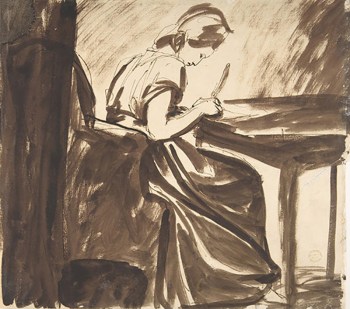
George Romney, Lady Seated at a Table (recto); pen and brown ink, brush and brown wash (NY: The Metropolitan Museum of Art, 11.66.3).
Master Drawings is now accepting submissions for the Fifth Annual Ricciardi Prize for Young Scholars. The winner will receive a cash award of $5,000. The prize is given for the best new and unpublished article on drawings (of any period) by a scholar under the age of 40. The winning submission will be published in a 2023 issue of Master Drawings and will be featured at our annual symposium.
For additional information about essay requirements and how to apply, visit the Master Drawings website, where you can also learn about the broad range of research by past winners of the prize.
Exhibition | Piranesi: A Dream of Stone and and Ink
Now on view at the Mazarin Library:
Piranèse et son empreinte : un rêve de pierre et d’encre
Bibliothèque Mazarine, Paris, 1 March — 14 May 2022
Curated by Yoann Brault with Olivier Thomas and Érik Desmazières
 Figure emblématique de cette « Académie de l’Europe » qu’est Rome au 18e siècle, Piranèse (1720–1778) occupe une place singulière dans notre héritage artistique et notre culture visuelle. Certes, il n’est pas seul à avoir fait accéder l’architecture figurée, réelle ou fictive, à un genre de plein droit. Mais cet artiste au génie impétueux et tourmenté, par la souplesse de sa technique, par ses effets dramatiques dans l’arrangement des lumières, ses disproportions et perspectives inattendues, a produit un univers visuel d’une puissance poétique inégalée.
Piranèse a nourri la veine française du néoclassicisme, et les efforts redoublés de ses fils ont permis de diffuser son oeuvre et d’étendre son influence depuis Rome ou Paris. Mais, après un demi-siècle de fascination, les productions de son génie n’ont pas échappé à l’usure de la curiosité et du goût. Dès la Restauration, les artistes du nouveau siècle se détournent de son empreinte. Bien qu’ici ou là tel amateur célèbre encore la « vigueur » de sa manière, on brocarde bientôt un oeuvre « improvisé avec facilité par l’imagination plutôt que produit par l’étude et par le temps » (Alfred Maury).
Cette déprise n’est pourtant pas totale. La poésie de ses planches, qui a tant et si précocement influencé l’art et la littérature préromantique, fait de Piranèse un passeur inopiné et, de ses Prisons, un motif obsédant que l’on retrouve en Angleterre puis en France, de Thomas De Quincey à Théophile Gautier. Il faut attendre l’entre-deux-guerres pour que le graveur recouvre la faveur des spécialistes, du public et des artistes qui y puisent à nouveau. Peut-être parce que son exploration inquiète du passé, son attrait pour le sublime et la démesure, pour la perte et la détresse, rejoignent les obsessions de notre temps.
Exposition organisée par les bibliothèques Mazarine et de l’Institut de France
Commissariat : Yoann Brault, avec la collaboration d’Olivier Thomas (bibl. de l’Institut)
Conseiller artistique et scientifique : Érik Desmazières (Académie des Beaux-Arts)
New Book | Animating the Antique
From Penn State UP:
Sarah Betzer, Animating the Antique: Sculptural Encounter in the Age of Aesthetic Theory (University Park: Pennsylvania State University Press, 2022), 272 pages, ISBN: 978-0271088839, $125.
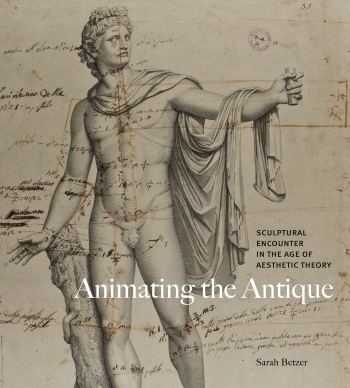 Framed by tensions between figural sculpture experienced in the round and its translation into two-dimensional representations, Animating the Antique explores enthralling episodes in a history of artistic and aesthetic encounters. Moving across varied locations—among them Rome, Florence, Naples, London, Dresden, and Paris—Sarah Betzer explores a history that has yet to be written: that of the Janus-faced nature of interactions with the antique by which sculptures and beholders alike were caught between the promise of animation and the threat of mortification.
Examining the traces of affective and transformative sculptural encounters, the book takes off from the decades marked by the archaeological, art-historical, and art-philosophical developments of the mid-eighteenth century and culminates in fin de siècle anthropological, psychological, and empathic frameworks. It turns on two fundamental and interconnected arguments: that an eighteenth-century ontology of ancient sculpture continued to inform encounters with the antique well into the nineteenth century, and that by attending to the enduring power of this model, we can newly appreciate the distinctively modern terms of antique sculpture’s allure. As Betzer shows, these eighteenth-century developments had far-reaching ramifications for the making and beholding of modern art, the articulations of art theory, the writing of art history, and a significantly queer Nachleben of the antique.
Bold and wide-ranging, Animating the Antique sheds light upon the work of myriad artists, in addition to that of writers ranging from Goethe and Winckelmann to Hegel, Walter Pater, and Vernon Lee. It will be especially welcomed by scholars and students working in eighteenth- and nineteenth-century art history, art writing, and art historiography.
Sarah Betzer is Professor of Art History at the University of Virginia and the author of Ingres and the Studio: Women, Painting, History, also published by Penn State University Press.
Exhibition | Antoine Coypel and the Theater of Troy
Now on view at the Musée des Beaux-Arts de Tours:
Le Théâtre de Troie: Antoine Coypel, d’Homère à Virgile
Musée des Beaux-Arts de Tours, 22 January — 17 April 2022
 L’exposition, présentée au musée des Beaux-Arts de Tours, en partenariat avec la Bibliothèque nationale de France, est une invitation à redécouvrir Antoine Coypel (1661–1722), peintre du roi Louis XIV et du régent Philippe d’Orléans. Aucune exposition monographique concernant Coypel n’a vu le jour jusqu’à présent, mais la connaissance de l’artiste a été récemment enrichie grâce à l’apparition sur le marché de l’art d’oeuvres inédites, à la redécouverte de tableaux que l’on croyait perdus et à la restauration de décors monumentaux, tel le plafond de l’hôtel d’Argenson, sur le point d’être révélé au public aux Archives Nationales. Sans prétendre à l’exhaustivité, l’exposition est une invitation à redécouvrir la personnalité attachante et la carrière prolifique d’Antoine Coypel, ainsi que les grands textes de l’Antiquité, d’Homère et de Virgile, ayant nourri son inspiration.
Autour de La Colère d’Achille et des Adieux d’Hector et Andromaque de Tours, une cinquantaine d’oeuvres des XVIIIᵉ et XIXᵉ siècles (tableaux, estampes, dessins, sculptures, objets d’art et planches gravées) sont réunies, grâce au prêt exceptionnel de la Bibliothèque nationale de France, du château de Versailles, des musées du Louvre, de Rennes, d’Angers, d’Arles, du Mobilier national et de l’École des Beaux-Arts de Paris.
Point d’orgue de l’exposition, la galerie d’Énée du Palais-Royal, chef-d’oeuvre d’Antoine Coypel aujourd’hui disparu, renaît au travers d’estampes spectaculaires de la Bibliothèque nationale de France. Les recherches approfondies menées pour reconstituer ce grand décor ont également permis de concevoir une maquette numérique de la galerie, en partenariat avec le musée Fabre de Montpellier, qui offre pour la première fois une proposition de reconstitution virtuelle en 3D très aboutie.
Une riche programmation culturelle (cycle de conférences, visites, spectacles de danse, musique, théâtre, cycle de péplums à la cinémathèque de Tours, cours d’histoire de l’art tout public, etc.) accompagnera toute la durée de cette exposition.
Le théâtre de Troie: Antoine Coypel, d’Homère à Virgile (Paris: Lienart éditions, 2022), 192 pages, ISBN: 978-2359063547, 23€.
Exhibition | La Fabrique des passions
Now on view at the Musée des Beaux-Arts de Tours:
La Fabrique des passions
Musée des Beaux-Arts de Tours, 17 December 2021 — 28 March 2022
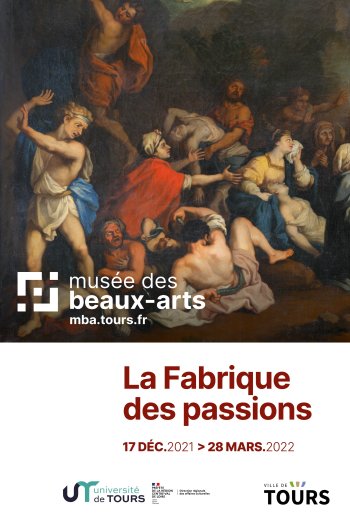 À partir du Serpent d’Airain (anonyme, 17ᵉ siècle) d’après Charles Le Brun, l’exposition La Fabrique des passions propose d’appréhender ce thème dans les arts du 17ᵉ au 19ᵉ siècle. Conformément à la pensée de René Descartes (Traité des passions, 1649), dont Charles Le Brun s’est inspiré, la passion—aujourd’hui synonyme d’émotion—se traduit comme l’expression incontrôlable d’un état affectif qui soumet l’âme et le corps. En 1668, Charles Le Brun, peintre du roi Louis XIV, donne une conférence à l’Académie royale de peinture et de sculpture dans laquelle il définit des modèles types d’expression des différentes passions.
Le parcours de l’exposition construit à partir d’oeuvres issues des réserves comporte trois entrées thématiques :
• les origines des passions dans les sources bibliques et mythologiques
• le théâtre comme nouvelle source d’inspiration des passions héroïques
• l’individualité des passions à travers les portraits et les études de têtes.
Origines des passions
Les origines des passions, observées à la fois d’un point de vue théorique, esthétique, religieux et historique, sont illustrées par trois oeuvres. Le Serpent d’Airain d’après Charles Le Brun, oeuvre maîtresse de l’exposition, présente les prémisses de la codification des passions. Les émotions—telles que l’admiration, l’effroi ou le ravissement—sont mises au service de la narration pour toucher le spectateur. Outre le travail sur l’expressivité des visages et des corps, l’intensité des couleurs participe à cette exaltation des émotions. Les origines des passions sont explorées à travers les thèmes fondateurs de la Bible. Aussi, pour mieux émouvoir, les artistes puisent-ils dans la culture du spectateur. Caïn et Abel (anonyme, 19ᵉ siècle), qui décrit le premier meurtre de l’histoire de l’humanité dans l’Ancien Testament, montre la brutalité de la passion débordante assimilée à la jalousie. La mythologie fournit d’autres sujets iconographiques propices à la mise en scène des passions à l’instar d’histoires légendaires de la Rome antique. L’Enlèvement d’une Sabine (anonyme, 19ᵉ siècle) d’après le chef-d’oeuvre du maniériste Jean de Bologne (16ᵉ siècle), sert ainsi de support plastique à la fabrique moderne d’une nouvelle esthétique des passions. Ici, la peur et la violence charnelle sont évoquées avec force.
Passions héroïques
Le théâtre, qui revisite la culture littéraire classique et savante aux 17ᵉ et 18ᵉ siècles, s’impose comme une nouvelle source d’inspiration de la figuration des passions héroïques. Les scènes de groupe, comme Les Funérailles de Pallas d’après Antoine Coypel (Louis Desplaces, 17ᵉ siècle), présentent une multitude de personnages qui incarnent le deuil, la tristesse et la désolation. Avec sa composition du dessin Briséis enlevée à Achille (18ᵉ siècle), Gaudar de Laverdine sublime les passions par un jeu de théâtralité des corps et des mouvements. Cléopâtre (huile sur toile, anonyme, 17ᵉ siècle) représente quant à elle la passion héroïque des femmes fortes, tout comme Polyxène (gouache, Guillaume Goudin, 18e siècle), princesse troyenne qui se sacrifie à la suite de la disparition de son bien-aimé.
Portraits et passions
Les portraits favorisent la focalisation progressive sur l’individualisation des émotions. À la suite du concours de têtes ouvert à l’initiative du Comte de Caylus (membre de l’Académie né en 1692 et mort en 1765), les études se consacrent désormais à la seule expressivité du visage. Jean-Baptiste Greuze apparaît comme l’archétype de l’artiste traitant de la tête d’expression (Tête de jeune femme, 18ᵉ siècle, copie), thème qui eut un grand succès à Paris et qui trouva également un écho à Tours comme en témoigne l’oeuvre d’Auguste Vinchon (Étude de femme, épisode de l’histoire de Venise, 19ᵉ siècle). L’exposition se conclut par un dessin d’Étienne-Pierre-Adrien Gois (plume et encre, 2ᵉ moitié du 17e siècle). L’autoportrait central, affichant une profonde expression méditative et introspective, est entouré de douze visages féminins et masculins, montrant la diversité des passions humaines. Les caricatures associées aux citations apportent un caractère comique et moralisateur à la lecture de l’image.
Entre théorie académique, théâtralisation et interprétation plus personnelle de la palette des émotions, ces oeuvres illustrent donc la manière dont les artistes se sont confrontés à la difficile codification des passions.
Commissariat
Andy Bodin, Alice Brozzoni, Emeline Chassine, Zoé Machado-Formiga, Marine Nabon, Elodie Poinha, Jurgen Poirier, Clara Roig, étudiant.e.s en Master 2 histoire de l’art, séminaire Pratique de l’exposition, à l’Université de Tours.
Lucie Gaugain, Maître de conférences en Histoire de l’art médiéval à l’Université de Tours, membre du CeTHiS, EA 6298
Delphine Rabier, ATER en Histoire de l’art moderne à l’Université de Tours, chercheur associé au CESR, UMR 7323
Coordination
Hélène Jagot, directrice des Musées-Château de Tours
Virginie Dansault, médiatrice, chargée des publics
Jessica Degain, conservatrice du patrimoine en charge des collections XVIIᵉ–XIXᵉ siècles
Catherine Pimbert, régisseuse des collections










leave a comment