New Book | Watteau, Gersaint, et le Pont Notre-Dame
From Presses Universitaires du Septentrion:
Youri Carbonnier, Sophie Raux, Christophe Renaud, François Rousselle, eds., avec Youri Carbonnier, Laura Louvrier-Masquelier, Nicolas Moucheront, Mylène Pardoen, Sophie Raux, Sophie Reculin, Christophe Renaud, François Rousselle, Rémi Synave, Watteau, Gersaint, et le pont Notre-Dame à Paris au temps des Lumières: Les enjeux d’une restitution numérique (Villeneuve-d’Ascq: Éditeur Presses Universitaires du Septentrion, 2021), 208 pages, ISBN: 978-2757432839, 22€. Also available in a PDF edition.
 Le pont Notre-Dame fut l’un des ponts habités les plus extraordinaires de Paris. Son histoire reste attachée à un événement : la présentation éphémère en façade de la boutique de Gersaint de la fameuse Enseigne peinte par Watteau en 1720. À quoi ressemblait ce pont monumental avant la destruction de ses habitations? Pourquoi L’Enseigne de Gersaint eut-elle un tel retentissement? Comment se projeter dans cet univers si étranger à notre expérience actuelle des ponts parisiens? Comment dépasser l’image mentale que chacun peut se faire à partir des sources qui nous sont parvenues? Autant de questions qui ont motivé cette restitution numérique du pont Notre-Dame. En s’attachant à restituer le sens des espaces et des volumes de son architecture disparue, ainsi qu’à rendre sensible l’ambiance lumineuse et sonore de son environnement, ses auteurs offrent une exploration inédite en 5D du pont, ainsi qu’une réflexion sur l’apport des technologies numériques à la recherche historique.
S O M M A I R E
Sophie Raux
• Introduction : Un dialogue entre présent et passé
Youri Carbonnier
• Le pont Notre-Dame
• Des maisons sur un pont
• La pompe du pont Notre-Dame
Sophie Raux
• Le pont Notre-Dame et le commerce d’art à Paris
Christophe Renaud
• Restitutions historiques et photoréalisme
• Notions de simulation d’éclairage
Sophie Reculin
• Ombres et lumières sur le pont Notre-Dame : la première simulation de l’éclairage public durant l’époque moderne
Nicolas Moucheront
• L’histoire du pont Notre-Dame au XVIIIe siècle : enjeux professionnels et épistémologiques
François Rousselle
• La restitution du pont Notre-Dame en 3D temps réel
Mylène Pardoen
• De l’ambiance sonore
Sophie Raux
• De quoi L’enseigne de Gersaint était-elle l’image ?
• Jean Antoine Watteau (Valenciennes, 1684 – Nogent-sur-Marne, 1721)
• Edme-François Gersaint (Paris, 1694 – Id., 1750)
Laura Louvrier, François Rousselle, Rémi Synave
• Restituer l’intérieur de la boutique de Gersaint : questions méthodologiques et techniques
François Rousselle
• Des applications adaptées aux supports de restitution
Youri Carbonnier
• Paysage restitué, paysage recréé, paysage rêvé ?
• Apports et limites de la restitution 5D du pont Notre-Dame
Index des noms
Liste des auteurs
Remerciements
◊ ◊ ◊ ◊ ◊
Also see, Sophie Raux, “Virtual Explorations of an 18th-Century Art Market Space: Gersaint, Watteau, and the Pont Notre-Dame,” Journal18, Issue 5 Coordinates (Spring 2018), https://www.journal18.org/2542. DOI: 10.30610/5.2018.3
Conference | Body and Power: The Body in Political Art
From ArtHist.net:
Corps et pouvoir: le corps dans l’art politique des temps modernes
Body and Power: The Body in Political Art in Early Modern Times
Online and In-person, Hôtel d’Assézat, Toulouse, 6–8 October 2021
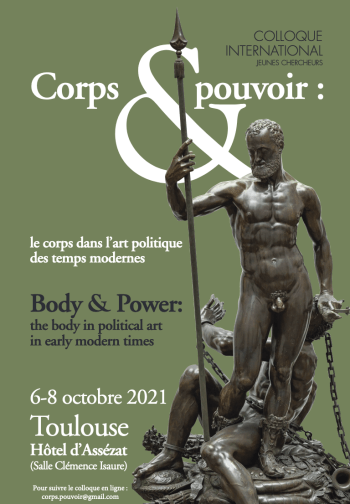 During the Renaissance, it became common to see bodies—both male and female—transformed and strategically exploited through artworks. Real or mythical, aged or juvenile, often bearers of a complex imaginary, they were conceived and perceived as metaphors and regularly used as propaganda devices. In early modern times, the representation of the body had a fundamental place in the process of exaltation and legitimation of the elite.
‘Body and Power’ tends to emancipate from the figure of the prince—although central but not exclusive. Rulers relied on the idealisation of their own person to reinforce their pre-eminence. However, if their bodies were staged and glorified within their portraits—as an essential element to reassure or impress—they could also be juxtaposed with others. The bodies of these secondary figures, whether enemies or allies, could be used to intensify the message, either within or outside of their representations. Thus, all bodies could be evoked: those of the elites as well as those of auxiliaries, intended to support the idea of power from a semantic point of view.
Elements that make this power concrete, visible, and palpable will also be examined. Apparent objects covered the bodies to transcend them, while in response, bodies in turn covered the objects, all of which articulated a substantial discourse that must be deciphered. These same bodies adorned the space of palaces and other places where authority was exercised. Within both perennial and ephemeral decorations, they gave rhythm to the facades through anthropomorphic orders, populated niches, adorned the porticoes of triumphal entrances, inhabited fountains, staircases, fireplaces, etc. Here again, each of these expressions must give rise to a reflection on its context of creation and exhibition, as well as its intentions.
The programme revolves around the inherent relationship between the body and the polysemy of the terms ‘power’ and ‘potency’, referring to ability as well as strength and authority. Showing a body is an effective way to subjugate and convince. The posture, the gestures, the musculature attributed to it, the sensuality, the grace, the elegance that emerge from it, contribute to translate ideas. The body is both subordinated and esteemed by and for power and, like a mirror effect, it is also through its aesthetic, emotional, and symbolic power that it honours and valorises the powerful.
If for a long time the biblical reference served as a pretext for the exhibition of these bodies, the reappropriation of ancient culture brought them out of the private and sacred spheres and into the public space. This development reflects a widespread understanding of the hermeneutic power, the expressive and persuasive range of the body, whose evocative power is developed in relation to the close relationship between physical impression and psychological aspect. These compositions, full of vitality, affect, and dynamism, conferred an emotional and sensory force on ambivalent and sometimes violent subjects that was indispensable to the process of political seduction. It is then a question of assessing the place of the senses—optical and haptic—in political iconography, both formally and semiotically.
In short, the ambition of these two days is to explore issues related to the body as a bearer of political discourse by bringing together artworks created from the Renaissance to the dawn of the 19th century. By bringing together young and experienced researchers, both French and foreign, this event will allow us to compare methodologies (formal, iconographic, and aesthetic approaches, etc.) by bringing together various case studies discussing these imposing, heroic, seductive, disturbing, or repulsive bodies, whose anatomy was more or less revealed to embody, among other things, the figure of the invincible victor as well as that of the vulnerable victim.
For online access, please contact corps.pouvoir@gmail.com.
W E D N E S D A Y , 6 O C T O B E R 2 0 2 1
14.30 Introductions by Mathilda Blanquet and Juliette Souperbie
15.00 Opening Lecture
• Victor I. Stoïchita (Professeur émérite, Université de Friburg), Gardiens du corps, gardiens du visage
15.40 Discussion
T H U R S D A Y , 7 O C T O B E R 2 0 2 1
8.45 Welcome
9.15 Morning Session
Moderation: Juliette Souperbie (Doctorante, Université de Toulouse)
Le corps comme stratégie figurative dans les représentations des élites / The Body as a Figurative Strategy in the Representations of Elites
• Chloé Pluchon-Riera (Doctorante, Université de Grenoble), Petits corps, grandes ambitions. Enjeux politiques des portraits d’enfants dans l’Italie de la première modernité (XVe–XVIe siècles)
• Yann Lignereux (Professeur, Université de Nantes), Voy le portrait au vif de Henri quatrième. Sur une économie modeste de la persuasion politique : les portraits gravés d’Henri IV
• Émilie Ginestet (Doctorante, Université de Toulouse), Le corps inaltérable du roi, triompher du temps de Louis XIII à Louis XVI
• Andreas Plackinger (Maître de conférences, Université de Freiburg im Breisgau), Quelques observations sur l’imaginaire du souverain-père (XVe–XVIIIe siècles)
• Itay Sapir (Professeur, Université du Québec à Montréal), Le roi est mort, vive le roi ? : le corps royal à l’instant de son décès
• Dominic-Alain Boariu (Chercheur Senior, Université de Fribourg), Louis-Philippe à l’épreuve de la photographie
13.00 Lunch Break
14.30 Afternoon Session
Moderation: Frank Fehrenbach (Professeur, Hamburg Universität)
Pouvoirs du corps dans les objets d’apparat / Body’s Power in Pageantry Objects
• Gaylord Brouhot (Docteur, Historien de l’art et de la mode), Quand la mode façonne la persona privée d’une Reine : le « Cabinet Doré » de Marie de Médicis
• Simon Colombo (Doctorant, Université de Toulouse), Le corps-décor : fantaisies anatomiques dans les armes et armures de la Renaissance
• Yannis Hadjinicolaou (Chercheur associé, Université de Hambourg / Warburg Haus), The Ruler in Action: Falconry, Training, and the Body
• Diane Bodart (Professeure associée à Columbia University, en détachement de l’Université de Poitiers) – en visioconférence, Armures de lumière pour la Conquête
17.30 Discussion
F R I D A Y , 8 O C T O B E R 2 0 2 1
8.45 Welcome
9.15 Morning Session
Moderation: Pascal Julien (Professeur, Université de Toulouse)
Le pouvoir du corps : sens et émotions enflammés dans l’imaginaire politique / The Power of the Body: Meaning and Emotions Ignited in the Political Imagination
• Mathilda Blanquet (Doctorante, Université de Toulouse / Junior Fellow Hamburg Universität), De l’éphèbe à l’athlète : variations esthétiques dans la sculpture politique (Florence, XVIe siècle)
• Mathilde Jaccard (Doctorante, Université de Genève), Pistoia 1479 : une Déjanire dénudée en Fortitude endeuillée
• Juliette Souperbie (Doctorante, Université de Toulouse), Sublime et dévoilé, immonde et écrasé : les ambiguïtés du corps féminin dans l’iconographie bourbonnienne
• Nicolas Cordon (Chercheur associé, Université Panthéon-Sorbonne), La politique du corps dans la Sala Regia du Vatican : interface et pouvoir de sujétion
• Bastien Hermouet (Doctorant, Université de Toulouse), La draperie et le corps sacré du roi : le buste de Louis XIV par le Bernin
13.00 Lunch Break
14.00 Afternoon Session
Moderation: Émilie Roffidal (Chargée de recherche CNRS, laboratoire FRAMESPA)
Les règnes du corps dans les décors princiers / The Reigns of the Body in Princely Decorations
• Tania Levy (Maîtresse de conférences, Université de Brest), Aprochant de corsage & traict de visage a la noble personne du Roy nostre sire’. Le corps du roi dans les entrées royales françaises du XVIe siècle : décors et manuscrits
• Marie Bouichou (Masters de l’université Columbia et de Toulouse), Le corps dans l’apparat politique des princes et des élites. Carrosses et décors éphémères au XVIIe siècle à Rome
• Caroline Ruiz (Doctorante, Université de Toulouse / membre de la Casa de Velázquez), Des corps déchus, un corps célébré : La fontaine de la Renommée de Sa Majesté Catholique à San Ildefonso (1728–1738)
• Giulia Cicali (Post-doctorante, EPHE), Vers l’apothéose du corps absolu
16.15 Discussion
16.30 Concluding Remarks
Exhibition | The Hidden Horizontal: Cornices in Art and Architecture

Giovanni Battista Piranesi, De Romanorum magnificentia et architectura: Della magnificenza ed architettura de’ Romani (Rome, 1761). ETH-Bibliothek Zürich, Rar 1311.
◊ ◊ ◊ ◊ ◊
From the press release for the exhibition:
The Hidden Horizontal: Cornices in Art and Architecture
Die unterschätzte Horizontale: Das Gesims in Kunst und Architektur
Graphische Sammlung ETH Zürich, 25 August — 14 November 2021
Curated by Linda Schädler and Maarten Delbeke, with Anneke Abhelakh, David Bühler, and Emma Letizia Jones
In architecture, the cornice hides in plain sight. Omnipresent as the elaborate junction between roof and wall, or wall and ceiling, this ornamental element seems to have attracted far less attention from architects, critics, or theoreticians than, for instance, columns or the architectural orders. But in a new exhibition at the Graphische Sammlung ETH Zürich, the cornice makes its long overdue grand entrance, displaying its many incarnations in art and architecture. Over 150 drawings, prints, books, and objects from the 15th century to the present day are united in a new dialogue, some shown for the first time in Switzerland.
Cornices are everywhere. Once you start looking, their ubiquity is almost irritating. Windows, doors, ceilings, mirrors, and wall panelling from across the centuries sport elaborate profiles at their edges. The skyline of any city street is a ragtag procession of cornices in various states of materiality, refinement, and maintenance. It does not stop there. Cars and clothes, furniture, and household objects feature their own cornice-like elements. Strips, bands, and lines of paint act like cornices by framing, delineating, or crowning almost any kind of artefact. Still, they attract far less attention from architects, critics, theoreticians, or even the general public than other building parts. In response, a reappraisal of this underrated element are presented in the current exhibition at Graphische Sammlung ETH Zürich, where the cornice is placed at centre stage.
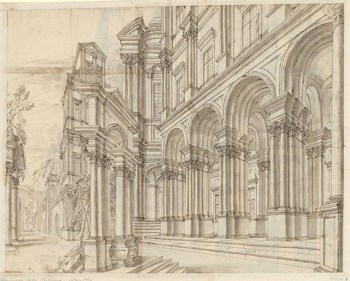
Giuseppe Gallli Bibiena, Sketch for Set Decoration ‘Scena per angolo’, 1700–50, pen and ink drawing (Graphische Sammlung ETH Zürich).
The cornice, once an essential part of any classical composition, incurred the wrath of modernists at the beginning of the 20th century. It has, at various times, been identified as the most expressive part of architecture, as well as the most problematic. It has drawn attention to itself in drawings, etchings, and other works of art. Hence, a history of the cornice in many ways offers a new window onto the multiple histories of architecture and its representations. For, on account of its ubiquity, the cornice carries several layers of meaning: as an element defined by, and defining building regulations; as the solution to the technical problem of joining wall and roof; and as a site to expression of social aspirations or distinction. As the visual limit of a construction, the cornice is as much about the individual building as it is about the city or the landscape. As an ornament applied to buildings, it involves matters of taste and aesthetics as much as of craft and industrial production. And as a subject depicted in two-dimensional works of art on paper, it allows us to interrogate the art historical conventions of image-viewing and composition. Finally, as a complex three-dimensional object, the cornice raises questions of cultural representation and communication through material transfers over time.
The exhibition unites a unique selection of drawings, prints, books, and objects from the 15th century to the present day. Authors and artists exhibited include Francesco di Giorgio Martini, Giovanni Battista Piranesi, Gottfried Semper, Frank Lloyd Wright, and Le Corbusier, amongst many others. By bringing works from earlier centuries from the ETH collections into direct dialogue with loans from important institutions in Switzerland and abroad—including the Fondation Le Corbusier, Paris, the Louvre, the Biblioteca Nazionale Centrale di Firenze, the Art Institute of Chicago, the Canadian Centre for Architecture, Montreal, the Drawing Matter Collections (UK), the Berlin State Museums, the Rietberg Museum Zurich, and more—the exhibition exposes the ‘hidden horizontal’ at the centre of five centuries of art and design thinking.
Featuring works by:
Cherubino Alberti, Daniel Badger, Ottavio Antonio Baiardi, Baccio Bandinelli, Pietro Santi Bartoli, Nicolas Beatrizet, François-Joseph Bélanger, Stefano della Bella, Ferdinando and Giuseppe Galli Bibiena, Jacques-François Blondel, Jan van Bronchorst, Andreas Buschmann, Richard Cahan, Cesare Cesariano, Charles Chipiez, François Collignon, Francesco Colonna, Le Corbusier, Pascal Coste, Marco Dente after Raphael, Deutscher Werkbund, Wendel Dietterlin, Giovanni Dosio, Albrecht Dürer, Louis-Émile Durandelle, Charles Eisen, Theodor Fischer, Domenico Fontana, Johannes Gachnang, George Jackson and Sons, Ludger Gerdes, Francesco di Giorgio Martini, Hubertus Goltzius, Karl Adolf Graffenried, Michael Graves, Iain Hales, Herzog & de Meuron, Utagawa Hiroshige, Jacques Hittorff, Daniel Hopfer, Lucas Kilian, Henri Labrouste, Mari Lending, Johann Baptist Marzohl, Johann Matthäus Mauch, Meister GA mit der Fussangel, Nicoletto da Modena, Richard Nickel, Friedrich Ohmann, Ordinary Architecture (Charles Holland and Elly Ward), Andrea Palladio, Manuel Pauli, Georges Perrot, Pablo Picasso, Christiane Pinatel, Giovanni Battista Piranesi, Marcantonio Raimondi, Mies van der Rohe, Diego Prévost Sagredo, Antonio Sangallo the Younger, Karl Friedrich Schinkel, Gottfried Semper, Sebastiano Serlio, Hermann Spielberg, Philippe Starck, Christian Ludwig Stieglitz, Gabriel Ludwig Stürler, Johann Georg Sulzer, Charles Heathcote Thatham, Philippe Thomassin, Constantin Uhde, Agostino Veneziano, Howard Charles Walker, Frank Lloyd Wright, Giacomo Barozzi da Vignola, Eugène-Emmanuel Viollet-le-Duc, Hans Vredeman de Vries, and Nicolai Zabaglia.
The presentation is jointly organised by the ETH collection of prints and drawings, Dr. Linda Schädler, and the chair of the History and Theory of Architecture ETH Zürich, Prof. Dr. Maarten Delbeke. Additional curatorial support has been provided by Anneke Abhelakh, David Bühler, and Dr. Emma Letizia Jones.
Programming details including guided tours, a lecture series, and walks can be found here.
Publications
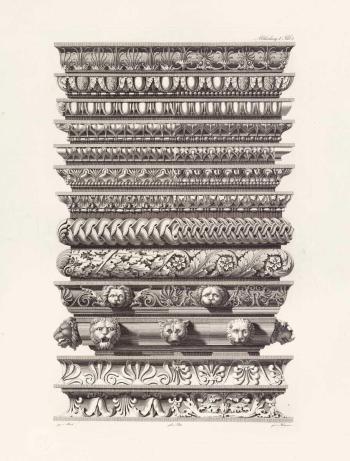
Illustration from Vorbilder für Fabrikanten und Handwerker (‘Patterns for Manufacturers and Handicraftsmen‘), edited by Christian Peter Wilhelm Beuth and Karl Friedrich Schinkel (1821).
A special edition of gta papers (the journal of the Institute for the History and Theory of Architecture ETH Zurich) dedicated to the cornice will be published in Fall 2021 to coincide with the exhibition (retail price: Fr. 25.–). Edited by Maarten Delbeke, Erik Wegerhoff, and Adam Jasper, the issue features an introduction by Maarten Delbeke and texts by Richard Anderson, Guido Beltramini, Emma Letizia Jones, Edoardo Piccoli, Linda Schädler, Oliver Streiff, David Bühler, Flavia Crisciotti, Linda Stagni with Claudio Gianocelli, Xu Han, and Maxime Zaugg.
The September 2021 issue of werk, bauen + wohnen focuses on the cornice as well. It contains an introduction by Maarten Delbeke, the first German translation of Luigi Moretti’s 1952 text “I valori della modenatura: Wert und Wirkung plastischer Profile,” a text by Mario Rinke, and reviews of projects by De Smet Vermeulen Architecten, 31/44 Architects, KilgaPopp Architekten, Joos & Mathys Architekten, Lütjens Padmanabhan Architekten, and Studio Anne Holtrop.
New Book | Château de Haroué
From Rizzoli:
Victoria Botana de Beauvau-Craon, with photographs by Miguel Flores-Vianna and foreword by Jean-Louis Deniot, Château de Haroué: The Home of the Princes de Beauvau-Craon (New York: Rizzoli, 2021), 272 pages, ISBN: 978-0847870929, $65.
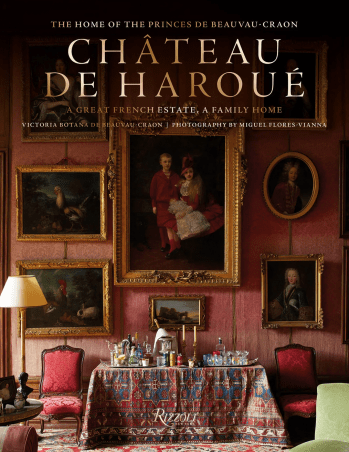 A dazzling tour of Château de Haroué, the epitome of opulent French style and one of today’s must-see examples of vibrant eighteenth-century architecture and design.
Located in a remote village in the Lorraine region of northeastern France, the estate of Chateau de Haroue is an unrivaled treasure of Gallic culture and heritage. Built between 1720 and 1729 for Marc de Beauvau, Prince de Beauvau-Craon, constable of Lorraine and viceroy of Tuscany, his descendants have inhabited the castle and kept it going in high style ever since. Here, readers are invited to discover the château’s impressive architecture and fashionably chic interior design. Newly commissioned photographs by Miguel Flores-Vianna alongside archival documents offer unprecedented access to 82 sumptuous rooms, which are enlivened by dynamic tapestries and family portraits, a breathtaking artwork collection, and stately antique furniture. Informative texts by Victoria Botana de Beauvau, one of France’s preeminent modern-day aristocrats and an It girl in Parisian society, paint a picture of the castle’s architectural splendors, lifestyle, notable events, and her family’s unique approach to keeping history alive.
Victoria Botana de Beauvau is a creative director and producer. Miguel Flores-Vianna is a renowned Argentine-born, London-based photographer whose images regularly appear in Architectural Digest and Cabana magazine. Jean-Louis Deniot is a French interior designer and a close friend of the de Beauvau-Craon family.
New Book | At Home in the Eighteenth Century
From Routledge:
Stephen G. Hague and Karen Lipsedge, eds., At Home in the Eighteenth Century: Interrogating Domestic Space (New York: Routledge, 2021), 378 pages, ISBN 978-0367276799, $160.
 The eighteenth-century home, in terms of its structure, design, function, and furnishing, was a site of transformation—of spaces, identities, and practices. Home has myriad meanings, and although the eighteenth century in the common imagination is often associated with taking tea on polished mahogany tables, a far wider world of experience remains to be introduced. At Home in the Eighteenth Century brings together factual and fictive texts and spaces to explore aspects of the typical Georgian home that we think we know from Jane Austen novels and extant country houses while also engaging with uncharacteristic and underappreciated aspects of the home. At the core of the volume is the claim that exploring eighteenth-century domesticity from a range of disciplinary vantage points can yield original and interesting questions, as well as reveal new answers. Contributions from the fields of literature, history, archaeology, art history, heritage studies, and material culture brings the home more sharply into focus. In this way At Home in the Eighteenth Century reveals a more nuanced and fluid concept of the eighteenth-century home and becomes a steppingstone to greater understanding of domestic space for undergraduate level and beyond.
Stephen G. Hague is an Associate Professor of Modern European History at Rowan University. He specializes in British and British imperial history and is the author of The Gentleman’s House in the British Atlantic World, 1680–1780 (2015). He researches and writes on the intersections of political, social, cultural, and architectural history.
Karen Lipsedge is an Associate Professor in English Literature, at Kingston University, England. Her research focuses on eighteenth-century domestic space, material culture, and society and its representation in British eighteenth-century literature and art. She is the author of Domestic Space in the Eighteenth-Century British Novel (2012).
C O N T E N T S
Introduction, Stephen Hague and Karen Lipsedge
Part I: The Organization and Arrangement of Space
1 Paula Humfrey, Staging Fictions for Domestic Privacy in Early Eighteenth-Century London Households
2 Karen Lipsedge, Reading Pamela through the Domestic Parlour: Rooms, Social Class, and Gender
3 Kristin Distel, ‘I will not be thus constrained’: Domestic Power, Shame, and the Role of the Staircase in Richardson’s Clarissa
4 Julie Park, ‘A Small House in the Country: Cottage Dreams and Desires in the Eighteenth-Century English Imagination
Part II: Money, Value, and Consumption
5 Stephen Hague, ‘I am now determined to inform you what I am sure will amaze you’: Objects, Domestic Space, and the Economics of Gentility
6 Beth Cortese, Home Economics: Female Estate Managers in Long Eighteenth-Century Fiction and Society
7 Gillian Williamson, Genteel, Respectable, and Airy: The Lodgings Market in London, 1770–1800
8 Deborah L. Miller, “Great earthly riches are no real advantage to our posterity”: Space, Archaeology, and the Philadelphia Home
Part III: Different Perspectives on Home
9 Victoria Barnett-Woods, Transatlantic Domesticity and the Limits of a Genre in A Woman of Colour
10 Margaret A. Miller, Making Room: Queer Domesticity in Jane Austen’s Emma and the Anne Lister Diaries
11 Jon Stobart, Servants’ Furniture: Hierarchies and Identities in the English Country House
12 Katie Barclay, Making the Bed, Making the Lower-Order Home in Eighteenth-Century Scotland
13 Laura Keim, Hierarchies of the Home: Spaces, Things, and People in the Eighteenth Century
14 Oliver Cox, Twenty-First Century Visitors in Eighteenth-Century Spaces: Challenges and Opportunities
Conclusion: Assessing Eighteenth-Century Domestic Space, Stephen Hague and Karen Lipsedge
Conference | The Humours of Collecting: Books and Related Material

Thomas Rowlandson, The Doctor’s Dream, ca. 1812.
◊ ◊ ◊ ◊ ◊
From the conference flyer:
The Humours of Collecting: Motive and Opportunity in Collecting Books and Related Material
42nd Annual Conference on Book Trade History
Stationers’ Hall (St Martin within Ludgate), London, 26–27 November 2021
Organized by Robin Myers, Michael Harris, and Giles Mandelbrote
This year’s conference on book-trade history can be seen as a moment of renewal. We look forward to a rich and informative exploration of current research on aspects of the history of collecting books and book-related material. Our emphasis will be on the individual collector, whose motives, methods, and experience have developed alongside the steady accumulation by libraries and specialist institutions.
The conference fee includes coffee/tea, a sandwich lunch, and a reception on both days. Registered students may apply for a limited number of reduced-rate places, sponsored by the Bibliographical Society. Conference fee: £95, with limited availability for the following: Student conference fee, £60; Single-day fee, £60; and Student single-day fee, £50. Early booking is recommended and places will be offered in order of receipt.The number of places may be limited, as we will be observing social distancing restrictions applicable at the time.
S P E A K E R S
Mark Byford, formerly Salvesen junior fellow at New College, Oxford, is an associate member of the Oxford History Faculty. His doctorate focused on religious change in Elizabethan Essex. A collector of early modern books and manuscripts, he is a Council member of the Bibliographical Society.
Laura Cleaver is Senior Lecturer in Manuscript Studies at the University of London and Principal Investigator of the Cultivate MSS project, funded by the European Research Council. The project is examining the international trade in pre-modern manuscripts c.1900–1945 and its impact on the formation of collections and scholarship.
Michelle Craig is a Leverhulme Trust doctoral scholar working on the library of Dr William Hunter (1718–1783). Her thesis is titled “From Early Modern to Enlightenment: Provenance in William Hunter’s Library.” She is interested in 18th-century book auctions, library cataloguing systems, and the materiality of books, provenance, and bindings.
Patrick Goossens studied history at the universities of Antwerp and Louvain. Closely connected with the Plantin-Moretus Museum in his home town of Antwerp, he is Treasurer of the Association of European Printing Museums and board member of the printing museum at the Royal Library of Belgium. His archival research into innovation in the printing industry in 19th-century Belgium is complemented by his collecting of historical printing equipment.
Robert Harding is a director of the London antiquarian bookdealer Maggs Bros Ltd., specialising in early modern Britain, and has a personal interest in the history of collecting in the Stuart period, especially around the circle of Thomas Howard, 14th Earl of Arundel.
Julie Anne Lambert has been Librarian of the John Johnson Collection at the Bodleian Library, Oxford, for more than 30 years. She is interested in all ephemera, while her exhibitions have focused principally on trade and advertising: A Nation of Shopkeepers (2001) and The Art of Advertising (May–August 2021). Both are accompanied by publications.
Robin Myers is archivist emeritus of the Stationers’ Company, where she was in charge of the archive for 30 years. Her many publications include The Stationers’ Company Archive (1990) and The Stationers’ Company, a History of the Later Years, 1800–2000 (2001).
Julian Pooley FSA is Public Services and Engagement Manager at Surrey History Centre and Honorary Visiting Fellow of the Centre for English Local History at the University of Leicester. He is preparing an analytical guide to the Nichols family papers from the time of John Nichols (1745–1826) to the death of John Gough Nichols in 1873. His recent publications include articles about John Nichols for The Journal of Eighteenth Century Studies and the British Library website Picturing Places.
F R I D A Y , 2 6 N O V E M B E R 2 0 2 1
10.00 Registration and coffee
10.30 Mark Byford — Study, Self-Expression, and Sentiment: Charting the Meaning of Some Early Modern English Books for Their Successive Owners
11.45 Coffee
12.15 Robin Myers — Booksellers and Bookbinders’ Collections within the Stationers’ Company Archive
1.30 Lunch
2.30 Robert Harding — Connoisseurs and Patriots: Four Centuries of Collecting the Prints and Drawings of Wenceslaus Hollar
3.45 Tea
4.15 Julian Pooley — ‘A Copious Collection of Newspapers’: John Nichols and His Collection of Newspapers, Pamphlets, and News Sheets, 1760–1865
5.30 Reception at Stationers’ Hall
S A T U R D A Y , 2 7 N O V E M B E R 2 0 2 1
10.00 Coffee
10.30 Laura Cleaver — Henry White (1822–1900): Wine Merchant and Collector of Second-Rate Manuscripts?
11.45 Coffee
12.15 Julie Anne Lambert — John de Monins Johnson and His ‘Sanctuary of Printing’
1.30 Lunch. During the break, Dr Michael Harris will lead a walking tour to visit some parts of the parish with book-trade connections
3.00 Michelle Craig — A Physician and a Book Collector: The Library of Dr William Hunter (1718–1783)
4.15 Tea
4.45 Patrick Goossens — Wood, Iron, Lead, and Printed Matter: On Converging Collections
New Book | L’art du XVIIIe siècle
From PU Rennes:
Guillaume Glorieux, L’art du XVIIIe siècle (Rennes: Presses Universitaires de Rennes, 2021), 342 pages, ISBN: 978-2753582668, 25€.
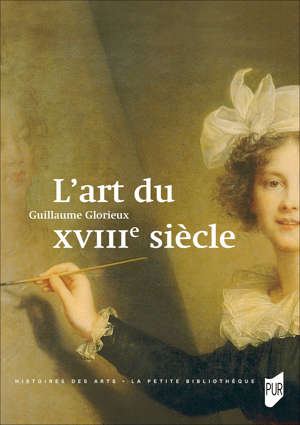 Des dernières lueurs du règne de Louis XIV, qui s’éteint à Versailles en 1715, à la disparition de Catherine II de Russie en 1796 à Saint-Pétersbourg, ce livre aborde la création artistique en Europe au siècle des Lumières. Entre les deux dates s’écoule un siècle marqué par de profonds bouleversements dans la production artistique et, plus encore, dans la façon dont l’art s’inscrit dans la société. Source de délectation, l’oeuvre d’art fait aussi l’objet de débats et de critiques, à une époque qui voit l’essor d’une réflexion sur l’art et ses finalités. L’effervescence créatrice qui caractérise la période s’exprime dans tous les domaines, la peinture, l’architecture, la sculpture et les arts décoratifs. Ce livre se propose de parcourir le XVIIIe siècle—ses grands artistes, les oeuvres majeures et les principaux courants—dans un cheminement chronologique attentif aux données sociales, politiques et culturelles.
Professeur des universités et historien de l’art, Guillaume Glorieux est directeur de l’enseignement et de la recherche de L’École des Arts joailliers, avec le soutien de Van Cleef & Arpels, après avoir enseigné à l’université Rennes 2. Il est l’auteur de plusieurs livres sur la peinture, le commerce du luxe et les arts décoratifs, dont Watteau (Citadelles & Mazenod, 2011) et À l’enseigne de Gersaint. Edme-François Gersaint, marchand d’art sur le pont Notre-Dame (1694–1750) (Champ Vallon, 2002, prix Eugène-Carrière de l’Académie française). Son dernier livre porte sur les métiers et les savoir-faire de la joaillerie : Les Arts joailliers. Métiers d’excellence (Gallimard / L’École des Arts Joailliers, 2019).
S O M M A I R E
Introduction
1 Les fantaisies de l’art rocaille
2 Les bouleversements de la peinture
3 L’exotisme dans les arts au XVIIIe siècle
4 Scénographies urbaines
5 Un art porteur de sens : les Lumières et les arts
6 Marché de l’art et collectionnisme
7 Sentiment, nature et subjectivité : le préromantisme
8 Néoclassicisme et retour à l’ordre
Conclusion
Analyses d’œuvres
Images des œuvres
Chronologie
Bibliographie
The Burlington Magazine, September 2021
The eighteenth century in this month’s issue of The Burlington . . .
The Burlington Magazine 163 (September 2021)
 E D I T O R I A L
• “Nicholas Goodison and The Burlington,” p. 779.
A R T I C L E S
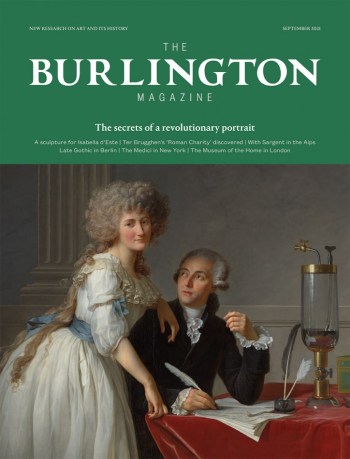
• David Pullins, Dorothy Mahon, Silvia A. Centeno, “The Lavoisiers by David: Technical Findings on Portraiture at the Brink of Revolution,” pp. 780–91.
Recent technical examination of Jacques-Louis David’s portrait of Antoine-Laurent and Marie-Anne Lavoisier in the Metropolitan Museum of Art, New York, painted between 1787 and 1788, has revealed significant and previously unknown alterations that transform our understanding of this celebrated portrait, its author, and its sitters.
R E V I E W S
• Susan Babaie, Review of the exhibition Epic Iran (V&A, 2021), pp. 837–39.
• Jonathan Conlin, Review of the exhibition Creating a National Collection: The Partnership between Southampton City Art Gallery and the National Gallery (Southampton City Art Gallery, 2021), pp. 845–48.
• Tanya Harrod, Review of the newly renovated Museum of the Home (previously the Geffrye Museum), pp. 858–61.
• John Bold, Review of John Martin Robinson, Wilton House: The Art, Architecture, and Interiors of One of Britain’s Great Stately Homes (Rizzoli Electa, 2021), pp. 872–74.
• Simon Lee, Review of Janis Tomlinson, Goya: A Portrait of the Artist (Princeton UP, 2020), pp. 874–75.
• Peter Fuhring, Review of Elena Cooper, Art and Modern Copyright: The Contested Image (Cambridge UP, 2018), pp. 875–76.
O B I T U A R Y
• Simon Jervis, “Ronald Lightbown (1932–2021),” pp. 879–80.
Spending most of his career at the Victoria and Albert Museum and National Art Library, Ronald Lightbown was a scholar of exceptional breadth, whose publications ranged from goldsmiths’ work of the late Middle Ages to Renaissance art and from the history of jewellery to Baroque wax sculpture.
New Book | Villa Albani Torlonia: The Cradle of Neoclassicism
From Rizzoli:
Carlo Gasparri, Raniero Gnoli, and Alvar González-Palacios, with photographs by Massimo Listri, Villa Albani Torlonia: The Cradle of Neoclassicism (New York: Rizzoli, 2021), 336 pages, ISBN: 978-8891832146, $150.
 Villa Albani Torlonia, with its collections, the Italian garden, and the hemicycle of the Kaffeehaus, is a sublime testimony of that particular antiquarian taste which came to the fore in the mid-eighteenth century, that for which Rome became a favorite destination on the Grand Tour. The classicist dream of Cardinal Alessandro Albani (1692–1779) was preserved thanks to the Torlonia family, who purchased the villa in 1866, enlarging the collection and the gardens and restoring the most important cardinal residence of the eighteenth century.
More than 300 images by the great Italian master Massimo Listri recount the history of this extraordinary cultural heritage for the very first time. An immersive journey leads the reader between its collections of ancient masterpieces. Statues, bas-reliefs, and fountains are ensconced between the various buildings and gardens of the villa in a composition of environments, landscapes, and works of art forever waiting to be discovered.
Massimo Listri is a photographer who has published more than 70 books and has exhibited his work at numerous solo exhibitions throughout the world. Carlo Gasparri is emeritus professor at the University of Naples Federico II and has authored several books about archaeology and Greek and Roman art. Raniero Gnoli is an Orientalist and historian of religions. Alvar González-Palacios is an author and art historian and former collaborator of FMR magazine.
New Book | The Living Death of Antiquity
From Oxford UP:
William Fitzgerald, The Living Death of Antiquity: Neoclassical Aesthetics (Oxford: Oxford University Press, 2021), 288 pages, ISBN: 978-0192893963, £75 / $100.
 The Living Death of Antiquity examines the idealization of an antiquity that exhibits, in the words of Johann Joachim Winckelmann, “a noble simplicity and quiet grandeur.” Fitzgerald discusses the aesthetics of this strain of neoclassicism as manifested in a range of work in different media and periods, focusing on the late eighteenth and early nineteenth centuries. In the aftermath of Winckelmann’s writing, John Flaxman’s engraved scenes from the Iliad and the sculptors Antonio Canova and Bertel Thorvaldsen reinterpreted ancient prototypes or invented new ones. Earlier and later versions of this aesthetic in the ancient Greek Anacreontea, the French Parnassian poets, and Erik Satie’s Socrate, manifest its character in different media and periods. Looking with a sympathetic eye on the original aspirations of the neoclassical aesthetic and its forward-looking potential, Fitzgerald describes how it can tip over into the vacancy or kitsch through which a ‘remaindered’ antiquity lingers in our minds and environments. This book asks how the neoclassical value of simplicity serves to conjure up an epiphanic antiquity, and how whiteness, in both its literal and its metaphorical forms, acts as the ‘logo’ of neoclassical antiquity, and functions aesthetically in a variety of media. In the context of the waning of a neoclassically idealized antiquity, Fitzgerald describes the new contents produced by its asymptotic approach to meaninglessness, and how the antiquity that it imagined both is and is not with us.
After taking a BA in Classics at Oxford (1974) and a PhD in Comparative Literature at Princeton (1980), William Fitzgerald taught for 23 years at the University of California, San Diego and Berkeley. He returned to the UK in 2003 and taught at Cambridge University until 2007, when he became Professor of Latin Language and Literature at King’s College London. He has published books and articles on Latin literature, especially poetry, and on classical reception.
C O N T E N T S
1 Introduction: Why Neoclassicism?
2 The Iliad Backtranslated: Alexander Pope and John Flaxman
3 Sculpture between the Graceful and the Heroic: Antonio Canova and Bertel Thorvaldsen
4 Voicing Antiquity: The Anacreontea and Charles Leconte de Lisle’s Études Latines
5 Modernism, Neoclassicism, and Irony: Erik Satie’s Socrate
Conclusion










 Enfilade
leave a comment