New Book | Provenance Research Today
Now available as an e-book, with the paperback edition forthcoming from Lund Humphries:
Arthur Tompkins, ed., Provenance Research Today: Principles, Practice, Problems (London: Lund Humphries, 2021), 224 pages, ISBN: 978-1848222762, £30 / $50.
 Covering key aspects of provenance research for the international art market, this accessible publication explores a range of themes including challenges and best practice to considerations specific to Nazi looted art and the trade in illicit antiquities. Provenance research is a crucial component of any art-market transaction. Without a provenance it is often difficult to establish a work’s authenticity, its true value or who has legal title. Whether buying, selling or simply maintaining an artwork in either a private or a public collection, the days when a blind eye could be turned to the history (or the lack of a known history) of a work have long gone. Proper, thorough and effective provenance research is the minimum required and demanded in today’s art world—a world that is increasingly recognising the need for greater and more effective self-regulation in the face of fakes, forgeries and challenges to ownership or authenticity that are now commonplace.
Provenance Research Today is essential reading for a broad audience, from those studying to become part of the art world or professionals starting a career in provenance research, to collectors or would-be collectors, dealers, galleries, auction houses, police and art lawyers.
Arthur Tompkins is a District Court Judge based in Wellington, New Zealand. He is author of Plundering Beauty (Lund Humphries, 2018) and editor of Art Crime and Its Prevention: A Handbook for Collectors (Lund Humphries, 2016).
Exhibition | Sublime on the Small Scale
From The Morgan:
Sublime on the Small Scale
The Morgan Library & Museum, New York, 29 September 2020 — 12 September 2021

Gustaf Söderberg, The Grotto of Posillipo, Naples, 1820, oil on paper, irregularly cut, mounted to Masonite (Thaw Collection, Jointly Owned by The Metropolitan Museum of Art and The Morgan Library & Museum, Gift of Eugene V. Thaw, 2009).
In 1757, the British statesman and philosopher Edmund Burke published A Philosophical Enquiry into the Origin of Our Ideas of the Sublime and Beautiful, an aesthetic treatise that profoundly influenced artists across Europe well into the nineteenth century. Burke understood the Sublime as deriving from “whatever is fitted in any sort to excite the ideas of pain, and danger, that is to say, whatever is in any sort terrible…or operates in a manner analogous to terror.” He emphasized the powerful, even pleasurable, emotional response that could arise from the contemplation of such possibilities, particularly when considered from a place of safety.
Many artists turned to the natural world as their principal source of the Sublime, emphasizing its magnitude and power. While the Sublime is mostly associated with large-scale oil paintings intended to engulf and overwhelm viewers, artists frequently worked on a smaller scale to develop and experiment with their representations. They endeavored to render nature and its effects faithfully by sketching en plein air, particularly on their travels through dramatic landscapes. The oil sketches displayed here engage with a range of Sublime effects, from the impressive vastness of a mountain range and the thrill of rushing water to the terror of a raging storm.
Sublime on the Small Scale highlights works from the collection of oil sketches given jointly to The Morgan and The Metropolitan Museum of Art by Trustee Eugene V. Thaw.
Napoleon’s Barge, Newly Restored, Unveiled in Brest

Le Canot impérial de Napoléon, 1810, as installed at Brest, December 2020.
◊ ◊ ◊ ◊ ◊
Unveiled last week at the Musée de la Marine in Brest, as reported in the press release, via CNN (14 December 2020). . .
A spectacular imperial barge built for Napoleon Bonaparte has been unveiled at the Naval Museum in Brest, France, following a restoration project. Ten specialist restorers worked on the vessel, which was constructed in 1810, for two months prior to the opening of the new display on Friday [11 December 2020], according to a press release from the maritime museum. Visitors can appreciate the 62-foot barge from all angles, thanks to glass bays underneath and a mirror that hangs over the top.
Napoleon … ordered the secretive construction of the imperial barge in spring 1810, and it was first used to ferry him around during a visit to the French naval fleet at Antwerp later that year.
The original barge, which had fairly muted decorative elements including an eagle on the prow, was kept in Brest from 1814 onward. The more elaborate elements we see today—a figure of Neptune on the prow, figures at the bow carrying imperial weapons, and the large gold crown supported by four angels on the roof—were added in 1858 prior to a visit from Napoleon III and Empress Eugenie.
In 1943, the barge was moved from Brest to Paris under the protection of the occupying German forces to form part of the new Navy Museum. However, after an eight-day train journey, it was discovered that the doors of its new home, the Palais de Chaillot, were too small to fit the barge. It took two years to make a large gap in the wall of the building, and the barge was finally installed in August 1945.
In 2018, the barge was returned to Brest when the Paris museum closed for renovation.
Jean-Yves Besselièvre, manager of the Naval Museum in Brest, said the barge is one of the museum’s treasures and the only vessel of its kind preserved in France. The restoration is special, he said, because the barge wasn’t built to last a long time: “There is in fact a certain fragility to the object, but it has been perfectly managed by the restorers… and by the hauliers.”
◊ ◊ ◊ ◊ ◊
More information on the larger renovation of the Musée national de la Marine in Paris (scheduled to be completed in 2022) and the institution’s vision for the future is available from this press release.
New Book | Carmontelle’s Garden at Monceau
From Yale UP:
Carmontelle, Garden at Monceau, edited by Elizabeth Barlow Rogers and Joseph Disponzio, translated by Andrew Ayers, with an introductory essay by Laurence Chatel de Brancion and contributions from Joseph Disponzio, Florence Gétreau, David L. Hays, Elizabeth Hyde, Susan Taylor-Leduc, Caroline Weber, and Gabriel Wick (New Haven: Yale University Press, 2020), 196 pages, ISBN: 978-0300254686, $75.
 Carmontelle’s landmark publication, Garden at Monceau, beautifully reproduced to show the Parisian garden’s artistic and cultural importance before the French Revolution.
Originally published in 1779, Garden at Monceau is a richly illustrated presentation of the garden Louis Carrogis, known as Carmontelle, designed on the eve of the French Revolution for Louis-Philippe-Joseph d’Orléans, duc de Chartres. With its array of architectural follies intended to surprise and amaze the visitor, the garden was a setting for ancien régime social life. Carmontelle’s portrayal of his work in Garden at Monceau therefore serves as an expression of a key moment in the history of European landscape design, garden architecture, and social history. This facsimile edition, with its English-language text and reproductions of the original engravings, is accompanied by essays that interpret the landscape design and examine Carmontelle’s larger career as a painter and theater producer.
Elizabeth Barlow Rogers is the president of the Foundation for Landscape Studies, New York. Joseph Disponzio is a landscape architect with the New York City Department of Parks and Recreation.
Exhibition | Carmontelle (1717–1806)

Carmontelle, Self-Portrait, ca. 1762; graphite, watercolor, red chalk, and gouache on paper
(Chantilly: Musée Condé)
◊ ◊ ◊ ◊ ◊
From the Domaine de Chantilly:
Carmontelle (1717–1806), ou la Douceur de Vivre / And the Age of Pleasures
Musée Condé, Château de Chantilly, 5 September 2020 — 28 March 2021
Curated by Nicole Garnier
A playwright, draughtsman, and landscape architect, Louis Carrogis— known as Carmontelle—was a brilliant connoisseur whose many talents reflect the cultivated and cosmopolitan world in which he lived. The organizer of festivities for the Duke of Orléans, famous for his portraits and improvised comedies called Proverbes, Carmontelle designed the Parc Monceau in Paris for the Duke of Chartres and perfected transparencies or long rolls of paper depicting delightful landscapes.
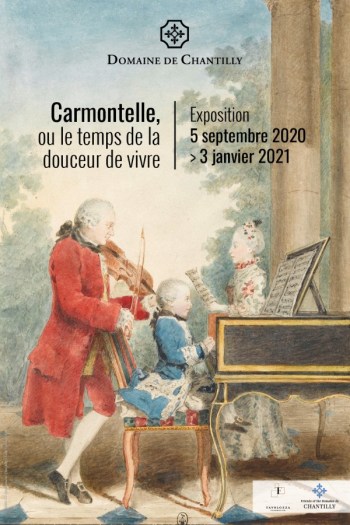 With sitters ranging from Mozart to Buffon, from Rameau to Baron Grimm, Carmontelle created a faithful portrait of mid-18th century Parisian society: princes of the blood, writers, philosophers, musicians, scientists, and elegant beauties of the ‘age of pleasures’—words coined by Talleyrand to describe the Ancien Régime. Thanks to Henri d’Orléans, Duke of Aumale (1822–1897), descendant of the Orléans who acquired the majority of this ensemble, the Condé museum at Chantilly has the best collection in the world of Carmontelle’s works with 484 drawn portraits and one transparency.
The son of a master cobbler, Louis Carrogis took the name ‘Carmontelle’ in 1744 after studying geometry. A topographer during the Seven Years’ War (1756–1763), he spent his spare time making portraits of the officers and organizing improvised comedies. In 1759, he entered the service of the Duke of Orleans as tutor to the young Duke of Chartres (1747–1793), the next Duke of Orléans and future Philippe Egalité; and from 1755 to 1784, he created ‘bad but accurate likenesses’ (Grimm) in gouache and watercolour of the entire court of the Orléans family at the Palais-Royal, Saint-Cloud, and Villers-Cotterêts. As an amateur draughtsman, Carmontelle preferred profile portraits for their ease of execution.
Nicole Garnier-Pelle, Carmontelle (1717–1806) ou le Temps de la Douceur de Vivre: Collection les Carnets de Chantilly n11 (Dijon: Éditions Faton, 2020), 96 pages, ISBN: 978-2878442779, €20.
Note: The exhibition, originally scheduled to close in January, has been extended until the end of March.
Mary D. Sheriff Travel and Research Award
Mary D. Sheriff Travel and Research Award
Applications due by 15 February 2021
Supporting feminist topics in eighteenth-century art history and visual culture
Award Amount: $2000
Eligibility: Doctoral candidates, early career scholars, and contingent faculty who are current members of the American Society for Eighteenth-Century Studies (ASECS) and the Historians of Eighteenth-Century Art and Architecture (HECAA).
Submission Materials: A 750-word description of the proposed project, a CV, and a budget (as a PDF file or MS Word doc). Please send submissions to MarySheriffAward@gmail.com.
New Book | The Versailles Effect
From Bloomsbury:
Mark Ledbury and Robert Wellington, eds., The Versailles Effect: Objects, Lives, and Afterlives of the Domaine (London: Bloomsbury, 2020), 320 pages, ISBN: 978-1501357787, $120.
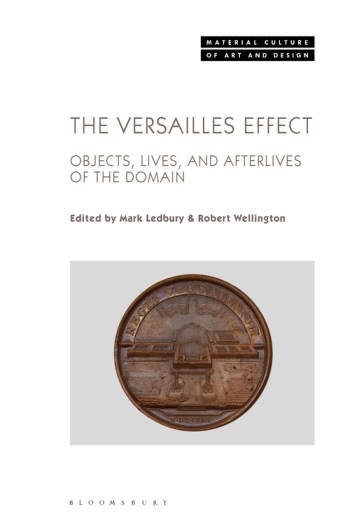 The essays in this volume show that Versailles was not the static creation of one man, but a hugely complex cultural space: a centre of power, but also of life, love, anxiety, creation, and an enduring palimpsest of aspirations, desires, and ruptures. The splendour of the Château and the masterpieces of art and design that it contains mask a more complex and sometimes more sordid history of human struggle and achievement. The case studies presented by the contributors to this book cannot provide a comprehensive account of the Palace of Versailles and its domains, the life within its walls, its visitors, and the art and architecture that it has inspired from the seventeenth century to the present day. However, this innovative collection will reshape—or even radically redefine—our understanding of the palace of Versailles and its posterity.
Mark Ledbury is Power Professor of Art History & Visual Culture and Director of the Power Institute at the University of Sydney. He is the author of James Northcote, History Painting, and the Fables (2014) and Sedaine, Greuze, and the Boundaries of Genre (2000). He is also the editor of three books, including Fictions of Art History (2013).
Robert Wellington is Senior Lecturer in Art History & Art Theory at the Australian National University. He is the Book Placement Editor for Early Modern Art History Studies (1500–1800) for H-France and serves on the advisory board for Bloomsbury’s Material Culture of Art & Design book series. His monograph Antiquarianism and the Visual Histories of Louis XIV: Artifacts for a Future Past was published in 2015.
C O N T E N T S
Enduring Versailles — Robert Wellington and Mark Ledbury
Part I. Making the Palace
1 The Other Palace: Versailles and the Louvre — Hannah Williams (Queen Mary University)
2 The Grands Décors of Charles Le Brun: Between Plan and Serendipity — Bénédicte Gady (Musée des Arts Décoratifs)
3 Artisans du Roi: Collaboration at the Gobelins, Louvre and the Académie Royale de Peinture et de Sculpture under the Influence of the Petite Académie — Florian Knothe (University of Hong Kong)
4 Rough Surfaces: Etching Louis XIV’s Grotto at Versailles — Louis Marchesano (Philadelphia Museum of Art)
Part II. Versailles Life
5 Porcelain and Power: The Meaning of Sèvres Porcelain in Ancien Regime France — Matthew Martin (National Gallery of Victoria)
6 Hair, Politics, and Power at the Court of Versailles — Kimberly Chrisman Campbell (Independent scholar, USA)
7 The Politics of Attachment: Visualizing Young Louis XV and His Governess — Mimi Hellman (Skidmore College)
8 Courting Favour: The Apartments of the Princesse de Lamballe at Versailles, 1767–1789 — Sarah Grant (Victoria and Albert Museum)
Part III. Outsiders
9 Enslaved Muslims at the Sun King’s Court — Meredith Martin (New York University) and Gillian Weiss (Case Western Reserve University)
10 A Turk in the Hall of Mirrors — David Maskill (University of Wellington)
11 Cornelis Hop (1685–1762), Dutch Ambassador to the Court of Louis XV — Daniëlle Kisluk-Grosheide (The Metropolitan Museum of Art)
Part IV. Versailles Now
12 Melancholy, Nostalgia, Dreams: Adventures in the Grand Cimetière Magique — Mark Ledbury (University of Sydney)
13 American Versailles: From the Gilded Age to Generation Wealth — Robert Wellington (Australian National University)
Bibliography
List of Contributors
Index
New Book | Jean-Henri Riesener
From Bloomsbury:
Helen Jacobsen, Rufus Bird, and Mia Jackson, eds., Jean-Henri Riesener: Cabinetmaker to Louis XVI and Marie Antoinette (London: Philip Wilson Publishers, 2021), 304 pages, ISBN: 978-1781300909, £50 / $100.
 Jean-Henri Riesener (1734–1806) was one of the greatest French cabinetmakers of all time. From humble beginnings as a German immigrant in Paris, he found fame through the delivery of a magnificent roll-top desk to Louis XV in 1769 and went on to become Marie-Antoinette’s favourite cabinetmaker, supplying the queen and the court of Louis XVI with sumptuous furniture of superb quality. Renowned for his exquisite marquetry and refined designs, his pieces were ornamented with spectacular gilt-bronze mounts made by some of the greatest metalworkers in Paris. In the nineteenth century, Riesener’s name became associated with the very best of Louis XVI-period French furniture; his pieces continue to be highly sought after and are found in major museums worldwide.
This first major monograph on Riesener traces his life and career, bringing new insights into his business practice, his designs, and construction techniques. Based on the extensive collections of Riesener furniture in the Wallace Collection, Waddesdon Manor, and the Royal Collection, the authors examine the objects and their history and highlight the changing tastes of the nineteenth-century collectors who acquired so many former French royal pieces. The new illustrations and visual glossary add another important resource for art historians, decorative arts enthusiasts, and furniture lovers.
Helen Jacobsen is Senior Curator and Curator of French Eighteenth-Century Decorative Arts at the Wallace Collection. Rufus Bird is Surveyor of The Queen’s Works of Art. Mia Jackson is Curator of Decorative Arts at Waddesdon Manor.
C O N T E N T S
The Cabinetmaker
• Christian Baulez, Jean-Henri Riesener: A Portrait Sketch
• Laura Langelüddecke, A German in Paris
• Carolyn Sargentson, Jean-Henri Riesener and the Business of Furniture-Making
• Lindsay Macnaughton, A Question of Language: The Royal Furniture Administration’s Accounts
• Mia Jackson, ‘Executed in the Taste of Painting’: Riesener’s Marquetry Designs
• Juliet Carey, Jean-Henri Riesener: The Portraits
The Collectors
• Rufus Bird, From Versailles to Windsor Castle: George IV and Riesener
• Helen Jacobsen, Alteration and Appropriation: The 4th Marquess of Hertford and the Taste for Riesener
• Ulrich Leben, Riesener and the Rothschilds at Waddesdon Manor
• Daniëlle Kisluk-Grosheide, Buying from Britain: The Development of a New Market
The Furniture
• Works in the Wallace Collection, the Royal Collection, and Waddesdon Manor
The Materials and Techniques
• Jürgen Huber, Materials and Techniques
• Alexander Collins, Visual Glossary
The Decorative Arts Trust Announces Four Failey Grants

Hunter House, ca. 1748. Courtesy the Preservation Society of Newport County.
◊ ◊ ◊ ◊ ◊
Press release from The Decorative Arts Trust (11 December 2020). . .
The Decorative Arts Trust congratulates the New-York Historical Society, the Preservation Society of Newport County, and authors Adrienne Childs and Iris Moon on receiving Failey Grants. The Failey Grant program provides support for noteworthy research, exhibition, publication, and conservation projects through the Dean F. Failey Fund, named in honor of the Trust’s late Governor. Preference is given to projects that employ or are led by emerging professionals in the museum field. The Trust increased the amount of funding available this cycle to $25,000 in recognition of the acute need for resources to underwrite important endeavors.
• New-York Historical Society will open the groundbreaking exhibition Black Dolls in 2022.
• The Preservation Society of Newport County in RI is planning a comprehensive reinterpretation of Hunter House.
• Adrienne Childs is finalizing the manuscript of Ornamental Blackness, to be published by Yale University Press in 2023.
• Iris Moon is concluding an analysis of the decorative arts of the French Revolution that will result in the publication of Luxury of Terror by the Pennsylvania State Press in 2022.

Topsy-turvy Doll, United States, 1890–1905, textile and paint (New-York Historical Society, Gift of Katharine Prentis Murphy, 1961).
In 2022, the New-York Historical Society will open the groundbreaking exhibition Black Dolls, which examines handmade Black dolls as both artistic expressions and windows into critical issues of race, gender, identity, and the legacy of slavery. Drawing from the collection of Deborah Neff, the show will present more than 100 home-made cloth dolls created largely by African American women between 1850 and 1940. Co-curated by Margaret K. Hofer, Vice President and Museum Director, and Dominique Jean-Louis, Project Historian, the exhibition will immerse visitors into the world of dolls, doll play, and doll making.
The Preservation Society of Newport County in Rhode Island is planning a comprehensive reinterpretation of Hunter House, the oldest property in the Society’s collection and long a landmark of Newport’s 18th-century prominence. The project aims to expand the public’s knowledge of the house through an overhauled interpretive presentation for onsite and online visitors. The investigation is led by research fellows Catherine Doucette and MaryKate Smolenski under the guidance of Leslie B. Jones, Director of Museum Affairs and Chief Curator. The team will address the ethics, scholarship, and restoration of histories and voices missing from the historic site. The new visitor experience will present an inclusive story that details Newport’s complex role in the economies of slavery and colonialism.

Clock Case, Paris, ca. 1785 (Washington, DC: Hillwood Estate, Museum and Gardens, Bequest of Marjorie Merriweather Post, 1973).
Adrienne Childs is finalizing the manuscript of Ornamental Blackness, to be published by Yale University Press in 2023. The book examines the long and complex tradition of the ornamental Black figure in European art and will create a framework for understanding how the decorative arts figure into the larger discourse of representing Blacks in European visual culture. Scant critical attention has been paid to this material, and the publication will have great value to museums, historic houses, and academia. Childs is an Associate of the W.E.B. Du Bois Research Institute at the Hutchins Center for African and African American Research at Harvard University.
Iris Moon, Assistant Curator of European ceramics and glass at The Metropolitan Museum of Art, is concluding an analysis of the decorative arts of the French Revolution that will result in the publication of Luxury of Terror by the Pennsylvania State Press in 2022. Moon’s research explores the production and circulation of French luxury after the death of Louis XVI and Marie Antoinette and how makers with strong ties to the monarchy found ways to survive the Terror, the most radical and violent phase of the Revolution. The publication will expand the study of French decorative arts by drawing attention to the creative and experimental forms of luxury that emerged during a turbulent period of history.
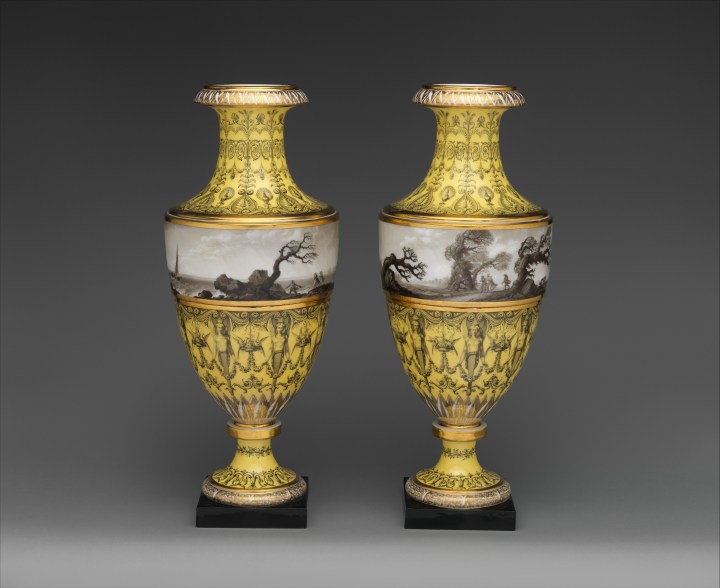
Dihl et Guérhard, possibly painted by Jean-Baptiste Coste, Pair of Vases with Landscapes at Sea and on Land, Paris, ca. 1797–98, hard-paste porcelain with enamel decoration and gilding (New York: The Metropolitan Museum of Art, Wrightsman Fund, 2014).
◊ ◊ ◊ ◊ ◊
The Decorative Arts Trust is a non-profit organization that promotes and fosters the appreciation and study of the decorative arts through: exchanging information through domestic and international programming; collaborating and partnering with museums and preservation organizations; and underwriting internships, research grants, and scholarships for graduate students and young professionals. Learn more about the Trust at decorativeartstrust.org or by contacting thetrust@decorativeartstrust.org.
Print Quarterly, December 2020

Meissen bowl with leopard licking its paw, after engraving with six leopards (see below), part of Hanbury Williams service, ca. 1745, porcelain, diameter 340 mm.
◊ ◊ ◊ ◊ ◊
The eighteenth century in the latest issue of Print Quarterly:
Print Quarterly 38.4 (December 2020)
A R T I C L E S
Malcolm Jones, “Early Modern English Prints in the Joseph Ames Album at the Morgan Library,” pp. 411–31.
This article publishes, for the first time, some of the contents of an album in the Morgan Library and Museum, New York, entitled Emblematical and Satirical Prints in Persons and Professions. Compiled around 1750 by Joseph Ames (1689–1759) and containing 237 miscellaneous European prints. About 125 are catalogued as English; 33 of these are unique or exceedingly rare examples and are discussed in detail throughout the article. The remaining English prints in the album are described in an appendix.
N O T E S A N D R EV I E W S

Anonymous artist, Six Leopards, from album with prints of animals published by Joos de Bosscher, 1581–1600, engraving, 125 x 177 mm (Amsterdam, Rijksmuseum).
Maureen Cassidy-Geiger, Review of Raffinesse im Akkord: Meissener Porzellanmalerei und ihre grafischen Vorlagen (2018), pp. 465–69.
This note reviews a two-volume publication about print sources for imagery on eighteenth-century Meissen porcelain. Where possible, the catalogue of 475 entries presents the names of the artists, engravers or publishers of Dutch, French, German, and Italian print sources used.
Tom Young, Review of Douglas Fordham, Aquatint Worlds: Travel, Print, and Empire, 1770–1820 (2019), pp. 470–74.
This note, and the book it reviews, emphasises the close ties the medium of aquatint has with British exploration and imperialism. Using J.R. Abbey’s (1894–1969) collection of aquatint travel books, today held by the Yale Center for British Art, the case studies show how aquatint’s advantages in colour and detail helped to convey antiquarian details with meticulous accuracy, but that it also had a broader impact on developing a community of taste dependent on travel and the recognition of difference.










leave a comment