Exhibition | Marie-Antoinette: Metamorphosis of an Image
The exhibition opens today, 226 years after Marie-Antoinette was executed (the press release is available here). . .
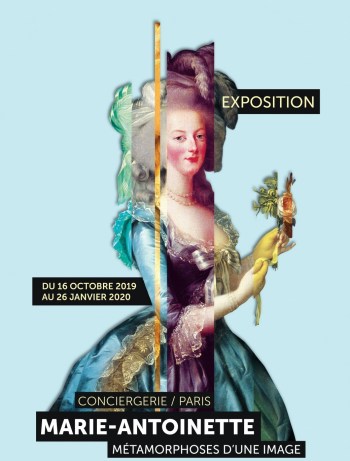
Marie-Antoinette: Métamorphoses d’une Image
Conciergerie, Paris, 16 October 2019 — 26 January 2020
Only a handful of historic figures have been the subject of such an abundance of representations: Marie-Antoinette is one of these, both during her lifetime and more notably after her death on 16 October 1793. Even today, this queen-turned-icon is still a key emblem in popular culture. The exhibition illustrates the many representations of Marie-Antoinette through almost 200 works, artefacts, heritage and contemporary archives, never-before-seen interviews, film extracts, and fashion accessories—shining a light on this worldwide phenomenon of media overkill through both a historic approach and a critical and comparative examination of forms.
 Marie-Antoinette at the Conciergerie
This section illustrates the final ten weeks that saw the most dramatic moments experienced by the queen in the ‘corridor of death’, during her trial by the Revolutionary Tribunal. A number of memorial fetishes testify to this: shirt, shoe, belt, and archival documents from the trial and execution of the Queen
The Histories
Marie-Antoinette’s life has been transformed since her death through numerous accounts and biographies, as well as testimonies and memories, from the Restoration to the present day, and from all points of view. The exhibition illustrates twenty events, both public and private, in Marie-Antoinette’s life, from her birth to her death, and including her official funeral in 1814.
The Image of the Queen
The figure of Marie-Antoinette is a veritable ‘expanse of images’, which can quickly be packaged to suit an event, a commemoration, the latest cultural trend or fashionable motif. Thus, according to the era, this proliferation affected the official image of the queen, particularly the portraits of her by Elisabeth Louise Vigée Le Brun, the political images of the ‘martyred’ queen, the historical imagery, the character portrayed on-screen, and in Japanese manga.
Fetishes of the Queen
The relationship with Marie-Antoinette has often been passionate, creating cults, tributes, or, on the contrary, provoking violent attacks. Furthermore, it has often been subject to fantasy and imagination, on a level where intimacy can overlap with mythology. The exhibition here displays a selection of images and objects, based on three motifs, symbolising Marie-Antoinette throughout history and the world.
• The Hair
• The Body
• The Severed Head
The Return of the Queen
Marie-Antoinette is experiencing a surprising revival, due to the modernization of the character, who has become a young woman of hers, and our time. The revival is illustrated by Japanese manga, which reinvented Marie-Antoinette in Riyoko Ikeda’s The Rose of Versailles; the biography of the English writer Antonia Fraser, Marie-Antoinette: The Journey; and its Hollywood adaptation by Sofia Coppola. Fashion has also appropriated the phenomenon associating the queen with several contemporary supermodels. A fan cult has appropriated the figure of Marie-Antoinette, a phenomenon of globalised post-modernism, as commercial as it is cultural and ideological. The overriding style of this onslaught is a popularised form of pop art, and its diffusion affects all genres, every type of consumerism and every country. The exhibition highlights this great blend of genres and objects, while revealing its commercial aspect.
A cycle of Marie-Antoinette films will be screened at the Le Champo cinema from 5 November to 3 December.
◊ ◊ ◊ ◊ ◊
The catalogue is published by Éditions du Patrimoine:
Antoine de Baecque, ed., Marie-Antoinette: Métamorphoses d’une image (Paris: Éditions du Patrimoine, 2019), 215 pages, ISBN: 978-2757706817, 39€.
 Un très beau livre qui donne à voir et à comprendre les multiples visages de la figure historique française la plus connue à travers le monde. De la princesse idéale à la ‘reine scélérate’, de la traîtresse étrangère à la figure martyre, de l’héroïne adolescente à la mère bigote, de la femme de culture à l’icône de mode, l’image de la reine Marie-Antoinette, tour à tour adorée ou honnie, n’a cessé d’évoluer au cours des siècles.
En suivant le fil de l’exposition qui se tiendra à la Conciergerie du 16 octobre 2019 au 26 janvier 2020, cet ouvrage, à travers 14 essais et 16 notices, commentera les multiples représentations de la reine et montrera comment le rapport à Marie-Antoinette a souvent été passionnel, déterminant des cultes, des hommages, ou au contraire de violentes attaques.
Historien, spécialiste de la culture des Lumières et de la Révolution française, Antoine de Baecque a entre autres publié Le Corps de l’histoire. Métaphores et politique 1770–1800 (Calmann-Lévy, 1993), La Gloire et l’effroi (Grasset, 1996) sur la Terreur, puis Les Eclats du rire (Calmann-Lévy, 2000), sur la culture des rieurs au XVIIIe siècle. Il a également écrit le volume sur les Lumières de l’Histoire culturelle de la France en 1998 aux éditions du Seuil, et participé aux volumes collectifs, Histoire du corps, Histoire de la virilité, Histoire des émotions. Antoine de Baecque est également commissaire de nombreuses expositions, membre du comité de rédaction de la revue L’Histoire, du conseil scientifique de la BNF, président de la commission d’aide à l’écriture documentaire au CNC et professeur d’histoire du cinéma à l’École normale supérieure de la rue d’Ulm.
S O M M A I R E
La tradition royale
• Marie-Antoinette, reine de France, Fanny Cosandey
• Marie-Antoinette et ses soeurs : portrait de groupe, Mélanie Traversier
• La fabrique de la célébrité, Antoine Lilti
• La reine des modes, du chic au kitsch, Catriona Seth
> Notices : Les colliers de la reine. Gravures de mode royale
Face à la Révolution
• Une reine traînée dans la boue : les caricatures contre Marie-Antoinette, Annie Duprat
• Un fantasme de reine, entretien avec Chantal Thomas
> Notices : Une Autrichienne en goguette. Archives du procès et dernière lettre de Marie-Antoinette. La chemise de Marie-Antoinette. Soulier « à la Saint-Huberty » dit de Marie-Antoinette. Marie-Antoinette conduite à son exécution. Le peintre David dessinant Marie-Antoinette conduite au supplice.
Le culte de Marie-Antoinette
• « C’était là »… », l’ombre tutélaire de la Conciergerie, Guillaume Mazeau
• L’impératrice Eugénie et le culte visuel de Marie-Antoinette, Clémence Poupin
• Pierre de Nolhac, le chevalier servant des images, Baptiste Roger-Lacan
• Deux clés biographiques : des Goncourt à Stefan Zweig, Cécile Berly
> Notices : la cellule de la reine, oratoire de la Conciergerie. La châtelaine-reliquaire de la duchesse de Tourzel. La Chapelle expiatoire. Marie-Antoinette à la basilique-cathédrale de Saint-Denis.
Métamorphoses et revival
• Marie-Antoinette à l’écran, François Huzar
• Marie-Antoinette, héroïne manga-pop, fille d’Ikeda, Cyril Triolaire
• Effigie en série, trajectoire iconique d’une reine de France dans la pop culture internationale, Martial Poirson
• Marie-Antoinette en quelques clics…, Cécile Berly
> Notices : Les collections de la Cinémathèque française. Anne Seibel, chef décoratrice. Œuvres contemporaines. Michèle Lorin, collectionneuse passionnée.
Biographie des auteurs
Exhibition | The Moon
From the press release (4 April 2019) for the exhibition:
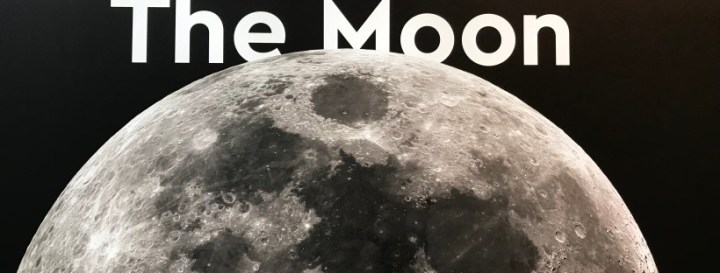
The Moon
National Maritime Museum, Greenwich (London), 19 July 2019 — 5 January 202
Curated by Melanie Vandenbrouck, Megan Barford, Louise Devoy, and Richard Dunn
To celebrate 50 years since NASA’s Apollo 11 mission landed the first humans on the Moon, the National Maritime Museum (NMM) stages The Moon, the UK’s biggest exhibition dedicated to Earth’s nearest celestial neighbour. Featuring over 180 objects from national and international museums and private collections, the exhibition presents a cultural and scientific story of our relationship with the Moon over time and across civilisations. Through artefacts, artworks and interactive moments, the exhibition will enable visitors to reconnect with the wonders of the Moon and discover how it has captivated and inspired us.
The exhibition will explore how humans have used, understood and observed the Moon from Earth. Visitors will get the chance to relive the momentous events of the Space Race and the Moon landings before discovering the motivations behind 21st-century lunar missions.
 Significant objects on display include Apollo mission artefacts that travelled to the Moon, loaned from the Smithsonian National Air and Space Museum in Washington D.C. The ‘Snoopy Cap’ Communications Carrier, worn by astronaut Edwin ‘Buzz’ Aldrin during Apollo 11, will be exhibited alongside the Hasselblad camera equipment that captured some of the most recognisable and iconic images of the 20th century.
Lunar samples collected from NASA’s Apollo missions and the Soviet Union’s Luna programme, will be accompanied by a rare lunar meteorite from the Natural History Museum’s collection. This will give visitors to the NMM’s exhibition a unique opportunity to get close to such a diverse range of moon rocks and discover how researching these specimens continues to advance our understanding of the Moon.
Historical and contemporary artworks will illustrate how the Moon has long inspired artists, acting as a metaphor for the human condition. Moonlit scenes by J.M.W. Turner and John Constable will be displayed alongside contemporary pieces by Katie Paterson, El Anatsui, Chris Ofili, and Leonid Tishkov. Artworks by Cristina De Middel, Aleksandra Mir, and Larissa Sansour will consider our relationship with the Moon through the lenses of gender and nationhood.
In the exhibition’s opening section, visitors will discover ways in which the Moon has been embedded in human culture, spiritually, practically, and artistically, with its changing phases used to mark time in religion, navigation, and medicine. The oldest object on display, a Mesopotamian Tablet from 172 BCE on loan from the British Museum, shows how lunar eclipses were considered to be bad omens. Detailed Islamic and Chinese calendars highlight the continuing importance of using the Moon to set the date for key festivals such as Chinese New Year and Ramadan. Examples of historic medical texts, such as a 1708 pamphlet by the English Doctor Richard Mead show how the position of the Moon was once believed to influence our physical and mental health.
The exhibition will explore how new technologies, such as 17th-century telescopes, 19th-century cameras and remote equipment for space photography and mapping in the 20th century brought increasing understanding of the lunar surface and the Moon’s origins. A selection of maps, paintings, photographs, models, and drawings from the 17th century to the present will emphasise humanity’s continuing desire to understand more about the Moon. Examples include the earliest-known drawing of the lunar surface made from telescopic observations by British astronomer Thomas Harriot in 1609 and the detailed pastel drawings of the Moon by 18th-century Royal Academician John Russell.
From classic science fiction through to the defining events of the Space Race, visitors will see how the Moon went from being a distant object of observation and place of imagination to a destination that was within human reach. The Moon looks at key moments within the Space Race, highlighting how a number of Soviet ‘firsts’ were ultimately overshadowed by Neil Armstrong’s century-defining ‘one small step’ in July 1969. Video artist Christian Stangl will show a new and exclusive version of his film ‘Lunar’, in which animated photographs from Apollo missions allow visitors to experience the Moon landings through the eyes of the astronauts. Apollo objects will sit alongside film posters, books, comics, and magazines that celebrated and questioned these momentous events.
In 1969, the Apollo 11 astronauts left a plaque on the Moon claiming, “we came in peace for all mankind.” Today, there is renewed drive to return to the Moon, reflected in future projects from China, Europe, India, Israel, Japan, Russia, and the United States. No longer the domain of superpowers, international space agencies, private companies, and entrepreneurs are all part of this 21st-century race for the Moon. Scientists, lawyers, artists, and architects are considering the practical, psychological, and ethical implications of human exploration and settlement on the Moon. The closing chapter of the exhibition will look at these contemporary motivations for Moon travel, leaving visitors to contemplate whether the Moon will become a theatre for exploitation and competition or remain a peaceful place for all humankind.
Melanie Vandenbrouck, Megan Barford, Louise Devoy, and Richard Dunn, eds., The Moon: A Celebration of Our Celestial Neighbour (London: Collins, 2019), 256 pages, ISBN: 978-0008282462, £20.
From ArtHist.net:
Art and Science of the Moon
Royal Museums Greenwich, London, 14–15 November 2019
With contributions from academics, artists, and curators exploring the interface between art, in its widest sense, and science, this conference will consider various creative responses to our cosmic companion. In keeping with RMG’s interest in interrogating the collision of science, history and art, The Art and Science of the Moon will explore how the Moon’s motions and phases have influenced human activities, beliefs, and behaviours; how sustained scrutiny of the lunar surface have enabled us to understand more about ourselves; how attempts, imaginary and real, to reach this other world have fostered creativity and technological progress; and how in the 21st century we are rethinking our relationship with the Moon.
The provisional programme is available here»
Exhibition | Making Marvels: Science & Splendor

From the press release (21 May 2019) for the exhibition:
Making Marvels: Science & Splendor at the Courts of Europe
The Metropolitan Museum of Art, New York, 25 November 2019 — 1 March 2020
Curated by Wolfram Koeppe
Between 1550 and 1750, nearly every royal family in Europe assembled vast collections of exquisite and entertaining objects. Lavish public spending and the display of precious metals were important expressions of power, and possessing artistic and technological innovations conveyed status. In fact, advancements in art, science, and technology were often prominently showcased in elaborate court entertainments that were characteristic of the period. Opening November 25, Making Marvels: Science and Splendor at the Courts of Europe will explore the complex ways in which the wondrous objects collected and displayed by early modern European monarchs expressed these rulers’ ability to govern.
The exhibition will feature approximately 170 objects—including clocks, automata, furniture, scientific instruments, jewelry, paintings, sculptures, print media, and more—from The Met collection and over 50 lenders. A number of these works have never been displayed in the United States. Among the many exceptional loans will be silver furniture from the Esterházy Treasury; the largest flawless natural green diamond in the world, weighing 41 carats and in its original 18th-century setting; the alchemistic table bell of Emperor Rudolf II; a large wire-drawing bench made for Elector Augustus of Saxony; a rare example of an early equation clock by Jost Bürgi; and a reconstruction of a late 18th-century semi-automaton chess player, known as The Turk, that once famously caught Napoleon Bonaparte cheating.
Making Marvels is the first exhibition in North America to highlight the important conjunction of art, science, and technology with entertainment and display that was essential to court culture. The exhibition will be divided into four sections dedicated to the main object types featured in these displays: precious metalwork, Kunstkammer objects, princely tools, and self-moving clockworks or automata.
In order to emphasize the scientific and technological content of these objects, the exhibition will begin by establishing the high level of material value and artisanal quality that princes had to meet in these displays of wealth and power. Visitors will encounter a set of superbly fashioned silver furniture that was considered the ultimate symbol of power, status, and money during the early modern period. The second section will be dedicated to the unusual objects of the Kunstkammer, as these collections were known in German-speaking provinces. These pieces were typically composed of newly discovered natural materials set in finely crafted mounts of silver or gold, whose highly inventive designs often embodied the most up-to-date knowledge of the natural world. Reflective of the multi-layered objects they housed, Kunstkammern functioned simultaneously as places of amusement, research retreats for the investigation of nature, and political showcases for magnificence.
Knowledge of subjects such as natural philosophy, artisanal craftsmanship, and technology was considered tantamount to the practical wisdom, self-mastery, and moral virtue integral to successful governance. Pursuits such as metalsmithing, surveying, horology, astronomy, and turning at the lathe were part of the education and entertainment of princes in courts across Europe. The exhibition’s third section will present the scientific instruments, artisanal tools, and experimental apparatus used by rulers as they developed the technical skills so important to their princely identity.
The exhibition will conclude with innovations in mechanical technology. Self-moving clockwork machines—perhaps the most well-known technological display objects—were also a rich source for allegories of rulership. Additionally, as courts competed for technical supremacy, many innovations in mechanical technology were developed at the urging of princely patrons. Automata represented the ultimate attempt to use mechanics to create life-like movement, and were extremely popular additions to princely collections from the Renaissance to the Enlightenment. One highlight will be The Draughtsman Writer, a late 18th-century writing automaton that inspired the book The Invention of Hugo Cabret and its movie adaptation. The advanced mechanism of this piece, which stored more information than any machines that came before it, was the forerunner of the computer, the most common technology used today.
Throughout each gallery, videos and digital models will vividly evoke the historical reality of the objects on view and emphasize the similarities between early modern objects and contemporary technological entertainments. Exhibition visitors will discover innovative marvels that engaged and delighted the senses of the past much like 21st-century technology holds our attention today—through suspense, surprise, and dramatic transformations.
Making Marvels is organized by Wolfram Koeppe, Marina Kellen French Curator in The Met’s Department of European Sculpture and Decorative Arts. The exhibition and accompanying catalogue, distributed by Yale University Press, are made possible by the Anna-Maria and Stephen Kellen Foundation.
Wolfram Koeppe, ed., Making Marvels: Science and Splendor at the Courts of Europe (New York: The Metropolitan Museum of Art, 2019), 320 pages, ISBN: 978-1588396778, $65.
Above Image: Gerhard Emmoser, Celestial Globe with Clockwork, 1579; partially gilded silver, gilded brass (case); brass, steel (movement); diameter of globe: 14 cm (New York: The Metropolitan Museum of Art, Gift of J. Pierpont Morgan, 1917).
Call for Papers | Making a Case for Cases
From ArtHist.net:
Making a Case for Cases: The Furniture of Display
The Bowes Museum, County Durham, 10–11 January 2020
Proposals due by 22 November 2019
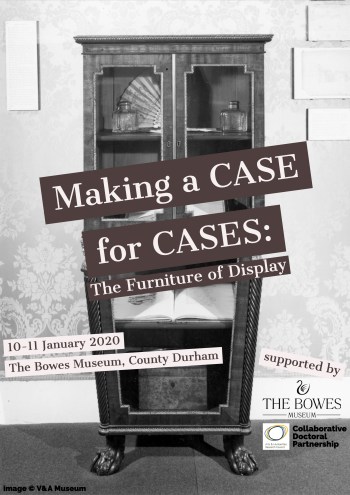 This conference aims to explore the furniture used by collectors, museums and institutions for displaying artefacts. Spanning diverse functions and definitions, objects known as display cases, showcases, china cabinets, vitrines, specimen tables, or even trophy cabinets, are ubiquitous in the home and museum. However, there remains a lack of scholarly engagement with cases in the writing on and about museums, demoting them as merely utilitarian or secondary to the objects they contain. This conference aims to shift the focus from the contained to the container.
From the earliest wunderkammer, treasure houses, and royal palaces, collectors and institutions have purchased, or commissioned craftsmen to make furniture to hold possessions or artefacts. With the rise and development of public art museums and large-scale international exhibitions in the nineteenth century, display cases became increasingly central to the aesthetics and practicalities of exhibiting art. As more people jostled to see or touch objects, cabinets were redesigned to fit with new techniques of preservation and display. We might consider the boom in the luxury furniture trade that offered private collectors from a range of social backgrounds the opportunity to decorate their homes and show off their prize pieces. How did public and private display cases mould forms of class and gender identity? How did they balance the need for access with the claims of distinction?
The display case was an invitation to close-looking and even scientific investigation. Types of visual scrutiny were inherently bound up with technological advances and this was mediated through shifts in case design. What were the power dynamics at work when something was placed inside a case, particularly in the imperial context of the nineteenth century, as foreign cultures were subject to study and objects were displaced from their original locations. Which histories do display cases speak to? This event will open a discussion around the topic between historians of any discipline who examine display cases and their role in presenting art and material culture.
The organisers invite abstracts for 20-minute papers and also shorter, in-focus presentations of around 5–8 minutes in length. We welcome papers on topics engaging with, but certainly not limited to:
• Cases in domestic or historic interiors, c.1750–1950
• The different taxonomy of cases: for porcelain, jewellery, taxidermy, documents, coins and medals, natural history and botanical specimens.
• Uniformity and difference in display cases
• Case design and architecture
• The impact of curators, collectors, artists or dealers on display case design.
• The criteria of cases; for study, classification or aesthetics?
• Display cases and preservation/conservation
• Display cases and Empire
• Display cases in commercial spaces.
Please direct all submissions to casesconference2020@gmail.com by noon on Friday 22 November 2019. The organisers will be in touch with the outcome of applications the following week.
The conference will take place in The Bowes Museum on Friday, 10 January and the morning of Saturday 11 January, allowing time for speakers and delegates to arrive via Darlington train station on Friday morning and to leave on Saturday after lunch. With its important collection of furniture used for display purposes, The Bowes Museum offers the ideal venue for this conference. We warmly invite all participants to join us on the afternoon of Saturday, 11 January at the museum for extra discussion and activities. Information on arrangements for accommodation will be available in due course.
This conference is generously supported by the Collaborative Doctoral Partnership Consortium and The Bowes Museum.
We look forward to receiving your abstracts. With thanks from the organisers:
Charlotte Johnson (The University of Birmingham and Kedleston Hall, National Trust),
Lindsay Macnaughton (Durham University and The Bowes Museum),
Simon Spier (The University of Leeds and The Bowes Museum)
Call for Papers | Animaterialities
From ArtHist.net:
Animaterialities: The Material Culture of Animals (including Humans)
Sixteenth Material Culture Symposium for Emerging Scholars
University of Delaware, 24–25 April 2010
Proposals due by 5 December 2019
The Center for Material Culture Studies at the University of Delaware invites submissions for graduate student papers that examine the relationship between material culture and animal studies for its biennial Emerging Scholars Symposium (April 24–25, 2020). This symposium merges the interdisciplinary study of animals—and the related critical conversations surrounding animality, species, agency, objectivity, and subjectivity—with material culture studies.
Five years after the Audubon Society’s startling Birds and Climate Change Report, we continue to hear about the prices non-human animals pay for human choices: extinction, loss of habitat, and poisoned food sources. The present moment begs, more than ever, critical questions about the intersections between the material world and the (fellow) animals with whom we share it. We thus propose the theme ‘animaterialities’, a term which acknowledges the constant presence of other-than-human animals as physical bodies entangled in various anthropocentric systems, whether political, economic or cultural. Animaterialities encourages participants to consider animals not as passive forms of matter for human use, but as active beings capable of resilience in the face of humans’ material domination and exploitation. Finally, it recognizes the necessary turn material culture studies must take when applied to other-than-human animals, as opposed to artificial, vegetal, or mineral subjects/materials.
Generative questions might include:
• How do material objects define or challenge the boundaries between humans, animals, and objects?
• How are animals transformed into material forms?
• How are animals made visible or invisible in the built environment, text, image, material goods, the archive, and the museum?
• How do animal materialities cut across, complicate, and generate global, hemispheric, and imperial worlds?
• How can we re-conceptualize materialities and animalities as active agents in their worlds, rather than passive participants?
Contributions to this theme may take, but are not limited to, the following forms:
• The production and conservation of animal materials
• Materials that imitate animals
• Animals as objects, the “thingness” of animals, and defying objective treatment
• The materialities of animal labor
• Experimentation with animals and animal materials
• Animal classification, collecting, and display
• Material culture of living history farms, zoos and zoological gardens, and preserves
• Visual culture and representation of animal materials
• The social life of animals
• The material aspects of animal abuse
Submissions: Proposals by current graduate students and recent graduates (May 2019 or later) should be no more than 250 words. Up to two relevant images are welcome. Send your proposal and a current c.v. (two pages or fewer) to emergingscholars2020@udel.edu.
Deadline: Proposals must be received by December 5th, 2019. Speakers will be notified of the committee’s decision by the end of January 2020. Confirmed speakers will be asked to provide digital images for use in publicity and are required to submit their final papers and presentations/slide decks ahead of the conference. Travel grants will be available for participants.
Fellowships | Bard Graduate Center, 2020–21
The fellowship programs at Bard Graduate Center (BGC) are designed to further the institution’s goal of promoting research in the areas of decorative arts, design history, and material culture—what we call the “cultural history of the material world.” We offer a number of fellowship opportunities for researchers working in these and allied areas. We are currently accepting applications for two types of fellowships, see below for details. For questions, please contact fellowships@bgc.bard.edu.
Bard Research Fellowships, 2020–21
Applications due 15 November 2019
Bard Graduate Center is pleased to announce its Fields of the Future Initiative, a funded research fellowship and mentorship program aimed to help promote diversity and inclusion in the advanced study of the material world. As a reflection of the need to explore and expand the sources, techniques, voices, perspectives, and questions of interdisciplinary humanities scholarship, our research fellowship theme for academic year 2020–21 is “How do we know?” We invite scholars from university, museum, and independent backgrounds with a PhD or equivalent professional experience, as well as current doctoral students, to apply for funded research fellowships, to be held during the 2020–21 academic year. Applicants are asked to address in a cover letter how their projected work will bear on this question. The fellowships are intended to fund collections-based research at Bard Graduate Center or elsewhere in New York, as well as writing or reading projects in which being part of our dynamic research environment is intellectually valuable. Eligible disciplines and fields of study include—but are not limited to—art history, architecture and design history, economic and cultural history, history of technology, philosophy, anthropology, and archaeology. Learn more»
Bard Visiting Fellowships, 2020–21
Applications due 1 February 2020
Bard Graduate Center invites scholars from university, museum, and independent backgrounds with a PhD or equivalent professional experience to apply for non-stipendiary visiting fellowships, to be held during the 2020–21 academic year. The theme for this period is “How Do We Know?” Applicants are asked to address in a cover letter how their projected work will bear on this question. Bard Graduate Center Visiting Fellowships, which are intended for scholars who have already secured means of funding, provide scholars with workspace in the Bard Graduate Center Research Center and enable them to be a part of our dynamic scholarly community in New York City. Eligible disciplines and fields of study include—but are not limited to—art history, architecture and design history, economic and cultural history, history of technology, philosophy, anthropology, and archaeology. Visiting Fellowships may be awarded for anywhere from one month to the full academic year. Learn more»
Call for Papers | ‘Dark Enlightenments’

From the conference website:
‘Dark Enlightenments’: David Nichol Smith Seminar in Eighteenth-Century Studies XVII
Adelaide, Australia, 2–4 December 2020
Early proposals due by 1 November 2019; regular proposals due by 1 March 2020
The Australian and New Zealand Society for Eighteenth-Century Studies (ANZSECS), Flinders University, and the University of Adelaide invite you to the 17th David Nichol Smith (DNS) Seminar for Eighteenth-Century Studies. Inaugurated in 1966 by the National Library of Australia, the DNS is the leading forum for eighteenth-century studies in Australasia. It brings together scholars from across the region and internationally who work on the long eighteenth century in a range of disciplines, including history, literature, art and architectural history, philosophy, theology, the history of science, musicology, anthropology, archaeology, and studies of material culture.
The theme for this conference is ‘Dark Enlightenments.’ We ask delegates to consider the dark, shadowy aspects of enlightenment processes of the eighteenth century. When broadly conceived, the theme is open to numerous up-to-the-minute, interdisciplinary possibilities, including (for example):
• the dark side of the public sphere, such as expressed in satire and polemic
• Empire and enlightenment
• critiques of empathy and humanitarianism
• negative emotions
• crime, conflict and violence
• the use and abuse of the past
• progress and ethics (political, social, scientific)
• war
• romanticising death
• the Gothic
• the numinous eighteenth century
• the transformation of night-time
• developments in notions of privacy, secrecy and the hidden self
• the ‘shady’ moralities of libertinism
• the aesthetics of darkness and light
This, we believe, is a particularly timely theme, partly owing to the nationalist turn in global politics, and the recent controversy stirred in Australia by the proposed Ramsay Centre for Western Civilisation. It offers both sides of the political spectrum the opportunity to interrogate and fully understand the costs, benefits, and legacies of eighteenth-century ‘progress’. It is also a theme designed to emphasise the Enlightenment in its moral complexity and richness, and the wide range of domains (from the everyday to philosophical thought) that contributed to its production.
We also welcome papers for subjects that fall outside the main conference theme. Proposals for 20-minute papers should consist of a title, 250-word abstract, and short bio sent via email as a pdf attachment to DNS2020@flinders.edu.au. We also accept proposal for panels of three papers, which should include all the above for each presenter, a panel title, and if possible, the name and short bio of the panel chair.
Deadlines for submissions
For early deliberation: 1 November 2019. A first round of acceptances will be made shortly after this date to facilitate international attendance.
Final deadline: 1 March 2020
Keynotes
Associate Professor Kate Fullager (Macquarie)
Professor Sasha Handley (Manchester)
Associate Professor Eugenia Zuroski (McMaster)
◊ ◊ ◊ ◊ ◊
Attention Early Career Researchers!
Aspiring to deliver a keynote lecture at a major international conference? Here’s your chance! We’d like to invite early career researchers to propose a keynote lecture addressing the conference theme. This scheme is open to all topics and areas of expertise in literary/humanities studies broadly defined, and to researchers who are in regular university employment as well as those who are not. Applicants must:
• have an outstanding research track record relative to opportunity;
• be within 5 years after award of the PhD (extended to 7 if not in stable university employment or with a significant career interruption).
To apply, please submit a proposed title, 300–400 word abstract, a bio, and a CV (3 pages max) to DNS2020@flinders.edu.au.
In making a selection diversity and the presence of under-represented groups will be recognised, as well as the spectrum of existing keynotes at the conference. We also reserve the right to seek third-party testimony as to the researcher’s capacity to speak and deliver scholarly presentations. The winner will deliver the proposed keynote lecture, with flights, accommodation, and registration covered. The deadline for early career researcher keynote proposals is 1 November 2019.
Visiting Fellowship | University of Glasgow Library
From the University of Glasgow Library:
University of Glasgow Library Visiting Research Fellowships, 2020
Applications due by 15 November 2019
The University of Glasgow Library is pleased to announce that its Visiting Research Fellowships scheme for 2020 is now open. This scheme seeks to support scholars from across academic disciplines to come to Glasgow to work on our unique research collections.
Glasgow is proud to have an outstanding library of old, rare and unique material, including many illuminated medieval and renaissance manuscripts of international importance, and more than 10,000 books printed before 1601. It also houses extensive collections relating to art, literature and the performing arts, as well as the University’s own institutional archive which dates back to the 13th century. It is also home to the Scottish Business Archive, with over 400 collections dating from the 18th century to the modern-day.
The Fellowships are competitive peer-assessed awards. They are designed to provide financial support towards the costs of travel and accommodation to enable researchers to work on the unique collections held in the University Library. The successful recipients should spend between two and four weeks over the course of a year working with the collections in Glasgow. Two Fellowships are offered by the William Lind Foundation to support research into Scottish business history, otherwise, the scope of proposals is open to applicants to define.
Applicants are asked to complete the application form (available here) and to submit along with a short CV to information-services-businessteam@glasgow.ac.uk. The deadline for receipt of applications is 12pm on 15th November 2019.
Terms
• The value of the award is up to £2000.
• The award will be made for a project relating to the University of Glasgow Library collections. Applicants will be at any stage of their academic career but must be the holder of a completed PhD. Independent and emeritus scholars may also apply.
• The award will cover a period of at least two and no more than four weeks in the calendar year 2020.
• Scholars will make their own arrangements for travel and accommodation. Travel, subsistence, and other reasonable research expenses will be eligible to be claimed to a value of £2000.
• Applications will be peer-reviewed by a panel of University of Glasgow academics. Applicants will be notified of decisions by 19th December 2019.
• Acknowledgment of the award should be made in any future publications resulting from research undertaken during this award.
• Visiting Scholars are expected to submit a short report of their research findings for inclusion on the Library website and/or the Friends of Glasgow University Library newsletter.
Exhibition | Hogarth: Place and Progress
Press release (via Art Daily) for the exhibition:
Hogarth: Place and Progress
Sir John Soane’s Museum, London, 9 October 2019 — 5 January 2020
 Hogarth: Place and Progress unites all of the paintings and engravings in Hogarth’s series for the first time, displayed across the Georgian backdrop of Sir John Soane’s Museum. Through these works the exhibition will explore the artist’s complex stance on morality, society, and the city, and the enduring appeal of his satires.
• The concept of progress has positive connotations in the twenty-first century but was often construed negatively in Hogarth’s time. Hogarth’s complex and often darkly satirical narrative progresses move from moral abandon and social ostracism, to poverty, madness and death.
• New research pinpoints precise locations in London depicted in Hogarth’s works and examines the key role they play in a moral reading of Hogarth’s paintings.
• Hogarth’s ability to see beyond social conventions continues to resonate with 21st-century audiences, as he presented with wit and empathy the depictions of immorality and vice that he perceived in all classes of society.
The Soane Museum’s own Rake’s Progress and An Election will be joined by Marriage A-la-Mode from the National Gallery, The Four Times of Day from the National Trust and The Trustees of the Grimsthorpe and Drummond Castle Trust, as well as the three surviving paintings of The Happy Marriage from Tate and the Royal Cornwall Museum. The exhibition also includes engraved series of prints, lent by Andrew Edmunds, such as The Four Stages of Cruelty, Industry and Idleness, and Gin Lane and Beer Street. The works span Hogarth’s career as an engraver and painter and the exhibition will explore Hogarth’s increasing skill—or progress—in both fields, culminating in the masterly execution of An Election.
Hogarth’s concept of ‘progress’ was influenced by John Bunyan’s The Pilgrim’s Progress, where the word described a journey towards moral and spiritual redemption through dismal places: from the City of Destruction to the Slough of Despond and Valley of Humiliation. Hogarth: Place and Progress explores how Hogarth’s series depict this idea. Hogarth’s narratives move from moral abandon and social ostracism, to poverty, madness and death and are often presented as highlighting the follies of the upper classes.
The exhibition also examines the idea that Hogarth was not simply ‘the people’s champion,’ but increasingly his narrative series perceived immorality and impropriety at all levels of society. Those most likely to be safe from Hogarth’s satirical wit were those who knew their ‘place’ in the social order and lived up to the positive ideals of their class, high and low alike.
Hogarth’s self-titled ‘Modern Moral Subjects’ present detailed characters, plots and changes of scene, set in specific and recognisable locations. The idea of spiritual progress is shown through visible representations of London life. The key geographic contrast is between the City of London, with its winding alleys and crumbling houses, livery guilds, the Mansion House and Monument, associated with merchants, and the West End where the landed aristocracy live in spacious and orderly squares, physically nearer to the royal place of St James. Between the two, the area around Covent Garden is repeatedly presented as a hotbed of immorality. In A Rake’s Progress, the Rake moves from the City of London to an extravagant property in the West End, then a brothel in Covent Garden, and ultimately travels outside the City walls, ending up in Bedlam, where his dissolute life has led him to insanity and death. The exhibition demonstrates how Hogarth’s ‘Modern Moral Subjects’ married the idea of progress with the moral geography of London, in a dynamic and evolving way throughout his own progress as an artist.
Bruce Boucher, David Bindman, Frederic Ogee, and Jacqueline Riding, Hogarth: Place and Progress (London: Sir John Soane’s Museum, 2019), 144 pages, ISBN: 978-1999693213, £25.
Study Day | Understanding Stone Cantilevered Stairs
From The Georgian Group:
Study Day: Understanding Stone Cantilevered Stairs
Somerset House, London, 16 October 2019
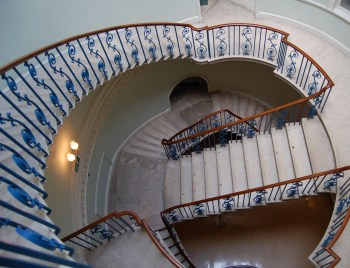
Staircase of he Navy Office, Somerset House, London.
The Georgian Group is holding a study day at Somerset House that will explore stone cantilevered stairs as a characteristic feature of Georgian architecture. The day is aimed at owners and custodians of buildings containing stone cantilevered stairs, as well as architects, surveyors, and structural engineers involved in the repair of existing stairs or the construction of new ones.
The study day will cover three broad areas:
History: The origins and development of stone cantilevered stairs and their importance to Georgian architecture
Structure: Why they work and how they are built
Repairs: What can go wrong, common problems and how they can be repaired
Speakers
• Russell Taylor — Principal of Russell Taylor Architects, an architect in the Classical tradition who has made a special study of the subject
• Sam Price — Founding Partner of Price and Myers, the leading structural engineer on stone cantilevered stairs, the author of several articles on the subject
• Helen Rogers — Engineer at Price and Myers, a specialist engineer and lecturer on stone cantilevered stairs
• Adam Stone — Managing Director of Chichester Stoneworks, a masonry contractor with wide experience in stone design, not least in cantilevered stairs, several of which have won awards
The event is open to all (members and non-members) and includes lunch and refreshments, £135. Doors open at 9am, lectures begin at 9.30am.










 Enfilade
leave a comment