New Book | Female Portraiture and Patronage in Marie Antoinette’s Court
From Routledge:
Sarah Grant, Female Portraiture and Patronage in Marie Antoinette’s Court: The Princesse de Lamballe (New York: Routledge, 2018), 248 pages, ISBN: 978-1138480827 (hardcover), $150 / ISBN: 978-1351061827 (ebook), $55.
 This comprehensive book brings to light the portraits, private collections and public patronage of the princesse de Lamballe (1749–1792), a pivotal member of Marie-Antoinette’s inner circle. Drawing extensively on unpublished archival sources, Sarah Grant examines the princess’s many portrait commissions and the rich character of her private collections, which included works by some of the period’s leading artists and artisans. The book sheds new light on the agency, sorority, and taste of Marie-Antoinette and her friends, a group of female patrons and model of courtly collecting that would be extinguished by the coming revolution.
Sarah Grant is Curator, Prints, at the Victoria & Albert Museum, London.
C O N T E N T S
Introduction
1 From Wife to Widow: Early Portraits of the Princesse de Lamballe
2 Paying Court: Careerism, Sentiment, and Sorority in Portraits of the Princesse de Lamballe
3 The Anglophile Princesse de Lamballe: Portraits, Prints, Gardens, and Anglomania at the Court of Marie-Antoinette
4 ‘Protector of the Fine Arts’: The Private Collection and Public Patronage of the Princesse de Lamballe, a Courtier-Collector
5 Epilogue
Bibliography
Index
New Book | Marie Antoinette at Petit Trianon
From Routledge:
Denise Maior-Barron, Marie Antoinette at Petit Trianon: Heritage Interpretation and Visitor Perceptions (New York: Routledge, 2018), 328 pages, ISBN: 978-1138565562 (hardcover), $140 / ISBN: 978-1315123080 (ebook), $55.
 Marie Antoinette at Petit Trianon challenges common perceptions of the last Queen of France, appraising the role she played in relation to the events of French Revolution through an original analysis of contemporary heritage practices and visitor perceptions at her former home, the Petit Trianon.
Controversy and martyrdom have placed Marie Antoinette’s image within a spectrum of cultural caricatures that range from taboo to iconic. With a foundation in critical heritage studies, this book examines the diverse range of contemporary images portraying Marie Antoinette’s historical character, showing how they affect the interpretation and perception of the Petit Trianon. By considering both producers and receivers of these cultural heritage exponents—Marie Antoinette’s historical figure and the historic house museum of the Petit Trianon—the book expands current understandings of twenty-first century cultural heritage perceptions in relation to tourism and popular culture. A useful case study for academics, researchers, and postgraduate students of cultural heritage, it will also be of interest to historians, keepers of house museums, and those working in the field of tourism studies.
Denise Maior-Barron is a Visiting Research Fellow at the School of Tourism at Plymouth University and a Reader at the Huntington Library. She obtained her PhD from Plymouth University in collaboration with the Château de Versailles, following two consecutive research internships at this UNESCO heritage site. Her research focuses on critical cultural heritage and tourist consumption, with an emphasis on rehabilitative history and popular representations in the social imaginary.
C O N T E N T S
Introduction
1 ‘Places of Memory’ in the Nationalist Era of the French Third Republic
2 ‘Places of Memory’ Anchored in Postmodernity
3 Methodology and Fieldwork Research at the Petit Trianon
4 Historical and Cinematic Narratives Encoding Marie Antoinette’s Contemporary Perception
5 Eighteenth-Century Architectural and Heritage Narratives of the Petit Trianon
6 ‘Memories’ of Marie Antoinette: Field Research Evidence at the Petit Trianon
7 ‘Ange ou Démon?’ Contemporary Images of the Last Queen of France at the Petit Trianon
Conclusion
Exhibition | Generation Revolution: French Drawings
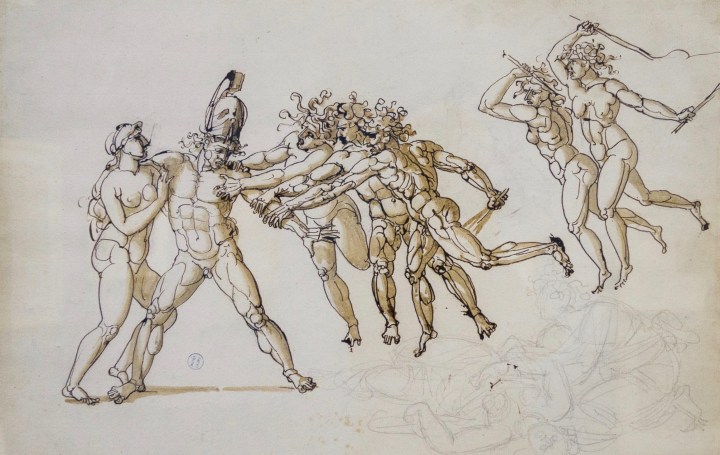
Philippe-Auguste Hennequin, Les Remords d’Oreste, ca. 1800
(Montpellier: Musée Fabre)
◊ ◊ ◊ ◊ ◊
Press release for the exhibition now on view at the Cognacq-Jay:
Generation Revolution: French Drawings from the Musée Fabre in Montpellier, 1770–1815
Musée Cognacq-Jay, Paris, 16 March — 14 July 2019
From 16 March through 14 July 2019, the Musée Cognacq-Jay explores the choices made by a generation of artists who were in their thirties during the French Revolution. The art world they had known was completely overthrown. How did they adapt? Where did they stand, and what coping strategies did they find? Artists were obliged to profoundly re-examine their practices and their opportunities, reconsidering even their subjects and their stylistic orientation, between Neoclassicism and Pre-Romanticism.
 The medium of intimacy par excellence, drawing reflects the richness and diversity of this transitional period. The exhibition brings together a selection of 80 exceptional drawings from the collection of the Musée Fabre in Montpellier. This unique group of drawings, never before shown in Paris, attests the acceleration of history and a prelude to modernity
The decades bridging the 18th and 19th centuries were a period of major political, economic, and social upheaval. The art world was by no means spared: royal commissions disappeared, the Académies were suppressed, and large projects cancelled. This exhibition, organised in collaboration with the Musée Fabre in Montpellier, speaks to the renewal of artistic techniques, styles, subjects, and sensibilities that emerged from these upheavals. While the birth of a republican patriotic ideal inspired artists to draw from the history of Antiquity, private and picturesque subjects also experienced an unprecedented success.
Focused on drawing, the exhibition presents a corpus of almost a hundred remarkable sheets, assembled by one of David’s favourite students, the painter François-Xavier Fabre, who was also a collector, art expert and art dealer. The collection he bequeathed to his native city was the basis for the Cabinet des arts graphiques at the Musée Fabre. The most famous artists of the time: David, Girodet, Vien, Fragonard and Prud’hon clustered around the personality of Fabre.
The exhibition plan is based on around four thematic sections presenting the different genres practiced by artists of the time, the development of artistic trends, and the emergence of individual personalities along with the diversity of graphic techniques employed.
Drawing to Learn
Until the end of the Ancien Regime, training at the Royal Academy was a requirement for any artist who hoped to obtain official commissions. Drawing instruction occupied a preeminent place in the curriculum and required a mastery of geometry, perspective, and anatomy. Figure drawing was considered the most noble exercise (and the most revelatory of youthful potential), so much so that the male nude was known as an ‘academy figure’. With the coming of the Revolution, the practice of drawing took off in an extraordinary way.
In Praise of the Individual
Although historical subjects continued to dominate the hierarchy of genres in painting, representations of daily life and its pleasures attracted an ever more substantial clientele. The portrait and the genre scene—less subject to political shifts and embraced by a growing bourgeoisie—expanded in an unprecedented way. Fragonard, for example, made a specialty of these types of painting.
The Virtues of History
The hegemony of history painting was exacerbated by the Revolution and took on a moralising role: the nascent Republic seized upon ancient Rome for its examples of virtue and heroism. Interest in subjects taken from the Bible and ancient history strengthened the dominance of Neoclassicism. Meanwhile, however, artists were fascinated by other imaginaries: the national past, especially the medieval past, and the Middle-East, revealed by scientific investigations and military campaigns, two points of reference which are at the source of later Neo-Gothic and Orientalism.
Travel and Nature

Antoine-Laurent Castellan, Etude de nuages, 1815 (Montpellier: Musée Fabre).
For the artists who chose exile, Italy remained a favoured destination. Attractive above all for its masterpieces of ancient and Renaissance art, Italy’s vast panoramas and striking light effects were also a draw. The French artists sojourning on the peninsula—in particular François-Xavier Fabre and his friends—went off into the countryside looking to immortalise grandiose sites where nature dominates the human figure.
Lead Curators
Michel Hilaire, Director, Musée Fabre
Annick Lemoine, Director, Musée Cognacq-Jay
Rose-Marie Herda-Mousseaux, chief curator for the modern era at the Louvre Abu Dhabi
Scientific Curators
Benjamin Couilleaux, Curator for cultural heritage, Director Musée Bonnat-Helleu
Florence Hudowicz, Curator for cultural heritage, Curator of drawings and decorative arts, Musée Fabre, Montpellier
Benjamin Couilleaux, Michel Hilaire, and Florence Hudowicz, Génération en Révolution: Dessins français du musée Fabre, 1770–1815 (Paris Musées, 2019), 174 pages, ISBN: 978-2759604197, 35€.
Catalogue cover Image: François-Xavier Fabre, Personnage nu saisissant un cube de pierre, 1789–92 (Montpellier: Musée Fabre).
Conference Papers | Académies d’art et mondes sociaux, 1740–1805
Conference papers from the study day on ‘Académies d’art et mondes sociaux, 1740–1805’, held last November in Rouen, are now available from the ACA-RES website. Also please note that the research programme’s next conference will be held in Paris 26–28 March 2020. Proposals for papers related to ‘Art Academies and Their Networks in the Age of Enlightenment’ are being accepted until 6 September 2019.
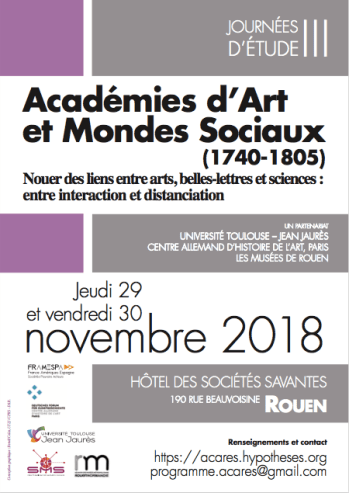
Journées d’étude III: Académies d’art et mondes sociaux, 1740–1805
Hôtel des Sociétés Savantes, Rouen, 29–30 November 2018
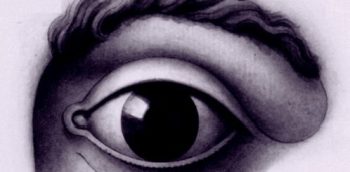
Jean-Jacques Lequeu, Études de l’œil (detail), 1798.
Nouer des liens entre arts, belles-lettres et sciences: entre interaction et distanciation
En partenariat Université Toulouse – Jean Jaurès ; Centre allemand d’histoire de l’art, Paris ; Les musées de Rouen
Les troisièmes journées d’étude du programme ACA-RES se sont tenues les 29 et 30 novembre 2018 à Rouen, en voici le compte rendu synthétique et les différents articles auxquels il renvoie :
• Anne Perrin Khelissa and Émilie Roffidal, « Nouer des liens entre arts, belles-lettres et sciences : entre interaction et distanciation », Les papiers d’ACA-RES, Actes des journées d’étude, 29–30 novembre 2018, Rouen, Hôtel des Sociétés Savantes, mis en ligne juin 2019 (PDF à télécharger : perrin khelissa-roffidal-2019)
1. Architecture, peinture, sculpture, des sœurs jumelles ?
• Émilie d’Orgeix, « L’ingénieur, les écoles du génie et les arts », à venir
• Dominique Massounie, « La place de l’architecture et de l’École des arts de Jacques-François Blondel dans l’histoire des académies artistiques provinciales du XVIIIe siècle », mis en ligne juin 2019 (PDF à télécharger : massounie-2019)
• Théodore Guuinic, « L’École des arts, ponts et chaussées de Montpellier sous la Révolution, 1787–1796 : un enseignement conjoint des sciences et des arts », mis en ligne juin 2019 (PDF à télécharger : guuinic-2019)
 2. L’art est-il utile à l’économie ?
• Aude Gobet, « Jean-Baptiste Descamps, les négociants et les manufactures à Rouen au XVIIIe siècle, 1741–1791 », mis en ligne juin 2019 (PDF à télécharger : gobet-2019)
• Moïra Dato, « État des lieux sur la question des rapports entre l’école de dessin et la Grande Fabrique à Lyon : les dessinateurs et marchands fabricants en étoffes d’or, d’argent et de soie », mis en ligne juin 2019 (PDF à télécharger : dato-2019)
• Céline Paul, « La Société d’agriculture, des arts et des sciences de la Haute-Vienne et la mise en place progressive d’un enseignement du dessin », à venir
3. Arts et lettres, quelles rencontres possibles ?
• Émilie Roffidal, « Marseille, contacts et relations inter-académiques : les liens entre l’Académie des sciences et belles-lettres et l’Académie de peinture et de sculpture », mis en ligne juin 2019 (PDF à télécharger : roffidal-2019)
• Véronique Krings, « Anne-Marie d’Aignan, marquis d’Orbessan, un curieux toulousain, entre arts, littérature et antiquarisme », mis en ligne juin 2019 (PDF à télécharger : krings-2019)
• Julie Lablanche, « Échos de la vie artistique et des progrès techniques dans les éloges, discours et mémoires de l’académie de Besançon », mis en ligne juin 2019 (PDF à télécharger : lablanche-2019)
4. Quelles sciences pour les arts ?
• Nelly Vi-Tong, « Entre les sciences et les arts : les ambitions pédagogiques de l’Académie des sciences, arts et belles-lettres de Dijon », mis en ligne juin 2019 (PDF à télécharger : vi-tong-2019)
• Flore César, « Des arts dans une ville de sciences, des sciences dans une école d’art : la Société des beaux-arts de Montpellier, 1777–1784 », mis en ligne juin 2019 (PDF à télécharger : cesar-2019)
• Jérôme Lamy, « Sciences, arts et belles-lettres, les académies entre ‘travail aux frontières’ et ‘objets frontières’ à l’époque moderne », mis en ligne juin 2019 (PDF à télécharger : lamy-2019)
New Book | From Stone to Paper: Architecture as History
From Yale UP:
Chanchal Dadlani, From Stone to Paper: Architecture as History in the Late Mughal Empire (New Haven: Yale University Press, 2019), 232 pages, ISBN: 978-0300233179, $65.
 By the 18th century, the Mughal Empire was well beyond its so-called golden age. Its control of the Indian subcontinent was increasingly threatened by regional Indian states, as well as by the encroaching British Empire. In response to a rapidly changing sociopolitical landscape, the Mughal emperors used architecture to harness their illustrious past and stage cultural authority for contemporary audiences. Chanchal Dadlani provides the first in-depth look at this crucial period of architectural history. Discussing a rich array of built forms and urban spaces—from grand imperial mosques to Delhi’s bustling thoroughfares—the volume sheds light on long-overlooked buildings. It also explores representations of architectural monuments that circulated in the form of building plans, manuscript paintings, and postcards. Ultimately, the book reveals how Mughal architects, artists, and patrons built on the cultural legacy of their imperial predecessors to create the very concept of a historical style identifiable as Mughal.
Chanchal B. Dadlani is associate professor of art and architectural history at Wake Forest University.
C O N T E N T S
Acknowledgments
Note on Translation and Transliteration
Introduction: The Mughal Eighteenth Century
1 Between Experimentation and Regulation: The Foundation of an Eighteenth-Century Style
2 The Urban Culture of Mughal Delhi
3 ‘The Last Flicker in the Lamp of Mughal Architecture’: Transforming the Imperial Capital
4 Codifying Mughal Architecture on Paper
5 Mughal Architecture between Manuscript and Print Culture
Conclusion: From Historicization to Abstraction
Notes
Select Bibliography
Index
Illustration Credits
Call for Papers | Lithography in Asia
From The University of Chicago, Delhi:
Global Technology in Local Contexts: Lithography in Asia
The University of Chicago Center in Delhi, 16–17 March 2020
Proposals due by 15 August 2019
Organized by Ulrike Stark, Thibaut d’Hubert, and Abhijit Gupta
The year 2022 will mark the bicentenary of the arrival of lithography in India, a watershed moment in the history of printing in South Asia. In anticipation of this anniversary, the University of Chicago Center in Delhi will host a two-day workshop on 16–17 March 2020. We invite scholars working on various aspects of lithography in Asia to submit proposals for papers. We especially welcome proposals from scholars based in South Asia and from early career researchers.
The upcoming anniversary provides a timely moment to review the history of lithography in its technological, sociocultural, economic, and aesthetic dimensions, and from both local and transregional perspectives. Rather than focusing on India alone, the workshop aims to look at the rise of lithography across Asia, from Teheran to Shanghai, and to address the impact of a global technology that bridged traditional and modern practices of textual production from a variety of disciplinary lenses, languages, and local contexts. The workshop will bring together junior and senior scholars from the US, Europe, India and other Asian countries to discuss approaches to the study of lithography in light of recent interest in material cultures, entangled histories, and the circulation of knowledge and technologies. We will explore new lines of inquiry into the relationship between manuscript and print production and the competition between lithography and typography. Possible topics of discussion may include: the social history of lithography; lithography’s trajectory from the sphere of artistic book production to commercial mass printing, lithography as a religious technology, lithography as an art form, the democratizing effect of lithography, lithography and community formation, lithography and the rise of vernacular journalism, global flows of technology and expertise, missionary uses of lithography, lithography in graphic design and advertising.
The workshop will be free and open to invited guest participants. We are unable to cover travel costs for international presenting participants from outside South Asia, but will cover two nights of accommodation in Delhi as well as refreshments and meals for the duration of the workshop. For speakers based in South Asia, we will cover two nights of accommodation and travel expenses (domestic economy round-trip travel).
We invite proposals for papers of 30-minute duration. Proposals should be submitted no later than 15 August 2019 and must include:
1 An abstract of no more than 350 words outlining your research presentation
2 A current CV
3 A completed contact information form, available here.
Please email these materials to Shruti Brar at shrutibrar@uchicago.edu. Proposals may also be sent via mail to the following address:
University of Chicago Center
Attn: Shruti Brar
DLF Capitol Point
Baba Kharak Singh Marg
New Delhi, India 110001
Workshop Conveners
Professor Ulrike Stark, Department of South Asian Languages and Civilizations, University of Chicago
Professor Thibaut d’Hubert, Department of South Asian Languages and Civilizations, University of Chicago
Professor Abhijit Gupta, Department of English, Jadavpur University, Kolkata
New Book | The Anarchy: The Relentless Rise of the East India Company
From Bloomsbury this fall:
William Dalrymple, The Anarchy: The Relentless Rise of the East India Company (London: Bloomsbury Publishing, 2019), 320 pages, ISBN: 978-1408864371, £25 / $30.
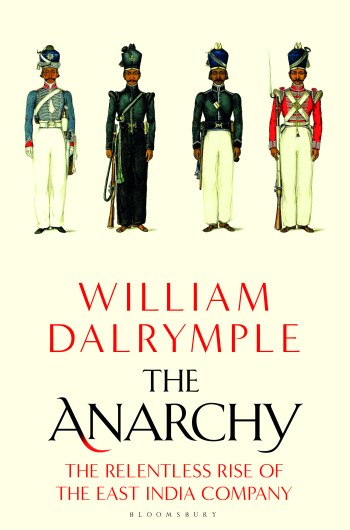 In his most ambitious book to date, bestselling historian William Dalrymple tells the timely and cautionary tale of the rise of the East India Company and one of the most supreme acts of corporate violence in world history.
In August 1765 the East India Company defeated and captured the young Mughal emperor and forced him to set up in his richest provinces a new government run by English traders who collected taxes through means of a vast and ruthless private army. The creation of this new government marked the moment that the East India Company ceased to be a conventional international trading corporation, dealing in silks and spices, and became something much more unusual: an aggressive colonial power in the guise of a multinational corporation. In less than half a century it had trained up a private security force of around 260,000 men—twice the size of the British army—and had subdued an entire subcontinent, conquering first Bengal and finally, in 1803, the Mughal capital of Delhi itself. The Company’s reach stretched relentlessly until almost all of India south of the Himalayas was effectively ruled from a boardroom in London.
The Anarchy tells the remarkable story of how one of the world’s most magnificent empires disintegrated and came to be replaced by a dangerously unregulated private company, based thousands of miles overseas and answerable only to its shareholders. In his most ambitious and riveting book to date, William Dalrymple tells the story of the East India Company as it has never been told before, unfolding a timely cautionary tale of the first global corporate power.
William Dalrymple is the bestselling author of In Xanadu, City of Djinns, From the Holy Mountain, The Age of Kali, White Mughals, The Last Mughal and, most recently, Nine Lives. He has won the Thomas Cook Travel Book Award, the Sunday Times Young British Writer of the Year Award, the Ryszard Kapuscinski Award for Literary Reportage, the Hemingway Prize, the French Prix d’Astrolabe, the Wolfson Prize for History, the Scottish Book of the Year Award, the Duff Cooper Memorial Prize, the Asia House Award for Asian Literature, the Vodafone Crossword Award and has three times been longlisted for the Samuel Johnson Prize. In 2012 he was appointed Whitney J. Oates Visiting Fellow in Humanities at Princeton University. He lives with his wife and three children on a farm outside Delhi.
Exhibition | Indian Painting for the East India Company
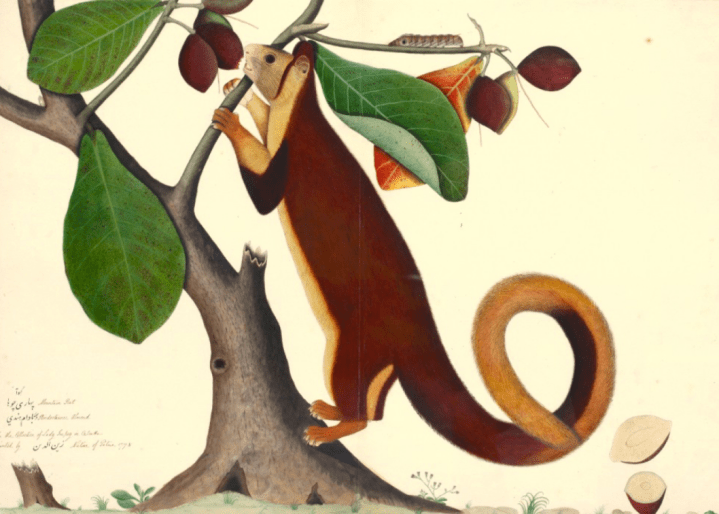
Shaikh Zain al–Din, Malabar Giant Squirrel, Eastern India, Calcutta, 1778
(Private Collection; photo by Margaret Nimkin)
◊ ◊ ◊ ◊ ◊
From the press release related to the exhibition:
Forgotten Masters: Indian Painting for the East India Company
The Wallace Collection, London, 4 December 2019 — 19 April 2020
Curated by William Dalrymple
In September 2019, the Wallace Collection presents Forgotten Masterpieces of Indian Painting for the East India Company. Curated by renowned writer and historian William Dalrymple, this is the first UK exhibition of Indian paintings commissioned by East India Company officials in the late eighteenth and nineteenth centuries. Reflecting both the beauty of the natural world and the social reality of the time, these dazzling and often surprising artworks offer a rare glimpse of the cultural fusion between British and Indian artistic styles during this period.
Comprising works from a wide variety of Indian traditions, the exhibition belatedly honours historically overlooked Mughal artists including Shaikh Zain al–Din, Bhawani Das, Shaikh Mohammad Amir of Karriah, Sita Ram, and Ghulam Ali Khan. It will shed light on a forgotten moment in Anglo-Indian history, recognising the vivid and highly original paintings it produced as among the greatest masterpieces of Indian painting.
William Dalrymple, ed., Forgotten Masters: Indian Painting for the East India Company (London: Philip Wilson Publishers, 2019), 192 pages, ISBN: 978-1781300978, $40.
Note (added 25 September 2019) — The original posting listed the exhibition as being open from September until December.
Note (added 22 October 2021) — The original posting listed the title as ‘Forgotten Masterpieces’, rather than ‘Forgotten Masters’.
Exhibition | Un brin de panache, éventails de Chine

Opening this week at the Museum of the French East India Company:
Un brin de panache, éventails de Chine
Musée de la Compagnie des Indes, Port-Louis (Brittany), 15 June — 25 November 2019
Les aristocrates européens se piquent d’exotisme extrême-oriental au 17e siècle. Cette passion entraîne l’apparition, en Asie, d’une production d’objets à destination de l’exportation européenne. L’éventail devient l’objet indispensable des cours royales européennes dès le début du 17e siècle.
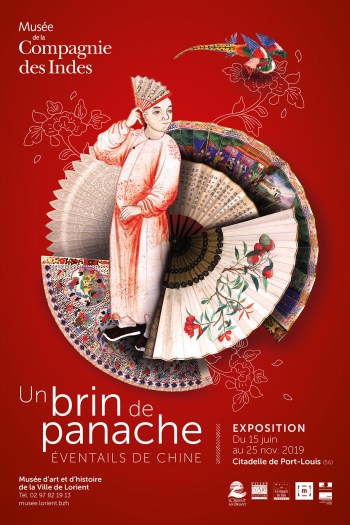 Les premiers éventails chinois destinés au marché occidental sont faits de brins d’ivoire repercés dont les motifs évoquent la finesse de la production de la porcelaine. Les scènes représentent des figures animales et de riches décors floraux. L’usage de l’éventail se démocratise au 18e siècle et ce sont plus de 45,000 éventails qui sont importés par la Compagnie française de 1722 à 1741. Ils sont majoritairement en bambou mais les plus beaux sont en ivoire, en écailles de torture ou en laque. L’iconographie des feuilles évolue et la variété des scènes représentées se multiplie. L’engouement pour les éventails chinois perdure au 19e siècle. Ainsi, le navire Le Fils de France, armé par l’armateur nantais Thomas Dobrée, rapporte dans ses cales 2,200 éventails qui sont vendus à Nantes en 1819.
Bien que le thé, les porcelaines et la soie soient les marchandises principales importées de Chine par les compagnies des Indes, cette exposition présente une sélection d’éventails, ces objets d’art qui ont participé au goût particulier de certains amateurs de l’exotisme asiatique.
About the Museum
Since 1984, the musée de la Compagnie des Indes de Lorient (the Museum of the French East India Company) has been housed in one of the buildings of the Port-Louis Citadel, a marvel of seventeenth-century military architecture initiated by the Spanish and completed by the architect Jacques Corbineau. The musée de la Compagnie des Indes is the only museum in France dedicated to the story of the great trading companies of the seventeenth and eighteenth centuries. Ship models, engravings, maps, Indo-European furniture, China porcelains, and Indian cottons shed light on this maritime epic.
Lecture | Susan Sloman, Mapping Gainsborough in Bath and London
From the Society of Antiquaries:
Susan Sloman, Mapping Thomas Gainsborough’s Career in Bath and London
Society of Antiquaries of London, 9 July 2019
Much of Susan Sloman’s research into the Thomas Gainsborough’s life and career has involved mapping and architecture. She is primarily interested in how the streets and buildings in which he lived affected his practice.
In Bath, Gainsborough shared a large central town house built for the Duke of Kingston with his sister (a milliner). This was destroyed at the time of the excavation of the Roman Baths in the last decade of the nineteenth century, and photographs of the excavation show Gainsborough’s house teetering at the edge of the Great Bath held up by wooden props. For the exhibition catalogue accompanying Gainsborough’s Family Album (National Portrait Gallery, November 2018 – February 2019), Sloman has written about the roles the artist’s wife and sister played within his professional life, and how his and his sister’s use of property created wealth for the family as a whole and supported his portrait-painting practice.
In the course of research for another exhibition (Gainsborough and the Theatre, Holburne Museum, Bath, October 2018 – January 2019), the changes in London’s streetscape south of Piccadilly that took place at the time of the construction of Regent Street were discovered to be particularly striking. The area Gainsborough frequented in the vicinity of Pall Mall looked very unlike the place we know now. He was only a short walk from the ‘Little’ Theatre (the site of the later Haymarket Theatre) and the King’s Theatre or Italian Opera House, also in Haymarket. Across Pall Mall from these theatres was Dalton’s Warehouse, home to the Royal Academy for the first ten years of its existence, between 1769 and 1779. It is hoped that these elements of geography and archaeology will be of wider interest beyond the confines of art history—and will form a key focus of this talk on Gainsborough’s career.
This public lecture will begin at 13.00; doors open at 12.30. It is free and open to the public, but space is limited and reservations are strongly recommended to avoid disappointment. To book online, simply click the ‘Reserve Your Seat’ button, available here.










 Enfilade
leave a comment