Colonial Williamsburg Acquires Portrait by William Dering
Press release (2 July 2018) from Colonial Williamsburg:

William Dering, Portrait of Joyce Armistead Booth (Mrs. Mordecai Booth), oil on canvas, ca. 1745 (Colonial Williamsburg, Gift of Julia Miles Brock, Edward Taliaferro Miles and Georginana Serpell Miles in memory of their mother, Alice Taliaferro Miles, 2018-165, A&B).
In the first half of the 18th century, William Dering was a well-connected dancing master and artist who lived and worked in Williamsburg, Virginia. Today, only six of Dering’s paintings are known to survive; four, including the artist’s only known signed and dated portrait, are in Colonial Williamsburg’s collection, the largest assemblage of his work. Now, through a generous gift from the sitter’s descendants, Joyce Armistead Booth (Mrs. Mordecai Booth), ca. 1745, a large-scale, oil on canvas, joins Dering’s other works at Colonial Williamsburg, including the well-known portrait of the subject’s son, George Booth. Until now, the painting of Mrs. Booth, which is in remarkable condition and survives in its original frame, has descended through the Booth family.
“Rare early works by local artists such as William Dering expand the depth and breadth of our collections and better enable us to share America’s enduring story,” said Mitchell Reiss, the Colonial Williamsburg Foundation’s president and CEO. “We are particularly grateful for gifts such as this since they allow us to teach history in a very human and personal way.”
“Executed in saturated, well-preserved reds, blues, and golds, and measuring more than four feet in height, this likeness of Joyce Armistead Booth is visually arresting,” said Ronald Hurst, the foundation’s Carlisle H. Humelsine chief curator and vice president for collections, conservation and museums. “The portrait commands the viewer’s attention, and in so doing, provides a window into the goals and aspirations of early Virginia’s planter aristocracy.”
This Dering portrait is significant to ongoing research that Colonial Williamsburg’s experts are undertaking. Laura Barry, Juli Grainger curator of paintings, drawings and sculpture, and Shelley Svoboda, senior conservator of paintings, are at work on a comprehensive study of the artist and his work from both historical and technical perspectives. The portrait of Joyce Armistead Booth, especially due to its pristine condition, informs this research and will help the experts to better understand the nuances in Dering’s other canvases.
“This generous gift gives us an extraordinary opportunity to reunite two family portraits, more fully tell the story of this important Virginia artist and to better understand the context of William Dering’s body of work,” said Ms. Barry. Along with the additional works by this artist in the collection, including the portrait of Elizabeth Buckner Stith (an oil on canvas dating from 1745–49, the only signed and dated Dering example and for years was the only means by which to measure his work), Ms. Barry and Ms. Svoboda are able to study the individual qualities of each painting as well as to examine them together as a group.
Little is known about William Dering in his early years, but he arrived in Williamsburg from Philadelphia in 1737. He advertised in the Virginia Gazette that same year, the first of several occasions he did so, to announce the opening of a dancing school at the College of William and Mary. By 1744 his success enabled him to purchase two lots and move into the Thomas Everard House on Palace Green. The following year, Dering advertised twice to promote “an assembly at the Capitol… during the Court,” a ball held when the capital city was busy with visiting elected representatives from across the colony. During his time in Williamsburg, Dering also befriended William Byrd II, a Virginia planter and Renaissance man who owned one of the largest art collections in the American colonies. During his many visits to Byrd’s James River estate, Dering painted his daughter Anne Byrd Carter. (Her portrait is also in the Colonial Williamsburg collection.) The artist’s extravagant lifestyle led to debt, however, and he was twice forced to mortgage his property. Ultimately, Dering departed Williamsburg for Charleston, South Carolina, leaving his wife and son behind for a year to handle the public sale of his possessions. Little is known about Dering or his family after 1750.
The portrait of Joyce Armistead Booth is a gift from Julia Miles Brock, Edward Taliaferro Miles and Georginana Serpell Miles in memory of their mother, Alice Taliaferro Miles. It will be included in a future exhibition of the artist’s portraits to be held at the Art Museums of Colonial Williamsburg.
“The painting of Joyce Armistead Booth, my five-times great-grandmother, has been a part of my life for all 74 years, but Miss Joyce (as we were taught to call her) is nearly 300 years old,” said Julia Miles Brock of Virginia. “My brother, sister, and I decided it was time she was in a museum with its attendant care, proper storage, and an appreciative audience.”
Call for Papers | Reading the Country House

From the CFP:
Reading the Country House
Manchester Metropolitan University, 16–17 November 2018
Proposals due by 31 August 2018
County houses were made to be read—as symbols of power, political allegiance, taste and wealth. This places emphasis on the legibility of their architecture and decorative schemes, and the paintings, collections and even the furniture they contained. It also draws our attention to the skills required to decode—to read—these signs and symbols. The messages and processes of reading were carried further by the growing number of images of country houses produced through the eighteenth and nineteenth centuries: in private sketchbooks and journals and as engravings published as collections or incorporated into written guidebooks. These allowed the country house to be read in very different ways, as did its appearance in the pages of novels, sometimes as the backdrop or stage for the action, but also symbolic of social structures and relations. This conference seeks to explore all of these perspectives on reading the country house and links them to how the country house is read today, by house managers and visitors and by viewers of period dramas.
We invite papers on any aspect of reading the country house, but we especially welcome papers which examine:
• The country house and the novel
• The presentation of country houses guidebooks and gazetteers
• Visitors perceptions and readings of the country house, both historic and present day
• Processes of reading the architecture and aesthetics of the country house
• Engravings and paintings, both as representations of the country house and as collections in the country house
We are particularly keen to encourage contributions that take a comparative approach: national, international and across time.
Keynote Speakers
Prof. Phillip Lindley (Loughborough) and Prof. Kathryn Sutherland (Oxford)
If you would like to present a paper, then please send a title and 200-word abstract together with a very brief biography to Prof. Jon Stobart: j.stobart@mmu.ac.uk by 31 August 2018.
Exhibition | 18th-Century Baltic Faience

Dish, eighteenth century, faience, Rörstrand
(Stockholm: Nationalmuseum)
◊ ◊ ◊ ◊ ◊
On view this summer in Sweden:
Colour and Form: 18th-Century Baltic Faience
Färg och form: Östersjöfajanser från 1700-talet
Läckö Castle, Lidköping, 10 June — 26 August 2018
Curated by Micael Ernstell
Eighteenth-century pieces of faience from the Baltic region seduced the market with their rich decoration and fine design. This exhibition presents faience artefacts from Nationalmuseum’s amazing collection of ceramics from the 18th century that were manufactured in the countries around the Baltic Sea.
The items in the exhibition, which Nationalmuseum is presenting in partnership with the Läckö Castle Foundation, have a vibrancy and joy that combine with the manufacturers’ ambitions for good design, both aesthetically and technically. The colour palette used by the pattern painters was a rich one, and it seduced the market for much of the 18th century. There has been strong interest among collectors since then.
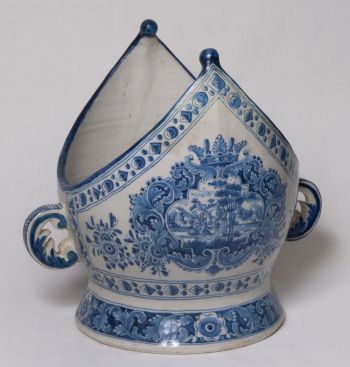
Bowl, so called ‘Bispebolle’, unknown Danish artist active during the 18th century, faience (Stockholm: Nationalmuseum).
The exhibition is dominated by Swedish faience, with the Rörstrand and Marieberg factories as the most important actors. The factories had their own designers, who created many inspirational models and patterns. Production resulted in many examples of international influences. There was also movement of labour between the factories. This saw patterns and designs moving between the competitors.
The manufacturing of faience in Sweden during the 18th century was one element of the national leadership’s desire to develop the nation’s economy and avoid expensive imports. Tax rules and other privileges created the economic preconditions for Swedish faience. Another major factor in helping the Swedish factories was the Manufactory Office (Manufakturkontoret), which aimed to provide manufacturers with both economic and artistic guidance.
“We’re delighted about the long-term and rewarding partnership with the Nationalmuseum. The fact that artefacts from Rörstrand are included feels especially pleasing for Lidköping. One of the financiers of the Rörstrand faience factory was Carl-Gustaf Tessin, the owner of Läckö from 1752 until 1770,” says Magnus Lönnroth, CEO of the Läckö Castle Foundation.
There were almost 40 faience factories around the Baltic Sea in the 18th century. Although production reached a high level, the factories were mostly unprofitable. This meant that many factories only existed for a few years. The ones that started up first were the factories of Store Kongensgade in Copenhagen and Rörstrand in Stockholm. They started in the 1720s, both with a dream of being able to produce the same kind of porcelain as in China or at the Meissen factory in Dresden.
Apart from examples of Swedish manufacturing, the exhibition features artefacts from ten or so factories around the Baltic. There are examples from the Store Kongensgade factory in Copenhagen, which was founded in 1722 and is the oldest faience factory in the Nordic region. Johan Wolff came from that factory to Stockholm and founded the Rörstrand factory in 1726. Norway is also represented, as that was part of Denmark at the time.
“It’s wonderful that we can also use the exhibition to highlight the 100th anniversary of the Baltic States as independent nations with colourful pieces of faience from the factory in Reval, the modern-day Tallinn in Estonia,” says Micael Ernstell, curator of the exhibition and director of the National Museum.
Call for Papers | Built Environments and Performances of Power
From H-ArtHist:
Built Environments and Performances of Power
44th Annual Cleveland Symposium
Cleveland Museum of Art, 26 October 2018
Proposals due by 15 July 2018
The Art History Department at Case Western Reserve University invites graduate students to submit abstracts for its 2018 Annual Symposium Built Environments and Performances of Power. We welcome innovative research papers that engage with the concept of built environments and their performative spaces, both within and without.
Architecture creates narratives, while simultaneously shaping the identities of builders and users. Monumental architecture conveys stability, which allows its patrons to emphasize authority. At the same time, occupants transform spaces through their physical presence and social dynamics. How do we engage with architectural locations and the objects found within them? How do patronage, artistic intent, and pre-existing power structures complicate the ways in which audiences connect with their environments? How does social performance vary within constructed spaces? How can architecture—and the spatial distribution of artifacts within it—complicate ideas of centrality and periphery?
Presentations may explore aspects of this theme across any time period, medium, or geographical region. Potential topics may include, but are not limited to:
• Social performance and movement within built environments
• Material spatiality
• Constructed spaces and ideas of comportment
• Interactions between loci memoriae, geography, and architecture
• Space as experienced by architects, engineers, institutions, and audiences
• Viewership, liminal spaces, or construction of memory within museums
• Reconstruction of space through (re)moveable objects and their functions
• Reception within a built environment
• Theatricality and performance
Current graduate students and recent graduates in art history and related disciplines are invited to submit a 350-word abstract and a CV for consideration to clevelandsymposium@gmail.com by the extended deadline of July 15, 2018. Selected participants will be notified by the end of July. Paper presentations will be 20 minutes in length. Please direct all questions to Angelica Verduci and Jacob Emmett at clevelandsymposium@gmail.com. The three most successful papers will be awarded prizes.
Exhibition | Pastels at the Louvre
Now on view at the Louvre:
Pastels in the Musée du Louvre: The 17th and 18th Centuries
Musée du Louvre, Paris, 7 June — 10 September 2018
Curated by Xavier Salmon
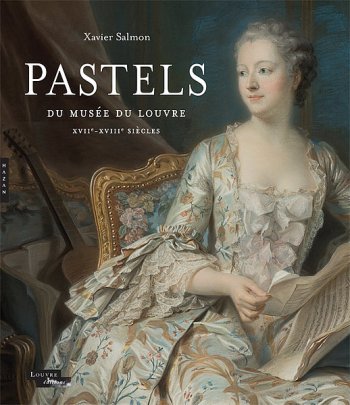 The Louvre holds an unrivaled collection of European pastels from the 17th and 18th centuries. Mostly dating from the reigns of Louis XV and Louis XVI, these extremely fragile works, created with a colored powder that has often been compared to that of a butterfly’s wings, introduce us to Enlightenment society and illustrate the genius of its most celebrated artists: Rosalba Carriera, Maurice Quentin de La Tour, Jean-Baptiste Siméon Chardin, Jean-Baptiste Perronneau, Jean Étienne Liotard, Jean-Marc Nattier, and Élisabeth Louise Vigée Le Brun, together with lesser known artists such as Marie-Suzanne Giroust, Adélaïde Labille-Guiard, Joseph Boze, and Joseph Ducreux.
These pastels illustrate the genius of the artists who produced them as artworks in their own right rather than preparatory studies enhanced with color. Many of them still have their original frame, and sometimes their original glass.
Thanks to the support of American Friends of the Louvre and Joan and Mike Kahn, the more than 150 works in the collection were systematically conserved and remounted to protect them from dust—a long-term project which provided an opportunity for new research on the collection. The results are included in a comprehensive annotated inventory, published in French and English with the support of the Joan Kahn Family Trust.
The exhibition takes a new look at masterpieces such as Maurice Quentin de La Tour’s Portrait of the Marquise de Pompadour and features new acquisitions such as Simon Bernard Lenoir’s portrait of the actor Lekain. It is also an opportunity to compare these works by French artists with others by eminent international pastel artists such as Rosalba Carriera in Venice, Jean-Étienne Liotard in Geneva, and John Russell in London.
The exhibition is curated by Xavier Salmon, director of the Départment des Arts Graphiques and general heritage curator at the Musée du Louvre.
The catalogue, in French and English editions, is published by Hazan and distributed by Yale UP:
Xavier Salmon, Pastels du musée du Louvre, XVIIe XVIIIe siècle (Paris: Hazan, 2018), 384 pages, ISBN: 978-2754114547 (French) / ISBN: 978-0300238631 (English), €59 / $75.
Call for Papers | Painting Childhood
From H-ArtHist:
Painting Childhood
Compton Verney Art Gallery & Park, 29 March 2019
Proposals due by 29 October 2018
Children have long fascinated artists and have been captured in images ranging from formal portraits to humorous genre scenes and intensely personal family sketches. These diverse works will be the subject of two exhibitions at Compton Verney from 16 March until 16 June 2019. Painting Childhood: Hans Holbein to Lucian Freud will present a survey of some of the most iconic paintings of children produced over the past 500 years, with sections devoted to the royal portrait, play and learning, and the fantasy and reality of children’s lives. Childhood Now will explore contemporary representations of children in the work of the painters Chantal Joffe, Matthew Krishanu, and Mark Fairnington.
To coincide with these exhibitions we invite proposals for an interdisciplinary study day on the subject of childhood from 1500 to today. The study day will enable us to interrogate the key themes and issues of the exhibitions in more detail, contributing to the field of childhood studies through fruitful cross-disciplinary discussions. Painting Childhood will include select examples of children’s costumes, toys, and schoolbooks. As such we welcome contributions from speakers with a range of disciplinary backgrounds and research perspectives (History, Literature, Sociology, Anthropology, and History of Art). To facilitate meaningful debate papers will be grouped thematically and may address, but are not limited to, the following topics: Intimacy and family ties; dynasty, duty and privilege; play, fantasy and children’s worlds; the material culture of childhood; the appropriation and commercialisation of childhood; memories and memorials; childhood today and the future of childhood.
Keynote speaker: Dr Martin Postle
Please send a 300-word abstract for a 20-minute paper to art@comptonverney.org.uk by Monday 29 October 2018. We welcome applications from emerging and established scholars. Please include a short professional biography. Travel bursaries will be available for speakers covering reasonable expenses incurred within the UK.
Organising committee: Amy Orrock (Compton Verney), Emily Knight (V&A), and Penelope Sexton (Compton Verney)
Symposium | Court Ceiling Painting around 1700
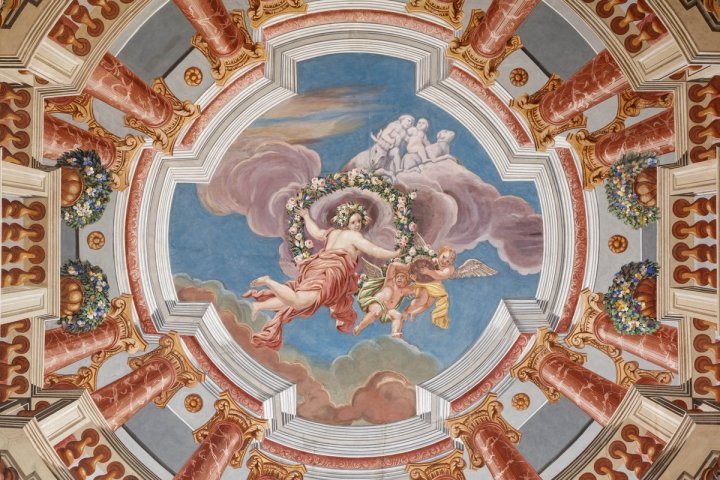
Galeriegebäude Hannover-Herrenhausen, Decke im Frühlingszimmer
© Bildarchiv Foto Marburg/CbDD/C. Stein/ T. Scheidt
◊ ◊ ◊ ◊ ◊
rom H-ArtHist (with a conference flyer available as a PDF file here). . .
Connecting across Europe? Ceiling Painting and Interior Design at the Courts of Europe, ca. 1700
Eine gemeinsame europäische Sprache? Deckenmalerei und Raumkünste an den europäischen Höfen um 1700
Gallery Building, Herrenhausen Gardens (Galerie Herrenhausen), Hanover, 13–15 September 2018
Registration due by 10 August 2018
International Symposium organized by the Corpus of Baroque Ceiling Painting in Germany (CbDD) based at the Ludwig-Maximilians-Universität in Munich (LMU); the German Documentation Centre for Art History – Bildarchiv Foto Marburg (DDK); and the Bavarian Academy of Sciences and Humanities (BAdW)—in cooperation with the City of Hanover, Herrenhausen Gardens; the Institute of History for Art and Musicology – IKM of the Austrian Academy of Sciences (ÖAW); and the Research Group for Baroque Ceiling Painting in Central Europe (BCPCE).
Project directed by Stephan Hoppe (LMU, Munich), Heiko Laß (LMU, Munich), Herbert Karner (ÖAW, Vienna)
 The Corpus of Baroque Ceiling Painting in Germany (Corpus der barocken Deckenmalerei in Deutschland) regards painting on walls and ceilings as a medium of pictorial representation. In a courtly context, mural painting would serve the sovereign to define his status within the court society, just as he did otherwise in the fields of architecture or interior design.
Around 1700, a formal and thematic change can be observed in the choice of these media of social distinction, especially at the courts north of the Alps. In the field of mural painting, it is striking in which way the ceiling was no longer divided into multiple fields, but preferably dominated by one single monumental painting. In this way, mural painting was able to define the room. Monumentality resided in scale, and a new form of illusionism became important. The inganno degli occhi, a highly sophisticated form of illusionism prevailed. Mural painting on ceilings gained autonomy, and as a medium, it followed its own logic. Furthermore, walls and ceiling could be integrated into one overarching decorative scheme. This change was not just a matter of form, but also a matter of content: glorifications and personifications were no longer represented in the old-established way and subject to dynastic formulas, but became more and more individualized and tailored for a specific patron.
Moreover, within the larger European context, mural painting should not be misunderstood as exclusively made in fresco or secco technique, or studied in isolation. The decision for oil painting on canvas or on walls or ceilings was for a longer period of time not only a question of quality or of the possibility to hire a specialist, but also a question of aesthetics. A large part of mural painting in Western, Central, and Northern Europe was painted on canvas and was adjusted onto ceilings and walls. Stucco did also play an important role and seems to have been applied especially in rooms of ‘higher rank’.
The symposium will link the described change to political, social, and cultural shifts in Europe around 1700. This artistic change occurred in parallel to a new position of power established by the monarchs, princes, and their states. The sovereigns were striving for an acknowledgment of their newly achieved status. Numerous territories and new princes within the Holy Roman Empire wanted to position their new rights of sovereignty, just as the kingdoms of England and Sweden or the court of the House of Orange in the Netherlands and, later, in England. Religious denomination played a marginal role in painting as opposed to politics. Despite their basically anti-Catholic orientation, motifs once established to mark protestant ideals, vanish, and patterns, before decidedly perceived as catholic, could be taken over generally. In this way, new forms of a supranational and trans-confessional culture of the courts and higher nobility developed in large parts of Europe.
Apparently, the rise of new dynasties and powers was responsible for the developments described above. The rise of the house of Bourbon and the house of Savoy and the descent of the Spanish Habsburgs in parallel are the most striking examples. An independent trend was the decline of artistic influence from the Netherlands in Northern Europe, giving way to a new influx of aesthetic ideas from France and Italy. This change turned out to be a cultural adjustment process that became apparent in almost all over Europe. Italy and France set the standard, and the Habsburgs did not succeed in gaining artistic dominance.
In addition to general overviews, the symposium will discuss examples from Austria, the Czech Republic, Denmark, England, France, Germany, Italy, the Netherlands, Poland, Spain, and Sweden. In this way, an attempt will be made to highlight connections and comparisons across Europe for the first time. The focus is exclusively on sovereigns and their courts. Sovereigns are understood as the monarchs and princes of Europe and the rulers over imperially immediate territories of the Holy Roman Empire. The States General of the Netherlands and the Republic of Venice were also sovereigns.
Numerous artists were active around 1700 and will be considered during the symposium. These include Jacques Foucquet, Luca Giordano, Daniel Marot, Sebastiano Ricci, Giuseppe Roli, Jerzy Eleuter Szymonowicz-Siemiginowski, Carpoforo Tencalla, Matthäus Terwesten, and Antonio Verrio. The aspect of cultural transfer and the import of artists initiated by clerical and secular clients will also be of interest. Mural painting is intended to be embedded into the development of the spatial arts in general.
The symposium will take place at the so-called Galeriegebäude in Hannover-Herrenhausen. This festive building of the Electors of Hannover is an outstanding example for the change in court culture around 1700. It was erected 1694/98 in the course of a rise in status of the patron and decorated with mural paintings by Tommaso Giusti.
The CbDD has reserved a room contingent for the conference participants until 31 July 2018, because two fairs and an additional conference are going to take place during our symposium. You can use this website for your booking.
The conference languages are German and English. Please keep in mind that it is not common practice in Germany to pay by credit card; take cash with you. The symposium fee is 20€ and will be paid in cash at the venue before the beginning of the symposium. Coffee/Tea and the visit to the Great Garden are included.
Please register until 10/08/2018 at
Corpus der barocken Deckenmalerei in Deutschland
Dr. Heiko Laß
Institut für Kunstgeschichte
Ludwig-Maximilians-Universität München
Zentnerstr. 31
D-80798 München
heiko.lass@kunstgeschichte.uni-muenchen.de
Symposium participants have the opportunity to purchase up to two tickets of the reduced price of 10€ each for the International Fireworks Competition, which will take place in the Great Garten at the night of 15 September, the final day of the symposium. The tickets must be reserved with the registration and paid in cash together with the conference fee.
T H U R S D A Y , 1 3 S E P T E M B E R 2 0 1 8
14:00 Opening of the Galeriegebäude
15:00 Introduction and Welcome
15:30 Session 1
• Steffi Roettgen (Munich), Götterhimmel und Theatrum sacrum – zur Erfolgsgeschichte der Deckenmalerei im barocken Italien
• Thomas Wilke (Stuttgart), Französisch – die gemeinsame europäische Sprache!? – Innendekoration und Deckenmalerei am französischen Hof um 1700
16:45 Coffee/Tea
17:15 Session 2
• Ulrike Seeger (Stuttgart), „weil es dauerhaffter ist und lufftiger aussiehet“. Die gänzlich freskierte Zimmerdecke um 1700 – Modus oder Medium?
• Heiko Laß (Munich), Das Galeriegebäude in Herrenhausen, die Stellung des Hannoverschen Hofs um 1700 und seine Wand- und Deckenmalerei
19:30 Dinner
F R I D A Y , 1 4 S E P T E M B E R 2 0 1 8
8:00 Opening of the Galeriegebäude
9:00 Session 3
• Sara Fuentes (Madrid), The Works of Luca Giordano to the Service of Charles II around 1700
• Herbert Karner (Vienna), Austria vor Jupiter: Deckenbildnerei in Schloss Schönbrunn um 1700
10:15 Coffee/Tea
10:45 Session 4
• Werner Telesko (Vienna), Thematische Multiperspektivität. Die Grazer Katharinenkirche und das Haus Habsburg um 1700
• Martin Mádl (Prague), The Palace of Prince Bishop Carl II of Lichtenstein-Castelcorn in Olomouc and its Decoration
• Andrzej Kozieł (Wrocław), A Jesuit Academy as a Symbol of Habsburgian Power: The Building of the University of Wrocław and its Fresco Decoration
12:40 Lunch
14:00 Session 5
• Ute Engel (Munich), Deckenmalerei und ‘Schönbornscher Reichsstil’? Lothar Franz von Schönborn als Auftraggeber in Bamberg, Mainz und Pommersfelden
• Konrad Pyzel (Warsaw-Wilanów), King Jan III Sobieski’s Wilanów Residence: Universal Patterns, Universal Stories — Unique Iconographical Message?
15:15 Coffee/Tea
15:45 Session 6
• Doris Gerstl (Erlangen/Regensburg), Aristokratie versus Monarchie? Zu Klöcker von Ehrenstrahls Deckenbild im Stockholmer Riddarhuset
• Martin Olin (Stockholm), War and Peace: Jacques Foucquet’s Paintings in the State Apartment of the Royal Palace in Stockholm
17:00 Coffee/Tea
17:20 Session 7
• Thomas Lyngby (Hillerød), The Audience Chamber of Frederiksborg Palace
S A T U R D A Y , 1 5 S E P T E M B E R 2 0 1 8
8:30 Opening of the Galeriegebäude
9:00 Session 8
• Margriet van Eikema Hommes (Delft), The Oranjezaal in Huis ten Bosch
• Alexander Dencher (Leiden), Daniel Marot as a Designer of Wall and Ceiling-Painting in the Age of William and Mary
10:15 Coffee/Tea
10:45 Session 9
• Lydia Hamlett (Cambridge), Mural Cycles of the Later Stuart Courts: Continental Influences and British Reception
• Christina Strunck (Erlangen), Flammende Liebe, höfische Intrigen und internationale Politik. Antonio Verrios Ausmalung des Queen’s Audience Chamber in Windsor Castle
13:00 Lunch
14:00 Session 10
• Elisabeth Wünsche-Werdehausen (Munich), Genealogie versus Mythologie: Die Galleria di Daniele im Palazzo Reale und die Tradition savoyischer Raumausstattung in Turin
• Martina Frank (Venice), Neue Decken für neue Räume. Der Wandel im venezianischen Palast- und Villenbau
15:15 Heiko Laß (Munich), Summary and final comments
18:00 Opportunity to visit the International Fireworks Competition in the Great Garden
Exhibition | Cozens and Cozens

The exhibition closed earlier this month:
Cozens and Cozens
The Whitworth, University of Manchester, 16 June 2017 — 24 June 2018
Father and son, Alexander and John Robert Cozens, were influential watercolour painters of the 18th century. Alexander was a drawing master who dedicated his career to teaching young men and the aristocracy how to create landscapes without needing to attend the Royal Academy. This resulted in the publication of multiple guides demonstrating how to create the ideal landscape from a catalogue of features, such as clouds, mountains and trees. Consequently, many of Alexander’s surviving works are fictional landscapes. Alexander argued that landscape images could evoke particular states of mind or moral feelings in the viewer. He became known as the ‘blot master’ for creating improvised compositions from random markings, an idea first suggested by Leonardo da Vinci. His theories elevated the status of landscape painting in the 18th century and helped propel art practice towards the freedom that resulted in Abstract Expressionism.
Visually John Robert inherited the skill of his father, but by contrast his works were honest accounts of his travels. The Romantic painter John Constable declared that John Robert ‘was the greatest genius that ever touched landscape’ as his work ‘was all poetry’. Painting a landscape with watercolours was traditionally for topography, mapping landscapes. Watercolour was ideal as it was portable and could be used to ‘tint’ or ‘stain’ a map within the lines without distorting it. John Robert revolutionized landscapes by painting with watercolour to create mystery and emotion in the places he depicted.
The Whitworth owns nineteen watercolours and a rare oil by Alexander, one of only five known to exist. The gallery owns seventeen watercolors and thirteen soft-ground etchings by John Robert. Seven sketchbooks from his Grand Tours of Europe in 1782–83 have been digitized allowing visitors to see every page for the first time. They are unique in the world and were copied by JMW Turner and Thomas Girtin in the 1790s. This exhibition showcases the Whitworth’s collection of works by father and son, the largest outside of London. By drawing on their uniting elements of trees and European exploration, visitors will gain a rare insight into the practices of 18th-century artists.
Exhibition | Japanese Arms and Armor
Now on view at The Met Fifth Avenue:
Japanese Arms and Armor from the Collection of Etsuko and John Morris
The Metropolitan Museum of Art, New York, 25 January 2018 — 6 January 2019

Armor (Gusoku), Helmet signed by Bamen Tomotsugu (Japanese, Eichizan province, Toyohara, active 18th century); iron, lacquer, copper-gold alloy (shakudō), silver, silk, horse hair, ivory (New York: The Metropolitan Museum of Art, 2001.642).
Presenting a wide array of samurai armor, blades, and accoutrements dating from the fifteenth to the nineteenth century, this exhibition celebrates the promised gift of thirty-seven objects from the collection of Etsuko and John Morris, as well as other important gifts made by Mr. and Mrs. Morris to The Met’s Department of Arms and Armor over the past seventeen years.
The collection was originally assembled in the early twentieth century by Dr. Frederick Malling Pedersen (1869–1947) of New York. It later passed by descent to Mr. and Mrs. Morris, who have seen to its care and restoration. Key works include a rare complete armor (gusoku) by Bamen Tomotsugu (active eighteenth century); a blade attributed to Fusamune of Sōshū (active late fifteenth–early sixteenth century) with mounting; and a helmet (kawari-kabuto) in the shape of a wave (seventeenth century, restored 2015). The gift of choice objects from the collection represents a significant addition to the Museum’s holdings of Japanese arms and armor, which are the most comprehensive of their kind outside of Japan.
Grey Room, Recent Issues
Some of the articles addressing the eighteenth century in recent issues of Grey Room:
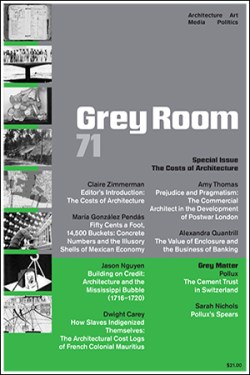 Grey Room
Editors: Zeynep Çelik Alexander, Lucia Allais, Eric C.H. de Bruyn, Noam M. Elcott, Byron Hamann, John Harwood, and Matthew C. Hunter
Grey Room brings together scholarly and theoretical articles from the fields of architecture, art, media, and politics to forge a cross-disciplinary discourse uniquely relevant to contemporary concerns. Publishing some of the most interesting and original work within these disciplines, Grey Room has positioned itself at the forefront of current aesthetic and critical debates. Featuring original articles, translations, interviews, dossiers, and academic exchanges, Grey Room emphasizes aesthetic practice and historical and theoretical discourse that appeals to a wide range of readers, including architects, artists, scholars, students, and critics.
No. 71 (Spring 2018) The Costs of Architecture
• Jason Nguyen, “Building on Credit: Architecture and the Mississippi Bubble (1716–1720),” pp. 40–67.
No. 69 (Fall 2017) Liquid Intelligence
• Jennifer L. Roberts, “The Veins of Pennsylvania: Benjamin Franklin’s Nature-Print Currency,” pp. 50–79
• Matthew C. Hunter, “The Cunning of Sir Sloshua: Reynolds, the Sea, and Risk,” pp. 80–107.










 Enfilade
leave a comment