Call for Papers | ASECS 2019, Denver
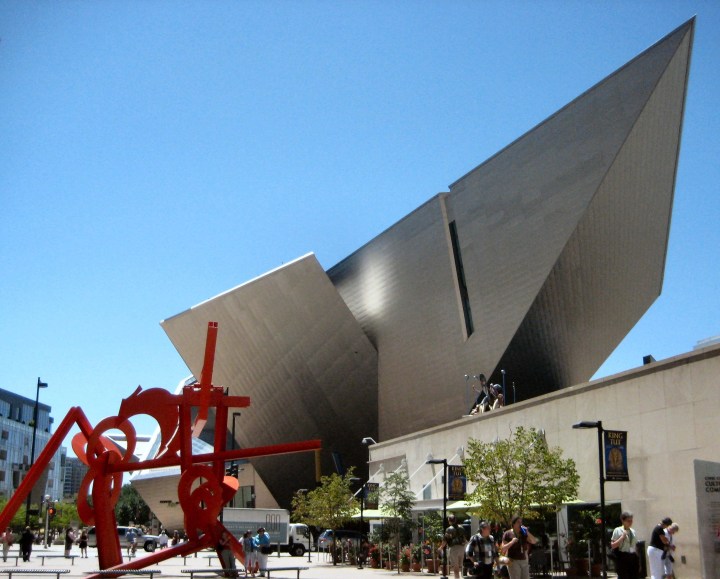
Frederic C. Hamilton Building, Denver Art Museum (Photo: Wikimedia Commons, August 2010). The Hamilton building, by Daniel Libeskind, opened in October 2006. Works from the Berger Collection Educational Trust have been on long-term loan at DAM since 1996; in February of this year 65 works of British art from the trust—including paintings by Thomas Gainsborough, Angelica Kauffman, George Stubbs, and Benjamin West—were donated to the museum. A selection will be on view beginning 3 March 2019 in Treasures of British Art: The Berger Collection, organized by Kathleen Stuart, curator of the Berger Collection at the DAM.
◊ ◊ ◊ ◊ ◊
From ASECS:
2019 American Society for Eighteenth-Century Studies Conference
Denver, 21–23 March 2019
Proposals due by 15 September 2018
Proposals for papers to be presented at the 50th annual meeting of the American Society for Eighteenth-Century Studies, in Denver, are now being accepted. Proposals should be sent directly to the session chairs no later than 15 September 2018. Along with our annual luncheon and business meeting, HECAA will be represented with the Anne Schroder New Scholars’ Session, chaired by Christina Lindeman. A selection of additional sessions that might be relevant for HECAA members is included below. A full list of panels is available as a PDF file here.
◊ ◊ ◊ ◊ ◊
Anne Schroder New Scholars Session
Christina K. Lindeman (University of South Alabama), clindeman@southalabama.edu
This is an open session intended for advanced graduate students and early career scholars in the art and architectural history of the eighteenth century.
◊ ◊ ◊ ◊ ◊
Picturing the Stage (Theatre and Performance Studies Caucus)
Michael Burden (Oxford University), michael.burden@new.ox.ac.uk
What is the relationship between the moving action of live theatre and the static ‘pictures’ that both adorned the stage and visually represented it? How did eighteenth-century audiences (and how do modern scholars) ‘picture’ or imagine stage action? The stage, by definition, makes ‘pictures’. In an eighteenth-century theatre, the proscenium arch forms a picture frame through which the theatre-goer viewed the action, and onstage pictures, such as moveable scenery, added dimension to the play text. Offstage, meanwhile, theatrical pictures proliferated, especially images of performers, both in conventional portraits, in character, and as caricatures. Pictures were also used in support of the dramas themselves; one of the great publishing schemes of the eighteenth century, John Bell’s plays, was accompanied by a series of prints of performers ‘in character’. Capturing stage action on the page or canvas, however, was not an easy task and presents the artist with a series of challenges, and it presents us with versions of the same challenges in interpreting the results. We invite papers on any aspect of the topic and encourage participants to be creative in interpreting the title of the panel.
◊ ◊ ◊ ◊ ◊
Interfaces (Roundtable, Digital Humanities Caucus)
Mattie Burkert (Utah State University), mattie.burkert@usu.edu and Collin Jennings (Miami University Ohio), jenninc@miamioh.edu
Interfaces are thresholds that separate and mediate; they are surfaces through which users encounter tools, as well as protocols that allow different systems to interact. Interfaces are central to digital scholarly work, enabling the operations of databases, archives, and exhibitions that provide new forms of access to historical materials. Interface design often prioritizes ease of use, but recent critiques of search engines and social media platforms have shown how streamlined, user-friendly interfaces can obscure choices made about what is displayed and how. Humanities scholars have a role in these conversations, both in critiquing existing interfaces and in developing new approaches. How, we might ask, can we design interfaces that highlight principles like transparency and ambiguity without sacrificing usability? We invite proposals that explore interface models for digital projects, as well as ones that examine how eighteenth-century authors and illustrators engaged what we might anachronistically call interfaces. These could include experimental forms (Chambers’s “view of knowledge,” Priestley’s timeline) or reflections on the limits of such sites (Sterne’s blank page). How can we reconsider Enlightenment interfaces, and how do interfaces affect the way we produce knowledge in eighteenth-century studies? How might a focus on interface change the way we approach our materials?
◊ ◊ ◊ ◊ ◊
Forms of Empire (Roundtable, Race and Empire Caucus)
Sunil Agnani (University of Illinois-Chicago), jukim@fordham.edu
Some recent scholarship on literary and aesthetic form has been framed as a corrective to critical overemphasis on historical, political, and cultural contexts. This panel asks, however, whether paying attention to a particular historical subject—namely, empire—actually precludes the study of form. After all, eighteenth-century writers and artists depicting empire experimented with genres ranging from travel narrative to porcelain ware. The administration of empire also depended heavily on forms like illustrations and maps. This roundtable thus seeks brief papers on the relationship between aesthetics and empire. Papers on diverse forms and geographical locales are welcome. Also welcome are papers that address the problems involved in aestheticizing the types of exploitation that constituted eighteenth-century empire. What were the limits of such a project in the eighteenth century, and what are the limits of the project of considering both aesthetics and empire today? Note: this roundtable will be a companion session to the Race and Empire Caucus’s other roundtable on “Forms of Resistance.” To encourage dialogue across sessions, organizers will ask participants in one roundtable to serve as respondents for the other. Papers will be circulated in advance.
◊ ◊ ◊ ◊ ◊
Ireland, Scotland, and the Sublime Landscape (Irish Caucus)
Michael Griffin (University of Limerick), Michael.J.Griffin@ul.ie
In 1739 Susanna Drury’s painting The Giant’s Causeway offered a glimpse of a sublime aesthetic in landscape painting in Ireland. Dr. Johnson’s description of the subject of Drury’s painting as “worth seeing, but not worth going to see” suggests, in spite of its dismissive tone, a domesticated appreciation for the wild Irish landscape. There has been a significant recent interest in the influence of Scotland and Ireland in and on the evolution of a Romantic aesthetic. To this panel we invite papers which discuss the influence of Irish and Scottish culture, not just on the culture of the Romantic period traditionally defined (1789–1830) but going back to an earlier moment when ideas of sublimity were being applied in innovative ways: to the representation of landscape in Ireland and Scotland, but also to representations by Irish and Scottish writers and artists of sublime landscapes more generally. A core consideration will be the extent to which sublimity in landscape complimented or complicated national and/or regional enlightenments. Proposals can be interdisciplinary, and we would welcome considerations of painters alongside literature and aesthetics. Please send a 300-word abstract for a 20-minute paper, along with a 50-word biographical note.
◊ ◊ ◊ ◊ ◊
The Black Legend (Ibero-America Society for Eighteenth-Century Studies)
Catherine Jaffe (Texas State University), cj10@txstate.edu and Karen Stolley (Emory University), kstolle@emory.edu
The Black Legend, the negative opinion of Spaniards and the Spanish Empire as cruel and intolerant, first emerged in response to accounts of Spanish abuses during the sixteenth-century conquest period and lived on in the eighteenth century in the context of evolving imperial, religious and commercial rivalries. How was the Black Legend envisioned, represented, fictionalized, historicized, critiqued, perpetuated, deployed, debated, dramatized, or denounced, in the transatlantic world during the long eighteenth century, and/or in eighteenth-century studies? We invite 15-minute papers from all fields—literature, history, art history, music, political theory, etc.—that offer fresh perspectives on the Black Legend in the eighteenth century.
◊ ◊ ◊ ◊ ◊
Queer Female Networks (Roundtable, Aphra Behn Society)
Jade Higa (University of Hawaii), jadehiga@hawaii.edu
In her poem, “To my Excellent Lucasia, On Our Friendship,” Katherine Philips writes, “thou art all that I can prize, / My joy, my life, my rest.” Restoration era poems of love between women by writers such as Philips establish and emphasize the importance of female networks throughout the eighteenth century. From 1660 to 1830, women supported each other in politics, art, literature, the theater, and more. In these networking relationships, women also developed strong attachments to one another that many scholars have recognized as at least homosocial if not homoerotic. This roundtable will further the conversation surrounding these queer female networks of the long eighteenth-century. Questions might include but are not limited to: What did specific queer female networks accomplish? How do these female networks complicate the false homo/hetero binary? How are implications of queerness a necessary element of these female networks? Proposals on these questions, on specific female relationships, or on any other subject related to queer female networks are welcome.
◊ ◊ ◊ ◊ ◊
Community Colleges and the Eighteenth Century (Roundtable)
Chloe Northrop (Tarrant County College), chloe.northrop@tccd.edu
Due to the growth of community colleges in America, many graduate students and early career scholars are finding employment opportunities in these institutions. In the past, community colleges have been on the sidelines of the conventional academic hierarchy. While the focus of community colleges mainly surrounds teaching survey level courses, the purpose of this roundtable will be to examine how scholars of the eighteenth century remain connected to the academic world of their respective disciplines. Furthermore, this roundtable will also focus on methods of instruction that incorporates the eighteenth century into classrooms. These presentations will illuminate both the barriers and opportunities present in the community college setting. We welcome proposals from all disciplines connected with community colleges and from full time and adjunct professors.
◊ ◊ ◊ ◊ ◊
The Lives of the Plants
Katie Sagal (Cornell College), aksagal@gmail.com
With the recent rise in critical plant studies as a vector for understanding the relationship between humans and nature, it is worth reflecting in 2019 on how eighteenth-century thinkers understood the relationship between humanity and vegetality. Where the conventional narrative of man’s inevitable and triumphal dominion over nature has long since been disrupted by early eco-criticism (like Carolyn Merchant’s landmark book The Death of Nature), this panel hopes to continue to rethink the possible intersections between people and plants in the Enlightenment. This panel thus proposes to think both about and beyond traditional narratives of taxonomizers, explorers, and collectors to sort through the complex and complicated nodes between humans (always a part of nature) and plant life (always a part of the human experience). We might also think specifically about the “lives of the plants” in ways that are separate from and not reliant upon human intervention. Papers might cover any aspect of the relationship between humans and plants in the eighteenth century, encompassing critical perspectives on medicine, science, pornography, fiction, poetry, visual arts, and so on.
◊ ◊ ◊ ◊ ◊
Women and Whiteness
Katharine Jensen (Louisiana State University), kjensen@lsu.edu
Inspired by Sue Lanser’s 2018 Presidential Address, this panel seeks multiple approaches to the racial/racist/class assumptions informing representations of women and whiteness in the eighteenth century. Whether literary, historical, or visual, the papers might consider: Are women portrayed and privileged as white to counter what were perceived as threats by people of color? Is this privileging linked to class as well, or instead, and why? Are women of color ever portrayed as ‘white’ and why? How do representations of women and whiteness do political work to enlist readers’ or viewers’ emotions and to what end?
◊ ◊ ◊ ◊ ◊
Scholarship across the Aisle: Establishing Meaningful Scholarly Relationships outside of One’s Linguistic/Cultural Tradition (Roundtable)
Logan J. Connors (University of Miami), logan.connors@miami.edu and Jason H. Pearl (Florida International University), jpearl@fiu.edu
In honor of the organization’s 50th anniversary, this roundtable seeks to reflect upon the disciplinary boundaries that are caused by specific linguistic and cultural traditions and posit new methods for crossing the divides that continue to characterize eighteenth-century studies. We seek a diverse group of scholars with different theoretical approaches and areas of specialization. Participants are encouraged to consider the following questions: what structures prevent us from engaging with scholars outside of our national/linguistic traditions? What can we do to make ASECS more welcoming to people working in areas outside British literature (the most dominant specialization inside the organization)? What can we do to facilitate more interaction among scholars of different fields? It’s common to talk of ‘the global eighteenth century’ and the value of interdisciplinarity— and yet we separate ourselves by subspecialty every year. What would it take for us to work beyond those boundaries and create meaningful interactions (conferences, colloquia, seminars, workshops, etc.) that allow us to learn more from each other?
◊ ◊ ◊ ◊ ◊
Repurposing
Lauren DiSalvo (Dixie State University), lauren.disalvo@dixie.edu and Sarah Sylvester Williams (Independent Scholar), sarahjswilliams@gmail.com
Objects have long been recycled, reused, and repurposed. In the eighteenth century Habsburg Empress Maria Theresa and her children repurposed Mughal paintings for display in gilt boiserie; Chinese porcelain was embellished with gilt handles, rims, and stands; and artists outfitted Roman statues with fully restored limbs and attributes during the Grand Tour. This panel seeks to explore the ways in which materials, ideas, motifs, and subjects were repurposed during the long eighteenth century. We would welcome papers that address the literal reuse of materials, such as old canvases, paper, textiles, etc; the adoption and reuse of visual or literary motifs, tropes, or processes; or the repurposing of a traditional subject for new ends. Submissions from any eighteenth-century discipline are welcome, and topics that are interdisciplinary or global in scope are particularly encouraged.
◊ ◊ ◊ ◊ ◊
Art, Literature, and Medicine in Italy
Francesca Savoia (University of Pittsburgh), savoia@pitt.edu
In the eighteenth-century—in Italy as in the rest of Europe—doctors, scientists, writers, and artists formed an integrated educated elite. A wide range of literary and figurative works testify to a close interplay of medicine, art and literature in this period. Painters, poets, novelists and dramatists—both men and women—drew on medical language and learning for their models of human nature and picked on themes emerging from scientific debates (on the treatment of diseases, the role of diet and lifestyle on health, the action of emotions, the dialectic of body and mind, whether reading and writing were themselves therapeutic or harmful etc.). This session seeks contributions that explore the reception, influence, and representation of medical theories and practices in Italian art and literature of the long eighteenth century.
◊ ◊ ◊ ◊ ◊
The Landscape Garden: In England and Beyond
Janet R. White (University of Nevada, Las Vegas School of Architecture), janet.white@unlv.edu
The eighteenth-century landscape garden has been called England’s most enduring contribution to design of the built environment. This interdisciplinary session invites historians, landscape architects, architects and others to discuss the landscape garden’s impact in England, beyond England, and beyond the eighteenth century. Topics might include such areas as selection and design of follies and pavilions, selection and distribution of plant materials, theoretical underpinnings in the Picturesque, differences between English and Continental examples of the phenomenon, women’s contributions to the design of the garden, travelers’ accounts of garden visits, or manifestations of the landscape garden in later centuries.
◊ ◊ ◊ ◊ ◊
Gesturing toward the Antique
Monica Anke Hahn (Community College of Philadelphia), mhahn@ccp.edu and Craig Hanson (Calvin College), CraigAshleyHanson@gmail.com
More than three decades on from the publication of Haskell and Penny’s seminal work, Taste and the Antique—an extended edition of which is slated for publication in 2019—this panel seeks to broaden, expand, and trouble the examination of classicizing poses and gestures in the eighteenth century. How might a borrowed pose elucidate themes of performativity, ephemerality, portraiture, or satire? What were the commercial, intellectual, poetic, or social stakes of such gestures? How did such evocations of antiquity function within larger aesthetic frameworks—whether a collection, a decorative arts program, or some other stratum of visual culture? We welcome proposals from a wide range of approaches with the goal of complicating and re-evaluating straightforward stylistic narratives, aiming to avoid making too little or too much of the antique along the way.
◊ ◊ ◊ ◊ ◊
Fashioning Power and the Power(s) of Fashion
Jennifer Buckley (University of York), jennifer.buckley@york.ac.uk and Benjamin Jackson (Queen Mary, University of London), b.l.t.jackson@qmul.ac.uk
This session seeks to redress the imbalance in our current understanding of the relationship between fashion, material culture, and gender. It desires to push beyond a notion of female fashion, with all its connotations, to consider how fashion was used by both sexes to simultaneously homogenise and destabilise traditional power relations. From architecture to clothing, books to consumer goods, the manifestations of power, commerce, and even colonialism, are imbued in the material world of the past. These materialisations of power are too often obliquely and uncritically accepted as part of a narrative of clear, delineated power structures. Addressing the relationship between print and material cultures, this panel seeks to re-expose the intricate nuances of power that permeated the eighteenth-century material world. Topics to consider may include, but are not limited to: letterpress printing and the manufacture of printed polemics; bespoke handcrafting and handicrafts; architectural plans; trade cards, magazines and periodicals; taste and politesse; the correlation of texts and textiles.
◊ ◊ ◊ ◊ ◊
Small Things
Chloe Wigston Smith (University of York), chloe.wigstonsmith@york.ac.uk and Beth Fowkes Tobin (University of Georgia), btobin@uga.edu
This panel invites papers that address the scale of material objects, in particular the smaller things that have received less critical attention than larger, substantial goods. We are interested in how the scale of things shapes the cultural and / or literary significance of objects and what size might illuminate more broadly about the value and meanings of material culture. Do small things merit different kinds of attention across genres or types of media? How does monetary value, labor, and time affect perceptions of the minute? What is the place of the small in scholarly conversations about material culture across humanities disciplines? This panel will serve as a starting point for discussion of the same theme at an interdisciplinary conference to be held June 6–7, 2019 at the University of York (organized by Chloe Wigston Smith and Beth Fowkes Tobin).
◊ ◊ ◊ ◊ ◊
Bon Appétit: Dining in the Eighteenth Century
Joanna M. Gohmann (The Walters Art Museum), jgohmann@thewalters.org
In the mid-eighteenth century, chefs began to delight aristocratic taste buds with nouvelle cuisine, a style of French cookery that gradually spread across mainland Europe and transformed food from nourishment into pleasurable, intellectual entertainment. In addition to foodstuff, the material landscape of eating—tablescapes, dining rooms, dishes, furniture, cookbooks etc.—became more complex, specialized, and pleasurable. Porcelain dinner services expanded, cookbooks included more categories of food, dining tables were marketed in a variety of shapes with surprising features, and dining rooms were increasingly elaborate. What cultural work did these transformations in food preparation and consumption achieve? Responding to such publications as E.C. Spary’s Eating the Enlightenment (2012) and Krikorian’s Les rois à table (2011), exhibitions like Winterthur Museum’s Dining by Design (2018), and popular blogs like The History Kitchen, this panel seeks to explore how eighteenth-century consumers understood the century’s new dining practices in relation to the century’s intellectual, social, political and even religious trends. This panel hopes to address the many ways in which individuals encountered these changes in culinary and dining practices—be it through text, visual art, material culture of the table, etc.—and invites participants from all disciplines and areas of specialization.
◊ ◊ ◊ ◊ ◊
Between Art and Labor: Craft in the Global Eighteenth Century
Cassidy Picken (Capilano University), cass.picken@gmail.com
Handicraft is a generative concept within at least two hierarchies of enlightenment thought. Within the realm of political economy, handicrafts are positioned midway between the foraged goods of hunter-gatherers and the manufactured wares of commercial society; within aesthetics, craftwork mediates between the drudgery of labor and the free play of the liberal arts. This panel explores the rise of craftwork as a distinct cultural category during the long eighteenth century. Shifting from accounts of craft that emphasize its ‘traditional’ status, we are interested in artisanal practices that emerged at the interstices of the eighteenth century’s global empires. How might we account for the relationship between the disciplinary formations mentioned above, and the actual practices of making that emerged at the frontiers (external and internal) of mercantile capitalism? What forms of knowledge and intimacy were grounded in the craftwork of women, the enslaved, creoles, indigenous communities, peasants, and domestics? How did poets, novelists, artists, philosophers, and scientists conceive of their crafts in relation to the field of labor?
◊ ◊ ◊ ◊ ◊
Trailing Spouses of the Enlightenment: In the Shadow of the Luminary?
Rori Bloom (University of Florida), ribloom@ufl.edu and Margaret Butler (University of Florida), mbutler@arts.ufl.edu
While the wedding scene continued to provide a happy ending to classical comedies in eighteenth-century theater, the real institution of marriage was undergoing important transformations off the stage and the page. By offering material resources, social connections, emotional support or intellectual stimulation, spouses in creative partnerships made valuable contributions to eighteenth-century culture. This interdisciplinary panel seeks to examine the spousal relationship in the context of cultural creation in the Enlightenment. At certain times, one spouse remained in the shadows to allow the other to shine as a writer, musician or painter, while at others the two shared the limelight, attracting public attention in different ways. Whether as enabler, impresario, teacher, collaborator, the spouses of Enlightenment figures often shaped each other’s careers. In this session, we are not asking whether we would have had Sade without Renée or Elisabeth Vigée Lebrun without Jean Baptiste Pierre Lebrun. Instead, we wish to reexamine assumptions about traditional roles in famous pairs to better understand the impact of creative partnerships on eighteenth-century culture.
◊ ◊ ◊ ◊ ◊
The Colors of Race
Jennifer Chuong (Harvard University), jennifer_chuong@harvard.edu and Oliver Wunsch (Harvard Art Museums), owunsch@gmail.com
Scholars in a variety of disciplines have argued that over the course of the eighteenth century, nascent racial categories began to coalesce around visual distinctions, skin color chief among them. The range of disciplinary perspectives on the topic reflects the many ways that color could be mobilized in the service of human difference, whether through the materials of the artist, the theories of the natural philosopher, or the lexicon of the writer. This panel provides an opportunity to bring together research in these different areas and to explore possible interactions among them. In doing so, we aim to initiate a larger conversation about the relationship between race and visuality in the eighteenth century. We welcome papers that explore the various practices through which color took on racial significance in this period, and we especially invite proposals that address the use of color in more than one setting (e.g. in multiple media, across fields, or for different audiences).
◊ ◊ ◊ ◊ ◊
‘This Unnatural Rebellion’: The Jacobite Rising of 1745
Phineas Dowling (Auburn University), pwd0002@auburn.edu
This panel seeks papers on literary, artistic, and material culture of the long eighteenth century with the goal of exploring the Jacobite Rising of 1745 and its ramifications—whether artistic, cultural, national, martial, political, etc. Topics might include, but are not limited to, the literary culture of the Jacobites (or anti-Jacobites); material culture of the Jacobites; cultural memory of the ’45; representations of the conflict and its participants; depictions or commentary of key figures or events; the political or social aftermath or ramifications of the rebellion; contextualization of the Rising and/or its impact; creative expressions in any medium of the contemporary or memorial experiences of participants and/or onlookers.
◊ ◊ ◊ ◊ ◊
Producers, Creators, Designers: Women Artists
Lindsay Dunn (Texas Christian University), l.m.dunn@tcu.edu and Franny Brock (University of North Carolina at Chapel Hill), mfbrock@live.unc.edu
This panel seeks proposals that consider women’s roles as producers, creators, and designers of art objects, buildings, and interior spaces in the long eighteenth century. We invite papers that further knowledge of women’s artistic production, and indeed, even reclaim their achievements. This panel will continue the conversation on women’s roles, a subject taken up most recently by the exhibition, Becoming a Woman In the Age of Enlightenment: French Art from the Horvitz Collection, curated by Melissa Hyde and the late Mary D. Sheriff. This exhibition, the first to focus specifically on representations of women from a broad range of ages and conditions, sheds light on the philosophical and cultural debates surrounding womanhood in this period. The dominant ideology assigned women to limited roles due to long-held beliefs about gender difference derived from Christianity and scientific and medical tracts. As a result, historians have often relegated women’s involvement in the art world to historical footnote or anecdote, despite a rich tradition of female creativity. Possible topics for this panel include investigations of women artists’ little-known objects and spaces, hierarchies of genre and their gendered implications, the role of women in the Academy, programs of commissioning, and collaborations with colleagues.
◊ ◊ ◊ ◊ ◊
Innovative Course Design Competition
asecsoffice@gmail.com
ASECS invites proposals for a new course on eighteenth-century studies, or a new unit (1–4 weeks of instruction) within a course on the eighteenth century. Proposals may address a specific theme, compare related works from different fields (music and history, art and theology), take an interdisciplinary approach to a social or historical event, or suggest new uses for instructional technology. The unit/course should have never been taught or have been taught very recently for the first time. Applicants should submit a 750–1500 word proposal that focuses sharply on the leading ideas distinguishing the unit/course. The proposal should indicate why particular texts and topics were selected and (if possible) how they worked; ideally, a syllabus will be provided. The competition is open to current members of ASECS. Up to three proposals will be selected for presentation on the Innovative Course Design session at the Annual Meeting; a $500 award will be presented to each of the participants, who also will be invited to submit a twelve-page account of the unit/course, a syllabus, and supplementary materials, for publication on the ASECS website.
◊ ◊ ◊ ◊ ◊
Social Network Analysis (Roundtable)
Jennifer Golightly (Colorado College), jgolightly@coloradocollege.edu
This roundtable will showcase digital projects using social network analysis for better understanding networks of texts, ideas, and/or people over the course of the long eighteenth century. The scope of the roundtable is broad in the hopes of providing fresh ideas about using social network analysis for the study of history and texts. What are the advantages of using this particular approach? What are the limitations? Which tools are most useable for conducting such analysis in the humanities?
◊ ◊ ◊ ◊ ◊
Print Room Pedagogies: Teaching the Eighteenth Century in the Print Room
Hope Saska (CU Art Museum, University of Colorado Boulder), hope.saska@colorado.edu
“Other pictures we look at, his we read.” With this pithy quip, Charles Lamb summed up the expectations brought by Romantic viewers to William Hogarth’s images. Today, Lamb’s distinction between looking at and reading images continues to resonate, especially with curators, faculty, instructors and librarians who regularly use printed images, illustrated books and paintings as core features of our pedagogy. This panel invites papers that address print room pedagogies and asks: how do we provide tangible connections with the visual and material worlds of the eighteenth century? What are the histories of and best practices for using visual culture to teach skills associated with ‘reading’ and/or what we today call ‘close looking’ (perhaps an enhanced version of the ‘looking at’ that Lamb describes)? How might the historical function of the print room connect to its contemporary use for object-based learning? Case studies and histories of the study room are invited, and interdisciplinary studies are most welcome.
◊ ◊ ◊ ◊ ◊
Living with the Ancients
Caroline Gonda (Cambridge University), cjg29@cam.ac.uk and Paul Kelleher (Emory University), pkelleh@emory.edu
This panel seeks papers that offer new perspectives for understanding the surprising, creative, idiosyncratic (in a word, the ‘queer’) conversations that eighteenth-century writers and artists sustained with ancient culture. We are especially interested in how the Classics were ‘used’ as a way to shape and sustain lives that deviated from normative forms of sexual, gendered, and class identity. Further, we suspect that the relationship between the ‘public’ and the ‘private’ will be an important reference point for some or all of our panelists. Some preliminary questions that we have in mind (but ones that are not meant to be prescriptive): what does it mean to quote or commonplace the Classics in private writings and how can this become a way of claiming intellectual and cultural territory? How do impassioned investments in the Classics create a place of refuge and resistance to public identities that constrain or cramp the self? How are ‘modern’ engagements with the ancients simultaneously a dialogue with the Classics and an exploration and fashioning of the self? We welcome papers from all disciplines and national literatures.
◊ ◊ ◊ ◊ ◊
Performance and its Representations
Sarah R. Cohen (University at Albany, SUNY), scohen@albany.edu
This session aims to bring together studies of the performing arts—theater, music, dance—and of the diverse ways in which performance was represented in art and literature. Considerations of architectural staging of performative events and such self-reflective devices as theater-within-theater and fashionable appropriations of costume are encouraged. Priority will be given to papers that address the performing body as a transformational device that breaks down disciplinary boundaries in the arts.
◊ ◊ ◊ ◊ ◊
Changing Faces: New Directions in Portraiture
William W. Clark (Queens College and The Graduate Center, CUNY), wwclark@comcast.net
This session invites papers that study portraits from different, multiple perspectives. Possible avenues of investigation might include (but are not limited to) portraits by Europeans of orientals or colonial subjects, or vice versa; portraiture as a locus of cultural exchange; portraiture and performance theory; portraits of celebrities including performers, heroes, heroines, criminals and/or their victims; the role that furnishings, fashion, and other accoutrements play in the construction of identity; portraits and emotions, given the recent works by Vigarello and Corbin on the history of emotions; science and portraiture, as in medical portraits; politics and portraiture; sexuality and portraits.
◊ ◊ ◊ ◊ ◊
Interactions between Art and Insurance
Sarah Carter (McGill University), sarah.carter@mail.mcgill.ca and Matthew C. Hunter (McGill University), matthew.hunter3@mcgill.ca
From studies of brokered connectivity to forays in new materialism, the movement of artifacts across medial, geographic and temporal boundaries figure significantly in recent accounts of eighteenth-century art and culture. Yet, conspicuously less attention has been paid to the arts’ imbrication with actuarial techniques of insurance robustly used in the period to govern mobile and perishable valuables. The silence is curious. Beyond its central role in assigning value, insurance casts a significant shadow across histories of Anglo-American art. English fire insurance originates with Nicholas Barbon, speculative builder and virtual architect of what we now call ‘Georgian London’. The core collection of London’s National Gallery was built by insurance underwriter John Julius Angerstein. Where else might we find insurance’s impacts on the arts of the long eighteenth century? Indeed, should we be seeking to find any visible imprint at all when reckoning with what Lauren Berlant has called the “actuarial imaginary”? In sum, if knowing “how to pack it, how to track it, and so forth” were key concerns for the arts of the long eighteenth century as Jennifer L. Roberts has claimed, this panel seeks papers expanding upon this provocation: the history of Anglo-American art is a history of insurance.
◊ ◊ ◊ ◊ ◊
Collecting Studies for the Twenty-First Century: Circulation and Disruption
Anne Nellis Richter (American University), arichter@american.edu and Bénédicte Miyamoto (Université Sorbonne Nouvelle – Paris 3), benedicte.miyamoto@sorbonne-nouvelle.fr
The discipline of collecting studies has long focused on the acquisition of objects and the development of prestigious European collections in a period when collectors often represented their collections as perennial documents of family history and unfaltering taste. In honor of ASECS’ 50th anniversary, this panel is intended to take stock of the state of collecting studies and look forward to the new avenues opened up by considering the circulation of art, antiquities and furniture due to personal, political or social upheaval, and to intensifying art market dynamics shaped by war, revolution, and empire. As dealers, auctioneers, and collectors took advantage of such opportunities, modern practices of collecting and displaying art were shaped. What strategies of classification, attribution, provenance and display did an increasingly international art market foster, and what professional or institutional ethos informed these new models? We invite the studies of local to transnational circulation of artefacts from any disciplinary perspective (including material culture, art history, visual studies, museum studies, art market studies, and social history). This panel is designed to continue the 2017 panel “Art Markets: Agents, Dealers, Auctions, Collectors” by Wendy Wassyng Roworth (University of Rhode Island).
◊ ◊ ◊ ◊ ◊
Ancients, Moderns, and the Visual Arts
Aaron Wile (USC), awile@usc.edu and Jason Nguyen (USC), jason.nguyen@usc.edu
In 1687, Charles Perrault rocked the French Academy when he proclaimed that achievements of the present, fostered by Louis XIV, had surpassed those of classical Greece and Rome. Perrault’s declaration ignited a smoldering debate about the relative merits of the ancients and moderns. This debate, known as the Quarrel of the Ancients and Moderns, has long been maligned as pointless and academic, but recent scholarship has shown that it occasioned a profound shift in historical consciousness, calling into question the authority of the past and reconfiguring the values that gave art meaning. Though this work has transformed our understanding of the debate, the role of the visual arts has received relatively little attention. This session seeks to revisit the Quarrel and its relationship to the visual arts, in all media, during the long eighteenth century. How did artists engage with the classical past and its shifting position of authority? How did awareness of cultural and historical difference affect artistic practice? How were notions of modern progress rejected or defended (and how was progress defined in the first place)? And how did the shifts in historical consciousness prompted by the debate affect artistic thinking about temporality, anachronism, and memory?
◊ ◊ ◊ ◊ ◊
Caricature in Song and Graphic Satire
Ian Newman (University of Notre Dame), inewman@nd.edu and Harriet Guest (University of York), harriet.guest@york.ac.uk
Recent studies of the golden age of graphic satire have confirmed the importance of caricature to British culture in the late eighteenth and early nineteenth centuries. Prints by the Cruikshanks, Gillray, Newton, Rowlandson and others have become a mainstay of the critical arsenal, widely recognized as in conversation with newspaper reporting and contributing to networks of gossip about royal scandals, political intrigue, and other rumors of notable figures. Less frequently commented upon, however, is the importance of aurality to the iconography of print—the political ballads, theatrical songs, and culture of singing that is constantly referenced in graphic prints. Yet many of the recognizable caricatures that appeared in print satire—John Bull, Young Billy Pitt, Georgiana the Canvassing Duchess, Farmer George—were developed simultaneously in graphic satire and political ballads; numerous popular songs, such as those composed by Charles Dibdin, were referenced in graphic satire; and graphic prints frequently alluded to the culture of song, often mocking amateur musicians. This panel invites papers on any aspect of the traffic between song and graphic print, with a view to finding a critical language to consider visual satire and song together.
◊ ◊ ◊ ◊ ◊
Art and Material Culture from the Ibero-American Realms
Jeffrey Schrader (University of Colorado Denver), jeffrey.schrader@ucdenver.edu
This panel seeks to consider the art and material culture of Latin America within the “same world, different worlds” paradigms identified by the historian John H. Elliott in his studies of peninsular Spain and its American realms. According to these approaches, one may identify the transatlantic relationship as characterized chiefly either by continuity or by difference. Art historians have implicitly recognized these methods of classifying developments in the New World, although the paradigms deserve greater attention within eighteenth-century studies in light of the political shifts toward independence by the early 1800s. Topics for papers may include portraiture, religious imagery, fashion, architecture, goods transported by the galeón de Manila, the formation of art collections, as well as other themes.
◊ ◊ ◊ ◊ ◊
Going Public: Taking Eighteenth-Century Material Culture into the Public Eye
Mallory Porch (Auburn University), map0030@auburn.edu
Jennie Batchelor’s Lady’s Magazine project, with its public engagement element The Great Lady’s Magazine Stitch-Off, revealed an enthusiastic interest in both the scholarly and the lay community for re-creating and experiencing eighteenth-century material culture. The purpose of this panel is to provide an arena for scholarly inquiry into eighteenth-century material culture, and also to explore the ways in which scholars, costumers, and hobbyists have taken the eighteenth century into the public eye. The purpose of this panel is intentionally broad, with the possible inclusion of topics such as: working with an entity like Winturthur or Fairfax House, costuming for eighteenth-century plays or reenactments, pursuing an in-depth study of one eighteenth-century object, or any other relevant line of inquiry. Panelists are welcome to present innovative presentations and/or traditional papers.
Exhibition | Triumph of the Baroque, Painting from 1600 to 1800
Now on view at the Hofburg:
Triumph des Barock: Malerei von 1600 bis 1800 / Il Trionfo del Barocco: Pittura dal 1600 al 1800
Diocesan Museum, Hofburg (Bishop’s Palace), Brixen / Bressanone, Italy, 28 April — 31 October 2018
 Barocke Kunst ist triumphale Ausdruckskunst. So auch in der Malerei. Die Ausstellung schöpft aus dem umfangreichen Bestand der Hofburg und zeigt Gemälde von den frühen Anfängen um 1600 bis in die Spätphase um 1800. Eine Schaulust für das Auge.
Nie waren den Menschen der Himmel und das Leben mit den Himmlischen so vertraut wie in der Barockzeit. Erzählungen aus der Bibel, Schilderungen aus dem Leben von Heiligen, Darstellungen von Maria mit dem Jesuskind—sie alle führen das Auf und Ab des Lebens vor Augen. Berühmte Maler aus Tirol sowie überregional bedeutende Künstler schufen Altarbilder für Kirchen und sakrale Gemälde zur privaten Andacht. Eine Auswahl ihrer Werke ist in der Ausstellung zu sehen, darunter Bilder von Stephan Kessler, Johann Georg Grasmair und Ulrich Glantschnigg, von Martin Theophil Polak, Karl Skreta und Johann Lingelbach. Auch Gemälde der in Wien zu Ruhm gelangten Tiroler Barockmaler, wie Paul Troger, Michael Angelo Unterberger und Josef Ignaz Mildorfer, sind ausgestellt.
Kopien nach berühmten Meistern spielten in der barocken Malerei eine große Rolle. Sie vermittelten das gedankliche Konzept des Originals nahezu ungeschmälert und trugen wesentlich zur Beliebtheit einzelner Bildmotive dar. Eine Auswahl hochwertiger Kopien wird in der Ausstellung gezeigt.
Neben Altarbildern und religiösen Werken sind auch Porträts zu sehen, einige von ihnen zum ersten Mal. Porträts stellten Macht und Reichtum, Bildung und Stand der Dargestellten zur Schau. Sie stehen für Inszenierung und Selbstdarstellung von Klerus, Adel und Bürgertum.
Johann Kronbichler, Die barocken Gemälde der Hofburg Brixen (Brixen: Hofburg, 2018), 396 pages, ISBN: 978-8888570235, $75.
 Zur Ausstellung erscheint ein Bestandskatalog. Dieser enthält—über die in der Ausstellung gezeigten Werke hinaus—alle barocken Gemälde aus der Schausammlung und den Depots sowie die Gemälde und Wandmalereien der barocken Ausstattung der Hofburg. Mit seinen knapp 700 vorgestellten Werken und dem umfangreichen Bildmaterial stellt der von Johann Kronbichler verfasste Bestandskatalog ein unverzichtbares Grundlagenwerk zur Barockkunst in Südtirol dar. Der Katalog, Band 4 der Veröffentlichungen der Hofburg Brixen, ist in der Hofburg und im Buchhandel erhältlich.
London Art Week, Summer 2018 / Painting by Joseph Wright

Joseph Wright of Derby, Portrait of a Young Boy with a Drum, inscribed with the letter ‘R’, ca. 1780, oil on canvas, 28 × 36 inches / 70 × 91 cm
(Courtesy Ben Elwes Fine Art)
◊ ◊ ◊ ◊ ◊
Press release for London Art Week, via Art Daily:
London Art Week, Summer 2018
28 June — 6 July 2018
A major rediscovery from the mature period of Joseph Wright of Derby is among many important paintings being unveiled at London Art Week Summer 2018, open now through Friday 6 July at forty galleries across Mayfair and St. James’s. Presented by Ben Elwes Fine Art, the painting by Joseph Wright of Derby (1734–1797) depicts a young boy with a drum and a landscape beyond. It shows the artist’s virtuosity as a masterful and empathetic portrait painter—he excelled at children—and a superb landscape artist. It dates from around 1780, a period, following Wright’s return from an Italian soujourn in 1775, when his art, across genres, brimmed with confidence.
Antonacci Lapiccirella Fine Art (new LAW participants from Rome) is exhibiting a sensational rediscovery of a work famed in art history circles; a painting by Antonio Canova thought to have been lost for two centuries. In a daring trick played by Canova on the greatest artists in Rome, he presented Self-Portrait of Giorgione to his peers as an original by the revered Venetian 16th-century painter. Whist all acclaimed it as a truth, a year later Canova announced that he himself had painted the portrait as a practical joke.
Maurizio Nobile, from Bologna, presents an extraordinary discovery, a large altar-piece by Gaetano Gandolfi (1734–1802) of The Holy Family and Saint Augustine dated 1761. Scholars were only aware of the existence of the work thanks to a photo published in the monograph dedicated to the painter by D. Biagi Maino (Turin, 1995). For the first time, this painting can be viewed by the public at large.
Further highlights among paintings offered at London Art Week include:
• At Colnaghi: A rarely-seen depiction of Saint Francis by Doménikos Theotokópoulos, known as El Greco (1541–1614). The Stigmatisation of Saint Francis is a powerful and dramatic composition which was first published in 1908, and last seen in public in 1999 at the major show on the artist held at Thyssen-Bornemisza Museum in Madrid.
• At Martyn Gregory: A rare view of China by William Daniell RA (1769–1837), the most important rediscovery in Daniell’s oeuvre for fifty years.
• At Robilant+Voena: A rare, signed, full-length male portrait of Antoine de Ville, a military engineer, by Artemisia Gentileschi (1593–c1654) one of the most highly regarded female artists of the Baroque. This work is a very important addition to the few portraits known in the oeuvre of this 17th-century artist who is famed mainly for her powerful depictions of Old Testament heroines, though contemporary sources testify that she was also celebrated for her portraits.
• At The Weiss Gallery: A rare Friesland School early Dutch portrait of a young boy aged three, painted 1603, is one of the earliest examples of a portrait incorporating a kolf club, used to hit a stuffed leather ball in the Dutch game of het kolven, an early form of golf.
Exhibition | Blast from the Past: Artillery in the War of Independence
Along with artillery objects, the exhibition includes British paintings of arms manufacturing on loan from the National Maritime Museum in Greenwich and the Musée de l’Armée at Les Invalides in Paris.
Blast from the Past: Artillery in the War of Independence
American Revolution Museum, Yorktown, 10 June 2018 — 5 January 2019
Curated by Sarah Meschutt
 As the last great victory of the American Revolution, the 1781 Siege at Yorktown is known for the use of artillery by General George Washington’s Continental Army. Through interactive elements and artifact displays, Blast from the Past: Artillery in the War of Independence features artillery used on all fronts of the American Revolution by the American, French, and British forces. This special exhibition explores a range of topics from innovations in artillery design and technology to the individual roles of an artillery crew. Topics examine artillery deployment and transport, as well as the range of fire and science behind these powerful weapons.
Blast from the Past highlights the chronology of the weapons and reveal the technology and innovation that delivered the last great victory of the Revolution—a victory that forever made Yorktown, Virginia, the place where the subjects of a king became the citizens of a nation.
American, French and British artillery pieces include:
• British Light 3-pounder bronze field cannon, cast by Jan and Pieter Verbruggen, ca. 1776, on loan from the U.S. Army Center of Military History
• ‘La Perileuse’ French 4-pounder bronze field cannon, cast by Jean Bérenger at Strasbourg, ca 1758, on loan from the National Park Service Springfield Armory National Historic Site
• British 12-pounder bronze ‘Lafayette’ cannon, cast by William Bowen, ca. 1759, on loan from the National Park Service, Colonial National Historical Park, Yorktown Collection
• American 6-pounder iron cannon, cast by Samuel and Daniel Hughes, ca. 1775–83, on loan from the Mayor and Council of Boonsboro, Maryland
• ‘La Bellone’ French 4-pounder bronze battalion cannon, cast by D.E. Dupont at Rochefort, ca. 1773, on loan from the National Park Service, Home of Franklin D. Roosevelt National Historical Site
Visitors can take in the size and scope of American, French, and British artillery and then explore the museum for a range of hands-on experiences.
• Discover types of artillery—cannons, mortars and howitzers—and types of ammunition, from shot and shell to canister and grape.
• Figure out the right artillery tool for the job—types of shot and essential implements of rammer, sponge and linstock—in a hands-on display.
• How does one move a gun? Lift a door to determine the strength by men and horses to advance a light or heavy gun.
• Examine an artilleryman’s pocket guide; see interactive 18th-century artillery field manuals that served as reference to determine tasks such as how to draw a 6-pounder up a steep cliff or bluff.
New Book | George Washington’s Washington
From the University of Georgia Press:
Adam Costanzo, George Washington’s Washington: Visions for the National Capital in the Early American Republic (Athens: University of Georgia Press, 2018), 264 pages, ISBN: 978-0820352855 (hardcover), $75 / ISBN: 978-0820353890 (paperback), $30.
 This book traces the history of the development, abandonment, and eventual revival of George Washington’s original vision for a grand national capital on the Potomac. In 1791 Washington’s ideas found form in architect Peter Charles L’Enfant’s plans for the city. Yet the unprecedented scope of the plan; reliance on the sale of city lots to fund construction of the city and the public buildings; the actions of unscrupulous land speculators; and the convoluted mixture of state, local, and federal authority in effect in the District all undermined Federalist hopes for creating a substantial national capital.
In an era when the federal government had relatively few responsibilities, the tangible intersections of ideology and policy were felt through the construction, development, and oversight of the federal city. During the Washington and Adams administrations, for example, Federalists lacked the funds, the political will, and the administrative capacity to make their hopes for the capital a reality. Across much of the next three decades, Thomas Jefferson and other Jeffersonian politicians stifled the growth of the city by withholding funding and support for any project not directly related to the workings of the government. After decades of stagnation, only the more pragmatic approach begun in the Jacksonian era succeeded in fostering development in the District. And throughout these decades, driven by a mixture of self-interest and national pride, local leaders worked to make Washington’s vision a reality and to earn the respect of the nation.
George Washington’s Washington is not simply a history of the city during the first president’s life but a history of his vision for the national capital and of the local and national conflicts surrounding this vision’s acceptance and implementation.
Adam Costanzo is a professional assistant professor of history at Texas A&M University, Corpus Christi.
Exhibition | The American Revolution: A World War

Louis-Nicolas Van Blarenberge, The Siege of Yorktown, 1786; gouache on panel, 24 × 37 inches
(Private Collection of Nicholas Taubman)
◊ ◊ ◊ ◊ ◊
Van Blarenberghe’s two Yorktown paintings were on view last year at Philadelphia’s Museum of the American Revolution. Press release (21 June 2018) from The National Museum of American History:
The American Revolution: A World War
Smithsonian’s National Museum of American History, Washington, D.C., 26 June — 9 July 2019
Curated by David Allison
A global lens is placed on the story of American independence in the exhibition The American Revolution: A World War, open June 26 through July 9, 2019, at the Smithsonian’s National Museum of American History. The focal point of this one-year exhibition, on view in The Nicholas F. and Eugenia Taubman Gallery, centers on two historical paintings that depict the culminating events at Yorktown in 1781, which ended the war on American soil, and a portrait of General George Washington.

Charles Willson Peale, Washington at Yorktown, 1780–82, painted for French General Comte de Rochambeau.
The American Revolution: A World War explores the Franco-American partnership during the Revolution and the extent to which international relations shaped the formation of the United States. General Jean-Baptiste Donatien de Vimeur, Comte de Rochambeau, led the French forces at Yorktown. Two of the paintings were created by Louis-Nicolas Van Blarenberghe and are copies he made for Rochambeau of paintings presented to King Louis XVI. The Washington portrait is by Charles Willson Peale. All three once hung in Rochambeau’s home as reminders of his partnership with Washington that resulted in the American victory.
“The American colonies had no hope of winning their independence alone,” said David Allison, project director and senior curator of the exhibition. “They had to gain support from other European powers, most importantly from France and Spain and the involvement of these nations would affect not only the history of the new United States of America, but their own histories as well.”
The Siege of Yorktown and The Surrender of Yorktown, both painted in 1786, and the Washington portrait painted in 1780–82 are united for the first time in a national museum since they were displayed together in the 1700s in Rochambeau’s chamber. The Van Blarenberghe paintings will each be augmented by an interactive computer, allowing visitors to examine enlargements of the paintings and to read eyewitness accounts of the events.
Other artifacts to be displayed include a pistol given to Washington by British General Edward Braddock during the Seven Years War; a cannon used at Yorktown, representing how the French supplied weapons, soldiers, funding and warships to America; Washington’s Yorktown siege map drawn after the conflict; a ship model of Admiral de Grasse’s Ville de Paris, which led the French fleet that blocked British ships; and an almanac and memorabilia commemorating the Marquis de Lafayette’s visit to the United States near the 50th anniversary of Independence. In addition to Peale’s Washington, images of the other three leaders involved in the American Revolution will be on display: Rochambeau, the Marquis de Lafayette of France and General Charles Cornwallis of Great Britain.
Americans often think that the American Revolution ended with the Siege of Yorktown in 1781, but, in fact, war continued around the world as European powers fought to defend their interests. These wider conflicts ultimately determined the terms Britain accepted in the 1783 treaty granting the United States its independence. Britain also had to negotiate treaties with France, Spain and the Dutch Republic before the wider war connected to the American Revolution finally concluded in 1784.
The exhibition is made possible through the generous support of Ambassador Nicholas F. and Eugenia L. Taubman with additional support from Jeff and Mary Lynn Garrett and Susan and Elihu Rose. A number of objects are on loan from private collections, museums and other institutions, including the Society of the Cincinnati, Winterthur and the Musée de l’Armée in Paris. The exhibition will open in the recently transformed wing of the museum’s second floor, which is themed The Nation We Build Together and features exhibitions that tell the story of America’s founding and future as a country built on the ideals and ideas of freedom and opportunity.
A book to accompany the exhibition will be published in November:
David Allison and Larrie Ferreiro, eds., The American Revolution: A World War (Washington, D.C.: Smithsonian Books, 2018), 272 pages, ISBN: 978-1588346339, $30.
 The American Revolution: A World War argues for the importance of understanding the American Revolution in a global context. The illustrated companion volume to the Smithsonian National Museum of American History exhibition of the same name, this book posits that it is not possible to fully understand the Revolution if it is seen as a solely American conflict. Instead, American motivations and contributions must be considered alongside those of the British, French, Spanish, and Dutch. Highlighting the often overlooked international nature of the Revolution while grounding it in its origins—the fight for independence from Great Britain—this collection of essays from leading writers on the Revolution touches on such topics as European diplomacy, overseas empires, economic rivalries, supremacy of the seas, and more. Together the book’s incisive text, full-color images, and topical sidebars underscore that America’s fight for independence is most clearly comprehended as one of the first global struggles for power.
David K. Allison is Senior Scholar at the Smithsonian’s National Museum of American History. Larrie D. Ferreiro teaches history and engineering at George Mason University in Virginia, Georgetown University in Washington, D.C., and the Stevens Institute of Technology in New Jersey. He is the author of Brothers at Arms: American Independence and the Men of France and Spain Who Saved It, a finalist for the Pulitzer Prize.
New Book | Committed to Memory: The Art of the Slave Ship Icon
From Princeton UP:
Cheryl Finley, Committed to Memory: The Art of the Slave Ship Icon (Princeton: Princeton University Press, 2018), 320 pages, ISBN: 978-0691136844, $50 / £40.
 How an eighteenth-century engraving of a slave ship became a cultural icon of black resistance, identity, and remembrance
One of the most iconic images of slavery is a schematic wood engraving depicting the human cargo hold of a slave ship. First published by British abolitionists in 1788, it exposed this widespread commercial practice for what it really was—shocking, immoral, barbaric, unimaginable. Printed as handbills and broadsides, the image Cheryl Finley has termed the ‘slave ship icon’ was easily reproduced, and by the end of the eighteenth century it was circulating by the tens of thousands around the Atlantic rim. Committed to Memory provides the first in-depth look at how this artifact of the fight against slavery became an enduring symbol of black resistance, identity, and remembrance.
Finley traces how the slave ship icon became a powerful tool in the hands of British and American abolitionists, and how its radical potential was rediscovered in the twentieth century by black artists, activists, writers, filmmakers, and curators. Finley offers provocative new insights into the works of Amiri Baraka, Romare Bearden, Betye Saar, and many others. She demonstrates how the icon was transformed into poetry, literature, visual art, sculpture, performance, and film—and became a medium through which diasporic Africans have reasserted their common identity and memorialized their ancestors.
Beautifully illustrated, Committed to Memory features works from around the world, taking readers from the United States and England to West Africa and the Caribbean. It shows how contemporary black artists and their allies have used this iconic eighteenth-century engraving to reflect on the trauma of slavery and come to terms with its legacy.
Cheryl Finley is associate professor of art history at Cornell University. She is the coauthor of Harlem: A Century in Images and the coeditor of Diaspora, Memory, Place: David Hammons, Maria Magdalena Campos-Pons, Pamela Z.
Installation | Brian Tolle’s Eureka

Press release, via ArtDaily (30 June 2018). . .
Brian Tolle’s Eureka
Federal Hall National Memorial, Wall Street, New York, 27 June — 8 September 2018
The National Parks of New York Harbor Conservancy, in partnership with the National Park Service, announces the presentation of Brian Tolle’s Eureka, on view from June 27 until September 8, 2018, in Federal Hall, the iconic memorial to democracy on Wall Street. Eureka is part of a new art initiative, curated by Bonnie Levinson, inviting contemporary artists to investigate themes that resonate with the history and legacy of Federal Hall, melding the past and present, to serve as a catalyst toward the reinvigoration of civic life and a platform for free expression.
 For this presentation of Eureka, Tolle has chosen to exhibit his work alongside a rare viewing of the Flushing Remonstrance, the 1657 New Netherland petition for “liberty of conscience” that served as the precursor to religious freedom, as cemented in the First Amendment written at Federal Hall over a century later. Not seen in Manhattan in over 30 years, the Remonstrance shares a room with the Bible from President Washington’s 1789 inauguration at Federal Hall.
Tolle’s 40-foot tall sculpture, reflecting a rippling and distorted facade of a 17th-century Dutch canal house, pays homage to the legacy of 40 years of Dutch rule in New York. Originally created for Jan Hoet’s city-wide exhibition, Over the Edges, 2000, in Ghent, Belgium, its re-presentation in Federal Hall blurs the site’s architectural and political history with the contemporary in the conceptual artwork.
Brian Tolle describes the work: “Eureka is a sculptural play with illusion—a facade of a facade. Its Dutch-inspired form points to New York’s early history and its fluid, but troubled, transformation from a Dutch seat of power to British colony, to an American platform for diversity and democracy. The sculpture is an apparition, a mirage of a building that has been displaced and no longer exists. Like the Dutch buildings of lower Manhattan and the canal that was once Broad Street—erased with only the street names lingering as a reminder of their existence—Eureka serves as a marker of Federal Hall’s complex history. Its thin veil floats upwards, into the neoclassical dome of Federal Hall, evoking the strife between form and object, as well as the tension between political volley and social action.”
The artwork’s title is inspired by the brilliant Greek polymath Archimedes’s exploration of displacement. After finding the upward pressure on a submerged object created buoyant force, Archimedes ran through the streets of Syracuse, Sicily, shouting, “Eureka! Eureka!” or “I found it! I found it!” Tolle envisioned Eureka as a metaphor for Archimedes’s principle of leverage. With the right tools, Archimedes believed all was possible. “Give me a lever long enough and a fulcrum on which to stand,” he said, “and I shall move the world.”
The nation’s Founders leveraged principles as powerful as Archimedes’s when they codified the historic events that occurred at Federal Hall, including: the acquittal in 1735 of the newspaper publisher John Peter Zenger for libel, after he exposed government corruption, which established the foundation for freedom of the press; the 1765 Stamp Act Congress, which protested taxation of then British colonies without representation, and sowed the seeds for the union to come; and the passing of the first amendments to the Constitution, which cemented in perpetuity individual rights.
“The National Park Service is honored to host Tolle’s magnificent edifice Eureka and the Flushing Remonstrance, a transformational document to establishing the governing principles of the United States,” said Shirley McKinney, Superintendent for Federal Hall National Memorial. “As the site where George Washington took the oath of office as our first President and the site of the first Congress, Supreme Court, and Executive Branch offices, Federal Hall is the appropriate venue to bring the two together to spark conversations about history through a contemporary lens.”
“As we embark on a new day for Federal Hall, this installation highlights this historic site’s potential as an ever-evolving arena for public discourse through the arts,” said Marie Salerno, President of the Harbor Conservancy. “Federal Hall must be steeped, but not stuck in the past. This will be a place where artists with diverse perspectives will be invited to interpret the ideas, ideals and flaws of our democracy forged here.
Brian Tolle’s sculptures and installations emphasize a formal and iconographic dialog with history and context. Using a variety of media, his work draws from the scale and experience of its surroundings, provoking a rereading by cross-wiring reality and fiction. Drawing ideas from a broad-based conceptual analysis, Tolle blurs the border between the contemporary and the historical. His approach involves in-depth research, which is then distilled and directed creating an intuitive personal response.
Tolle is acclaimed for his major permanent public artworks including the Irish Hunger Memorial in Battery Park City, New York; Miss Brooklyn and Miss Manhattan at the entrance of the Manhattan Bridge, Flatbush, Brooklyn; and his recent appointment as the lead artist of the East Midtown Waterfront Project, an esplanade between East 53rd and East 59th Streets along New York City’s East River. Tolle’s works have been exhibited in the Whitney Biennial; the Tate Modern; the S.M.A.K.; the Institute of Contemporary Art, Philadelphia; the Queens Museum of Art, New York; and the Invitational Exhibition at the American Academy of Arts. The artist is currently represented by C24 Gallery.
Lecture | David Saunders on Museum Lighting
From the Eventbrite page:
David Saunders | A Clearer View: New Thinking on Lighting in Museums and Galleries
21st Annual Plenderleith Memorial Lecture, Icon Scotland Group
Dundee, 29 November 2018
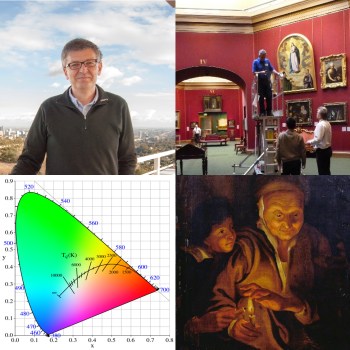 Lighting in museums and galleries has long been a contentious subject. Too much light can cause damage to artworks, too little creates a poor visitor experience. In the forty years since The Museum Environment by Garry Thomson was first published, much has changed in the field of museum lighting. David Saunders will discuss how our understanding of the effects of light on collections and the lighting needs of our visitors have changed. He will explore how new approaches and developments in museum lighting affect practices and strategies for both display and conservation. The talk will be followed by a drinks reception and preceeded by the Icon Scotland Group Annual General Meeting between 5.00 and 5.45pm to which Icon members are invited to attend.
Dr. Saunders was recently Keeper of Conservation, Science and Documentation at the British Museum (and previously, Principle Scientist the Scientific Department of the National Gallery, London). He is presently writing a major work on lighting in museums and galleries which is expected to be published in 2018.
Exhibition | Storytelling: French Art from the Horvitz Collection
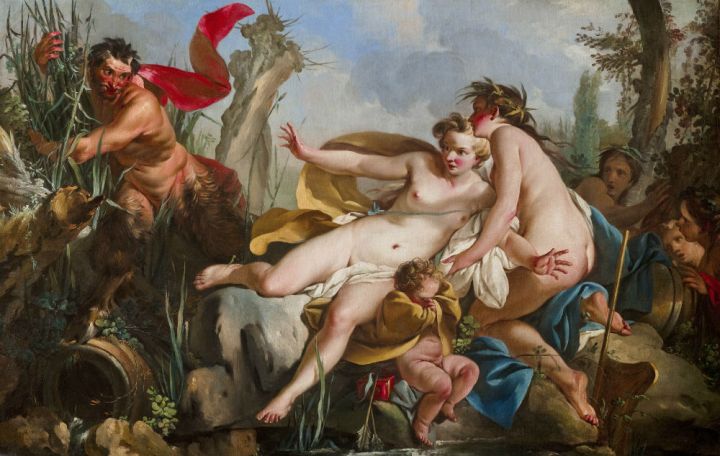
Jean-Baptiste-Marie Pierre, Pan and Syrinx, 1746, oil on canvas, 90 × 141 cm
(Boston: The Horvitz Collection, P-F-57).
◊ ◊ ◊ ◊ ◊
Now on view at the Cummer Museum:
Storytelling: French Art from the Horvitz Collection
Cummer Museum of Art & Gardens, Jacksonville, Florida, 25 May — 29 July 2018
John and Marble Ringling Museum of Art, Sarasota, Florida, 9 September — 2 December 2018
Fairfield University Art Museum, Fairfield, Connecticut, 25 January — 29 March 2019
Curated by Alvin Clark
Storytelling: French Art from the Horvitz Collection combines two exhibitions: Imaging Text: Drawings for French Book Illustration and Seventeenth- and Eighteenth-Century French Paintings, from one of the world’s finest private collections of French art. Created between the 16th and 19th centuries, and ranging from mythological and biblical studies to more playful imagery, the 80 works included in the exhibition vary in terms of style, genre, and period. Captured in crisp and swift pen strokes, finely modulated chalk, or brilliant colors, these captivating compositions were produced by some of the most prominent artists of their time, such as Charles Le Brun (1619–1690), Charles-Nicolas Cochin, the younger (1715–1790), and Jean-Honoré Fragonard (1732–1806).
The exhibition is curated by Alvin L. Clark, Jr, Curator, The Horvitz Collection, Department of Drawings, Division of European and American Art, Harvard Art Museums.
Alvin Clark and Elizabeth M. Rudy, Imaging Text: French Drawings for Book Illustration from The Horvitz Collection (Boston: The Horvitz Collection, 2018), 76 pages, ISBN: 978-0991262533, $15.
◊ ◊ ◊ ◊ ◊
Note (added 10 January 2018) — The posting was updated to included Fairfield University Art Museum.










 Enfilade
leave a comment