Exhibition | A Stitch in Time at Ham House
Now on view at Ham House near London:
A Stitch in Time
Ham House, Richmond, 10 February — 29 April 2018
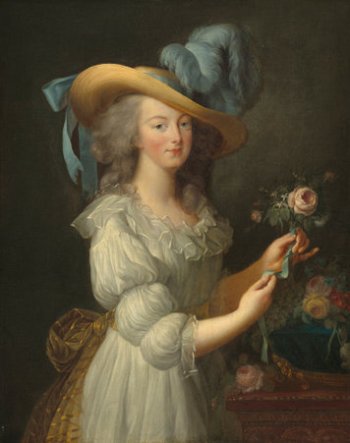
Anonymous artist, after Élisabeth-Louise Vigée Le Brun, Portrait of Marie-Antoinette in a Chemise Dress, after 1783, oil on canvas (Washington, DC: National Gallery of Art).
Earlier this year, BBC Four broadcasted the documentary A Stitch in Time. Presenter Amber Butchart and a team of expert tailors headed by Ninya Mikhaila, took inspiration from works of art and recreated historical clothing using only authentic methods. The six costumes created come to Ham House this spring, allowing visitors to see the intricate work of costumier Ninya Mikhaila and her team up close.
The six costumes include:
• Charles II from a painting at Ham House by Thomas Stewart (from the collection at Ham House)
• The dress from the Arnolfini Portrait by Jan van Eyck at the National Gallery
• The Hedge Cutter leather jacket from a portrait at Broughton Castle
• The dress of Dido Elizabeth Belle from a painting at Scone Palace
• The Jupon of the Black Prince from the effigy at Canterbury Cathedral
• Marie Antoinette’s Chemise à la Reine from a painting by Élisabeth Louise Vigée Le Brun

From left to right: Harriet Waterhouse, Ninya Mikhaila, Amber Butchart, Hannah Marples
A Stitch in Time can be viewed in the UK via the BBC iPlayer. The show is not available in the US, but some episodes have been uploaded to YouTube.
Conference | The Properly Dressed Window
From Winterthur:
The Properly Dressed Window: Curtain Design Over Time
Winterthur, Wilmington, Delaware, 15–16 May 2018
Join Winterthur staff, visiting scholars, designers, and fellow ‘textilians’ for a two-day program of lectures and hands-on workshops. For information and registration, please call 800.448.3883. Registration opens on February 6, 2018. Read The Journal of Antiques and Collectibles article on curtains at Winterthur.
Sandy Brown, with an introduction by Linda Eaton and a foreword by Thomas Jayne, The Well-Dressed Window: Curtains at Winterthur (New York: The Monacelli Press, 2017), 208 pages, ISBN: 9781580934589, $50.
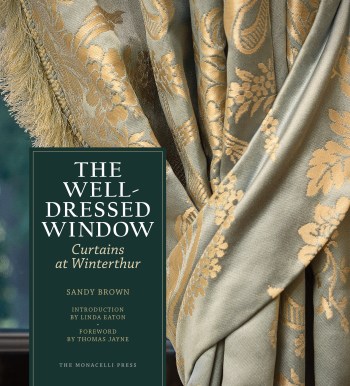 Today Henry Francis du Pont, the force behind the transformation of Winterthur from a family house to the premier museum of American decorative arts, is recognized, along with Henry Davis Sleeper and Elsie de Wolfe, as one of the early leaders of interior design in this country.
Working with architects, curators, and antiques dealers, du Pont created some 175 room settings within the house. He assembled his rooms using architectural elements from historic houses along the East Coast and filled them with an extraordinary collection of American furniture and decorative arts. Du Pont’s unique talent was his ability to arrange historically related objects in a beautiful way, in settings that enhanced their shape and form through the choice of color, textiles, and style.
Du Pont paid particular attention to the design of the curtains, and The Well-Dressed Window surveys his achievement, explaining how the fabrics were selected as well as their relationship to the architecture and other decorative elements in the rooms. Forty rooms are presented, each specially photographed to show the overall space in addition to details of fabric and trim. A series of stereoviews taken in the 1930s as well as other period photographs reveal the evolution of the window treatments and upholstery over nearly sixty years. Of particular interest is du Pont’s seasonal changing of the curtains, which were rotated throughout the year as the lighting and colors in the surrounding garden shifted.
Call for Papers | Portraiture
From H-ArtHist:
Portraiture: an Interdisciplinary Conference
Centre for Visual Arts and Culture, Durham University, 13–15 July 2018
Proposals due by 1 March 2018
The study of portraiture is beginning to come into its own now that old assumptions about the low status of the genre have been challenged and contextualised. The ubiquity and diversity of portraits means that they can be used as evidence to address a wide range of questions, while the very idea ‘portrait’ is immensely rich. The conference is designed to open up fresh perspectives on a potent form of visual culture that is of continuing importance yet unevenly distributed in time and place.
Proposals may deal with any period and location. Papers are especially welcome that explore the interdisciplinary potential of studying portraiture and that address the following themes:
• The ways portraits create, sustain and comment on occupational identity
• Portraits and/in institutions
• ‘Portrait’ as an idea and its metaphorical dimensions
• Portraits where the face is not present
• Portraiture in the North East of the UK
• Comparative approaches to portraiture, which might focus on place, time, occupation, race, social status, and/or gender, for example.
We invite contributions of short papers for the conference. Please send an abstract—maximum 250 words—together with a one page CV by 1 March 2018 to cvac@durham.ac.uk and include ‘portraiture conference’ in the subject line. Please note presenters of short papers will need to cover their own costs, which will be kept as low as possible. There will be no conference fee for speakers. This conference follows the summer school Visual Intersections 3 (11–13 July). Early career researchers are especially welcome at both events.
Keynote Speakers: Professor Elizabeth Cowling and Professor Viccy Coltman
Exhibition | Peacock in the Desert: The Royal Arts of Jodhpur
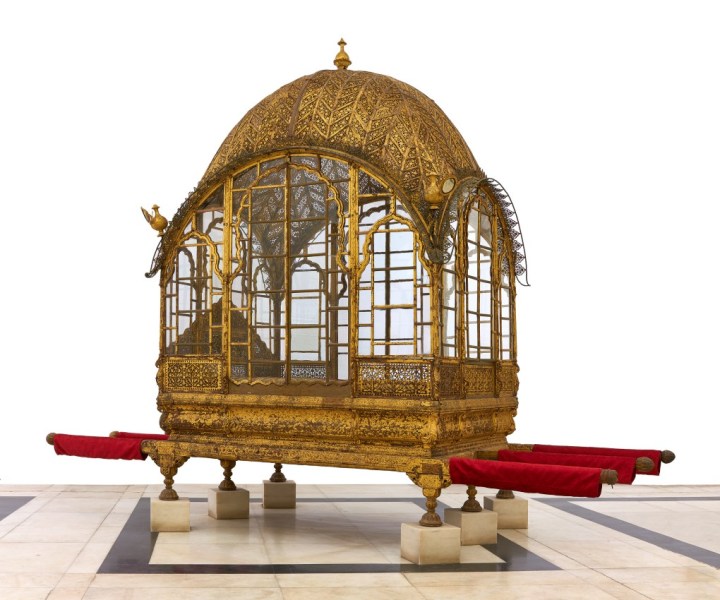
Palanquin (Mahadol), Gujarat, ca. 1700–30, gilded wood, glass, copper and ferrous alloy (Mehrangarh Museum Trust; photograph by Neil Greentree).
◊ ◊ ◊ ◊ ◊
Press release (8 January 2018) from the MFAH:
Peacock in the Desert: The Royal Arts of Jodhpur, India
Museum of Fine Arts, Houston, 4 March — 19 August 2018
Seattle Art Museum, 18 October 2018 — 21 January 2019
Royal Ontario Museum, Toronto, 9 March — 2 September 2019
Curated by Mahrukh Tarapor, Karni Singh Jasol, Martand Singh, and Angma Dey Jhala
A major collaboration brings a groundbreaking exhibition of royal treasures from India to Houston in March. Organized by the Museum of Fine Arts, Houston, in partnership with the Mehrangarh Museum Trust of Jodhpur, Peacock in the Desert: The Royal Arts of Jodhpur, India showcases nearly four centuries of artistic creation from the kingdom of Marwar-Jodhpur, one of the largest princely states in India, in the northwestern state of Rajasthan.
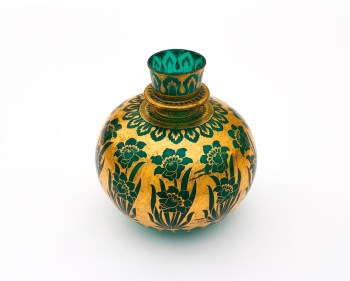
Mughal, Huqqa Vase, early 18th century, glass and gold paint (Umaid Bhawan Palace; photograph by Neil Greentree).
Through lavishly made ceremonial objects, finely crafted arms and armor, sumptuous jewels, intricately carved furnishings, and more, the exhibition outlines the dynamic history of the Marwar-Jodhpur region and the Rathore dynasty that ruled it for over seven centuries. Established in the 15th century, the city of Jodhpur was once the powerful capital of Marwar, a vast desert kingdom ruled by the Rathores, who were descendants of a hereditary social caste of Hindu warriors and kings (known as ‘kshatriyas’). Over the course of several centuries, the prosperity of Jodhpur attracted the attention of two successive empires who ruled India: the Mughals and the British. Both encounters reshaped Jodhpur’s cultural landscape, introducing objects, artists, languages, architectural styles and systems of administration that influenced the royal identity of the Rathore dynasty. Through some 250 objects from Indian courtly life, most never before seen outside of Jodphur, the exhibition illuminates how the Rathores acquired and commissioned objects amidst these cross-cultural exchanges to leverage patronage, diplomacy, matrimonial alliances, trade, and conquest.
Drawn primarily from the collections of the Mehrangarh Museum Trust and the private collections of the royal family of Jodhpur, the exhibition marks the first time that most of these treasures—including paintings, decorative arts and furniture, tents, canopies, carpets, textiles, and weapons—will be seen outside of their palace setting at Mehrangarh Fort and the first time they will travel abroad. The foundations of the Fort, carved out of a rocky hillside 400 feet above Jodhpur, were laid by the Rathores in 1459 as a military stronghold. The Fort, famously described by Rudyard Kipling as “a palace that might have been built by Titans and colored by the morning sun,” has been the seat of the Rathore dynasty since then, serving as a royal residence, a center of cultural patronage, and a place of worship for the royal clan. Today, it houses the collection of the Mehrangarh Museum Trust, which was established in 1972 by the current dynastic head of the Rathore clan, His Highness Maharaja GajSingh II of Marwar-Jodhpur, and remains one of the most important and best-preserved collections of fine and applied arts from the Mughal period of Indian history. A handful of carefully chosen objects from other notable collections, including The al-Sabah Collection, Kuwait, complete the presentation, while large-scale photomurals will evoke the stunning setting of the Mehrangarh Museum, where H. H. Maharaja Gaj Singh II continues to preserve the living heritage of Jodhpur.
“Peacock in the Desert is the result of a landmark partnership, marking the first time the Mehrangarh Museum Trust has shared so many of the treasured objects of their collection,” commented Gary Tinterow, MFAH director. “We are deeply honored and grateful to be the first U.S. organization to present this show, and for the opportunity to provide visitors this unprecedented experience of India’s rich cultural history.”
“The fort of Jodhpur-Mehrangarh has been preserved as a record of the lives and legacy of the Rathores,” added His Highness Maharaja GajSingh II. “I look forward to sharing the artistic and cultural heritage of my country, India, and the city of Jodhpur and its people, with new audiences across North America.”
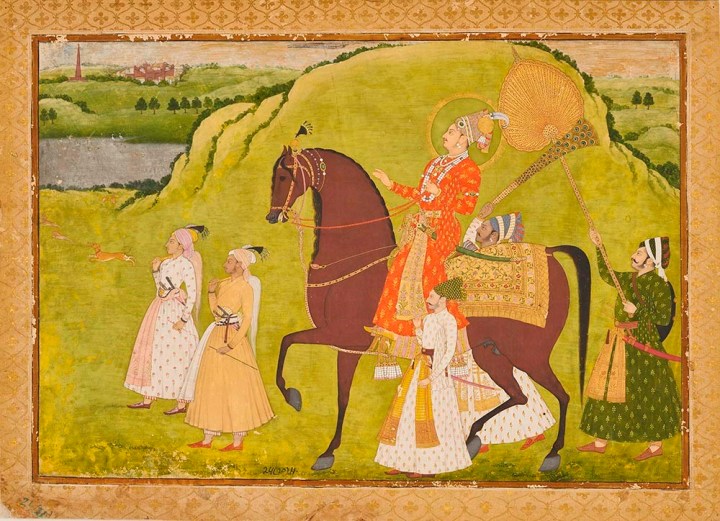
Dalchand, Maharaja Abhai Singh on Horseback, Jodhpur, ca. 1725, opaque watercolor and gold on paper (Mehrangarh Museum Trust; photograph by Neil Greentree).
◊ ◊ ◊ ◊ ◊
Three central, underlying themes woven throughout Peacock in the Desert build upon recent and emerging scholarship to deepen visitors’ understanding of the multifaceted character of a traditional Indian kingdom:
• Interconnections: The relationships between palace and town, urban and rural, central empire and subsidiary kingdom, as well as those that resulted from migratory trade routes, marital alliances, and military partnerships/confrontations, all led to a dynamic crosspollination of new ideas and belief systems, which found brilliant expression in fine and decorative arts, architecture, design, performing arts, and more.
• The role of women and artisans: Contrary to the popular assumption that royal women were quietly hidden away, the exhibition explores the crucial role they played as agents of cultural change and patrons of the arts, showcasing how the gender roles, social etiquette, and aesthetic practices employed by women influenced the identity of Indian courts.
• Royal patronage and the continuity of tradition: An exploration of the royal courts and the ways they were able to preserve India’s cultural traditions, while at the same time absorbing and incorporating external influences.
These themes offer a new perspective on the cosmopolitan culture of the royal courts of the Marwar–Jodhpur region, communicated through the careful juxtaposition of objects, interpretive materials, and immersive installation within the exhibition’s six interlinked sections.
Tradition and Continuity: The Royal Wedding Procession
The exhibition opens with a dramatic recreation of a royal wedding procession with video projections of actual footage from royal weddings performed in the 20th century. Featuring elephant howdahs (seats), horse and elephant mannequins adorned with traditional wedding regalia, and royal insignia, this immersive environment introduces visitors to the role that marital alliances played in the lives of the citizens of Marwar-Jodhpur and in the development of the region’s aesthetic traditions.
The Rathores of Marwar
This section introduces the desert landscape of Marwar-Jodhpur, its diverse peoples, and the exhibition’s central protagonists: the Rathore clan that ruled the region from the 13th to the mid-20th century. Highlights include illuminated manuscript pages that illustrate the scenery of the region and detail the history of the dynasty; an exquisite wood and glass Mahadol (palanquin); textiles, such as turbans worn by various members of the desert community; and a model of the Mehrangarh Fort, in silver.
Conquest and Alliance: The Rathores and the Mughals
The arrival of, and eventual takeover by, the Mughal Empire in 1561 began centuries of political and military alliances brokered between the Mughals and the Rathore clan. This section examines the movement of objects throughout these alliances in the 16th and 17th centuries, presenting ornate sabers, daggers, and rifles alongside 17th- and 18th-century paintings and illustrations of court and war scenes. The section culminates in the extraordinary 17th-century Lal Dera tent, one of the oldest, if not the only, intact Indian court tent of its time.
Zenana: Cross-cultural Encounters
In this section, paintings, carpets, textiles, jewelry, along with intricately-carved sandstone jalis (screens), from behind which women viewed courtly activities, evoke the setting of a royal zenana, the womens’ wing of a Rathore palace. Here, the zenana is explored as a dynamic cosmopolitan space that not only housed women and objects, but also functioned as a preserver of intangible cultural traditions through the propagation of heirlooms, rituals, and dress throughout the centuries. Among the furnishings shown in this section is an exceptional wood baradari (pavilion).
Durbar: The Rathore Court
As Mughal influence began to decline in the late 18th century, the Rathore durbar (royal reception) capitalized on its diminished power by attracting artists and craftsmen from their weakened court. This, in addition to the growing trend of exchanging artworks as gifts, led to a period of intense creativity in artistic and decorative production and a cross-fertilization of Mughal and Rathore styles, as indicated by the woven canopy and textiles, finely crafted arms and armor, and 18th- and 19th-century paintings on view.
The Raj
Extravagant, large-scale objects immediately convey the tone of the last section of the exhibition, which explores the most dramatic period of transformation in Jodhpur’s history, triggered by the arrival of the British in 1818. Garments, paintings, decorative arts, and a 1944 Stinson L-5 Sentinel aircraft illustrate the influence of the British on the region and the unprecedented scale on which Jodhpur royalty began to embrace modernity and western culture as the movement for Indian independence—eventually granted in 1947—gained traction.
Peacock in the Desert is curated by a team of scholars and professionals from India: Dr. Mahrukh Tarapor, senior advisor for international initiatives at the Museum of Fine Arts, Houston; Dr. Karni Singh Jasol, director of the Mehrangarh Museum Trust, Jodhpur; the late Martand Singh, chief consultant from the Mehrangarh Museum Trust; and Dr. Angma Dey Jhala, associate professor at Bentley University, who serves as project advisor and volume editor for the accompanying catalogue.
Distributed by Yale UP:
Karni Jasol, with contributions by Peter Alford Andrews, Robert Elgood, Catherine Glynn, Karni Jasol, Angma Jhala, Shailka Mishra, and Giles Tillotson, and edited by Angma D. Jhala, Peacock in the Desert: The Royal Arts of Jodhpur, India (Houston: Museum of Fine Arts, Houston, 2018), 296 pages, ISBN: 9780300232967, $85.
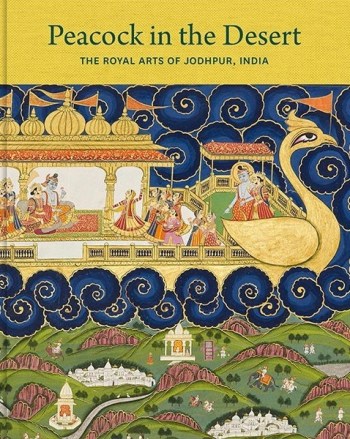 Peacock in the Desert traces the evolution of royal identity in the kingdom of Marwar-Jodhpur in southwestern Rajasthan from the 17th century to the establishment of independence after 1947, presenting the area as a microcosm of India’s extraordinarily vibrant culture. An international team of contributors has contextualized these regional narratives in relation to external—and even global—forces. The book thus offers a new perspective on the acquisition and commissioning of objects through patronage, diplomacy, matrimonial alliances, trade, and conquest. It sheds fresh light on the influential role of women at the royal courts and examines monarchies as lenses onto cross-cultural relationships, the unrecognized roles of groups marginalized in earlier accounts, cultural heterodoxy, and large-scale multicultural exchange. Exploring these webs of connection, Peacock in the Desert makes a transformative contribution to scholarship. Its multidisciplinary approach to artistic and cultural exchange offers pathbreaking insights, adding crucial chapters to the story of India’s royal visual splendor.
Decorative Arts Trust Curatorial Internship at The Met
The Decorative Arts Trust Curatorial Internship
The Metropolitan Museum of Art, New York, 2018–2020
Applications due by 9 March 2018
The Metropolitan Museum of Art is seeking eligible candidates for The Decorative Arts Trust Curatorial Internship/Research Scholarship for 2018–2020, a two-year position funded jointly by The Decorative Arts Trust and The Metropolitan Museum of Art. This partnership seeks to provide hands-on curatorial experience for students and young professionals interested in museum careers.
The Curatorial Intern/Research Scholar will participate in a range of curatorial activities in the American Wing of The Met over a two-year period, with their efforts divided primarily between an exhibition project and permanent-collection work. The majority of the time will be devoted to myriad aspects of developing the exhibition, Stories in Clay: Stoneware from Edgefield District, South Carolina, currently scheduled to open at The Met in the fall of 2020. The intern/research scholar will be involved with researching objects, including provenance and methods of production; organizing loan paperwork as well as conservation examinations and photography of exhibition objects; developing and maintaining exhibition files; and participating in catalogue production and label writing. The individual will also participate in other permanent-collection curatorial tasks, including assisting with acquisitions and deaccessions as well as collection management.
Eligible candidates will have an M.A. degree in a field related to Decorative Arts, American Art, and/or Museum Studies, or comparable experience. The ideal candidate will have strong research and writing skills, a familiarity with digital resources and research platforms, and strong organizational skills. A proficiency with Microsoft Office is required and familiarity with TMS database recommended.
The Internship/Research Scholarship stipend for the 2-year period will be $35,000/year with an additional stipend of $2,500 for research, educational, and professional development programs. The 2-year position will ideally begin in September 2018. The deadline for all applications is March 9, 2018. Interested applicants should submit their resume, a statement of interest, and a writing sample of no more than 1000 words to: Marcie Karp, Senior Managing Educator, Academic and Professional Programs, at Academic.Programs@metmuseum.org.
Social Media | Redressing Pleasure
Social media and crowd sourcing campaigns can be daunting tasks for museum professionals. The Museum of London’s recent #redressingpleasure campaign offers an exemplary model. With fashion curator Timothy Long’s Twitter and Instagram videos reaching thousands, their efforts have been both engaging and effective.
–Intern JMB
Timothy Long, our fashion curator, has been posting some selfies from inside our Costume Store, as part of our month-long Redressing Pleasure campaign. He’s highlighting some of the most fascinating fashions from our collection of 18th- and 19th-century clothing and picking the best to include in our new, updated Pleasure Gardens gallery display.
Please join us in #redressingpleasure & help us conserve & exhibit rare 18-19th century artefacts. Go to @artfund @ https://t.co/zJQL6Vmnoa pic.twitter.com/dD8Br0fde6
— Timothy Long (@Fashion_Curator) November 3, 2017
We need your help to conserve & exhibit this late 18th century dress, as part of the #redressingpleasure project 👉🏽 https://t.co/lb7K933Qm9 pic.twitter.com/r2g2TTlOmJ
— Timothy Long (@Fashion_Curator) November 4, 2017
This exquisite c. 1790 dress is one of the artefacts we want to conserve and exhibit as part of #redressingpleasure. The conservation will be done by Textile Conservator @melina.plottu. While the bodice is in near mint condition, the skirt needs attention as it is sewn to a thin and fragile silk ribbon waistband, which is not strong enough to support the weight of the skirt. We need your support to help us conserve the waistband and a few other areas. We also need your support to help us reproduce some petticoats, which is a fun, yet time-consuming process—as the shape must be cut to properly exhibit the skirt (and to fit the mannequin).
Will you help us put our ‘Queen of the Night’ back together again? For more info on #RedressingPleasure @artfund: https://t.co/zJQL6Vmnoa pic.twitter.com/4uGZW18LaZ
— Timothy Long (@Fashion_Curator) November 5, 2017
Oh wow! What a treasure. This late 18th-century dress was donated with dozens of ‘scrap’ pieces. As I started to go through these pieces, I was shocked and delighted to find identifiable parts, giving us glimpses of older incarnations of the dress. While the sleeves and the inner layer of the bodice appear to have remained throughout each upgrade, the exterior to the bodice and parts of the skirt, were cut off and kept. We would like to include this dress in our new Pleasure Gardens display, but it requires some creative solutions to put it back together again and then to build a mannequin to exhibit it properly, including petticoats. Will you help us put the ‘Queen of the Night’ back together again?
A Victorian Archeress 💘 We need your support to complete this ensemble. We must make a skirt & undersleeves & we hope to buy an 1850s archery bow! Will you help us? 👉🏽 https://t.co/zJQL6Vmnoa pic.twitter.com/3xxKscFZsc
— Timothy Long (@Fashion_Curator) November 8, 2017
A Victorian Archeress! It doesn’t get much better than this. This stunning ensemble was donated to the Museum of London in 1954. It was worn by Mrs Fanny Giveen (1833–1863). If you know anything about her, please do get in touch. This ensemble will be our ‘performer’ in the 19th-century side of the gallery. Vauxhall Pleasure Gardens had ‘archery fetes’ in the 19th century, represented by this costume. We are so pleased to have an excuse to exhibit this incredible ensemble. However, we must reproduce her skirt and undersleeves and I hope to buy an original 1850s women’s archery bow, to complete the ensemble.
Thank you for your positive responses to our Archeress. Here are more details of the ensemble. Filled pages, water coloured targets & purple feathers on the arrows 💘 For more info & to donate 👉🏽 https://t.co/zJQL6Vmnoa pic.twitter.com/Vm6o1VR9Kv
— Timothy Long (@Fashion_Curator) November 9, 2017
Our Archeress received such a wonderful response on social media that I recorded a second video. Thank you! I thought you might like to see more of the ensemble. Every page of the notebook is filled with scores, lists and drawings…all appear archery related and all written by Fanny Giveen herself! And then the water coloured targets… I’m in love.
If you ❤menswear, we have some rare 18-19th century examples, which need your support! For info & to donate: https://t.co/zJQL6Vmnoa #style pic.twitter.com/Qk24rNvYjq
— Timothy Long (@Fashion_Curator) November 6, 2017
We hope to exhibit this 1830s pelisse next to the men’s 1830s coat. We are calling this ‘couple’, Jeremiah and Electa. I fell in love with this pelisse immediately. For women’s fashion, I think the period around 1830 is fascinating. The odd proportion in design, enormous sleeves, towering hats, and feathers. We may even get to work with ‘sleeve supporters’ (parts of a costume, not donors to #RedressingPleasure). I am really looking forward to seeing this pelisse conserved and mounted, with all the correct undergarments and accessories.
On Loan | Fragonard’s Young Girl Reading
Press release, via Art Daily (21 February 2018). . .
Honoré Fragonard’s Young Girl Reading
Speed Art Museum, Louisville, February — 15 May 2018
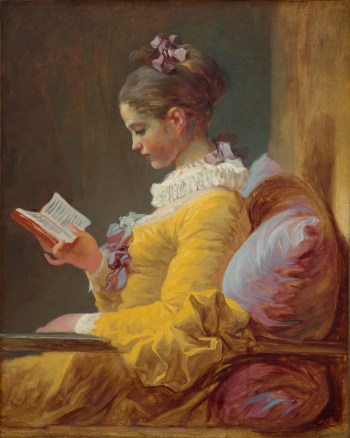
Jean Honoré Fragonard, Young Girl Reading, ca. 1769, oil on canvas, framed: 104.9 × 89.5 cm (National Gallery of Art, Washington, D.C., Gift of Mrs. Mellon Bruce in memory of her father, Andrew W. Mellon).
The Speed Art Museum unveiled a special “Mystery Masterpiece”, Jean Honoré Fragonard’s (1732–1806) Young Girl Reading, ca. 1769. The painting is on loan from the National Gallery of Art in Washington, D.C., through May 15, 2018. The painting was most recently part of the Fragonard: The Fantasy Figures exhibition at the National Gallery of Art.
“The Speed is thrilled to showcase this important and beautiful masterpiece,” said Erika Holmquist-Wall, Chief Curator, Speed Art Museum, and Mary and Barry Bingham, Sr. Curator of European and American Paintings and Sculpture. “We are so fortunate and happy to welcome this painting to Kentucky, even for a short while. It’s really a treasure and has to be seen in person.”
The Speed and the National Gallery of Art have participated in reciprocal loans, sending the Speed’s popular Portrait of Madame Adélaïde by Adélaïde Labille-Guiard, (ca. 1787) to the National Gallery in 2017 (it has since returned to the Speed) where it was on view in the exhibition America Collects Eighteenth-Century French Painting, and now welcoming Fragonard’s Young Girl Reading to the Speed.
“This painting is one of the most beloved works in the National Gallery of Art’s collection,” said Yuriko Jackall, the National Gallery’s specialist of eighteenth-century French paintings and curator of Fragonard: The Fantasy Figures. “It doesn’t leave the National Gallery often, so this is a rare opportunity for the Speed to showcase this painting to the public.”
“Fragonard was consistently among the most innovative and brilliant painters of his time,” said Holmquist-Wall. “He was interested in the world as a setting for imagined pleasures, as were his clients, who were mostly private financiers and aristocrats. He developed a style characterized by delicate color and an affinity for witty, lighthearted subjects. It can be pretty risqué, too—Fragonard’s paintings are filled with abundant gardens populated with amorous young couples. Of course, these were very popular with his patrons, and such paintings helped him earn his keep.”
Fragonard epitomized the artistic style known as Rococo, a highly ornate, decorative style of art which was dominant in France during the reign of Louis XV (1715–74). Rococo art was fanciful and airy, often featuring witty, elegant, or voyeuristic subject matter. It was a style that introduced a greater playfulness and sensitivity to feelings and moods. Unfortunately, the demand for such carefree themes ceased with the French Revolution. Until shortly before his death in 1806, Fragonard worked as a curator at the Parisian museum that would eventually become the Louvre, and he died virtually forgotten.
Around 1769, Fragonard painted a group of works known today as his fantasy figures: vibrant canvases showing individual models in fancy dress engaged in different poses and activities. The paintings have a lot in common with each other: they are of nearly identical dimensions; each is reputed to have taken about an hour to complete; the subjects’ attitudes and faces are all similar; they are all dressed in a distinctive style with ruffs and feathers. For decades, Young Girl Reading was associated with the fantasy figure series. Yet, Young Girl Reading is slightly different. While the other figures gaze directly at the viewer, or off into the distance, she is completely absorbed in her book, her posture relaxed and calm.
“An intriguing note to this painting is that in 2012, researchers discovered a previously unknown drawing by Fragonard that included sketches of 18 paintings related to the fantasy figures, including a sketch corresponding to Young Girl Reading,” said Holmquist-Wall. “In fact, an earlier X-ray of Young Girl Reading revealed that Fragonard had painted the head of the girl over another portrait, but it was impossible to determine the details.”
“The emergence of the drawings was momentous for scholars because it provided vital clues about the meaning of the fantasy figure ensemble. It also provided tangible evidence of a relationship between Young Girl Reading and the group,” added Jackall. “The very first sketch on the first row of the paper represented Young Girl Reading.”
In 2013, Jackall and a team of researchers at the National Gallery used hyperspectral imaging and X-ray fluorescence (XRF), imaging techniques that permitted a clearer view of the underlying portrait. It became obvious that the sitter was a woman wearing a large feathered headdress. Further tests indicated that the painting existed in this state for at least six months before Fragonard painted over it. “This intrigued the research team,” said Holmquist-Wall, “and they recreated a digital simulation of the first portrait, giving us a look at the artist’s original composition, painted over two centuries earlier.”
“Visually, Young Girl Reading is a beautiful painting, highlighting tremendous freedom of brushwork and coloring that it sets Fragonard up as a precursor to the Impressionists,” said Jackall. “Fragonard was a model for those artists who came after him and I hope the loan will introduce new audiences to eighteenth-century French art.”
Fragonard’s Young Girl Reading is on view during the same time as the Speed’s groundbreaking exhibition, Women Artists in the Age of Impressionism, which features over 80 exceptional paintings by 37 women artists from 13 countries. Drawn from prominent collections across the United States and abroad, Women Artists in the Age of Impressionism showcases renowned artists including Mary Cassatt (American) and Rosa Bonheur (French), alongside lesser-known, but equally important peers including Anna Ancher (Danish), Lilla Cabot Perry (American), and Paula Modersohn-Becker (German). Fortuitously, the exhibition also includes the work of Berthe Morisot (French), a great-great niece of Jean Honoré Fragonard. Women Artists in the Age of Impressionism is being featured at the Speed from February 17 through May 13, 2018.
Seminar | Alden Gordon on the French Financial Crises, 1760s–70s
From the seminar flyer:
Alden Gordon | ‘Heureux ceux qui ont un coeur de bronze…’: The French Financial Crisis in the late Reign of Louis XV and Its Impact on Royal Manufactures and Royal Patronage
The Wallace Collection, London, 26 February 2018

Louis Tocqué, Portrait of the Marquis de Marigny, 1755 (Paris, Musée Carnavalet).
The French Royal Treasury experienced a crisis which began during the Seven Years’ War and persisted through the end of the reign of Louis XV and into that of Louis XVI. This particularly affected the Direction des Bâtiments du Roi which saw its allowances for the payments to the employees of the Gobelins and the entrepreneurs who maintained the many properties of the Maison du Roi cut to the bone in the 1760s and 1770s. To try to keep his skilled workforce intact, the Marquis de Marigny, Directeur-Général des Bâtiments, Arts, Académies et Manufactures du Roi, was forced to resort to exceptional tactics in paying employees while balancing the fulfillment of projects most essential to statecraft and the priorities of the royal family.
Notable among the projects pending during these years were the preparations for the marriage of the future Louis XVI to the Austrian princess Marie-Antoinette. The financial crisis forced Marigny to confront difficult choices in assigning new commissions while witnessing the distress of his loyal artists and craftsmen. His secretary, Jean Étienne Montucla, wrote of the emotional distress in Marigny’s inner circle saying that “I am saddened to give you such frightful news; happy those who, under these circumstances, have a heart of bronze, and who would suffer a whole world to perish without experiencing any movement of sensibility.”
This talk will address the archival evidence for understanding the financial crisis of the late 1760s and early 1770s and chronologically synchronize the actions on behalf of workers with simultaneous royal commissions. This research points to Marigny’s anguish over the fiscal starvation of his administration as the real motivation for his repeated efforts to resign his post rather than the often stated hypothesis that he had lost influence with Louis XV in the years after the death of his sister, the Marquise de Pompadour.
Alden Gordon is the Paul E. Raether Distinguished Professor of Fine Art at Trinity College in Hartford, Connecticut. This research forms part of the book in preparation on The Life and Career of the Marquis de Marigny: Patron in the Enlightenment.
Monday, 26 February 2018, 5.30pm, The Wallace Collection Lecture Theatre. Admission is free, and booking is not required. More information and details of future seminars can now be found here.
Workshop | Probing Provenance
From the workshop flyer:
Probing Provenance: Sources, Methods and Implications
Institute for Historical Research, London, 28 March 2018

Monogram bookplate: M L y C (Provenance Online Project) by Provenance Online Project (flickr) Penn Libraries call number: IC55 G9315 590p 1591.
The Society for the History of Collecting is pleased to announce a workshop on provenance on 28th March 2018. Organised at the Institute for Historical Research (IHR), Senate House in London, it will bring together distinguished researchers with a range of geographical and period expertise: Kate Hill, Claire Wintle, Alexis Ashot, Niko Munz, Melanie Aspey, and Alexandra Gerstein). The aim is to have a broad methodological discussion that introduces provenance as a concept and a practice: what skills it requires; what sources it can draw on; how it can be effectively deployed; what other histories and processes it can illuminate. The event will run from 10.00 until 13.00 in Wolfson Room 1 of the IHR. It is open to all, and doctoral students and early career researchers are especially welcome to attend.
Provenance is a central tool and indispensable concept within the history of collecting. Not only does it permit scholars to retrace the chain of lost collections, and to reconstruct the biography of an object. Provenance can also act as badge of esteem, a promise of authenticity, a financial asset and a narrative device. In recent years, it has generated not just vast digital databases centred on the art market, but also fascinating international exhibitions and intense clashes over the restitution of cultural property. Provenance is not merely one more research tool, then. Rather, it is central for understanding the itinerary of objects and the transformative effects of ownership.
The workshop has been organized by Adriana Turpin (Chairman of the Society), Tom Stammers (University of Durham), Silvia Davoli (Strawberry Hill Trust/ University of Oxford), and Barbara Pezzini (University of Manchester/ National Gallery). Booking, via Eventbright, is essential. For any questions about the day please contact Tom Stammers: t.e.stammers@durham.ac.uk.
Conference | Art History Before English
From the Kunsthistorisches Institut in Florenz:
Art History Before English: Negotiating a European ‘Lingua Franca’ from Vasari to the Present
Kunsthistorisches Institut in Florenz, Florence, 8–10 March 2018
Organized by Alessandro Nova in collaboration with Robert Brennan, Marco Mascolo, and Oliver O’Donnell within the framework of the research project Languages of Art History
 The expansion of art historical scholarship across cultural and linguistic boundaries reveals problems with the inherited vocabularies of the discipline. Today, for better or worse, English has become an ever more prominent common language of academic discourse, art history being no exception, and yet the problems this development poses are not without historical precedent within the European tradition of art writing.
Alongside the task of adapting classical concepts to modern usage, scholars have long had to contend with what was arguably the ‘lingua franca’ of art historical discourse in their own time: Italian in the 16th and 17th centuries, French in the 17th and 18th, and German in the 19th and 20th. This conference seeks to leverage this succession of dominant languages in order to shed light on the present assumption of English as a ‘lingua franca’ of art history. In so doing, the conference seeks to evaluate how Italian, French, and German have decisively shaped the discipline, assembling a cache of certain terms, concepts, and modes of thought—often to the exclusion of others—that remain central across a wide variety of languages in the field today.
T H U R S D A Y , 8 M A R C H 2 0 1 8
14:30 Introduction
Alessandro Nova, C. Oliver O’Donnell, and Robert Brennan
15:00 Panel 1 | Inventions of Academic Languages
Chair: Alessandro Nova
• Massimiliano Rossi (Università del Salento, Lecce), Di lotta e di governo: Lessico, codici e categorie critiche degli scritti accademici sull’arte dagli Umidi alla Crusca
• Robert Williams (University of California, Santa Barbara), Terms of Art
16:20 Coffee Break
16:50 Panel 1, continued
Chair: Marco Mascolo and Robert Brennan
• Jacqueline Lichtenstein (Université Paris-Sorbonne), The Conferences of the Royal Academy of Painting and Sculpture: A New Discourse on the Arts
• Olivier Bonfait (Université de Bourgogne), La lingua francese e la scrittura della storia dell’arte, 1660–1700
• John Leavitt (Université de Montréal), Language Ideologies and the Inventions of Art History
F R I D A Y , 9 M A R C H 2 0 1 8
9:30 Panel 2 | Assimilation and Transformation of Academic Models
• Alessandra Russo (Columbia University), Antiguidade and Pintura: Concepts Redefined by a Novel Artistic Universality
• Francesca Terrenato (Università degli Studi di Roma La Sapienza), In the Manner of Vasari: Italian Loanwords and Calques in Karel van Mander’s Schilder-Boeck (1604)
10:50 Coffee Break
11:20 Panel 3 | In the Shadow of the Academy
Chair: Alexander Nagel
• Michael Fried (Johns Hopkins University), Reading Diderot in America
• Stephen Bann (University of Bristol), Historical Genre: Negotiating a Hybrid Concept in and outside of 19th-Century France
12:40 Lunch Break
14:00 Panel 4 | Translating and Untranslating Art Writing
Chair: Brigitte Sölch
• Elisabeth Décultot (Universität Halle), Winckelmanns Sprachen: Kunsttheorie als Übersetzung
• Andreas Beyer (Universität Basel), Art Historical Untranslatables
• Christopher S. Wood (New York University), Why did the ‘Renaissance’ Resist Translation?
16:00 Coffee Break
16:30 Site Visit
Chapel of Saint Luke, Basilica della Santissima Annunziata, led by Fabian Jonietz (Kunsthistorisches Institut in Florenz) — for speakers only
S A T U R D A Y , 1 0 M A R C H 2 0 1 8
9:30 Panel 5 | Ekphrasis in the 20th Century
Chair: Andreas Beyer
• Marco Mascolo (Kunsthistorisches Institut in Florenz), Roberto Longhi e la sua ricezione, tra ekphrasis e connoisseurship
• Émilie Passignat (Università Ca’ Foscari, Venezia), Nello specchio della traduzione: l’ecfrasi longhiana alla prova della lingua francese
10:50 Coffee Break
11:20 Panel 6 | Art History and Social Science
Chair: Hana Gründler
• C. Oliver O’Donnell (Kunsthistorisches Institut in Florenz), Schapiro and Lévi-Strauss: Structuralist Arguments among Color Field Paintings
• Whitney Davis (University of California, Berkeley), Reading-In: Franz Boas and the Languages of the Anthropology of Art
12:45 Concluding Discussion
Image: Joseph Kosuth, Ten Locations of Meaning, 2009










leave a comment