Exhibition | Spanish Still Life

Francisco de Goya y Lucientes, Dead Turkey, 1808–12, oil on canvas
(Madrid: Museo Nacional del Prado)
◊ ◊ ◊ ◊ ◊
Press release (via Art Daily) for the exhibition:
Spanish Still Life: Velázquez, Goya, Picasso, Miró
BOZAR (Centre for Fine Arts), Brussels, 23 February — 27 May 2018
Musei Reali di Torino, Turin, 22 June — 30 September 2018
Curated by Ángel Aterido
Eighty works by Spanish masters are arranged in a chronological overview, from the 1600s to the present-day. The still life paintings of great and universally acknowledged artists, such as Cotán, Velázquez, Goya, Picasso, Miró and Dalí are shown alongside works by their predecessors and contemporaries, providing the most comprehensive picture possible of this genre and its evolutions.
The still life has been known since time immemorial, but only flourished from the seventeenth century onwards, coming into its own as a separate genre. Spanish still life holds a particular position in the European context. While the connection with the Flemish and Italian models is unmistakable, the early Spanish specialists of the still life developed a visual language of their own. The plain and simple style of the seventeenth-century bodegones represents a peak in the genre’s history.
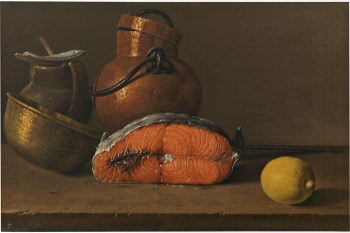
Luis Egidio Meléndez, Still Life with Salmon, Lemon, and Three Vessels, 1772, oil on canvas, 41 x 62.2 cm (Madrid: Museo Nacional del Prado).
Despite its popularity among patrons and at the royal courts, still life painting remained a relatively unappreciated genre. Critics regarded it as an academic exercise in composition, colour and texture, of interest solely for its decorative qualities. And yet it is a fascinating area in the history of art. The huge variety of objects portrayed, such as tables decorated with foods, fruits or game, florals, vanitas paintings, trompe l’oeils, and even cooking scenes—often have symbolic meaning and teem with moralising messages. Still life also experienced a fascinating evolution: from its huge growth and expansion in the lavish Baroque years of the seventeenth and eighteenth centuries to its avant-garde revival in the early twentieth century. Cubist experiments by artists such as Picasso raised this traditional genre to a new level and made it relevant again.
It has been almost 20 years since the last exhibition of Spanish still life (Bilbao Fine Arts Museum, 1999). This retrospective gives the first ever overview of the four-hundred year evolution of Spain’s most beautiful still life paintings and is based on four thematic and chronological clusters per century. The eye-catcher at the exhibition’s start in the seventeenth century is a piece by Sánchez Cotán, who is considered the ‘founding father’ of the genre and influenced several generations to come. From the first seventeenth-century bodegones the exhibition shifts its attention to the personal interpretations of artists such as Velázquez, Zurbarán, and Goya, before going on to the formal experiments of Picasso, Dalí and Miró, and works by contemporary Spanish artists such as Barceló and López. The exhibition focuses on a lesser-known aspect of their work, casting another light on the oeuvres of these prominent Spanish artists by showcasing them in the still life context.
Ángel Aterido, who holds a PhD in art history and is an expert on Spanish still life painting, selected the pieces for the exhibition. A good 70% are from private and public Spanish collections (such as Museo Nacional del Prado, Museo Reina Sofía, Royal Academy of Arts Madrid, Museo Nacional d’Art de Catalunye…). Many are on loan from the Prado, which has one of the largest and best collections of Spanish still life paintings in the world. The remainder are on loan from other great museums around the world including the National Gallery in London, the Fitzwilliam Museum in Cambridge, the Louvre, the Pompidou, the Uffizi, the Museo Nacional de Arte Antiga Lisboa, and the Museum of Modern Art in New York. Spanish Still Life presents a unique opportunity to discover these exceptional artworks at a single location. After its first showing in the Centre for Fine Arts Brussels the exhibition will travel to the Musei Reali di Torino.
Exhibition | Goya and the Enlightenment Court

Antonio Carnicero Mancio, The Ascent of a Montgolfier Balloon at Aranjuez, ca. 1784, oil on canvas, 169 × 280 cm
(Madrid: Prado)
◊ ◊ ◊ ◊ ◊
Now on view at the Bilbao Fine Arts Museum:
Goya and the Enlightenment Court / Goya y la corte ilustrada
CaixaForum, Zaragoza, 28 September 2017 — 21 January 2018
Bilbao Fine Arts Museum, 14 February — 28 May 2018
Curated by Manuela Mena and Gudrún Maurer
Having studied in Italy, Francisco de Goya (Fuendetodos, Zaragoza, 1746 – Bordeaux, 1828) moved to Madrid in 1775 and was first employed at the court of Charles III to work on the production of tapestry cartoons on hunting themes for El Escorial. Goya achieved recognition some years later when he was first appointed painter to the King (1786) then First Court Painter (1799). Despite this success at court, Goya maintained his connections with his native Zaragoza, and his correspondence with his childhood friend Martín Zapater offers proof of this ongoing relationship with his circle of friends and relatives while also providing crucial information on the progress of his career. The Prado’s exceptional loan of 13 original letters offers the documentary counterpoint to Goya as court painter and this is in fact the essential argument of the exhibition, which moves between Goya’s success at the courts of Charles III and Charles IV and the persistent echoes of his origins through his continuing contact with those closest to him.
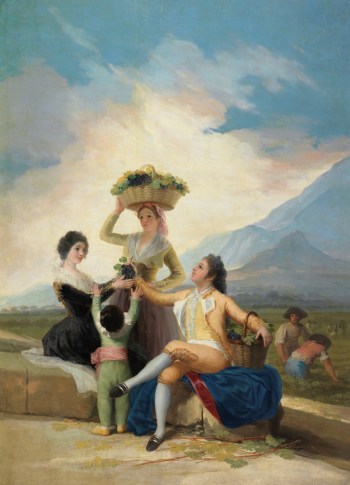
Francisco de Goya y Lucientes, The Grape Harvest, or Autumn, 1786, oil on canvas, 268 × 191 cm (Madrid: Prado).
Co-organised by the Museo Nacional del Prado, Fundación Bancaria “la Caixa” and the Bilbao Fine Arts Museum, Goya and the Enlightenment Court will be on display from 14 February until 28 May 2018, having previously been on view at the CaixaForum, Zaragoza. Curated by Manuela B. Mena and Gudrun Maurer, Chief Curator and Curator in the Department of 18th-century Painting and Goya at the Museo del Prado respectively, the exhibition brings together 96 works, many of which (71, of which 52 are oil paintings and the rest documents and examples of the decorative arts) come from the Museo del Prado. The remaining works on display comprise 9 paintings from the Bilbao Fine Arts Museum’s own collection and further loans from the Museo de Arte de Ponce, Puerto Rico, the Museo de Zaragoza, the Fundación Colección Ibercaja, the Sociedad Ecónomica Aragonesa de Amigos del País and a number of private collections.
In addition to the core group of canvases and cartoons by Goya, the exhibition also features works by other important 18th-century artists such as Luis Paret, Mariano Maella, José del Castillo, Luis Meléndez, Antonio Carnicero and Lorenzo Tiepolo, which together provide a context and also reveal the remarkable originality of Goya’s work. Finally, the exhibition includes examples of the above-mentioned correspondence with Martín Zapater, in addition to miniatures, prints and examples of the decorative arts.
Along with extensive restoration carried out for to this exhibition, the research undertaken has revealed new information, reflected, for example, in the presentation of a new portrait and a miniature of Martín Zapater painted by Goya and by Francisca Ifigenia Meléndez respectively, as well as the attribution to Agustín Esteve of a copy of Goya’s lost portrait of Ramón Pignatelli. Other new discoveries to be seen in Bilbao include the recently restored portrait of Pantaleón Pérez de Nenín and the presentation in context of Luis Paret’s remarkable View of Bermeo, a work recently acquired by the Bilbao Fine Arts Museum.
Major sections of the exhibition address
1 ‘Zaragoza, my heart, Zaragoza, Zaragoza’
2 Goya and Madrid, 1775: Hunting
3 The Enlightenment Court: Meeting Points
4 Friendship and Success
5 Female Refinement in the 18th Century
6 Portraits of Basques and Navarrans
Manuela B. Mena Marqués, Gudrun Maurer, and Virginia Albarrán, Goya y la corte ilustrada (Madrid: Prado, 2018), 216 pages, ISBN: 978 849900 1944, 39€.
Kickstarter | Fashioning the New England Family
From the Massachusetts Historical Society via Kickstarter:
The Massachusetts Historical Society has spent the last two years delving into its collections to uncover stories as told by various examples of clothing, fabric, accoutrements, and associated manuscripts. Through this process, textiles that have largely been divorced from their familial ties have been reunited with family papers. Later this year, we hope to share them with the world through Fashioning the New England Family, a project encompassing a publication, exhibition, and online presentation. But we need your help to bring these stories to life.
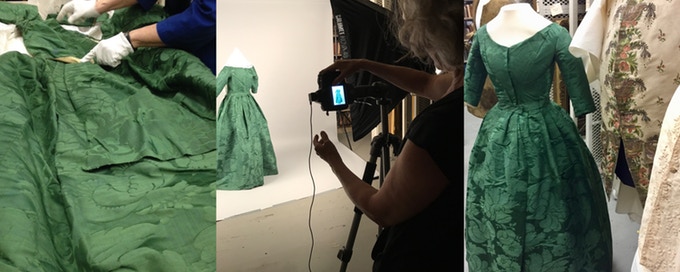
What is Fashioning the New England Family?
This is a project that will make accessible the dynamics of fashion, textiles, and costume across the span of our history. The MHS will produce an exhibition and companion volume to fully explore the ways in which the multiple meanings of fashion and fashionable goods are reflected in patterns of consumption and refashioning, recycling, and retaining favorite family pieces.
This is a unique and significant endeavor. Many of the items that will be featured in the project have been out of sight, having never been exhibited for the public or seen in living memory. The publication and exhibition will give scholars, students, and professionals in fields such as fashion, material culture, and history the chance to see these items for the first time; encourage research; and, provide the possibility for new discoveries. For the public, it is an opportunity to view in detail painstaking craftsmanship, discover how examples of material culture relate to significant moments in our history, and learn how garments were used as political statements, projecting an individual’s religion, loyalties, and social status. It may allow some to recognize and appreciate family keepsakes but it will certainly help us all to better understand the messages we may have previously missed in American art and literature. The MHS is dedicated to producing the exhibition, but we need your help to create the companion volume. Our project page will be updated with fun facts, images, and video clips throughout the month of February.
Why Create a Companion Volume?
Planned as a high-quality, full-color publication, this volume will serve both as a record of the exhibition and as a testament to the importance of the textiles and garments it illustrates and describes. The themes and subject matter pursued in the exhibition also provide the frames of reference for the book, which will include a preface by Catherine Allgor, President of the Massachusetts Historical Society, and a foreword by Anne E. Bentley, MHS Curator of Art and Artifacts. The primary author of the publication and guest curator of the exhibition is Dr. Kimberly S. Alexander.
What’s in the Budget?
While the entire project will cost around $100,000, we have set a Kickstarter campaign goal of $15,000 to produce the companion volume. We want to provide as many people as possible the opportunity to be part of this project. The companion volume is a natural fit for both the Kickstarter community and our mission to make this project as widely accessible as possible. The companion volume will be a lasting resource, serving as both a record of the exhibition and as a testament to the importance of the textiles and garments it illustrates and describes. We are counting on you and other members of the Kickstarter community to make this publication a reality.
What are the Rewards?

First and foremost—our gratitude! The ability to produce a companion volume remains the primary goal of the Society’s Kickstarter campaign. A gift at any level will go towards helping us bring this project to life. All donations also come with an opportunity to be named and publicly thanked as a Kickstarter backer on the Society’s project page. Donations at $15 and more also receive a set of postcards, exclusive to Kickstarter. A successful campaign also means that backers of the project at $50 or more on Kickstarter will be the first to receive the Fashioning the New England Family companion volume.
Backers of the project at higher levels get even more opportunities to engage with and learn about our textile collection. Be sure to check out the special event invitations, tours, and behind-the-scenes opportunities different rewards offer for supporting this project. If our project is completed and the goal is met, you will be asked to fill out a survey so that we can send you your rewards. The MHS is unable to provide your rewards or recognize any gift you made unless the informational survey is completed. Once rewards are shipped, please allow an additional 4–6 weeks for your reward(s) to ship internationally. Note: we are not responsible for international custom fees.
◊ ◊ ◊ ◊ ◊
About the MHS
Founded in 1791, the Massachusetts Historical Society is an invaluable resource for American history, life, and culture. Its extraordinary collections tell the story of America through millions of rare and unique documents, artifacts, and irreplaceable national treasures. As the nation’s first historical society, the MHS strives to enhance the understanding of our nation’s past and its connection to the present, demonstrating that history is not just a series of events that happened to individuals long ago but is integral to the fabric of our daily lives. Its collections are accessible to anyone with an interest in American history. Beyond research, the MHS offers many ways for the public to enjoy its collections including thought-provoking exhibitions, publications, engaging programs, seminars, and teacher workshops.
Call for Papers | The Architecture of James Gibbs
As noted in Salon, the newsletter of the Society of Antiquaries of London, issue 401 (20 February 2018) . . .
The Architecture of James Gibbs
Society of Antiquaries of London, 29 September 2018
Proposals due by 28 February 2018
The Georgian Group is organising a day-long symposium on James Gibbs (1682–1754), to be held at the Society of Antiquaries at Burlington House. The symposium will reassess the work of one of the most important, but still underestimated, British architects of the 18th century, responsible for the church of St Martin-in-the-Fields in London and the Radcliffe Camera in Oxford, many other commissions throughout the British Isles, and one of the most important 18th-century architectural pattern books. Proposals are invited for 20-minute papers based on original research on any aspect of Gibbs’s work, including his training, his practice, his patrons and clients, and his influence on contemporary and subsequent architecture and design (including urban, garden, and interior design) both in Britain and within the British diaspora. Please send abstracts of no more than 250 words and a CV to Geoffrey Tyack FSA (Kellogg College, Oxford, Editor of The Georgian Group Journal: geoffrey.tyack@kellogg.ox.ac.uk) by the end of February 2018. Notifications of acceptance will be sent before the end of March, and further details will follow soon afterwards.
Wallace Collection Announces £1.2million New Exhibition Space

The Wallace Collection, Manchester Square, London
(Photo: Wikimedia Commons, 2005)
◊ ◊ ◊ ◊ ◊
As announced by The Wallace Collection (13 February 2018) . . .
The Wallace Collection has secured funding to develop expanded exhibition galleries, tripling the capacity of the museum’s existing exhibition space and setting the scene for an ambitious programme of temporary, ticketed [paid] exhibitions. The new space will enable the museum to explore aspects of its existing collection in more depth and collaborate with other institutions, creating partnerships both within the UK and internationally. This transformative project has been made possible by the generosity of The Linbury Trust, the Wolfson Foundation, and an anonymous major donor, creating facilities that reflect the vision and ambition of the Director and Board of Trustees and the growing number of museum visitors.
The new space opens on 19 June 2018 with an inaugural exhibition marking 200 years since the birth of the museum’s founder, Sir Richard Wallace (1818–1890), celebrating him as a great philanthropist and undiscovered cultural luminary. Sir Richard Wallace: The Collector highlights for the first time Sir Richard’s personal contributions to the Collection we know today, focusing on the diverse and idiosyncratic works of art he acquired and his considerable philanthropic legacy. Featuring over twenty works of art collected by Sir Richard, the exhibition explores his eclectic tastes and highlights some of the unexpected treasures of the museum, ranging from a gold trophy head from the Asante Kingdom to imperial ceremonial wine cups from China and a majestic ostrich figure made by the Augsburg silversmith Elias Zorer.
In 2019, Henry Moore: The Helmet Head Series (working title) will be our first paid exhibition, presented in partnership with the Henry Moore Foundation. Moore’s powerful sculptures and drawings will be juxtaposed with Renaissance helmets from the Wallace Collection, which he studied while he was a student at the Royal College in the 1920s. Moore took great inspiration from the Arms and Armour galleries at the Wallace, and this exhibition will demonstrate for the first time a direct connection between Moore’s work and works of art on display within the museum. This inaugural exhibition will be followed by a wide ranging programme of both contemporary and old master exhibitions that will present our extensive collections of paintings, sculpture, armour, and decorative arts in a new light.
Dr Xavier Bray, Director of the Wallace Collection, says: “The Wallace Collection is the greatest gift ever made to the nation, and this new space will enable us to shine a light on the immense quality of our works of art and raise the profile of the museum. The exhibition programme at the Wallace will provide an opportunity to get to know our collection in new ways as well as collaborate with other cultural institutions. Thanks to the generous support of three major donors, who have made it possible to extend our exhibition galleries, we will be able to reach our potential as a truly international institution, sharing the museum with a broader and more diverse audience both at home and abroad.”
Exhibition | Mirroring China’s Past
From the Art Institute of Chicago:
Mirroring China’s Past: Emperors, Scholars, and Their Bronzes
Art Institute of Chicago, 25 February — 13 May 2018
Curated by Tao Wang

Artist Unknown, Court Beauty, Qing Dynasty, Late Kangxi Reign, between 1709 and 1723 (Beijing: The Palace Museum).
Chinese bronzes of the second and first millennia BC are some of the most distinctive achievements in the history of art. Exquisitely ornamented, these vessels were made to carry sacrificial offerings, to use in burial, or to commemorate family in public ceremonies. When they were found by emperors centuries later, these spiritually significant objects were seen as manifestations of a heavenly mandate on a ruler or dynasty and became prized items in imperial collections. This exhibition—the first to explore how these exquisite objects were collected and conceptualized throughout Chinese history—presents a rare opportunity to experience a large number of these works together in the United States.
Unlike Greek and Roman bronze sculptures of human and animal forms, most objects from Bronze Age China (about 2000–221 BC) were vessels for ritual use. Beginning with the Song dynasty (960–1279), emperors unearthed these symbolic works and began collecting them, considering them to be evidence of their own authority and legitimacy as rulers. Several 18th-century portraits of Emperor Quianlong include his bronze collection, demonstrating how ancient bronzes came to play a critical role in imperial ideology and self-fashioning. In addition to impressive collections, the royal fascination with bronzes led to the creation of numerous reproductions and the meticulous cataloguing of palace holdings. These catalogues are works of art themselves, with beautiful illustrations and detailed descriptions.
From the 12th century onward, scholars and artists also engaged in collecting and understanding ancient bronzes, especially their inscriptions. Unlike emperors, who commonly employed art to promote and implement political and cultural policies, scholars regarded bronzes as material evidence of their efforts to recover and reconstruct the past, and they occasionally exchanged them as tokens of friendship. Today ancient bronzes still occupy a prominent position in Chinese culture—as historical or nostalgic objects and as signifiers of an important cultural heritage that inspires new generations, as seen in the works of contemporary artists on view in this presentation.
Mirroring China’s Past brings together approximately 180 works from the Art Institute of Chicago’s strong holdings and from the Palace Museum in Beijing, the Shanghai Museum, and important museums and private collections in the United States. By providing viewers with a new understanding of ancient bronzes and their significance through time, the exhibition illuminates China’s fascinating history and its evolving present.
The catalogue is distributed by Yale UP:
Tao Wang, ed., with essays by Sarah Allan, Jeffrey Moser, Su Rongyu, Edward L. Shaughnessy, Zhixin Jason Sun, Tao Wang, Zhou Ya, Liu Yu, and Lu Zhang, Mirroring China’s Past: Emperors, Scholars, and Their Bronzes (Chicago: Art Institute of Chicago, 2018), 296 pages, ISBN: 9780300228632, $60.
 A lavishly illustrated book that offers an in-depth look at the cultural practices surrounding the tradition of collecting ancient bronzes in China during the 18th and 19th centuries.
In ancient China (2000–221 BC) elaborate bronze vessels were used for rituals involving cooking, drinking, and serving food. This fascinating book not only examines the cultural practices surrounding these objects in their original context, but it also provides the first in-depth study tracing the tradition of collecting these bronzes in China. Essays by international experts delve into the concerns of the specialized culture that developed around the vessels and the significant influence this culture, with its emphasis on the concept of antiquity, had on broader Chinese society. While focusing especially on bronze collections of the 18th and 19th centuries, this wide-ranging catalogue also touches on the ways in which contemporary artists continue to respond to the complex legacy of these objects. Packed with stunning photographs of exquisitely crafted vessels, Mirroring China’s Past is an enlightening investigation into how the role of ancient bronzes has evolved throughout Chinese history.
Tao Wang is Pritzker Chair of Asian Art and curator of Chinese art at the Art Institute of Chicago.
New Book | Building Washington
From Johns Hopkins UP:
Robert Kapsch, Building Washington: Engineering and Construction of the New Federal City, 1790−1840 (Baltimore: Johns Hopkins University Press, 2018), 384 pages, ISBN: 978 14214 24873, $70.
 In 1790, George Washington and Thomas Jefferson set out to build a new capital for the United States of America in just ten years. The area they selected on the banks of the Potomac River, a spot halfway between the northern and southern states, had few resources or inhabitants. Almost everything needed to build the federal city would have to be brought in, including materials, skilled workers, architects, and engineers. It was a daunting task, and these American Founding Fathers intended to do it without congressional appropriation.
Robert Kapsch’s beautifully illustrated book chronicles the early planning and construction of our nation’s capital. It shows how Washington, D.C., was meant to be not only a government center but a great commercial hub for the receipt and transshipment of goods arriving through the Potomac Canal, then under construction. Picturesque plans would not be enough; the endeavor would require extensive engineering and the work of skilled builders. By studying an extensive library of original documents—from cost estimates to worker time logs to layout plans—Kapsch has assembled a detailed account of the hurdles that complicated this massive project. While there have been many books on the architecture and planning of this iconic city, Building Washington explains the engineering and construction behind it.
Robert J. Kapsch is a researcher and principal of the Center for Historic Engineering and Architecture. He is the author of The Potomac Canal: George Washington and the Waterway West, Historic Canals and Waterways of South Carolina and Over the Alleghenies: Early Canals and Railroads of Pennsylvania.
Exhibition | Canova’s George Washington
From The Frick:
Canova’s George Washington
The Frick Collection, New York, 23 May 2018 — 23 September 2018
Gypsotheca e Museo Antonio Canova, Possagno, 10 November 2018 — 22 April 2019
Curated by Xavier Salomon and Peter Jay Sharp in collaboration with Mario Guderzo

Antonia Canova, George Washington, 1818; Gesso (Possagno: Gypsotheca e Museo Antonio Canova).
In 1816, the North Carolina Senate commissioned a full-length statue of George Washington to stand in the State House in Raleigh. Thomas Jefferson, believing that no American sculptor was up to the task, recommended Antonio Canova (1757–1822), then one of Europe’s most celebrated artists. The first and only work Canova created for America, the statue depicted the nation’s first president in ancient Roman garb, per Jefferson’s urging, drafting his farewell address to the states. It was unveiled to great acclaim in 1821, and people traveled from far and wide to see it. Tragically, only a decade later, a fire swept through the State House, reducing the statue to just a few charred fragments.
Canova’s George Washington examines the history of the artist’s lost masterpiece, probably the least well known of his public monuments. It brings together for the first time Canova’s full-sized preparatory plaster model (which has never left Italy), four preparatory sketches for the sculpture, and related engravings and drawings. The exhibition also includes Thomas Lawrence’s 1816 oil portrait of Canova, which, like the model and several sketches, will be on loan from the Gypsotheca e Museo Antonio Canova in Possagno, Italy, the birthplace of the artist. The exhibition is organized by Xavier F. Salomon, Peter Jay Sharp Chief Curator, in collaboration with Mario Guderzo, Director of the Gypsotheca e Museo Antonio Canova, the Venice International Foundation, and Friends of Venice Italy Inc. Following its presentation at the Frick, the exhibition will be shown in Italy at the Gypsotheca e Museo Antonio Canova in Possagno in the fall of 2018.
The accompanying catalogue will include correspondence relating to the commission, as well as essays by Salomon, Guderzo, and Guido Beltramini, Director of the Palladio Museum in Vicenza, Italy.
Catalogue details are available here»
Exhibition | Jean Jacques Lequeu (1757–1826)
Opening this December at the Petit Palais:
Jean Jacques Lequeu (1757–1826): Builder of Fantasy / Bâtisseur de fantasmes
Petit Palais, Paris, 11 December 2018 — 31 March 2019
Menil Drawing Institute, Houston, 4 October 2019 — 5 January 2020
The Morgan Library & Museum, New York, 2020
Curated by Laurent Baridon, Jean-Philippe Garric, Martial Guédron, Corinne Le Bitouzé, and Christophe Leribault
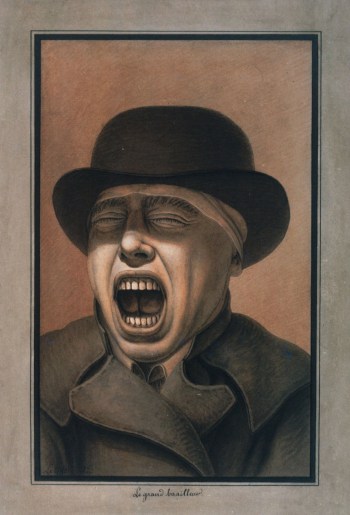 Six months before he died impoverished and forgotten, Jean-Jacques Lequeu donated one of the most singular and fascinating graphic oeuvres of his time to the French National Library. The set of several hundred drawings, presented here in its entirety for the first time, is a testimonial to the solitary and obsessive downward spiral of an exceptional artist that goes well beyond the first steps of an architectural career. Using the precise technical tool represented by the geometric working drawing made in wash, which he filled with handwritten notes, Lequeu scrupulously described the monuments and imaginary factories that filled his imaginary landscapes, rather than carrying out projects. But this initiatory journey, which he made without leaving his studio and enriched with figures and narratives from his library, this pathway that led him from temple to bush, from artificial grotto to palace, from kiosk to subterranean labyrinth, resolved itself as a quest to find himself. To see everything and describe it all—systematically, from the animal to the organic, from fantasy and raw sex to the self portrait—became the mission he assigned to himself.
As a typical representative of the artisanal class, who tried, with the Enlightenment and the French Revolution, to rise socially and break free of the world of trades, Lequeu quickly became disenchanted with the new order and the new hierarchies. Lequeu—the child of his century, the century of licentiousness and Anglo-Chinese gardens—nevertheless pursued an entirely free and singular path. Reduced to employment in a subordinate office, ignored by those in place, now far from his roots, but freed of social or academic pressure, he stalked his dreams with the obstinacy of a builder and without compromise.
Curators
Laurent Baridon, Professor at University of Lyon II; Jean-Philippe Garric, Professor at University of Paris 1 Panthéon-Sorbonne; Martial Guédron, Professor at the University of Strasbourg; Corinne Le Bitouzé, General Curator, Deputy Director of the Department of Prints and Photography at the French National Library; Christophe Leribault, Director of the Petit Palais
Laurent Baridon, et al., Jean-Jacques Lequeu: Batisseur de fantasmes (Paris: Norma, 2018), 176 pages, ISBN: 978-2376660217, $65.
◊ ◊ ◊ ◊ ◊
Note (added 2 January 2018) — The original posting did not include details for the catalogue.
Note (added 23 September 2019) — The posting was updated to include information on the two U.S. venues: the Menil Drawing Institute in Houston and The Morgan Library & Museum in New York.
Rediscovered: Portrait of Saint-Simon-Montbléru
Press release from Art Daily (16 February 2018). . .

Vicente Lopez, Claude-Anne de Rouvroy, Marquis de Saint-Simon-Montbléru, 1815–19 (Washington DC: American Revolution Institute).
The American Revolution Institute of the Society of the Cincinnati in Washington, D.C., is pleased to announce the discovery of a unique portrait of a French general: Claude-Anne de Rouvroy, Marquis de Saint-Simon-Montbléru (1743–1819), who was instrumental in winning the final great battle of the Revolutionary War. The Institute just acquired the painting from a family in Spain. It is now on display at the headquarters of the American Revolution Institute—the first time the painting has been on view in the United States in its two-hundred-year history.
In the fall of 1781, Saint-Simon commanded some 3500 French soldiers. Arriving from the West Indies, they landed at Jamestown, Virginia and joined the much smaller American army under Lafayette near Williamsburg. Together they kept Cornwallis pinned at Yorktown. Washington and Rochambeau arrived with the main French-American army from the north a few weeks later. Saint-Simon commanded the left wing of the allied army at the Siege of Yorktown, barring the roads toward Williamsburg and preventing the British army under Lord Cornwallis from escaping by land. Saint-Simon was wounded but refused to leave the lines until the British army surrendered. Though shot in the leg, he mounted his horse to take part in the surrender ceremonies. Shortly thereafter, he sailed back to the West Indies with the French navy and never returned to the United States.
Americans quickly forgot about him. Other French leaders—Lafayette and Rochambeau, mainly—are remembered today. Mention Saint-Simon and even people who know a good deal about the American Revolution are likely to ask ‘who’?
“One of the main reasons Americans forgot him is that we didn’t know what he looked like,” says Jack Warren, director of the American Revolution Institute. “There wasn’t a single portrait on public display in the United States—or in Europe either.”
That’s changed. The portrait now on display at the Institute was painted between 1815 and 1818 by Vicente Lopez, the greatest Spanish portrait painter of the early nineteenth century. The painting has been in private hands for two hundred years. It was briefly displayed at the Prado in 1902 but hasn’t been seen in public since. It has been the property of a Spanish family for several decades, but even they forgot who the sitter was. It took a good deal of research to confirm his identity.
An aristocrat, Saint-Simon escaped France during the French Revolution and led a small army loyal to the king in a war against the French revolutionary government in the Pyrenees. He was made a general of the Spanish army, and led Spanish troops against Napoleon. Captured by the French, he was sentenced to death for treason. Napoleon commuted his sentence to life imprisonment, from which he was released when Napoleon fell from power. He lived in Spain for the rest of his life.
The portrait tells his story. The old hero wears the elaborate uniform of a Spanish general, with the blue and white sash and star of the Order of Charles III, the highest Spanish military honor of the time. He also wears a gold and silver medal suspended from a yellow ribbon, presented by King Ferdinand VII to soldiers who suffered imprisonment at the hands of the French. And above them all is the eagle insignia of the Society of the Cincinnati, the private patriotic organization founded by George Washington and his officers to perpetuate the memory of the American Revolution. Saint-Simon was an original member. Some thirty-seven years after the Siege of Yorktown, he remembered it as one of the proudest moments of his life.
“We started searching for a portrait of Saint-Simon a decade ago,” Jack Warren says, “when we were planning an exhibition on the Siege of Yorktown. We couldn’t find one. An old and not very good engraving in a mid-nineteenth-century book suggested that there was a portrait, but it seemed to be irretrievably lost. So much art was destroyed, damaged or displaced in Spain during their civil war in the 1930s, that we concluded that it may have gone missing then. Its identity was lost, so that when the portrait finally surfaced last year it took some research to be certain Saint-Simon was the subject.”
“This is the perfect home for this portrait,” says Warren. “The purpose of the American Revolution Institute of the Society of the Cincinnati is to ensure that Americans understand and appreciate the achievements of the American Revolution—the event that gave us our independence, our republic, our national identity, and the ideals of liberty, equality, natural and civil rights and civic participation that shape our country and the world. The Revolution was the great transforming event of modern history. Men like Saint-Simon who participated in it knew that they had been a part of something extraordinary. It’s our job to share their stories.”










leave a comment