Tim Knox Named as New Director of the Royal Collection Trust
From The Fitzwilliam (November 2017) . . .
 Her Majesty The Queen has appointed Mr Tim Knox as the new Director of the Royal Collection Trust. As Director, Mr Knox will be responsible for the care of the Royal Collection, its presentation to the public, and for the management of the public opening of the official residences of The Queen.
Tim Knox has been Director of the Fitzwilliam since April 2013. An eminent architectural historian and curator of country houses, he was previously Director of the Sir John Soane’s Museum and Head Curator at the National Trust. A graduate of the Courtauld Institute of Art, Tim’s early career was spent at the Royal Institute of British Architects, before he joined the National Trust in 1995. He will leave the Fitzwilliam Museum and take up the Royal Collection directorship in the new year.
Note (added 24 January 2018) — The press release from The Royal Collection Trust is available here.
New Book | Exiles in a Global City: The Irish and Early Modern Rome
From Brill:
Clare Lois Carroll, Exiles in a Global City: The Irish and Early Modern Rome, 1609–1783 (Leiden: Brill, 2017), 342 pages, ISBN: 978 900433 5165, €149 / $172.
 In Exiles in a Global City, Clare Carroll explores Irish migrants’ experiences in early modern Rome and interprets representations of their cultural identities in relation to their interaction with world-wide Spanish and Roman institutions. This study focuses on some sources in Roman archives not previously considered by Irish historians. The book examines a wide array of cultural productions—Ó Cianáin’s account of O’Neill’s progress from Ireland to Rome, Luke Wadding’s history of the Franciscan order, the portraits at S. Isidoro, the first printed Irish grammar, the letters of Oliver Plunkett, the records of a hospice for converts, Charles Wogan’s memoir, and reports on the national college—for how they transformed emerging senses of an Irish nation.
Clare Carroll (Professor of Comparative Literature, Queens College and The Graduate Center, CUNY) is the author of Circe’s Cup: Cultural Transformations in Early Modern Ireland (Cork UP, 2001) and editor of Ireland and Postcolonial Theory (Cork, 2003).
C O N T E N T S
Acknowledgements
List of Illustrations
Introduction
1 The ‘Nation’ in Rome: Ó Cianáin’s “Pilgrimage of the Earls” (1609)
2 The Exile as Historian: Luke Wadding’s Annales Minorum (1625–54) between Global and Local Affiliations
3 The Transculturation of Exile: Visual Style and Identity in the Frescoes of the Aula Maxima at St. Isidore’s (1672)
4 A Poetic Anthology for Exiles: Irish Cultural Memory in the First Printed Gaelic Grammar (1677)
5 The Return of the Exile: Oliver Plunkett between Rome and Ireland
6 Irish Protestants in the Theater of the World: The Apostolic Hospice for the Converting, Rome, 1677–1745
7 The Romance and Disillusionment of Exile: Charles Wogan and his Memoir of Clementina Sobieska
8 ‘The Spiritual Government of the Entire World’: A Memorial for the Irish College Rome, January 1783
Conclusion
Appendix 1: Comparison of GLH with manuscript Grammars
Appendix 2: Index of first lines in Grammatica Latino-Hibernica
Appendix 3: List of Irish Guests at the Ospizio Apostolico dei Convertendi
Bibliography
Index
Exhibition | Napoleon: The Imperial Household
On this day, 2 December, in 1804, Napoleon became emperor of the French. This exhibition exploring the imperial household opens in February in Montreal:
Napoleon: The Imperial Household / Napoléon: La maison de l’empereur
Montreal Museum of Fine Arts, 3 February — 6 May 2018
Virginia Museum of Fine Arts, Richmond, 9 June — 3 September 2018
Nelson-Atkins Museum of Art, Kansas City, 4 October 2018 — 13 January 2019
Musée National du Château de Fontainebleau, 13 April — 15 July 2019
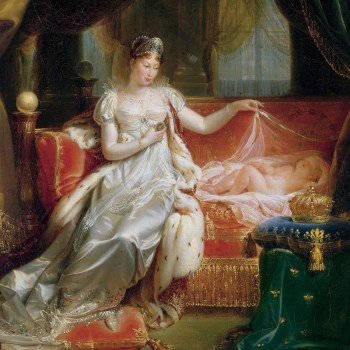
Joseph Franque, Empress Marie-Louise Watching over the Sleeping King of Rome, 1811 (Châteaux de Versailles et de Trianon).
The Imperial Household was a key institution during the reign of Napoléon Bonaparte (1769–1821). It was responsible for the daily lives of the Imperial family and the day-to-day existence of former general Bonaparte, who became Emperor Napoleon in 1804. Napoleon: The Imperial Household aims to re-create the ambience and capture the spirit that prevailed in the French court during the Empire. A selection of works and objets d’art, most of which have never before been exhibited in North America, will reveal the Imperial Household’s role in fashioning a monarchic identity for the new emperor who ruled France following the Revolution, as well as his family and loyal entourage.
The Imperial Household consisted of six departments, each headed by a grand officer, a high-ranking dignitary of the Empire: the grand chaplain, grand master of ceremonies, grand marshal of the Palace, grand master of the hunt, grand chamberlain and grand equerry were each involved in orchestrating every minute of the pageantry in the Court. This is another aspect of the Napoleonic saga that will be presented here, with more than 250 works in which the fine arts and decorative arts were used for purposes of ideology and official propaganda.
Sylvain Cordier, Napoleon: The Imperial Household (New Haven: Yale University Press, 2018), 350 pages, ISBN: 978 030023 3469, $50 / £40.
◊ ◊ ◊ ◊ ◊
Note (added 17 August 2018) — The posting was updated to include dates for venues other than Montreal. It’s also worth noting that the exhibition title varies according to location; in Richmond and Kansas City it’s called Napoleon: Power and Splendor.
Student Workshop | Questions of Technique in Art History
From H-ArtHist:
Questions of Technique in Art History
International Student Workshop of the Deutsches Forum für Kunstgeschichte Paris and the École du Louvre in Paris, 18–24 March 2018
Applications due by 8 January 2018
For some time now and with few exceptions, instruction in artistic materials and techniques has ceased to be an integral part of an art historian’s education. Nevertheless, throughout one’s research in this discipline, one is constantly confronted with the assumption that one has already acquired knowledge on everything from painting materials to reproductive processes, drawing practices, paper, pigment, and bronze casting, to cite only some of the most familiar examples.
In response to this lack, the Deutsche Forum für Kunstgeschichte Paris (DFK), in partnership with the École du Louvre, is offering a week-long workshop for art history students that focuses on artisanal, technical, and restorative techniques, and on how these issues relate to the history of artistic education in France. Study days presided over by international specialists will be punctuated by student presentations, and by site visits to artists’ ateliers at the École nationale supérieure des beaux-arts de Paris (ENSBA), to the Musée Bourdelle, and to the Centre de restauration des musées de France (C2RMF), among other locations. There will also by hands-on opportunities for exploring this subject, including an etching and lithography workshop, and a drawing session with an artist, a professor of the ENSBA.
Participation will be limited to ten master’s and doctoral students from an international pool of applicants. All participants are required to have a professional proficiency in the French language and will be asked to give a presentation whose theme will be assigned in advance.
Travel and lodging expenses for students residing outside of Paris will be covered with a grant of up to 300 Euros with the presentation of receipts. Participants will need to cover their meal expenses. Arrival is expected on March 18th, departure day will be Saturday March 24th.
Application documents must include a letter of motivation (not to exceed 2 pages), a recommendation letter from a professor, and a CV indicating prior academic achievements. There is no guarantee of admission. To be considered, please send your documents to Dr. Julia Drost and Prof. Dr. François-René Martin (ateliersderecherche@dfk-paris.org) with the subject line “Questions de techniques en histoire de l’art / Techniken und Materialien in der Kunstgeschichte” by January 8th, 2018.
New Book | François Boucher: Sociability, Mondanité, and the Academy
From Artbooks.com:
Christoph Vogtherr and Leda Cosentino, eds., François Boucher: Sociability, Mondanité, and the Academy in the Age of Louis XV (Oakville: Mosaic Press, 2017) 360 pages, ISBN: 9780993658839, $50.
 This volume assembles a group of interrelated thought-provoking essays from leading international scholars originally presented at the conference Boucher and the Enlightenment, held at the Wallace Collection in London in 2005. The conference was one of a series of extraordinary events celebrating the tercentenary of the artist’s birth: exhibitions were held in Paris, Dijon, London, and New York, a conference was dedicated to the artist’s work at The Getty Research Institute in Los Angeles, and a number of associated ground-breaking publications were published. All were agreed on the significance of Boucher’s achievement, his contemporary success, and the startlingly rapid critical decline. Yet, although much valuable new research was presented elsewhere regarding the connoisseurship, interpretation, and critical reception of Boucher’s work, the Wallace Collection conference was outstanding in its emphasis on the essentially social nature of Boucher’s artistic enterprise, the seriousness of his artistic ambition, and how the artistic relationships he forged both influenced his artistic practice and affected his critical reputation for both good and bad.
Subsequent research in eighteenth-century studies has confirmed many of the ideas first posited at the conference, but no other major publication on the artist has appeared in the intervening ten-year period that has been able to present or benefit from the advances made at the Wallace Collection. It has thus become increasingly obvious that the original conference papers, unpublished at the time, should be issued. The papers have been revised and enriched with further original research, incorporating important recent discoveries and trends in Boucher scholarship. Taken as a whole, the essays present a wealth of new material concerning Boucher’s social and professional relationships to his patrons, dealers, and fellow artists, which in turn illuminate, as no subsequent publication has done, his extraordinary position at the crossroads of the fine, decorative, literary and musical arts of his time. The book includes a variety of inter-disciplinary topics including new biographical information regarding Boucher’s life, artistic practices, and relationships, while new research is also published regarding the detailed connoisseurship and dating of his work alongside new interpretations of its iconography and critical and commercial reception. The diverse subject matter and variety of art-historical approach of the essays open up new perspectives in our understanding not only of François Boucher but also of the wider cultural and social context of his time. Together they shed new light on Boucher’s significance as one of the most original and controversial artists of the eighteenth century.
Call for Papers | MAHS 2018, Indianapolis
From the MAHS Fall 2017 Newsletter:
45th Annual Conference of the Midwest Art History Society
Indianapolis, 5–7 April 2018
Proposals due by 15 December 2017

Indianapolis Museum of Art (Wikimedia Commons, 15 January 2012).
The Midwest Art History Society (MAHS) will hold its 45th Annual Conference in Indianapolis, Indiana, 5–7 April 2018. Sessions on Thursday, April 5th and Friday, April 6th will be held at the Indianapolis Museum of Art at Newfields. Friday’s program will conclude with a bus trip to the celebrated showcase of 20th–century architecture, Columbus, Indiana, with a tour of the Miller House and Garden, designed by Eero Saarinen. Sessions on Saturday, April 7th will be held at the Eiteljorg Museum of American Indians and Western Art. This year’s keynote speaker will be Erika Doss, Professor of American Studies at the University of Notre Dame. Her talk will be related to her 2010 book Memorial Mania: Public Feeling in America, a topic with particular relevance in light of the current re-evaluation of public monuments. We welcome your participation. In most cases, conference presentations are expected to be under twenty minutes long. Proposals of no more than 250 words and a two-page CV should be emailed (preferably as Word documents) to the chairs of individual sessions by Friday, 15 December 2017.
The following is a selection of sessions potentially relevant for eighteenth-century studies; please see the newsletter for the full listing.
◊ ◊ ◊ ◊ ◊
Monumental Troubles: Rethinking What Monuments Mean Today
Chair: Erika Doss (University of Notre Dame), doss.2@nd.edu
Papers are sought that contribute to contemporary conversations about monuments, broadly defined as commemorative objects, images, and spaces. The recent removal, and call for removal, of monuments and memorials throughout the United States and around the globe—in South Africa, England, Taiwan, India, Hungary, and Canada, among other countries—suggests a generative rethinking about why they are made, how their meanings change over time, and issues regarding their removal, relocation, and destruction.
Textiles and Intimacy
Chair: Erica Warren (Art Institute of Chicago), ewarren2@artic.edu
This panel invites papers that explore and examine the ways in which costume and/or textiles are involved in intimate aspects of human life. Papers might consider everyday, familiar objects, such as quilts, or less quotidian items, such as fetish couture, exploring the close relationship between textiles and/or costume and the body. Papers are welcome on any period and specialization.
Women in Art and Art History
Chair: Marilyn Dunn (Loyola University Chicago), mdunn@luc.edu
This session invites papers representing new research or approaches to the examination of women as artists, patrons, or subjects in art. Topics that consider how women’s agency is manifested in art within specific cultural or political contexts are especially encouraged. Papers focused in any chronological period or geographic area will be considered.
Undergraduate Research Session
Co-chairs: Paula Wisotzki (Loyola University Chicago), pwisots@luc.edu; and Mark Pohlad (DePaul University), mpohlad@depaul.edu
Faculty members who have received outstanding research papers from undergraduate students within the past two academic years are invited to submit them for inclusion in our sixth annual Undergraduate Research Session. These papers should explore specific art historical research questions. In all cases, a faculty member (usually the submitter) must serve as a mentor and accompany the undergraduate student to the annual conference. Submissions should include the complete paper—no more than 2500 words—a 250-word abstract, and the student’s resume (as Word documents). In the event that the paper is accepted, undergraduate student presenters and faculty mentors are expected to pay membership and conference fees.
Past and Present in Latin American Art
Chair: Jorge Rivas (Denver Art Museum), jrivas@denverartmuseum.org
In today’s polarized political and social climate where the future for Latino and Latin American artists in the U.S. is becoming more uncertain and daunting, the art from the past is ever present. From Aztec archaisms to present- day references to mid-century avant-garde movements among contemporary artists, revivalism has become central to Latino/ Latin American artistic practices during periods of change and doubt. This session seeks papers that explore how such ideas of the past inform and shape the present.
Art History and Civic Engagement
Chair: Laura Holzman (Indiana University–Purdue University, Indianapolis), holzmanl@iupui.edu
At a time when museums and universities are emphasizing their public responsibility through activities described as audience engagement, service learning, and community partnerships, this session will examine how art historians approach their work as a public practice. Of particular interest are submissions from those who share scholarship and research methods in informal learning contexts such as exhibits, public programs, or op-eds; create scholarship in collaboration with partners from outside of the university or the museum; or use their art historical practice to strengthen communities in other ways. Presentations may discuss practical, ethical, or theoretical matters related to connecting art history with current events, social responsibility, or civic engagement.
Writing Indigenous Art Histories
Chair: Polly Nordstrand (Colorado Springs Fine Arts Center, Colorado College), pnordstrand@coloradocollege.edu
This session welcomes papers that address methods in shaping the future of Indigenous art history. Topics may include, but are not limited to: Indigenous art history as American art history, museum collection scholarship, academic journals, critical historiography, and collaborative and interdisciplinary research, as well as current research that aims to form art histories. While the field has long recognized the difficulty of critical and scholarly writing around Indigenous art as blocked from canonized art history, this session seeks to also address successful avenues so that a meaningful discussion beyond the obstacles may lead participants to strategies in producing art histories.
Rethinking Museum Collections of African Art and Art of the African Diaspora
Chair: Elizabeth Morton (Wabash College), mortone@wabash.edu
This session invites papers on current trends of all aspects of exhibitions and reinstallations of the arts of Africa and the Atlantic world.
Asian Art
Chair: Miki Hirayama (University of Cincinnati), hirayam@ucmail.uc.edu
This session invites papers on all aspects of East and South Asian art.
British Art
Chair: Catherine Goebel (Augustana College), catherinegoebel@augustana.edu
This session invites papers on any aspect of British art. All periods and media are welcome. Eminent architectural historian, Sir Nikolaus Pevsner, questioned whether one could discern national character via the geography of art (The Englishness of English Art, 1955). Might we effectively examine this question today if extended to the Britishness of British art? Creative approaches are encouraged.
Art of the Baroque/Europe in the Seventeenth and Eighteenth Centuries
Chair: Rebecca Brienen (Oklahoma State University), rebecca.brienen@okstate.edu
This session invites papers that investigate the art, architecture, and general visual culture in Europe during the seventeenth and eighteenth centuries.
Prints and Drawings in the West
Co-Chairs: Robert Randolf Coleman (University of Notre Dame, Emeritus) rcoleman@nd.edu; and Cheryl Snay (Snite Museum of Art, University of Notre Dame), csnay@nd.edu
This session is open to topics concerning any aspect—technical, iconographical, functional, historical, social, political, scientific, etc.—of American or European prints and drawings from any time period, medieval through contemporary.
Islamic Art
Chair: Margaret Graves (Indiana University, Bloomington), marggrav@indiana.edu
This session invites historically specific papers within any area of the broad field of Islamic art.
Technical Art History
Chair: Greg D. Smith (Indianapolis Museum of Art at Newfields), gdsmith@imamuseum.org
This session invites submissions dealing with the technical or scientific investigation of artworks, authenticity studies rooted in materials analysis, or the development of new approaches to the physical examination of artworks.
American Art
Chair: Nicole Woods (University of Notre Dame), nwoods@nd.edu
This session invites papers on all aspects of American art and visual culture from the eighteenth through the twentieth centuries.
The Burlington Magazine, November 2017
The eighteenth century in The Burlington:
The Burlington Magazine 159 (November 2017)
 A R T I C L E S
• Oronzo Brunetti, “A Nymphaeum for the Villa Salviati at Ponte alla Badia in Florence,” pp. 893–99.
R E V I E W S
• Jeremy Warren, Review of Mark Gregory d’Apuzzo, La collezione dei bronzi del Museo Civico Medievale di Bologna (Libro Co. Italia, 2017), pp. 912–13.
• François Marandet, Review of Hannah Williams, Académie Royale: A History in Portraits (Ashgate, 2015), pp. 918–19.
• Peter Murray, Review of Jane Fenlon, Ruth Kenny, Caroline Pegum, and Brendan Rooney, eds., Irish Fine Art in the Early Modern Period: New Perspectives on Artistic Practice, 1620–1820 (Irish Academic Press, 2016), p. 923.
• David Cowan, Review of the exhibition Bonnie Prince Charlie and the Jacobites (National Museum of Scotland, Edinburgh, 2017), pp. 930–31.
• Xavier F. Salomon, Review of the exhibition Caroline Murat, Sister of Napoleon, Queen of the Arts / Caroline, Soeur de Napoléon, Reine des Arts (Palais Fesch, Musée des Beaux-Arts, Ajaccio, Corsica, 2017), pp. 940–41.
Call for Papers | American Art Symposium, [Un]making Empires
From H-ArtHist:
Fourteenth Annual Yale University American Art Graduate Symposium, [Un]making Empires
Yale University, New Haven, 7 April 2018
Proposals due by 26 January 2018

Portrait of Chief Hendrick, engraving, ca. 1755.
The history and experience of immigration, colonization, and nation-building in the Americas have contributed to a complex artistic legacy. From Incan quero vessels to Kara Walker’s A Subtlety, or the Marvelous Sugar Baby, the arts of North, Central, and South America and the Caribbean have engaged and served different imperial visions. A means of both consolidating and challenging state power, material and visual cultures of empire have also shaped the identities of individuals, larger communities, and entire countries alike.
The Fourteenth Annual Yale University American Art Graduate Symposium invites papers that present new ways of thinking about art’s relationships to colonialism and empire. We invite submissions from graduate students working on American art across all time periods and media. Papers of an interdisciplinary and cross-cultural nature are especially encouraged.
Possible topics include, but are not limited to:
• Artistic expressions of confederation, empire, or sovereignty by indigenous American peoples
• Early modern colonial art and architecture, including relationships between colonies and their respective metropoles, inter-imperial exchange, and global currents
• Colonial subjects and artists as agents of empire
• Slavery and diaspora
• Questions of artistic agency, appropriation, authenticity, and hybridity in colonial art
• Colonial tropes and allegorical representations of the Americas and ‘Americans’
• Arts of exploration, conquest, and Manifest Destiny
• Colonial ‘afterlives’, heritage, and memory (ex. the Colonial Revival, museums such as Colonial Williamsburg, etc.)
• Post-colonialism, independence, and decolonization
• Art of non-political empires (ex. religious or commercial empires)
• Neo-colonialism and modern imperialism
Interested graduate students are invited to submit an abstract of no more than 350 words along with a CV by January 26, 2018. All submissions and questions should be directed to americanist.symposium@gmail.com. Accepted participants will be notified in early February. Accommodations will be provided in New Haven, Connecticut.
Keynote Speaker: Zara Anishanslin, Assistant Professor of History and Art History, University of Delaware
Call for Papers | A Farewell to Critique?
From H-ArtHist:
A Farewell to Critique? Reconsidering Critique as Art Historical Method
University of Copenhagen, NORDIK conference, 25–27 October 2018
Proposals due by 23 March 2018
Session convenors: Sara Callahan (PhD Candidate, Stockholm University), sara.callahan@arthistory.su.se; Anna-Maria Hällgren (PhD, Stockholm University), anna-maria.hallgren@arthistory.su.se; Charlotta Krispinsson (PhD, Humboldt University), charlotta.krispinsson@culture.hu-berlin.de
Since the advent of so-called New Art History, critique has been an omnipresent as well as welcomed part of the discipline. Critical perspectives on traditions and methods proved previous discourses of objectivity and neutrality to be inherently ideological. This new, critical art history enabled methodological approaches that questioned taken-for-granted assumptions of the discipline. Further, it brought attention to underlying social and structural aspects of art production and opened up new, exciting avenues of knowledge. In hindsight, thinking critically has resulted in some of the most ground-breaking research over the last few decades.
But when did thinking critically become the only way of thinking? Within the humanities, critique has turned into a default-mode, near synonymous with what is regarded as good research. This situation has of late come under scrutiny, most notably by Bruno Latour and Rita Felski. While Latour has argued that critique simply has “run out of steam” (Latour 2004), Felski stresses the importance of regarding critique as one method amongst others. In The Limits of Critique (2015) Felski argues that critique—like all methods—comes with its own tropes, narratives, and blind spots. What, exactly, are we doing while engaging in critique? What is the cost of habitually “reading against the grain”? Of continually deconstructing, denaturalizing and demystifying the world as we know it? What could we do otherwise? Felski does not offer a ready-to-use methodological alternative to critique—her concern is to examine what we do when we engage in critique and to challenge the view that it is the only game in town.
The aim of this session is to invite a discussion on critique in art history. We invite paper proposals that may include, but are not limited to, replies to the following questions:
• What are the challenges and/or benefits of critique and post-critique?
• What, specifically, would post critical methods look like within Art History?
• What are the geographical and cultural variations when it comes to the historiography as well as present state of critique?
• In addition to research practices, the academic profession involves teaching, participating in seminars and conferences, writing proposals and supervising students and junior researchers; can the discussion of post-critique be useful in developing these practices in some ways?
Please submit your proposal via a form on the conference website, where you will need to fill in personal information, an abstract no more than 1800 characters, a brief c.v. of no more than 360 characters, and full contact information by 23 March 2018.
In all, there are 19 panels now accepting proposals:
1 Post Democratic Culture and Culture in Post Democracy
2 Art and Design in Translation: The Circulation of Objects, People, and Approaches
3 A Farewell to Critique? Reconsidering Critique as Art Historical Method
4 (In)hospitalities
5 Medieval Nordic Art and the Un-nameable
6 Queer Art, Artists, and Identity: Nordic and Global Contexts
7 Futures from the Past? Nordic Exhibition Histories
8 Mixed Media
9 Nature, Non-Human and Ecology in Modern Art, Architecture, and Environmental Planning
10 Networks and Collaborations in Nordic Architectural Culture
11 A Whiter Shade of Pale: Whiteness Perspective on Nordic Visual Culture
12 Art, Artists, and Art Institutions in Times of War and Conflicts
13 Showing Not eTlling: Art Institutional Practices of Inclusions/Exclusions
14 Art and Spirituality in a Secular Society
15 Remembering: Art History and Curatorial Practices in Nordic Post-War Exhibition Studies
16 Life: On Art, Animation, and Biology
17 Decolonial Aesthetics: A View from the North
18 To Be [Titled], or Not To Be [Titled]? Art History and Its ‘Well-(un)Known’ Masters…
19 Untitled Spaces: Scenography and Nordic Art History
Research Lunch | Emily Knight on Portraiture as Remembrance
From the Paul Mellon Centre:
Emily Knight | ‘The Last Sad Testimony of Affection’:
Portraiture as Remembrance in Eighteenth-Century Britain
Paul Mellon Centre for Studies in British Art, London, 8 December 2017

George Romney, Ann Wilson with Her Daughter, Sybil, ca. 1776–77, oil on canvas, 124.5 × 100.3 cm (New Haven: Yale Center for British Art, Paul Mellon Fund, B1983.1).
In 1773, six year-old Sibyl Wilson died. Her grief-stricken parents George and Ann commissioned the artist George Romney to complete a portrait of Ann and Sibyl. This touching work shows the mother’s head cast downward but not quite touching the head of her now deceased daughter, her arms softly embracing the child’s delicate form. The young girl looks out to the viewer with a solemn expression, connected to her mother in space but not time.
Using Romney’s portrait as a starting point, this paper will examine the particularities of posthumous portraits of children in light of new ideas about childhood put forward by Jean-Jacques Rousseau and John Locke. I will analyse the resulting impact that this change had on artists who fulfilled the commissions of grieving parents and argue that the various ways in which artists attempted to capture a deep sense of loss reveals much about familial relationships during this period and provides a deeper understanding of overt expressions of emotion that emerged during the age of sentimentality.
Over the course of the paper, I will demonstrate how artists in the mid-eighteenth century assumed a varied yet interconnected mode of emotional expression in portraiture that was distinct from the symbolic devices used by previous generations, and compelled the viewer to unpick embedded artistic and cultural references.
8 December 2017, 12:30–2:00pm, Seminar Room, Paul Mellon Centre
Emily Knight is a DPhil candidate at the University of Oxford working on posthumous portraiture in the mid-eighteenth to early nineteenth centuries in Britain. She has undertaken research as a Visiting Scholar at the Yale Center for British and she has recently been awarded a Robert R. Wark Fellowship at The Huntington. She is also Curatorial Assistant at Historic Royal Palaces working on the current exhibition Enlightened Princesses: Caroline, Augusta, Charlotte and the Shaping of the Modern World and is the Paul Mellon Centre’s Doctoral Researchers Network Co-Convenor.










leave a comment