Call for Papers | Visual and Material Culture Exchange across the Baltic
From H-ArtHist:
Visual and Material Culture Exchange across the Baltic Sea Region, 1750–1850
Berlin, 22–24 March 2018
Proposals due by 1 December 2017
Although one of the world’s greatest cultural crossroads, the Baltic Sea has often been overlooked by scholars as a site of cultural exchange in favor of exploring national and regional identities. Since the 1990s, the concept of a Baltic Sea Region encompassing the sea and its surrounding land has fostered transnational thinking about the region, transcending Cold War binaries of ‘East’ and ‘West’ in an effort to view the area more holistically. Still, common terminology such as ‘Scandinavia’ and ‘the Baltic States’, suggests these cultures are mutually exclusive, or, as the case with ‘Central and Eastern Europe’, ambiguously monolithic.
While historians have been examining the Baltic Sea Region—present-day Denmark, Estonia, Finland, Germany, Latvia, Lithuania, Poland, Russia, and Sweden—as an important center of cross-cultural interaction, the area’s visual and material culture, one of the most important avenues of exchange, is often reduced to illustrative examples of historical phenomena. Art historical narratives continue to be tethered to national and ethnocentric approaches, a bias this conference seeks to complicate.
This project (three conferences—Greifswald 2017, Berlin 2018, and Tallinn 2019—and an anticipated edited volume) emerges from these twin desires: to study the Baltic Sea Region as a cultural crossroads and to depart from isolated, national/regional narratives. By foregrounding visual and material exchanges and the ideological or pragmatic factors that motivated them, we seek to establish common ground for viewing the Baltic Sea as a nexus of intertwined, fluctuating individuals and cultures always in conversation. We invite papers that engage material/visual culture as conceptual lenses through which to reevaluate the history, meaning, and significance of the Baltic Sea Region.
The 2018 conference focuses on the period 1750–1850. We invite proposals on any relevant topic; possibilities include:
• art education: students/professors at foreign academies
• itinerant artists/craftsmen
• foreign artists at royal courts
• art commerce: agents, dealers, collectors, advisors
• visual and material culture of race, slavery, colonialism, imperialism, Enlightenment theories regarding the ‘noble savage’
• relationship between art and science, constructions of ‘visual epistemologies’
• impact of print media/books
• artists’ travel
Proposals must include (in English):
a) an abstract of maximum 150 words summarizing your argument
b) academic resume
c) full contact information including email
Papers will be 20 minutes in length and will be followed by discussion. The language of the conference is English. Contributions should be sent to Michelle Facos (mfacos@indiana.edu) and Bart Pushaw (bcpushaw@gmail.com) by 1 December 2017. Notification of acceptance will be by 15 December. This conference is sponsored by Indiana University-Bloomington and will be held at IU’s Berlin Gateway in Kreuzberg.
New Book | The East India Company at Home
From UCL Press:
Margot Finn and Kate Smith, eds., The East India Company at Home, 1757–1857 (London: University College London Press, 2018) 500 pages, ISBN: 978 178735 0281 (hardback), £50 / ISBN: 978 178735 0298 (paperback), £30 / ISBN: 978 178735 0274 (open access PDF), free.
 The East India Company at Home, 1757–1857 explores how empire in Asia shaped British country houses, their interiors, and the lives of their residents. It includes chapters from researchers based in a wide range of settings such as archives and libraries, museums, heritage organisations, the community of family historians, and universities. It moves beyond conventional academic narratives and makes an important contribution to ongoing debates around how empire impacted Britain.
The volume focuses on the propertied families of the East India Company at the height of Company rule. From the Battle of Plassey in 1757 to the outbreak of the Indian Uprising in 1857, objects, people and wealth flowed to Britain from Asia. As men in Company service increasingly shifted their activities from trade to military expansion and political administration, a new population of civil servants, army officers, surveyors and surgeons journeyed to India to make their fortunes. These Company men and their families acquired wealth, tastes and identities in India, which travelled home with them to Britain. Their stories, the biographies of their Indian possessions and the narratives of the stately homes in Britain that came to house them, frame our explorations of imperial culture and its British legacies.
Margot Finn is Professor of Modern British History at UCL. The author of After Chartism (1993) and The Character of Credit (2003), she has published extensively on the families and material culture of the East India Company. A former editor of the Journal of British Studies, she is President of the Royal Historical Society.
Kate Smith is Senior Lecturer in Eighteenth-Century History at the University of Birmingham. Kate specialises in material culture in eighteenth- and nineteenth-century Britain. She published Material Goods, Moving Hands: Perceiving Production in England, 1700–1830 in 2014.
New Book | Cultivating Commerce
From Cambridge UP:
Sarah Easterby-Smith, Cultivating Commerce: Cultures of Botany in Britain and France, 1760–1815 (Cambridge: Cambridge University Press, 2017) 252 pages, ISBN: 978 131641 1339, $99.
 Sarah Easterby-Smith rewrites the histories of botany and horticulture from the perspectives of plant merchants who sold botanical specimens in the decades around 1800. These merchants were not professional botanists, nor were they the social equals of refined amateurs of botany. Nevertheless, they participated in Enlightenment scholarly networks, acting as intermediaries who communicated information and specimens. Thanks to their practical expertise, they also became sources of new knowledge in their own right. Cultivating Commerce argues that these merchants made essential contributions to botanical history, although their relatively humble status means that their contributions have received little sustained attention to date. Exploring how the expert nurseryman emerged as a new social figure in Britain and France, and examining what happened to the elitist, masculine culture of amateur botany when confronted by expanding public participation, Easterby-Smith sheds fresh light on the evolution of transnational Enlightenment networks during the Age of Revolutions.
Call for Papers | Frenemies in British Art, 1769–2018
From the Paul Mellon Centre:
Frenemies: Friendship, Enmity, and Rivalry in British Art, 1769–2018
Paul Mellon Centre for Studies in British Art, London, 19–20 July 2018
Proposals due by 14 December 2017
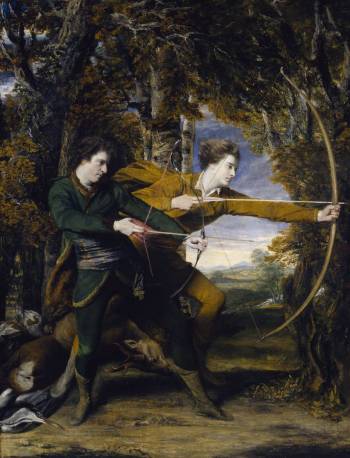
Joshua Reynolds, Colonel Acland and Lord Sydney: The Archers, 1769, oil paint on canvas, 236 × 180 cm (London: Collection of Tate, T12033).
From the earliest histories of art, the friendships and rivalries of artists have been the subject of anecdote and gossip. For that reason they have been associated with the popular storylines of art, rather than with the scholarly discourse of art history. However, the wide-ranging re-evaluation of affect and emotion that is taking place in the humanities, and the increasing recognition of a synchronic, network model of understanding rather than a diachronic, emulative one in art history, have suggested that artistic friendships and rivalries are key agents in the production and reception of works of art. This methodological shift has helped art historians perceive the significance of interpersonal relationships to art-making. It has drawn attention to the sociability of artists, and to the entwining of their personal and professional networks. Meanwhile, across other disciplines, the impact of friendship, personal networks and communities of rivalry upon cultural production have been the subject of important studies. Furthermore, the idea of productive or inhibiting enmities (a more awkward but still profoundly important category of affective relationship) is also becoming a fruitful avenue of exploration.
The long history of British art furnishes many examples of complex and productive friendships and bitter, crushing rivalries. The Royal Academy, from its foundation to today, is one major locus of such complex affective networks, as has been its annual summer exhibition. In conjunction with the exhibition The Great Spectacle: 250 Years of the Summer Exhibition, to be held at the Royal Academy between June and August of 2018, and curated by the Paul Mellon Centre’s Mark Hallett and Sarah Victoria Turner, this conference seeks to explore the impact of friendships and enmities on subject matter and artistic method, as well as on the formation of artistic careers and on the reception of works of art. We aim to re-evaluate and elevate these relationships, shifting them from the peripheral status of cultural gossip to central aspects of making and meaning.
We seek applications for 20-minute papers that address these questions in imaginative ways, and which focus on the history of British art in an international context, from 1769 to today. Whilst proposals that look to the Royal Academy as a locus of interpersonal artistic exchange are welcome, we also invite papers on other relevant topics. Please submit titles, 300-word abstracts and a brief professional biography and c.v. to Ella Fleming on efleming@paul-mellon-centre.ac.uk by December 14 at 5.00pm 2017.
The symposium is funded by the Paul Mellon Centre for Studies in British Art and convened by Georgina Cole (The National Art School, Sydney), Mark Hallett, Mark Ledbury (The Power Institute, University of Sydney), and Sarah Victoria Turner.
New Book | The Social Life of Maps in America, 1750–1860
From UNC Press:
Martin Brückner, The Social Life of Maps in America, 1750–1860 (Chapel Hill: University of North Carolina Press, 2017), 384 pages, ISBN: 978 14696 32605, $50.
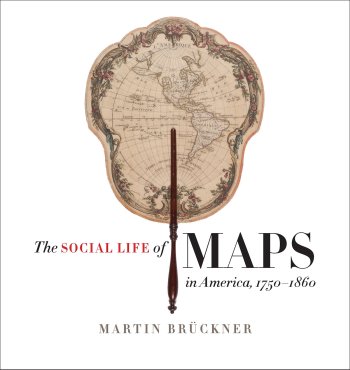 In the age of MapQuest and GPS, we take cartographic literacy for granted. We should not; the ability to find meaning in maps is the fruit of a long process of exposure and instruction. A ‘carto-coded’ America—a nation in which maps are pervasive and meaningful—had to be created. The Social Life of Maps tracks American cartography’s spectacular rise to its unprecedented cultural influence. Between 1750 and 1860, maps did more than communicate geographic information and political pretensions. They became affordable and intelligible to ordinary American men and women looking for their place in the world. School maps quickly entered classrooms, where they shaped reading and other cognitive exercises; giant maps drew attention in public spaces; miniature maps helped Americans chart personal experiences. In short, maps were uniquely social objects whose visual and material expressions affected commercial practices and graphic arts, theatrical performances and the communication of emotions. This lavishly illustrated study follows popular maps from their points of creation to shops and galleries, schoolrooms and coat pockets, parlors, and bookbindings. Between the decades leading up to the Revolutionary War and the Civil War, early Americans bonded with maps; Martin Bruckner’s comprehensive history of quotidian cartographic encounters is the first to show us how.
Published by the Omohundro Institute of Early American History and Culture and the University of North Carolina Press
Martin Brückner is professor of English and material culture studies at the University of Delaware.
C O N T E N T S
Acknowledgments
List of Illustrations
Preface: Introducing the Social Life of American Maps
Part One: American Mapworks
1 The Artisanal Map, 1750–1815: Workshops and Shopkeepers from Lewis Evans to Samuel Lewis
2 The Manufactured Map, 1790–1830: Centralization and Integration from Mathew Carey to John Melish
3 The Industrial Map, 1820–1860: Innovation and Diversification from Henry S. Tanner to S. Augustus Mitchell
Part Two: The Spectacle of Maps
4 Public Giants: Re-Staging Power and the Theatricality of Maps
5 Private Properties: Ornamental Maps and the Decorum of Interiority
6 Self-Made Spectacles: The Look of Maps and Cartographic Visualcy
Part Three: The Mobilization of Maps
7 Looking Small and Made To Go: The Atlas and the Rise of the Cartographic Vade Mecum
8 Cartographic Transfers: Education and the Art of Mappery
Epilogue: Cartoral Arts and Material Metaphors
Appendix 1: Price Table—Maps and Their Sales Prices, 1755–1860
Appendix 2: Inventory of “John Melish Geographer and Map Publisher”
Graphs
Index
New Book | The New Map of Empire: How Britain Imagined America
From Harvard UP:
S. Max Edelson, The New Map of Empire: How Britain Imagined America before Independence (Cambridge: Harvard University Press, 2017), 480 pages, ISBN 978 067497 2117, $35.
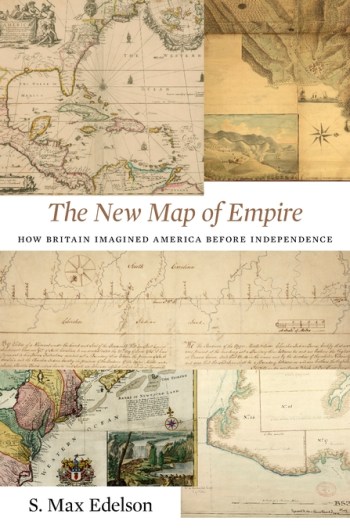 After the Treaty of Paris ended the Seven Years’ War in 1763, British America stretched from Hudson Bay to the Florida Keys, from the Atlantic coast to the Mississippi River, and across new islands in the West Indies. To better rule these vast dominions, Britain set out to map its new territories with unprecedented rigor and precision. The New Map of Empire pictures the contested geography of the British Atlantic world and offers new explanations of the causes and consequences of Britain’s imperial ambitions in the generation before the American Revolution. Under orders from King George III to reform the colonies, the Board of Trade dispatched surveyors to map far-flung frontiers, chart coastlines in the Gulf of St. Lawrence, sound Florida’s rivers, parcel tropical islands into plantation tracts, and mark boundaries with indigenous nations across the interior. Scaled to military standards of resolution, the maps they produced sought to capture the essential attributes of colonial spaces—their natural capacities for agriculture, navigation, and commerce—and give British officials the knowledge they needed to take command over colonization from across the Atlantic.
Britain’s vision of imperial control threatened to displace colonists as meaningful agents of empire and diminished what they viewed as their greatest historical accomplishment: settling the New World. As London’s mapmakers published these images of order in breathtaking American atlases, Continental and British forces were already engaged in a violent contest over who would control the real spaces they represented.
Accompanying Edelson’s innovative spatial history of British America are online visualizations of more than 250 original maps, plans, and charts.
S. Max Edelson is Associate Professor of History at the University of Virginia.
C O N T E N T S
List of Maps*
A Note on the Maps
Introduction
1 A Vision for American Empire
2 Commanding Space after the Seven Years’ War
3 Securing the Maritime Northeast
4 Marking the Indian Boundary
5 Charting Contested Caribbean Space
6 Defining East Florida
7 Atlases of Empire
Conclusion
Abbreviations
Notes
Map Bibliography
Acknowledgments
Index
* Maps
• Detail from Emanuel Bowen, An Accurate Map of North America (London, 1763). From The National Archives of the UK, Open Government License v3.0
• Detail from Daniel Paterson, “Cantonment of His Majesty’s Forces in N. America,” 1767, Library of Congress Geography and Map Division, Washington, DC, gm72002042
• Detail from [Samuel Holland] and John Lewis, “A Plan of the Island of St. John in the Province of Nova Scotia,” 1765, The National Archives of the UK, Open Government License v3.0
• Detail from John Pickens, “Boundary Line between the Province of South Carolina and the Cherokee Indian Country,” 1766, The National Archives of the UK, Open Government License v3.0
• Detail from M. Pinel, Plan de l’Isle de la Grenade ([London], 1763). From Baldwin Collection, Toronto Public Library, 912.72984 J24
• Detail from William De Brahm, “Special Chart of Cape Florida” [1765], Library of Congress Geography and Map Division, Washington, DC, 75693274
• Detail from J. F. W. Des Barres, [Chart of Hell Gate, Oyster Bay and Huntington Bay,] 1778, in The Atlantic Neptune (London, 1777–[1781]). Map reproduction courtesy of the Norman B. Leventhal Map Center at the Boston Public Library, Richard H. Brown Revolutionary War Map Collection
Exhibition | The Sweat of Their Face: Portraying American Workers

Lewis Wickes Hine, Child Labor, ca. 1908; gelatin silver print
(Bank of America Collection)
◊ ◊ ◊ ◊ ◊
Press release (17 October 2017) for the exhibition:
The Sweat of Their Face: Portraying American Workers
National Portrait Gallery, Smithsonian, Washington, D.C., 3 November 2017 — 3 September 2018
Curated by Dorothy Moss and David Ward
The National Portrait Gallery’s exhibition The Sweat of Their Face: Portraying American Workers presents nearly 100 portrayals of laborers by some of the nation’s most influential artists. The multifaceted exhibition includes paintings, sculptures, drawings, prints, media art and photographs that reveal how American workers have shaped and defined the United States over the course of its history—from the Colonial era to the present day. The exhibition examines the intersections between work, art, and social history. The fully bilingual (English and Spanish) display is on view from November 3 until September 3, 2018.

John Rose, Miss Breme Jones, 1785–87, watercolor and ink on paper (Williamsburg: Abby Aldrich Rockefeller Folk Art Museum, museum purchase, the Friends of Colonial Williamsburg Collections Fund).
The Sweat of Their Face includes portraits by Winslow Homer, Dorothea Lange, Elizabeth Catlett, Lewis Hine, Jacob Lawrence, and other renowned American artists. Power House Mechanic, a photograph by Lewis Hine, and The Riveter, by Ben Shahn, are significant works in their own right, but they also highlight the artist’s ability to recognize the vast population of anonymous workers and the contributions that their subjects have made. Furthermore, those depicted in The Sweat of Their Face—many of whom now appear as anonymous workers—draw attention to the relationships that exist between viewers, artists, and subjects.
“In The Sweat of Their Face, we explore who works, why, and how their surrounding conditions have changed and evolved over time,” said Kim Sajet, Director of the National Portrait Gallery. “In the early years of the 21st century, crucial questions persist over issues of jobs and workers’ rights, as well as larger issues of economic equality and social mobility. As we grapple with these questions, we might reflect on the labor of the workers from past epochs who have been brought out of anonymity and given the fullness of their humanity by some of America’s great fine artists.”
Spanning centuries and encompassing various genres, each of the artists in The Sweat of Their Face depicts an individual at a specific moment amidst America’s changing landscape, but as the exhibition reveals, some laborers remain the same. For example, migrant workers have always been a part of American labor’s story, and portraits such as Jean Charlot’s Tortilla Maker and photographs from the California fields are reminders that with immigration, the United States has benefited from cultural exchange, innovation, and economic growth.
This exhibition displays loans from such notable institutions as the Smithsonian American Art Museum, the Metropolitan Museum of Art, the J. Paul Getty Museum, the Phillips Collection, and the Pennsylvania Academy of the Fine Arts, among others. The Sweat of Their Face is organized by curator of painting and sculpture, Dorothy Moss and historian emeritus, David C. Ward. An accompanying catalog presents essays by Moss, Ward, and British art historian John Fagg.
David Ward and Dorothy Moss, with an essay by John Fagg, The Sweat of Their Face: Portraying American Workers Hardcover (Smithsonian Books, 2017), 224 pages, ISBN: 978 158834 6056, $40.
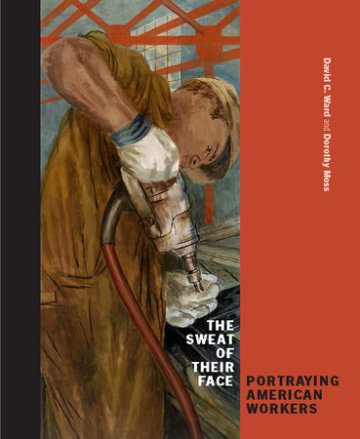 Work always has been a central construct in the United States, influencing how Americans measure their lives and assess their contribution to the wider society. Work also has been valued as the key element in the philosophy of self-improvement and social mobility that undergird the American value system. Yet work can also be something imposed upon people: it can be exploitative, painful, and hard. This duality is etched into the faces of the people depicted in the portraits showcased in The Sweat of Their Face: Portraying American Workers. This companion volume to an exhibition at the Smithsonian National Portrait Gallery examines working-class subjects as they appear in artworks by artists including Winslow Homer, Elizabeth Catlett, Danny Lyon, and Shauna Frischkorn. This richly illustrated book charts the rise and fall of labor from the empowered artisan of the eighteenth century through industrialization and the current American business climate, in which industrial jobs have all but disappeared. It also traces the history of work itself through its impact on the men and women whose laboring bodies are depicted. The Sweat of Their Face is a powerful visual exploration of the inextricable ties between American labor and society.
David C. Ward is the National Portrait Gallery’s senior historian. He has curated exhibitions on Walt Whitman, Abraham Lincoln, American poetry, and the award-winning Hide/Seek: Difference and Desire in American Portraiture. He has also authored several books, including Charles Willson Peale: Art and Selfhood in the Early Republic. Dorothy Moss is director of the Outwin Boochever Portrait Competition and curator of painting and sculpture at the National Portrait Gallery. She has contributed to numerous exhibition catalogues, and her articles and essays have been published in The Burlington Magazine, Gastronomica, and American Art.
Nationalmuseum Sweden Acquires Three Master Drawings
Press release (November 2017) from the Nationalmuseum in Stockholm:

Edme Bochardon, Little Girl in a Bonnet, Portrait of Geneviève-Thérèse Mariette, the daughter of Pierre-Jean Mariette, 1736 (Stockholm: Nationalmuseum, photo by Cecilia Heisser).
Nationalmuseum has acquired three drawings by Edme Bouchardon (1698–1762), François Boucher (1703–1770), and Nicolas Bernard Lépicié (1735–1784), some of the leading artists of the French 18th century. The works comprise two portraits and a figure study for one of the museum’s most famous paintings, The Triumph of Venus. Each exemplifies how drawing had become a significant art form in its own right in 18th-century France.
The drawing by Edme Bouchardon is a portrait of Geneviève-Thérèse Mariette, the daughter of Bouchardon’s close friend Pierre-Jean Mariette (1694–1774), an engraver and art collector. Mariette had catalogued the collection of the banker Pierre Crozat (1665–1740), sold at auction in Paris in 1741, from which Carl-Gustaf Tessin acquired a number of drawings now owned by Nationalmuseum. On the back of the drawing, Mariette has noted that this is a portrait of his daughter drawn by Edme Bouchardon in 1736. The following year the artist exhibited six drawings at the Paris Salon, two of them depicting Mariette’s children. The catalogue describes the piece acquired by Nationalmuseum as “little girl in a bonnet.”
The portrait, an exquisite example of Bouchardon’s mastery of the art and techniques of drawing, is a fully fledged work of art. The model is seen in profile, gazing out a little shyly beneath her bonnet. Through sharp outlines and graduated shading in sanguine, Bouchardon has formed blocks that create almost a three-dimensional effect. Works like this, coupled with the fact that the artist exhibited them at the Salon, helped entrench the status of drawing as an art form in its own right.

François Boucher, Study of a Triton, 1740 (Stockholm: Nationalmuseum, photo by Cecilia Heisser).
The recently acquired Boucher drawing is a study for one of the central figures in The Triumph of Venus, regarded by many as the artist’s foremost work. The drawing corresponds to the triton at right in the painting, who is lifting and supporting a naiad. She in turn is holding out a seashell, offering Venus a pearl necklace. As the triton lifts the naiad, he twists his body, and Boucher has captured the action of the muscles in a way that appears free yet exact. The lines of red and black chalk are drawn with a strong, confident hand. The sensual touch typical of the artist and so readily apparent in the painting is perhaps even more pronounced in this study. Boucher has not yet clothed the naked naiad, and the triton’s lift in this work also becomes an ardent embrace. This drawing is the only known preparatory study for The Triumph of Venus.
The last of the three drawings is also a preparatory study but gives the impression of being a fully fledged work. Nicolas Bernard Lépicié studied under Carle van Loo (1705–1765) and, as a historical painter, was admitted to the Académie royale de peinture et de sculpture in 1769. He later focused increasingly on genre painting. The Lépicié drawing is a study for the man in the painting Old Beggar with Child, signed and dated 1777 and now in an American private collection. The drawing is a complete work in which the beggar’s doleful expression is as powerful as in the finished painting. Although the drawing started out as a preparatory study, it seems that, as he worked on it, Lépicié became convinced of its merits as a standalone piece. This may be the reason why he signed it.
These three works are superb examples of 18th-century French drawing. The Bouchardon and Boucher drawings in particular are significant acquisitions in art history terms: the former with its direct connection to Pierre-Jean Mariette and the emergence of drawing as an art form at the Salon; the latter as the sole surviving preliminary study for The Triumph of Venus, a major work in 18th-century art history.
Expansion of Gainsborough’s House in Sudbury

Plans by ZMMA for the Gainsborough Museum in Sudbury, Suffolk.
◊ ◊ ◊ ◊ ◊
As reported by the BBC (17 November 2017). . .
The latest plans for an £8.5m centre to commemorate a world-renowned artist have been revealed. Gainsborough’s House wants to redevelop a former labour exchange building at the rear of its existing museum in the centre of Sudbury, Suffolk. The plans include a gallery showing the best of Thomas Gainsborough’s full-length portraits.
Museum director Mark Bills said the project would “give the nation a centre for one of its greatest artists.”
The plans were drawn up following a public consultation earlier this year.
Thomas Gainsborough was born in 1727, the youngest of nine children, and spent much of his childhood sketching in the woods and fields surrounding Sudbury. . .
The full article is available here»
Conference | Fans as Images, Accessories, and Instruments of Gesture
From H-ArtHist:
‘Num’rous Uses, Motions, Charms, and Arts’: Fans as Images, Accessories, and Instruments of Gesture in the 17th and 18th Centuries
Der Faecher als Bild, Accessoire und gestisches Instrument im 17. und 18. Jahrhundert
Kunsthistorisches Institut, Universität Zürich, 29 November — 1 December 2017
Organized by Danijela Bucher, Fabienne Ruppen, and Miriam Volmert
This interdisciplinary conference discusses the cultural role of European folding fans in art, fashion, and material culture in the seventeenth and eighteenth centuries. In eighteenth-century Europe, fans became important fashion accessories across social classes and were almost omnipresent in social interaction. Painted and printed fans presented a wide variety of social knowledge through fast and fleeting pictures, in this way conveying personal statements of those who carried them. Early modern fan depictions were often inspired by or based on Renaissance and contemporary paintings. In the course of the eighteenth century, fan leaves displayed an increasing variety of cultural themes, thereby also functioning as souvenirs as well as conveyors of political and social messages.
The conference aims to take a closer look at the pictorial and intermedial interplay of ornamental patterns, figurative elements, and artistic subject matters against the background of European fan manufacture, artistic networks and international trade. Furthermore, it seeks to closer examine fans as gender-specific instruments of gesture and communication. The conference is funded by Schweizerischer Nationalfonds zur Förderung der wissenschaftlichen Forschung (SNF), Graduate Campus der Universität Zürich, and UZH Alumni. Please direct any questions to miriam.volmert@khist.uzh.ch.
2 9 N O V E M B E R 2 0 1 7
20.00 Welcome and introduction
3 0 N O V E M B E R 2 0 1 7
9.15 Welcome (Bettina Gockel) and introduction (Danijela Bucher and Miriam Volmert)
9.30 I | Fans as Accessories and Instruments of Gesture
Moderation: Danijela Bucher and Miriam Volmert
• Pascale Cugy, ‘La Dame paroist badiner avec son Eventail qu’elle porte au coin de sa bouche’: Les éventails dans la gravure de mode féminine sous Louis XIV
• Allison Goudie, The 18th-Century Mask Fan: More than the Sum of its Parts
• Pierre-Henri Biger, Faux et vrais langages de l’éventail
11.00 Coffee
11.30 II | History Painting on Folding Fans in the late 17th and in the 18th Centuries
Moderation: Fabienne Ruppen
• Christl Kammerl-Baum, Bilder-Sprache auf Fächern – eine ikonographische und ikonologische Bedeutungsanalyse anhand eines Fallbeispiels
• Georgina Letourmy-Bordier, De Coriolan à la rosière de Salency, le héros et l’incarnation de la vertu au XVIIIe siècle
12.30 Lunch
14.00 III | Fans as Media of Memory and Souvenirs in the 18th Century
Moderation: Miriam Volmert
• Mary Kitson, ‘Thanks for the Memory’: Typical Imagery of the Grand Tour Fan Leaf
• Heiner Krellig, Souvenir der Grand Tour: Ein Fächer als Erinnerung an Venedig
• Adelheid Müller, Reputation in Falten: Elisa von der Reckes Autographenfächer, ein Zeugnis selbstvergewissernder Positionierung
15.30 Coffee
16.00 IV | Fans as Political Media in 18th-Century France
Moderation: Danijela Bucher
• Aurore Chéry, La représentation de la famille royale de France sur les éventails du XVIIIe siècle
• Rolf Reichardt, Bild-Kompositionen revolutionärer Faltfächer in Frankreich, 1789–94
17.00 Discussion
1 D E Z E M B E R 2 0 1 7
9.00 Introduction
9.15 V | Artistic Networks, Paths of Reception, and Production Sites
Moderation: Patrizia Munforte
• Kirsty Hassard, Sarah Ashton and Her Contemporaries: Female Fan Makers and Publishers in 18th-Century London
• Geneviève Dutoit, Les éventails décorés d’après les œuvres d’Angelica Kauffmann à la fin du XVIIIème et du début du XIXème siècle
10.15 Coffee
10.45 VI | Fans in the Context of Historical Material and Textile Cultures
Moderation: Katharina Haack
• Suet May Lam, From Ephemeral to Eternal: Unfolding Early Modern ‘Fashion’ for Asia
• Isa Fleischmann-Heck, Textile Dekore auf Fächerblättern des 18. Jahrhunderts – Formen, Erscheinung, Wirkung
11.45 End of Public Conference Program
Afternoon Workshop (Limited to Conference Speakers) at the Collection Centre of the Swiss National Museum, Affoltern am Albis
14.30 Round Table | Fans in Museum Collections
Markus Leuthard, Welcome
• Mathilde Semal, L’éventail du XVIIIe siècle, véritable attribut social ? La richesse des montures de la collection Preciosa (Musée du Cinquantenaire, Bruxelles)
• Annette Kniep/Maike Piecuch, Neulagerung und Konservierung der Fächer im Bernischen Historischen Museum – Konzept und Umsetzung
• Yolaine Voltz, Principes et compromis de la restauration des éventails : étude de cas particuliers
15.30 Guided Tour
Conservation and Restoration of Fans in the Swiss National Museum with Nikkibarla Calonde, Véronique Mathieu, and Isabel Keller










leave a comment