Call for Papers | Women Inventors in Architecture, 1700–2000
From SAH:
Women Inventors in Architecture, 1700–2000
International Archive of Women in Architecture 2018 Symposium
School of Architecture + Design, Virginia Tech, Blacksburg, Virginia, 28–30 March 2018
Proposals due by 15 December 2017
For centuries, women in architecture have been involved in pushing the boundaries of architecture and architectural practice. Whether as registered architects, members and leaders of architectural firms, academics and scholars, or in any of the less conventional capacities, women have helped transform the discipline of architecture and the related design fields shaping the built environment. The 2018 IAWA Symposium invites abstracts that address specific women or gendered natures of architectural invention. We welcome papers that tackle subjects or inventions generated between the years 1700-2000, and that are international or domestic in scope. We seek papers that conceptualize architectural invention in its many guises, including (but not limited to) ideas, technology, form-making, modes of professional practice that present views into and histories of practices of women in architecture. We encourage abstracts that address how women’s practices have been expanded through invention, as well as how architectural practice has been expanded or impacted by inventions by women.
Please email 300-word abstract and a one-page CV to Donna Dunay, Chair, Board of Advisors, International Archive of Women in Architecture Center (ddunay@vt.edu) with the subject heading ‘2018 IAWA Symposium’.
The International Archive of Women in Architecture (IAWA) was established in 1985 as a joint program of the College of Architecture and Urban Studies and the University Libraries at Virginia Tech. The purpose of the Archive is to document the history of women’s contributions to the built environment by collecting, preserving, and providing access to the records of women’s architectural organizations and the professional papers of women architects, landscape architects, designers, architectural historians and critics, and urban planners as well as the records of women’s architectural organizations, from around the world.
New Book | Francis Towne’s Lake District Sketchbook
Timothy Wilcox, Francis Towne’s Lake District Sketchbook: A Facsimile Reconstruction (Birmingham: The Winterbourne Press, 2017), 200 pages, ISBN: 978 099548 5709, £40.
 The watercolours of Francis Towne (1739–1816) are among the most admired in eighteenth-century British art. After his trip to Italy and the Alps, it was his subsequent tour, to the Lake District in 1786, which marked the true climax of his career. He created a series of 40 views in a single sketchbook, which he then dismantled and exhibited separately. The scattered pages are here reassembled and reproduced at their original size for the first time. The sketchbook itself is accompanied by an introduction, along with detailed notes on the individual subjects, which include classic locations such as Windermere, Ambleside and Coniston, along with far less familiar Buttermere and Bassenthwaite. The result is a unique document of British watercolour painting, and a testament both to the artistic discovery of the Lake District and to the great age of Picturesque travel.
Timothy Wilcox is a leading authority on British painting, especially the watercolour and landscape artists of the Romantic era. He is a writer, lecturer and the curator of exhibitions on Constable, John Sell Cotman, and the bicentenary celebration of the Royal Watercolour Society in 2005. His books include Samuel Palmer (2005), Turner and His Contemporaries: The Hickman Bacon Watercolour Collection (2012), and contributions to The Solitude of Mountains: Constable in the Lake District (2006).
Call for Papers | Public Agency in Private Spaces, Female Agency
Public Agency in Private Spaces: Politics, Painting, and Patronage in the Long Eighteenth Century
Christie’s Education Symposium 2018: Celebrating Female Agency in the Arts
New York, Christie’s, 26–27 June 2018
Proposals due by 10 January 2018
Scholars across disciplines have long probed the relationship between politics and art in the public sphere in the long eighteenth century—the tumultuous, seminal historical period that saw the rise of the Enlightenment, modern systems of representative democracy, and, eventually, the Industrial Revolution. Yet, to date, scholarship of this period has largely failed to notice female artists and patrons, despite their omnipresence in public shows and frequent initiation of substantial commissions. Similarly, political history has overlooked non-royal women, despite their strong influence as the wives, mothers, and sisters of politicians.
This interdisciplinary panel explores ways in which elite women wielded power through the active fusion of politics and art. Domestic and other private spaces often provided fertile ground for the cultivation of wide-ranging artistic production. In these spaces, women made decisions that both mirrored and diverged from the (often public) actions of their male contemporaries. They exercised their own, distinct agency to establish relationships with male and female artists and designers, to initiate commissions, and to oversee these projects, most of which were undeniably infused with cultural, social, national, and even international politics.
We seek papers that work to reveal women’s central role as patrons and artists at this key moment in time, when the nature of politics itself was changing—and, with it, the production of art. Contributors might consider a wide range of female patrons and artists, and the historical context of their activities. Topics might include: the ways in which female sitters fashioned political personae through portraiture; the commissioning of original artworks or the production of copies for domestic interiors; gendered dynamics of the art market; or elite women’s growing engagement with methods of print artistry. We see this topic as a transnational story, and encourage approaches that upend prevailing narratives regarding individual works of art.
Organized by Laurel O. Peterson (Yale University) and Paris Spies-Gans (Princeton University)
Proposals for 20-minute papers, consisting of an abstract of 250–300 words and a brief bio of the presenter, should be submitted by January 10, 2018, to laurel.peterson@yale.edu and spies@princeton.edu.
Additional information on the symposium is available here»
The Wallace’s History of Collecting Seminars, 2018
From the 2018 schedule:
History of Collecting Seminars
The Wallace Collection, London, 2018
The seminars, typically held on the last Monday of each month, act as a forum for the presentation and discussion of new research into the history of collecting. Seminars are free and open to curators, academics, historians, archivists, and all those with an interest in the subject. Papers are generally 45–60 minutes long and take place at the Wallace Collection between 5.30 and 7pm (except for December’s presentation as noted below). For inquiries, please contact: collection@wallacecollection.org.
29 January
Tessa Murdoch (Deputy Keeper of Sculpture, Metalwork, Ceramics and Glass, Victoria & Albert Museum) and Matthew Winterbottom (Curator of Sculpture and Decorative Arts, Ashmolean Museum, Oxford) , ‘This Jew of Taste’: Sir Ernest Cassel’s Collection of Silver
26 February
Alden Gordon (Paul E. Raether Distinguished Professor of Fine Arts, Trinity College, Hartford), ‘Heureux ceux qui ont un Coeur de bronze . . . “: The French Financial Crisis in the Late Reign of Louis XV and Its Impact on Royal Manufactures and Royal Patronage
26 March
Barbara Pezzini (PhD candidate, University of Manchester, and Editor-in-chief, Routledge-Taylor & Francis Journal), The Politics of Public Collecting: William Gladstone and the National Gallery
30 April
C. Tico Seifert (Senior Curator, Northern European Art, Scottish National Gallery), Collecting Rembrandt’s Art in Britain Please note that this event will take place in the Regatta Room in Durrants Hotel on George Street, located directly behind the Wallace Collection; the 60 available seats will be allocated on a first come first serve basis.
21 May
Kajal Meghani (Exhibition Assistant Curator, Royal Collection Trust), The Prince of Wales’s Indian Collection: The Circulation of Giften from the 1875–76 Tour of India
25 June
Caroline McCaffrey-Howarth (PhD Candidate and History of Art Tutor, University of Leeds), Sèvres Mania? The History of Collection Sèvres Porcelain in Britain in the Later Nineteenth Century
30 July
Elizabeth Pergam (Lecturer, Sotheby’s Institute of Art, New York), Paris over London: Victorian Curator J. C. Robinson’s Collection at Auction
24 September
Saskia van Altena (Cataloguer of prints, Rijksprentenkabinet, Rijksmuseum, Amsterdam), The Sale of Sir Peter Lely’s Paintings and Prints: A Breaking Point in the History of Collection in Britain?
29 October
Alexandre Tissot Demidoff (Independent scholar), The Last Great Demidoff Sale of Paintings
26 November
Catrin Jones (Curator of Decorative Arts, Holburne Museum, Bath), Piercing Together a Collection: Sir William Holburne’s Display Mounts
10 December (please note the 5:00pm start time)
Robert Wenley (Deputy Director, Head of Collections, Barber Institute of Fine Arts, University of Birmingham), ‘Rare and Most Magnificent’: The Picture Collection of Stephen Alers Hankey (1809–1878)
◊ ◊ ◊ ◊ ◊
Note (added 26 April 2018) — The venue change for the April 30 seminar was added.
Research Lunch | Helen Whiting on Duff House and the House of Duff
From the Paul Mellon Centre:
Helen Whiting, ‘Your Beautiful and Hopeful Family’: Dynasty, Duff House, and the House of Duff
Paul Mellon Centre for Studies in British Art, London, 24 November 2017

William Mosman, William Duff, Lord Braco (1697–1763) and His Son George, detail, signed and dated: ‘Gul Mosman Pingebat, 1741’.
This paper will consider the link between a set of family portraits and the house within which they were intended to hang. I will discuss the idea of the ‘family group portrait’ not simply existing in one frame but depicted across several canvases nevertheless conceived as a coherent whole. The focus will be a group of five portraits executed by William Mosman (c1700–1771) in 1741 for William Duff of Braco. The portraits were commissioned to hang in Duff House, the grand family seat designed for Braco by the architect William Adam and built between 1735 when its foundation stone was laid and 1741 when work came to halt due to a dispute between architect and patron. The connection between the portraits, those of other family members and worthies, and the place in which they were designed to hang, I will be argue, constituted a conscious, indeed ostentatious, act of dynastic establishment which was orchestrated by Braco and further developed by his son, James. The tools used in establishing ‘the house of Duff’ as a noble entity was, for both men, a partnership of paint and stone. The paper will offer a close reading of the featured portrait group along with consideration of archival material which highlights the changes in display patterns over time, family relations and dynastic concerns.
Friday, 24 November 2017, 12:30–2:00pm.
Nel Whiting is undertaking an AHRC funded inter-disciplinary PhD at the University of Dundee. She is using Scottish family group portraits from the second half of the eighteenth century along with archival sources to investigate gendered constructions of national and familial identity. She was awarded the Leah Leneman Essay Prize 2010 by Women’s History Scotland for new writing in Scottish gender history and is author of “Gender and National Identity in David Allan’s ‘Small, Domestic and Conversation’ Paintings,” in the Journal of Scottish Historical Studies 34 (May 2014), and “Depictions of Childhood in David Allan’s Family Group Portraiture,” in Childhood and Youth in Pre-Industrial Scotland, ed. Elizabeth Ewan and Janay Nugent (Boydell and Brewer, 2015).
As our events are free, not everyone who asks for tickets comes to our events. To make sure we have a full house we allocate more tickets than there are seats. We do our best to get the numbers right, but unfortunately we occasionally have to disappoint people. Admission is on a first come, first served basis, so please arrive in good time for the start of the event.
Rijksmuseum Fellowship Programme, 2018–19

Cuypers Research Library at the Rijksmuseum (Photo by Davidh820, Wikimedia Commons, September 2017). From the Rijksmuseum: “The Cuypers Library is the largest and oldest art historical library in the Netherlands. Following an intensive restoration campaign, it has now been fully returned to its former glory. In the newly reopened museum, the visiting public will finally be able to admire the nineteenth-century library’s splendid reading room.”
◊ ◊ ◊ ◊ ◊
Rijksmuseum Fellowship Programme, 2018–19
Applications due by 14 January 2018
We welcome international research proposals which open new perspectives on the Rijksmuseum’s collection, its history, and activities. The purpose of the programme is to enable applicants to base part of their research at the Rijksmuseum and thus to strengthen the bonds between the museum and universities. The focus of research should relate to the Rijksmuseum’s collection and activities and may encompass any of its varied holdings, including paintings, sculpture, decorative arts, prints, drawings, photography, and historical artefacts. The programme offers students and academic scholars access to the museum’s collections, library, conservation laboratories, and curatorial expertise. Furthermore, the museum facilitates opportunities for fellows to engage in workshops and excursions to encourage the exchange of knowledge—both amongst themselves and the broader museum audience.
Please review the eligibility, funding and application requirements by visiting the Rijksmuseum website. For the 2018–2019 academic year, candidates can apply for
• Andrew W. Mellon Fellowship for art historical research – Apply here
• Johan Huizinga Fellowship for historical research – Apply here
• Migelien Gerritzen Fellowship for conservation research – Apply here
• Anton C.R. Dreesmann Fellowship for art historical research – Apply here
The closing date for all applications is 14 January 2018, at 6:00pm (Amsterdam time/CET). No applications will be accepted after this deadline. All applications must be submitted online and in English. Applications or related materials delivered via email, postal mail, or in person will not be accepted. Selection will be made by an international committee in February 2018. The committee consists of eminent scholars in the relevant fields of study from European universities and institutions and members of the curatorial and conservation staff of the Rijksmuseum. Applicants will be notified by 1 March 2018. All fellowships will start in September 2018.
Further information and application forms are available here. For questions concerning the application procedure, contact Marije Spek, Coordinator of the Fellowship Programme, m.spek@rijksmuseum.nl.
New Book | Writing Britain’s Ruins
Michael Carter, Peter Lindfield, and Dale Townshend, eds., Writing Britain’s Ruins (London: British Library Publishing, 2017), 240 pages, ISBN: 978 07123 09783, £30.
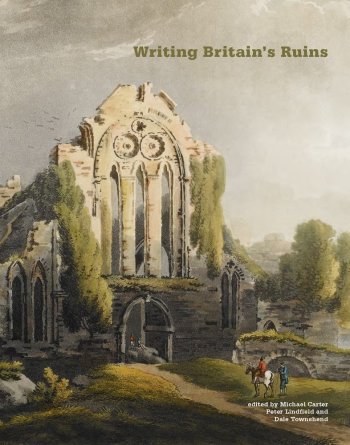 Over the course of the long eighteenth century, Britain’s ruined medieval or ‘Gothic’ abbeys, castles, and towers became the objects of intense cultural interest. Turning their attention away from Classical to local and national sites of architectural ruin, antiquaries and topographers began to scrutinise and sketch, record, and describe the material remains of the British past, an expression of interest in domestic antiquity that was shared by many contemporary painters, poets, writers, politicians, and tourists. This book traces the ways in which a selection of English, Scottish, Welsh, and Irish ruins served as the objects of continuous cultural reflection between 1700 and 1850, drawing together essays on the antiquarian, poetic, visual, oral, fictional, dramatic, political, legal, and touristic responses that they engendered. Writing Britain’s Ruins provides an accessible and engaging interdisciplinary account of the ways in which Britain’s ruins inspired writers, artists, and thinkers during a period of extraordinary cultural richness.
Michael Carter is Senior Properties Historian at English Heritage. Peter N. Lindfield is a Leverhulme Early Career Fellow based at the University of Stirling. Dale Townshend is Professor of Gothic Literature in the Centre for Gothic Studies at Manchester Metropolitan University.
Call for Papers | Kings & Queens Conference #7, Ruling Sexualities
From the call for papers, via the Royal Studies Network:
Kings & Queens Conference 7, Ruling Sexualities
Hampton Court Palace and the University of Winchester, 9–12 July 2018
Proposals due by 31 December 2017
The Kings & Queens conference series will be hosted by Historic Royal Palaces and the University of Winchester for its seventh edition on 9–12 July 2018. The first day will be held at Hampton Court Palace with the remaining days at the University of Winchester. We aim to connect scholars across the world whose research focuses on topics related to royal history, diplomacy, art history, political history, biographical studies or any other issues included in the scope of royal studies. This edition of the Kings and Queens conference will have a particular focus on gender and sexuality as central themes. We are especially interested in studies relating to Lesbian, Gay, Bisexual, Trans, and Queer (LGBTQ) identities and the role of sexuality and gender to royal histories.
We look to gain an understanding of the perceptions, practices, and legacies of gender and sexual identities relating to monarchs, royals and their courts, realising that these may have been very different in historic periods to our contemporary understandings. All topics related to these issues will be welcomed, from diverse chronological periods and parts of the world. We hope that interpretation of these topics for the public in heritage contexts will form a particular focus of the day at Hampton Court Palace. We also welcome papers which are unrelated to our central theme and subtopics but contribute more widely to the field of royal studies.
The following list includes potential topics for papers, panels or posters, which are suggested as inspiration. Proposers should not feel limited by these topics and we welcome a broad range of ideas and interpretations.
Perceptions and Performance
• The self-representation of monarchs, royals, and courtiers
• Royal and court fashion, including cross-dressing
• The construction and definition of royal sexual and gender identities, including LGBTQ identities, heterosexuality, and straight identities
• Asexuality and virgin monarchs
Practices
• The lives and roles of companions and influencers, including concubines, mistresses, and same-sex favourites
• The biographies of LGBTQ monarchs, royals, and courtiers
• Propaganda around sexuality and gender identity, whether positive or negative
• Concealed, illicit, or hidden royal relationships
• Close same-sex friendships
Legacies
• The posthumous perception and representation of royal sexuality and gender identity, and how this defines legacy and dynasty
• The changing historiography and perception of royal sexuality, gender identity, and LGBTQ histories
• The interpretation of royal gender and sexuality in museum and heritage contexts
The conference will include both paper sessions and a poster session at Hampton Court Palace to highlight the developing research of students and early career scholars. Please note that postgraduate students and early career scholars are welcome to give either posters at the Hampton Court session or papers in the general sessions at Winchester, depending on their preference.
Individual proposals should indicate whether it is for a poster or paper and include a title, institutional affiliation, an abstract of 250–300 words, and a one-page CV or biography. For panels, the proposal should include a maximum of four different papers accompanied by the same information required for individual proposals and a short rationale of approximately 100 words for the panel. If the panel has an institutional or societal sponsor, please include this with the panel proposal. All proposals should be submitted by 31 December 2017, to kq7winchester@gmail.com, and any queries about the conference can also be directed to this address.
Conference | Münster Castle at 250

Johann Conrad Schlaun, Palace at Münster, 1767–87, constructed for Maximilian Friedrich von Königsegg-Rothenfels (1708–1784), the Archbishop-Elector of Cologne and the Bishop of Münster from 1761 to 1784 (Photo: Wikimedia Commons).
◊ ◊ ◊ ◊ ◊
From H-ArtHist, with a copy of the conference flyer here:
Das Münsteraner Schloss: Fürstbischöflicher Residenzbau am Ende des 18. Jahrhunderts
Das Münsteraner Schloss, Münster, 7–8 December 2017
Internationale Tagung organisiert vom Institut für Kunstgeschichte und der Zentralen Kustodie der Universität Münster
 Am 26. August 2017 jährte sich die Grundsteinlegung des Fürstbischöflichen Residenzschlosses in Münster zum 250. Mal. Der bedeutende Bau, der seine Zweckbestimmung nur gut anderthalb Jahrzehnte erfüllen konnte und heute als Hauptgebäude der Westfälischen Wilhelms-Universität genutzt wird, ist vielfach Gegenstand kunsthistorischer Forschungen gewesen. Diese betrafen insbesondere die Klärung der Planungs- und Baugeschichte sowie die Stellung des Schlosses im Oeuvre seines Entwerfers, des fürstbischöflichen Architekten Johann Conrad Schlaun.
Im Lichte neuerer, stärker kulturgeschichtlich orientierter Forschungsansätze möchten wir das Jubiläum nutzen, um neue Fragen an den Bau zu richten: Wie lässt sich das Münsteraner Schloss im Kontext fürstbischöflicher Residenzen im Heiligen Römischen Reich kontextualisieren? Auf welche Modelle höfischer Repräsentations- und symbolischer Kommunikationskultur bezieht es sich, und welche eigenen Akzente wurden dabei gesetzt? Welchen konkreten Nutzungen wurde das Schloss unterworfen? In welche Beziehung tritt es zur Stadt?
Die Tagung ist öffentlich. Eine Anmeldung ist nicht erforderlich; eine Teilnahmegebühr wird nicht erhoben.
D O N N E R S T A G , 7 D E Z E M B E R 2 0 1 7
13.30 Begrüßung/Einführung
14.00 Werner Freitag (Münster), Tridentinische Reform und katholische Aufklärung: Das Fürstbistum Münster im 18. Jahrhundert
14.45 Gerd Dethlefs (Münster), Das Schloss und die Politik. Voraussetzungen und Folgen 1688–1803
16.00 Stefan Kummer (Würzburg), Die Würzburger Residenz als fürstbischöfliches Schloss
16.45 Georg Satzinger (Bonn), Die Dreiflügelanlage als Problem: Schloss Weißenstein in Pommersfelden
19.00 Abendvortrag | Elisabeth Kieven (Rom/Osnabrück), Schlossbau gegen Ende des Ancien Régime. Das Fürstbischöfliche Schloss in Münster im europäischen Kontext
F R E I T A G , 8 D E Z E M B E R 2 0 1 7
9.15 Marc Jumpers (Bonn), Das Schloss zu Münster als Residenz eines geistlichen Reichsfürsten: Innenraumdisposition und Zeremoniell unter Kurfürst und Fürstbischof Maximilian Friedrich von Königsegg-Rothenfels
10.00 Kristina Deutsch (Münster), Vom Luxus der Privatheit: Das Gelbe Kabinett und die fürstbischöflichen Appartements im Münsteraner Schloss
11.15 Katharina Krause (Marburg), Bauen ohne Messlatte: Die Münsteraner adligen Wohnhöfe in einer Residenzstadt ohne Schloss
12.00 Eva-Bettina Krems (Münster), Das Münsteraner Schloss: Ein- und Ausblick
Konzeption
Eva-Bettina Krems
Jens Niebaum
Exhibition | Animals: Respect, Harmony, Subjugation
Press release for the exhibition:
Animals: Respect, Harmony, Subjugation
Museum für Kunst und Gewerbe Hamburg, 3 November 2017 — 4 March 2018
 Animals are a frequent subject of debate these days. Do they have a soul? How much do they suffer? Are we under any obligation to protect their individuality by granting them rights? Are human beings morally authorized to do as they want with animals, to consume them, rob them of their freedom and train them for the purposes of entertainment? Scientific discussion takes the relationship between animal and human being very seriously. In the everyday life of our consumption-oriented society, on the other hand, that relationship oscillates between unreflecting exploitation and sentimental anthropomorphization. Against the background of these contrasts, the exhibition Animals at the Museum für Kunst und Gewerbe Hamburg has been geared primarily towards informing visitors and sensitizing them to ways and means of respectful co-existence. With a view to the visual and applied arts but also to science, the show undertakes to re-evaluate the common history of man and animal from the perspective of a wide range of epochs, cultures and media. Loans from museums as well as natural history and ethnology-oriented institutions of Germany and the world will enhance the objects from the MKG’s own abundant and diverse collection. The chief focus is on works of the visual arts in which the interaction between animal and man gives rise to something altogether new. So-called thematic islands unite creations of high culture with those from popular contexts, while also integrating examples from indigenous cultures and natural history. The exhibition features some 200 objects dating from antiquity to the present, including paintings, sculptures, prints, photographs, video art, large-scale installations and films. In addition to the 1,200 square metres exhibition there are 14 satellite locations throughout the entire museum that focus on animals. The exhibition is accompanied by a catalogue published by Hirmer Verlag.
This exhibition explores the relationship of animals and mankind with a view on the arts and focusses on ethical, spiritual and emotional questions. The centre for Natural History (CeNak) at the University of Hamburg, as a cooperation institution of the MKG, completes the perspective with a scientific view of mankind in the animal world. Beside the joint projects with the Zoological Museum, CeNak presents a special exhibition Vanishing Legacys: The world as a Forest (10 November 2017 – 29 March 2018) addressing the current research results regarding species extinction, deforestation and climate change.
Origins and Inspiration
The oldest known depictions of animals date to over 30,000 years ago—carved out of bones or painted on the walls of caves. Ever since humans started making artworks, animals have been one of the main sources of inspiration. The earliest object in the exhibition, the engaging amber sculpture of a moose from Weitsche, dates back to the Ice Age. Just like a falcon sculpture found in Egypt, a jade deer from China, a bull from the ancient Orient, and a golden boar from Greece, it bears witness to the encounter between human and animal. All of these works tell us something about how humans viewed the animals around them, how the particular society saw itself and about its religious and moral constitution, its attitude to creation and to nature. The exhibition examines how artists across the ages envisioned animals and the aesthetic developments that influenced their interpretations.
Longing and Distance
Paradise! A return to Arcadia is not possible, but the arts can play a vital role on the way to a better future. The selection of works on view is not based on chronology or specific species; instead, two renderings of elephants form thematic bookends for a wide range of animal depictions ranging from early civilizations to the present. The cave was the birthplace of both magic and enlightenment, as our ancestors began to develop a first impression of themselves and the world. Humans did not yet dominate their world; on a painting in the Mutoko Cave in Zimbabwe, fleet stick figures seek their place in the vast animal kingdom. Two majestic elephant silhouettes stand watch over the scene teeming with flora and fauna. They are the rulers of the visible world and the mediators between it and transcendental spheres. The life-size copies made by art students in 1929 on an expedition to Zimbabwe with the ethnologist Leo Frobenius spread word of the prehistoric rock and cave paintings. The seven-meter-wide drawing of the Big Elephants and further sheets convey in the exhibition a connection between human and animal in prehistoric times, in a society whose organization we still know very little about. But they stand above all for modern man’s longing for a harmonious consensus with nature, a primordial state that we presume prevailed in many early civilizations.
It is for this reason that Franz Marc’s Dog Lying in the Snow (1911) and The Goldfish (1925) by Paul Klee are juxtaposed with the cave paintings in the show. Both artists tried in their work to picture an authentic world that had in the meantime been lost. Klee’s Goldfish visualizes the beginnings of life emerging from the primordial soup of the waters. Marc’s metaphysical view of a resting animal at peace with itself and the world imagines an early state of innocence, which must then yield to the exigencies of civilization. Joseph Beuys, too, evoked melancholy at the loss of an edenic unity of man and animal. He sought closer contact with the animal spirit in ceremonial acts. Just as the ‘animalization’ of the world represented for Marc a vision of the future, for Beuys, recovering the communication between human and animal was an integral part of a new, environmentally motivated social movement.
A contemporary response to the elephants from the cave is provided in a video installation by Douglas Gordon from 2003: the elephant cow Minnie was brought from the circus to New York’s Gagosian Gallery. We see her there laying down—or falling—and awkwardly getting up again in a clinical white room. In Play Dead; Real Time, Gordon doesn’t summon thoughts of a common origin but instead reflects on the changed balance of power in the course of thousands of years of co-evolution of humans and elephants. Forced to assume unusual poses for the camera, Minnie looks both powerful and vulnerable at the same time. In her clumsy movements, she lends a face to all the anonymous trapping, training, and exploitation of elephants perpetrated by so many humans. The impressive work combines admiration for the beauty and dignity of the animal with empathy for a subjugated and drilled creature, and finally grief over the dying out of an endangered species.
Insight and Appropriation
We can never really know what it feels like to be an animal, nor can we say with any certainty how an animal feels about us. The desire to understand animals is an ancient one. Insights have been sought using all conceivable means. Scientific developments in this field and innovations in technical media have also influenced artistic practice. Over the centuries, paintings and graphic art techniques have shaped our basic concepts about the animal world. In the Renaissance, animals were made the sole subjects of depictions. Durer’s Young Hare is still today an iconic animal image. A contemporary copy by Hans Hoffmann is on view in the exhibition. Dürer’s Rhinoceros, on the other hand, originally printed as a leaflet, brought an animal worldwide fame that normally lies outside our horizon of experience. The combination of the fantastical, factual, and direct observation is characteristic of bestiaries and zoological encyclopedias that map the myriad species of the animal kingdom; exotic and mythical beasts are rendered here just as realistically as domestic animals. The deceptively true-to-life images are not an end in themselves, however, but are above all testimonies to the skills of the artists who made them. In the mid-18th century, George Stubbs’s gaze penetrated right under the animal’s skin. In five layers, he dissected the body of a horse down to the bare skeleton. This knowledge-oriented deconstruction reveals not only the anatomical facts but also a fundamental realization: The horse, like the human, is a creature of flesh and blood, vulnerable and capable of feeling pain. In the 19th century, the new media of photography and film brought previously hidden phenomena to light, and X-rays laid bare the internal structure of animals. Etienne-Jules Marey’s chrono-photographic experiments captured motion sequences in slow motion, in order to find new answers to the ageold question: Why does a cat always fall on its paws?
Animals can do many things humans can’t: they can rise into the air and maneuver safely through the dark night, like the bat. Bats sleep upside down while we are awake, and then unfurl their wings at dusk. A watercolor from the Dürer school depicts the bat’s flight apparatus in detail, the animal’s wingspan spreading beyond the margins of the sheet. Detailed anatomical studies were meant to make the ‘fantastic’ world of animals understandable. Ernst Haeckel, for example, ventured in his 1904 Art Forms in Nature thirteen taxonomic descriptions of various bat faces. In the exhibition, a contemporary study of the bat’s abilities is contributed by Bat Bot from 2017. An American research team succeeded in mimicking the fascinating bat aeronautics, complete with complex movement sequences and a whisper-thin flight membrane.
Subjugation and Fascination
Do animals have a soul? Are we really entitled to eat them, imprison them, and drill them to do our bidding? In an image cosmos made up of 177 individual photographs made between 2006 and 2010 in various European food production locations, Michael Schmidt shows matter-of-factly, without sentiment or any moral appeal, the reality of the processing of animals for food. The very objectivity of this presentation of an everyday practice prompts us to critically reflect on the mass exploitation of animals. A rejoinder to the tableau Food is posed by an 18th-century Boar’s Head Tureen from the collection of MKG. In that era, hunting wild animals was still a dangerous feat, and their consumption not yet commonplace and hence associated with special ceremonies. While in the Middle Ages the bloody animal corpse would be placed directly on the table, the etiquette of the European courts banished the evisceration and cutting up of the animal to the kitchen. The deceptively realistic porcelain boar’s head contains not an identifiable animal but rather a steaming pot of game meat ragout.

Tethart Philipp Christian Haag, Orangutan Eating Strawberries, 1776, oil on canvas, 109 × 89 cm (Braunschweig, Herzog Anton Ullrich-Museum, Kunstmuseum des Landes Niedersachsen).
The young female orangutan that was brought to The Hague from the Dutch East Indies in 1776 caused a sensation. Speculations about the nature and appearance of the great apes and the boundaries between human and animal could finally be tested on a living specimen. The orangutan was clever, could break free of her chains, open a bottle of wine, take a swig, and then put it back. She was always in a good mood and didn’t like sleeping alone. On the first oil painting of a great ape, this orangutan eats strawberries from a porcelain plate with a silver fork. Despite these civilized traits, however, her abode is still a barren pen lined with straw. Human superiority is substantiated. Two generations later, Charles Darwin would characterize the ape as man’s closest relative, arguing for its ability to feel and empathize with others. Since then, humans have been forced to acknowledge that they are not the crowning achievement of all creation but merely one animal among others. Only recently there have been discussions in the USA and Turkey about banning Darwin’s theory of evolution from school curricula—demonstrating how disturbing this realization can still be even today.
No animal has preoccupied man as much as the ape. This is evident from a variety of exhibits: For the Egyptians, the baboon was the incarnation of Thot, the god of wisdom. The medieval world view banished the apes to the kingdom of the devil. On the stage of the Baroque courts, the ape wore a wig and inspired laughter with his vain attempts as an artist. In the wake of Darwin’s theorizing about evolution, Gabriel von Max showed a rhesus monkey confronting the skeleton of a fellow ape in a painting from around 1900—does the ape realize upon this sight its own mortality? As late as the 1920s, apes in the zoo were still being presented dressed in human clothing. The constellation of ape and woman became a hot topic in the 1930s with the movie hero King Kong, a subject of lasting fascination. The chilling realism of the monstrous giant ape and the breathtaking chase scenes and views of the beast scrambling up New York’s Empire State Building contrasted the savage beast with the contemporary ideal of the progress of civilization. In the bloody end, however, pity for the unrequited lover triumphs over the fear of untamed nature.
Myth and Desire
Ancient mythology provided some disturbing answers to the question of where human nature ends and animality begins. From the constellation of god—human—animal, it developed hybrid creatures that challenge boundaries and taxonomies. How close or how far apart are human and animal? These composite creatures are unsettling because they make us sense that the boundaries are fluid … Out of the countless anthropomorphic creatures that lie outside the accepted systems, the exhibition has chosen to focus on feathered changelings. The femme fatale decked out in feathers is dangerous! The Sphinx with her riddles about the world is featured on Sigmund Freud’s ex libris for good reason … Medusa’s gaze can kill, no man alive can resist the song of the sirens, and vampires subsist on the blood of humans. As erotic temptresses, they make men their victims, arousing desire even today. Amidst ancient sculptures and paintings by Fernand Khnopff, Franz von Stuck, and Max Beckmann, the exhibition circuit also presents a modern-day siren: a bolero covered in parrot feathers from Jean Paul Gaultier’s first haute couture collection, in 1997, animated by a multimedia projection created at the Hochschule für Musik und Theater Hamburg that lends the seductive feathered object a voice.

Johann Heinrich Füssli, The Nightmare, oil on canvas (Freies Deutsches Hochstift / Frankfurt Goethe Museum, photo: David Hall).
Humans do not appear physically in this exhibition; they are presented instead by way of their desires and fears as mirrored in the depiction of animals. After their physical bearings have been lost and their faculty of reason switched off, however, we do encounter humans in two memorable images: Francisco Goya’s The Sleep of Reason Produces Monsters from 1799 shows a man in an ‘exceptional state’, beset by owls and bats. The most famous scene of animals taking command is Johann Heinrich Füssli’s Nightmare, whose animal protagonists give rise to a wide range of interpretations: incest fantasy, the processing of unfulfilled passions, a moral panorama of the revolutionary age, or an encoded expression of violence. Because it lends itself to so many possible readings, the painting with its trio of white horse, apelike incubus, and woman’s body lasciviously draped upside-down across the bed has become an iconic image of the unfathomable relationship between human and animal. In the age of Enlightenment, animals insist in this picture on having a life of their own, which humans try to suppress and dominate without being able to fully comprehend it. When the dreamer awakes, her nighttime companions have vanished. This is why the physical weight of these chimeras so disturbs the subconscious mind. They point to the connection between animals and sexuality, an association already anchored in ancient mythology, which was taken up by Sigmund Freud and then appears in various forms in the erotic fantasies of the 20th century. Max Ernst painted the motif of the Bride of the Wind in 1927 as something he had seen in a dream, under the influence of psychoanalysis. Two amorphous horse bodies writhe in love play, under the sway of a magical star. The concept of the ‘uncanny’ that Freud formulated in 1919, which acknowledges a feeling of strangeness, repulsion, and fear as part of what we find aesthetic, applies exceptionally well to the animals people encounter in their dreams.
Reconciliation and Respect
The exhibition ends on a conciliatory note with the video installation Raptor’s Rapture by Allora & Calzadilla. A musician and an Old World vulture sit opposite one another, and aggressive tones fill the room. The music is played on a prehistoric flute, a replica of the oldest surviving musical instrument, which came to light in 2008 in the Hohle Fels Cave. It was carved 35,000 years ago from the wing bone of a griffon vulture, an ancestor of our protagonist. Through the music, the bird and woman symbolically come into contact with their ancestors. They communicate in this way, the vulture responding to the sound of the flute with guttural calls and spanning its powerful wings. ‘Kak, kak’, calls the flute just like the vulture, sounds from a distant world. If the ability to express oneself artistically is part of being human, then it was apparently the animal that triggered this creativity in the first place. The vulture contributed the material for the flute not only with its wing bone, also sending the impulse to create sound and conveying to humans a sense of musicality. Raptor’s Rapture shows human and animal wrapped up in a dialogue and thus awakens the longing for harmonious co-existence—a desire that is presumed to have prevailed in primitive society but which has now been lost and must be regained in order to confidently face a common future.
Sabine Schulze and Dennis Conrad, eds., Tiere: Respekt, Harmonie, Unterwerfung (Munich: Hirmer Verlag, 2017), 288 pages, ISBN: 978 37774 29571, 40€.










leave a comment