Study Day | First Look: Portrait Medals
From H-ArtHist:
First Look: Portrait Medals Study Day
The Frick Collection, New York, 24 March 2017
Applications due by 7 February 2017
The Frick Collection invites applications for First Look: Portrait Medals Study Day, a program for graduate students organized in anticipation of the special exhibition The Pursuit of Immortality: Masterpieces from the Scher Collection of Portrait Medals (opening May 9, 2017). The Scher Collection—the largest and most significant collection of portrait medals in private hands—has been given in part to the Frick; the exhibition celebrates this gift and explores the art of the medal from its invention in the Renaissance through the 19th century, and its histories in Italy, Germany, France, the Netherlands, England, Russia and Scandinavia, Mexico, and the United States. Long considered a specialist field of study, portrait medals have been the focus of increasing scholarly attention. Recent studies have explored, for example, their function as a medium of commemoration, their role in social and cultural exchange, and their efficacy as reproducible vehicles of representation and identity.
Applications are welcome from students in all disciplines; participants need not have prior experience in the field of medallic art. The study day centers on the essential experience of handling a wide range of superlative examples from the Scher Collection in advance of their installation in the exhibition galleries. Session leaders, who will engage the art of the medal from various perspectives, include Aimee Ng (Associate Curator, The Frick Collection), Marisa Bass (Assistant Professor of the History of Art, Yale University), and Stephen Scher (collector and art historian). Admission is limited due to the hands-on nature of the program. Please submit a brief statement of interest (max. 250 words) and CV to edevents@frick.org by Tuesday, February 7, 2017. Accepted applicants will be notified by Tuesday, February 21, 2017.
Exhibition | The Pursuit of Immortality: Portrait Medals
Opening in May at The Frick:
The Pursuit of Immortality: Masterpieces from the Scher Collection of Portrait Medals
The Frick Collection, New York, 9 May — 10 September 2017
Curated by Aimee Ng and Stephen Scher
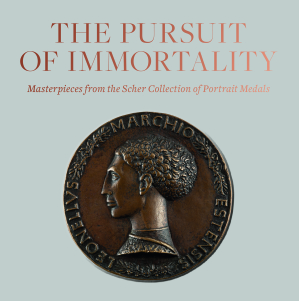 The Frick Collection recently announced the largest acquisition in its history—a promised gift of approximately 450 portrait medals from the incomparable collection of Stephen K. and Janie Woo Scher. Representing the development of the art of the portrait medal from its inception in fifteenth-century Italy to the nineteenth century, the Scher collection is arguably the world’s most comprehensive and significant collection of portrait medals. Comments Director Ian Wardropper, “Henry Clay Frick had an abiding interest in portraiture as expressed in the paintings, sculpture, enamels, and works on paper he acquired. The Scher medals will coalesce beautifully with these holdings, being understood in our galleries within the broader contexts of European art and culture. At the same time, the intimate scale of the institution will offer a superb platform for the medals to be appreciated as an independent art form, one long overdue for fresh attention and public appreciation.”
To celebrate the promised gift, The Frick Collection will mount an exhibition this spring entitled The Pursuit of Immortality: Masterpieces from the Scher Collection of Portrait Medals. The exhibition will explore the flourishing of the medallic arts in major European centers of artistic production and will feature superlative examples by masters of the art such as Pisanello (Italy), Dupré (France), and Reinhart (Germany). Taking and fresh approach to the study of medals, which have often been viewed in the past as specialist objects closer to the field of numismatics, this exhibition will examine medals within the larger context of art, honoring them as a triumph of sculptural production on a small scale. Visitors to the show will encounter a number of renowned sculptors who were also masters of the medal.
The Pursuit of Immortality: Masterpieces from the Scher Collection of Portrait Medals is organized by Aimee Ng, Associate Curator at the Frick, and Stephen K. Scher, an esteemed art historian as well as a collector. Accompanying the exhibition is a richly illustrated exhibition catalogue including an essay by Aimee Ng. (In the spring of 2018, a catalogue of the entire Scher Collection will be published, featuring essays by leading medals scholars and illustrated entries about each of the almost one thousand medals in the collection.)
◊ ◊ ◊ ◊ ◊
Aimee Ng, The Pursuit of Immortality: Masterpieces from the Scher Collection of Portrait Medals (London: Giles, 2017), 64 pages, ISBN: 978 19112 82068, £15 / $20.
Accompanying the exhibition is a richly illustrated exhibition catalogue including an essay by Aimee Ng. In the spring of 2018, a catalogue of the entire Scher Collection will be published, featuring essays by leading medals scholars and illustrated entries about each of the almost one thousand medals in the collection.
Aimee Ng is associate curator at The Frick Collection, New York, and a specialist in Italian Renaissance art. She has held curatorial and academic positions at the Morgan Library & Museum, where she was postdoctoral fellow at the Morgan’s Drawing Institute in 2014, and at Columbia University, where she earned her Ph.D. She was guest curator of The Poetry of Parmigianino’s ‘Schiava Turca’ (2014) and organizing curator of Andrea del Sarto: The Renaissance Workshop in Action (2015–16).
Former Labour MP Tristram Hunt To Direct the V&A
Press release (13 January 2017) from the V&A:
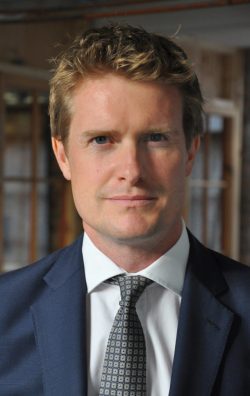 The V&A Trustees have today appointed Dr Tristram Hunt as the new Director of the V&A. Hunt has served as Labour MP for Stoke-on-Trent Central since 2010 and was previously the Shadow Secretary of State and Shadow Minister for Education. A historian, politician, writer, and broadcaster, Hunt is an expert on the eighteenth and nineteenth centuries, with a particular focus on Victorian urban history. He is the author of several books, including The English Civil War: At First Hand and most recently Ten Cities That Made An Empire. A regular history broadcaster on BBC and Channel 4, Hunt has made more than a dozen series on subjects including Elgar and Empire, Isaac Newton, and the English Civil War. Hunt lectures on modern British history at Queen Mary University of London. He is a Fellow of the Royal Historical Society, a founder of the Stoke-on-Trent Literary Festival and a Patron of the British Ceramics Biennial, and was previously a Trustee of both the Heritage Lottery Fund and the National Heritage Memorial Fund, and a Curator of the Mayor of London’s History Festival.
Hunt’s support of the ceramics industry, together with the Art Fund, played an important role in saving the Wedgwood Collection in 2014. The collection was gifted to the V&A and is on long-term loan to the Wedgwood Museum in Barlaston, Stoke-on-Trent. He brings widespread expertise across education, industry, and politics to the V&A and a keen awareness of the important role of major public institutions in the UK, having been at the forefront of political, cultural and public life for the last decade. Hunt’s appointment has been confirmed by the Prime Minister and the Secretary of State for Culture, Media and Sport, and he will join the Museum in the coming months.
Announcing the appointment, V&A Chairman Nicholas Coleridge said: “On behalf of the Trustees, I am delighted to announce the appointment of Dr Tristram Hunt as Director of the Victoria and Albert Museum. He has a highly compelling mixture of experience across public life, the arts, history, education and academia, and knows our collections well from his writing and broadcasting. In addition, he is an informed and articulate leader and communicator on numerous facets of culture, both historic and contemporary, and I greatly look forward to working with him at the V&A.”
Dr Tristram Hunt said: “I am delighted and honoured to have been appointed Director of the V&A. I have loved the V&A since I was a boy, and today it is a global leader in its unrivalled collections, special exhibitions, academic research, and visitor experience. It is a moment of transformation and renewal for the V&A, with the upcoming opening of the new Exhibition Road entrance and new sites and galleries in Dundee, China, and Stratford. I am particularly pleased that, through the V&A ownership of the Wedgwood Collection, my passion for education in Stoke-on-Trent can continue. The combination of the power of the collections and expertise of an inspirational team is what makes the V&A the world’s greatest museum of art, design, and performance. I am honoured to take on this exciting opportunity.”
Hunt has a First Class degree in history from the University of Cambridge (1995), before serving as an Exchange Fellow at The University of Chicago (1996). Hunt also has a PhD from the University of Cambridge on “Civil Thought in Britain, 1820–1860.” He has lectured on British and international culture at the Centre for European Studies, University of California, Berkeley; the Centre for European Studies at Harvard; Princeton University; and the National University of Singapore.
After working on the 1997 General Election campaign, he became a Special Adviser to Science Minister Lord Sainsbury (1997–2000), Associate Fellow at the Centre for History and Economics, King’s College, Cambridge and Senior Fellow at the Institute for Public Policy Research.
Between 2001 and 2010, Hunt combined his post as Senior Lecturer in British History at Queen Mary, University of London with work as a history broadcaster, presenting over fifteen radio and television programmes for the BBC and Channel 4 on subjects including Elgar and Empire, Isaac Newton, and the English Civil War. In addition to making regular contributions to The Guardian and The Observer, he is also the author of The English Civil War: At First Hand (2002), Building Jerusalem: The Rise and Fall of the Victorian City (2004), and the award-winning biography, The Frock-coated Communist: The Revolutionary Life of Friedrich Engels (2009), and Ten Cities That Made an Empire (2014). During this period, Hunt also served as a Trustee of the National Heritage Memorial Fund, the Heritage Lottery Fund, and the Centre for Cities think-tank.
Since entering Parliament, Hunt has focused on educational excellence, the regeneration needs of Stoke-on-Trent, the ceramics industry, and energy intensive sector. He is a Trustee of the History of Parliament Trust and fellow of the Royal Historical Society. From October 2013 until September 2015, Hunt served as Labour’s Shadow Education Secretary focusing on developing Labour’s policy on teachers’ professional development, vocational education and early years education.
Exhibition | Alexandre Lenoir’s Museum of French Monuments
I’m nearly a year late with this posting, but the catalogue is still available. –CH
From the Louvre:
Un Musée révolutionnaire: Le musée des Monuments français d’Alexandre Lenoir
A Revolutionary Museum: Alexandre Lenoir’s Museum of French Monuments
Musée du Louvre, Paris, 7 April — 4 July 2016
Curated by Geneviève Bresc-Bautier and Béatrice de Chancel-Bardelot
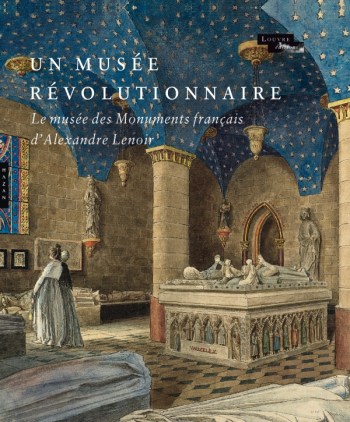 Dating from 1795, the Museum of French Monuments was France’s second national museum, coming in the wake of the Louvre, founded in 1793. It played a major part in the birth of the notion of heritage and the emergence of medieval history. However, it was closed in 1816 and its contents are currently to be found in institutions in France—the Louvre’s Department of Sculptures, the Ecole des Beaux-Arts in Paris, the basilica of Saint-Denis, the Musée de Cluny, Notre Dame, various churches in the Paris diocese—and abroad: mainly in the Metropolitan Museum in New York, but also in the Victoria and Albert Museum in London. The exhibition recounts the pioneering achievement of Alexandre Lenoir as museum curator, exhibition designer, and fervent heritage protector. It also explores the establishment and history of the Museum of French Monuments, whose exhibition style had a powerful influence on the sensibility and the arts of the period.
Organized by Geneviève Bresc-Bautier (Musée du Louvre), and Béatrice de Chancel-Bardelot (Musée de Cluny-Musée National du Moyen Âge).
From Hazan:
Geneviève Bresc-Bautier and Béatrice de Chancel-Bardelot, eds. Un Musée révolutionnaire: Le musée des Monuments français d’Alexandre Lenoir (Paris: Hazan, 2016), 380 pages, ISBN: 978 27541 09376, €45.
Alexandre Lenoir (1761–1839), fervent défenseur des arts face au vandalisme révolutionnaire, fut le créateur et l’administrateur du musée des Monuments français de 1791 à sa fermeture en 1816 et à la dispersion de ses collections.L’exposition qui se tiendra dans le hall Napoléon du musée du Louvre du 7 avril au 4 juillet 2016 s’attache dans un premier temps à présenter l’histoire et l’influence de cette institution et de son fondateur sur l’historiographie et la conservation du patrimoine français. Dans un second temps, l’exposition dévoile au public plusieurs ensembles de sculptures tels qu’ils étaient exposés au musée des Monuments français, notamment les statues-colonnes de Gaillon représentant Jeanne d’Arc et Louis XII ou encore le tombeau de Valentine Balbiani et du cardinal René de Birague. Plus qu’un catalogue d’exposition, la publication accompagnant cet événement constitue un véritable ouvrage de référence sur le musée des Monuments français. Dirigé par les commissaires d’exposition Geneviève Bresc-Bautier et Béatrice de Chancel, il rassemble vingt-huit textes d’historiens de l’art accompagnés de plus de deux cent cinquante illustrations, notamment les nombreuses vues de salles à l’aquarelle de Jean-Lubin Vauzelle qui font revivre un instant ce musée aujourd’hui disparu.
New Book | ‘Muilman, Crokatt, and Keable’ by Gainsborough, ca. 1750
My heading is something of a misnomer. This publication isn’t a codex and doesn’t work the way even a digital book typically does. And yet, it also is different from a collection of essays, such as one finds in a journal (whether with paper or digital formats). I don’t think we (yet) have a name for this sort of publication. Perhaps it’s simply a catalogue, but that seems to suggest something grander than this entirely focused scope. I would welcome suggestions. Looking too casually at the Tate’s website where the publication is hosted, one might think it comparable to the sorts of entries often available on museum websites. And it may be akin in some ways, but it is conceived as a coherent, discreet publication, complete with an editor and peer review. The default word (for almost everything) now seems to be ‘project’. Whatever we call it, I’m looking forward to using it in class later this spring. –CH
From Tate:
John Chu, ed., “A Tate In Focus Project: Peter Darnell Muilman, Charles Crokatt and William Keable in a Landscape c. 1750, by Thomas Gainsborough, ca. 1750,” with essays by John Chu, Huw David, Hannah French, Alexandra Gent, Rebecca Hellen, and Peter Moore, and a recording and interview by Hannah French (London: Tate Research Publication, 2017).
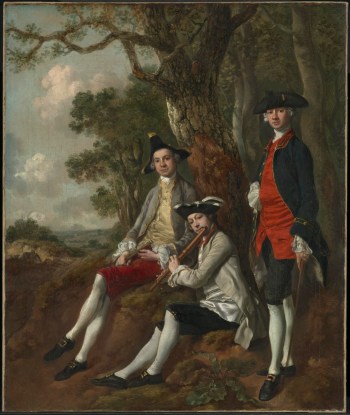
Thomas Gainsborough, Portrait of Peter Darnell Muilman, Charles Crokatt, and William Keable in a Landscape, ca.1750 (Tate T06746 / Gainsborough’s House).
Offering a multi-disciplinary discussion of Gainsborough’s early triple portrait, this project considers the painting as a depiction of polite and refined society, as a reflection of the growing wealth of a global mercantile elite, and as a ‘painting within a painting’ by an artist as renowned for his landscapes as he was his portraiture.
The mid-eighteenth-century ‘conversation piece’ Peter Darnell Muilman, Charles Crokatt and William Keable in a Landscape was painted by Thomas Gainsborough (1727–1788) when he was still making a name for himself as landscape and portrait painter. It was acquired jointly by Gainsborough’s House and Tate in 1993 and is regarded as a masterpiece of this early phase of his career. This project draws together expertise from the fields of art history, conservation, history of commerce and musicology to throw light on the social and cultural milieu that gave rise to the commission. It asks as many questions about the financial and social privileges of the portrait’s sitters as it does about Gainsborough himself, proposing new ways of understanding why Muilman, Crokatt and Keable presented themselves making music in the midst of a remote rustic landscape.
C O N T E N T S
• John Chu—The Painting and ‘Early Gainsborough’
• Huw David—Patronage: Mercantile Sitters
• Rebecca Hellen and Alexandra Gent—Painting the Picture
• John Chu—Portraiture, Conversation, Politeness
• Hannah French—Music, Refinement, Masculinity
• Hannah French and John Chu,—Baroque Flute Recording and Interview with Hannah French
• John Chu—Landscape, Imitation, Cosmopolitanism
• Peter Moore—Mercantile Culture and National Identity
• Acknowledgments
Contributors
John Chu, Assistant Curator, Pictures and Sculpture, National Trust
Huw T. David, Director of Development, Rothermere American Institute, University of Oxford
Rebecca Hellen, Paintings Conservator, Tate
Alexandra Gent, Paintings Conservator, Tate and Courtauld Institute of Art
Hannah French, musicologist and baroque flautist, Royal Academy of Music
Peter Moore, Research Curator, Gainsborough’s House
Call for Papers | Water, Gods, and the Iconography of Power

Design for a Carriage Built by Andrea Cornely after a design by Ciro Ferri, engraving published in An Account of His Excellence, Roger Earl of Castelmaine’s Embassy from His Sacred Majesty James the II King of England, Scotland, France and Ireland &c. To His Holiness Innocent XI (London, ca. 1687). London: V&A 19393. Inscriptions read: “The Tritons behind support two Majestic figures of Neptune & Britannia who extend each / an Arm & rear up the Imperial Crown of England’ and in the lower center of the plate, “A Marine Lion with two Genii each curbing ye Lion & Unicorn, one next Neptune holds his Trident”
◊ ◊ ◊ ◊ ◊
A donde Neptuno reina: Water, Gods and the Iconography
of Early Modern Power (16th–18th Centuries)
CHAM Conference—Oceans and Shores: Heritage, People, and Environments
Lisbon, 12–15 July 2017
Proposals due by 1 February 2017
Since Antiquity, the personification of water—rivers or seas—has been a recurrent elements in the iconography related to power. From the Tigris to the Ganges, from the Mare Nostrum to the Atlantic Sea, water seems to have been an essential element in the visual display of powerful monarchies and empires. After the European discovery of the Americas, oceans started also to play an extraordinary role in allegorical representations, especially in Spain and Portugal, though elsewhere, too. This panel approaches water iconography, especially as related to oceans, as a mode of representation of power during the early modern period, addressing its role in politics and culture. We are interested in arts, music, and literature, and how they relate to the iconography of water and its relationship with power. Especially welcome are cross-disciplinary contributions, proposals that address different cases studies in a comparative way, and studies focused on ephemeral architecture and theatrical contexts. Topics may include, but are not limited to:
• Ephemeral art: Celebrations of victories, kings’ birthdays, or even religious events were the perfect context for the representation of water as the image of rulers.
• Prints, emblems, and propaganda: How does the topic relate to rulers’ propaganda?
• European powers and the new geography: How did sovereigns employ discoveries into their own images of power?
• Odes, poetry, and epic: How did literature use the image of oceans and rivers to glorify rulers, and what were the implications for the visual arts?
More information is available at the CHAM conference website, and please direct any questions to Dr. Pilar Diez del Corral Corredoira, diezdelcorralcorredoira@tu-berlin.de. Proposals are due by 1 February 2017.
Print Quarterly, December 2016
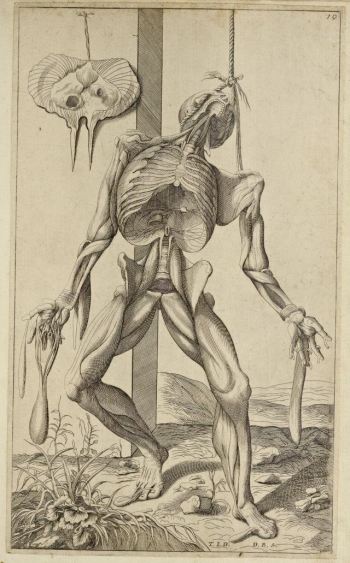
Domenico Bonaveri, Muscle Figure, pl. 10 from Notomie di Titiano (Bologna, ca, 1685–90), etching and engraving (Los Angeles: Getty Research Library).
The December 2016 issue of Print Quarterly includes several items relevant to the eighteenth century: articles concerning a redating of the Notomie di Titiano to c. 1685–90, a scrapbook in the Bibliotheca Thysiana in Leiden assembled in the late seventeenth or early eighteenth century, and a rediscovered drawing of 1669–80 by Jean Boulanger, as well as shorter pieces on the Dresden festivities of 1719 and prints and propaganda in the age of Napoleon.
Print Quarterly 33.4 (December 2016)
A R T I C L E S
• Monique Kornell, “A Dating for Domenico Bonaveri’s Notomie di Titiano,” pp. 379–91.
• Daphne E. Woutsa, “Exploring the Thysiana Scrapbook,” pp. 391–406.
• Angelamaria Aceto, “A Rediscovered Drawing by Jean Boulanger (1608–c.1680),” pp. 406–15,
N O T E S
• Madeleine Brook, “Constellatio Felix in 1719,” pp. 449–51.
• Philippe Bordes, “Prints and Propaganda in the Age of Napoleon,” pp. 453–55.
A full content list is available here»
Knole, Kent in the ‘NT Houses & Collections Annual, 2016’
Now available for free digitally, or as a hard copy through the National Trust:
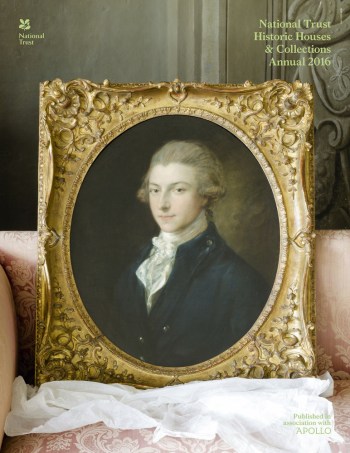 The National Trust Historic Houses & Collections Annual 2016, published in association with Apollo, is dedicated to Knole in Kent and includes these essays on eighteenth-century topics:
• Camilla Beresford, “The Bird House At Knole.” Considers a mid-18th-century gothic curiosity that once housed a remarkable collection of exotic birds.
• Christopher Rowell and Wolf Burchard, “The Third Duke of Dorset and the First Earl Whitworth as Diplomatic Patrons and Collectors.” Considers the many examples of furniture at Knole associated with the French court on the eve and aftermath of the French Revolution.
• John Chu, “Thomas Gainsborough’s Portrait of Louis-Pierre, Marquis de Champcenetz.” On how the Marquis, whose portrait by Gainsborough returns to Knole this year, found refuge and friendship in England (the portrait was at Knole by 1793 and remained there until 1930).
A full list is available here»
Call for Articles | French Porcelain, 1789–1918

Makers, Markets, and Museums: French Porcelain in the Long Nineteenth Century, 1789–1918
The French Porcelain Society Journal 7 (2018)
Proposals due by 7 April 2017
The French Porcelain Society Journal is the leading academic English-language journal on European ceramics and their histories, illustrated throughout in full colour. The society is pleased to announce the publication of Volume 6, Céramiques sans Frontières: The Transfer of Ceramic Designs and Technologies across Europe. Based on the society’s 2015 symposium, fourteen articles investigate the impact of French ceramic design on makers elsewhere in Europe and in Britain in the eighteenth and nineteenth centuries. These range from an analysis of the transfer of the Istoriato maiolica tradition from Italy to France in the late sixteenth century and an account by J.V.G. Mallet of the travels of Walther Ehrenfried von Tschirnhaus to an investigation of the links between Sèvres and Minton porcelain in the nineteenth century. For a full list of contents or to order, please consult the society’s website.
The editors now invite submissions for volume 7 of the journal, Makers, Markets, and Museums: French Porcelain in the Long Nineteenth Century, 1789–1918, to be published in 2018. From the dispersal of Sèvres porcelain from royal palaces and aristocratic collections after the French Revolution to the founding of outstanding collections of French porcelain in Britain and the United States and the establishment of new museums for the decorative arts, the nineteenth century was undoubtedly one of seismic change. It witnessed the growth of a flourishing London art market and new departures in collecting French eighteenth-century decorative art, all encouraged by the rise of the dealer. Innovation in design and manufacture was documented in a plethora of printed specialist publications, pattern books and popular journals. It is hoped that this volume will enlarge our understanding of this under-researched but important aspect of ceramic history.
The journal will include an article based on the 2016 Geoffrey de Bellaigue lecture given to the society by Dr Tom Stammers (Durham University) on “Baron Jean-Charles Davillier: A Paragon and Historian of Taste in Nineteenth-Century France.” Topics for consideration could include:
• Nineteenth-century French ceramics or those of other factories influenced by them
• Nineteenth-century collectors
• Methods of display in the nineteenth-century interior
• The role of new museums, exhibitions, and publications in advancing the study and collecting of French ceramics
• The dealer, the auction, and the art market
• New technical advances in ceramic production
• Connoisseurship
Submissions in the first instance should be a summary of no more than 750 words, with a brief description of the argument, a historiography and a note of the research tools and sources used. Please include a brief CV. The journal accepts articles in French as well as in English. The volume will comprise about 15 articles which will be peer reviewed by the editorial board and the FPS council of academic and museum specialists which includes: Dame Rosalind Savill, DBE, FBA, FSA (Curator Emeritus, The Wallace Collection, London); Oliver Fairclough, FSA, John Whitehead, FSA, Patricia Ferguson, Errol Manners, FSA, Diana Davis and Caroline McCaffrey-Howarth (University of Leeds). Articles should be no more than 6,000 words in length excluding endnotes. Up to 15 high-resolution images per article will be accepted. Please send abstracts as an e-mail attachment to: diana_davis@hotmail.co.uk by 7 April 2017. If your abstract is accepted, articles and images will be due by 29 September 2017.
Exhibition | Classicisms
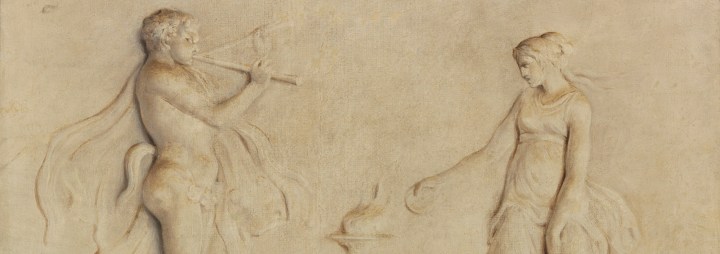
Tommaso Gherardini, Classical Relief (detail), 1765, oil on canvas (Chicago: Smart Museum of Art, Gift of the Collection of Edward A. and Inge Maser, 2008.23).
◊ ◊ ◊ ◊ ◊
From the Smart Museum of Art:
Classicisms
Smart Museum of Art, The University of Chicago, 16 February — 11 June 2017
Curated by Larry Norman and Anne Leonard
Classicism, as an aesthetic ideal, is often associated with a conventional set of rules founded on supposedly timeless notions such as order, reason, and decorum. As a result, it can be understood as rigid, outdated, or stodgy. But classicism is actually far from a stable concept—throughout history, it has given rise to more debate than consensus, and at times has been put to use for subversive ends.
Organized by the Smart Museum of Art and informed by an interdisciplinary planning process involving faculty members from across the University of Chicago, Classicisms explodes the idea of classicism as an unchanging ideal. The exhibition features 70 objects spanning diverse genres, eras, and media—paintings, ancient and modern sculpture, cast plaster replicas, and works on paper. Together with a scholarly catalogue, the exhibition traces classicism’s meanings across the centuries from varying artistic, cultural, and ideological perspectives to reveal a multifaceted concept with a complicated history.
◊ ◊ ◊ ◊ ◊
Distributed by The University of Chicago Press:
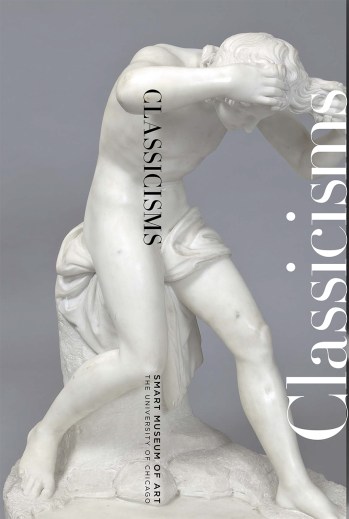 Larry F. Norman and Anne Leonard, ed., Classicisms (Chicago: Smart Museum of Art, The University of Chicago, 2017), 184 pages, ISBN: 978 0935 573572, $30. With essays by Richard T. Neer, Susanna Caviglia, Andrei Pop, Frederick A. de Armas, Benjamin Morgan, Jennifer Wild, Rebecca Zorach, and Glenn W. Most; and other contributions from Rainbow Porthé, Ji Gao, Esther Van Dyke, Caitlin Hoff, Rebecca Crisafulli, and James Nemiroff.
This volume explodes the idea of classicism as an unchanging ideal. Through essays and other contributions from an interdisciplinary group of scholars, it traces the shifting parameters of classicism from antiquity to the twentieth century, documenting an exhibition of seventy objects in various media from the collection of the Smart Museum of Art and other American and international institutions. With its impressive historical and conceptual reach—from ancient literature to contemporary race relations and beyond—this colorfully illustrated book is a dynamic exploration of classicism as a fluctuating stylistic and ideological category.










 Enfilade
leave a comment