2015 Berger Prize for British Art History: James Barry’s Murals
Congratulations to Bill Pressly!
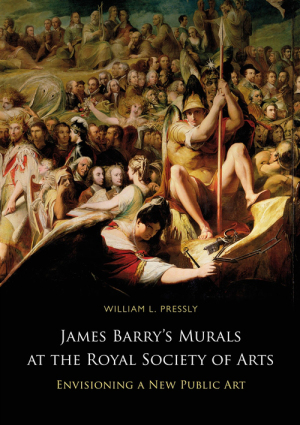 On December 7, William Pressly was awarded the 2015 William M. B. Berger Prize for British Art History for his book James Barry’s Murals at the Royal Society of Arts: Envisioning a New Public Art (Cork University Press). The book demonstrates that Barry’s RSA paintings contain a hidden meaning that has gone undetected for 230 years. The pictures offer in the heart of the London establishment a glorification of the Roman Catholic Church. The artist’s creation of a complex, mythic narrative establishes him as the mentor of William Blake, whose approach to art owes a profound debt to the Irishman’s example.
Other titles relevant to the eighteenth century on the short list included:
• Ruth Guilding, Owning the Past: Why the English collected Antique Sculpture, 1640–1840 (Yale University Press for the Paul Mellon Centre for Studies in British Art)
• Jane Munro, Silent Partners: Artist and Mannequin from Function to Fetish (Yale University Press in Association with the Fitzwilliam Museum, Cambridge)
• Malcolm Baker, The Marble Index: Roubiliac and Sculptural Portraiture in Eighteenth-Century Britain (Yale University Press for the Paul Mellon Centre for Studies in British Art)
The complete list, including the long list is available here»
Winterthur’s Online Collections Reaches 60,000 Entries
As noted recently at Art Daily:
In an effort that began ten years ago, Winterthur Museum, Garden & Library has accomplished a significant milestone: 60,000 objects in the Winterthur collection have been catalogued or re-catalogued and made available to the public through Winterthur’s Online Collections.
In late summer of 2005, Winterthur welcomed new collections management software, and more than 70 staff and volunteer cataloguers began the process of cataloguing or re-cataloguing the entire collection of nearly 90,000 objects. With the help of many grants, approximately 16,000 ceramics, 14,500 metals, 11,000 textiles and needlework 3,500 prints and maps, 3,200 glass objects, 3,000 pieces of furniture, as well as architectural elements, paintings, tools, toys and games, works on paper, and more have been catalogued. In addition, nearly 152,000 digital images have been added to Winterthur’s collection database.
“We are incredibly grateful to all of our cataloguers over the years, as well as to those agencies, organizations, and individuals who have contributed to this project. Creating our Online Collections has given the public and scholars important access to the Winterthur collection and the wealth of information it has to offer, and in doing so, the Museum has been able to engage new audiences with its collection,” said Linda Eaton, John L. & Marjorie P. McGraw Director of Collections & Senior Curator of Textiles.
The original grant that started this process was given by the Jane du Pont Lunger Residual Trust Fund, which also funded the purchase of digital photographic equipment. Several other grants from federal agencies, foundations, and generous private supporters have helped Winterthur reach this achievement. Four grants from the Institute of Museum and Library Services made possible cataloguing discrete parts of Winterthur’s diverse collections of decorative and fine arts. The textile collection, an important resource for historians internationally, was partially catalogued through two grants for furnishing textiles and printed textiles. Winterthur’s collection of tools used by artisans in trades ranging from carpentry to silversmithing to needlework is the focus of the most recent grant that will be completed June 2016. An additional grant from the National Endowment for the Arts scanned and photographed half of the maps and prints in the collection, which are now available online. A grant from The Coby Foundation catalogued quilts and other bed covers, while a grant from the Museum Loan Network was used to catalogue and photograph 100 pre-1800 English ceramics that were then made available for loan on the MLN website. The generosity of Leslie B. Durst has made it possible to catalogue and photograph the needlework collection.
The Getty Acquires 31 Pieces of French Decorative Arts
Press release (12 January 2016) from The Getty:

Wall Clock, with clock movement probably by Nicolas Thomas, ca. 1785; gilt bronze, enameled metal, glass, 49.5 x 55.9 cm (Los Angeles: The J. Paul Getty Museum)
The J. Paul Getty Museum today announced the acquisition of an important collection of eighteenth-century French decorative arts assembled by Dr. Horace Wood (Woody) Brock, one of the world’s foremost economists. The acquisition is a combined gift and purchase. The thirty-one works of art include seven clocks; six gilt-bronze mounted porcelain, feldspar and porphyry objects; five works in gilt bronze including a pair of candelabra, two sets of firedogs, and two sets of decorative vases; a carved gilt-wood console table; a porcelain inkstand; and a leather portrait medallion of Louis XIV. The collection substantially enhances the Getty Museum’s extraordinary holdings of French decorative arts, renowned as one of the most important outside France.
“These exquisite objects constitute the most significant acquisition of French decorative arts made by the Museum in many years,” said Timothy Potts, director of the J. Paul Getty Museum. “Produced in the sophisticated artistic culture of eighteenth-century Paris, these extraordinary works epitomize the skill and artistry that made the French court and aristocratic life the epitome of elegant extravagance, and the envy of collectors throughout Europe. We are deeply grateful to Dr. Brock for his generosity in enriching our collection with this important gift and purchase.”

Mantel Clock, ca. 1789. Clock case attributed to Pierre-Philippe Thomire; clock movement by Charles-Guillaume Manière; patinated bronze, gilt bronze, enameled metal, glass, white marble, griotte marble, 55.2 × 64.5 × 19.1 cm (Los Angeles: The J. Paul Getty Museum, Los Angeles)
Dr. Brock has been collecting French and English decorative arts and Old Master drawings for the last thirty years. He began lending decorative arts objects to the Getty Museum in 1997 and made several long-term loans through 2008. Since being lent to the Getty, these objects have been on continuous display in the European decorative arts galleries in the South Pavilion Plaza Level at the Getty Center.
“The objects collected by Dr. Brock are sumptuous and refined pieces of the highest quality that have significantly enriched the French Decorative Arts galleries since the opening of the Getty Center in 1997,” said Anne-Lise Desmas, curator and department head of Sculpture and of Decorative Arts. “They have become key components in the Museum’s recreation of French eighteenth-century interiors and have played an essential role in our visitors’ experience and understanding of this critical period of European art.”
The newly-acquired works were created as luxury objects that would have decorated the lavishly furnished residences of the French aristocracy and bourgeoisie. Many, such as the clocks, candelabra, and the inkstand, were made for practical use, but their sophisticated design and rare materials were also meant to demonstrate the wealth, prestige, and refined taste of their owners. The objects represent the full range of decorative styles practiced during the eighteenth century, from the grandeur and opulence of late Baroque and Régence, through the intimate brilliance of the Rococo, to the severe restraint of the Neoclassical.
Highlights of the collection include a pair of gilt-bronze candelabra (2015.60.1) attributed to the prominent Baroque cabinetmaker André-Charles Boulle, called during his lifetime “the most skillful artisan in Paris.” Two early Rococo lidded jars (2015.70) include exotic motifs from the Far East; porcelain and hardstones were avidly collected and prominently displayed, mounted with gilt bronze to highlight the beauty and rarity of porphyry and feldspar.
A passionate collector of decorative arts, Dr. Brock knows the Getty Museum’s outstanding collection intimately. Consequently, he has given works that fit exceptionally well in the context of the Museum. For example, the extraordinary gilt-bronze wall clock in the form of a winged clock face (2015.67) adds an important model not currently represented in the collection and the imposing Neoclassical mantel clock with Vestal Virgins (2015.64) attributed to Pierre-Philippe Thomire joins a significant group of objects from early in that artist’s career already belonging to the Museum.
Most of the donations have been made in honor of Theodore Dell, an important scholar who catalogued the French furniture and gilt bronzes at The Frick Collection in New York. Dell was a consultant to Gillian Wilson, former Getty Museum curator of decorative arts, and helped Dr. Brock in the formation of his collection. Dell assembled an important library of sales catalogues, journals, magazines, books, and museum catalogues, all focused on French decorative arts, which he donated to the Bard Graduate Center Library in 2012. Other objects have been donated to the Getty in honor of Gillian Wilson as well as knowledgeable dealers in decorative arts such as Leon Dalva, Will Iselin, Pascal Izarn, Laurent and Olivier Kraemer, and Martin Zimet; and, in memory of Frank Berendt, Philippe Kraemer, and François Léage.
“The J. Paul Getty Museum contains a superb collection of the decorative arts of eighteenth-century France, a period in which the quality of design and craftsman ship arguably reached its historical zenith. My hope is that the objects I have collected will permanently enhance this already remarkable collection,” says Dr. Horace Wood Brock.
Dr. Horace Brock earned his B.A., M.B.A., and M.S. in Mathematics from Harvard University, and his M.A. and Ph.D. from Princeton University (Mathematical Economics and Political Philosophy). He is the former president and founder of Strategic Economic Decisions (SED), Inc., and specializes in applications of the modern economics of uncertainty to forecasting and risk assessment in the international economy and its asset markets. He has developed a new theory of rational beliefs that disputes the classical theory of efficient markets and is the author of American Gridlock: Why the Right and the Left Are Both Wrong — Commonsense 101 Solution to the Economic Crises (Wiley: 2012).
Congratulations to Pierre-Henri Biger
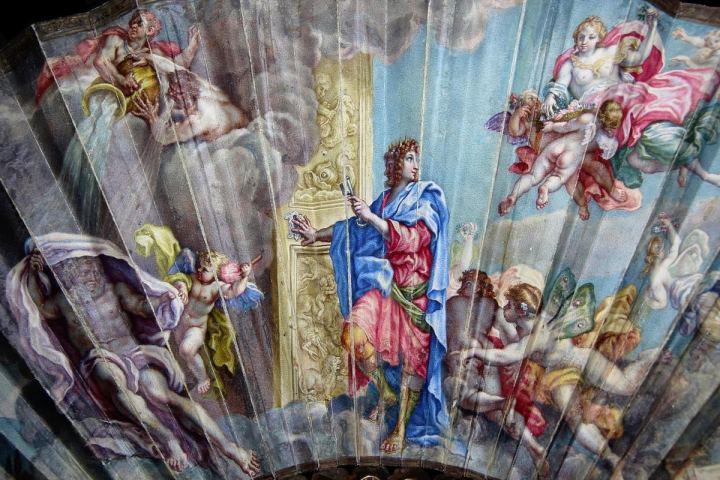
Eighteenth-century fan, after Carlo Maratta, showing Janus at the Door of the New Year
(C&PHB Collection)
◊ ◊ ◊ ◊ ◊
Along with so many fabulous readers, Enfilade has become what it is thanks to fabulous contributors. There are many. But today, I’m glad to single out Pierre-Henri Biger, who defended his PhD thesis in October (at, he tells me, the spry age of 64). Congratulations Pierre-Henri, and we look forward to seeing what comes next! –CH
Pierre-Henri Biger, “Sens et sujets de l’éventail européen de Louis XIV à Louis-Philippe,” Université Rennes 2.
Abstract : Nowadays fans are often kitsch and for tourists. Associated with fashion, these fragile feminine objects have been misjudged and remain unknown. Built for this thesis from public and private collections and public sales, an eclectic database is capable, thanks to a statistical approach, to query and study 2350 items. This study deals mainly with the topics on fan leaves during a very long eighteenth century. Twenty monographs are focusing on objects of the various determined categories. Statistics and monographs, informed by the observation of contemporary art and society, enter into dialogue. The fan appears as a reflection of art through myths, sacred and ancient history, and morality painting. But it is also a witness or an actor in the social, political, and theatrical life, and even used for promoting economic projects or for caricature. Almost all fans carry a meaning, even those ‘without history’, adorned with pastoral scenes, seemingly only mirrors of fashion or occasions of entertainment. This meaning has long been obscured because of the social transformations of the nineteenth century, perhaps for the reason that fans were originally an area of freedom and power of women – even going to libertinism? – For this objet d’art, both public and private, speaks, through the subjects that adorn it, a real speech (largely related to marriage but to love as well). Woman was both recipient and speaker. Studying these objects and learning to decipher their messages would improve their understanding and benefit various disciplines.
More information, including how to download a copy is available here
Exhibition | Forbidden Fruit: Chris Antemann at Meissen

Chris Antemann in collaboration with Meissen®, Covet, 2013
©Chris Antemann and Meissen Couture®
◊ ◊ ◊ ◊ ◊
Closing this weekend in Pittsburgh, the exhibition opens in Bellevue next month:
Forbidden Fruit: Chris Antemann at Meissen
Portland Art Museum, Portland, Oregon, 27 September 2014 — 19 April 2015
The Frick, Pittsburgh, 3 October 2015 — 10 January 2016
Bellevue Arts Museum, Bellevue, Washington, 26 February — 29 May 2016
Museum of Arts and Design, New York, 22 September 2016 — 5 February 2017
In 2012, Oregon-based sculptor Chris Antemann was invited to participate in the Art Studio program of the legendary Meissen Porcelain Manufactory. During the program she collaborated with the Meissen master artisans on unique pieces and a series of limited editions of her sculptures, resulting in a grand installation that reinvents and invigorates the great porcelain figurative tradition.
Using the Garden of Eden as her metaphor, the artist created a contemporary celebration of the 18th-century banqueting craze. Inspired by Meissen’s great historical model of Johann Joachim Kändler’s monumental Love Temple (1750), Antemann created her own 5-foot work. Stripping the original design back to its basic forms, she added her own figures, ornamentation, and flowers, as well as a special finial with three musicians to herald the guests to the banquet below. Employing her signature wit and formal references to classic Baroque Meissen figurines, Antemann has invented a new narrative on contemporary morality through her one-of-a-kind porcelain figures in a setting that evokes the decadence of Boucher and Watteau.
Exhibition | Blood in the Sugar Bowl
Opening in the spring at Stanford:
Blood in the Sugar Bowl
Cantor Arts Center, Stanford University, 6 April — 4 July 2016
Curated by Rachel Newman
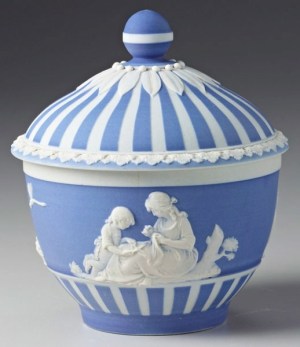
Josiah Wedgwood, Covered Sugar Bowl, ca. 1785–95, stoneware (Cantor Arts Center Collection, 1989.154.a-b)
This exhibition focuses on sugar plantation slavery during the peak of the sugar trade, the late 18th to mid-19th century. On display are sugar bowls from the Cantor’s collection, Henry Corbould’s illustration Fashionable Women Pouring Tea, James Gillray’s caricature The Anti-Saccharites, several volumes from Stanford University Libraries Special Collections including James Hakewill’s beautiful plantation views from his 1821 Picturesque Tour of the Island of Jamaica and William Blake’s depictions of slave torture in his 1777 Narrative, of a five years’ expedition, against the revolted Negroes of Surinam. Personalizing the slave narrative are Benjamin M’Mahon’s Jamaica Plantership and other audio excerpts of texts written by slaves and sugar plantation employees. D. R. Wakefield’s 2004 series Resistance Is Useless: Portraits of Slaves from the British West Indies is also on display.
Student curator: Stanford PhD candidate and Mellon Curatorial Research Assistant Rachel Newman
Exhibition | Portals to the Past: British Ceramics, 1675–1825

William Greatbatch, Tea Canister, Soup Plate, Teapot; Fenton, Staffordshire, England, 1765–1770, cream-colored earthenware, lead glaze (Charlotte: The Mint Museum)
◊ ◊ ◊ ◊ ◊
From The Mint Museum:
Portals to the Past: British Ceramics, 1675–1825
The Mint Museum, Charlotte, North Carolina, opening 16 January 2015 (running for two years)
The Mint Museum’s collection of eighteenth-century British pottery and porcelain is widely respected for its scope and quality. The collection numbers over 2,000 objects and includes important examples of both salt-glazed and dry-bodied stoneware from Staffordshire; tin-glazed earthenware from Bristol, Liverpool, and London; and cream-colored earthenware from Derbyshire, Staffordshire, and Yorkshire. Notable eighteenth-century porcelain factories represented include Chelsea, Bow, and Vauxhall in London, Longton Hall in Staffordshire, Worcester, Bristol, and others. Individual works in the collection are exceptional because of their rarity, craftsmanship, provenance, or as representative examples of particular types or methods of production or decoration.

William Littler, Sweetmeat Stand; West Pans, East Lothian, Scotland, 1765–70, earthenware, lead glaze (Charlotte: The Mint Museum)
British Ceramics 1675–1825 presents more than 200 highlights of this collection in a new installation in the Alexander, Spangler, and Harris Galleries at Mint Museum Randolph. The objects are interpreted through a variety of thematic lenses—function, style, manufacturing technique, maker—to encourage visitors to engage with the objects in ways they find personally meaningful and interesting. The exhibition includes many objects that have never before been on view, as well as contemporaneous works of art in from the Mint’s holdings in other media, including paintings, furniture, fashion, and silver.
The exhibition’s opening follows the December release of a 270-page, illustrated catalogue, British Ceramics 1675–1825: The Mint Museum, produced by the museum in collaboration with D. Giles Limited, London. Both the catalogue and the exhibition honor the fiftieth anniversary of the museum’s purchase of the Delhom Collection of British and European ceramics.
Portals to the Past: British Ceramics 1675–1825 is presented by the Delhom Service League, ceramics affiliate of The Mint Museum, with additional support provided by Moore & Van Allen.
◊ ◊ ◊ ◊ ◊
From Giles:
Brian Gallagher, Barbara Stone Perry, Letitia Roberts, Diana Edwards, Pat Halfpenny, Maurice Hillis, and Margaret Ferris Zimmerman, British Ceramics 1675–1825: The Mint Museum (London: D. Giles Limited, 2015), 272 pages, ISBN: 978-1907804366, £50 / $80.
 British Ceramics 1675–1825 is an important and visually stunning new publication which highlights 200 of the best pieces from the The Mint Museum’s collection, selected on account of their rarity, craftsmanship, notable provenance, or as important examples of particular types, or methods of production, or decoration. Each object is illustrated in colour, and is accompanied by a catalogue entry including title, manufacturer, date, medium, marks, dimensions, description of other unique physical aspects (inscriptions or quote on the body of the vessel), provenance, previous publication history and exhibition history. Descriptive text for each piece covers unusual and pertinent aspects of its manufacture and history.
Brian Gallagher is the curator of Decorative Arts, The Mint Museum. Barbara Stone Perry is the former curator of Decorative Arts, The Mint Museum. Letitia Roberts is an independent scholar and consultant, and the former senior international specialist for European Ceramics and Chinese Export Porcelain at Sotheby’s, New York. Diana Edwards is a prolific writer and lecturer on seventeenth- and eighteenth-century British ceramics, and advises numerous ceramics organizations. Pat Halfpenny is a highly respected expert on Staffordshire pottery, and is curator emerita of Ceramics and Glass and retired Director of Museum Collections at Winterthur Museum, Delaware. Maurice Hillis has published extensively on eighteenth-century English pottery and porcelain, and is the former chairman and current president of the Northern Ceramic Society, United Kingdom. Margaret Ferris Zimmermann lectured on ceramics for the Delhom Service League’s orientation program at The Mint Museum for many years and is the former editor of the American Ceramic Circle Journal.
Call for Papers | Imagining Apocalypse
Imagining Apocalypse
Oxford University, 18 June 2016
Proposals due by 28 February 2016
The University of Oxford research network, Romanticism and Eighteenth-Century Studies Oxford invites proposals for a one-day interdisciplinary conference to be held at Oxford University on 18 June 2016 on the subject of Imagining Apocalypse. A plenary lecture will be given by Professor Fiona Stafford (Professor of English Language and Literature, University of Oxford). The conference aims to bring together academics from across English, History, Theology, History of Art, and Music to reassess the numerous responses to the idea of apocalypse produced during the long eighteenth century (1660–1830).
Possible topics might include, but are not limited to:
• The French Revolution as apocalyptic
• Millenarial cults, the Bible, and prophecy
• The summer of 1816 and apocalyptic anxiety
• Secular doomsday and apocalypse without millennium
• Scientific predictions concerning the end of the world
• The figure of the ‘Last Man’
• Parodies and satires of apocalypse
• The apocalyptic city
• Apocalypse as ‘unveiling’
• Post-apocalypse
• The legacy of long eighteenth-century depictions of apocalypse
Please email abstracts of no more than 250 words to catherine.redford@hertford.ox.ac.uk no later than Sunday 28 February 2016 along with a short biographical note. Proposals for roundtables and panels, as well as traditional 20-minute papers, are welcome.
V&A Design a Wig

◊ ◊ ◊ ◊ ◊
As noted by various sources (Hyperallergic and Harper’s Bazaar, among others), the V&A has recently launched its ‘Design a Wig‘ game, the perfect antidote to procrastinating a bit longer the chores still waiting in your inbox. . .
New Book | Furniture-Makers and Consumers in England, 1754–1851
From Ashgate:
Akiko Shimbo, Furniture-Makers and Consumers in England, 1754–1851: Design as Interaction (Farnham: Ashgate Publishings, 2015), 280 pages, ISBN: 978-0754669289, $125.
 Covering the period from the publication of Thomas Chippendale’s The Gentleman and Cabinet-Makers’ Director (1754) to the Great Exhibition (1851), this book analyses the relationships between producer retailers and consumers of furniture and interior design, and explores what effect dialogues surrounding these transactions had on the standardisation of furniture production during this period. This was an era, before mass production, when domestic furniture was made both to order and from standard patterns and negotiations between producers and consumers formed a crucial part of the design and production process. This study narrows in on three main areas of this process: the role of pattern books and their readers; the construction of taste and style through negotiation; and daily interactions through showrooms and other services, to reveal the complexities of English material culture in a period of industrialisation.
Akiko Shimbo is Professor in the Department of Architecture and Environment Systems, School of Systems Engineering and Science,
Shibaura Institute of Technology, Japan.
◊ ◊ ◊ ◊ ◊
C O N T E N T S
List of Tables
List of Figures
List of Illustrations
General Editor’s Preface
Acknowledgments
1 Introduction
2 Furniture Design: Sharing Knowledge among Craftspeople
3 Pattern Books: Communicating between Producers and Consumers
4 Forming Taste and Style: Consumers’ Needs and Participation
5 The Showroom as Mediator
6 Furniture Repairs and Services: Building a Clientele
7 Taste, State and the Market: Changing Relationships between Producers and Consumers
8 Conclusion
Appendix: Pattern Books and Trade Guides (1750–1853) Consulted in this Study
Bibliography
Index










leave a comment