New Book | William Hunter’s World
From Ashgate:
E. Geoffrey Hancock, Nick Pearce, and Mungo Campbell, eds., William Hunter’s World: The Art and Science of Eighteenth-Century Collecting (Farnham: Ashgate Publishing, 2015), 424 pages, ISBN: 978-1409447740, $140.
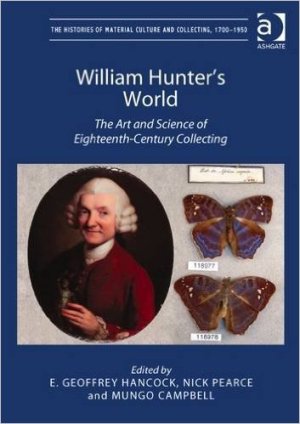 Despite William Hunter’s stature as one of the most important collectors and men of science of the eighteenth century, and the fact that his collection is the foundation of Scotland’s oldest public museum, The Hunterian, until now there has been no comprehensive examination in a single volume of all his collections in their diversity. This volume restores Hunter to a rightful position of prominence among the medical men whose research and amassing of specimens transformed our understanding of the natural world and man’s position within it.
This volume comprises essays by international specialists and are as diverse as Hunter’s collections themselves, dealing as they do with material that ranges from medical and scientific specimens, to painting, prints, books and manuscripts. The first sections focus upon Hunter’s own collection and his response to it, while the final section contextualises Hunter within the wider sphere. The volume includes references to The Hunterian’s web pages and on-line databases, enabling searches for items from Hunter’s collections, both from his museum and library.
Locating Hunter’s collecting within the broader context of his age and environment, this book provides an original approach to a man and collection whose importance has yet to be comprehensively assessed.
E. Geoffrey Hancock, an entomologist with a career in various British museums, is currently Honorary Curator of Entomology and a Research Fellow in The Hunterian Museum. His interests include the history of museums and their collections.
Nick Pearce holds the Sir John Richmond Chair of Fine Art at the University of Glasgow, where he specialises in the arts of China. His career has spanned both museums and universities, including the Victoria & Albert Museum, The Burrell Collection in Glasgow and the universities of Durham and Edinburgh.
Mungo Campbell worked at the National Galleries of Scotland until 1997 and is now Deputy Director of The Hunterian. Curating several major loan exhibitions culminated recently in Allan Ramsay: Portraits of the Enlightenment (2013), and he edited the accompanying publication.
◊ ◊ ◊ ◊ ◊
C O N T E N T S
Foreword, David Gaimster
Introduction, Mungo Campbell
Part I—William Hunter: Developing His Museum
1 The Great Windmill Street Anatomy School and Museum, Helen McCormack
2 Anatomy and the ‘museum oeconomy’: William and John Hunter as collectors, Simon Chaplin
Part II—William Hunter: Anatomy in Practice
3 William Hunter’s sources of pathological and anatomical specimens, with particular reference to obstetric subjects, Stuart W. McDonald and John W. Faithfull
4 ‘An universal language’: William Hunter and the production of The Anatomy of the Human Gravid Uterus, Caroline Grigson
5 The anatomist and the artists: Hunter’s involvement, Anne Dulau Beveridge
6 William Hunter’s anatomical and pathological specimens, Stuart W. McDonald
Part III—William Hunter: Collector
7 Animal specimens in William Hunter’s anatomical collection, Stuart W. McDonald and Margaret Reilly
8 William Hunter’s zoological collections, Margaret Reilly
9 The shaping role of Johann Christian Fabricius: William Hunter’s insect collection and entomology in 18th-century London, E. Geoffrey Hancock
10 Dr John Fothergill: Significant donor, Starr Douglas
11 The mineral collection of William Hunter: Assembly and function, John W. Faithfull
12 A collection without a catalogue: Captain John Laskey and the missing vertebrate fossils from the collection of William Hunter, Jeff Liston
13 Archaeological objects in William Hunter’s collection, Sally-Anne Coupar
14 William Hunter’s parade shield: A memento of Leonardo’s Milan?, Martin Kemp
15 Ethnographic treasures in the Hunterian from Cook’s voyages, Adrienne L. Kaeppler
16 ‘At last in Dr Hunter’s library’: William Hunter’s Chinese collections, Nick Pearce
17 William Hunter’s numismatic books, Donal Bateson
18 The ‘Hunterian orchard’: William Hunter’s library, David Weston
Part IV—William Hunter: The Wider World
19 On the way to the museum: Frederich The Great’s Bildergalerie in the park of Sanssouci in the context of other painting collections in 18th-century Germany, Heiner Krellig
20 Dr Black goes down to town: The 1788 tour to Ireland and England, Robert G. W. Anderson
21 For ‘instruction and delight’: The enfilade of nature at Sir Ashton Lever’s museum, Leicester House, London, 1775–86, Clare Haynes
22 David Ure (1749–98): The enlightened fossil collector, Neil D. L. Clark
Index
Exhibition | About Face: Human Expression on Paper
Press release (28 July 2015) for the exhibition:
About Face: Human Expression on Paper
The Metropolitan Museum of Art, New York, 27 July — 13 December 2015

Charles Antoine Coypel, Medea, ca. 1715, pastel, 12 x 8 inches / 29.4 x 20.6 cm (NY: The Metropolitan Museum of Art)
The representation of human emotion through facial expression has interested Western artists since antiquity. Drawn from The Metropolitan Museum of Art’s collection of drawings, prints, and photographs, the diverse works in About Face: Human Expression on Paper—portraits, caricatures, representations of theater and war—reveal how expression underpinned narrative and provided a window onto the character and motivations of the subjects, the artists, and even their audiences.
Using Charles Le Brun’s illustrations for Expressions of the Passions and Guillaume-Benjamin-Armand Duchenne de Boulogne and Adrien Tournachon’s photographic series as touchstones, the approximately 60 works dating from the 16th through the 19th century show how artists such as Hans Hoffmann, Francisco Goya, Jean-Baptiste Greuze, and Thomas Rowlandson explored the animated human face.
Expression was at one time thought to reveal elements of individual character and was codified through the influential publications on physiognomy by the French artist Charles Le Brun (1619–1690). In 1668 Le Brun delivered a lecture to the French Academy entitled Conférence sur l’expression générale et particulière (Lecture on General and Particular Expression). When published in 1698, the text was illustrated with engravings based on the artist’s drawings—images of facial expressions that range from calm to states of agitation. Le Brun’s rational approach and precise titles were scientific in tone and distilled the chaotic variety of nature into a coherent form that had a lasting influence on European artists. The writings, which came to be known as Expressions of the Passions, were translated into different languages and influenced art theory and practice for the next two centuries. The study of expression became a key component of artistic training in art schools and academies across Europe—so much so, in fact, that by the late 18th century it had also become a rich subject of caricature and other satirical works.
In the mid-19th century, the pioneering French neurologist and physiologist Guillaume-Benjamin-Armand Duchenne de Boulogne conducted experiments involving the application of electrical current to stimulate the animation of the face. Wishing to move beyond abstract theory and into a scientific foundation for the study of facial expression, Duchenne published a scientific grammar of human emotions to be used as study material by artists at the École des Beaux-Arts. For this purpose, Duchenne collaborated with Adrien Tournachon (brother of the famous Nadar), a photographer who specialized in portraiture, to use the evidentiary power of photography to record his experiment precisely. The resulting series of gripping photographic portraits, made between 1854 and 1856, directly follow the physiognomic tradition of Le Brun and occupy a unique place at the intersection of art, science, and sentiment. Some 30 of these portraits are presented in the installation.
About Face: Human Expression on Paper is a collaboration between the Met’s Department of Drawings and Prints, and its Department of Photographs. The exhibition is made possible by The Horace W. Goldsmith Foundation.
Call for Papers | Framing the Face: New Perspectives on Facial Hair
From the conference website:
Framing the Face: New Perspectives on the History of Facial Hair
Friend’s Meeting House, London, 28 November 2015
Proposals due by 30 September 2015
Over the past five centuries, facial hair has been central to debates about masculinity. Over time, changing views of masculinity, self-fashioning, the body, gender, sexuality and culture have all strongly influenced men’s decisions to wear, or not wear, facial hair. For British Tudor men, beards were a symbol of sexual maturity and prowess. Throughout the early modern period, debates also raged about the place of facial hair within a humoural medical framework. The eighteenth century, by contrast, saw beards as unrefined and uncouth; clean-shaven faces reflected enlightened values of neatness and elegance, and razors were linked to new technologies. Victorians conceived of facial hair in terms of the natural primacy of men, and new models of hirsute manliness. All manner of other factors from religion to celebrity culture have intervened to shape decisions about facial hair and shaving.
And yet, despite a recent growth in interest in the subject, we still know little about the significance, context and meanings of beards and moustaches through time, or of its relationship to important factors such as medicine and medical practice, technology and shifting models of masculinity. We therefore welcome papers related to, but by no means limited to the following questions:
• To what extent were beards a symbol of masculinity and what key attributes of masculinity did they symbolise?
• To what extent did the profession of the barber influence beard styles and the management of facial hair?
• To what extent were beard trends led by the elite and by metropolitan fashion?
• How far did provincial trends influence metropolitan trends through migration?
• What impact did changing shaving technologies have on beard fashions/trends?
• How were beards understood within the medical frameworks of different eras?
• How have women responded to facial hair in different eras?
• How has the display of facial hair by women been viewed as both a medical and cultural phenomena?
Please send abstracts of up to 300 words, by 30th September 2015, to framingtheface@gmail.com. For further information please contact the organisers: Dr Alun Withey, University of Exeter, A.Withey@exeter.ac.uk, and Dr Jennifer Evans, University of Hertfordshire J.evans5@herts.ac.uk.
Conference | The Artist’s Studio in Eighteenth-Century Britain
From the Paul Mellon Centre for Studies in British Art:
The Painting Room: The Artist’s Studio in Eighteenth-Century Britain
Sotheby’s Institute of Art, London (Thursday), and Gainsborough’s House, Sudbury, Suffolk (Friday), 29–30 October 2015
 This two-day conference, sponsored by the Esmée Fairbairn Collections Fund and the Paul Mellon Centre for Studies in British Art, examines the role and character of artists’ painting rooms in the long eighteenth century. It is organised in association with an exhibition focusing on the painting room that is to be held at Gainsborough’s House between October 2015 and January 2016.
The conference aims to bring together current scholarship on the nature of the painting room, primarily in Britain but also in France, which was a constant model for British artists. The first day, to be held at the Sotheby’s Institute of Art, considers the varying character and function of the painting room in London, Bath and Paris: how it was used, how it was seen by outsiders, and how artists exploited it to create spaces for the display and sale of their work. Detailed studies of the painting rooms of Joshua Reynolds and Joseph Wright of Derby will help to illustrate these arguments. The second day of the conference, which will take place at Sudbury, will focus more particularly on the example of Thomas Gainsborough. Speakers will consider technical issues such as the use of materials, lay figures, drapery and costumes within the painting room, together with the role of the copy. This second day will also feature a discussion of the relationship between the painting room and the modern-day artist’s studio.
The aim of the conference as a whole is to explore the distinctive world of the Georgian painting room, and to complement the innovative recreation of such an environment within the exhibition at Gainsborough’s House.
Confirmed Speakers
Mark Bills (Gainsborough’s House)
Spike Bucklow (Hamilton Kerr Institute)
Matthew Craske (Oxford Brookes University)
Edwina Ehrman (Victoria & Albert Museum)
Karen Fielder (Portsmouth University)
Rica Jones (Independent Scholar)
Kristina Mandy (Hamilton Kerr Institute)
Peter Moore (Gainsborough’s House)
Jane Munro (Fitzwilliam Museum)
George Shaw (Artist)
Susan Sloman (Independent Scholar)
Hannah Williams (Queen Mary, University of London)
Jonathan Yarker (Lowell Libson Ltd)
Tickets
£30 Standard Ticket (for both days)
£20 Concession Ticket (students and senior citizens, for both days)
Tickets include refreshments, lunch and a drinks reception on both days. Tickets will not be sold separately for each day; attendees must commit to both days.
Please note your ticket does not include your travel to Sudbury on Day 2 and we kindly ask you to make your own way there. If you are travelling from London to Sudbury, the conference organisers will be travelling on the train stated on the timetable, if you wish to join them.
Funding the Larson Historic Fashion Collection for the FIDM Museum
$4 for 400 Years of Fashion: Helen Larson Social Media Fundraising Campaign
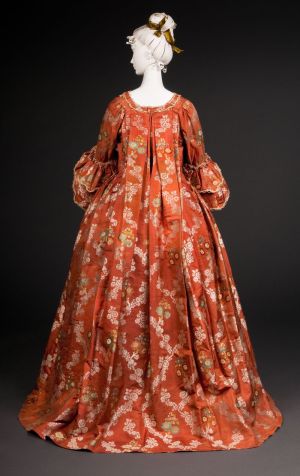
Robe volante, France, ca. 1745 (Helen Larson Historic Fashion Collection)
The Fashion Institute of Design and Merchandising Museum is fundraising to acquire a truly remarkable collection of rare historical fashion, ranging from a man’s red velvet jerkin dating to 1600 to stunning couture creations of the twentieth century. These pieces were collected by Helen Larson, a collector and successful entrepreneur who understood the importance of fashion history. The Helen Larson Historic Fashion Collection encompasses more than 1,400 pieces representing 400 years of history—but this critically important collection could be broken up and lost forever. The Museum has until the end of 2015 to raise the remaining $2 million needed to purchase the collection for our institution. Without these funds, the collection will be dispersed or absorbed into another private collection, inaccessible to students, researchers, and the general public.
On August 4, 2015, the FIDM Museum will launch the #4for400 project, a social media fundraising campaign to keep the Larson Collection at a public institution. The Museum’s Facebook, Twitter, and Instagram accounts will ask supporters to text MUSEUM to 243-725 and donate just $4 to save more than 400 years of fashion. Our hope is that a momentum will build, resulting in #4for400 posts being shared, liked, re-tweeted, and re-grammed, creating a flurry of donation activity. In conjunction with the launch, the Museum will host an Open House event from 3–7 pm, allowing the public to join in the excitement of the fundraising campaign with refreshments, raffles, music, and gallery tours.
The #4for400 campaign has the power to keep this one-of-a-kind cultural treasure at an academic institution in downtown Los Angeles, where it can be appreciated by museum visitors and used for research and inspiration by generations to come.
You can also donate by clicking here»
Exhibition | Dionysos Unmasked: Ancient Sculpture and Early Prints
Now on view at AIC:
Dionysos Unmasked: Ancient Sculpture and Early Prints
Art Institute of Chicago, 31 July 2015 — 15 February 2016

Hellenistic or Roman, Eastern Mediterranean. Statue of Young Dionysos, 100 BC–AD 100, bronze, copper and silver (modern). 136 x 62 x 52 cm (54 x 24 1/2 x 20 in.). Anonymous loan, 1.2013. Photography by Richard Valencia.
This innovative collaboration between the Department of Ancient and Byzantine Art and the Department of Prints and Drawings examines Renaissance and Baroque printmakers’ direct responses to Classical antiquity through the figure of Dionysos, the ancient Greek god of wine and theater. Installed in the Mary and Michael Jaharis Galleries of Greek, Roman, and Byzantine Art, this exhibition juxtaposes ancient sculpture with prints from the 15th through the 18th century with nearly 100 objects—pieces from the permanent collection, new loans of ancient art, and recently acquired works on paper.
Dionysos—known as Bacchus to the Romans—cavorted with an entourage of satyrs, the god Pan, and frenzied maenads, female followers of the god. All these devotees represented the untamed and hedonistic desires of humanity, which were unleashed by the intoxicating elixir of wine. Because performance was a part of the early Greek festivals of Dionysus, he also became known as the patron god of theater, an aspect of the deity that is less well known today. In ancient art, Dionysos could take many forms, from a graceful youth to a bearded mature man. During the Renaissance and Baroque periods, the time of early printmaking, interest in antiquity—especially Dionysos—flourished. Ancient sculptures depicting the god and his raucous retinue inspired artists to find new ways to transform age-old Dionysian subjects into prints and drawings that would appeal to their own contemporary audiences.

Left: Statue of a Young Satyr Wearing a Theater Mask of Silenos, ca. 1st century AD, restorations by Alessandro Algardi, 1628. Anonymous loan. Right: John Downman, Antique Statue of Seated Putto Holding Mask of Pan, 1775 (AIC, Leonora Hall Gurley Memorial Collections).
Anchoring the exhibition are Greek and Roman sculptures depicting Dionysos and his wild followers along with vessels used in ritual drinking parties and festivals honoring the god of wine and theater. Their printed counterparts are masterpieces from the Italian Renaissance to the French Rococo, including notably Andrea Mantegna’s Bacchanal with a Wine Vat, a 15th-century Italian engraving with striking visual similarity to the bronze Statue of Young Dionysos (a current long-term loan to the museum). Bringing together this rich selection of works, separated by as many as 1,500 years, this exhibition offers new, enticing insights into the art of Classical antiquity and its later revivals.
The June 2013 press release announcing the long-term loan of the bronze Statue of Young Dionysos is available as a PDF
file here»
New Book | Indian Cotton Textiles from the Karun Thkar Collection
From ACC Distribution:
John Guy, Indian Cotton Textiles: Chintz from the 14th to the Early 20th Centuries in Karun Thkar Collection (New York: ACC Art Books, 2015), 172 pages, ISBN: 978-1851498093, $70.
 India has been at the heart of the global trade in textiles since ancient times, and cotton has been at the heart of the Subcontinent’s economy for millennia. Indian dyed and painted cottons were admired in and traded to the Far East and the Mediterranean world for many generations before European interest in chintz created a new market. The trade in Indian cloth flourished due to the ability of its craftsmen to create a multitude of detailed and expressive patterns with strong and fast colors. Such textiles gained high esteem among the elite at home and abroad, ultimately acquiring heirloom status.
Karun Thakar has been collecting textile art for more than 30 years, and has one of the world’s leading private collections from the Indian Subcontinent, with costume and fabrics from the 14th century through to the early 20th. Aspects of the Thakar Collection have been exhibited in the Victoria & Albert Museum in London and at the Metropolitan Museum of Art in New York.
The Indian dyed and painted cotton cloths in the Thakar Collection are perhaps the best in private hands. Many have never previously been published. Dating from the 15th century onwards, the collection illustrates the trade in textiles across the Indian Ocean with the Malay-Indonesian world, with Sri Lanka, Armenia and Europe, as well as within the Indian domestic market.
John Guy is the Florence and Herbert Irving Curator of the Arts of South and Southeast Asia, Department of Asia Art, The Metropolitan Museum of Art, New York, and an elected Fellow of the Society of Antiquaries, London. His major publications include: Woven Cargoes: Indian Textiles in the East (1998), Indian Temple Sculpture (2007), Wonder of the Age: Master Painters of India, 1100–1900, and Lost Kingdoms: Hindu-Buddhist Sculpture of Early Southeast Asia (2014).
2014 Dissertation Listings
From caa.reviews:
Dissertation Listings
PhD dissertation authors and titles in art history and visual studies from US and Canadian institutions are published each year in caa.reviews. Titles can be browsed by subject category or year.
Titles are submitted once a year by each institution granting the PhD in art history and/or visual studies. Submissions are not accepted from individuals, who should contact their department chair or secretary for more information. Department chairs: please consult our dissertation submission guidelines for instructions. The annual deadline is January 15 for titles from the preceding year.
In 2003, CAA revised the subject area categories of art history and visual studies used for all our listings, including dissertations. These categories are listed in the Dissertation Submission Guidelines.
◊ ◊ ◊ ◊ ◊
The index for 2014 lists eight eighteenth-century dissertations completed, including:
• Cannady, Lauren, “Owing to Nature and Art: The Garden Landscape and the Eighteenth-Century French Interior” (IFA/NYU, T. Crow)
• Fox, Abram, “The Great House of Benjamin West: Family, Workshop, and National Identity in Late Georgian England” (Maryland, College Park, W. Pressly)
• Francis, Razan, “Secrets of Enlightenment Spain’s Contested Islamic Craft Heritage” (MIT, D. Friedman)
• Marchand, Marie-Ève, “L’histoire de l’art mise en pièces. Analyse matérielle, spatiale et temporelle de la period room comme dispositif muséal” (Université de Montréal, J. Lamoureux)
◊ ◊ ◊ ◊ ◊
and forty-one dissertations in progress, including:
• Brosnan, Kelsey, “Seductive Surfaces: Anne Vallayer Coster and the Eighteenth-Century Still Life” (Rutgers, S. Sidlauskas)
• Cooper, John, “Imperial Balls: The Arts of Sex, War, and Dancing in India, England, and the Caribbean, 1780–1870” (Yale, T. Barringer, R. Thompson)
• DiSalvo, Lauren, “Micromosaics as Grand Tour Souvenirs in Europe from the Early Eighteenth Century to the Late Nineteenth Century” (Missouri, M. Yonan, K. W. Slane)
• Gratta, Eva, “‘Great Links of the Chain’: Maritime Imagery in North America, 1750–1850” (CUNY, K. Manthorne)
• Greenberg, Daniel, “A New Imperial Landscape: Ritual, Representation, and Foreign Relations in the Qianlong Court (1735–1796)” (Yale, Y. Kim)
• Mitchell, David, “Mimetic Heresies: Waxworks in Paris, 1661–1723” (McGill, A. Vanhaelen; R. Taws)
• Presutti, Kelly, “Terroir after the Terror: Landscape and Representation in Nineteenth-Century France” (MIT, K. Smentek)
• Rado, Mei, “Xiyang Textiles in the Eighteenth-Century Qing Imperial Court: Fabrication, Display, and Representation of the West” (Bard Graduate Center, F. Louis)
• Ridlen, Michael T., “Prud’hon and the Graceful Style” (Iowa, D. Johnson)
• Szalay, Gabriella, “Materializing the Past: The History of Art and Natural History in Germany, 1750–1800” (Columbia, K. Moxey)
• Von Preussen, Brigid, “The Antique Made New: Commercial Classicism in Late Georgian Britain” (Columbia, A. Higonnet)
• Wunsch, Oliver, “Painting Against Time: The Decaying Image in the French Enlightenment” (Harvard, E. Lajer-Burcharth)
Call for Papers | Posing the Body
From The Courtauld:
Posing the Body: Stillness, Movement, and Representation
Regent Street Cinema, University of Westminster and The Courtauld Institute of Art, London, 6–7 May 2016
Proposals due by 2 October 2015
Posing has been central to art, dance, and sculpture for thousands of years. In recent years, the growing interest in fashion media and modelling has also focused attention on questions of pose and posing. Incorporating notions of movement and stillness, posing can be understood in terms of historical modes of representation, as well as contemporary media and rapidly evolving relationships between bodies, subjects, and technologies of representation. Posing incorporates symbolic and semiotic meaning alongside embodied action and feeling. Recent coverage of the work of choreographer Stephen Galloway in 032c magazine, and new publications such as Steven Sebring’s Study of Pose: 1000 Poses by Coco Rocha testify to the growing interest in the cultural significance of posing and the pose—yet both remain under-researched areas with little discussion of their significance.
This symposium will assert the importance of pose as both a creative practice and an emerging area of critical inquiry. It will bring together multi-disciplinary academics and practitioners to discuss and develop new ways of understanding pose and posing in a historical and contemporary context. We encourage proposals for papers that address pose from global and diverse perspectives. This event represents a potentially fruitful and exciting moment to bring these strands together to the benefit of researchers within practice and theory-based media, historians of dress, photography, art and film and allied disciplines.
The keynote lecture will be delivered by David Campany, internationally recognised writer and curator, and Reader in Photography at the University of Westminster.
Possible themes include (but are not limited to)
• Modelling (fashion and artistic)
• Gesture
• Dance (popular and classical)
• Pose and the everyday
• Movement and stillness
• Posing, corporeality and the body
• Posing and social media (blogs, Instagram, etc.)
Please submit abstracts of 150–200 words in English, along with a short biography of approximately 100 words to Posingthebody@gmail.com by 2 October 2015.
Organised by Rebecca Arnold, Oak Foundation Lecturer in History of Dress & Textiles, The Courtauld Institute of Art; Katherine Faulkner, Study Skills and Widening Participation Academic Coordinator, The Courtauld Institute of Art; Katerina Pantelides, Visiting Lecturer, The Courtauld Institute of Art and Eugénie Shinkle, Reader in Photography, University of Westminster.
New MA in the Art Market and History of Collecting
From The University of Buckingham and The National Gallery:
MA in the Art Market and History of Collecting
 The University of Buckingham and the National Gallery, in association with Waddesdon Manor (The Rothschild Collection), are delighted to announce the launch of a new MA course on the History of Collecting and the Art Market in January 2016.
The study of the art market and the history of collecting has been one of the most significant growth areas within Art History in the last 30 years, attracting wide interest internationally, particularly in Europe and the United States. Competitively priced, this new MA will investigate American and European art markets and cultures of collecting from the Renaissance to the present day. The first of its kind in the UK, it will be taught by staff from the University of Buckingham, the National Gallery and Waddesdon Manor. The course will include study trips to Paris and Florence. All the London-based teaching, spread over two terms, will be based at the National Gallery in London.
A unique feature of the course will be access to two of the greatest surviving art dealers’ archives: Agnew’s, acquired by the National Gallery in 2014, and Colnaghi’s, housed in the Windmill Hill Archive, Waddesdon, since February 2014. Under the guidance of experts, students will be given practical training on how to use, unlock and analyse their rich holdings. Aimed at art historians, would-be curators, collectors, those with a professional interest in the art market or a general interest in the arts, the programme provides a pathway to a career in the art world or a step towards further postgraduate research.
University of Buckingham Programme Director, Jeremy Howard said: “I am thrilled by the exciting opportunities that our new MA will offer. Developed and delivered by the University of Buckingham and the National Gallery in association with Waddesdon, the MA will enable Buckingham to offer students privileged access to the two greatest London-based dealer archives, first-class research training, and an entrée to one of the fastest-growing areas of art history. For those with an eye on a PhD, a possible career in curatorship or the art market, the course will provide a valuable spring-board; but we are also hoping that this new MA will appeal to those who are interested in studying the history of collecting as a fascinating subject in its own right.”
Sir Nicholas Penny, Director of The National Gallery, said: “I am delighted that the National Gallery is collaborating with the University of Buckingham’s research-led MA focusing on the history of collecting and the art market. In an increasingly popular area of research, this course, designed and taught by leading figures in the field, will introduce students to the many and varied facets of the subject, as well as providing much-needed training in the use of archives, drawing on some of the National Gallery’s own important holdings, including the recently-acquired Agnew’s archive.”
Pippa Shirley, Head of Collections and Gardens at Waddesdon Manor said: “We are delighted to be working with the University of Buckingham and the National Gallery on this new MA, which explores a critical aspect of the nineteenth-century art market. There is a particular appropriateness for Waddesdon to be a part of this collaboration—not only is the Colnaghi Archive housed with us, but the collections at the Manor are a reflection of the passions of one of the most influential of nineteenth-century collecting dynasties, the Rothschilds, who bought through both Colnaghi and Agnew, which allows their archives to be brought to life in a very vivid way.”
Buckingham, set up in 1976, was the only university to be independent of direct government support in the United Kingdom and has used its independence to pioneer a distinctive approach to higher education.
The programme brochure is available as a PDF file here»










2 comments