Colloquium | Think Small: Artistic Miniaturization
From the conference programme (with an English summary). . .
Think ‘Small’: Textual Approaches and Practices of Artistic Miniaturization from Antiquity to the Nineteenth Century / Penser le « petit » de l’Antiquité au XIXe siècle: Approches textuelles et pratiques de la miniaturisation artistique
Université Toulouse – Jean Jaurès Nouvelle Maison de la Recherche, 1–2 October 2015
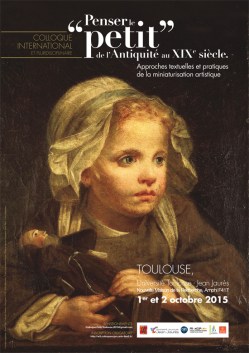 From Tanagra statuettes to the automata of the industrial age, there are many material manifestations of the ancient fascination with shapes, images, and tiny objects. Examples abound: carved micro-architectures of Gothic buildings, small engravings by Stefano della Bella or Sébastien Leclerc, eighteenth-century objects of vertu, and the Lilliputian creatures of children’s literature. Rare, however, are the historical sources that allow us to understand their cultural foundations. While the written sources usually consider the ‘small’ only in relationship to the ‘big’, the analysis of the consumption of these objects reveals a set of practical, symbolic, and artistic skills such as manoeuvrability, mobility, economy, poverty, preciousness, thoroughness, prettiness, and strangeness. Too often, the dominant sources focus on the size of the objects, which diminishes the presence of other considerations. At times miniaturization reduces the scale of a given object, while at other times it may be an independent creation governed by specific criteria. Whatever the case, miniaturization is based on a set of justifications, usages, and judgments that this conference aims to clarify.
◊ ◊ ◊ ◊ ◊
J E U D I , 1 O C T O B R E 2 0 1 5
Présidence de la journée : Jean-Marie Guillouët (université de Nantes)
9.00 Accueil par Sophie Duhem – Estelle Galbois – Anne Perrin Khelissa (université Toulouse – Jean Jaurès)
9.10 Introduction générale par Jean-Marie Guillouët (université de Nantes)
9.30 Techniques, esthétiques et fonctions du changement d’échelle
• Raffaella Da Vela (université de Bonn), Petit et très petit : miniaturisations des modèles grecs dans les ateliers de potiers et de sculpteurs de Volterra à l’époque hellénistique
• Véronique Sarrazin (université d’Angers), Le « format Collombat », ou comment le petit format d’un modeste livret est devenu une référence de goût et de commodité au XVIIIe siècle
• Cyril Lécosse (université de Lausanne), La vogue des grandes miniatures ou le développement d’une nouvelle catégorie de portrait autour de 1800
• Élodie Voillot (université Paris Ouest Nanterre), Un musée dans chaque foyer : les réductions de sculptures, du grand art au petit bibelot, 1839–1900
12.00 Pause déjeuner
14.00 Luxe, préciosité et réceptions de l’objet minuscule
• Alice Delage (Centre d’Études supérieures de la Renaissance de Tours), La microarchitecture dans l’orfèvrerie florentine : la Renaissance du « petit »
• Rori Bloom (université de Floride), « Voilà mon portrait que je vous donne » : Political, Gallant, and Aesthetic Uses of the Boîte à portrait in Two Seventeenth-Century French Texts
• Michel Sandras (université Paris – Diderot), « Le Poète est ciseleur » (Hugo). Histoire et signification d’un cliché : le terme « ciselé » appliqué au travail de l’écrivain
V E N D R E D I , 2 O C T O B R E 2 0 1 5
Présidence de la journée : Jan Blanc (université de Genève)
9.00 Accueil par Sophie Duhem – Estelle Galbois – Anne Perrin Khelissa (université Toulouse – Jean Jaurès)
9.10 Introduction générale par Jan Blanc (université de Genève)
9.30 Images et représentations du « petit » monde
• François Ripoll (université Toulouse – Jean Jaurès), « Si parua licet componere magnis » (Georg., IV, 176) : la dialectique du grand et du petit dans les chants III et IV des Géorgiques de Virgile
• Vincent Robert-Nicoud (université d’Oxford), Grand débat sur le « petit » monde : l’homme microcosme de Rabelais à Scève
• Sarah Grandin (université d’Harvard), « Cironalité » and Scale in Cyrano de Bergerac’s Les États et Empires de la Lune
• Nathalie Rizzoni (CNRS, université Paris – Sorbonne), « Les petits, toure lourirette / Valent bien les grands » : les enfants comédiens à Paris au XVIIIe siècle
12.00 Pause déjeuner
14.00 Pouvoirs mémoriels de l’objet miniature
• Audrey Dubernet (université Bordeaux – Michel de Montaigne), Souvenir d’une œuvre d’art ; les peintures et sculptures antiques transposées en glyptique
• Manuel Charpy (CNRS, université Lille 3), Fragments et réductions. Petites choses et espaces de l’intimité au XIXe siècle
• Manuel Royo (université François-Rabelais de Tours), Le « grand » dans le « petit », enjeux de la maquette d’architecture : le cas de Rome à la fin du XIXe siècle
• Claire Barbillon (université de Poitiers), Le paradoxe de la monumentalité en format réduit : la statuaire monumentale publique et la carte postale
15.40 Discussion et clôture du colloque
Symposium | Small Worlds: Dolls’ Houses
From the Bath Preservation Trust:
Symposium | Small Worlds: Dolls’ Houses from the 18th and 19th Centuries
Bath Royal Literary and Scientific Institution, Bath, 6 November 2015
Small Worlds, the current exhibition at No.1 Royal Crescent, aims to go beyond showing dolls’ houses simply as exquisite collector’s items by exploring wider themes, such as the part they played in girls’ education and women’s history, links with philanthropy (because toys for wealthy children were often furnished with the labours of the poorest), and their importance as material culture. We are holding a special day symposium to explore further some of these themes.
 To be chaired by Adrian Tinniswood and featuring Liza Antrim in conversation with Antique Roadshow’s Fergus Gambon, the event will bring together a panel of speakers who are experts in their fields. Kathryn Jones, Curator of Decorative Arts, the Royal Collection, will talk about Queen Mary’s Dolls’ House while curators from the V&A and the National Trust showcase other national treasures and their links with the English Country House. The idea of dolls houses as ‘emotional objects’ and their connection with philanthropy and the history of childhood is explored by Professor Joanne Bailey of Oxford Brooks and Dr. Mary Claire Martin of Greenwich University, while symbolic inspiration for film and literature, in particular the ghost story and all things gothic, is covered by Lucy Arnold of Leeds University in a splendidly named paper, ‘Shrinking in Terror’!
Tickets: £55, students £35. A limited number of bursary places are available to full or part time students. Click here for a link to our website and a copy of our bursary application form. Lunch and an exhibition drinks reception at No. 1 Royal Crescent is included within the ticket price. If you have any questions about
the symposium please email our Events Officer, Kate Rogers,
krogers@bptrust.org.uk.
◊ ◊ ◊ ◊ ◊
P R O G R A M M E
9.45 Registration
10.00 Welcome from Adrian Tinniswood
10.10 Liza Antrim and Fergus Gambon in conversation
10.40 The Voice of the House: Material Culture and Emotion, Joanne Bailey (Oxford Brooks University)
11.10 Questions
11.30 Coffee
11.45 The Utensil for Marriage? The Dutch Kitchen Cabinet and the Place of Women in the 17th Century, Rachel Barber
12.15 Furnishing the 18th-Century Baby House: A Working Country House in Miniature, Patricia Ferguson (National Trust external advisor on ceramics)
12.45 Questions
1.00 Lunch
2.00 Childhood and Philanthropy in Victorian England, Mary Clare Martin (University of Greenwich)
2.30 Upstairs, Downstairs: Queen Mary’s Dolls House as a Record of Edwardian England, Kathryn Jones (Curator of Decorative Arts, The Royal Collection)
3.00 Questions
3.15 Tea
3.45 Shrinking in Terror: Gothic and the Dolls House, Lucy Arnold (doctoral student at University of Leeds and administrator of Home, Crisis and the Imagination Network)
4.15 Small Stories: A Collection of Characters at the V&A Museum of Childhood, Alice Sage (Curator, V&A Museum of Childhood)
5.00 Questions
5.20 Summing Up by Adrian Tinniswood
6.00 Drinks reception and opportunity to view the exhibition at No.1 Royal Crescent
New Book | Ruins and Fragments: Tales of Loss and Rediscovery
Distributed by The University of Chicago Press:
Robert Harbison, Ruins and Fragments: Tales of Loss and Rediscovery (London: Reaktion Books, 2015), 208 pages, ISBN: 978-1780234472, $35.
 What is it about ruins that are so alluring, so puzzling, that they can hold some of us in endless wonder over the half-erased story they tell? In this elegant book, Robert Harbison explores the captivating hold these remains and broken pieces—from architecture, art, and literature—have on us. Why are we, he asks, so suspicious of things that are too smooth, too continuous? What makes us feel, when we look upon a fragment, that its very incompletion has a kind of meaning in itself? Is it that our experience on earth is inherently discontinuous, or that we are simply unable to believe in anything whole?
Harbison guides us through ruins and fragments, both ancient and modern, visual and textual, showing us how they are crucial to understanding our current mindset and how we arrived here. First looking at ancient fragments, he examines the ways we have recovered, restored, and exhibited them as artworks. Then he moves on to modernist architecture and the ways that it seeks a fragmentary form, examining modern projects that have been designed into existing ruins, such as the Castelvecchio in Verona, Italy and the reconstruction of the Neues Museum in Berlin. From there he explores literature and the works of T. S. Eliot, Montaigne, Coleridge, Joyce, and Sterne, and how they have used fragments as the foundation for creating new work. Likewise he examines the visual arts, from Schwitters’ collages to Ruskin’s drawings, as well as cinematic works from Sergei Eisenstein to Julien Temple, never shying from more deliberate creators of ruin, from Gordon Matta-Clark to countless graffiti artists.
From ancient to modern times and across every imaginable form of art, Harbison takes a poetic look at how ruins have offered us a way of understanding history and how they have enabled us to create the new.
Until his retirement, Robert Harbison was professor of architecture at London Metropolitan University. He is the author of many books, including Reflections on Baroque and Travels in the History of Architecture, both also published by Reaktion Books.
C O N T E N T S
Prologue
1 Rough Edges
2 Fragmented Wholes
3 Modernist Ruin
4 Interrupted Texts
5 Ruined Narratives
6 Art and Destruction
7 Dreams of Recovery
Epilogue: Remembering and Forgetting
Notes
Acknowledgements
Photo Acknowledgements
Index
Call for Papers | Reading Architecture across the Arts and Humanities
From the CFP:
Reading Architecture across the Arts and Humanities
University of Stirling, 5 December 2015
Proposals due by 26 September 2015
An interdisciplinary conference organised in cojunction with the AHRC-funded project, Writing Britain’s Ruins, 1700–1850: The Architectural Imagination at the University of Stirling.
The organisers of this one-day multidisciplinary conference seek to solicit proposals for 20-minute papers that consider the creation, expression and subject-areas across the Arts and Humanities. Papers should seek to address the creation, understanding, circulation and cultural impact of both real and international contexts. Original and creative accounts of how architecture might variously be ‘read’ and interpreted across such disciplines as welcome.
Plenary Speakers: Rosemary Hill and Olivia Horsfall Turner
Possible topics may include, but are by no means limited to, the following:
• Historicism
• Responses to, and recreations of, the architectural past
• Reflections upon architectural styles and ‘movements’
• Assessments of architecture and architectural practices
• Representations of architecture in film
• Architecture and the law
• Antiquarianism and architecture
• Architectural ruin and the tourist industry
• Architectural conservationism
• The politics of architectural form
• Literary representations of architecture
• Lives of architects
• The aesthetics of architectural form
• Historiography
• Architectural Heritage
300-word proposals should be emailed to the conference organisers, Dr Dale Townshend and Dr Peter N. Lindfield—architecture@stir.ac.uk—by 26 September 2015. The School of Arts and Humanities at the University of Stirling has generously agreed to fund a number of postgraduate travel-bursaries for this event. Please contact the conference organisers for further details.
This conference is the first event in a series of outputs arising from the AHRC-funded project, Writing Britain’s Ruins, 1700–1850: The Architectural Imagination at the University of Stirling (June 2015–December 2016).
Exhibition | Le Roi est Mort!
As reported by the AFP:
 To mark the 300th anniversary of the Sun King’s death on Tuesday, the Palace of Versailles turned to modern-day town crier Twitter to relay his slow and agonising demise from gangrene. “Breaking News. Louis XIV passed away,” the palace said from its account @CVersailles at 0615 GMT (8:15am) on Tuesday, after livetweeting the king’s illness as if it were taking place today.
The hashtag #leroiestmort (“the king is dead” in English) was rolled out to mark the anniversary of his death at 76 years old on September 1, 1715. With 72 years on the throne, king Louis XIV was the longest-reigning monarch in European history, overseeing a period of glory in France in which he built the glittering palace west of Paris. . . .
The tweets will continue up to his funeral (the schedule is available here), all as a perfect build-up to the exhibition at Versailles, which opens next month:
The King Is Dead!
Châteaux de Versailles, 27 October 2015 — 21 February 2016
Curated by Béatrix Saule, Hélène Delalex, and Gérard Sabatier
Scenography by Pier Luigi Pizzi
The death of the king, both as a man and an institution, was a key moment in the construction of the public perception of the monarchy, combining religion (the death of a Christian) and politics (the death and resurrection of the king, who never dies). From his final death throes to the burial it resembled a performance, a great Baroque show of huge significance to courtly society, which was affected more than ever by it.
 The exhibition—the first on the subject—will look back on the details of the death, autopsy and funeral of Louis XIV, which strangely are little known, and to situate them in the funeral context of European sovereigns from the Renaissance period to the Enlightenment. It also discusses the survival—often paradoxical—of this ritual from the French Revolution to the contemporary era.
The exhibition will bring together works of art and historical documents of major importance from the largest French and foreign collections, including ceremonial portraits, funeral statues and effigies, gravestones, the manuscript for the account of the autopsy of the king, coins from the Saint-Denis Treasury, gold medals, emblems and ornaments, and furniture of funeral liturgy. Some of the pieces on display have never been exhibited in public.
Exhibiting these masterpieces has required grand scenography effects. Scenographer Pier Luigi Pizzi was asked by Béatrix Saule, the exhibition’s Head Curator, to design the layout for this great Baroque show. Across the nine sections, visitors will discover a veritable funeral opera conducted by the artist.
The subject of the exhibition will not fail to surprise, and is scientifically rigorous. It is based on an international research program on royal ceremonies in European Courts, undertaken over the course of three years at the Palace of Versailles Research Centre under the leadership of Professors Gérard Sabatier and Mark Hengerer and with the participation of a team representing a range of disciplines, from coroners to liturgists, from medieval to contemporary historians.
Curated by Béatrix Saule, Director and Head Curator of the Musée National des Châteaux de Versailles et de Trianon, assisted by Hélène Delalex Conservation Officer at the Musée National des Châteaux de Versailles et de Trianon, and Gérard Sabatier, Emeritus Professor. Scenography by Pier Luigi Pizzi.
Additional information is available at the exhibition website.
Terra Foundation for American Art International Publication Grants
Terra Foundation for American Art International Publication Grants
Letters of inquiry due by 21 September 2015
In 2014, the Terra Foundation for American Art awarded the College Art Association (CAA) a major, three-year grant to administer an annual program to support book-length scholarly manuscripts in the history of American art. This program, now in its second year, makes funds available to US and non-US publishers through the Terra Foundation for American Art International Publication Grant.
Awards of up to $15,000 will be given for books that examine American art in an international context, increase awareness of American art internationally through publication outside the United States, allow wider audiences to access important texts through translation, and/or result from international collaboration. The program also will support the creation of an international network of American art scholars by providing two non-US authors whose books are funded through the grant program with travel stipends and complimentary registration to attend CAA’s annual conference.
Grant guidelines, detailed eligibility requirements, and application instructions are available on the CAA website. Letters of inquiry should be submitted to CAA by September 21, 2015. Applicants whose projects fall within the guidelines and successfully fulfill the mission of the grant program will be invited to submit full applications, due November 9, 2015. The first round of award winners will be announced in March 2016.
New Book | The Idea of the Cottage in English Architecture, 1760–1860
From Taylor & Francis:
Daniel Maudlin, The Idea of the Cottage in English Architecture, 1760–1860 (New York: Routledge, 2015), 212 pages, ISBN: 978-1138793873, $160.
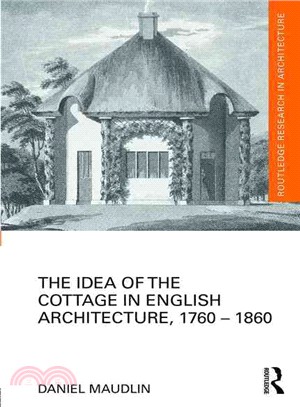 The Idea of the Cottage in English Architecture is a history of the late Georgian phenomenon of the architect-designed cottage and the architectural discourse that articulated it. It is a study of small buildings built on country estates, and not so small buildings built in picturesque rural settings, resort towns and suburban developments.
At the heart of the English idea of the cottage is the Classical notion of retreat from the city to the countryside. This idea was adopted and adapted by the Augustan-infused culture of eighteenth-century England where it gained popularity with writers, artists, architects and their wealthy patrons who from the later eighteenth century commissioned retreats, gate-lodges, estate workers’ housing and seaside villas designed to ‘appear as cottages’.
The enthusiasm for cottages within polite society did not last. By the mid-nineteenth century, cottage-related building and book publishing had slowed and the idea of the cottage itself was eventually lost beneath the Tudor barge-boards and decorative chimneystacks of the Historic Revival. And yet while both designer and consumer have changed over time, the idea of the cottage as the ideal rural retreat continues to resonate through English architecture and English culture.
Daniel Maudlin is Professor of Early Modern History at the University of Plymouth. He has previously held positions at Plymouth School of Architecture, Design and Environment, Dalhousie University, the University of Pennsylvania and the University of Glasgow. From farmhouses in Nova Scotia to aristocratic retreats on English country estates, his work focuses on the social meanings of design and the consumption of domestic architecture in the early modern British Atlantic world. He also writes on architectural theory, modern vernaculars and the everyday.
◊ ◊ ◊ ◊ ◊
C O N T E N T S
1 The Cottage, Rural Retreat and the Simple Life
2 The Cottage in English Architecture
3 The Architect-Designed Cottage
4 The Cottage in Arcadia
5 Architects, Patrons and Connoisseurs
6 Habitations of the Labourer
7 The Appreciation of Cottages
8 Re-Imagining the Vernacular
9 The Cottage Ornée
10 The Cottages of Old England
Fellowships | Bard Graduate Center Research Fellowships
From BGC:
Bard Graduate Center Research Fellowship for 2016–17
Bard Graduate Center invites scholars from university, museum, and independent backgrounds with a PhD or equivalent professional experience to apply for funded research fellowships, to be held during the 2016–2017 academic year. The fellowships are intended to fund collections-based research at Bard Graduate Center or elsewhere in New York, as well as writing or reading projects in which being part of Bard Graduate Center’s dynamic research environment is intellectually valuable. Eligible disciplines and fields of study include—but are not limited to—art history, architecture and design history, economic and cultural history, history of technology, philosophy, anthropology, and archaeology.
The stipend rate is $3,500 per month, and housing is available. Both long- and short-term fellowships are available (for example, 6, 4 and 2 months). The timing of dates will be negotiated with individual awardees. Fellows will be given a workspace in the Bard Graduate Center Research Center at 38 West 86th Street, between Columbus Avenue and Central Park West, in New York City.
Bard Graduate Center is a graduate research institute devoted to the study of the decorative arts, design history, and material culture, drawing on methodologies and approaches from art history, economic and cultural history, history of technology, philosophy, anthropology, and archaeology. It offers MA and PhD degrees, possesses a specialized library of 60,000 volumes exclusive of serials, and publishes West 86th: A Journal of Decorative Arts, Design History and Material Culture and Cultural Histories of the Material World (both with The University of Chicago Press), and the catalogues that accompany the four exhibitions it presents every year in its Gallery space (with Yale University Press). Over 50 research seminars, lectures and symposia are scheduled annually and are live-streamed around the world on Bard Graduate Center’s YouTube channel.
To apply, please submit the following materials electronically, via email to fellowships@bgc.bard.edu, in a single PDF file: (1) cover letter explaining why Bard Graduate Center is an appropriate research affiliation and indicating the preferred length and dates of the fellowship; (2) detailed project description; (3) CV; (4) publication or academic writing sample of approximately 20-30 pages. In addition, please arrange for two letters of reference to be submitted either via email (to fellowships@bgc.bard.edu) or post (to Bard Graduate Center, Research Fellowship Committee, c/o Dean Elena Pinto Simon, 38 West 86th Street, New York, NY, 10024). All materials must be received by November 15, 2015. Incomplete or late applications will not be considered. Please direct questions to the Research Fellowship Committee via email (fellowships@bgc.bard.edu).
Bard Graduate Center does not reimburse fellows for travel, relocation, or visa-related costs in connection with this fellowship award. Also, please note that the fellowship stipend and the value of the provided housing may be subject to taxes for both US citizens and non-US citizens in accordance with US tax code. Fellowships are awarded without regard to race, color, gender, religion, national origin, sexual orientation, age, or disability. Please also see our Frequently Asked Questions page.
Two Paintings Returned to the Deutsches Historisches Museum
Press release (14 August 2015) from the Gemäldegalerie:

Frans Lütgert, The Margrave of Bayreuth, Officer of the Dragoon Regiment, 1734
(Berlin: Deutsches Historiches Museum)
The Gemäldegalerie in Berlin is returning two paintings, originally from the Zeughaus (Armoury) holdings, to the Deutsches Historisches Museum. The eighteenth-century portraits had been placed in safekeeping at the Gemäldegalerie, as works of unknown provenance. The Deutsches Historiches Museum, which is now responsible for the Zeughaus collections, believed the paintings had been lost in the war.
The portrait entitled The Margrave of Bayreuth, Officer of the Dragoon Regiment was painted by the artist Frans Lütgert in 1734. It shows Friedrich III of Brandenburg-Bayreuth wearing a short powdered wig and a uniform of the period of Friedrich Wilhelm I. The second work, painted in 1770, is a portrait of Albrecht Christian von Oheimb, Lieutenant General of the Cavalry and Governor of Rinteln. He wears the Order of the Golden Lion of the House of Hesse and the Hessian Order of Military Merit ‘Pour la vertu militaire’. The identity of the artist is unknown.
Staff members of the Deutsches Historisches Museum came across entries for the two works while searching the Lost Art database of the Deutsches Zentrum Kulturgutverluste (German Lost Art Foundation). On the basis of its own catalogue of items of unknown provenance, the Stiftung Preussischer Kulturbesitz had placed the works in the keeping of the Gemäldegalerie. A comparison with the catalogue of works lost by the Berlin Zeughaus confirmed their identification and they have now been returned to the Deutsches Historisches Museum.
For both institutions, the return of the paintings is a success story for provenance research, which includes the identification of works which museums hold but do not own. The Stiftung Preussischer Kulturbesitz attempts to trace the origins of such items and restore them to their rightful owners. All works which are held by the Stiftung but which are not its legal property are being documented in a series of publications by the Staatliche Museen zu Berlin: the first catalogue, for the Gemäldegalerie, appeared in 1999, the volume for the Nationalgalerie was published in 2008, and a volume for the Antikensammlung is now in production.
The Deutsches Historisches Museum has made its digitalised collections available to the public on-line since 1992. So far, 600,000 data records can be accessed via the museum’s website and are thus available to support provenance research.
Exhibition | De Versailles à La Motte Tilly: L’abbé Terray
Press release for the exhibition now on view at the Château de La Motte Tilly:
De Versailles à La Motte Tilly: L’abbé Terray, Ministre de Louis XV
Château de La Motte Tilly, 29 May — 20 September 2015
Curated by Gwenola Firmin and Vincent Bastien
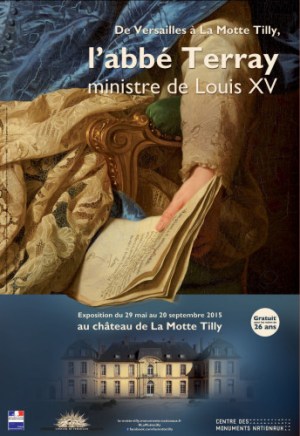 Après Sacres Royaux, de Louis XIII à Charles X au palais du Tau à Reims et Le salon de George Sand à Nohant, en 2014, la troisième exposition du partenariat entre le Centre des monuments nationaux et le château de Versailles se tiendra au château de La Motte Tilly (Aube) du 29 mai au 20 septembre 2015. Cette nouvelle exposition conjointe est consacrée à l’abbé Joseph Marie Terray (1715–1778), ministre des finances de Louis XV, à l’occasion du tricentenaire de sa naissance.
L’abbé Terray et La Motte Tilly
Joseph Marie Terray bénéficie, à ses début, de l’héritage financier de son oncle, premier médecin de la princesse Palatine, belle-sœur de Louis XIV. Nommé abbé de Notre-Dame de Molesme, au diocèse de Langres, en octobre 1764, il devient, le 23 décembre 1769, contrôleur général des Finances de Louis XV. Après le renvoi du duc de Choiseul en 1770, il est l’un des hommes forts du ministère dit du Triumvirat. Incarnation de l’ascension sociale du XVIIIe siècle, talentueux réformateur, grand homme de l’histoire économique et politique du règne de Louis XV, l’abbé Terray, malgré l’appui constant de Madame de Pompadour puis de Madame Du Barry, est très impopulaire. Il mène en effet une politique financière, certes efficace et progressiste, mais aussi brutale et autoritaire. Le ministre occupe finalement la prestigieuse charge de directeur des Bâtiments du Roi en août 1773. Mais, un an plus tard, il démissionne avec l’avènement de Louis XVI et se retire à La Motte Tilly, tout en rêvant secrètement d’être rappelé au gouvernement.
Son domaine de La Motte Tilly, parfait exemple de l’architecture du XVIIIe siècle, est sa résidence de 1748 à son décès en 1778. La demeure et son parc, comprenant aujourd’hui près de 1080 hectares, témoignent d’un certain art de vivre au Siècle des Lumières. L’actuel château, élevé à partir de 1755, est l’œuvre de l’architecte parisien François-Nicolas Lancret (1717–1789), le neveu du célèbre peintre de scènes galantes, Nicolas Lancret. L’implication de l’abbé Terray dans les différents chantiers de sa demeure de plaisance s’amplifie à mesure que sa carrière politique prend de l’importance.
L’exposition
Présentée dans les anciens appartements du ministre, l’exposition De Versailles à La Motte Tilly. L’abbé Terray, ministre de Louis XV retrace l’ascension et la vie du maître des lieux, personnage historique parmi les plus influents de la fin du règne de Louis XV mais aussi parmi les plus controversés du XVIIIe siècle. Réunis pour la première fois, des documents d’archives, des objets d’art précieux, des dessins et des tableaux contribuent également à mettre en lumière le domaine de La Motte Tilly, chef-d’œuvre architectural trop longtemps ignoré. L’exposition est enfin l’occasion unique de présenter un somptueux portrait conservé dans les collections versaillaises : l’effigie officielle du ministre tout puissant peinte par Alexandre Roslin à la demande de Terray en 1773. Ce dernier y est figuré au sommet de sa gloire.
L’exposition est rendue possible grâce au prêt d’œuvres des collections du musée national de Versailles et de Trianon, ainsi qu’aux concours généreux du musée du Louvre, de l’abbaye de Chaalis, de la Bibliothèque nationale de France, de la Bibliothèque municipale de Versailles, des Archives nationales, des Archives départementales de l’Aube et de plusieurs collections particulières.
Ce parcours historique est conçu par Gwenola Firmin, conservateur, en charge des peintures du XVIIIe siècle au château de Versailles, assistée de Vincent Bastien, docteur en Histoire de l’art, chargé de mission.
Le partenariat entre le CMN et le château de Versailles
Le partenariat établie en 2013 entre le CMN et le château de Versailles instaure un dialogue entre des collections trop souvent méconnues et des hauts lieux du patrimoine national. Des expositions temporaires conjointes permettent aux deux institutions d’unir leurs ressources afin de donner au plus grand nombre la possibilité de découvrir ou de redécouvrir quelques pages de l’Histoire de France. En 2014, les expositions Sacres royaux, de Louis XIII à Charles X au palais du Tau à Reims et Le salon de George Sand au domaine de Nohant ont attiré au total près de 76 000 visiteurs.
Gwenola Firmin and Vincent Bastien, De Versailles à la Motte Tilly: L’abbé Terray, Ministre de Louis XV (éditions du Patrimoine / Centre des Monuments Nationaux, 2015), 48 pages, ISBN: 978-2757704714, 12€.
The full dossier de presse is available as a PDF file here»










leave a comment