Exhibition | Tables from the Great Gallery of The Wallace Collection
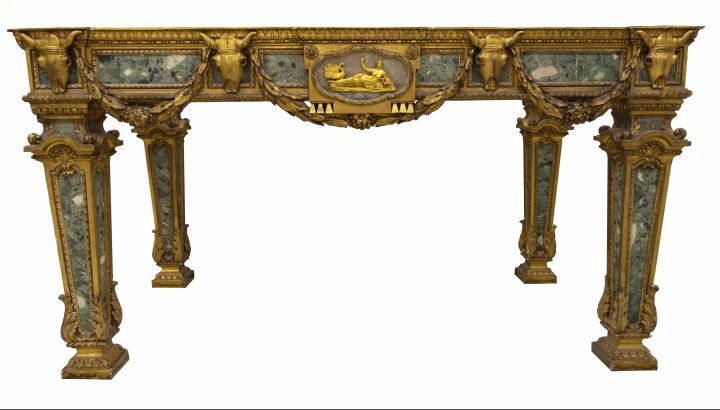
Pier table, Italy, ca. 1770 (London: The Wallace Collection)
A high resolution image is available here»
◊ ◊ ◊ ◊ ◊
Now on at The Wallace:
Collaboration, Conservation and Research: Furniture from the Great Gallery
The Wallace Collection, London, 19 September 2014 — 27 September 2015
Two pairs of monumental tables have been on display in the Great Gallery for more than a century. The recent Great Gallery refurbishment project provided the perfect opportunity for all four tables to undergo full cleaning and conservation treatment. To address the treatment needs of the tables, the Wallace Collection teamed up with Buckingham New University, City and Guilds of London Art School and West Dean College and several students undertook the work as an integral part of their degree course. Now, some two years later, the tables have returned from treatment and look stunning in their former locations, much as they would have looked in Sir Richard Wallace’s day.
During the course of their treatment conservators and curators were able to analyse the tables forensically, discovering, for example, that the two in the centre of the gallery (F510-511) are not in fact a pair, instead one is a later copy of the other. To learn more about our new findings, as well as the techniques which the students used in their conservation work on these and the pair of pier tables (F514-515), come and visit the display from 19 September in the Conservation Gallery at the Wallace Collection.
T A L K S
All talks start at 1pm in the Conservation Gallery.
Monday, 22 September: John Slight, a former student from Bucks New University, will discuss the treatment of a grand nineteenth-century Italian table.
Monday, 20 October: Hans Thompson, a former student from City and Guilds of London Art School, will discuss the treatment of the Italian eighteenth-century Pier table.
Thursday, 20 November: Kate Aughey, a former student from West Dean College, will discuss the treatment of the Italian eighteenth-century Pier table.
Monday, 8 December: Dr. Marina Sokhan, Head of Conservation at City and Guilds of London Art School, will discuss the treatment of the Italian eighteenth-century Pier table as well as the conservation course at City and Guilds of London Art School.
Exhibition | Birth of Design, Furniture Masterpieces, 1650–1789
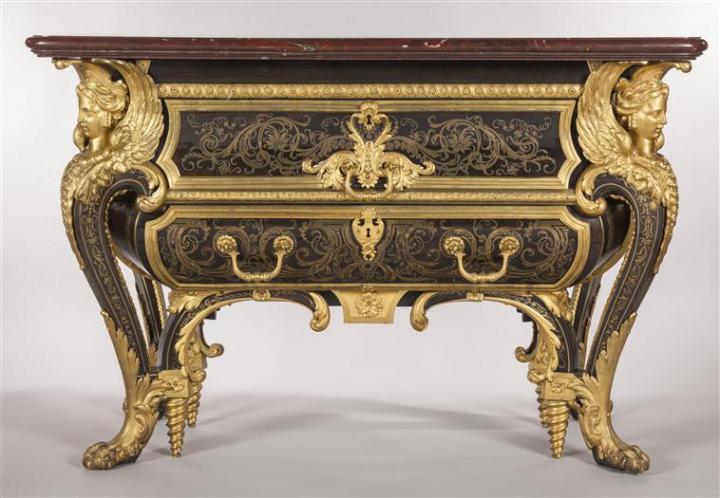
André-Charles Boulle, Louis XIV’s commode; made of resinous wood, ebony veneer, tortoiseshell and bronze inlay, gilt bronze, griotte marble; Paris, 1708, H. 88 x 131 x 65 cm (Versailles, National Museum of the Palaces of Versailles and Trianon; Inv. VMB 14279.1)
◊ ◊ ◊ ◊ ◊
From the Château de Versailles:
Eighteenth Century, Birth of Design, Furniture Masterpieces, 1650–1789
18e, aux sources du design, chefs-d’œuvre du mobilier 1650 à 1790
Château de Versailles, 28 October 2014 — 22 February 2015
From 28 October 2014 to 22 February 2015, the Palace of Versailles is hosting the exhibition 18th Century, Birth of Design, Furniture Masterpieces from 1650 to 1790 in the Africa and Crimea Rooms. The exhibition offers a glimpse of the ingenuity of a bygone era viewed from a present-day perspective and showcases the innovative and avant-garde nature of the shapes, techniques, decorations, and materials used in 18th-century furniture. The exhibition includes around 100 major works from collections at the Palace of Versailles, the Louvre Museum, the Musée des Arts Décoratifs, the Palace of Fontainbleau, and the Getty Museum, alongside works from private collections which will be on show to the public for the first time. Cabinets, desks, writing tables, commodes, and console tables, but also sofas, armchairs, folding chairs, and seating chairs will testify to the revolution that the 18th century brought about in the history of furniture, a reflection of the evolving tastes of a society enamoured by modernity and wanting to live in comfort and luxury.
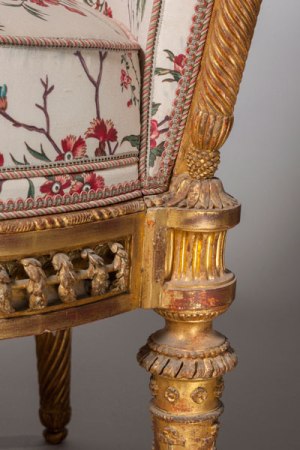
Jacques Gondoin and François II Foliot, Chair from the Pavillon du Rocher at the Petit Trianon; carved, gilded beech; 1781, 89 x 56 x 56 cm (Versailles, National Museum of the Palaces of Versailles and Trianon, Inv. V 5358)
Concept of Design
In 1712, Shaftesbury introduced the term and concept of design to art theory. It contains the dual meaning of ‘plan’ and ‘intention’ and unifies the processes of conceiving and shaping a work. For the first time, furniture was planned with forethought, created with specific intention and shaped for both functionality and comfort. 18th-century furniture was produced according to design sources, both in its overall conception and its quest for harmony between form and function.
The Transformation of Furniture
The quest for the ideal shape and form hit its peak in the 18th century, when the shape of furniture began to change. Inventiveness and creativity abounded and new outlines began to take shape, from console tables to commodes to secretary and armoire desks. Rigid outlines began to soften, then morphed into rounded curves, subsequently giving way to curved legs—sometimes four, six or even eight of them. Furniture became multi-purpose and featured mechanisms that allowed it to transform into something else.
Boldness of Materials and Colours
The same quest characterised the use of materials: furniture was covered with exotic woods, lacquers, varnishes, tortoiseshell, mother-of-pearl, bronze, brass, lead, porcelain, straw, steel and stone marquetry. Cloth, bulrush and copper began to be used in chairs. Long before the garish colours afforded by plastic in the 20th and 21st centuries, the 18th century saw the birth of furniture in red, daffodil yellow, turquoise blue, apple green, partially gilded or silvered, etc. At the same time, other colour palettes were limited to the black and gold of lacquer and bronze, and patterns were reduced to natural ones made out of quality materials such as mahogany.
◊ ◊ ◊ ◊ ◊
The catalogue is available in both French and English:
18th Century, Birth of Design, Furniture Masterpieces, 1650–1790 (Dijon: Éditions Faton, 2014), 280 pages, ISBN 978-2878441949 (English) / 978-2878441901 (French), 42€.
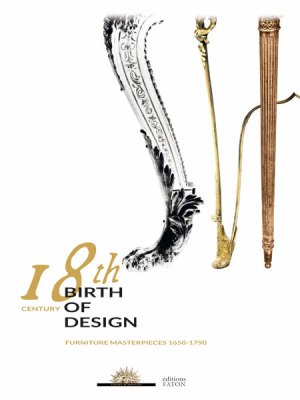 The sole purpose of this book, published to tie in with the magnificent exhibition at the Palace of Versailles, is to lay bare the incredible inventiveness of the century of Enlightenment, a century in which, for the first time, furniture became an art. Architects, artists and dealers as well as ordinary craftsmen set about organising furniture and elaborating it as never before.
The eighteenth century was to turn three everyday acts—sitting, sitting at table, storing things—into an art. Furniture changed its skin and shape. For the first time, it explored new materials, sought out new forms. It broke free of architecture, but went on playing with some of its styles. It became movable and occasional, and the notion of comfort came into being. Furniture found its identity in everyday actions to which it was closely linked. The connection between the individual and furniture became obvious. From its disposition to its ingenuity, and through the matchless quality of its incomparable workmanship, furniture in the eighteenth century came to be an integral part of daily life and fashion, quick to respond to changing moods and styles. Having thus secured both a new status and recognition, it became for ever a distinct element in the intellectual process of creation.
Daniel Alcoufe, conservateur général honoraire
Gérard Mabille, conservateur général honoraire
Yves Carlier, conservateur en chef au Musée national des châteaux de Versailles et de Trianon
Patrik Hourcade, photographe et designer
Patrick Lemasson, conservateur en chef au Musée du Petit Palais
Call for Papers | Charles de La Fosse and the Arts in France, ca. 1700
As noted at Le Blog de L’ApAhAu:
Charles de La Fosse et les arts en France autour de 1700
Château de Versailles, 18–19 May 2015
Proposals due by 15 December 2014

Charles de la Fosse, Clitia Changed into a Sunflower, 1688, 128 x 156 cm (Versailles: Châteaux de Versailles et de Trianon)
En complément de l’exposition Charles de La Fosse qui se tiendra au Château de Versailles du 23 février au 24 mai 2015, l’établissement public du château, du musée et du domaine national de Versailles et le centre recherche du Château de Versailles organisent un colloque sur l’artiste, les lundi 18 et mardi 19 mai 2015.
L’exposition, organisée en cinq grandes sections (les commandes pour les maisons royales ; La Fosse dessinateur ; la tradition académique ; le triomphe du coloris ; un précurseur du XVIIIe siècle) sera en effet de l’occasion de faire le point sur un artiste majeur de la seconde moitié du règne de Louis XIV.
Le colloque voudrait être à la fois un approfondissement et un élargissement du propos de l’exposition et permettre de mieux situer La Fosse dans les enjeux de la pratique artistique autour de 1700. Il s’articulera donc en quatre grandes sections, chacune avec plusieurs thématiques possibles (indiquées ici à titre d’exemple), qui pourront accueillir entre trois et cinq communications d’environ 20/25 minutes:
• L’art de La Fosse (la question du dessin; les artistes contemporains élèves ou collaborateurs de La Fosse)
• Le grand décor au temps de La Fosse (quadratura et plafond; le grand décor religieux)
• La mythologie vue par La Fosse et ses contemporains (Apollon- Soleil; Clytie et les fleurs; les amours des dieux)
• La Fosse et le rayonnement des capitales artistiques (Venise à Paris; le séjour Londres; le cercle Crozat)
Toute personne qui souhaiterait présenter une communication doit envoyer un synopsis de celle-ci en 300–500 mots pourvu d’un titre, avec un curriculum vitae d’une page avant le 15 décembre 2015 à
beatrice.sarrazin@chateauversailles.fr et olivier.bonfait@u-bourgogne.fr. Les réponses seront données autour du 10 janvier. Le colloque devrait pouvoir être publié.
Direction scientifique
Béatrice Sarrazin (Conservateur général au Château de Versailles et de Trianon) et Olivier Bonfait (professeur à l’Université de Bourgogne)
Comité scientifique
Olivier Bonfait (professeur à l’Université de Bourgogne), Adeline Collange-Perugi (conservateur au musée des beaux-arts de Nantes), Clémentine Gustin-Gomez (historienne de l’art), Béatrice Sarrazin (Conservateur général au Château de Versailles et de Trianon).
Call for Papers | After Print: Manuscripts in the Eighteenth Century
While this conference falls outside of art history, some readers may find it useful, and it got me thinking, by way of analogy, about the relationship between printed texts and manuscripts, on the one hand, and prints and drawings on the other. Might there be a productive way of thinking about all four together? If someone has just written a brilliant book, dissertation, or article on the topic, I would be glad to learn about it. –CH
◊ ◊ ◊ ◊ ◊
From the ASECS listserv:
After Print: Manuscripts in the Eighteenth Century
The University of California, Santa Barbara, 24 April 2015
Proposals due by 15 December 2014
Co-sponsored by the Mellon Fellowship in Critical Bibliography at Rare Book School and the UCSB Early Modern Center
This one-day conference at UCSB will bring together junior and senior scholars to explore the continued vitality of manuscript publication and circulation in the eighteenth century. Scholars now often take for granted that the eighteenth century constituted an established ‘print culture’, whether that culture was inherent in the technology or forged by its users. By the age of Addison and Pope, this narrative contends, the spread of print and lapse of licensing had rendered superfluous a manuscript world of scurrilous libels, courtly poetry, and weekly newsletters. But a growing body of research is arguing for the ongoing importance of manuscript production and publication into the Romantic period, and for a critical stance that questions the solidity of the print-manuscript binary. In texts from diaries and journals to notes, letters, sheet music, scientific observations, and hybrid multimedia documents, scholars are turning their attention to the manuscript traditions and innovations that were also central to eighteenth-century literature. And they are drawing connections to our own moment of protracted media shift, focusing on aggregative, iterative steps rather than a single ‘revolution’.
After Print will join this exciting subfield by exploring a range of manuscript practices in the long eighteenth century. Margaret Ezell, distinguished professor of English and Sara and John Lindsay Chair of Liberal Arts at Texas A&M University—whose works Social Authorship and the Advent of Print (1999) and The Patriarch’s Wife: Literary Evidence and the History of the Family (1987) have been foundational to the field—will deliver the keynote lecture on Friday evening. Proposals are solicited for papers on any aspect of eighteenth-century studies related to the theme; in particular, proposals are welcomed from junior scholars (graduate students, postdocs, and untenured faculty) for a special panel on new methods. Limited travel support for junior scholars may be available. Please send paper proposals by December 15 to Rachael Scarborough King (Asst. Prof. of English, UCSB), rking@english.ucsb.edu.
Exhibition | Caspar Wolf and the Aesthetic Conquest of Nature

Caspar Wolf, Panorama of the Grindelwald Valley with the Wetterhorn, Mettenberg, and Eiger, ca. 1774 (Aarau: Aargauer Kunsthaus, photo by Jörg Müller)
◊ ◊ ◊ ◊ ◊
From the Kunstumuseum Basel:
Caspar Wolf and the Aesthetic Conquest of Nature
Kunstmuseum Basel, 19 October 2014 — 1 February 2015
Curated by Bodo Brinkmann and Katharina Georgi
The Alps as magnificent spectacle of nature—a surprisingly recent opinion. It was only during the course of the 18th century that people began regarding jagged mountain ranges as ‘sublime’ and aesthetically pleasing. The Swiss landscape painter Caspar Wolf (1735–1783) was one of the first to conquer this largely undeveloped Alpine landscape on his extensive treks and made it available as subject matter for artistic treatment. In his galvanizing compositions, massive boulders, thundering mountain torrents, and bizarre glacier formations impede the viewer’s path. The human being, standing in awe, is reduced to a tiny figure before expansive panoramas. Wolf stands well apart from the idyllic Baroque landscapes with his radical formations and as one of the most significant precursors to European romanticism. But the same time, his work breathed the spirit of enlightenment. The exhibition includes 126 works by Caspar Wolf and his contemporaries as well as a selection of recent photographs taken at these respective locations in the Alps. In conjunction with this exhibition, the Kupferstichkabinett at the Kunstmuseum Basel will present highlights from its wealth of drawings and prints by Caspar Wolf.
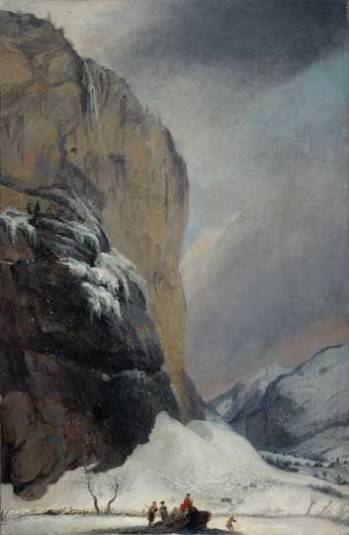
Caspar Wolf, The Staubbachfall in Winter, ca. 1775
(Bern: Kunstmuseum)
A fluke of history can be credited for Caspar Wolf ascent from impoverished childhood in Muri as carpenter’s son and moderately successful painter to artist of standing in European art history: the most important pioneer of Alpine painting and one of the most significant precursors to European Romanticism.
The fluke in question is Caspar Wolf’s encounter with the influential Bernese publisher Abraham Wagner (1734–1782). Wagner, one year his senior, had an ambitious project: to issue an encyclopedic publication of the Swiss Alpine landscape complete with illustrations of the highest artistic standard; and more to the point, these illustrations would be worked immediately from nature. The landscape that Wagner had in mind as motif was the rarely travelled and difficult to reach high Alpine region. The idea was to offer viewers a new conception of the Alpine landscape in images of previously unparalleled precision and magnificence. To author the written sections of this publication, Wagner engaged the Bernese priest and eminent natural philosopher Jacob Samuel Wyttenbach. Wolf was to accompany the two men on their extensive treks through the Alpine mountains. His task was to document and depict in paintings these unique encounters with nature.
What resulted was a comprehensive picture cycle of the Swiss Alps. Working in his studio from the nature studies completed on location, Wolf created some 200 paintings of imposing quality that bring together spontaneous observations and highly artistic formulations. Wolf invents astute painterly formulations to depict mountain ranges and glaciers, waterfalls and caves, bridges and raging torrents, lakes and high plateaus, sometimes rendering these in expansive panorama views, sometimes in close, claustrophobic compositions. His paintings include many prominent natural monuments, some no longer existent due to the environmental destruction of recent centuries: hence, the famous ‘séracs’ (pinnacles of glacier ice) of the Lower Grindelwald Glacier, evident in two exceptionally powerful paintings by Wolf, have long since melted, for instance.
Wolf’s paintings can neither be grouped with the vedute, a type painting popular at the time, nor can they be described as explicitly documentary images. Instead, they speak to a more fundamental subject matter: they consider the relationship between the mountain as rational concept and the mountain as sensual perception.
But what was the origin for the remarkable aesthetic assurance with which the artist entered the virginal territory of Alpine painting? Wolf’s intense engagement with French painting while in Paris in 1770/71 proved to be of central importance. This is vividly demonstrated in the exhibition with works by François Boucher, Claude-Joseph Vernet, Philippe-Jacques de Loutherbourg the Younger, and Hubert Robert. Surprisingly, Wolf profits greatly from his engagement with contemporary marine paintings and their depictions of dramatic storms at sea and shipwrecks.
The exhibition includes 126 works by Caspar Wolf and his contemporaries as well as a selection of recent photographs taken at these respective locations in the Alps. In conjunction with this exhibition, the Kupferstichkabinett at the Kunstmuseum Basel will present highlights from its wealth of drawings and prints by Caspar Wolf.
◊ ◊ ◊ ◊ ◊
The catalogue is available in German and English:
Caspar Wolf und die ästhetische Eroberung der Natur (Ostfildern: Hatje Cantz Verlag, 2014), 224 pages, ISBN: 978-3775738323 (German) / ISBN: 978-3775738330 (English), €58.
 The notion of the Alps as a magnificent natural spectacle is surprisingly recent. It was not until the eighteenth century that its craggy mountain ridges began to be seen as ‘sublime’ and beautiful. The Swiss landscape painter Caspar Wolf (1735–1783) was one of the first to discover the then largely unexplored world of the Alps as a subject of art through his extended forays into the mountains. Trained in southern Germany and Paris, Wolf was commissioned to produce a comprehensive series on the Swiss Alps, which he completed between 1773 and 1779. Working in his studio, the artist created some 180 imposing paintings from nature studies done outdoors. The publication demonstrates how he conveyed what he had seen according to his aesthetic criteria. In his dramatic compositions, paths are blocked by immense boulders, roaring streams of water, and glaciers, or the
view opens up to reveal giant panoramas, which are
observed by tiny, awestruck human figures.
Call for Papers | Jean-Pierre Saint-Ours (1752–1809)
As noted at H-ArtHist:
Saint-Ours Aujourd’hui
Geneva, 19–21 November 2015
Proposals due by 30 November 2014
À l’occasion de l’exposition rétrospective consacrée à Jean-Pierre Saint-Ours (1752–1809), le Musée d’art et d’histoire (MAH) et le Département d’histoire de l’art de l’Université de Genève lui consacreront un colloque international, à Genève, du 19 au 21 novembre 2015. Ce colloque souhaiterait faire le point de la recherche, passée et présente, sur l’un des peintres les plus importants de l’histoire des arts à Genève.
Invitant des spécialistes confirmés mais aussi de jeunes chercheurs, ce colloque offrira aussi l’occasion de réinterroger les relations que les peintres genevois ont établies avec les autres artistes européens et la place des arts à Genève à la fin du XVIIIe siècle et au début du XIXe siècle.
Les chercheur-e-s intéressé-e-s sont prié-e-s de transmettre
• le titre envisagé et un résumé de 300 mots de leur conférence
• un bref curriculum-vitae, agrémenté d’une éventuelle liste de publications
à Jan Blanc jan.blanc@unige.ch, avant le 30 novembre 2014
An extended Call for Papers with bibliography is available at Le Blog de L’ApAhAu.
Exhibition | Detroit before the Automobile
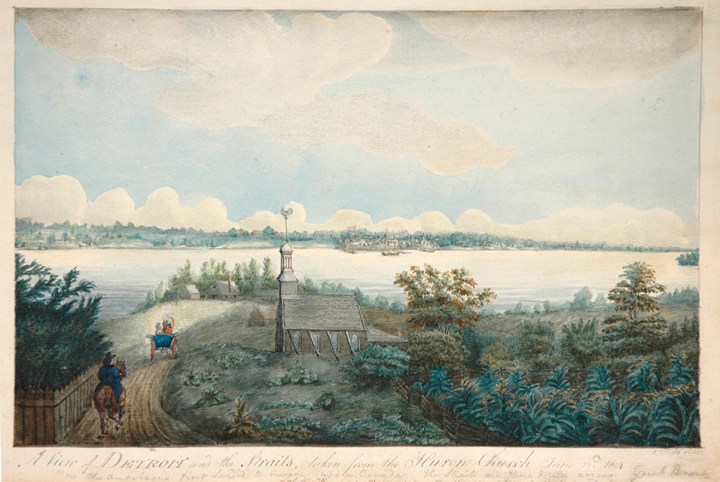
Edward Walsh, View of Detroit and the Straits,
Taken from the Huron Church, 1804
(University of Michigan: William L. Clements Library)
◊ ◊ ◊ ◊ ◊
Now on view at the University of Michigan, as noted at Art Daily:
Detroit before the Automobile: The William L. Clements Library Collection
University of Michigan Museum of Art, Ann Arbor, 18 October 2014 — 18 January 2015
In spite of the economic reverses of the last few decades, Detroit is still perceived by most Americans as the cradle of the automotive industry and the testing ground for twentieth-century innovations in manufacturing that changed the world. ‘Motown’, however, was already two centuries old by the time the Model T rolled off the first assembly line. Detroit before the Automobile examines the first 200 years of the city’s history using rare books, manuscripts, maps, and graphics from the extensive collection of the University of Michigan’s William L. Clements Library.
Detroit was founded by the French in 1701 as a trading center and agricultural settlement. In 1760 it passed to the British and became an important post for them during the American Revolution. It was ceded to the United States by the peace treaty of 1783, although the United States did not actually take control of the city until 1796. In 1805, Detroit became the capital of the Michigan Territory, but it was destroyed by fire the same year. Rebuilt to a radical new design, the town and fort were taken by the British at the outset of the War of 1812 and then recovered by the United States in 1813. In 1817 it saw the birth of the University of Michigan. During the nineteenth century, Detroit matured and grew in importance as a shipping center with a developing industrial base of shipbuilding, rail-car construction, stove manufacturing, and similar industries that ensured the city would have the infrastructure and transportation network needed to greet the infant auto industry at the dawn of the twentieth century.
The Clements Library has a rich variety of primary sources documenting the history of Detroit before 1900, from maps outlining the distinctive ‘ribbon farm’ land pattern of the French, to plans of the town, and prints charting the city’s increasing size and the height of its buildings. Together this array of primary documents brings to life the early history of one the oldest cities in the Midwest.
The exhibition is part of the U-M Collections Collaborations series, co-organized by and presented at UMMA and designed to showcase the renowned and diverse collections at the University of Michigan. The U-M Collections Collaborations series is generously supported by the Andrew W. Mellon Foundation.
Richard Wilson Online Catalogue Now Available
 The Richard Wilson Online catalogue raisonné has been compiled by Dr Paul Spencer-Longhurst (Senior Research Fellow) with the collaboration of Professor David Solkin (Curator of the exhibition, Richard Wilson: The Landscape of Reaction, 1982–83) and Kate Lowry (formerly Chief Conservator at the National Museum Wales, Cardiff), with the assistance of Maisoon Rehani (Project Coordinator) and Peter Thomas (Technical Project Consultant).
Richard Wilson Online is the outcome of intensive ongoing research undertaken since 2009 to re-establish Richard Wilson’s (1713/14–1782) status and redefine his output in celebration of the tercentenary of his birth. The website is launched as a work-in-progress designed to provide an up-to-date and freely accessible record of Wilson’s autograph paintings and works on paper. It complements and extends the public interest in and academic focus on his achievements stimulated by the exhibition, Richard Wilson and the Transformation of European Landscape Painting, on show at the Yale Center for British Art, New Haven, USA, and Amgueddfa Cymru – National Museum Wales, Cardiff in 2014.
Accessing Richard Wilson Online
Call for Papers | ISECS 2015 Panel—For the Greater Glory of Portugal

◊ ◊ ◊ ◊ ◊
Now accepting proposals for this panel for next year’s ISECS Congress in Rotterdam:
For the Greater Glory of Portugal: Cultural Policy and Artistic Trade in the Age of João V
ISECS Congress, Rotterdam, 26–31 July 2015
Proposals due by 12 January 2015 (though earlier submissions are very much encouraged)
Organiser: Dr. Pilar Diez del Corral Corredoira, Art History Institute, New University of Lisbon: pilarddcc@gmail.com; pcorral@fcsh.unl.pt
João V (1689–1750) propelled Portugal into the arena of international politics and raised the country’s prestige to new and unprecedented levels. His imperial policies affected vast swathes of territory in Africa, Asia, and Latin America. With his huge spending on art, music, and luxury items—intended to strengthen his position within European—he can be seen as a second Sun King. It is surprising, therefore, that relatively little interest has been shown in his kingship by non-Portuguese historians.
This panel will be devoted to analyzing Joao’s V artistic policy in Europe after the Treaty of Utrecht. One example of this was his massive print collection, intended to cover all areas of knowledge in a kind of Encyclopédie avant la lettre. The king used diplomatic channels to gather this, putting some of his best ambassadors and diplomats in Rome, Paris, London, and The Hague in charge. He was also extremely interested in developing strong ties with the Church in Rome. He supported lavish ambassadorial entrées, made substantial donations to the Pope and became (in absentia) one of the most generous patrons of art in Rome. He commissioned hundreds of masterpieces, namely the magnificent sculptures for his palace in Mafra and the sumptuous chapel of San Rocco in Lisbon, and he and his courtiers became some of the most influential collectors in the new Grand Tour.
Topics might include (but are not restricted to):
• The cultural milieu and artistic trade involving the embassies
• The print collection and the Mariettes
• The Boendermaker Atlas
• The art markets in Rome, Paris, and The Hague
• Collectors and diplomats as trading agents for the king
Exhibition | Anne Seymour Damer: Sculpture and Society
Now on view at Strawberry Hill:
Anne Seymour Damer: Sculpture and Society
Strawberry Hill, Twickenham (London), 11 August — 9 November 2014

Anne Seymour Damer, Shock Dog, 1780
Anne Damer was the daughter of Horace Walpole’s favourite cousin, Henry Seymour Conway. Born into a life of luxury in 1748, Anne was subjected to an arranged marriage in 1767 to John Damer, a man she neither knew or liked. Her husband’s bankruptcy and subsequent suicide led her to turn to a different life as a sculpture. In marble, terracotta or bronze, Anne Damer modelled friends, family and their animals, and also political heroes, including Admiral Nelson. Anne Damer’s art provides a wealth of insight into nineteenth–century British sculpture, including the negative reactions towards the work of a woman. Living through the turbulent times, Anne Damer mixed sculpture with acting, writing and travel. Many of her friends included leading members of the political, arts and theatre world and with Georgiana, Duchess of Devonshire she became known as one of the fashionable set of ladies of London.
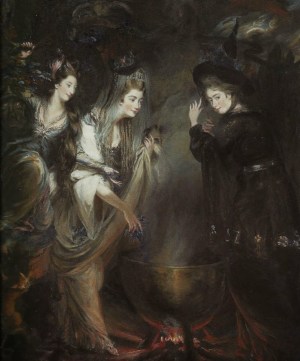
Daniel Gardner, The Three Witches from Macbeth (Elizabeth Lamb, Viscountess Melbourne; Georgiana, Duchess of Devonshire; Anne Seymour Damer), 1775 (London, National Portrait Gallery).
Horace Walpole played a significant role in Anne Damer’s life as he was her godfather and encouraged her interest in sculpture. Indeed, she developed a triangular friendship with her godfather and his protégée, Mary Berry. Horace’s affection for Anne Damer was shown in the bequest of his house to her, enabling her to live and work at Strawberry Hill until 1811. Her studio was part of Walpole’s printing house, part of which still survives today.
For the first time, Anne Damer’s life and work will be formally shown to the general public at Strawberry Hill. The exhibition, which is supported by The Henry Moore Foundation and Rainer Zietz, will showcase some of her sculptures, many from private collections and her anatomy drawing book, personal objects and a rare set of her prompt copies of plays performed at Richmond House and Strawberry Hill. The painting of The Three Witches from Macbeth (Elizabeth Lamb, Viscountess Melbourne, Georgiana, Duchess of Devonshire, Anne Seymour Damer) by Daniel Gardner will also be displayed courtesy of the National Portrait Gallery, London.
Michael Snodin, Chairman of the Trustees of Strawberry Hill Trust said, “Anne Seymour Damer: Sculpture and Society is one of a series of exhibitions on subjects related to Horace Walpole and Strawberry Hill. Anne Damer was a leading light for women of her generation and with the current interest in Georgian England, her life and work will interest many visitors to Strawberry Hill.”










 Enfilade
leave a comment