New Book | The Life of Anne Damer: Portrait of a Regency Artist
Published last year by Rowman & Littelfield:
Jonathan Gross, The Life of Anne Damer: Portrait of a Regency Artist (Washington, DC: Lexington Books, 2013), 410 pages, ISBN: 978-0739167656, £52 / $85.
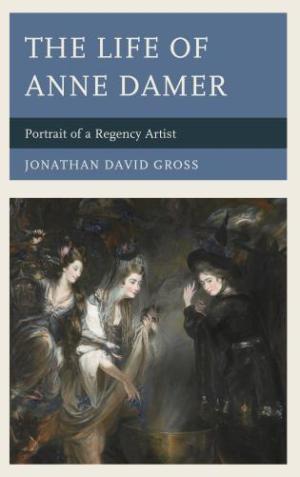 The first biography of Anne Damer since 1908, The Life of Anne Damer: Portrait of a Regency Artist, by Jonathan Gross, draws on Damer’s notebooks and previously unpublished letters to explore the life and legacy of England’s first significant female sculptor. Best known for her portraits of dogs and other animals, Damer also created busts of England’s most important political heroes, sometimes within days or hours of their historical accomplishments.
This in-depth biography traces her life during the American Revolution, the French Revolution, the Peace of Amiens and the Hundred Days. Damer was convinced that art could have significant political influence, sending her bust of Nelson to the King of Tanjore to encourage trade with India. Her art stands at the transition between neoclassicism and romanticism and provides a wealth of insight into nineteenth-century British sculpture. In the last twenty years, there has been a strong revival of interest in Damer’s life, particularly in gay and lesbian studies due to her famous relationship with author Mary Berry. This text serves as a deeper investigation of this fascinating and important figure of British art history.
The emotional ménage a trois of Anne Damer, Mary Berry, and Horace Walpole forms the heart of this new biography. Gross contends that all three individuals, had they led more conventional lives, would never have given the world the literary and artistic gifts they bestowed in the form of Strawberry Hill, Belmour, and Fashionable Friends. The struggles they faced will encourage modern readers to appreciate anew the fluidity of sexual identity and passionate friendship, as well as the restraints put in place by society to control them. Anne Damer’s life has much to teach a new generation concerned with the complex relationship between love, art, and politics. The Life of Anne Damer will interest historians of Georgian England, and readers in the fine arts, literature, and history.
New Book | Diplomats, Goldsmiths, and Baroque Court Culture
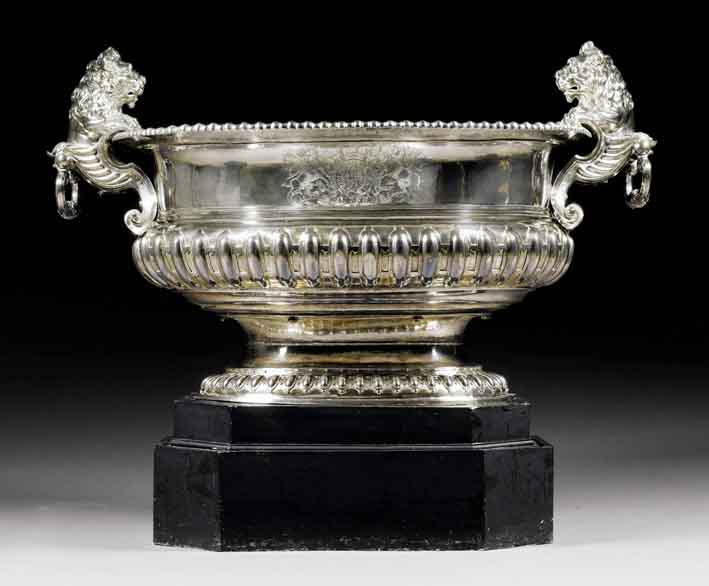
Philip Rollos the Elder, Great Silver Wine Cistern of Thomas Wentworth, Lord Raby, 1705–1706. On display at Temple Newsam House, Leeds. This enormous cistern sold for more than £2million at Sotheby’s in 2010.
More information is available here»
◊ ◊ ◊ ◊ ◊
This collection of essays grows out of a 2012 conference at Wentworth Castle, Yorkshire. From the New Arcadian Press:
Patrick Eyres and James Lomax, eds., Diplomats, Goldsmiths, and Baroque Court Culture: Lord Raby in Berlin, The Hague, and Wentworth Castle (Stainborough: Wentworth Castle Heritage Trust, 2014), 196 pages, ISBN: 978-1909837171, £20.
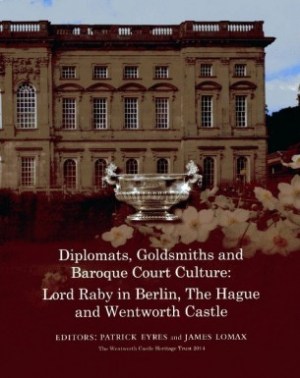 Lord Raby’s celebrated silver wine cistern was saved for the nation after a major appeal in 2011. It was part of the spectacular group of silver provided by the government for his important embassy to Berlin (1705–1711). He received even more silver as ambassador to the Dutch Republic (1711–1714) when he was Britain’s co-negotiator of the Peace of Utrecht. This book explores the political contexts to Lord Raby’s embassies; the craftsmanship, ritual function and cultural politics of Baroque court Goldsmiths’ work in England, Germany and Holland; as well as the influence of Prussia and peacemaking on the architecture, collections and gardening of Lord Raby’s Wentworth Castle estate in Yorkshire, which he had acquired in 1708.
“The book is particularly strong on the role of goldsmiths work in European diplomacy … [and] is delightfully wide-ranging, offering new scholarship on aspects of cultural politics and dining.” Susan Jenkins, The Art Newspaper (October 2014): 86.
◊ ◊ ◊ ◊ ◊
C O N T E N T S
• Patrick Eyres and James Lomax, Diplomats, Goldsmiths and Baroque Court Culture: Lord Raby in Berlin and at Wentworth Castle
• Alfred Hagemann, The Cultural Milieu of the Berlin Court of Frederick I
• Michael Charlesworth, Lord Raby’s Prussians: Art, Architecture and Amour, 1703–1713
• Patrick Eyres, Lord Raby’s Embassies and their Representation at Wentworth Castle
• James Lomax, The Ambassador’s Plate
• Jet Pijzel-Dommisse, Ambassadorial Plate, Embassies and the Dutch Court
• Philippa Glanville, Goldsmiths and Diplomats in Baroque Europe
• Ellenor Alcorn, Silver and the Early Hanoverians
• James Lomax, Baroque Silver Fountains, Cisterns, and Coolers in England
• Christopher Hartop, German Silver in England
• Jane Furse, Lord Raby and His Scientific Instruments
Call for Papers | Think ‘Small’: Artistic Miniaturization
From the Call for Papers (avec l’Appel à communication en français). . .
Think ‘Small’: Textual Approaches and Practices
of Artistic Miniaturization from Antiquity to the Nineteenth Century
Université de Toulouse – Jean Jaurès, Maison de la recherche, 1–2 October 2015
Proposals due by 15 January 2015
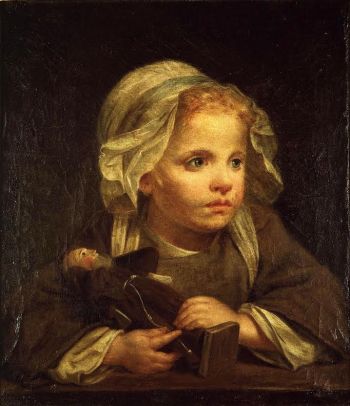
D’après Jean-Baptiste Greuze, Fillette au capucin
(Montauban: Musée Ingres). Commentaire de Diderot sur le tableau original de Greuze, Salon de 1765: “Approchez, voyez-vous cette enfant ? C’est de la chair ; ce capucin, c’est du plâtre. Pour la vérité et la vigueur de coloris, petit Rubens.”
From the Tanagra statuettes to the scientific automata of the industrial age, there are many material manifestations of the ancient fascination with shapes, images, and tiny objects. The examples abound: carved micro-architectures of Gothic buildings, small engravings by Stefano della Bella or Sébastien Leclerc, the objects of vertu of the eighteenth-century upper classes, and the Lilliputian creatures of children’s literature.
Rare, however, are the historical sources that allow us to understand their cultural foundations. While the written sources usually consider the ‘small’ only in its hierarchical relationship to the ‘big’, the analysis of the consumption of these objects reveals a set of practical, symbolic, and artistic skills such as manoeuvrability, mobility, economy, poverty, preciousness, thoroughness, prettiness, and strangeness. Too often, the dominant sources focus on the size of the objects, which diminishes the presence of other considerations. At times miniaturization reduces the scale of a given object, while at other times it may be an independent creation governed by specific criteria. Whatever the case, miniaturization is based on a set of justifications, usages, and judgments that this conference aims to clarify.
This area of research is nourished by recent scientific trends and interest which have benefited the European production of miniatures, notably through the recent conferences: The Gods of Small Things (Reading, 21–22 September 2009); La miniature en Europe, XVIIe–XIXe siècles (Paris, 11–12 October 2012); L’automate: Enjeux historiques, techniques et culturels (Neuchâtel, 6–7 September 2012); and Micro-architecture et figures du bâti: l’échelle à l’épreuve de la matière (Paris, 8–10 December 2014). Our conference will consider the multiple reasons that explain the taste and interest in miniaturization over time, without favouring any particular medium. We will therefore discuss architecture, painting, sculpture, decorative arts, folk art, as well as poems and epigrams. Crossing disciplinary approaches (art history, history, anthropology, philosophy, literature, philology), this conference will focus in the first place on the theoretical reflections underlying the examination of a body of works. Secondly, we will examine those texts that, even if they comment on the ‘small’ in marginal and critical terms, are nonetheless important in the context of an anthology project in which the presenters will participate.
In order to define the ‘small’ in art and question its varied reception through the ages, each presentation, lasting 20 minutes, will explore three registers of perception, by no means reductive:
Consumption and contexts of use
Economic, marketing and circulation (reproducible series or unique work, mobility, swarming); conservation and presentation (curio cabinets, boxes, editing); functionality, usability, destinations and meanings (private / public; domestic / fun / political; secular / sacred / memorial).
Artistic and aesthetic aspects
Ideological tensions between ‘small’ and ‘high’ art; the issue of miniature reproduction of the human figure (dwarf, pygmy, monsters); characters of courtesy, refinement, oddity, impoverishment, etc., specific to the ‘small’; intercultural relations (exchanges and influences between East, the Americas and the West, exotic).
Human and emotional dimensions
Individuals, human categories and social structures involved in the ‘small’ (women, children, ‘ignorant’, princes, peasants, etc.); an attempt at classification; challenges of physical manipulation and microscopic observation; moral criticism (worship and fetishism); imaginary fables and tales and history of mentalities.
Proposals for papers up to one page and a brief bio-bibliographical record in English or French should be sent to Colloque.Petit.Toulouse.2015@gmail.com before January 15, 2015. The proceedings of the symposium will be published along with an anthology of textual sources dealing with the ‘small’; the papers and the list of references and possible sources for the anthology should be sent by December 15, 2015. Languages used in the symposium: French and English.
Organizers
Sophie Duhem (université Toulouse – Jean Jaurès, FRAMESPA UMR 5136); Estelle Galbois (université Toulouse – Jean Jaurès, PLH-CRATA); Anne Perrin Khelissa (université Toulouse – Jean Jaurès, FRAMESPA UMR 5136)
Scientific Committee
Jean-Pierre Albert (EHESS, LISST, Toulouse); Lorine Bost (Centre de recherches en Littérature et Poétique comparées, EA 3931); Quitterie Cazes (université Toulouse – Jean Jaurès, FRAMESPA); Pierre-Olivier Dittmar (EHESS, GAHOM); Jean-Marie Guillouët (université de Nantes); Pascal Julien (université Toulouse – Jean Jaurès, FRAMESPA); Jean-Marc Luce (université Toulouse – Jean Jaurès, PLH-CRATA); Christian Michel (université de Lausanne); Jean Nayrolles (université Toulouse – Jean Jaurès, FRAMESPA); Odile Nouvel (Les Arts décoratifs, Paris); Nathalie Rizzoni (CELLF 17e-18e UMR 8599 CNRS et université Paris – Sorbonne)
Penser le « petit » de l’Antiquité au XIXe siècle.
Approches textuelles et pratiques de la miniaturisation artistique
The Call for Papers in French is available here»
Call for Articles | Irish Fine Art in the Early Modern Period
From the Call for Papers:
Collection of Essays | Irish Fine Art in the Early Modern Period
Proposals due by 12 January 2015
Papers are invited for a forthcoming book which will showcase new scholarship focused on the history of fine art in Ireland in the early modern period (c.1600–c.1815). Publication by Irish Academic Press is due in 2016. Dedicated research in the past decade into Irish fine art of this period has produced some excellent—though isolated—examples in the form of displays, publications, and articles. In notable contrast are coeval fine art studies in Britain which currently enjoy a revival in research funding, museum partnerships, publishing opportunities, exhibitions, and active expertise networks, all of which provide vital scholarly momentum to the field.
While a more sustained format for focused scholarly output in this area remains a desideratum, this project provides an opportunity to draw together and highlight substantial new work on the production and reception of fine art in Ireland in this period and its contemporary discourse. Contributions are warmly welcomed from academics and graduate students working in art history and associated humanities disciplines, curators, and independent scholars actively engaged in related research. Papers should engage with fine art media—painting, drawing, miniatures, sculpture, and print culture—and demonstrate original and previously unpublished research.
Possible topics for papers include, but are not confined to, the following themes as considered in an Irish context:
• Artistic patrons, patronage, and collecting
• Modes of acquisition and display
• The impact of contemporary politics and ethnographic change on artistic production and consumption
• Artistic networks
• Artistic genres
• Artist biographies
• Artistic training and education
• Foreign travel for formal or informal artistic education
• Amateur artists and artistic production
• Fashioning an artistic career: artists’ means of self-promotion and engagement with patrons and the art market
• Art writing, published or otherwise
• Art historiography of the early modern period
Please send an abstract of your proposed paper (approximately 400 words) and a brief biographical note (maximum 200 words) to IrishArtCFP@outlook.com by Monday 12 January 2015. If you have any queries, please address them to the same email. Final papers will be in the region of 9,000 words, but abstracts for shorter papers are also welcome (please indicate if possible when submitting your abstract). Authors are welcome to submit more than one abstract for consideration by the editorial committee, which comprises Dr Jane Fenlon, Dr Ruth Kenny, Caroline Pegum, and Dr Brendan Rooney. Final papers will be peer-reviewed.
Call for Papers | Robert Adam and His Brothers

Information about the chimneypiece is available here
◊ ◊ ◊ ◊ ◊
From the Call for Papers:
Robert Adam and His Brothers: New Light on Britain’s Leading Architectural Family
London, September 2015
Proposals due by 25 December 2014
The Adam style revolution transformed British architecture in the latter half of the eighteenth century. The brothers’ unique and inventive approach to design, based on a modern reinterpretation of the art of antiquity, found widespread popularity and was to have a lasting impact on European and American architecture. The movement and surface variety inherent in their buildings, combined with the lightness and informality of their interiors, set new standards of elegance and were widely imitated.
This two-day symposium aims to highlight important new research and findings on Robert Adam and his brothers across all aspects of their life and work, including architecture, interior decoration, the use of colour, the influence of classical sources, drawing office procedure, the art market, town-planning and building speculation. The conference will present papers from established scholars as well as new research by a younger generation of historians and doctoral students, and is intended to stimulate further study into this most important of British architectural families.
We welcome proposals for 20-minute presentations on any aspect of the Adams’ oeuvre. Please email abstracts of no more than 250 words and a copy of your CV by 25 December 2014 to Colin Thom (Senior Historian, Survey of London) or Geoffrey Tyack (Director, Stanford University Programme, Oxford, and Editor, Georgian Group Journal) at c.thom@ucl.ac.uk and geoffrey.tyack@kellogg.ox.ac.uk. Notifications of acceptance will be sent by 12 January 2015. The symposium is being hosted by the Georgian Group with the support of the Bartlett School of Architecture, University College London, and will be held in London in September 2015. Further details of the symposium dates, venue and programme will follow by 2 February 2015. It is intended that selected papers will be published in an edited volume in 2016.
Journée d’études | L’architecture des ingénieurs, 1650–1850
From the conference programme:
L’architecture des ingénieurs, 1650–1850
Bibliothèque municipale, Versailles 8 November 2014
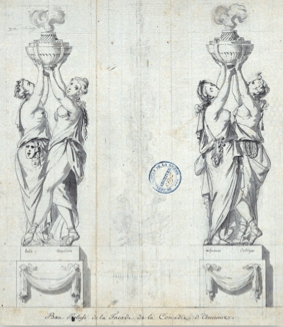
Jacques-Pierre-Jean Rousseau, ingénieur des ponts et chaussées, puis architecte de la ville d’Amiens, reliefs de la façade du théâtre de la ville, 1778, Archives départementales de la Somme
Organisée par les universités Bordeaux-Montaigne, Paris-Sorbonne, Paris-Ouest, avec le concours du Ghamu
Les années 1980 furent propices à l’étude du travail des ingénieurs : en 1981, Anne Blanchard publiait un Dictionnaire des ingénieurs militaires actifs en France entre 1691 et 1791, témoignant par son volume de l’importance de leur activité, tandis qu’en 1988, Antoine Picon, dans son ouvrage Architectes et ingénieurs au siècle des Lumières, accordait enfin aux ingénieurs des Ponts l’attention qu’ils méritaient et examinait leur formation et leurs méthodes de travail au regard de celles des architectes de l’Académie royale d’architecture.
Au-delà des programmes attendus, fortifications, ouvrages hydrauliques, ponts et routes, les ingénieurs, militaires et des Ponts et Chaussées, honorèrent des commandes dans le domaine de l’architecture publique monumentale, de l’architecture religieuse et hospitalière, mais aussi dans celui de l’architecture domestique et de l’art des jardins. L’historiographie fait la part belle aux architectes dans les embellissements de la capitale, tandis que les études récentes sur la province accordent aux ingénieurs une place de plus en plus importante : le tableau est en réalité bien plus nuancé. Cette journée sera l’occasion de présenter les limites de cette opposition et d’initier un travail systématique sur l’activité des ingénieurs du règne de Louis XIV à la monarchie de Juillet.
Cette première rencontre se concentre plus particulièrement sur l’architecture privée et son décor, la distribution et le projet urbain. Une deuxième rencontre se déroulera en 2015.
Direction scientifique : Basile Baudez, maître de conférences, Paris-Sorbonne, Alexia Lebeurre, maître de conférences, Bordeaux-Montaigne, et Dominique Massounie, maître de conférences, Paris Ouest-Nanterre.
Contacts : basile.baudez@gmail.com, alexialebeurre@gmail.com, dommassounie@aol.com
◊ ◊ ◊ ◊ ◊
P R O G R A M M E
9:30 Accueil
Matinée: L’ingénieur et l’habitat, 10:00–12:00
Introduction et présidence, Dominique Massounie (maître de conférences, Paris Ouest-Nanterre-La Défense)
• Jean-Loup Leguay (attaché de conservation, musée de Picardie, Amiens), Le château de Saint-Gratien, près Amiens, une merveille de l’ingénieur Rousseau
• Adrian Almoguera (doctorant, allocataire-moniteur, Paris-Sorbonne), L’influence des ingénieurs militaires français sur l’architecture espagnole au XVIIIe siècle : Charles Lemeaur (1720–1785) et le palais Rajoy à Saint-Jacques de Compostelle
• Alexia Lebeurre (maître de conférences, Bordeaux-Montaigne), Charles-François Mandar et la décoration intérieure : les projets pour l’hôtel d’Osuna à Madrid (1799)
Déjeuner
Après-midi: L’art urbain des ingénieurs, 14:00–16:00
Présidente de séance, Alexia Lebeurre, maître de conférences, Bordeaux-Montaigne
• Samuel Bothamy (doctorant, Bordeaux-Montaigne), L’ingénieur militaire Isaac Robelin à Rennes (1721–1724) : plan d’embellissement, transfert foncier, système global des constructions.
• Agueda Iturbe-Kennedy (doctorante, université Laval, Québec), La porte de ville au sein du projet urbain de l’ingénieur
• Linnéa Rollenhagen-Tilly, (UMR AUSSER), Joseph-Marie de Saget, ingénieur des États du Languedoc (1725–1782)
• Raphaël Tassin (doctorant, EPHE), Richard Mique. Chantiers publics et urbanistiques en Lorraine (1755–1766)
New Book | Turquerie: An Eighteenth-Century European Fantasy
From Thames & Hudson:
Haydn Williams, Turquerie: An Eighteenth-Century European Fantasy (Thames & Hudson, 2014), 240 pages, ISBN: 978-0500252062, £40 / $65.
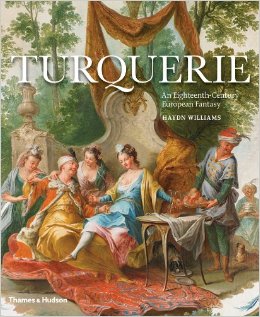 At the end of the 17th century, the long-standing fear of the Turk in Europe was gradually replaced by fascination. Travellers’ accounts of the Ottoman lands, translations of works such as One Thousand and One Nights, and the magnificent spectacle of Ottoman ambassadors and their retinues were among the catalysts that inspired the creation of a European fantasy of this world for the delight of the ruling elite, a reverie that was only shattered by the French Revolution. Turbaned figures appeared in paintings, as ceramic figures, and on the stage; sumptuous boudoirs turcs were created; and crescent moons, palm trees and camels featured on wall panels, furniture and snuff boxes.
Turquerie was a theme that sparked varied responses in different places. Its most intense and long-lasting expression was in France, but its reach was broad—from a mosque folly in Kew Gardens to the Turkish tents erected along the Elbe to celebrate a royal marriage in Dresden in 1719, from an ivory statuette of a janissary created for King Augustus II of Poland to the costumes worn for a procession to celebrate carnival in Rome in 1748.
The subject is explored thematically within a broadly chronological framework, from early contacts between Europe and the Ottomans following the fall of Constantinople in 1453, through the great flourishing of turquerie in the 18th century, to the 19th century, when other interpretations, such as Orientalism, took hold. Focusing on categories, including painting, architecture, interiors and the theatre, Turquerie provides an engaging account of this whimsical European fantasy.
Haydn Williams, formerly a director and head of the objects of vertu and Russian works of art department at Sotheby’s, is now an independent fine art consultant. He was editor and principal author of Enamels of the World 1700–2000, and curator of the related exhibition at the State Hermitage Museum, St Petersburg, in 2009–10.
Exhibition | Alexander Roslin: Portraitist of the Aristocracy
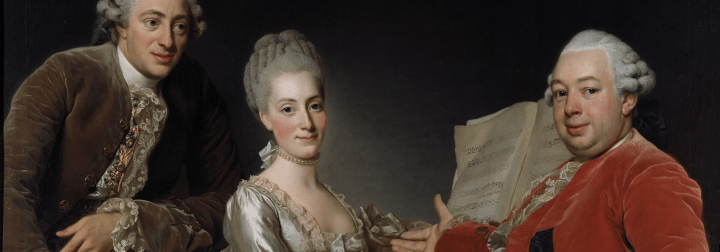
Alexander Roslin, John Jennings Esq., with His Brother
and Sister-in-Law, detail (Stockholm: Nationalmuseum)
◊ ◊ ◊ ◊ ◊
From the Rijksmuseum Twenthe:
Alexander Roslin: Portraitist of the Aristocracy / Portrettist van de aristocratie
Rijksmuseum Twenthe, Enschede, The Netherlands, 18 October 2014 — 12 April 2015
Beauty, wealth, power and prestige: the Swedish painter Alexander Roslin had an unerring grasp of how to portray the ruling class of his time. As a travelling portraitist in the second half of the eighteenth century, he visited the European centres of power to portray kings, queens and other members of the aristocracy and nobility in their finest dress. The exhibition, Alexander Roslin (1718–1793). Portraitist of the Aristocracy gives a wonderful overview of a turning point in history. The portraits of Roslin are personal documents of a period that is coming to an end, one of limitless power, extreme poverty, of beauty and atrocity. It was perhaps a tense and nervous time in modern history, which fell like a house of cards and changed Europe forever.

Alexander Roslin, Lady with the Veil, 1768 (Stockholm: Nationalmuseum)
Le Chevalier Roslin, as he was sometimes known, immortalised the ruling class at the height of its wealth and power. He was the chronicler of the wealth and decadence of the late eighteenth century. But this ‘pageant’ was with hindsight the last spasm of a class that would soon lose its power and prestige. These were turbulent times: political and social unrest prevailed, which reached its climax with the outbreak of the French Revolution in 1789. Many aristocrats who were painted by Roslin lost then their high positions and corresponding status. Some even literally lost their head under the guillotine or died a violent death through other means. The fact that Roslin himself, as representative of the hated ruling class of the Ancien Régime, miraculously survived the Revolution is probably due to his not being a French citizen.
This first Roslin exhibition in the Netherlands is not only a unique opportunity for the Dutch public to get to know the wonderful work of Alexander Roslin, but it also draws the visitors into the world of the aristocrats he portrayed. Their fascinating stories, which were sometimes dramatic and always personal, and which included political and moral intrigues, form the thread which guides the visitor through this exhibition. The luxury in which the portrayed class lived and the sweeping changes they encountered in their world are brought to life by objects from their entourage: costumes, furniture and porcelain, but also letters and prints. An intriguing picture is given of a class and way of life which experienced its climax in Roslin’s time, just before its downfall. In this way we get close to the artist and his clientele.
The exhibition will show in total more than thirty works from different international collections. Rijksmuseum Twenthe is the only museum in the Netherlands which has two portraits by Roslin in its museum collection. The delicately painted and elegant portraits of the French couple Marie Romain Hamelin and Marie Jeanne Puissant represent a type of painting that is unique in Dutch museum collections.
Especially for this exhibition RMT will have no less than sixteen top artworks on loan from the Roslin collection of the Nationalmuseum in Stockholm, including Portrait of Gustave III and the Lady with the Veil, which was described by the famous French author and critic Denis Diderot as ‘très piquante’. From the collection of the Nationalmuseum there will also be portraits on show of the Swedish Royal family, such as those of the Swedish king Gustav III (1775) and of his dominant mother Lovisa Ulrika, princess of Prussia, queen of Sweden (also 1775). Members of the French Royal family and others associated with the Roi, including Louis-Philippe de Bourbon (1725–1785), duke of Chartres, later duke of Orleans also figure prominently in the exhibition. The aristocracy is well represented in the exhibition, with wonderful portraits of the Baron and Baroness de Neubourg-Cromière (1756). One of the highlights of the exhibition is the dual display of the portrait of Princess Hedvig Elisabet Charlotta of Sweden and the original bridal dress which she is wearing on her portrait.
This exhibition has been made possible through the generous support of: Nationalmuseum Stockholm, Friends of the Rijksmuseum Twenthe, the Prins Bernhard Cultuurfonds (Nieske Fonds), Mondriaan Fund, VSB Fund, SNS Reaal Fund.
400 Years of Friendship between Sweden and the Netherlands
In 1614 Sweden opened in the Netherlands its first-ever embassy. This was the start of a friendship which has enriched and continues to enrich our economies and societies to the present day. In 2014 we’re celebrating this friendship through a special activity programme. The exhibition Alexander Roslin: Portraitist of the Aristocracy is part of an international programme. Look for more information on www.swe400nl.com.
New Book | Solomon’s Secret Arts: The Occult in the Enlightenment
This book from Paul Monod (like John Fleming’s The Dark Side of the Enlightenment: Wizards, Alchemists, and Spiritual Seekers in the Age of Reason, featured in the previous posting) appeared last year, but since I failed to note it and since we’ve just highlighted the Gothic Imagination and Witches, it seemed like a good time to backtrack.
And, I would note, after so many events to mark the Hanoverian anniversary, Coronation Day is finally here: George I was crowned at Westminster Abbey on 20 October 1714. –CH
◊ ◊ ◊ ◊ ◊
From Yale UP:
Paul Kléber Monod, Solomon’s Secret Arts: The Occult in the Age of Enlightenment (New Haven: Yale University Press, 2013), 440 pages, ISBN: 978-0300123586, $50.
 The late seventeenth and eighteenth centuries are known as the Age of Enlightenment, a time of science and reason. But in this illuminating book, Paul Monod reveals the surprising extent to which Newton, Boyle, Locke, and other giants of rational thought and empiricism also embraced the spiritual, the magical, and the occult. Although public acceptance of occult and magical practices waxed and waned during this period they survived underground, experiencing a considerable revival in the mid-eighteenth century with the rise of new anti-establishment religious denominations. The occult spilled over into politics with the radicalism of the French Revolution and into literature in early Romanticism. Even when official disapproval was at its strongest, the evidence points to a growing audience for occult publications as well as to subversive popular enthusiasm. Ultimately, finds Monod, the occult was not discarded in favor of ‘reason’ but was incorporated into new forms of learning. In that sense, the occult is part of the modern world, not simply a relic of an unenlightened past, and is still with us today.
Paul Monod is A. Barton Hepburn Professor of History at Middlebury College. He lives in Weybridge, Vermont.
New Book | The Dark Side of the Enlightenment
From Norton:
John V. Fleming, The Dark Side of the Enlightenment: Wizards, Alchemists, and Spiritual Seekers in the Age of Reason (New York: W. W. Norton, 2013), 432 pages, ISBN: 978-0393079463, $28.
 In The Dark Side of the Enlightenment, John V. Fleming shows how the impulses of the European Enlightenment—generally associated with great strides in the liberation of human thought from superstition and traditional religion—were challenged by tenacious religious ideas or channeled into the ‘darker’ pursuits of the esoteric and the occult. His engaging topics include the stubborn survival of the miraculous, the Enlightenment roles of Rosicrucianism and Freemasonry, and the widespread pursuit of magic and alchemy.
Though we tend not to associate what was once called alchemy with what we now call chemistry, Fleming shows that the difference is merely one of linguistic modernization. Alchemy was once the chemistry, of Arabic derivation, and its practitioners were among the principal scientists and physicians of their ages. No point is more important for understanding the strange and fascinating figures in this book than the prestige of alchemy among the learned men of the age.
Fleming follows some of these complexities and contradictions of the ‘Age of Lights’ into the biographies of two of its extraordinary offspring. The first is the controversial wizard known as Count Cagliostro, the ‘Egyptian’ freemason, unconventional healer, and alchemist known most infamously for his ambiguous association with the Affair of the Diamond Necklace, which history has viewed as among the possible harbingers of the French Revolution and a major contributing factor in the growing unpopularity of Marie Antoinette. Fleming also reviews the career of Julie de Krüdener, the sentimental novelist, Pietist preacher, and political mystic who would later become notorious as a prophet.
Impressively researched and wonderfully erudite, this rich narrative history sheds light on some lesser-known mental extravagances and beliefs of the Enlightenment era and brings to life some of the most extraordinary characters ever encountered either in history or fiction.
John V. Fleming is the Louis W. Fairchild, ’24 Professor of English and Professor of Comparative Literature emeritus at Princeton University, where he taught for forty years before retiring in 2006. Fleming graduated from Sewanee (the University of the South) in 1958, before spending three years in Oxford as a Rhodes Scholar. After taking his Ph.D. from Princeton in 1963, he taught for two years at the University of Wisconsin (Madison). He has published widely in the fields of medieval literature, art history, and religious history.










 Enfilade
leave a comment