Call for Papers | CAA 2015 Session, Home Subjects
A late addition to the CAA 2015 sessions:
Home Subjects: Domestic Space and the Arts in Britain, 1753–1900
HBA Session at the 103rd Annual Conference of the College Art Association
New York, 11–14 February 2015
Proposals due by 15 August 2014
Session chairs:
Melinda McCurdy (Associate Curator of British Art, Huntington Art Collections), mmccurdy@huntington.org
Morna O’Neill (Wake Forest University), morna.oneill@gmail.com
Anne Nellis Richter (independent scholar and adjunct instructor, American University), anne.nellis@gmail.com
Home Subjects is a new research working group which aims to illuminate the domestic display of art in Britain. Our goal is to examine the home as a place to view and exhibit works of art within the historical context of the long nineteenth century.
Recent scholarship has emphasized the importance of the house itself and notions of ‘domesticity’ as important touchstones in British culture. At the same time, art historians have tended to focus on a history of British art premised on the display of art in public; according to this important narrative, British art developed in relationship to the public sphere in the eighteenth century. Art institutions and exhibitions asserted the importance of the display of art in forming audiences into publics in cultural and political terms. Such efforts continued in the ‘exhibition age’ of the nineteenth century, when display of artwork in museums, galleries, and special exhibitions solidified the important role given to art in articulating a public sphere. This narrative overlooks the continuation of older paradigms of display, especially those premised on the private and domestic audience for works of art. Within this context, the country house takes it place alongside the townhouse as an important venue for the display of art. We aim to explore this ‘counter-narrative’ of the home as the ideal place to view works of art, a view which permeated all areas of art and design and which persisted throughout the nineteenth century, despite the prevailing narrative of the development of public museums.
Also at stake in this project is a reconsideration of domesticity and its relationship to modernity. Important recent scholarship has illuminated some of the ways in which entrenched narratives of modernity and artistic modernism were defined in opposition to the domestic sphere. In a typical avant-garde gambit, artists distinguished works of art from objects of interior decoration by rejecting the private and the domestic.
This session aims to bring together scholars whose work addresses this topic in order to posit a new trajectory for modernity, one that can be traced through the private, domestic sphere. Topics of interest include but are not limited to:
• the display of easel painting and its relationship to the domestic interior
• decorative arts, their status as works of art and relationship to interior decoration
• domestic architecture and museum/gallery architecture, both public and private
• collecting and taste
• the interrelationship between private and public modes of display and decoration
Proposal abstracts should be no more than 500 words, and should be accompanied by a current 2-page c.v. and must be received by email to homesubjects@gmail.com by August 15, 2014. Please also include a mailing address, telephone number, and email.
New Book | Portraiture and Politics in Revolutionary France
From Penn State UP:
Amy Freund, Portraiture and Politics in Revolutionary France (University Park: The Pennsylvania State University Press, 2014), 312 pages, ISBN: 978-0271061948, $85.
 Portraiture and Politics in Revolutionary France challenges widely held assumptions about both the genre of portraiture and the political and cultural role of images in France at the beginning of the nineteenth century. After 1789, portraiture came to dominate French visual culture because it addressed the central challenge of the Revolution: how to turn subjects into citizens. Revolutionary portraits allowed sitters and artists to appropriate the means of representation, both aesthetic and political, and articulate new forms of selfhood and citizenship, often in astonishingly creative ways. The triumph of revolutionary portraiture also marks a turning point in the history of art, when seriousness of purpose and aesthetic ambition passed from the formulation of historical narratives to the depiction of contemporary individuals. This shift had major consequences for the course of modern art production and its engagement with the political and the contingent.
Summer 2014 Issue of the CODART eZine
The 4th issue of the CODART eZine focuses on the eighteenth-century:
CODART eZine 4 (Summer 2014)

Jan Ekels, A Writer Sharpening His Pen, 1784
(Amsterdam: Rijksmuseum)
• Tom van der Molen, “Editor’s Note: Eighteenth-Century Art”
• Gerdien Verschoor, “Welcome: CODART Director Dies under Avalanche of Books”
• Virginie D’haene, “Bruges Artists Abroad: Neoclassicist Drawings in the Printroom of the Groeningemuseum”
• Stefaan Hautekeete, “A Cabinet of the Most Delightful Drawings: Eighteenth-Century Netherlandish Drawings from the Collection of Jean de Grez, To Be Exhibited at the Koninklijke Musea voor Schone Kunsten van België (Royal Museums of Fine Arts in Belgium) in 2016”
• René Dessing, “Historic Country Houses in the Netherlands”
• Silke Gatenbröcker, “Duke Anton Ulrich of Braunschweig-Wolfenbüttel: One of the First Collectors of Dutch Paintings outside the Netherlands”
• Jacek Tylicki, “Collecting at the Court of Poland-Lithuania and the Activities of King Stanislaus II August”
• Curator’s Interview: Paul Knolle interviewed by Andrea Rousová
• Friends: Brian Capstick interviewed by Gerdien Verschoor
• Rebecca Long, “CODART ZEVENTIEN Congress Review”
About CODART
CODART—the international council for curators of Dutch and Flemish art—aims to further the study, care, accessibility and display of art from the Low Countries in museums around the globe. It serves as a platform for exchange and cooperation between curators from different parts of the world, with different levels of experience, and from different types and sizes of institutions. Our organization stimulates international inter-museum cooperation through a variety of activities, including congresses, focus meetings, publications and our website. By these means CODART strives to solidify the cultural ties between the Netherlands and Flanders, and to make the artistic heritage of these countries accessible to the international art-loving public.
Exhibition | How Glasgow Flourished, 1714–1837
◊ ◊ ◊ ◊ ◊
From the Kelvingrove Art Gallery:
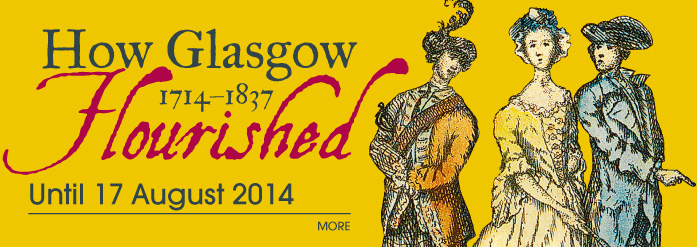
How Glasgow Flourished, 1714–1837
Kelvingrove Art Gallery and Museum, Glasgow, 18 April — 17 August 2014
How Glasgow Flourished takes a fresh look at a hugely significant but often overlooked period in Glasgow’s history. Discover how over 300 years ago, Glasgow’s businessmen made their fortunes from trading in colonial goods and through slave labour, and how they manufactured and exported products made in Glasgow, across the world. This was also when ordinary Glaswegians came together in workers’ associations and co-ops to campaign for better working and living conditions for them and their families and paved the way for the Trade Union movement.
The exhibition shows how weaving changed from a cottage industry to a full-blown manufacturing industry and green fields were covered over by some of the largest and most advanced dyeing and smelting factories in the world. You can see a reconstructed weaver’s loom, factory engines and dresses and outfits, which have never been displayed before. Other exclusive displays include new portraits of members of one of Glasgow’s wealthiest families, the Glassfords and a newly conserved music organ made by James Watt, as well as the great man’s steam engine with its condenser unit. There are also many other pieces from Glasgow Museums’ collection that have never been on display before, including art and objects relating to the lives of Glaswegians.
Teixeira’s Topographia de la Villa de Madrid in The Art Bulletin

◊ ◊ ◊ ◊ ◊
In the latest issue of The Art Bulletin (which I’m just now catching up on). . .
Jesús Escobar, “Map as Tapestry: Science and Art in Pedro Teixeira’s 1656 Representation of Madrid,” The Art Bulletin 96 (March 2014): 50–69.
Abstract: Pedro Teixeira’s Topographia de la Villa de Madrid is arguably the greatest representation of a city in the Spanish Habsburg world. Measuring nearly six feet high and more than nine feet wide, the map is a remarkable scientific achievement as well as a sophisticated art object. An exploration of the map’s text and ornament details the efforts of a scientist working in a court setting to shape a grandiose picture of the Spanish capital. Displayed on a wall, Topographia de la Villa de Madrid rivaled paintings and tapestries in their ability to exalt the image of a powerful ruler.
◊ ◊ ◊ ◊ ◊
Though dating to the the mid-seventeenth century, the map caught my attention for Enfilade because of this statement and footnote toward the end of the article:
As testament to the map’s legacy, a derivative map at a smaller scale than Teixeira’s was engraved in four plates in 1683 by the Dutch-Spanish artist Gregorio Fosman (1635–1713) and printed in the Madrid studio of Santiago Ambrona.107 (66).
107. Molina Campuzano, Planos de Madrid, 283–89, notes that the depiction of the city in Fosman’s map is approximately one-seventh the size of Teixeira’s. Fosman’s image would, in itself, serve as a model for a number of eighteenth-century maps of Madrid engraved by foreign artists in Paris, Amsterdam, and Augsburg. . . (69).
If anyone is looking then for the equivalent for Madrid of Giambattista Nolli’s 1748 map of Rome, Teixeira’s Topographia de la Villa de Madrid would seem to be at least part of the answer. -CH
Conference | The Images and Texts of Alexander Pope
Originals, Translations, and Imitations:
The Images and Texts of Alexander Pope
Waddesdon Manor, Buckinghamshire, 12 July 2014
 A one-day conference organized by Waddesdon Manor (the Rothschild Foundation) in collaboration with The Paul Mellon Centre for Studies in British Art
This conference will explore some central themes running through the exhibition, Fame and Friendship: Pope, Roubiliac, and the Portrait Bust in Eighteenth-Century Britain, organised jointly by the Rothschild Foundation and Waddesdon Manor with the Yale Center for British Art. At the heart of the exhibition are eight portrait busts of the poet Alexander Pope by Roubiliac along with various replications of this model. These images imitate classical portrait busts, translating the conventions of the originals into an eighteenth-century mode. At the same time, the replications translate Roubiliac’s original into other media, such as plaster or ceramic. At Waddesdon these various images will not only shown not only alongside both some of the most celebrated painted portraits of the poet and examples of his printed texts, but also juxtaposed with French works celebrating Pope and other writers. These various processes of imitation and translation could hardly be more appropriate for a subject whose contemporary fame rested partly on his own translations of Homer and whose poetry constantly imitated classical models. In its turn, Pope’s work was itself translated into French. All the papers in this conference will address different aspects of imitation and translation, in the form of both images and texts. The fee for the day is £40. To book a place, please ring the booking line on 01296 653226. Please let us know of any dietary requirements.
◊ ◊ ◊ ◊ ◊
P R O G R A M M E
9:45 Coffee and registration in the Manor Restaurant with the exhibition open for viewing
10.30 Welcome by Sarah Weir (Chief Executive, Waddesdon Manor)
10:45 Text, Image, and Translation (Chair: Alastair Laing)
• Nigel Wood (Loughborough University), Pope as the Translator of Homer and Horace
• James McLaverty (Keele University), Pope in his Pastorals: Manuscript and Print
• Valerie Rumbold (Birmingham University), The Use of Art in Alexander Pope’s “To Mr. Addison, Occasioned by Dialogues on Medals”
12:45 Lunch
1:50 Pope and the Image (Chair: Martin Postle)
• Caroline Pegum (Independent Scholar), Charles Jervas and Pope’s Portraits
• Malcolm Baker (University of California, Riverside), For Friends and Admirers: The Sculptural Replication of Pope’s Image
• Juliet Carey (Waddesdon Manor), Pope and the Ceramic Canon
3.50 Tea
4:20 Pope, Writers, and France (Chair: Malcolm Baker)
• Russell Goulbourne (Kings College, London), Voltaire’s Pope
• Guilhem Scherf (Musée du Louvre), French Sculptors and the Image of the Writer
5:45 Drinks reception (Parterre or Manor Restaurant, depending on weather) during which the exhibition will again be open for viewing.
Call for Papers | CAA 2015 Session, The Materiality of Art and Experience
A late addition to the CAA 2015 sessions:
The Materiality of Art and Experience in the Eighteenth Century
ASECS Session at the 103rd Annual Conference of the College Art Association
New York, 11–14 February 2015
Proposals due by 1 July 2014
The recent interdisciplinary ‘material turn’ in the humanities and social sciences has, according to anthropologist Daniel Miller, followed two distinct paths. The first is to emphasize artifacts, to create object theories in which things are investigated as they relate to social processes. The second is a more totalizing conception of materiality, one far broader in its implications. It encompasses consciousness, knowledge, history, theory, and sensation and conceives all of them as rooted in material conditions: the immaterial is expressed materially and accessible only through it. Materiality enables the structures of human experience to exist. Art History has largely followed the first path in its interrogation of objects and their social meanings. This panel asks what can be gained by following the second. How did the materiality of eighteenth-century art, its physical presence and its capacity to elicit an embodied relation to a viewer, shape or determine human experience? How did art objects broadly defined engage the eighteenth-century material world? How did new and coveted materials alter the experience of eighteenth-century collectors, connoisseurs, antiquarians, and others who engaged with art? And more broadly still, how did eighteenth-century art make the immaterial material?
Please send an abstract and C.V. to Michael Yonan (yonanm@missouri.edu) and Kristel Smentek (smentek@mit.edu) by July 1, 2014.
Exhibition | Design and Fashion: Norway 1814
◊ ◊ ◊ ◊ ◊
Now on display in Oslo:
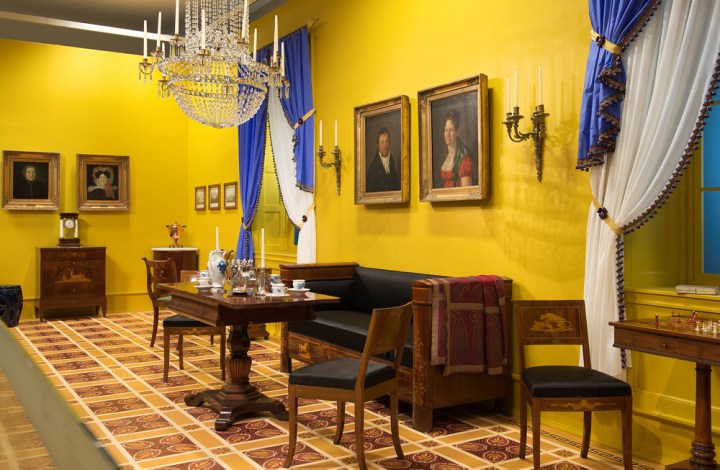
Design and Fashion: Norway 1814
Museum of Decorative Arts and Design, Oslo, 2 February — 31 August 2014
To celebrate the bicentennial of Norway’s constitution, the National Museum presents three historical exhibitions under the common title Norway 1814, in three different venues: the National Gallery, the Museum of Decorative Arts and Design, and the National Museum. These exhibitions will explore the art of the period in a new light. Visitors will be able to view many works that have rarely if ever been shown in public before. The exhibition is accompanied by a packed programme of events aimed at a broad audience, and a variety of educational activities for children and young people.
Furniture, glass, ceramics, fashion and architecture all express new ideas about democracy and national independence in the transitional period from the opulent splendour of the rococo to the simplicity of the Empire style, which built on the ideals of antiquity. Trade relations with foreign countries and the development of Norwegian industry were other important factors that influenced new ideas about design and fashion in these decades.
The exhibition at the Museum of Decorative Arts and Design presents, among other things, the magnificent residence of the Anker family known as the Paleet, which in 1814 became the royal residence of Christian Frederick and, later, of Karl Johan, Norway’s first king during its union with Sweden. The exhibition presents objects from the National Museum’s collection together with artefacts loaned from other national and international collections.
New Book | A Surviving Legacy in Spanish America
From the Antique Collectors Club:
María Campos Carlés de Peña, A Surviving Legacy in Spanish America: Seventeenth- and Eighteenth-Century Furniture from the Viceroyalty of Peru (Madrid: Ediciones El Viso, 2014), 448 pages, ISBN: 978-8494006180, $75.
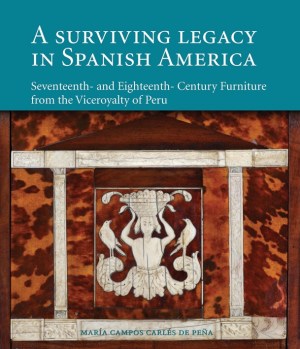 María Campos Carlés de Peña, a leading expert in furniture history, has undertaken an exhaustive project of research into the large and varied production of furniture made in Peru in the seventeenth and eighteenth centuries—the colonial period—for churches, convents, monasteries and private collections. Over eleven chapters she provides a thorough description of this type of furniture, which was inspired by artistic styles ranging from Mannerism to Neoclassicism, with their many variants and creators. Her analysis allows for an appreciation of the way vice-regal furniture in Peru is a valuable witness to its time: an example of a syncretism of varied and different cultures, endowed with symbolism, iconographic meaning and enormous beauty.
The Burlington Magazine, June 2014
The eighteenth century in The Burlington:
The Burlington Magazine 156 (June 2014)
 A R T I C L E S
• Meredith M. Hale, “Amsterdam Broadsheets as Sources for a Painted Screen in Mexico City, c. 1700,” pp. 356–64.
European print sources for a twelve-panel screen made in Mexico City (c. 1697–1701).
• Alvar González-Palacios, “Giardini and Passarini: Facts and Hypotheses,” pp. 365–75.
New documents on the gold- and silversmith Giovanni Giardini (1646–1721).
• Koenraad Brosens and Guy Delmarcel, “Raphael’s Acts of the Apostles: Italians in the Service of the Habsburg Monarchy and the Leyniers Tapestry Workshop, 1725–55,” pp. 376–81.
A seven-part series of tapestries made by Daniel Leyniers (1752–54) in the Villa Hugel, Essen, based on Raphael’s Acts of the Apostles (woven 1516–21).
R E V I E W S
• Simon Jervis, Review of the exhibition William Kent: Designing Georgian Britain, pp. 391–94.
• Christopher Baker, Review of Christopher Rowell, ed., Ham House: 400 Years of Collecting and Patronage (The Paul Mellon Centre for Studies in British Art and the National Trust, 2013), pp. 398–99.
• Kate Retford, Review of the exhibition catalogue Moira Goff et al, Georgians Revealed: Life, Style, and the Making of Modern Britain (British Library, 2013), p. 401.
• David Pullins, Review of the exhibition From Watteau to Fragonard: Les Fêtes Galantes, pp. 408–10.
• Philippe Bordes, Review of the exhibition Le Goût de Diderot, pp. 413–15.










 Enfilade
leave a comment