Robin Nicholson Named Director of The Frick, Pittsburgh
Press release (4 June 2014) from Pittsburgh’s Frick Art & Historical Center:
 The Board of Trustees of the Frick Art & Historical Center announces the appointment of Robin Nicholson as the institution’s third director. Currently Deputy Director for Art and Education at the Virginia Museum of Fine Arts (VMFA) in Richmond, Virginia, Mr. Nicholson will assume his new post in Pittsburgh on September 2.
Mr. Nicholson’s appointment is the result of an intensive national search, conducted by a Search Committee that was formed immediately following the October 2013 retirement announcement of current Director Bill Bodine, whose 12-year tenure began in 2002. The seven-member Search Committee worked in collaboration with Management Consultants for the Arts, Inc. Search Committee Chair Betsy Watkins comments, “The Search Committee enthusiastically recommended Mr. Nicholson to the Board. We are impressed by his creative energy, his scholarship, his appreciation for our collections, and his ideas about programming at the Frick. We feel fortunate to have attracted someone of his caliber to the Frick and are confident that
he will bring inspired leadership to the institution.”
Carolyn ‘Cary’ Reed, Chair of the Frick’s Board of Trustees, says, “We are excited about welcoming Mr. Nicholson to the Frick in September. He joins us at an important time in the Center’s history, as we open a new Orientation Center and break ground for renovated spaces for our education programs, a new carriage gallery and a community center.”
This summer the Frick will open an Orientation Center, which will serve as a point of entry for visitors. The completion of this new facility marks the culmination of the first phase of a site-wide expansion project that began in 2012. The second phase of the project is planned to begin this summer.
Robin Nicholson has served as Deputy Director for Art and Education at the Virginia Museum of Fine Arts since 2010. In this post, he has overseen the museum’s curatorial, exhibitions, education, statewide partnerships, publications, and library departments. Mr. Nicholson began his tenure at the VMFA in 2006 as director for exhibitions. Prior to joining the staff of the VMFA, he spent 14 years as director and curator of the corporate art collection of the Drambuie Corporation, headquartered in Edinburgh, Scotland, and with corporate offices in England and the United States.
 A renowned scholar of the art of the eighteenth-century Stuart royal courts in Paris and Rome, Robin Nicholson was educated at Queen’s University, Ontario, Canada, and the University of Cambridge, England, where he earned an MA degree. He has published and lectured extensively on eighteenth- and nineteenth-century European art. Mr. Nicholson is the author of a book on the portraiture of Prince Charles Edward Stuart that was published by Bucknell University Press in 2002.
At the VMFA, he oversaw a number of major exhibition projects, including Picasso: Masterpieces from the Musée Picasso, Paris, the most ambitious exhibition in the VMFA’s history. A 2008 alumni of the Getty Museum Leadership Program and past Chair of the Scottish Society for Art History, Mr. Nicholson served as cultural representative on the Presidential Bilateral Commission on US-Russia Relations.
In discussing his appointment as the Frick’s third director, Mr. Nicholson says, “I am thrilled to take on the leadership of an organization that is poised to take its place as a true icon in the dynamic Pittsburgh cultural landscape. The legacy of two inspirational previous directors has transformed the Frick and placed it in a position of strength where anything is possible—with collections, exhibition, collaborations, interpretation, education, programs, and a great historic green space in the heart of the city. The Frick has many compelling stories to tell, a great staff, and an extraordinarily supportive board leadership; it is a unique institution with unique opportunities at a key moment in its history.”
Frick Board of Trustees Chair Cary Reed remarks, “In its relatively short history, the Frick is fortunate to have had two extraordinary directors—Dick McIntosh and Bill Bodine—each of whom made significant contributions to the institution’s development. We are confident that Robin Nicholson will build on these great legacies as we continue and expand the quality exhibitions and programs which have been the hallmarks of the Frick Art & Historical Center.”
Exhibition | Progress

Left: David Hockney, Bedlam from A Rake’s Progress, 1961–63; Right: William Hogarth, The Madhouse, Plate 8 from A Rake’s Progress, 1735. The images are from the University of Colorado at Boulder, which in 2012 mounted the exhibition Hockney and Hogarth: Selections from the CU Art Museum’s Collection of British Art.
◊ ◊ ◊ ◊ ◊
From The Foundling Museum:
Progress
The Foundling Museum, London, 6 June — 7 September 2014
To mark the 250th anniversary of Hogarth’s death, Progress brings together for the first time three great contemporary responses to his eternally modern moral tale, A Rake’s Progress. David Hockney’s A Rake’s Progress (1961–63), Yinka Shonibare MBE’s Diary of a Victorian Dandy (1998), and Grayson Perry’s The Vanity of Small Differences (2012) are shown alongside Hogarth’s original 1735 prints and joined by a newly commissioned work by Jessie Brennan.
Hogarth’s popularity with both artists and the public has endured for over two hundred years, and his work has provided inspiration to successive generations. Hockney, Shonibare, and Perry not only update Hogarth’s searing social commentary; they also add their own personal concerns to the creative dialogue. Commissioning an emerging female artist to respond to Hogarth’s work, the Foundling Museum further develops the conversation. Exploring issues of sexuality, race, class, vice, temptation, youth, and urban living this exhibition both highlights Hogarth’s continuing relevance and allows us to consider the idea of ‘progress’.
◊ ◊ ◊ ◊ ◊
Rough Music: A Folk at The Foundling Museum
The Foundling Museum, London, 1 July 2014
To accompany the Progress exhibition the Foundling Museum is excited to present a unique event by Dead Rat Orchestra and Jeremy Barlow. Dead Rat Orchestra will perform Rough Music, a new work, incorporating performances on a set of tuned bronze meat cleavers. These specially-commissioned instruments were designed by composer and DRO member Nathaniel Mann as part of his Embedded Residency at The Pitt Rivers Museum and Oxford Contemporary Music working with a professional swordsmith using bronze sword casting techniques. The performance will be preceded by a talk by author and early music expert Jeremy Barlow, author of The Enraged Musician. Barlow will consider Hogarth’s prints and explore the artist’s representations of music and sound.
See more at the event website.
Introducing the Summer 2014 Intern, Mattie Koppendrayer
![greenwich[2]](https://enfilade18thc.com/wp-content/uploads/2014/06/greenwich2.jpg?w=250&h=375) I’m delighted to welcome Mattie Koppendrayer on-board here at Enfilade as a summer intern. As one of my students at Calvin College, Mattie is used to putting up with me during the school year; it’s good of her to sign on for June and July, too.
I’m delighted to welcome Mattie Koppendrayer on-board here at Enfilade as a summer intern. As one of my students at Calvin College, Mattie is used to putting up with me during the school year; it’s good of her to sign on for June and July, too.
She is an exceptional student—the only case I’ve had of a student finding her way to a paper topic on Chinese export ceramics with nothing in the class materials leading her there. Earlier this year, I had the chance to get to know Mattie better during a January-term spent in London (12 of us altogether). I can vouch for her good judgment, keen interest, and warm sense of humor.
-Craig Hanson
Arlene Leis on Sarah Sophia Banks’s Collection of Ephemera
Those of you working on ephemera may be interested in the John Johnson Collection’s Ephemera Resources Blog, associated with The John Johnson Collection of Printed Ephemera at the Bodleian Library, which itself
is one of the most important collections of printed ephemera in the world and is a very rich source for social and printing historians. Assembled by John de Monins Johnson (1882–1956), papyrologist, and Printer to the University, it contains c.1.5 million items. Spanning from 1508 to 1939 (and beyond in some areas), the strengths of the Collection are in the 18th, 19th and early 20th centuries. The John Johnson Collection (formerly called the Constance Meade Memorial Collection of Ephemeral Printing) was transferred to the Bodleian Library from Oxford University Press in 1968.
Online since 2011, the blog then
aims to accumulate a useful and growing guide to the many websites either wholly or partially devoted to ephemera. The blog will list two types of resources: online resources and bibliographic references (books and articles, both hard copy and electronic).
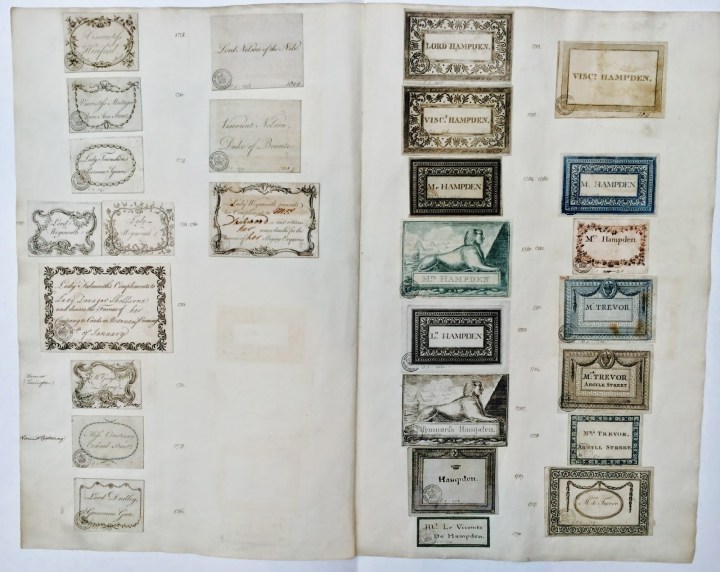
British Museum. Prints and Drawings. C.1-193-219.
◊ ◊ ◊ ◊ ◊
Most recently, Arlene Leis contributes a guest posting:
Arlene Leis, “Sarah Sophia Banks: Collecting Ephemera in Late Georgian England,” John Johnson Collection’s Ephemera Resources Blog (3 June 2014).
The Prints and Drawings room at the British Museum holds a fascinating collection of ephemera amassed by Sarah Sophia Banks (1744–1818), sister of the celebrated botanist and President of the Royal Society Sir Joseph Banks. While Sir Joseph is a well-known collector of natural history whose collections helped shape the foundations of the Natural History Museum, Sarah Sophia, also an avid collector, has remained for the most part in her brother’s shadow. This, fortunately, is beginning to change. . . .
The full posting is available here»
New Book | Ways of Making and Knowing
From the University of Michigan Press (with an excerpt and more information available at the website for the series, The Bard Graduate Center Cultural Histories of the Material World) . . .
Pamela H. Smith, Amy R. W. Meyers, and Harold J. Cook, eds., Ways of Making and Knowing: The Material Culture of Empirical Knowledge (Ann Arbor: University of Michigan Press, 2014), 448 pages, ISBN: 978-0472119271, $60.
 “Making” and “knowing” have generally been viewed as belonging to different types and orders of knowledge. “Craft” and “making” have been associated with how-to information, oriented to a particular situation or product, often informal and tacit, while “knowing” has been related to theoretical, propositional, and abstract knowledge including natural science. Although craftspeople and artists have worked with natural materials and sometimes have been viewed as experts in the behavior of matter, the notion that making art can constitute a means of knowing nature is a novel one.
This volume, with contributions from historians of science, medicine, art, and material culture, shows that the histories of science and art are not simply histories of concepts or styles, or at least not that alone, but histories of the making and using of objects to understand the world. The common view of craftspeople more or less mindlessly following a collection of recipes or rules—which are said to be fundamentally different from “science” and “art”—has greatly distorted our understanding of the growth of natural knowledge in the early modern period. More intensive examination of material practices makes it clear that the methods of the artisan represent a process of knowledge-making that involved extensive experimentation and observation, in addition to generalizations about matter and nature. As increasing numbers of people came to be immersed in such activities, whether as craftspeople, medical practitioners, merchants, nobles, magistrates, reformers, collectors, or even scholars, the attributes of “nature” were not only articulated in a variety of ways, and not only seen as a resource for human use, but came to be identified with a variety of “goods.” Knowing nature could of course lead to material betterment but for many, living according to nature’s dictates also led to the development of personal ethics and the public good. As natural knowledge became increasingly important in society in these various ways, it forged new connections among groups, helped create new identities, brought about new kinds of claims to authority and intellectual legitimacy, and gave rise to new ways of thinking about the senses, certainty, and epistemology. None of this could have happened without the conversations and controversies that enabled the assessment of objects in novel ways.
◊ ◊ ◊ ◊ ◊
C O N T E N T S
Introduction: Making and Knowing
Harold J. Cook, Pamela H. Smith, and Amy R.W. Meyers
1. Making as Knowing: Craft as Natural Philosophy
Pamela H. Smith
2. From Skills to Wisdom: Making, Knowing and the Arts
Suzanne B. Butters
3. Between Trade and Science: Dyeing and Knowing in the Long Eighteenth Century
Alicia Weisberg-Roberts
4. How to Cure the Golden Vein: Medical Remedies as Wissenschaft in Renaissance Germany
Alisha Rankin
5. Evidence, Artisan Experience and Authority in Early Modern England
Patrick Wallis and Catherine Wright
6. American Roots: Technologies of Plant Transportation and Cultivation in the Early Atlantic World
Mark Laird and Karen Bridgman
7. Inside the Box: John Bartram and the Science and Commerce of the Transatlantic Plant Trade
Joel Fry
8. From Plant to Page: Aesthetics and Objectivity in a Nineteenth-Century Book of Trees
Lisa Ford
9. The Labor of Division: Cabinetmaking and the Production of Knowledge
Glenn Adamson
10. Making Lists: Social and Material Technologies in the Making of Seventeenth-Century British Natural History
Elizabeth Yale
11. The Preservation of Specimens and the Take-Off in Anatomical Knowledge in the Early Modern Period
Harold J. Cook
12. Conrad Gessner on an ‘ad vivum’ image
Sachiko Kusukawa
13. Corals versus Trees: Charles Darwin’s Early Sketches of Evolution
Horst Bredekamp
14. Decaying Objects and the Making of Meaning in Museums
Mary M. Brooks
Epilogue
Malcolm Baker
Exhibition | Peace Breaks Out! London and Paris in the Summer of 1814

Henry Parke, Drawing of the Arc de Triomphe, 1819
(London: Sir John Soane’s Museum)
Click here for a higher resolution image.
◊ ◊ ◊ ◊ ◊
From the press release (9 April 2014) for the upcoming exhibition:
Peace Breaks Out! London and Paris in the Summer of 1814
Sir John Soane’s Museum, London, 20 June – 13 September 2014
In the centenary year of the start of the First World War, Sir John Soane’s Museum presents Peace Breaks Out! an exhibition focusing on the summer of 1814, when Europe celebrated peace after the Treaty of Paris following the fall of Napoleon. Displaying over 100 rare pieces from the museum and private collections, the exhibition will explore this pivotal moment in the history of Europe, through the eyes of its contemporaries. Pieces on show include paintings and prints created for the festivities held in London and across the United Kingdom to mark the Treaty; drawings of Paris demonstrating the architectural changes that took place under Napoleon’s government; Sir John Soane’s collection of Napoleonica (objects belonging to Napoleon and his closest collaborators); and a quirky, satirical depiction of Englishmen visiting Paris, as seen by the French.
Dr Jerzy J. Kierkuć-Bieliński, Exhibitions Curator at Sir John Soane’s Museum, explains: “The Peace of 1814 and the subsequent congress of Vienna in 1815, after the final defeat of Napoleon at Waterloo, laid the geo-political framework of the European Empires that would dominate the Continent and much of the globe up to the outbreak of the First World War. The Allies who celebrated the signing of the Treaty as guests of the Prince Regent in London, would, almost exactly one hundred years later face each on the battlefields of Europe—this time as enemies. In many ways, to understand the origins of the First World War, one has to look at the events of 1814 and the false promise of lasting peace that it offered.”
Sir John Soane’s drawings of Paris, commissioned by his clerk Henry Parke during their second visit in 1819, will be on display. The collection documents Soane’s personal study of the vast architectural changes to the French capital under Napoleon’s empire, especially the introduction of public space. Soane saw the French ruler as a great example of a self-made man, and he appreciated Napoleon as a patron of the arts, and keen supporter of architecture. From the Arc de Triomphe, to Place Vendôme, the drawings illustrate how Napoleon’s architectural innovations made a great impression on Soane.
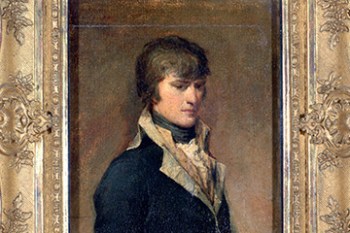
Cossia, Portrait of Napoleon, 1797 (London: Sir John Soane’s Museum)
Items from Soane’s collection of Napoleonica—bronze medals commemorating the significant events of Napoleon’s reign and a sword thought to have been presented to Napoleon by one of his officers—will also be on display. The collection of Napoleonica features rare books from Soane’s library, including an exquisite hand-coloured volume by Napoleon’s personal architects and interior designers, Percier and Fontaine—arguably the most famous interior designers of the time. The volume, a gift to the future Empress Joséphine, illustrates a selection of late 15th- and 16th-century villas and palaces in and around Rome. The influence of Percier and Fontaine’s designs are most evident in Soane’s designs of his Library-Dining Room in the Museum. This section of the exhibition is completed by Sir John Soane’s ‘Napoleonic Ring’, a chased gold ring containing a lock of the Emperor’s hair, and a portrait from 1797 of a young Napoleon—aged just 27—the youngest portrait of Napoleon in any British collection, painted by a little known Italian artist named Cossia.
French caricatures of the British visitors to Paris in that summer of 1814 will complete the exhibition, presenting a view of French-British relations at the time. Paris had been cut off during Napoleon’s reign but in 1814 saw visitors flooding the French capital. The image portrayed is not flattering: the Parisians saw the British as awkwardly dressed, glutinous, obsessed with bodily functions and prone to the charms of Parisian courtesans. Such scenes, including the English gawping at the treasures amassed in the Louvre, dining at the elegant Café des Milles Colonnes or strolling in Place Vendôme would have been familiar to Soane, who travelled to Paris shortly after the fall of Napoleon.
This is the first exhibition devoted to marking a significant but somewhat overshadowed bicentenary. In 1914, plans were underway to mark the centenary of the Peace Treaty in 1814, but the outbreak of the Great War meant that these plans were abandoned as Europe (and much of the globe) spiralled once again into conflict.
Historian Alexander Rich, co-curator, comments: “We are now as far away from the outbreak of the First World War as the protagonists of that conflict were from the Peace Celebrations of 1814. This exhibition looks for the first time at a very specific time in the artistic production of Europe, and offers a different, perhaps hidden perspective, on the events that have shaped the world as we know it today.”
Peace Breaks Out! is part of the London Festival of Architecture. A series of events, special curator-led tours giving unprecedented access to unique and rarely seen architectural models in the Soane’s collection will be offered as part of the Festival.
Display | Capital Investment: Sir John Soane’s Model of Tyringham Hall
In conjunction with the London Festival of Architecture:
Capital Investment: Sir John Soane’s Model of Tyringham Hall, Buckinghamshire
Sir John Soane’s Museum, London, 3–28 June 2014
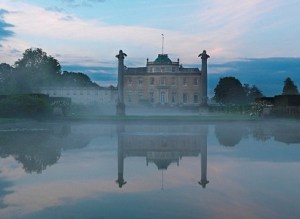 Sir John Soane revived the use of architectural models in Britain in his teaching and in his architectural practice. One of the more beautiful architectural models in Sir John Soane’s Museum is for Tyringham Hall, Buckinghamshire. Made by Joseph Parkins, c. 1793–94, in box wood, the highly detailed model was commissioned by Soane to present to his client William Praed, a Fleet Street banker. Soane designed and executed his country house from 1792 to 1800, and this model is an exceptional survival of a Soane Office ‘presentation model’ given to a client to explain volume, the arrangement of rooms and the play of light in the completed building (the model opens to reveal the interior arrangements of rooms and staircases). This is a rare opportunity to see this highly detailed presentation model which is not usually on display to the public. A model by a contemporary architect will be shown alongside to demonstrate the use importance of architectural models in today’s architectural practice.
Abraham Thomas as New Director of Sir John Soane’s Museum
I’m afraid this posting should have run six months ago. The press release dates to last July, though Thomas has been in the position only since December.
It perhaps, however, can serve as a useful reminder of how many things slip by me. Particularly with summer here (or at least summer in the northern hemisphere) and so many of you doing fascinating things around the world, please don’t be bashful in writing to share news. All the best for the next few months, -Craig Hanson
◊ ◊ ◊ ◊ ◊
 The Trustees of Sir John Soane’s Museum are pleased to announce the appointment of Abraham Thomas as the next Director of the Museum. He will take up the appointment on 3 December 2013. Announcing the appointment, Guy Elliott, Chairman of the Trustees, said, “The Trustees have appointed Abraham Thomas to be their next Director on the unanimous recommendation of their search committee, which included senior external members, as well as four Trustees. The decision has been endorsed by the Royal Academy of Arts, as required by our governing legislation.
“Mr Thomas comes to us from The Victoria and Albert Museum, where, as Curator of Designs, he was responsible for, amongst other exhibitions, the brilliant and much praised Heatherwick Studio: Designing the Extraordinary. He joins the Soane Museum at a particularly creative and challenging time in its history. The immediate priority is to complete the museum’s acclaimed Opening up the Soane project, which has already delivered a new exhibition gallery, conservation studios, disability access, and shop. Sir John Soane’s private apartments, not seen since 1837,
will feature prominently once the current phase concludes in 2014.
The new Director will build upon recent successes to lead The Soane’s talented staff and volunteer force in realizing the fullest potential of the museum as an ‘academy’, as Soane described it, that is, a centre of learning. The work and reputation of Sir John Soane himself, the unique atmosphere of his former home and its unparalleled collections have the ‘permanently magical’ power to inspire and inform all those who seek knowledge and understanding of the story of architecture.”
Responding, Mr Thomas said “I am delighted to be appointed the next Director of Sir John Soane’s Museum. It’s a great honour to be invited to lead this unique institution, and I look forward to building upon the fantastic work carried out by my predecessor, Tim Knox, and the staff, in order to create an exciting future for the Museum. I have always considered the Soane to be an extraordinary container of ideas, and I’m thrilled at the prospect of working closely with the staff and Trustees to explore boldly Sir John Soane’s original vision for his building and wide-ranging collections—a legacy which I believe can offer immeasurable relevance for today’s world.”
Abraham Thomas was Curator of Designs, and lead curator for architecture, at the V&A. During his eight years at the Museum he made an outstanding contribution to the public programme, working across historical and contemporary architecture and design with responsibility for the V&A’s collection of approximately 200,000 design drawings, maquettes and models. This collection ranges in scope from the 16th century to the present day and across disciplines such as architecture, furniture, sculpture, metalwork and ceramics, all of which are represented at the Soane.
Thomas has played a key role as lead curator in the V&A + RIBA Architecture Partnership. In addition to curating such acclaimed exhibitions as Heatherwick Studio: Designing the Extraordinary and 1:1 – Architects Build Small Spaces, he was the curator of the V&A’s bicentenary retrospective on the 19th-century designer, Owen Jones, A Higher Ambition and co-curator of an expanded version which later toured internationally. He has subsequently published related research on Owen Jones, who, like Soane, broke the mould by proposing a modern style unique to the nineteenth century, as well as on James Wild (curator of Sir John Soane’s Museum from 1878 to his death in 1892) and other key 19th-century artists working in the Middle East. Thomas succeeds Tim Knox, who was with the Soane for almost eight years before being appointed Director and Marlay Curator of the Fitzwilliam Museum in Cambridge.
Exhibition | The Splendours of Royal Coronations, 1610–1825

Palais du Tau, Reims (Photo by Ludovic Péron, 9 September 2007, Wikimedia Commons). From Wikipedia: “The building was largely rebuilt in Gothic style between 1498 and 1509, and modified to its present Baroque appearance between 1671 and 1710 by Jules Hardouin-Mansart and Robert de Cotte. It was damaged by a fire on 19 September 1914, and not repaired until after the Second World War. The Palace was the residence of the Kings of France before their coronation in Notre-Dame de Reims. The King was dressed for the coronation at the palace before proceeding to the cathedral; afterwards, a banquet was held at the palace. The first recorded coronation banquet was held at the palace in 990, and the most recent in 1825.”
◊ ◊ ◊ ◊ ◊
From the Palais du Tau à Reims (the 22-page press release is available as a PDF file here) . . .
Splendours of Royal Coronations from Louis XIII to Charles X
Sacres Royaux, de Louis XIII à Charles X
Palais du Tau, Reims, 28 May — 2 November 2014
Curated by Frédéric Lacaille and Benoît-Henry Papounaud
Le Centre des monuments nationaux présente, en partenariat avec le château de Versailles, l’exposition Sacres Royaux, de Louis XIII à Charles X au Palais du Tau à Reims du 28 mai au 2 novembre 2014.
 C’est au Palais du Tau, qui a accueilli à 33 reprises le roi la nuit précédant son sacre, que le Centre des monuments nationaux (CMN) a choisi de présenter cette exposition d’envergure, en partenariat avec le château de Versailles. Les visiteurs pourront y découvrir les cérémonies de sacres de 1610 à 1825, fondement essentiel de la monarchie absolue, qui consacraient le pouvoir, la puissance et la légitimité du roi. Ce partenariat d’exception avec le Château de Versailles donnera à voir de nombreuses œuvres encore jamais présentées au grand public.
Découvrez, au palais du Tau, séjour des rois pour leur couronnement, plus de 70 œuvres, témoins des fastes du règne des Bourbons, à l’occasion de cette exceptionnelle exposition en partenariat avec le château de Versailles. Au travers de tableaux, dessins, gravures, tapisseries, pièces d’orfèvrerie, éléments textiles et mobilier, l’exposition évoque les différentes étapes de la cérémonie du sacre des rois de France. Le calice des sacres, dit de Saint Remi (XIIème siècle), ou le manteau du sacre de Charles X, conservés au palais du Tau, sont mis en lumière aux côtés des collections du château de Versailles et de pièces prêtées par d’autres institutions, tel le Mobilier National, la Bibliothèque nationale de France ou le musée de l’hôtel Le Vergeur de Reims.
Le commissariat est assuré par Frédéric Lacaille, conservateur en chef au musée national des châteaux de Versailles et de Trianon, et par Benoît-Henry Papounaud, administrateur du Palais du Tau.
◊ ◊ ◊ ◊ ◊
Information about the catalogue is available as a PDF file here:
Frédéric Lacaille, Alexandre Maral, and Benoît-Henry Papounaud, Sacres Royaux, de Louis XIII à Charles X (Paris: Éditions du Patrimoine, 2014), 64 pages, ISBN: 978-2757703878, 12€.
Call for Papers | Making Room for Order: Court Ordinances
I’ve no idea how flexible the end date of 1700 is for the larger Palatium project, but I imagine this workshop will be of interest to many readers. -CH
From the Call for Papers:
Making Room for Order: Court Ordinances as a Source
for Understanding Space at Early Modern Princely Residences
Kalmar Castle, Sweden, 2–3 October 2014
Proposals due by 22 June 2014
Organized by ESF Research Networking Programme PALATIUM with Linnaeus University, Kalmar
One of the obvious sources when analysing how space was used at early modern royal residences are court ordinances. These are however far from as clear‐cut as they may seem. In several instances we can see how a world of order emerges that can easily be an illusion. Court ordinances are thus a rich material to use, but a source that poses a number of important methodological questions. The value of court ordinances has long been apparent. Already in 1761 Friedrich Carl Moser used court ordinances while compiling his work Teutsches Hof‐Recht. A more scholarly approach came later however. In 1905 and 1907 Arthur Kern published Deutsche Hofordnungen des 16. und 17. Jahrhunderts. This was an important step in making court ordinances accessible for research. After Kern various court ordinances have been published for principalities such as Kleve, Aragon, Brandenburg and Burgundy.
For court studies, the analysis of court ordinances has been indispensable. In his groundbreaking research on early modern courts, David Starkey made extensive use of the Eltham Ordinances. The possible Burgundian influences on the late Plantagenet English court, through court ordinances, is an on‐going debate. In later years two important scholarly works on early modern court ordinances have been published. The first, edited by Werner Paravicini, was Höfe und Hofordnungen 1200–1600 in 1999. This was the result of a conference in 1996 by the Residenzen‐Kommission. The second large volume, Zu Diensten Ihrer Majestät: Hofordnungen und Instruktionsbücher am frühneuzeitlichen Wiener Hof, was published in 2011 by Jakob Wührer and Martin Scheutz.
Thus, some scholars have highlighted court ordinances recently. They have however not focussed specifically on royal residences and the interplay between architecture and court life. This leaves a fruitful and rich vein for PALATIUM to tap into. The workshop in Kalmar is aimed at analysing from a methodological standpoint how we can understand the uses and ideas of space at court by deploying court ordinances as a source. It will be necessary to include not just court ordinances proper but also instructions and similar sources. The differences between court ordinances, instructions and other court laws/regulations were fluid at the time and this should be reflected in the discussions.
Naturally court ordinances have methodological issues. Why was a court ordinance drawn up? Was the aim to enforce economy at court or to enhance magnificence? The information we can draw from court ordinances depends to a large degree on such reasons. A number of evident questions to discuss leap to mind. Can we see how the shift from peripatetic to more sedentary courts is reflected in court ordinances? Will court ordinance reflect specific palaces rather than a generic group of royal residences for a prince?
Another obvious issue is how court ordinances both reflect reality and norms. Can we see if court ordinances were translated verbatim without any consideration for spatial differences between courts? Would court ordinances be switched from one architectural setting to another? Did this result in changes in architectural layout? What happened if a new court ordinance clashed with the existing palace plan? Yet another issue concerns whether we can see how different court ordinances influence each other? The example of Burgundy and the court of Edward IV have already been mentioned. Were certain court ordinances especially influential?
The interplay between the spatial reality and court ordinances must always be kept in mind. Perhaps we can deduce what a lost court ordinance looked like by using the architectural material, which can indicate both functions and shifts in those functions.
Papers will be organised around the following three topics:
I. Space and Function: Norm versus Reality
Court ordinances are interesting on two levels. First, they tell us something about prevailing ideas and attitudes within courtly society at the time. Second, they might tell us something about how reality was organised. The second half is, however, far from straightforward. As a normative source, court ordinances pose special problems. How certain can we be that ordinances paint a true picture of how space was used at court? We need case studies that analyse how far the norm was realised. What can ordinances really tell us about the use of certain spaces at certain ceremonies?
II. Invention or Tradition?
Did court ordinances actually introduce real change in how space was organised at princely courts? Can we see if court ordinances precede or follow real changes in palatial space? Perhaps a court ordinance merely reflected already existing usage rather than introducing new ways? Might court ordinances act as a conservative force?
III. A Source Leaving the Residence Partly in Shadow?
An evident methodological issue when using court ordinance is whether there are spaces at royal palaces that fall outside court ordinances? Will certain areas not be covered? Will the hunt, gardens or the menagerie be outside the usual scope? Does that mean that these areas were less constricted by ceremony and regulation? (more…)










 Enfilade
leave a comment