Fair | Art Antiques London, 2014
From the fair’s website:
 Art Antiques London
London, 11–18 June 2014
The Albert Memorial and Kensington Gardens once again provide the stunning backdrop to one of London’s most exciting and glamorous art and antique fairs. Held in a beautiful bespoke pavilion opposite the Royal Albert Hall and close to the site of the Great Exhibition of 1851, Art Antiques London brings together leading international dealers and discerning visitors from all over the world, who can buy with confidence at this strictly vetted sumptuous summer showcase for the arts.
◊ ◊ ◊ ◊ ◊
From the fair’s lecture series (with information about each speaker available here) . . .
Jewellery in the Age of Queen Victoria: A Mirror to the World
Thursday, 12 June, 11:30
Judy Rudoe (Curator of Jewellery and Decorative Arts, The British Museum)
This lecture emerges from the speaker’s recent book co-authored with Charlotte Gere (see biography). The ‘age of Victoria’ is taken in its widest sense to encompass jewellery from across Europe and America, at a time when expanding foreign trade, the new illustrated press and a growing tourist industry brought jewellery from many parts of the world to a wide audience. Queen Victoria played a huge role: what she wore and did had tremendous impact, so what might seem a narrow subject acts as a key to our understanding of the entire Victorian age. Using examples from the British Museum and collections worldwide, Judy Rudoe considers Victorian jewellery against its global background and uncovers what jewellery meant to those who wore it, both literally and metaphorically. She will show how it was used in private and in public to reveal that politics, nationalism and even humour of the period are all embodied in jewellery.
◊ ◊ ◊ ◊ ◊
J.M.W. Turner: The Artist and His House at Twickenham
Thursday, 12 June, 2:30
Catherine Parry-Wingfield (Chairman of Turner’s House Trust)
Turner is rightly one of the most famous names in the history of British art, and remains an inspiration to painters today. Tucked away in Twickenham is a small unknown work by this great artist, not a painting, but a work in three dimensions. Sandycombe Lodge was designed by Turner himself as a country retreat from the pressures of the London art world; his ‘old Dad’ kept house here, Turner sketched, fished the river and occasionally entertained. This talk will explore a little-known side of Turner’s life and work, against the backdrop of the ‘Matchless Vale of Thames’, the beautiful Thames scenery which inspired much of his work. Sandycombe Lodge is now owned by Turner’s House Trust, which is developing plans for major conservation and future use of this beautiful and important building.
◊ ◊ ◊ ◊ ◊
A Matter of Fashion: The Collecting of English Ceramics
Friday, 13 June, 11:30
Anton Gabszewicz (Independent ceramics researcher)
Since the death of Lady Charlotte Schreiber in 1895, English ceramics have been collected with increasing enthusiasm. The founding of the English Porcelain Circle in 1927, under the Presidency of Mrs Radford, brought leading enthusiasts together and since then, through the yearly publication of the ECC Transactions their knowledge has been disseminated to a wider public. Yet the collections the speaker will discuss are markedly varied in their content and in the way they have been assembled. The names form a roll call of the influential collectors of the last 70 years. This lecture identifies those influences and how they informed the taste of succeeding generations.
◊ ◊ ◊ ◊ ◊
Of Soup and Love: The Campbell Collection of Soup Tureens at Winterthur Museum
Friday, 13 June, 2:30
Pat Halfpenny (Independent researcher)
The Campbell Collection of soup tureens is the finest collection of its type in the world. Although this lecture will focus on the magnificent ceramic pieces, they will be set in a context that includes highly prized silver and gilt examples that will help us understand the evolution of high style in the eighteenth and early nineteenth centuries. As grand gilded baroque examples, fanciful rococo porcelain, and elegant neoclassical forms will be discussed, the speaker will share some of the changes in social life and dining practices that created the environment in which tureens were first introduced, rose to great prominence, declined, and found new purpose in the twentieth and twenty-first centuries.
◊ ◊ ◊ ◊ ◊

Early Chelsea Model of a Finch, ca. 1745–49, exhibited by the Brian Haughton Gallery.
Nature, Porcelain and Enlightenment: Early English Porcelain and its Place in the Eighteenth-Century Home
Friday, 13 June, 4:30
Paul Crane (Lecturer, researcher, and dealer)
England in the mid-eighteenth century was a country riveted by an insatiable appetite for knowledge, exploration, and discovery. This forged a new scientific approach which was to spearhead the Age of Enlightenment. Through new eminent publications Science and Nature became the pinnacle of taste and fashion within the Aristocracy, who decorated their homes with this organic natural force. The birth of English porcelain in London in the 1740s provided an opportunity for enlightenment to fuse with the arts. Examples of the production at the porcelain manufactories of Bow, Chelsea, Worcester, and Vauxhall together with the Liverpool factories of Samuel Gilbody, William Reid, and Richard Chaffers will illustrate these natural recreations that were to fill the eighteenth-century home with a totally re-invented Cabinet of Natural Curiosity.
◊ ◊ ◊ ◊ ◊
The Silver Society Study Day: New Silver Projects
Saturday, 14 June, 11:00–6:00
Dirk-Jan Biemond, Michèle Bimbenet Privat, Hazel Forsyth, Christopher Hartop, James Rothwell, Peter Taylor, and Charles Truman
Tickets: £50 society members / £65 non-members. Please note that The Silver Society Study Day is booked separately from the Art Antiques London lecture programme. To book, visit The Silver Society’s website or email events@thesilversociety.org.
◊ ◊ ◊ ◊ ◊
Around the World in 80 Figures: Highlights of the Pauls-Eisenbeiss-Stiftung, Basel
Sunday, 15 June, 11:30
Samuel Wittwer (Director, Prussian Palaces and Gardens Foundation, Berlin-Brandenburg)
Established in 1975 in Basel, the Pauls-Eisenbeiss Foundation is one of the world’s leading collections of eighteenth-century German porcelain figures. The collection concentrates on four leading manufactories (Meissen, Frankenthal, Ludwigsburg, and Höchst) bringing together 750 objects, mainly figures. This treasure trove of German porcelain has been open to the public since 1977. It is not just a collection of important examples of each manufactory; it is a collection cleverly put together in the 1950s and 1960s and is the perfect study base enabling collectors to compare variations of decoration and modelling, discovering unique pieces and also enabling students to gain insight to a wide range of topics such as fashion and social aspects of the eighteenth century. This lecture introduces us to this important collection in a multifaceted way by giving us a general overview as well as concentrating on new aspects of research and details.
◊ ◊ ◊ ◊ ◊
Freedom of Expression: The Fantastic Range of du Paquier Porcelain
Sunday, 15 June, 3:30
Claudia Lehner-Jobst (Art historian and curator, Vienna)
This lecture will pay homage to two personalities: Claudius Innocentius du Paquier, the founder of the first porcelain manufactory in Vienna and his artistic resourcefulness and to one of the first collectors of his work, Marchese Emanuele d’Azeglio whose objects now form the heart of the ceramics collection at the Palazzo Madama in Turin. The speaker will discuss the history of that collection and some outstanding objects in depth.
◊ ◊ ◊ ◊ ◊
A Behind the Scenes Look at Ming: 50 Years that Changed China
Monday, 16 June, 11:30
Jessica Harrison-Hall (Curator of Chinese Ceramics, British Museum and Sir Percival David Collections and Vietnamese Art)
This year the British Museum will open a major exhibition on Ming courts and their international engagement. Ming: 50 Years that Changed China shows how fifty years of the Ming dynasty transformed China in ways which still affect the country we know today. Ming China was thoroughly connected with the rest of the world in these years and absorbed many influences. The staggering wealth of the courts included some of the most beautiful porcelain, gold, jewellery, furniture, paintings, sculptures, and textiles ever made. Many of these objects were undiscovered until recently and have never been shown within the context of China’s multiple courts and of Ming China’s interaction with foreign countries ranging from Mogadishu to Kyoto. This lecture takes a behind the scenes look at the four years of collaborative research and international co-operation which culminate in the exhibition.
◊ ◊ ◊ ◊ ◊
Face to Face: Dame Rosalind Savill in Conversation with the Duke of Devonshirec
Monday, 16 June, 4:00
Where do you find the essential combination of sensibility and pizzazz needed to cherish the traditional and celebrate the innovative in a great country house? The answer is simple: at Chatsworth with the Duke and Duchess of Devonshire. Throughout its history the individual contribution of each generation has enabled it to evolve and flourish, often against huge odds, but the pressures and challenges today are more formidable than ever. Stoker and Amanda Devonshire have spent the last ten years reinventing Chatsworth in a myriad of inspirational ways, giving it a new twenty-first century lease of life, and using their magic touch to turn a possible millstone into a marvel. This discussion will attempt to discover the secrets of their success in bringing a thrilling new edge to Chatsworth. It will touch on the history of the house and its great collections, and will explore their daunting responsibilities and prospects when he inherited in 2004, how their grand plans took shape, the highs and lows of achievement, and the continuing excitement of future projects and dreams. Conversation sponsored by 1stdibs.
◊ ◊ ◊ ◊ ◊
The French Porcelain Society Study Day: Sèvres and China
Tuesday, 17 June, 11:00–5:30
Dame Rosalind Savill, John Whitehead, Juliet Carey, Kee Il Choi, Vincent Bastien, and David Peters
Tickets: £45 Society members / £65 non-members. Please note that The French Porcelain Study Day is booked separately from the Art Antiques London lecture programme. To book, visit The French Porcelain Society’s website or email rmcpherson@orientalceramics.com.
◊ ◊ ◊ ◊ ◊
Porcelain Figures in the Royal Court Pantries in Dresden, Warsaw and Hubertusburg: A Crash-Course in the Hof-Conditorei Inventories
Wednesday, 18 June, 2:30
Maureen Cassidy Geiger (Independent ceramic researcher)
Meissen figures have typically been studied via the work reports in the manufactory archives, which were suspended from 1748 to 1764, or the Japanese Palace inventories. By comparison, the highly detailed inventories of the court pantries of the Saxon-Polish realm have been overlooked as an essential resource for understanding the types and numbers of figures produced for table decoration, especially during the gap in the work reports. This Hof-Conditorei crash course will focus on three inventories taken between 1750 and 1755 at three royal palaces: Dresden, Warsaw, and Hubertusburg.
◊ ◊ ◊ ◊ ◊
Dining Culture in Enlightenment Europe
Wednesday, 18 June, 4:30
Ivan Day (British food historian)
From the town houses of Edinburgh to the palaces of St Petersburg, from the chocolate houses of Madrid to the grand salons of Stockholm, the cuisine and dining protocol of the French ancien regime spread rapidly during the course of the eighteenth century to all of the great European centres, frequently obliterating the native high status food traditions of those who adopted it. In this illustrated lecture, British food historian Ivan Day will examine the dramatic cultural impact that the spread of French court dining protocol had on the non-French speaking aristocratic world. He will not discuss not only the remarkable food itself, with a particular emphasis on the dessert course, but also its mode of service and the glittering material culture it spawned.
New Book | The Life and Times of Quatremère de Quincy
From Palgrave Macmillan:
Louis A. Ruprecht, Classics at the Dawn of the Museum Era: The Life and Times of Antoine Chrysostome Quatremère de Quincy (1755–1849) (New York: Palgrave Macmillan, 2014), 300 pages, ISBN: 978-1137384072, $95.
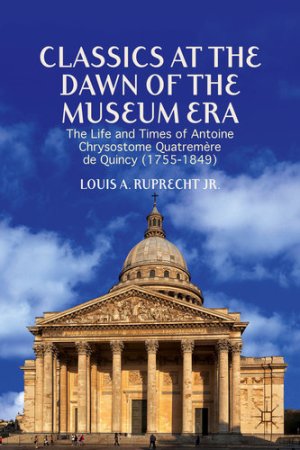 Antoine Chrysostome Quatremere de Quincy (1759–1849), arguably the foremost French classicist and art historian of the nineteenth century, is relatively little-known in English language scholarship. Three of his books were translated in the early nineteenth century, none in the twentieth century, and an important collection of two sets of open letters concerning museums, looting and repatriation was just published in 2012.
Quatremère has been unfairly called ‘the French Winckelmann,’ a charge that sticks primarily because so little of his work has ever been translated. In fact, he shows us, not what apish imitation of Wincklemann’s Neoclassicism looked like in the nineteenth century, but rather what these two overlapping disciplines had become in the generation after Winckelmann. Quatremère was formed by three crucial developments that Winckelmann did not and could not know: the French Revolution and its aftermath; Hegelian aesthetics; and the establishment of the museum era in Europe. Quatremère also remained committed to his Roman Catholicism and to the secular values of the early Revolution; in this he is very different than Winckelmann, who converted to Catholicism just before moving to Rome, and who was, according to many who claimed to understand him best, really a ‘closeted pagan’ if he were anything at all. Quatremère wrote eloquently and with deep insight concerning his understanding of the compatibilities between the Classical and Christian vision, an issue that does not figure in Winckelmann’s more intentionally ‘profane’ musings. Ruprecht hopes to show that Quatremère’s true importance emerges only if we situate him in his own times, one generation after Winckelmann, in a very different, and a far more revolutionary and secularizing cultural moment.
Louis A. Ruprecht is William M. Suttles Chair of Religious Studies at Georgia State University.
New Book | The Pathos of the Cross
According the the foreword, the book focuses on the period from 1600 to 1750. From Oxford UP:
Richard Viladesau, The Pathos of the Cross: The Passion of Christ in Theology and the Arts-The Baroque Era (New York: Oxford University Press, 2014), 368 pages, ISBN: 978-0199352685, £36 / $55.
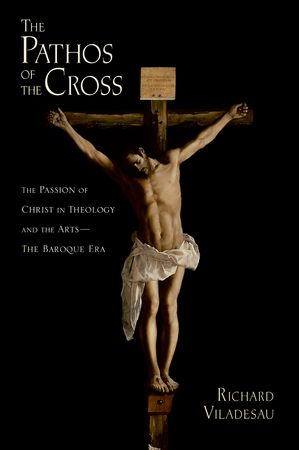 The Baroque period was in some senses the beginning of modern Western scientific and intellectual culture, the early budding of the Enlightenment. In the light of a new scientific and historical consciousness, it saw the rise of deism and the critique of traditional forms of Christianity. Secular values and institutions were openly or surreptitiously replacing the structures of traditional Christian society. At the same time, it was a time of religious renewal and of the reaffirmation of tradition. In sacred art, it was the age of of Bernini, Rubens, Van Dyck, Velazquez, and Rembrandt; in church music, the period of Monteverdi, Scarlatti, Handel, Telemann, and Bach. The pathos of Christ’s crucifixion—its power to evoke strong emotions of pity and compassion—was a central element in Baroque theology and spirituality. The sacred arts of the period reflect the centrality of this theme. Many of the works of the period retain their ability to move us emotionally and spiritually centuries later—even though the theology they represent has been challenged and frequently rejected. This volume traces the ways in which Roman Catholic and Protestant theologies of the period continued to proclaim the centrality of cross of Christ to human salvation. In a parallel movement, it illustrates how musical and artistic works of the period were both inspired and informed by these theologies, and how they moved beyond them in an aesthetic mediation of faith.
• Continues the historical theological/aesthetic survey of the first two volumes of this series
• Systematically examines the presence of theological themes in individual works of art and music of the Baroque period
• Is unique in its overview of the interrelationships of art and theology during a significant period of religious development
• Proposes the notion of ‘pathos’ as a means of summarizing the Baroque sensibility with regard to Christ’s passion
Richard Viladesau was ordained in 1969 in Rome for the Diocese of Rockville Centre. He is Professor of Theology at Fordham University, since 1988, and Administrator of Our Lady Star of the Sea Church, Saltaire, New York.
◊ ◊ ◊ ◊ ◊
C O N T E N T S
Foreword
Abbreviations
List of Illustrations
Introduction—The Social Context of the Baroque Period: The Beginnings of Modernity
Part I: The Survival of the Classical Paradigm of the Cross in Roman Catholicism
1 The Theoretical Mediation: The Cross in Baroque Tridentine Orthodoxy
2 The Aesthetic Mediation: The Cross in Baroque Catholic Art
3 The Aesthetic Mediation: The Passion in Catholic Music
Part II: The Cross in Protestant Orthodoxy
4 The Theological Mediation: Baroque Lutheran and Reformed Theology of the Cross
5 The Aesthetic Mediation: The Cross in Protestant Art
6 The Aesthetic Mediation: Protestant Passion Music
Part III: The Challenge to the Orthodox Doctrine of Redemption: The Enlightenment Paradigm
7 Challenges to the Classical Paradigm of the Cross and the Emergence of a New Paradigm of Salvation
Envoi
Appendix 1: Virtual Museum
Appendix 2: Discography—Music of the Passion of the Baroque Era
Bibliography
Index
Notes
Call for Papers | Object Fantasies: Forms and Fictions
As posted at H-ArtHist:
Object Fantasies: Forms and Fictions
Munich, 7–9 October 2015
Proposals due by 31 July 2014
Interdisciplinary Conference of the Junior Research Group Premodern Objects: An Archaeology of Experience (Elite Network of Bavaria / Ludwig-Maximilians-Universität Munich)
In modern understanding, the word ‘object’ signifies something material, spatially defined and functionally determined. These notions are accentuated by the word objectivity, which defines an ideal, systematic mode of grasping objects as ‘subjects’ that presumably operate neutrally and scientifically. In contrast, the Latin word
‘fantasia’ has, since antiquity, signified an apparition or the ability to imagine something that can equally be an image, a concept or, also, an object.
The conference takes the latter alternative meaning, that is, the non-objective experience of objects as well as recent positions of thing studies as the basis for inquiry into the creative act in the reception and construction of objects. How, for instance, do the object fantasies let the borders between object categories or objects and creatures blur? What role do they—equally nourished by illusion and experience—play in the perception and handling of material objects? To what degree do perceptions of and references to objects have a lasting effect on the conception and creation of other material objects or fictional objects in images and texts? And finally: What correlation exists between the creative handling of the objectual, the self-perception of subjects and the concrete and imaginary conditions of their social lives? The conference will pursue these as well as other lines of questioning of different formal as well as fictional possibilities in the creation of objects. Welcome are papers from all fields of human sciences on individual objects, object categories and systems, objects in images and texts, objects with images and script as well as object theories. The travel and accommodation costs of the speakers will be covered. The conference serves as a preparation for an anthology on the same topic. Working languages are English, German, French and Italian. Please send a one page abstract and a short CV by July 31, 2014 to objektfantasien@kunstgeschichte.uni-muenchen.de.
Exhibition | Satires: Caricatures Genevoises et Anglaises du XVIIIe Siècle
Now on view in Geneva:
Satires: Caricatures Genevoises et Anglaises du XVIIIe Siècle
Musées d’Art et d’Histoire de Genève, 16 May — 31 August 2014
 Dans la seconde moitié du XVIIIe siècle, Genève voit naître plusieurs artistes au talent satirique avéré, tels Jean Huber l’Ancien ou Wolfgang-Adam Töpffer. La France est alors le premier modèle de l’art «sérieux» pour les Genevois, mais ce sont les productions anglaises qui nourrissent leur verve comique et parfois férocement critique à l’égard des mœurs, de la politique ou de la religion de leur temps. Si le lien entre les artistes locaux et leurs illustres contemporains anglais, tel William Hogarth, a souvent été souligné par les historiens de l’art, jamais il n’a été présenté au public sous la forme d’une exposition. Le Cabinet d’arts graphiques se propose de combler cette lacune.
The exhibition flyer is available here»
The press release is available here»
On Site | The International Museum of the Reformation in Geneva

Geneva’s Maison Mallet (to the left), built between 1772 and 1725, houses the International Museum of the Reformation; it stands next to the thirteenth-century St. Pierre Cathedral, the front of which is dominated by a mid-eighteenth-century portico. The photo comes from the museum’s website.
◊ ◊ ◊ ◊ ◊
The Other Side of the Story: The International Museum of the Reformation in Geneva
By Tobias Locker
Art historians are—at least to generalize from my own experience—rarely surprised by museums. And yet, sometimes we visit an institution where subject, setting, and presentation complement each other so favorably that they transform the visit into an inspiring experience. I was recently surprised in such a way at Geneva’s International Museum of the Reformation. The visit expanded and enriched my view of the Reformation, which is sometimes cast as less important than Roman Catholicism for understanding the Baroque, even as it was the trigger for the Counter Reformation. The Museum tells the other side of the story, the one of an influential religious movement inspiring the arts and mentality of the early modern period.
The International Museum of the Reformation was inaugurated in 2005, next to St. Pierre Cathedral in the Maison Mallet, a hôtel particulier, modelled entre court et jardin and built between 1722 and 1725, after plans of the architect Jean-François Blondel (uncle and mentor of Jacques François Blondel, the architectural theorician and author of the famous multivolume works De la distribution des maisons de plaisance… and l’Architecture Française…). At its opening, the museum still had much in common with the original nineteenth-century project of presenting Geneva as the seat of the Calvinist Reformation. But today the focus is—as its name suggests—much wider, extending the narrative of historic Protestantism into the twenty-first century.
Besides offering a fine impression of a prestigious home of a wealthy eighteenth-century Genevan citizen, the museum’s presentation succeeds on multiple fronts. While relatively small, it gives a good idea of the different currents of the Reformation. On its ground floor figures like Martin Luther, John Calvin, the Huguenots, and John Knox are explained while the lower level addresses the development of reformed religions from the nineteenth century to the present in a global context.

◊ ◊ ◊ ◊ ◊
I was particularly impressed by installations allowing visitors to experience the rooms of the Maison Mallet while also employing a varied array of media to make the visit fresh and exciting. The Grand Salon, for example, presents chairs grouped around tables with imbedded screens. A film explaining the essential ideas of the Reformation alternates between these screens and two pier-glasses, which themselves turn into screens during parts of the presentation. I found the multimedia display entertaining and clever; the process of watching the film was made more active as the eye was forced to also experience the room, and, for me, the installation provides a rare case in which Philippe Starck’s translucent ‘Louis Ghost’ chairs serve as an appropriate solution, lightening the density of the room while still acknowledging the eighteenth-century setting.
I was also intrigued by the way the exhibition works well for very different intellectual levels. From a scholarly point of view, the information is satisfying, even as the presentations (in both French and English) are easy to understand. The film in the Grand Salon, for instance, is narrated from the point of view of a child, a ‘customer group’ that in my eyes often is not considered sufficiently. Likewise, some dioramas with cutout copies of engravings animated by the turn of a crank handle are positioned at the height of small children.
The efforts of the museum were rewarded in 2007 with the prestigious Museum Prize of the Council of Europe. The International Museum of the Reformation is well worth a visit, and the quick 45-minute walk-through you originally had in mind might extend into a longer visit. If you have energy and time left afterward, you could visit the adjoining St. Pierre Cathedral and the archaeological site under the present thirteenth-century structure, with ruins of earlier churches dating back to the fourth century (the site’s importance was recognized with a Europa Nostra Award in 2008).
Tobias Locker is an art historian and lecturer based in Barcelona/Spain. His research focuses on furniture and decorative arts of the eighteenth century in Europe.
Call for Papers | Sewell C. Biggs Winterthur Furniture Forum, 2015
From Winterthur:
Sewell C. Biggs Winterthur Furniture Forum
New York Furniture: From New Netherlands to Empire State
Winterthur, Wilmington, Delaware, 4–7 March 2015
Proposals due by 1 September 2014

Chest, 1700–35. Bequest of Henry Francis du Pont 1958.1144. Photo by Gavin Ashworth
Winterthur solicits paper proposals for the 2015 Sewell C. Biggs Winterthur Furniture Forum From New Netherlands to Empire State: New York Furniture, to be held March 4–7, 2015, at Winterthur Museum, Garden & Library, Winterthur, Delaware.
This forum will focus on the multifaceted furniture of New York and adjacent communities in New Jersey and Connecticut with talks that explore Dutch origins, English styling, and the ascendancy of designs marketed by nationally known manufacturers. Especially welcome are topics with an end date before 1870 that examine: expressions of ethnic and cultural identity in the production and consumption of furniture; links between the cabinetmaking and building trades and the architectural settings of furniture; labor and shop practices; mass production, the introduction of new designs and international marketing strategies. Other topics are also encouraged.
Proposals for presentations 30 minutes in length should include a brief letter of interest, one-page abstract, and short cv and may be e-mailed to: jlane@winterthur.org or mailed to: Furniture Forum 2015, Winterthur Museum, Garden & Library, 5105 Kennett Pike, Winterthur, DE 19735.
Exhibition | The Fortunes of the Italian Primitives, ca. 1800
From the exhibition website:
La Fortuna dei Primitivi: Tesori d’Arte dalle Collezioni Italiane fra Sette e Ottocento
The Fortunes of the Primitives: Art Treasures from Italian Collections
between the Late Eighteenth and Nineteenth Centuries
Galleria dell’Accademia, Florence, 24 June — 8 December 2014

Libro d’Ore di Lorenzo de’ Medici, Annunciazione (Firenze, Biblioteca Medicea Laurenziana, Ms. Ashb. 1874, c. 13v)
This exhibition is the first ever dedicated to the topic as a whole. It proposes to offer a critical-bibliographic picture of this very important cultural phenomenon concerning the history of taste and collecting in Italy between the late XVIII century and early XIX century. Among other things, this phenomenon exerted a considerable and direct influence on the formation of the major public art collections in the most important European countries.
The exhibition begins with the fundamental contribution of Giovanni Previtali (La fortuna dei primitivi. Dal Vasari ai Neoclassici, Turin, 1964), published exactly fifty years ago. With a scientific committee made up of art historians, historians of collecting and art critics, the exhibition intends to delve into this theme that to date has been relatively neglected. Significant progress has been made since the pioneering studies of Venturi, Previtali, Haskell and Pomian. The time is therefore ripe to reflect on this phenomenon and, especially, on the people who collected works by the primitives, to some extent systematically (and therefore not occasionally), and on those who strove to lay hands on these panel paintings with precious gold grounds (merchants, agents, procurers and restorers). Singling out Florence as the privileged site for an exhibition like this one is practically a foregone conclusion, given the wealth the Tuscan-Florentine area has had historically in the production of artworks in the fourteenth and fifteenth centuries. Almost all the collections of primitives indeed boasted works from this geographic area.
The exhibition will review the principal personalities who were in the forefront of this recovery, exponents of the church (from simple abbots to powerful cardinals), as well as noblemen and scholars who could not resist the attraction of these fragile and precious artistic representations. The rooms will therefore exhibit works of art (paintings, sculptures, objects of sumptuary art and illuminated codices) that were once in the collections of Francesco Raimondo Adami, Stefano Borgia, Angelo Maria Bandini, Alexis-François Artaud de Montor, Joseph Fesch, Teodoro Correr, Girolamo Ascanio Molin, Alfonso Tacoli Canacci, Sebastiano Zucchetti, Anton Francesco Gori, Agostino Mariotti, Matteo Luigi Canonici, Giuseppe Ciaccheri, Tommaso degli Obizzi, Gabriello Riccardi, Giovan Francesco De Rossi and Guglielmo Libri, to cite only the best-known names.
An animated dialogue will accompany visitors along a sort of ideal stroll through the Italy of collectors from the late XVIII century to the early XIX century. Visitors will be encouraged to make quick visual comparisons aimed at grasping the taste, the eye and the aesthetic sensitivity of the various collectors whose collections will be compared for the first time. Alongside paintings that at that time constituted the principal interest of collectors, there are other, equally important sections tied to illuminations and sculpture. The intention is to show the circularity of interests of collectors who with a pioneering approach sought to preserve these historical-scholarly representations, every day threatened by the risk of destruction or abandon.
The very numerous visitors of the Galleria dell’Accademia will thus be able to appreciate a selection of works of art of high and, in many cases, of the highest level, based on a serious scientific project, which will offer yet another confirmation of the heights of quality Italian art attained from the XIII to the XV century. The artists whose work will be on display in this exhibition include, among others, the Master of Magdalene, Arnolfo di Cambio, Bernardo Daddi, Taddeo Gaddi, Nardo di Cione, Lippo Memmi, Ambrogio Lorenzetti, Pietro da Rimini, Beato Angelico, Filippo Lippi, Andrea Mantegna, Cosmè Tura, Piermatteo d’Amelia and Giovanni Bellini. The exhibition catalogue is expected to constitute the till-now inexistent text of reference dedicated to this specific theme taken as a whole.
The catalogue will be available from ArtBooks.com:
Angelo Tartuferi and Gianluca Tormen, eds., La Fortuna dei Primitivi: Tesori d’Arte dalle Collezioni Italiane fra Sette e Ottocento (Firenze: Giunti, 2014), $78.
Exhibition | Art and Politics: The Electress Palatine

From the Museo delle Cappelle Medicee:
Art and Politics: The Electress Palatine and the Final Season of Medici Patronage in San Lorenzo
Museum of the Medici Chapels (Cappelle Medicee) Florence, 8 April — 2 November 2014
Curated by Monica Bietti
There are many reasons for paying due tribute to the Electress Palatine, Anna Maria Luisa de’ Medici (1667–1743), the last descendent of the Grand-ducal branch of the Medici dynasty. Indeed the last years of her life—following the death of her brother the last Medici Grand Duke Gian Gastone—were intimately bound up with the present and future life of her State, for the safeguarding of which she drafted the “Family Pact,” the fundamental document that guaranteed the protection and conservation of the heritage of the Medici within their city and their State.
The idea for the exhibition stemmed from a 2012 project organised in collaboration between the REM museums of Mannheim—which wished to honour the memory of the Electress who lived and reigned in Germany following her marriage to the Elector Palatine Johann Wilhelm von Pfalz Neuburg, from 1691 to 1716—the Museum of the Medici Chapels, the Faculty of Medical Surgery of the University of Florence and the Superintendencies for the Archaeological Heritage of Tuscany, for the Architectural, Landscape, Historic, Artistic and Ethno-Anthropological Heritage of the Province of Florence and the Opificio delle Pietre Dure. This project led, between the 8th and 22nd October of 2012, to the control of the state of conservation of the mortal remains of the Electress and the rehabilitation of the tomb as well as the restoration of part of the important collection of grave goods. The Museum of the Medici Chapels decided to illustrate to the public the results of this research and restoration by organising this exhibition, centred in particular on the last years of life of the Electress.
Among the outcomes of the control of the tomb and the remains of the last descendent of the Medici, the show displays to the public for the first time two gold medals, two coins and the dedicatory plaque. In addition, the exhibition is also intended to cast light on what Anna Maria Luisa did for art and politics in Florence from 1737, when her brother Gian Gastone died up to the year of her own death in 1743. It presents novelties and authentic rarities emerging from the new studies and researches that followed in the wake of the monographic show devoted to the Electress in 2006, curated by Stefano Casciu (The Wise Princess: The Legacy of Anna Maria Luisa de’ Medici, Electress Palatine).

Bartolomäus van Douven, Allegoria degli Elettori Palatini come protettori delle Arti, 1722 (Firenze, Galleria degli Uffizi)
The show is divided into four sections designed to introduce the heterogeneous public of the Museum of the Medici Chapels to the personality of the Princess. The first, Childhood and the Adolescent Years at Poggio Imperiale, briefly illustrates her education and the years of her early youth that she spent at the Medici Villa of Poggio Imperiale with her brothers Ferdinando and Gian Gastone, her uncle Francesco Maria and her grandmother Vittoria della Rovere.
The second section, Youth and Marriage, opens with the fine portrait of Anna Maria Luisa as Flora by Antonio Franchi and deals with the period of her marriage to the Elector Palatine of the Rhine, Johann Wilhelm, celebrated in 1691, and her long sojourn in Germany where the couple were intensely engaged in artistic patronage, well-represented by the works commissioned from Bartolomeo Van Douven, whose famous Allegory of the Electors Palatine as Patrons of the Arts can be admired at the exhibition.
The third section, The Return to Florence and the Commitment to the Family Church, constitutes the core of the exhibition, illustrating the years immediately following the return to Florence of the Electress after the death of her husband in 1716. The events of these years significantly affected the complex of San Lorenzo, which was enhanced by important commissions made by Anna Maria Luisa, presented here in the light of new “political” documents. Following the “Family Pact” of 1737, the Princess indeed launched the final season of Medici patronage in the great complex of San Lorenzo: “Anna Maria set in motion a wide-ranging series of commission initiatives which were focused on San Lorenzo, comprising the construction of the bell-tower, the painting of the cupola of the basilica, the project for the decoration of the ceiling of the Chapel of the Princes (never carried through): it was clearly an attempt on her part to conclude the extensive cycle of operations begun by her distant ancestor Giovanni di Bicci three centuries earlier, in the service of the famous basilica and the public magnificence of the family” (Cristina Acidini).
The show ends with the fifth section, Death, which took place on 18 February 1743, where period engravings and publications illustrate the ceremonies connected with the event. Also displayed in this section are the three-dimensional cast of the head of the Electress, the medals and the other objects found in her tomb.
◊ ◊ ◊ ◊ ◊
From Sillabe:
Monica Bietti, Arte e Politica: L’Elettrice Palatina e l’ultima stagione della committenza medicea a San Lorenzo (Livorno, Sillabe, 2014), 280 pages, ISBN: 978-8883477324, €30.
 La campagna di restauro e indagine che ha avuto per oggetto il monumentale complesso delle Cappelle dei Principi presso la basilica di San Lorenzo a Firenze ha dato esiti a dir poco straordinari, non ultima la riesumazione e la delicatissima ricognizione sulle spoglie mortali della principessa Anna Maria Luisa, evento eccezionale di altissimo profilo scientifico, documentato dal National Geographic, e in questo 2014 il Museo vuole renderne partecipe il pubblico.
Già nel 2006 Firenze ha reso omaggio all’ultima dei Medici con un’altra importante mostra La principessa saggia. L’eredità di Anna Maria Luisa de’ Medici Elettrice Palatina, edito da Sillabe; in questo nuovo evento saranno affrontati temi che approfondiscono la vita di Anna Maria Luisa, moglie dell’Elettore Palatino Johann Wilhelm von Pfalz-Neuburg, e la sua politica dopo il rientro a Firenze, in seguito della morte del fratello Giangastone.
La mostra delle 77 opere di vario genere, alcune delle quali mai esposte al pubblico, offriranno una panoramica aggiornata e approfondita della vita della principessa, le sue committenze artistiche, le sue scelte politiche e di famiglia.
Yorktown Museum Acquires Portrait of Ayuba Suleiman Diallo
Another portrait of Ayuba Suleiman Diallo by William Hoare. . . From the press release (6 June 2014). . .
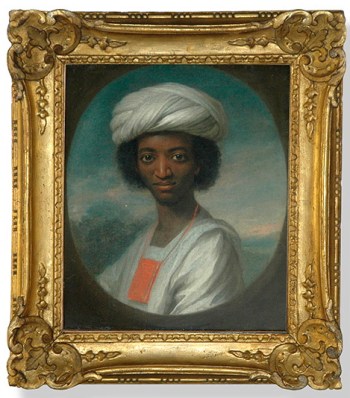
William Hoare, Portrait of Ayuba Suleiman Diallo, ca. 1733
(Jamestown-Yorktown Foundation)
The Jamestown-Yorktown Foundation, a Virginia state agency that operates Jamestown Settlement and Yorktown Victory Center history museums, has acquired a previously unknown oil portrait of Ayuba Suleiman Diallo, a freeborn, educated African who was kidnapped in Africa and sold as a slave in Maryland during the colonial era. Before taking its place as a centerpiece of the future American Revolution Museum at Yorktown (opening late 2016), the rare portrait (ca. 1733) goes on view at the Yorktown Victory Center this summer from June 14 through August 3.
Ayuba Suleiman Diallo was catapulted into fame in the 1730s when the remarkable story of his enslavement and redemption in the North American British colonies was published. From almost the moment he touched ground in London in April 1733, he won the respect of the leading lights of advanced learning in England and ultimately entered the annals of history as a figure embraced by the global abolitionist movement.

William Hoare, Portrait of Ayuba Suleiman Diallo (Job ben Solomon), 1733 (NPG L245, Lent by Qatar Museums Authority/Orientalist Museum, Doha, 2010)
Showing Diallo in a white robe and turban, wearing around his neck a bright red leather pouch probably containing texts from the Qur’an, the Jamestown-Yorktown Foundation portrait is one of two versions painted by William Hoare of Bath, a leading English portrait painter of the 18th century. They are the earliest known portraits done from life of an African individual who was held as a slave in the 13 British colonies that would become the United States of America. The other is currently on view in the National Portrait Gallery of London, on long-term loan following its purchase by the Qatar Museums Authority in 2009.
In a private collection since the 19th century, the Foundation’s portrait came to light following the publicity surrounding an appeal to the British public to keep the Qatar portrait in England. The Jamestown-Yorktown Foundation, Inc., purchased the oil-on-canvas painting with funds raised privately, including a lead gift from Foundation trustee Fred D. Thompson, Jr., of Thompson Hospitality, the country’s largest minority-owned food service company. “This portrait is a powerful symbol of the diversity of colonial America’s population, which included people from many different African cultures,” says Thompson. “Diallo—his image and story—is an ideal teaching opportunity for the American Revolution Museum at Yorktown galleries.”
“For approximately three years now, the Foundation has been in confidential negotiations to acquire this important portrait,” says Thomas E. Davidson, Jamestown-Yorktown Foundation senior curator. “Diallo’s visage speaks for the hundreds of thousands of enslaved Africans and African Americans who remain largely unknown, yet who constituted a major part of late-colonial America’s population.”
“As we plan for the new museum,” Davidson continued, “we hope to convey the way in which the American Revolution represented the beginning of the end for slavery in the United States. While the Revolution did not end slavery by itself, it created an intellectual, moral and political climate in which the practice could not and did not continue forever.”
While there are similarities, neither Hoare portrait is a copy of the other. The painting of Diallo that will be exhibited at the American Revolution Museum at Yorktown is 14 by 12 inches, with the subject’s upper body turned toward his right, against a landscape background, within a painted oval. In the other portrait, Diallo is turned toward his left against a solid background. (more…)










leave a comment