Exhibition | Anglo-American Portraiture in an Era of Revolution
From the Louvre:
Anglo-American Portraiture in an Age of Revolution
Musée du Louvre, Paris, 1 February — 28 April 2014
Crystal Bridges Museum of American Art, Bentonville, Arkansas, 17 May — 15 September 2014
High Museum of Art, Atlanta, 28 September 2014 — 18 January 2015
Curated by Guillaume Faroult
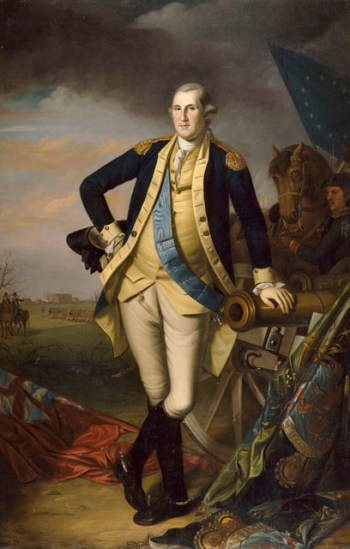
Attributed to Charles Wilson Peale, George Washington after the Battle of Princeton, 3 January 1777, ca. 1779 (National Museum of the Palace of Versailles and the Trianons)
The Louvre continues its exploration of the history of painting in America with a third special exhibition that compares and contrasts five Anglo-American portraits from 1780 to 1800 and slightly later, produced in the midst of a revolution that would lead to the independence and creation of the United States of America. The selected artworks revolve around the guardian and emblematic figure of General George Washington (1732–1799), elected first president of the United States in 1789.
The exhibition features three portraits of the Father of the Country, including one attributed to Charles Wilson Peale (1741–1827) depicting him as Commander in Chief of the Continental Army, on special loan from the Musée du Château de Versailles. Portraits of the opposing belligerents, notably a stunning, newly restored portrait of Captain Robert Hay of Spot by Scottish painter Sir Henry Raeburn (1756–1823), are presented in response to the magnificent portrait of Washington as president of the young nation painted in 1797 by Gilbert Stuart (1755–1828)—one of the most talented American portrait artists—on loan from the Crystal Bridges Museum.
This special exhibition is part of a long-term partnership with the Crystal Bridges Museum of American Art, the High Museum of Art, Atlanta, and the Terra Foundation for American Art, and was made possible through their generous support.
Digital Plans at the Reynolda House Museum of American Art
Press release (12 February 2014) from the Reynolda House Museum of American Art in Winston-Salem, North Carolina:

Joseph Blackburn, Portrait of Elizabeth Browne Rogers, 1761, oil on canvas (Reynolda House Museum of American Art)
As metropolitan museums across the country begin to focus personnel resources on digital content and new media strategies, Reynolda House Museum of American Art has created a new position to develop the extension of the museum’s desired impact and mission to an online audience. Trish Oxford has been named Assistant Director of Marketing & Communications, a position that will focus on the evolving need for digital communications. In this role she will create synergy between on-site experiences and virtual experiences through management of the Museum’s new website, email, social media, and other digital platforms. Oxford will also work closely with the curatorial staff to explore ways to enhance the visitor experience. She first joined the museum part-time in 2012 as Audience Engagement and Communications Specialist.
Oxford’s new position is part of a larger Reynolda House initiative called the Digital Engagement Project launched in 2010 with the digitizing of the museum’s collections. The federally funded project included cataloging each object in the museum’s collections, redesigning the museum’s website to facilitate access to collections, and creating new opportunities for people to interact with the museum online. Allison Perkins, Reynolda House executive director, said in her new position Oxford will invite museum visitors, online and in-person, to contribute their own interpretations and ideas, making all interactions with Reynolda House more impactful. (more…)
Historic New England 2014
From Historic New England:
Program in New England Studies
16–21 June 2014
Each year, Historic New England presents the Program in New England Studies, an intensive learning experience with lectures by curators and architectural historians, workshops, and behind-the-scenes tours of Historic New England’s properties and collections, as well as of other museums and private homes in the region.
Program in New England Studies examines New England history and material culture from the seventeenth century through the Colonial Revival, and delves into building design and technology, and the wide-ranging lifestyles illustrated by the historic sites on the itinerary. The program is designed to appeal to owners of historic houses, collectors, museum professionals, graduate students, and those who enjoy New England history, and is limited to twenty-five participants.
More information, including an itinerary, is available here»
2014 Summer Institute in Technical Art History for PhD Students
From the Institute of Fine Art’s Conservation Center:
2014 Summer Institute in Technical Art History for Doctoral Students in Art History
Institute of Fine Arts, New York University, 9–20 June 2014
Applications due by 24 March 2014
The Summer Institute in Technical Art History (SITAH) is an intensive two-week course, geared towards PhD candidates in art history who are looking to delve more deeply into technical studies. Students are immersed into the world of technical art history and conservation of works of art, with faculty ranging from conservators to conservation scientists, curators, art historians, and artists. The course takes full advantage of the wonderful resources of New York City, and many sessions are held in local conservation labs, where attendees have the opportunity to closely examine works of art with experts in the field. Off-site visits also include artists’ studios, museum permanent collections, and, where relevant, special exhibitions and galleries. A priority is placed on case studies and discussions, and students are encouraged to build relationships within the group, in the hopes of enriching their own research.
The Artist’s Book: Materials and Processes
A good understanding of material aspects of works of art is becoming increasingly important to art historical studies. The Artist’s Book is a two-week, intensive seminar that examines how technical art history might simultaneously clarify and complicate established art historical narratives of this important art form. The program will focus on works from the modern era, and will consider a variety of different formats. These might include: traditional letterpress printed books, deconstructed texts and book blocks, artists’ photo books, and other unique works. Bound volumes, as well as forms like scrolls, fold-outs, concertinas, loose leaves kept in boxes, and e-books may all be examined. This topic will allow us to explore the intersections of book construction, photography, printmaking, and graphic design within the context of literature, both experimental and traditional.
Under the direction of Professors Constance Woo (Long Island University) and Michele Marincola (Institute of Fine Arts, New York University), participants will study with distinguished conservators, book artists, scholars and master craftspeople. We will consider specific artworks as case studies, examine materiality and process through close looking and recreation of techniques and processes, and create a book in the studio. Participants will ascertain how these methodologies materially and theoretically inform their own diverse research interests. This seminar will provide a forum to develop critical skills in the interpretation of object-based analyses related to the scholarship of artist’s books.
Generously funded by the Mellon Foundation, the seminar will be held at the Institute of Fine Art’s Conservation Center, with selected sessions at area libraries, artist studios and in the conservation labs of New York City’s leading museums.
Eligibility and Application Process
Students currently enrolled in or completing a doctoral program in the US and Canada are eligible to apply. No background in science or conservation is required. A maximum of fifteen participants will be admitted to the program. Applicants will be evaluated on the basis of their academic accomplishment to date and on their expressed interest in integrating technical art history into their own research.
Applicants should submit a cover letter addressed to Professor Michele Marincola, Sherman Fairchild Chairman of the Conservation Center, Institute of Fine Arts, NYU; a statement of purpose of interest in integrating technical art history into their research; a letter of support from their advisor that addresses their academic standing and their interest in the topic; and an academic and professional CV. The application deadline is March 24, 2014. Please submit applications in electronic format to: Sarah Barack, course coordinator, sb340@nyu.edu.
Funding
Participants will receive housing (single room occupancy) and stipends of $1,300 to help defray travel and living costs. For further information, please contact: Professor Michele Marincola at 212-992-5849,email: michele.marincola@nyu.edu.
New Book | Johann Paul Egell, 1691–1752
From Imhof Verlag (and available at Artbooks.com). . .
Stefanie Michaela Leibetseder, Johann Paul Egell (1691–1752), Der kurpfälzische Hofbildhauer und die Hofkunst seiner Zeit: Skulptur – Ornament – Relief (Petersberg: Imhof, 2013), 176 pages, ISBN: 978-3865688514, 39€ / $75.
 Der kurpfälzische Hofbildhauer Paul Egell (1691–1752) zählt zu den bedeutendsten Bildhauern Deutschlands im 18. Jahrhunderts. Wie kein anderer Bildhauer der Zeit markiert sein Werk den Paradigmenwechsel zwischen den italienisch geprägten Traditionen des Barock und der französisch geprägten Formensprache des Rokoko. Das Buch spürt anhand exemplarischer Werke erstmals den Entstehungsbedingungen von Egells Werk nach. Im Mittelpunkt stehen sein Beitrag zum Nymphenbad des Dresdner Zwingers sowie die Skulpturen und Stuckaturen, die er für die kurpfälzische Residenz in Mannheim schuf. Es wird die ikonografische Tradition untersucht, in der sich Egell bewegte, und aufgezeigt, dass dessen Schaffen bereits sehr früh die Kunst der Régence in Frankreich rezipierte. Damit wird zum einen die Grundlage für eine differenziertere Einschätzung von Egells Œuvre gelegt, zum anderen werden Anregungen für die Auseinandersetzung mit anderen Bildhauern des deutschen Rokoko gegeben.
Conference | Maritime Culture in the Age of J. M. W. Turner
Next month at Greenwich:
Maritime Culture and Britain in the Age of J.M.W. Turner
Royal Museums Greenwich, London, 21–22 March 2014
Registration due by 20 March 2014

J.M.W. Turner, The Battle of Trafalgar, 21 October 1805, 1822–24, National Maritime Museum, Greenwich, London
To coincide with a major exhibition of the work of J.M.W. Turner (1775–1851), Royal Museums Greenwich is hosting an interdisciplinary conference exploring the cultural impact of the sea in the late 18th and 19th centuries. Turner and the Sea is the first full-scale examination of the artist’s lifelong preoccupation with the sea, and features many of his most celebrated works, from his transformative Academy paintings of the late 1790s and early 1800s to the unfinished, experimental seascapes he produced towards the end of his life. The exhibition offers the opportunity to discover the myriad ways in which Turner responded to the maritime art—past and contemporary—while challenging his audiences with new ways of representing the sea. The conference aims to locate Turner’s seascapes within a broader maritime context, and explore the cultural and political significance of the sea during his lifetime.
Conference fee: £100 (concessionary rate £90). Including Friday evening reception and private view of the Turner and the Sea exhibition. To book tickets contact Lizelle de Jager on 020 8312 6716, research@rmg.co.uk.
◊ ◊ ◊ ◊ ◊
F R I D A Y , 2 1 M A R C H 2 0 1 4
10.30 Registration and refreshments
11.00 Session 1
• ‘Now for the painter’: Turner and the Sea at Greenwich: Richard Johns (University of York)
• ‘Commercial care and busy toil’: Turner’s Image of Downriver Thames: Geoff Snell (National Maritime Museum and University of Sussex)
• Turner, the Mouth of the Thames and Commerce: Leo Costello (Rice University, Texas)
12.30 Lunch
14.00 Session 2
• Craft and Labour in John Ruskin’s Romantic Tradition: ‘The Harbours of England’: Carmen Casaliggi (Cardiff Metropolitan University)
• Nautical Zombies: Death and the Undead in Romantic Maritime Literature: James Robertson (University of Leeds)
15.00 Coffee and tea
15.30 Session 3
• Sperm, Blood, Blubber, Bone, Oil and Water: the 19th-Century Visual and Literary (Sub)Cultures of Whaling: Jason Edwards (University of York)
• Turner’s Abstraction and the Culture of Steam Power in the Ships of the Peninsular and Oriental Steam Navigation Company: Jonathan Stafford (Kingston University)
16.45 Keynote
• Stephen Deuchar (The Art Fund)
17.45 Reception and private view of Turner and the Sea
S A T U R D A Y , 2 2 M A R C H 2 0 1 4
8.45 Pre-conference discussion in Turner and the Sea exhibition
9.45 Coffee and tea
10.00 Session 4
• ‘Baptism of the Waves’: Vernet, Turner and the Near-Death Experience: Melanie Vandenbrouck (Royal Museums Greenwich)
• Literal or Littoral? Constable’s Representations of the Sea: Annie Lyles (independent scholar)
• Perceptions, Practice, Association: Turner and Stanfield: Pieter van der Merwe (Royal Museums Greenwich)
11.30 Coffee and tea
12.00 Session 5
• Carthage, Venice and Holland: Turner, British Identity and the Sea Powers of the Past: Andrew Lambert (King’s College, London)
• ‘One haunting conception’? Turner’s ‘Trafalgar’ Paintings: Christine Riding (Royal Museums Greenwich)
13.00 Lunch (from 13.45 to 14.30 a curatorial talk will take place in the Nelson, Navy, Nation gallery by James Davey, Royal Museums Greenwich)
14.45 Session 6
• Glorious Firsts! Turner, War and British Marine Painting: Eleanor Hughes (Yale Center for British Art)
• Relegation or Patriotic Promotion: a Reconsideration of George IV’s Donation of Turner’s Battle of Trafalgar to the National Gallery of Naval Art: Cicely Robinson (National Maritime Museum and University of York)
• The Sailor in the Gallery: Representing the Reception of Maritime Art: Catherine Roach (Virginia Commonwealth University)
Call for Papers | Creatures of Comfort, 1650–1950
Rienzi’s 15th Anniversary Symposium | Creatures of Comfort, 1650–1950
Museum of Fine Arts, Houston, 19–21 September 2014
Proposals due by 1 May 2014
Rienzi, the Museum of Fine Arts Houston’s house museum for European decorative arts, celebrates its 15th anniversary as a public collection with the symposium, Creatures of Comfort, 1650–1950. By examining the period from 1650 to 1950, how and why did the concept of comfort evolve and become an important part of European and American cultures? What objects, inventions, aesthetic or cultural changes improved ones’ physical or emotional well-being simply by making life more comfortable?
Rienzi houses a significant European collection of paintings, sculpture, furniture, porcelain, and silver from the mid-17th to mid-19th centuries. Built in 1953 as a residence and now a house museum, Rienzi evokes the fine European country houses of the 18th century with formal, yet comfortable, furnishings, entertaining and private spaces, and rooms specifically designed for the enjoyment of family and friends. Rienzi also retains many modern amenities such as central air conditioning, a dishwasher, an elevator and other luxurious essentials that defined the ultimate comforts in America in the 1950s.
The Creatures of Comfort, 1650–1950 symposium offers academics and emerging scholars an opportunity to explore the ever-changing role of comfort in European and American cultures. The symposium will take place at the Museum of Fine Arts, Houston, from Friday, September 19, 2014, through Sunday, September 21, 2014.
We invite masters, doctorial students and emerging scholars to submit a 400-word abstract outlining a twenty-minute presentation, along with a current CV by May 1, 2014. Please direct all submissions to rienzisymposium@mfah.org. Selected participants will be notified by July 1, 2014. Participants will be offered a $600 travel and lodging stipend. All presentations will be given on Saturday, September 20, and Sunday, September 21, at the Museum of Fine Arts, Houston.
Possible themes of investigation may include, but are not limited to: interiors, design, architecture, dining, privacy, leisure activities, etiquette, gender, costume, travel, technology, and economics.
The keynote address will be given on Friday, September 19, 2014 by Dr. Joan DeJean, Cultural Historian and Trustee Professor of Romance Languages at the University of Pennsylvania. Her research includes the cultural history and the material culture of late 17th- and early 18th-century France. She is the author of ten books on French literature, history, and material culture, including, The Essence of Style, How the French Invented High Fashion, Fine Food, Chic Cafes, Style, and Sophistication, The Age of Comfort: When Paris Discovered Casual and the Modern Home Began, and her most recent publication, How Paris Became Paris: The Invention of the Modern City.
New Book | Queen Caroline
From Yale UP:
Joanna Marschner, Queen Caroline: Cultural Politics at the Early Eighteenth-Century Court (London: The Paul Mellon Centre for Studies in British Art, 2014), 232 pages, ISBN: 978-0300197778, $75.
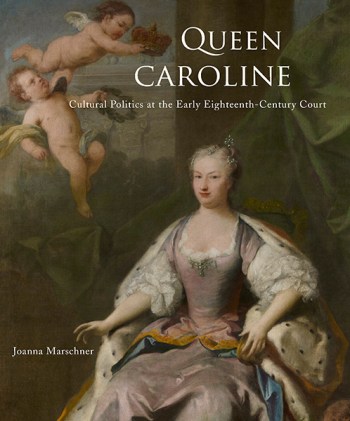 As the wife of King George II, Caroline of Ansbach became queen of England in 1727. Known for her intelligence and strong character, Queen Caroline wielded considerable political power until her death in 1737. She was enthusiastic and energetic in her cultural patronage, engaging in projects that touched on the arts, architecture, gardens, literature, science, and natural philosophy. This meticulously researched volume will survey Caroline’s significant contributions to the arts and culture and the ways in which she used her patronage to strengthen the royal family’s connections between the recently installed House of Hanover and English society. She established an extensive library at St. James’s Palace, and her renowned salons attracted many of the great thinkers of the day; Voltaire wrote of her, “I must say that despite all her titles and crowns, this princess was born to encourage the arts and the well-being of mankind.”
Joanna Marschner is senior curator at Historic Royal
Palaces.
Exhibition | The First Georgians: Art & Monarchy 1714–1760
Press release (29 January 2014) from The Royal Collection:
The First Georgians: Art & Monarchy 1714–1760
The Queen’s Gallery, Buckingham Palace, London, 11 April — 12 October 2014

◊ ◊ ◊ ◊ ◊
In 1714 Georg Ludwig, Elector of Hanover in Germany, acceded to the British throne as George I, the country’s first constitutional monarch. Despite many stronger genealogical claims to the crown than his, the 1701 Act of Settlement had declared that the choice of sovereign was the gift of Parliament alone and that only a Protestant could sit on the British throne. With this unprecedented decision, the Georgian era began, ushering in an unbroken line of succession to Her Majesty Queen Elizabeth II.
Marking the 300th anniversary of the Hanoverian succession, The First Georgians: Art & Monarchy 1714–1760 explores the reigns of George 1 (r.1714–27) and his son George II (r.1727–60), shedding light on the role of this new dynasty in the transformation of political, intellectual and cultural life. Through over 300 works from the Royal Collection, it tells the story of Britain’s emergence as the world’s most liberal, commercial and cosmopolitan society, embracing freedom of expression and the unfettered exchange of ideas.
The Hanoverians’ right to rule was fiercely disputed by the Jacobites, supporters of the Stuart claim to the throne. The ‘Old Pretender’, Prince James Francis Edward Stuart, set up a rival court in Paris and Rome, and his son, Prince Charles Edward—Bonnie Prince Charlie—led an uprising in 1745–46 on behalf of his father’s cause. The continuous threat to Hanoverian rule, both at home and overseas, is reflected in the exhibition’s military maps and battle plans. They include a draft order of battle at Culloden, thought to have been produced by George II’s son, the Duke of Cumberland, who led the King’s troops to victory in 1746.
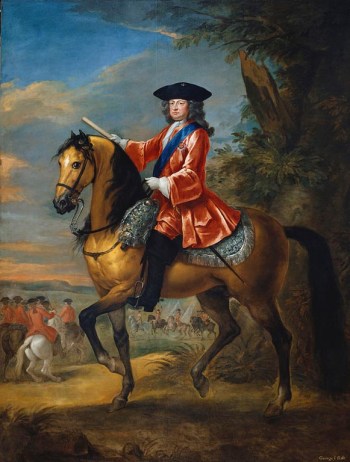
Vanderbank, Equestrian Portrait of George I, 1726
(Royal Collection 404412)
Although St James’s Palace remained the principal royal residence, the newly installed George I focused his artistic attention on Kensington Palace–its location outside London provided some shelter from the scrutiny of his more sceptical subjects. Here he appointed William Kent to decorate a new suite of State Rooms. The King filled Kensington with the best British furniture of the day, including pieces by James Moore and Old Master paintings, such as Don Roderigo Calderón on Horseback, 1612–15, and The Holy Family with St Francis, 1620–30, by Peter Paul Rubens.
The reigns of both Georges were fraught with familial strife. In 1717 George I expelled the Prince of Wales, the future George II, from St James’s Palace. Far from enduring a humiliating exile, the Prince established an alternative court, hosting ‘drawing rooms’, evening parties and balls, and regularly dining in public. Some 20 years later, George II’s son, Frederick, Prince of Wales (whose son George William Frederick became George III) was similarly banished and set up rival headquarters. Furnishing his private residences, the Prince could indulge his enthusiasm for the Old Masters. Among his acquisitions were Guido Reni’s Cleopatra with the Asp, c.1628, Anthony van Dyck’s Thomas Killigrew with an unidentified Man, c.1630, and ‘The Jealous Husband’, c.1660, by David Teniers.
Frederick presented himself as a fashionable man about town, entertaining freelyand informally—a typical supper party offered a menu of larks, pigeons, partridges, truffles, veal, turkey, lamb, turbot, salmon, teal, blackbird, asparagus, broccoli, sweetbreads, coffee cream and jelly. To dress his table, he commissioned dining plate in the new Rococo style, including the spectacular marine service by Paul Crespin and Nicholas Sprimont. Frederick’s mother, Queen Caroline, despised her son’s relaxed manner: “popularity always makes me sick,” she is reported to have said, “but Fretz’s popularity makes me vomit.”
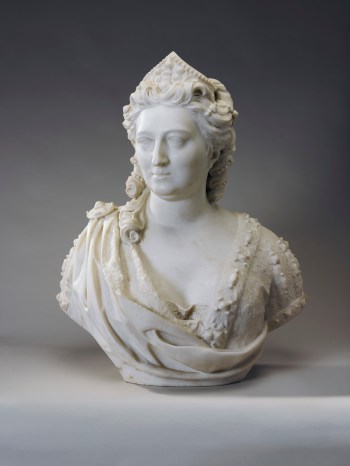
After John Michael Rysbrack and Joseph Highmore, Posthumous Portrait of Queen Caroline, Consort of George II, 1739
(Royal Collection, 31317)
Queen Caroline, consort of George II, was the most intellectual member of the Hanoverian dynasty. Her interests combined art, genealogy and a passion for gardening. She undertook major landscape projects at Kensington Palace and at her private retreat in Richmond, where she commissioned Charles Bridgeman to lay out the new gardens, complemented by follies created by William Kent. The most remarkable of these was the Hermitage, a picturesque temple devoted to British scientists and theologians, encapsulating Caroline’s belief in the interdependence of science and religion.
During the course of the 18th century, the focus of British cultural life began to shift away from court. Artists achieved success and fame through their own efforts, without the traditional support of a royal patron. William Hogarth’s portrait of David Garrick and his Viennese dancer wife, Eva-Marie Veigel, captures one of the most high-profile couples of the age. When the portrait was painted, in c.1757–64, Garrick had already combined great financial success as an actor-manager with international celebrity. Hogarth himself was not only a prominent artist, but
also a writer on art and a noted philanthropist.
The favourite genre of the early Georgian period was satire, both pictorial and literary. In 1724, its greatest practitioner, William Hogarth, published The Bad Taste of the Town, ridiculing British taste for foreign forms of art, such as Italian opera. London’s leading exponent of Italian opera was the German composer George Frideric Handel, who was employed in many royal roles. He was music teacher to George II’s daughter, Princess Anne, who is seen playing the cello with her two sisters and brother, Frederick, Prince of Wales, in Philippe Mercier’s The Music Party, 1733.

Meissen, Tea and coffee service with chinoiserie figures, 1720s
(Royal Collection, 5000106)
The desire for fashionable luxury goods drove Britain’s commercial enterprise and turned London into the most important trading city in the world. The Chelsea porcelain works, one of several new ventures set up to compete with the newly established Meissen factory in Germany, typified the entrepreneurialism of the time. With the emergence of a new leisure class came an explosion of coffee houses, gaming haunts, assembly rooms, theatrical entertainments and pleasure gardens. In the painting St James’s Park and the Mall, c.1745, all elements of cosmopolitan Georgian society mix together, with Frederick, Prince of Wales at the centre, rubbing shoulders with his future subjects.
◊ ◊ ◊ ◊ ◊
The catalogue is published by the Royal Collection and distributed by the University of Chicago Press:
Desmond Shawe-Taylor, ed., The First Georgians: Art & Monarchy 1714–1760 (London: Royal Collection Trust, 2014), 496 pages, ISBN 978-1905686797, £45 / $90.
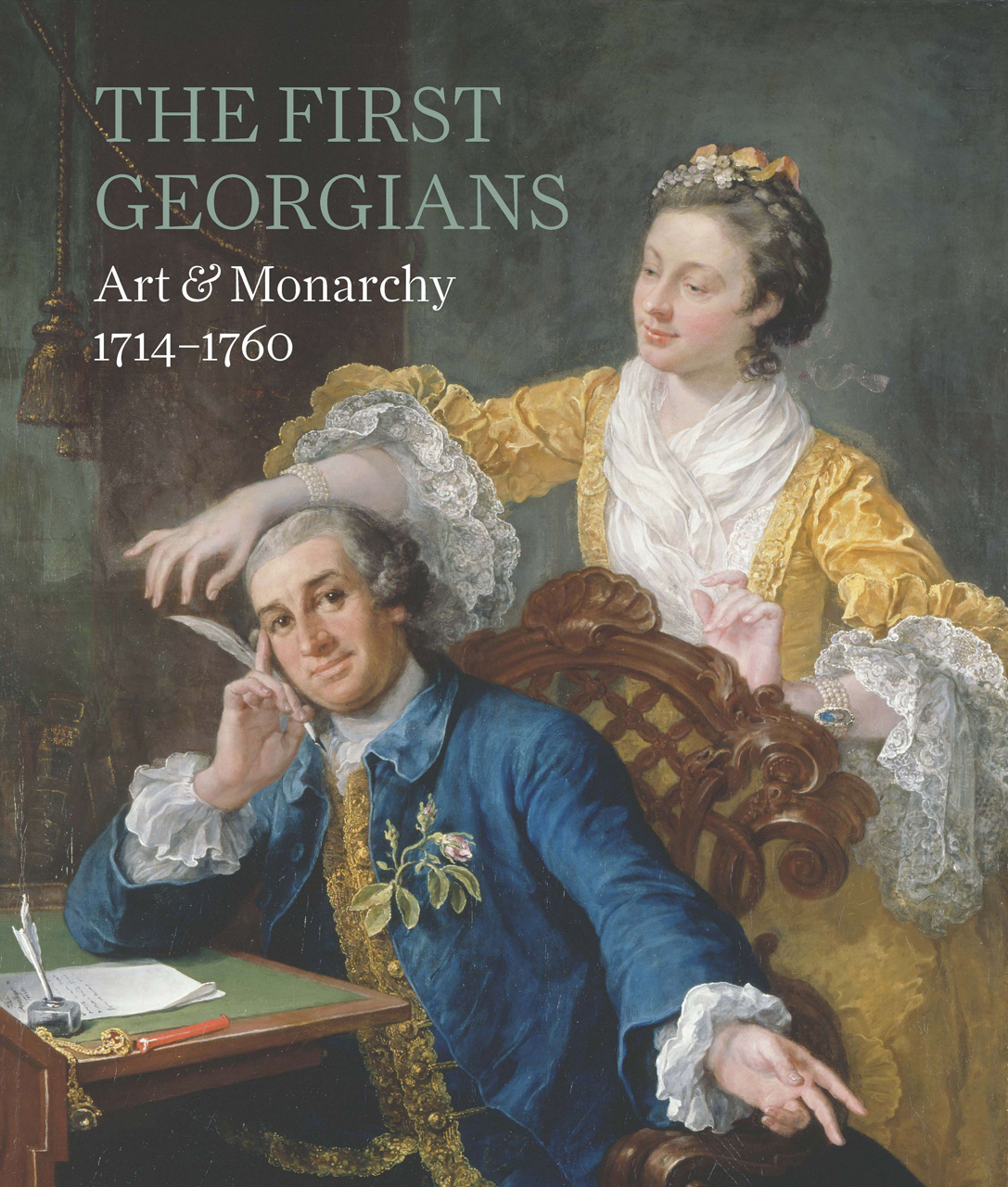 2014 marks the three-hundredth anniversary of the succession of the House of Hanover to the British throne. In celebration of this historic milestone, The First Georgians explores the rich artistic culture of the early Hanoverian period.
This publication showcases more than three hundred of the finest works of this period, many of which have never been on public display before. Created in Germany, France, and Britain during one of the most dramatic periods of change across all aspects of political, intellectual, and cultural life, they reflect changing views of science, politics, and art throughout the early to mid-eighteenth century—the period when modern Britain was coming into being.
New Book | The Great Mirror of Folly
Published in November 2013 by Yale University Press:
William N. Goetzmann, Catherine Labio, K. Geert Rouwenhorst, and Timothy G. Young, eds., The Great Mirror of Folly: Finance, Culture, and the Crash of 1720, with a foreword by Robert J. Shiller. Yale Series in Economic and Financial History (New Haven: Yale University Press, 2013). 360 pages, ISBN: 978-0300162462, $75.
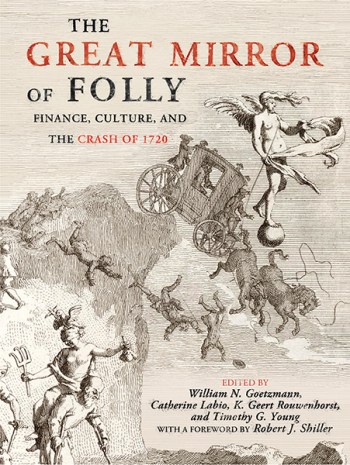 The world’s first global stock market bubble suddenly burst in 1720, destroying the dreams and fortunes of speculators in Paris, London, and Amsterdam. Their folly and misfortune inspired the quasi-simultaneous publication of an extraordinary Dutch collection of texts and images, including financial prospectuses, satirical prints, plays, poems, and suites of playing cards: Het groote Tafereel de Dwaasheid (The Great Mirror of Folly), the most aesthetically pleasing and historically valuable record of a financial crisis and its cultural dimensions.
No one discipline has been able to give a definitive account of the causes and effects of the bouts of “irrational exuberance” that have taken stock market participants and observers by surprise since 1720, when the collapses of the Mississippi, South Sea, and a host of smaller companies stunned Europe’s burgeoning financial markets. In this new and richly illustrated volume scholars from fields as diverse as economics, history, the history of art, literature, and cultural studies bring a wide variety of perspectives to bear on the Tafereel in order to provide a definitive account of the events of 1720 and of the mix of economic and cultural factors behind the financial crashes that have caused widespread economic and cultural shock for almost 300 years. The book also reproduces many of the engravings included in the Tafereel to give readers an approximation of the original volume and of the dramatic rise, progress, and fall of the first international stock market crash.
William N. Goetzmann is the Edwin J. Beinecke Professor of Finance and Management at the Yale School of Management. Catherine Labio is associate professor of English at the University of Colorado Boulder. K. Geert Rouwenhorst is Robert B. & Candice J. Haas Professor of Corporate Finance at the Yale School of Management. Timothy G. Young is curator of modern books and manuscripts at Beinecke Rare Book and Manuscript Library at Yale University.










 Enfilade
leave a comment