Exhibition | Quilts 1700–1945
From the QAG press release (14 June 2013) . . .
Quilts 1700–1945
Queensland Art Gallery, Brisbane, 15 June — 22 September 2013
Curated by Sue Prichard

Coverlet with sundial, cotton, 1797
(London: Victoria and Albert Museum)
An exhibition of historic British quilts from London’s Victoria and Albert Museum (V&A) is now on view at the Queensland Art Gallery, presenting enthralling social histories and personal stories of more than 200 years of quiltmaking and patchwork. The exhibition includes more than 35 hand-crafted textiles created to provide comfort and commemorate historical events and family occasions between 1690 and 1945, plus a host of associated material such as pin cushions, needlework tools and sewing baskets.
The works come primarily from the esteemed collection of the V&A, the world’s leading decorative arts and design museum. Select pieces have travelled from British regional museums and private collections, and there is the special addition of the much-admired Rajah quilt of 1841, sewn by convict women during transportation to Van Diemen’s Land, on loan from the National Gallery of Australia.
Divided into four thematic sections, the exhibition explores the domestic landscape of the wealthy bedrooms of 18th-century Britain; the private thoughts and political debates that emerged as patchwork spread to aspirational middle class homes in the early 19th century; the movement of quilts to the public sphere for exhibition and display in Victorian England; and the survival of quiltmaking in economically deprived areas in the face of the emergence of mass production in the early 20th century.
“The exhibition has been curated for QAG by Sue Prichard, Curator of Contemporary Textiles at the V&A, based on the popular exhibition Quilts 1700–2010: Hidden Histories, Untold Stories, presented in 2010 at the V&A,” explained Director Chris Saines.
The exhibition is accompanied by the 196-page publication Quilts 1700–1945, a co-edition from QAGOMA and the V&A.
Judge Rules Benjamin West Altarpiece Can Go to Boston
From The Art Newspaper (11 July 2013) . . .
Anglican Court Says Benjamin West Altarpiece Can Go to Boston
City of London church to sell the masterpiece to fund repairs
By Martin Bailey
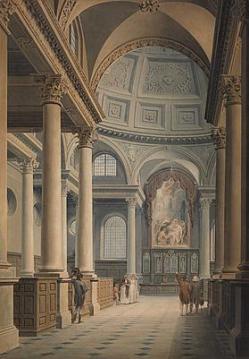
Thomas Malton (1748-1804), St Stephen Walbrook, London, watercolour over pencil, heightened with scratching out, 26 x 18 inches (646 x 447 mm)
Lowell Libson LTD (London).
West’s Devout Men Taking Away the Body of St Stephen is visible at the altar.
A Church of England court has ruled that Benjamin West’s altarpiece, Devout Men Taking Away the Body of St Stephen, 1776, which was made for one of the most important churches in the City of London can be sold for display in the US. The $2.85m painting is being bought by an anonymous foundation, which is due to lend it to the Museum of Fine Arts, Boston (The Art Newspaper, April 2013, pp6–7 and June 2013, p3). West was born in America, but worked in England.
In his judgment, delivered on 10 July, Judge Nigel Seed, chancellor of the consistory court of the Diocese of London, ruled that St Stephen Walbrook should be allowed to sell the masterpiece. The painting had been removed from the church in around 1987, in what he described as “perceived illegal actions”, and has since been kept in storage. . .
The full article is available here»
◊ ◊ ◊ ◊ ◊
As a starting place in the scholarly literature:
Jerry D. Meyer, “Benjamin West’s St Stephen Altar-Piece: A Study
in Late Eighteenth-Century Protestant Church Patronage and English
History Painting,” The Burlington Magazine 118 (September 1976): 634-41.
Conference | Materializing the Spirit: Art and Women Religious
From the conference programme:
Materializing the Spirit: Spaces, Objects, and Art in the Cultures of Women Religious
Histories of Women Religious of Britain and Ireland (HWRBI) 2013 Conference
Institute of Historical Research, Senate House, London, 5–7 September 2013
 This conference explores architecture, art, and design produced by and for women religious in Britain and Ireland from the Middle Ages to the present. Keynote speakers are Mary Schoeser on textiles and interiors, and Julian Luxford on medieval convents. Presenters include Emily Gee (English Heritage), Tim Knox (Fitzwilliam Museum), and Helen Hills (York). The conference also includes a thematic tour of the V&A’s collections. Additional information is available at the HWRBI website.
◊ ◊ ◊ ◊ ◊
T H U R S D A Y , 5 S E P T E M B E R 2 0 1 3
2.00 – 3.30 Women Religious and the Arts at the V&A
Tessa Murdoch (Acting Keeper of Metalwork, Sculpture, Ceramics and Glass, V&A) will lead a tour of the museum’s collections. Places are limited. Further information on registration.
F R I D A Y , 6 S E P T E M B E R 2 0 1 3
9.00 Registration and Refreshments
9.30 Welcome and Introduction
9.45 Session I: Place and Purpose, chaired by Caroline Bowden (QMUL)
• Roderick O’Donnell FSA, ‘The Pugins’ Houses of men and women contrasted’
• Michael O’Boyle (Bluett & O’Donoghue Architects), ‘The nature and character of convent buildings in Ireland in the eighteenth and nineteenth centuries’
• Sue Acheson RSCJ, ‘Space for the Heart: Representing Devotion in the Chapel of the Sacred Heart, Roehampton’
11.15 Break
11.30 Session II: Patrons and Subjects, chaired by Dominic Janes (Birkbeck)
• Tim Knox (Fitzwilliam Museum), ‘A Soldier and a Nun: Two “Ancestral Portraits” of English Sitters by Pietro-Tommaso Labruzzi’
• Patricia Harris CJ, ‘The Mystery of the “Painted Life” of Mary Ward’
• Anselm Nye (QMUL), ‘Artistic and Comic: The cartoon as historical memory amongst the English Dominican Sisters’
1.00 Lunch
2.00 Session III: Material and Immaterial, chaired by Carmen Mangion (Birkbeck)
• Susan O’Brien (Cambridge), ‘A Spirituality Represented: Images of the Holy Child in the Society of the Holy Child Jesus, England since 1846’
• Helen Hills (York), ‘Making Religion Matter?’
3.00 Break
3.15 Teaching and Publishing Session
“…Nuns are a remote reality, detached from the world”: The Challenges of Teaching and Researching Female Religious Life, (Session sponsored by History Lab Plus, IHR & Higher Eduction Academy)
5.00 Break
5.15 Keynote I | Mary Schoeser (President, The Textile Society), ‘Fair and beautiful to behold’
6.15 Reception and H-WRBI Annual Meeting
8.00 Conference Dinner
S A T U R D A Y , 7 S E P T E M B E R 2 0 1 3
9.00 Registration and Refreshments
9.30 Session IV: Space and Context, chaired by Lynne Walker (IHR)
• Ellie Pridgeon (Leicester), ‘Space and Location: The Cloister Paintings at Lacock Abbey’
• Deirdre Raftery (UCD), ‘ “Cover the Earth with Houses”: The form and function of the convents of the Society of
the Sacred Heart in nineteenth-century Ireland, North and South’
• Brenda King (The Textile Society), ‘Stitch and Stone’
11.00 Break
11.30 Session V: Symbolism and Devotion, chaired by Jane Hamlett (RHUL)
• Kate Jordan (UCL), ‘Artists Hidden from Human View: Mysticism and Art in the Victorian Convent’
• Ayla Lepine (Yale), ‘”The Story of a Life”: Nuns at the Epicentre of Modern Visual Culture’
12.30 Lunch
1.30 Session VI: Heritage and Preservation, chaired by Emily Gee (English Heritage)
• Abbot Geoffrey Scott (Catholic Archives Society), ‘The Archives and Collections of English Nuns Deposited at Douai Abbey’
• Frederick O’Dwyer (Conservation architect), ‘Historic Irish Convents, Redundancy and Reuse’
• Sophie Andreae (Vice Chair, Bishop’s Conference Patrimony Committee), ‘Important Artefacts: Some Recent Case Studies’
• Emily Gee (English Heritage, Head of Designation), ‘Reflections on the Heritage Landscape’
3.30 Break
4.00 Keynote II | Julian Luxford, (St Andrews), ‘Nuns, Art and Patronage in Later Medieval England’
5.00 Closing remarks
5.15 Reception
To register online, visit the HWRBI Eventbrite page.
We All Scream for Ice Cream
In case you’re somewhere hot, thinking about ice cream . . . (a full list of contents for the current issue of Past & Present is available here).
Melissa Calaresu, “Making and Eating Ice Cream in Naples: Rethinking Consumption and Sociability in the Eighteenth Century,” Past & Present 220 (August 2013): 35-78.
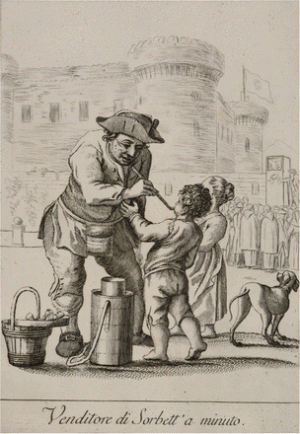
Pietro Fabris, Venditore di sorbett’a minuto, from his Raccolta di varii vestimenti ed arti del Regno di Napoli (Naples, 1773). © British Library Board D-7743.h.13.
Two barefoot children reach out to lick the spoon of the ice-cream seller. He carries a pouch around his waist that hints at the profits that are to be made from his trade. Two wooden containers rest on the ground beside him, one of which has a canister inside it and a strap outside to carry it, while the other holds a tray of cups to serve the ice cream (Plate 1).1 Behind this scene is the Angevin castle in Naples and a crowd gathered around a puppet stall. Pietro Fabris made this engraving as part of a collection depicting the costumes and customs of Neapolitans which was published in 1773 and dedicated to the British emissary to Naples, William Hamilton. Three years later, Fabris would provide elaborate hand-coloured illustrations for Hamilton’s scientific study of the eruptions of Vesuvius published in French and English and dedicated to the members of the Royal Society.2 Both books projected an image of Naples that appealed to the Grand Tourists who were flocking to see the excavations of the ancient cities of Herculaneum and Pompeii and the volcanic spectacle nearby (Vesuvius was particularly active in the last decades of the eighteenth century), and to experience life on the streets of the city. The collection of engravings including the sorbet seller appealed directly to a growing interest in Neapolitan popular culture and presented an image of the city as a theatre of extremes, in which the pleasures of life collided with the extreme poverty of the lazzaroni, and where its poorest inhabitants splurged on what — from a northern European perspective — might be seen as one of the great luxuries of the eighteenth century. We could leave our interpretation of the Fabris engraving there, safely within a history of the vast visual production of the Grand Tour in Italy, but the image conveys more than a tourist discourse about the exotic.3 In fact, the engraving illustrates the eating of a food product that was far from a luxury, and its sale to ordinary people on the streets of Naples, a point that has been completely overlooked by historians of the early modern period. . .
N O T E S
1 There is a variety of vocabulary in English, French and Italian describing ice or frozen desserts and drinks with a water or milk base. In Italian, sorbetto is used in the eighteenth century generally to describe what we know today as both sorbet and ice cream. Here I use the term ‘ice cream’ generically. All translations from Italian are my own unless otherwise stated.
2 Pietro Fabris, Raccolta di varii vestimenti ed arti del Regno di Napoli (Naples, 1773); William Hamilton, Campi Phlegræi: Observations on the Volcanos of the Two Sicilies as They Have Been Communicated to the Royal Society of London, 3 vols. (Naples, 1776–9), i–ii. On Fabris and Hamilton, see the essays in Ian Jenkins and Kim Sloan (eds.), Vases and Volcanoes: Sir William Hamilton and his Collection (London, 1996).
3 The use and the study of the term lazzaroni have a long history. It generally had a pejorative sense in travel accounts describing some of the poorer inhabitants of Naples, meaning ‘scoundrels’ or ‘layabouts’, although the lazzaroni became of increasing ethnographic interest at the end of the eighteenth century: see Melissa Calaresu, ‘From the Street to Stereotype: Urban Space, Travel and the Picturesque in Late Eighteenth-Century Naples’, Italian Studies, lxii (2007).
Bergpark Wilhelmshöhe Now a UNESCO World Heritage Site
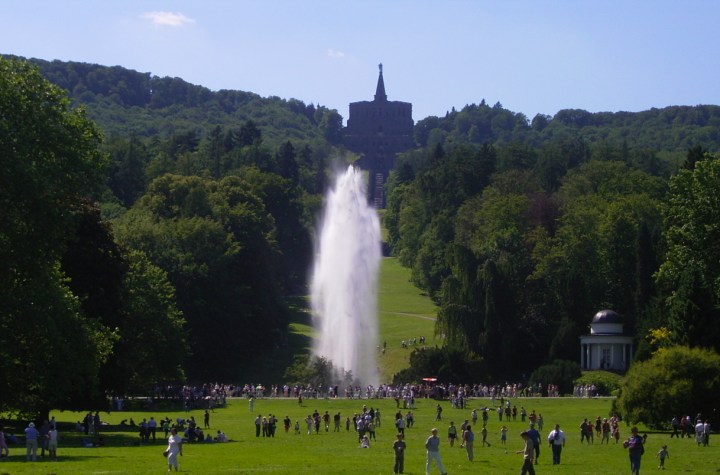 Bergpark Wilhelmshöhe, Kassel, Germany
Photo, 2005, Wikimedia Commons
◊ ◊ ◊ ◊ ◊
From UNESCO (23 June 2013) . . .
Sites in Germany and Italy Bring to 19 the Number of Sites Added to the World Heritage List
Two new sites and one extension to a Polish site were inscribed on UNESCO’s World Heritage List on Sunday afternoon, bringing to 19 the total number of sites added to the List during the 37th session taking place in Phnom Penh.
Bergpark Wilhelmshöhe, Germany
Descending a long hill dominated by a giant statue of Hercules, the monumental water displays of Wilhelmshöhe were begun by Landgrave Carl of Hesse-Kassel in 1689 around an east-west axis and were developed further into the 19th century. Reservoirs and channels behind the Hercules Monument supply water to a complex system of hydro-pneumatic devices that supply the site’s large Baroque water theatre, grotto, fountains and 350-metre long Grand Cascade. Beyond this, channels and waterways wind across the axis, feeding a series of dramatic waterfalls and wild rapids, the geyser-like Grand Fountain which leaps 50m high, the lake and secluded ponds that enliven the Romantic garden created in the 18th century by Carl’s great-grandson, Elector Wilhelm I. The great size of the park and its waterworks along with the towering Hercules statue constitute an expression of the ideals of absolutist Monarchy while the ensemble is a remarkable testimony to the aesthetics of the Baroque and Romantic periods.
◊ ◊ ◊ ◊ ◊
Also from UNESCO:

Bergpark Wilhelmshöhe
Photo by Jens Haines, 2012 from Wikimedia Commons
Inspired by the dramatic topography of its site, the Hercules monument and water features of the Bergpark Wilhelmshöhe created by the Landgrave Carl from 1689 combine in an outstanding demonstration of man’s mastery over nature. The monumental display of rushing water from the Octagon crowned by the massive Hercules statue via the Vexing Grotto and Artichoke Basin with their hydro pneumatic acoustic effects, Felsensturz Waterfall and Giant’s Head Basin down the Baroque Cascade to Neptune’s Basin and on towards the crowning glory of the Grand Fountain, a 50-metre high geyser that was the tallest in the world when built in 1767, is focused along an east-west axis terminating in the centre of the city of Kassel. Complemented by the wild Romantic period waterfalls, rapids and cataracts created under Carl’s great-grandson the Elector Wilhelm I, as part of the 18th-century landscape in the lower part of the Bergpark, the whole composition is an outstanding demonstration of the technical and artistic mastery of water in a designed landscape. Together with the 11.5m high bronze Hercules statue towering above the park and visible from many kilometres, which represents an extraordinary sculptural achievement, they are testimony to the wealth and power of the 18th- & 19th-century European ruling class.
Criterion (iii): The towering statue of Hercules and the water displays of the Bergpark Wilhelmshöhe are an exceptional symbol of the era of European Absolutism.
Criterion (iv): The water displays of Bergpark Wilhelmshöhe are an outstanding and unique example of monumental water structures. Cascades of similar size and artificial waterfalls of comparable height can be found nowhere else. The Hercules statue, towering over the 560 hectare park, is both technically and artistically the most sophisticated and colossal statue of the Early Modern era. The ensemble of water features with their monumental architectural settings is unparalleled in the garden art of the Baroque and Romantic periods. (more…)
Exhibition | Witches and Wicked Bodies
Press release (10 December 2012) from the Scottish National Gallery of Modern Art:
Witches and Wicked Bodies
Scottish National Gallery of Modern Art, Edinburgh, 27 July — 3 November 2013
 The fascination for witches, which has gripped many Western artists from the sixteenth century to the present, will be the subject of a major new exhibition at the Scottish National Gallery of Modern Art this summer. Witches and Wicked Bodies, will delve into the dark and cruel origins of the classic image of the witch, and demonstrate how the now familiar old woman on a broomstick is just one part of a rich and very diverse visual tradition.
Witches and Wicked Bodies will highlight the inventive approaches to the depiction of witches and witchcraft employed by a broad range of artists over the past 500 years, with striking examples by famous names such as Albrecht Dürer, Lucas Cranach, Salvator Rosa, Francisco de Goya, Henry Fuseli, John William Waterhouse and William Blake. The selection will also include more recent interpretations of the subject, by twentieth-century and contemporary artists including Paula Rego, Kiki Smith and Edward Burra. The exhibition has been curated by the National Galleries of Scotland with artist and writer Deanna Petherbridge and will contain major works on loan from the British Museum; the National Gallery (London); the Ashmolean Museum, Oxford; Tate; and the Victoria & Albert Museum, to be shown alongside key images from the Royal Scottish Academy and the Galleries’ own collections.
John Leighton, Director General of the National Galleries of Scotland, said: “We look to offer our public a world-class yet very distinctive programme of exhibitions. I believe that this is the first time that witchcraft across the ages has been the subject of a major art exhibition in the UK and we are delighted to be partners with the British Museum on this truly fascinating and compelling show.”
Europe has a long history of witchcraft and the persecution of witches was particularly widespread in the sixteenth and seventeenth centuries, accounting for thousands of deaths of women and even children. Prints and drawings dating from this period will form a key part of the exhibition, showing how the advent of the printing press gave artists as well as writers the means to share ideas, myths and fears about witches from country to country. Engravings by Albrecht Dürer will be shown alongside woodcuts by Hans Baldung Grien and many other printmakers including Bruegel and de Gheyn.

Paul Sandby, The Flying Machine from Edinburgh in One Day Performed by Moggy Mackenzie at the Thistle and Crown, etching, 1762. The print satirizes Scottish emigration to England.
Photograph: National Galleries of Scotland
The exhibition will focus on six key themes. The centrepiece of Witches’ Sabbaths and Devilish Rituals is one of the most famous images of witches of all time – Salvator Rosa’s Witches at their Incantations on loan from the National Gallery (London). Unnatural Acts of Flying will include the origins of the image of the witch as an old woman riding a broomstick against a night sky, but rather than the cloaked figure wearing a pointy hat that has become so widely known to adults and children alike, this section features more sinister images of flying witches attending black masses.
In Magic Circles, Incantations and Raising the Dead, visitors will encounter glamorous witches cooking up spells as in Frans Francken’s 1606 painting Witches’ Sabbath. This powerful section also includes the luscious 1886 painting by John William Waterhouse, The Magic Circle. Hideous Hags and Beautiful Witches will include the medusa-like witch with snakes for hair in John Hamilton Mortimer’s drawing Envy and Distraction. This introductory section will also feature unsettling works depicting old crones by Francisco de Goya – the exhibition contains a significant group of works by this major Spanish artist. Some of the images are genuinely frightening and disturbing, whereas others will reveal the negative attitudes towards women in periods when they were very much seen as the second sex. Due to the particular association of women with witchcraft, these works will highlight the ways in which a largely male-dominated European society has viewed female imperfections, highlighting the concerns created by women laying claim to special powers, or simply behaving in the ‘wrong’ way.

Daniel Gardner, The Three Witches from Macbeth (Elizabeth Lamb, Viscountess Melbourne; Georgiana, Duchess of Devonshire; Anne Seymour Damer), pastel on paper, 1775 (London: NPG)
Works depicting the various appearances of the witches in Shakespeare’s Macbeth, in Unholy Trinities and The Weird Sisters from Macbeth, will range from John Martin’s theatrical large-scale painting of Banquo and Macbeth lost on the blasted heath, with the turbulent skies swirling over exaggerated mountains, through to John Runciman’s striking drawing which here is interpreted as the Three Witches conspiring over Macbeth’s fate.
This fascinating thematic survey will culminate with The Persistence of Witches. Works by Kiki Smith and Paula Rego mark a sea-change with these high-profile contemporary artists’ own take on a subject that had previously been almost exclusively male-dominated. In Smith’s study Out of the Woods, the artist herself explores the expressions and attitudes of the ‘witch’, whereas Rego’s 1996 work Straw Burning relates to the famous Pendle Witch trials which took place in 1612 in Lancaster, 400 years ago.
The exhibition has been organised in partnership with the British Museum, whose loans will include William Blake’s magnificent drawing The Whore of Babylon which will be shown alongside the National Galleries’ own Blake drawing, once thought to depict Hecate, the classical witch of the crossroads. Witches and Wicked Bodies will be an investigation of extremes, exploring the highly exaggerated ways in which witches have been represented, from hideous hags to beautiful seductresses who ‘bewitch’ unwary men.
Writing for The Guardian (22 March 2013), Charlotte Higgins provides a useful introduction»
◊ ◊ ◊ ◊ ◊
From ACC Distribution:
Deanna Petherbridge, Witches & Wicked Bodies (Edinburgh: National Galleries of Scotland, 2013), 112 pages, ISBN: 978-1906270551, £15.
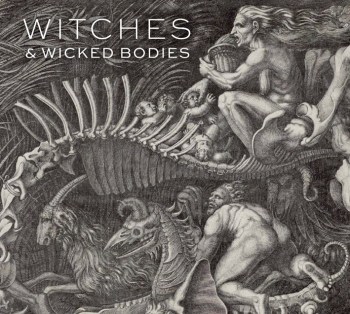 Witches & Wicked Bodies provides an innovative, rich survey of images of European witchcraft from the sixteenth century to the present day. It focuses on the representation of female witches and the enduring stereotypes they embody, ranging from hideous old crones to beautiful young seductresses. Such imagery has ancient precedents and has been repeatedly re-invented by artists over the centuries, to include scenes with corpses and cauldrons, caverns and kitchens, and the dead being raised through demonic or satanic rites – all inversions of an ordered and religious social world.
Petherbridge introduces this fascinating subject and includes catalogue entries on each of the exhibited works. The illustrations primarily feature drawings and prints as well as a group of important paintings. A wide range of artists is represented including Dürer, Goya, Fuseli, Blake, Burra and Rego.
Deanna Petherbridge CBE is an artist, curator and writer. Her book The Primacy of Drawing: Histories and Theories of Practice (Yale University Pres)s, was published June 2010. She was Visiting Professor of Drawing at the University of the Arts London from 2009 to 2012 and was Professor of Drawing at the Royal College of Art from 1995 to 2001 where she launched the Centre for Drawing Research. Between 2002 and 2006 Petherbridge held a post as Arnolfini Professor of Drawing at the University of the West of England, Bristol and a two year Research Professorship at the University of Lincoln from 2007 to 2009.
Exhibition | Northern Vision: Master Drawings
From the Soane’s Museum:
Northern Vision: Master Drawings from the Tchoban Foundation
Sir John Soane’s Museum, London, 21 June – 28 September 2013
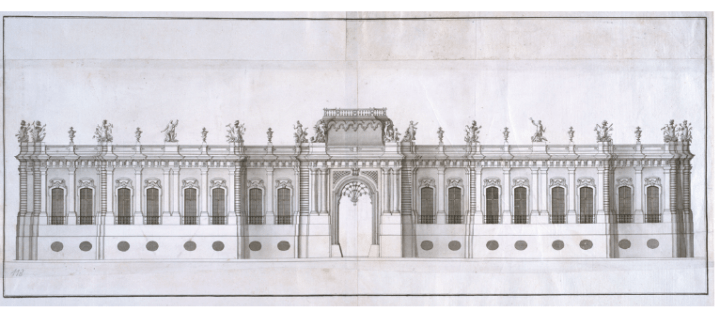
Matthäus Daniel Pöppelmann (1662–1736), Project for the Orangerie
of the Peterswalsky von Peterswald Palace, Silesia, undated
(Berlin: Tchoban Foundation)
◊ ◊ ◊ ◊ ◊
From Schinkel’s earliest attributed drawing to designs for the Palace of the Soviets, Moscow, this exhibition draws on the highlights of the Tchoban Foundation collection, Museum für Architekturziechnunung, Berlin. Amongst the architects represented will be seldom seen works by Matthias Daniel Pöppelmann (1662–1736), Leo von Klenze (1784–1864), Herman Giesler (1898–1987) and Boris Iofan (1891–1976). The Tchoban Foundation has been set up by the Russian Berlin-based architect Sergei Tchoban and the collections reflect his personal, architectural interests.
The exhibition includes drawings by Sergei Tchoban illustrating his practice’s interest in the continued use of architectural draughtsmanship. Many of these drawings also reflect the distinctive and historical cityscapes of Berlin and Sergei Tchoban’s native St Petersburg.
The 41-page guide (with wall text and images) is available as a PDF file here»
The catalogue is available from the museum shop»
Eighteenth-Century Studies 46 (Summer 2013)
Eighteenth-Century Studies 46 (Summer 2013)
A R T I C L E S
 Patrick C. Fleming, “The Rise of the Moral Tale: Children’s Literature, the Novel, and The Governess,” pp. 463–77.
Sarah Fielding’s The Governess has been called the first children’s novel. But by conflating two separate genres, critics risk oversimplifying both the novel and children’s literature. This article brings together children’s literature studies and novel studies in order to address the narrative form of The Governess, and to suggest that the term “moral tale” better captures the complex origins of the eighteenth-century children’s novel.
Mark Koch, ” ‘A Spectacle Pleasing to God and Man’: Sympathy and the Show of Charity in the Restoration Spittle Sermons,” pp. 479–97.
In the 1670s the long-standing Spittle sermons became almost exclusively charity sermons, many of which argued that almsdeeds are accompanied with a sensual pleasure and articulated principles of sympathetic response involving an affective theatricality. This paper considers the place of these sermons and their ancillary children’s processions in the London public sphere, how they worked as spectacle to evoke pity from spectators, and how, despite the Latitudinarian tendency toward rationalism, they often contained elements of what was deemed an empirically nebulous “show” or “fiction.”
Catherine Packham, “Cicero’s Ears, or Eloquence in the Age of Politeness: Oratory, Moderation, and the Sublime in Enlightenment Scotland,” pp. 499–512.
This paper argues that Hume’s essay, “Of Eloquence,” should be read as part of a Scottish Enlightenment attempt to accommodate the sublime to commercial modernity. Hume inherits the sublime of ancient oratory not as a matter for narrow stylistic regulation—to be rejected in a new age of politeness, as some have argued—but as a moral problem at the heart of modern subjectivity. Hume looks to taste to regulate and contain the sublime, but it is Adam Smith who solves the problem of the sublime by recouping its excess as a mark of the possibilities for virtue in the modern age.
Lisa T. Sarasohn, ” ‘That Nauseous Venomous Insect’: Bedbugs in Early Modern England,” pp. 513–30.
Bedbugs were perceived as a new entry in the rich range of vermin that plagued eighteenth-century England, and the way they were viewed and treated reveals much about the mentality, prejudices, assumptions and aspirations of society at that time. Their presence increasingly elicited repugnance and even hysteria. The reaction to bedbugs during the eighteenth century serves as an indicator of modernity and emerging attitudes towards the body, class, nature and science.
Ryan Whyte, “Exhibiting Enlightenment: Chardin as tapissier,” pp. 531–54.
This essay addresses the work of Jean-Baptiste Chardin as tapissier to show his design of the Salon du Louvre functioned as an ideological system that derived meaning from Enlightenment discourses of epistemology and taxonomy. First, this essay explores how the Salon design answered the Académie’s need to represent its structure to the Salon public, and to guide the public in judging the individual works comprising it. Second, this essay examines points of contact between Chardin, the Académie, Carl Linnaeus and the authors of the Encyclopédie of Diderot and Jean le Rond d’Alembert as intellectual context for the Salon design.
Abigail Zitin, “Thinking Like an Artist: Hogarth, Diderot, and the Aesthetics of Technique,” pp. 555–70.
In The Analysis of Beauty, William Hogarth advocated an unusual kind of formalism based in artistic practice: not form distilled into a rule for judgment but rather derived from the artist’s techniques for perception and composition. Denis Diderot, too, embraced an aesthetics of technique, particularly in the Paradoxe sur le comédien, in which he contends that what appears impassioned in an affecting dramatic performance is in fact calculated. Diderot, however, had the extra burden of reconciling the ideal of illusion with his demystification of the practitioner’s perspective, a reconciliation he could only conceive as a paradox.
R E V I E W S
Mark K. Fulk “Travel And/As Enigma: Review of Ian Warrell, ed., Turner Inspired in the Light of Claude (National Gallery Company, 2012) and Yaël Schlick, Feminism and the Politics of Travel After the Enlightenment (Bucknell University Press, 2012),” pp. 571–73.
Recent work on travel by scholars Nicola Watson (The Literary Tourist: Readers and Places in Romantic and Victorian Britain [2008]), Zoë Kinsley (Women Writing the Home Tour, 1682–1812 [2008]), and Ann C. Colley (Victorians in the Mountains [2010]) has added markedly to our understanding of British travel in the latter eighteenth and the nineteenth centuries through its foregrounding of issues of class, gender, and the changing understanding of landscape aesthetics and theories of the sublime. The books in this review supplement this discussion by their emphasis on Anglo-French experiences of travel in the period. . .
Jennifer Milam, “Review of Michael Yonan, Empress Maria Theresa and the Politics of Habsburg Imperial Art (The Pennsylvania State University Press, 2011),” pp. 575–77.
. . . Thanks to Yonan’s interpretive approach, Empress Maria Theresa and the Politics of Habsburg Imperial Art is a ground-breaking study in the history of Austrian art and architecture. His book is a substantial contribution to the study of women as powerful agents in the production and reception of visual culture in European court circles during the eighteenth century. Moreover, Yonan’s wide-ranging choice of material—portraiture, decorative objects, architecture, interior decoration, and garden sculpture—provides the reader with a comprehensive understanding of Maria Theresa’s individualized approach to the representation of her personal authority in the visual arts. This is complemented by a number of quality illustrations that allow readers to consider the details of many works that are rarely discussed in depth. . .
Mark K. Fulk, “Review of Adrian J. Wallbank, Dialogue, Didacticism and the Genres of Dispute: Literary Dialogue in an Age of Revolution (Pickering and Chatto, 2012),” pp. 578–79.
In his postscript, Adrian J. Wallbank explains that his project was meant to “open up multiple avenues for further research . . . into this seriously neglected literary genre” of the written dialogue, gesturing toward the beginnings of a history of “dialogic didacticism” in the Romantic era (217). The book meets these expectations well by revealing in elaborate detail this overlooked genre, and suggesting ways that Wallbank’s readings can help complement our approach to already canonical markers of the period. . .
Exhibition Catalogue | Paper Palaces: The Topham Collection
◊ ◊ ◊ ◊ ◊
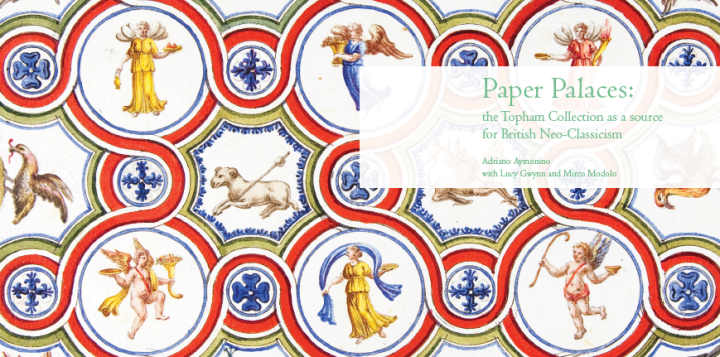
Adriano Aymonino with Lucy Gwynn and Mirco Modolo, Paper Palaces: The Topham Collection as a Source for British Neo-Classicism (Windsor: Eton College, 2013).
Exhibition on view from May until November 1, 2013 at The Verey Gallery, Eton College Library.
I’m delighted to announce that the 56-page catalogue for Paper Palaces is available free of charge for download as a PDF file here. Warm thanks to the exhibition organizers for their generous cooperation. -CH
Call for Articles | Service and Servants, 1500–1750
Call for Papers from The Journal of Early Modern Studies (JEMS) . . .
JEMS 4 (2015) | Service and Servants in Early Modern Culture, 1500–1750
Proposals due by 1 October 2013, Final Drafts due by 31 January 2014
The Journal of Early Modern Studies (JEMS) is an open access peer-reviewed international journal that promotes interdisciplinary research and discussion on issues concerning all aspects of early modern European culture.
We are now inviting contributions for volume 4, to be released online in March 2015. Jointly edited by William C. Carroll (Boston University) and Jeanne Clegg (Università Ca’ Foscari, Venice), JEMS 4, entitled Service and Servants in Early Modern Culture, 1500-1750, aims to bring together scholars from across a wide disciplinary spectrum to inquire into differences and similarities, continuities and changes in the ethics, representation and practice of service and servitude in different countries and contexts. The issue will be open to contributions on oral and visual forms of cultural expression as well as textual, and we invite studies of emerging voices and works intended for and by, as well as about, servants and service. Contributions addressing issues of class, gender, and ethnic/national representations are particularly encouraged.
Main deadlines
• 1 October 2013: adhere to project and send working title and short abstract to William Carroll (wcarroll@bu.edu) and Jeanne Clegg (jfclegg@unive.it).
• 31 January 2014: finalize paper for submission to referees. Articles must comply with the editorial norms and must not exceed 12,000 words, including endnotes and bibliography.
All articles are published in English. Please be so kind as to have your paper revised by a native speaker.










 Enfilade
leave a comment