Exhibition | Threads of Feeling in Williamsburg
This exhibition, organized by The Foundling Museum, was on view in London from October 2010 to March 2011. Through next May, it can be seen in Williamsburg (perfect timing for next year’s ASECS meeting). From the press release (17 May 2013) . . .
Threads of Feeling: The London Foundling Hospital’s Textile Tokens, 1740–1770
DeWitt Wallace Decorative Arts Museum, Colonial Williamsburg, 25 May 2013 — 26 May 2014
Curated by John Styles
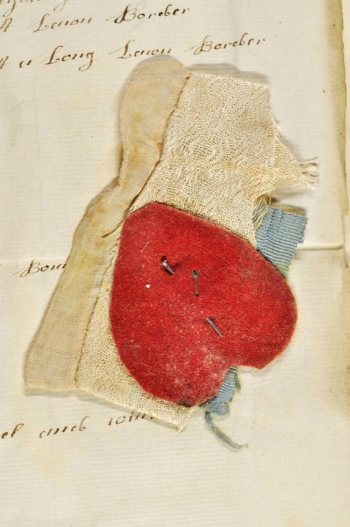 Each piece of fabric or token tells a poignant, emotional story from more than 200 years ago. Many of those stories are on view at the Art Museums of Colonial Williamsburg in a traveling exhibition organized by the Foundling Museum of London. Threads of Feeling consists of 59 books of textile tokens on loan from the Thomas Coram Foundation, a British children’s charity.
“These stories pack powerful, emotional punches, sure to resonate with parents,” said Ronald Hurst, Colonial Williamsburg’s chief curator and vice president for collections, conservation and museums. “We are pleased to have the only mounting of the exhibition in the United States since it closed in London two years ago.”
In the cases of more than 4,000 babies left at London’s Foundling Hospital between 1741 and 1760, a small object or token, usually a piece of fabric, was kept as an identifying record. The fabric was either provided by the mother or cut from the child’s clothing by the Foundling Hospital’s nurses. Attached to registration forms and bound up into ledgers, these pieces of fabric form the largest collection of everyday textiles surviving in Britain from the 18th century. A selection of the textiles and the stories they tell us about individual babies, their mothers and their lives form the focus of the Threads of Feeling exhibition. The exhibition also examines artist William Hogarth’s depictions of the clothes, ribbons, embroidery, and fabrics worn in the 18th century as represented by the textile tokens.
“The process of giving over a baby to the Foundling Hospital was anonymous,” said exhibition curator John Styles, research professor in history at the University of Hertfordshire. “It was a form of adoption. The Foundling Hospital became the infant’s parent and its previous identity was erased.”
The mother’s name was not recorded, but many left personal notes or letters exhorting the hospital to care for their child. Occasionally children were reclaimed, and the pieces of fabric in the ledgers were kept with the expectation that they could be used to identify the child if it was returned to its mother. The textiles are beautiful and poignant, embedded in a rich social history. Each swatch reflects the life of a single infant child. The textiles also indicate the types of clothing their mothers wore. Many clothes for babies were usually made up from worn-out adult clothing and the fabrics reveal how working women struggled to be fashionable in the 18th century.
Museum guests also are invited to participate in several programs related to the exhibition:
• Textiles and accessories can be much more than just material objects. Guests create their own memory token during Tokens of Affection. Like those in the Threads of Feeling exhibition, their creations tell their own unique stories. Presented 11 am – noon, Tuesdays and Fridays, June 18 – August 30.
• Open Drawers: Treasured Textiles from Colonial Williamsburg. Guests drop in to get a closer look at the new exhibition, Threads of Feeling and then peer into the textile study drawers and examine related clothing and needlework from Colonial Williamsburg’s collections. Presented 2–3 pm, Mondays, June 3 – August 26.
• Lives Lost and Found. Guests go behind the scenes of Threads of Feeling on a guided tour, examine the textiles on view and discuss the historical and emotional stories behind these textile tokens from the Foundling Hospital in London and the Colonial Williamsburg collection. Space is limited and a $10 ticket is required in addition to museum admission. Presented 9 – 10:30 am, Tuesdays and Fridays, June 18 – August 30.
The conference symposium, Threads of Feeling Unraveled, takes place 20–22 October 2013.
Symposium | Threads of Feeling Unraveled
From the conference program:

Threads of Feeling Unraveled
DeWitt Wallace Decorative Arts Museum, Colonial Williamsburg, 20–22 October 2013
In association with the loan exhibition Threads of Feeling, which opens at the DeWitt Wallace Decorative Arts Museum on May 25, 2013, Colonial Williamsburg is hosting a symposium that will explore these objects in context. When a mother left her infant at the Hospital during the mid-eighteenth century, she sometimes provided a token that was attached to the paper record, allowing her to later identify and reclaim her own child if her circumstances improved. Most of the tokens took the form of scraps of fabric, ribbons, or cuttings from the baby’s own clothing, identified in the record by their period names. The textile swatches are an invaluable source for identifying everyday textiles and the clothing of infants. As part of the symposium, exhibit guest curator and noted author John Styles will present two lectures. His keynote lecture will give a ‘behind-the-scenes’ look at the development of the Threads of Feeling exhibition that received rave reviews in London. Styles will also discuss the history of the Foundling Hospital, the London scene, what is known about the identity of the infants, and the various meanings that can be unraveled from the evocative tokens. Other lectures will discuss clothing for infants and children, what women wore during pregnancy, childhood and orphans in America, and the use of similar textiles by adults in Britain and America. (more…)
Exhibition | Charakterköpfe: Portrait Busts in the Enlightenment
From the museum’s 2013-14 exhibition schedule:
Charakterköpfe: Die Bildnisbüste in der Epoche der Aufklärung
Germanisches Nationalmuseum, Nuremberg, 6 June — 6 October 2013
Curated by Frank Matthias Kammel and Anna Pawlik
 The portrait bust is one of the most fascinating genres of sculpture. It was particularly adaptable to the varieties of concurrent artistic styles prevalent at the end of the 18th century. Portraits of rulers, burghers, artists and intellectuals were oriented towards idealized images, towards the antique, or presented the subject in unidealized, haunting realism. Often they show consideration of the interconnectedness between physiognomy and personality. Through the presentation of sculptural masterpieces, this exhibition illuminates a major facet of a politically and spiritually fascinating era, and not least will convey a lively image of the Enlightenment’s novel interest in the individual.
◊ ◊ ◊ ◊ ◊
From the Germanisches Nationalmuseumm:
Die Porträtbüste ist eine der faszinierendsten Gattungen der Bildhauerkunst. Ende des 18. Jahrhunderts war sie von der Gleichzeitigkeit gegensätzlicher Stile bestimmt wie in kaum einer anderen Epoche zuvor. Bildnisse von Regenten, Bürgern, Künstlern und Gelehrten orientieren sich an Idealbildern, an der Antike oder stellen den Porträtierten ungeschönt, in einem packendem Realismus dar. Nicht selten spiegeln sie Überlegungen zur Abhängigkeit von Gesichtzügen und Charakter wider. Die Ausstellung präsentiert dieses breite Spektrum anhand plastischer Meisterwerke zahlreicher bedeutender Künstler wie Johann Heinrich Dannecker, Franz Xaver Messerschmidt, Johann Valentin Sonnenschein oder Johann Gottfried Schadow. Namhafte Geistesgrößen der Zeit, wie Goethe, Herder, Pestalozzi oder Winckelmann, erscheinen in Glanzleistungen früher realistischer und klassizistischer Strömungen der Bildhauerei. Flankiert von zeitgenössischer Graphik und Malerei vermittelt die Ausstellung eine lebhafte Vorstellung von einem damals neuartigen Interesse am Bild des Menschen.
Frank Matthias Kammel, Charakterköpfe: Die Bildnisbüste in der Epoche der Aufklärung (Nürnberg: Germanisches Nationalmuseum, 2013), 244 pages, ISBN: 978-3936688757, €33.
Conference | Charakterköpfe: Portrait Busts in the Enlightenment
From the conference program:
Bildnisbuesten der Aufklaerung
Germanisches Nationalmuseum, Nuremberg, 11—13 September 2013
Registration due by 30 August 2013
 Begleitend zur Sonderausstellung „Charakterköpfe. Die Bildnisbüste in der Epoche der Aufklärung“ (6.6.–6.10.2013) behandelt eine internationale Fachtagung das plastische Porträt am Ende des 18. Jahrhunderts, ein Zeitalter großer geistiger und politischer Spannungen und Umbrüche. Vorgestellt und diskutiert werden unter anderem Fragen zur Funktion von Porträtbüsten im privaten und öffentlichen Raum, die seit der zweiten Hälfte des 18. Jahrhunderts leidenschaftlich geführte
Debatte zur Physiognomik und Charakteristik sowie die florierende Wachsplastik. Einzelstudien beleuchten die Gleichzeitigkeit gegensätzlicher Stile, die sich in den Bildnissen von Regenten, Bürgern, Künstlern und Gelehrten zwischen Ideal und Individualität bewegen wie in kaum einer anderen Epoche. Bislang war das plastische Porträt als repräsentatives Medium ausschließlich dem fürstlichen Stand vorbehalten, in den Jahren nach 1780 gelangt es auch in bürgerlichen Kreisen zu großer Popularität. Die Tagung richtet den Blick außerdem auf die neuen Materialien und Techniken, die diese Verbreitung bis hin zur Anlage umfangreicher Bildnisgalerien förderten.
Bitte melden Sie sich verbindlich bis 30. August an. Es werden keine Tagungsgebühren erhoben. Information und Anmeldung: Dr. Frank Matthias Kammel, charakterkoepfe@gnm.de.
◊ ◊ ◊ ◊ ◊
1 1 S E P T E M B E R 2 0 1 3
14:00 G. Ulrich Großmann (Generaldirektor des Germanischen Nationalmuseums): Begrüßung
14:15 Frank Matthias Kammel (Nürnberg): Blickwechsel. Warum man sich mit Bildnisbüsten beschäftigen sollte
14:45 Ulrich Söding (München): Die Heiligenbüste im 18. Jahrhundert. Funktionale und typengeschichtliche Aspekte
15:30 Andrea M. Kluxen (Nürnberg): Gibt es eine aufgeklärte Herrscherbüste? Absolutistische Inszenierung und aufgeklärter Legitimationswechsel
Kaffeepause
16:45 Karin Tebbe (Heidelberg): Das Haupt des Kurfürsten und andere Köpfe aus der Kurpfalz
17:30 Claudia Maué (Nürnberg): Die Porträtbüsten des Kurfürsten Maximilian III. Joseph von Roman Anton Boos
Pause
19:00 Roland Kanz (Bonn): Öffentlicher Abendvortrag:Physiognomik versus Charakteristik. Rollenmodellierungen in Porträtbüsten um 1800
1 2 S E P T E M B E R 2 0 1 3
9:00 Axel Christoph Gampp (Zürich): Ein Wiener Charakterkopf: Franz Christoph von Scheyb (1704–1777)
9:45 Mariana Scheu (Salzburg): Die Hervorhebung des Individuums – Johann Baptist Hagenauers Porträtbüsten in St. Peter in Salzburg
Kaffeepause
11:00 Peter Husty (Salzburg): Porträt des Porträtisten. Ein Blick ins Antlitz des Künstlers und Kunstmäzens Franz Laktanz Graf Firmian (1709–1786)
11:45 Anna Seidel (Hamburg): Bildnisbüsten von Bartolomeo Cavaceppi. Herzog Carl I. von Braunschweig-Lüneburg und König Friedrich II . von Preußen
Mittagspause
14:00 Beatrize Söding (München): Grabmal und plastisches Porträt. Die Denkmäler des 18. Jahrhunderts in der Wiener Schottenkirche
14:45 Ingeborg Schemper (Wien): Gelehrte Köpfe in Wien. Zu den Anfängen ehrenhalber aufgestellter Bildnisbüsten im 18. Jahrhundert und ihrem Kontext
Kaffeepause
16:00 Frank Matthias Kammel (Nürnberg): Der Garten als Denkmalort. Bildnisbüsten in Parks
16:45 Bernd Ernsting (Köln): Wie den Jungen der Tod gebildet. Karl Friedrich Wichmanns Zimmerdenkmal für Henriette Jordan im Kontext privater Memorialkultur um 1800
17:30 Yasmin Doosry (Nürnberg): Papierne Büsten. Die Bildnisbüste im Spiegel von Zeichnung und Druckgraphik
1 3 S E P T E M B E R 2 0 1 3
9:00 Anna Pawlik (Nürnberg): Christian Benjamin Rauschner. Zur Materialvielfalt von bossierten Wachsbildnissen im späten 18. Jahrhundert
9:45 Elisabeth Taube (Nürnberg): Alles nur Wachs? Eine kunsttechnische Studie zu den Wachsbildnissen des 18. Jahrhunderts im Germanischen Nationalmuseum
Kaffeepause
11:00 Doris Lehmann (Bonn): Die Guillotine als Porträtmaschine? Madame Tussauds Wachsköpfe und ihre Vermarktung
11:45 Petra Rau (Frankfurt am Main): Über den Handel mit prominenten Köpfen. Die Kunstmanufakturen in Leipzig, Weimar und Gotha/Altenburg
Mittagspause
13:15 Stefan Schnöll (Wien): Porträtbüsten der Kaiserlichen Porzellanmanufaktur Wien
14:00 Jürgen Klebs (Berlin): Die plastischen Bildnisse Goethes aus seiner Lebenszeit
14:45 Hans Ottomeyer (Berlin): Genies und Heroen. Europäische Galerien und andere Geschichtsforen
15:30 Schlusswort
New Title | Edward Pugh of Ruthin, 1763–1813: ‘A Native Artist’
Distributed for the University of Wales by the University of Chicago Press:
John Barrell, Edward Pugh of Ruthin, 1763–1813: ‘A Native Artist’ (Cardiff: University of Wales Press, 2013), 245 pages, ISBN: 978-0708325667, £65 / $100.
 Born in Ruthin, Denbighshire, Edward Pugh (1763–1813) was a Welsh-speaking artist and writer who worked as a miniaturist in London, exhibiting frequently at the Royal Academy. But Pugh’s passion was the landscape, and he painted remarkable views of North Wales that not only captivate but also reveal the development of the Welsh economy and Welsh national consciousness. Pugh also wrote and illustrated a fascinating, informative, and humorous account of a tour of North Wales around 1800–one of the only travel books written at that time by someone who could actually converse with the inhabitants.
Edward Pugh of Ruthin 1763–1813 is the first book to consider the work of this nearly forgotten Welsh artist and writer in detail, linking the history of art in Wales with the social history of the country. John Barrell shows how Pugh’s pictures and writings portray rural life and social change in Wales during his lifetime, from the effects of the war with France on industry and poverty, to the need to develop and modernize the Welsh economy, to the power of the landowners. Almost all of the pictures and accounts we have today of late eighteenth and early nineteenth century North Wales were made by English artists and writers, and none of these, as Barrell demonstrates, can tell us about life in North Wales with the same depth and authenticity as does Pugh.
John Barrell is professor in the Centre for Eighteenth Century Studies, University of York. He is the author of numerous books, including The Spirit of Despotism: Invasions of Privacy in the 1790s.
Call for Papers | James Logan and the Networks of the Atlantic
James Logan and the Networks of Atlantic Culture and Politics, 1699–1751
Philadelphia, 18–20 September 2014
Proposals due by 30 September 2013

The home of James Logan, Stenton was built between 1723 and 1730 in the (then) countryside near Philadelphia.
The McNeil Center for Early American Studies, The Library Company of Philadelphia, The Historical Society of Pennsylvania, and Stenton Museum invite proposals for an international interdisciplinary conference in Philadelphia reconsidering early Pennsylvania culture in an Atlantic World context. James Logan (1674–1751), Provincial Secretary to the Penn family, and his vast political, trade and knowledge networks provide a lens for examination of the Atlantic World in the first half of the eighteenth century. This conference is an effort to consider Logan’s milieu in the widest possible way. James Logan studied the sexuality of plants, mentored Benjamin Franklin and John Bartram, served as Mayor of Philadelphia and Chief Justice of Pennsylvania, shaped his province’s relationships with Native Americans, traded furs, owned slaves, was a gentleman-merchant, book collector, and scholar. His nearly 3,000-volume library remains intact at the Library Company of Philadelphia. The Historical Society of Pennsylvania archives include numerous papers collections related to his activities, and The National Society of The Colonial Dames in America in the Commonwealth of Pennsylvania preserves his house, Stenton.
Committed participants include Anthony Grafton of Princeton University, Bernard Herman of the University of North Carolina, Chapel Hill, and Gary B. Nash of the University of California, Los Angeles. Among possible themes for paper proposals are intellectual history, knowledge networks, natural and moral philosophy; books, poetry and literature, collecting, and botany; religion, in particular Quakerism; material culture, archeology, architecture, houses, foodways, landscapes, land acquisition and urban development; economics, industry, commerce; gender, servitude, enslavement and social structure; and politics, imperialism, and European-Native American interactions.
This conference aims to engage an interdisciplinary dialog. Proposals are encouraged from literary scholars, historians, archeologists, material culture studies, and other disciplines. The organizers will consider both individual papers and panel submissions. Papers for many of the panels will be pre-circulated. PowerPoint presentations, especially those relating to visual and material culture, may also be pre-circulated. Non-traditional panels and presentations (such as tours, workshops, brief papers or demonstrations) will be considered.
Please submit 250-word proposals and a one-page c.v. via e-mail no later than 30 September 2013; proposals should be headed with the title of the paper and the presenter’s name, affiliation, and contact information. Submissions and queries may be directed to mceas@ccat.sas.upenn.edu.
New Title | Ireland and the Picturesque
Due in August from Yale UP:
Finola O’Kane, Ireland and the Picturesque: Design, Landscape Painting, and Tourism, 1700–1840 (London: Paul Mellon Centre for Studies in British Art, 2013), 240 pages, ISBN: 978-0300185386, $85.
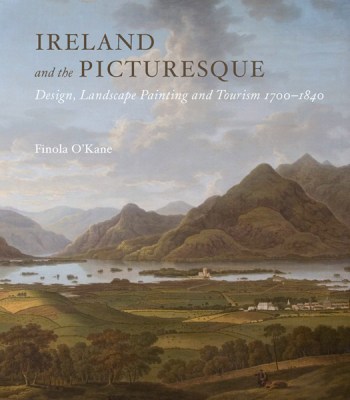 That Ireland is picturesque is a well-worn cliché, but little is understood of how this perception was created, painted, and manipulated during the long 18th century. This book positions Ireland at the core of the picturesque’s development and argues for a far greater degree of Irish influence on the course of European landscape theory and design. Positioned off-axis from the greater force-field, and off-shore from mainland Europe and America, where better to cultivate the oblique perspective? This book charts the creation of picturesque Ireland, while exploring in detail the role and reach of landscape painting in the planning, publishing, landscaping and design of Ireland’s historic landscapes, towns, and tourist routes. Thus it is also a history of the physical shaping of Ireland as a tourist destination, one of the earliest, most calculated, and most successful in the world.
Finola O’Kane is lecturer in the School of Architecture, Landscape and Civil Engineering, University College Dublin.
Exhibition | Prized and Played: The Jon Crumiller Chess Collection
From the World Chess Hall of Fame:
Prized and Played: Highlights from the Jon Crumiller Collection
World Chess Hall of Fame, St Louis, 3 May 2013 — 15 September 2013
Prized and Played showcases over 80 beautiful, antique chess sets from across the centuries and around the world, as well as many interesting artifacts related to the history of chess.

East India ‘John’ Company Chess Set, ca. 1800–1850,
Berhampore, India, ivory. King is 5 1/2 inches high.
(Jon Crumiller Collection). Photo © Bruce M. White, 2013
◊ ◊ ◊ ◊ ◊
Prized
Intended to be shown as objets d’art rather than used in play, ornamental chess sets are testaments to the artistic skill of their creators, as well as the refinement of the wealthy patrons who commissioned them. Freed from the confines of practicality, artists created chess sets of great beauty and originality. Master carvers flaunted their expertise in manipulating luxury materials such as ivory, gold, silver, pearls and precious stones in these ornamental chess sets. Many feature elaborate gilded decoration, delicate carving, and tall forms that made them less than ideal for playing, but perfect as demonstrations of wealth, or as a generous gift for a friend.

Dieppe Europeans vs. Africans Ivory Chess Set, ca. 1800, Dieppe, France, Ivory. King is 3 1/4 inches (Jon Crumiller Collection)
Photo © Bruce M. White, 2013
Ornamental sets were also symbols of the erudition and sophistication of their owners. Several of the ornamental sets in this show have themes drawn from history, mythology, or religion. The Good Versus Evil set contains bishops holding copies of Dante Alighieri’s The Inferno, while another set pits Venus and Bacchus, two figures from Roman mythology, against each other. Other artists turned to contemporary military conflicts for inspiration. The army of the British East India Company combats Indian military forces in John Company sets, while other sets celebrated the exploits of Emperor Napoleon. Ornamental sets could also show that a person was well-traveled. A set from Dieppe, France, where master carvers produced lovely ivory products could indicate the owners had traveled to the popular resort town. Swiss Charlemagne sets, produced in Brieze, Switzerland, were also marketed to tourists in catalogues. These sets were so prized by their owners that, despite their delicate nature and rich materials, they have survived centuries later as examples of the excellent craftsmanship of their makers. They continue to be valued, not only for their aesthetic qualities, but also for the fascinating stories they tell.
Played

François-André Danican Philidor, L’Analyze des échecs (London: 1749)
Photo © Bruce M. White, 2013
In Prized and Played, superb examples of antique playing sets from across Europe and Asia illuminate the fascinating history of stylistic evolution of chess pieces. Though some of the sets in this half of the exhibition feature elaborate decoration, they were all intended for use in play. Their widely varied appearances testify to the imagination and stylistic preferences of the artisans who created them, as well as the artistic tastes of the players who used them over the centuries. They were made of durable materials like wood, ivory, bone, and metal so that players could regularly use them for play over many years. While the style of the simple, brightly colored, and dome-topped Islamic sets in the show stands in contrast to that of the European sets, diverse styles of playing sets were often manufactured within the same country. Some examples include the Directoire, Régence, and Lyon style sets produced in France, or the Barleycorn and Northern Upright style sets manufactured in England.
The nineteenth century brought the rise of modern organized chess tournaments and clubs, which highlighted the need for standardized chess pieces. The regional styles that had proliferated in previous centuries led to confusion and contention when the great players of numerous nations gathered to compete. Prominent chess manufacturers in early-to-mid-nineteenth century England began to stabilize the designs of playing sets into recognizable precursors of the sets we use today. John Calvert set up shop in 1791 at 189 Fleet Street, London, and mass-produced several designs that grew in popularity. These designs, as well as fancier playing sets imported and sold by James Leuchars and other retailers in the initial years of the nineteenth century, influenced subsequent well-known London chess manufacturers such as George Merrifield, Thomas Lund and his son William, and Charles Hastilow.
Finally, the iconic Staunton chess set, designed by architect Nathaniel Cooke and endorsed by the famous English player Howard Staunton, emerged during this period. The sets were first manufactured and sold in 1849 by John Jaques and Son, Ltd, of London, and later became the standard for tournament play. (more…)
Exhibition | Paintings by Hubert Robert from the Musée de Valence
Now on view at the Petit Palais:
Tableaux d’Hubert Robert du Musée de Valence
Le Petit Palais, Paris, May — October 2013
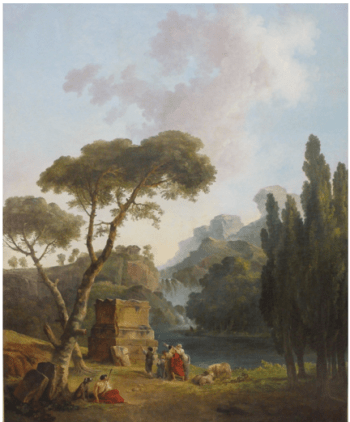
Hubert Robert, Paysage de cascade avec les bergers d’Arcadie
© Musée de Valence, photo Eric Caillet
En avant-première de la réouverture en décembre prochain du musée de Valence (Drôme), quatre des plus beaux tableaux d’Hubert Robert (1733–1808) sont présentés au Petit Palais, aux côtés des dix tableaux de l’artiste des collections permanentes.
Peintre par excellence des ruines de la Rome antique, Hubert Robert séjourna onze ans dans la ville des papes, à partir de 1754. Il en cultiva le souvenir jusqu’à la fin de sa carrière bien qu’il ait été également un chroniqueur inlassable du Paris du XVIIIe siècle. Hubert Robert a enchanté ses contemporains par sa verve, sa poésie et son inventivité – qualités qui ne pouvaient qu’enthousiasmer un critique comme Diderot. Le succès de ses paysages lui valut même la commande de plusieurs jardins qu’il peupla de « fabriques » et de grottes à la manière des tableaux qui avaient fait sa célébrité.
Connu pour sa collection incomparable de dessins d’Hubert Robert offerte par l’amateur Julien-Victor Veyrenc en 1836, le musée de Valence s’est attaché depuis plus d’une vingtaine d’années à étoffer ce fonds par l’acquisition de toiles significatives de l’artiste. L’ensemble formera un des centres de gravité du musée de Valence dont la rénovation, confiée à l’atelier d’architecture Jean-Paul Philippon, est en voie d’achèvement. Le prêt exceptionnel de quelques-uns de ses fleurons à Paris est l’occasion de les faire dialoguer avec les toiles conservées au Petit Palais. Ainsi la vue de la basilique Saint-Pierre du musée de Valence, cadrée de façon audacieuse à travers une baie, rejoint la toile vivement esquissée du Petit Palais montrant un Sculpteur sur un échafaudage dans la nef de Saint-Pierre. Le vaste Paysage de cascade avec les Bergers d’Arcadie, de Valence, est présenté dans la rotonde avec deux grandes toiles tirées des réserves du Petit Palais provenant du décor de l’hôtel Beaumarchais exécutés l’année suivante. A cette occasion, l’ensemble des salles du XVIIIe siècle du musée ont d’ailleurs été réaccrochées et des oeuvres d’autres artistes remises en valeur.
En attendant de parcourir les nouveaux espaces de l’ancien évêché de Valence, ce prêt de quelques mois est aussi une invitation à redécouvrir les galeries du XVIIIe siècle du Petit Palais – musée des Beaux-Arts de la Ville de Paris qui, rappelons-le, sont ouvertes gratuitement au public.
Le Petit Palais est heureux de soutenir la rénovation et l’extension du Musée de Valence. Pour plus d’information, téléchargez le communiqué de presse.
Call for Papers | The Early Modern Villa: The Senses vs. Materiality
From the Call for papers:
The Early Modern Villa: The Senses and Perceptions versus Materiality, 1450–1800
Wilanów Palace, Warsaw, 15–17 October 2014
Proposals due by 30 October 2013
Convenors: Barbara Arciszewska (Warsaw University) and Paweł Jaskanis (Wilanów Palace Museum)
Enhanced interest in sensual perception was one of the mainstays of early modern culture. The development of new visual conventions (most notably the linear perspective) and ‘ocularcentric’ character of early modern science has long focused scholarly attention on the contemporary obsession with sight and with optical illusion. Yet sight, although privileged as a nucleus of artistic theory and analytical instrument in natural philosophy, was but one of the senses which were to be attracted, and then gratified by the display of early modern art and architecture. The complex discourse of sensual perception and gratification embraced all senses, although their role depended on the comparative value assigned to the senses themselves, on their abilities to provoke desire, provide delight, and grant access to knowledge. The diversity of sensual stimuli was perhaps most evident in the villa estate – its architecture and landscape design. The role of the senses and sensual perception in the planning, design, as well as functioning and reception of the villa (c. 1450-1800), will be the focus of this conference, set against the essential materiality of architecture and nature, understood as the framework of reference for the sensual experience rooted in pre-modern concepts of the corporeal sensorium. (more…)










 Enfilade
leave a comment