Exhibition | Illuminated Palaces: Extra-Illustrated Books
Press release (15 May 2013) for the exhibition now on at The Huntington:
Illuminated Palaces: Extra-Illustrated Books from The Huntington Library
The Huntington Library, San Marino, 27 July — 28 October 2013
Curated by Stephen Tabor and Lori Anne Ferrell

Image from Mémoires du comte de Grammont (London, 1794)
with extra illustrations added by Richard Bull
◊ ◊ ◊ ◊ ◊
The eccentric art of customizing printed books by adding illustrations is the focus of a new exhibition now on view at The Huntington Library, Art Collections, and Botanical Gardens. Illuminated Palaces: Extra-Illustrated Books from The Huntington Library features more than 40 works dating from the late 1700s to the early 1900s, when the practice was most popular.
Extra-illustration is often referred to as ‘Grangerizing’, after a British clergyman named James Granger, but he did not invent the practice. In fact, extra-illustration has probably been practiced since the beginning of the printed book, says Stephen Tabor, the Huntington’s curator of early printed books and co-curator of the exhibition with Lori Anne Ferrell, English and history professor at Claremont Graduate University. But the practice did not soar in popularity until Granger published his Biographical History of England, from Egbert the Great to the Revolution in 1769. Granger’s book was essentially a catalog of portrait prints of famous English people, arranged by class—from otherwise ordinary commoners “remarkable from only one circumstance in their lives” to scientists, politicians, noblemen, kings, and queens. By creating an organized list of desiderata, Granger unwittingly motivated some collectors to illustrate copies of his own book with the portraits, setting off what one later critic called “a general rummage after, and plunder of, old prints.”
“Without intending to, he began a craze that lasted well into the 1900s, in which people would purchase a book, dismantle it, customize it with inserted illustrations, manuscripts, even other whole printed books, and reconstitute everything in a new form,” says Tabor. The practice gathered popularity at a time when wealthy Englishmen began collecting large numbers of engravings; it then caught on in America. “It’s at once fascinating and horrifying—the idea that someone would purposefully destroy a book, raid other books for illustrations, trim fine prints to size, and clip signatures of famous people in order to build their own custom creation.”
But, in fact, The Huntington has more than a thousand extra-illustrated books. Henry E. Huntington purchased most of them as part of the rare books and manuscripts he assembled in the early 20th century. Perhaps most surprisingly, says Tabor, “extra-illustrated books in the Library are home to more than 90 percent of the artwork at The Huntington. Truthfully, we’re still being surprised by what we find in these books because we’ve never had the resources to catalog them completely. That would take somebody expert in art history, manuscripts, and bibliography, and funds to keep the person on staff for many years.”
In fact, while working on the exhibition, Tabor and Ferrell discovered a pre-Revolutionary letter from George Washington to his brother Samuel. A prominent collector of American autographs bought it in 1886 and had it bound in an extra-illustrated book that Henry Huntington acquired in 1922. Soon after its rediscovery Tabor was able to bring it to the attention of a visiting editor of the ongoing Papers of George Washington project, who was delighted to have traced the missing original.
When important original works of art are found in extra-illustrated books, they are sometimes transferred from the Library to The Huntington’s art collections for cataloging and storage. A watercolor by William Blake, studies by Parmigianino, and numerous drawings by famous illustrators have turned up in the Library’s grangerized books.
Grangerizing became a matter of great intrigue for co-curator Ferrell when she was curating The Huntington’s exhibition The Bible and the People, in 2005. “It turns out that some of the most compelling of the Bibles are those that are extra-illustrated, and for obvious reasons,” she says. The blockbuster object of the Bible exhibition, she says, was the Huntington’s Kitto Bible, probably the largest Bible in the world. A 60-volume set, the Kitto was created in the mid 1800s by James Gibbs, who set out to “extra-illustrate” a regular two-volume Bible. By the time Gibbs finished his project, the Kitto Bible had expanded to hold more than 30,000 prints, engravings, and drawings, and a variety of other inserted materials. The entire Bible was displayed in the exhibition. “It’s an incredible work, absolutely astonishing,” says Ferrell. One volume of the Kitto—a massive tome containing just the books of Romans and I Corinthians—will be included in the Illuminated Palaces exhibition.
There was nothing simple or typical about how people went about the process of extra-illustration. Hobbyists went beyond illustrations to add other materials, including maps, pamphlets, original drawings, manuscripts, and news clippings. To create tidy volumes with leaves all the same size they mounted the added material, and often the leaves of the original book itself, in paper frames. But the process involved cutting and permanently altering the original material, “and for today’s book lovers and book conservators,” says Ferrell, “it’s considered a very questionable practice.” Extra-illustration, popular through the early 1900s, eventually vanished because collecting habits changed, the market for prints dropped, and the Great Depression made it impossible for most collectors to indulge this very expensive hobby.
Shakespeare has a particular appeal to grangerizers. On view in the exhibition will be one grangerized project of nine volumes of Shakespeare’s works expanded to 45. Other examples will include a rare pre-Granger example of extra-illustration, a copy of Virgil’s works from 1492, augmented 200 years later by a suite of German prints keyed to specific passages. “Faced with illustrations that were larger than the book,” says Ferrell, “the owner simply folded them to fit.”
The first and most famous of the grangerizers was a member of parliament, Richard Bull (1725–1806); he produced some 70 extra-illustrated volumes. After Granger published his Biographical History, Bull wrote to congratulate him: “I shall have pleasure in shewing you that I am endeavoring to follow your plan as near as I can.” He then went on to amass more than 14,000 prints and created, from Granger’s original work, 36 “giant bound volumes, using cuttings from the original book as the fragile thread running through the whole,” says Ferrell.
Two short videos produced by The Huntington will accompany the exhibition to help visitors get a richer sense of the ‘internal workings’ of grangerized books. Also, see this blog posting (25 July 2013) from The Huntington on how to inlay a print.
Exhibition | Useful Hours: Needlework and Painted Textiles
Press release (20 February 2013) for the exhibition now on at The Huntington:
Useful Hours: Needlework and Painted Textiles from Southern California Collections
The Huntington Library, Art Collections, and Botanical Gardens, San Marino, 1 June — 2 September 2013
Curated by Harold B. Nelson

Taking its title from a verse stitched in a 1796 sampler by 10-year-old Anne ‘Nancy’ Moulton, Useful Hours: Needlework and Painted Textiles from Southern California Collections explores the development of needlework and painted textiles in the United States in the late 18th and early 19th centuries. With a selection of 29 rare and finely wrought examples, the exhibition offers extraordinary insight into the early training, daily lives, and social and cultural values of American women during this rich period in American history.
Useful Hours includes several exceedingly rare pieces of 18th-century American needlework, drawn in large part from the collection of Victor Gail and Thomas H. Oxford, a promised gift to The Huntington, as well as from the collections of Los Angeles County Museum of Art and private lenders. The 25 surprisingly beautiful, touching, and painstakingly executed examples of American works are juxtaposed with four examples of British needlework, a related painting, American furniture, and other decorative arts objects, along with books and manuscripts from The Huntington’s collections.
“I hope visitors feel the sense of amazement that I feel when I explore these young women’s accomplishments,” said Hal Nelson, The Huntington’s curator of American decorative arts. “Their technical skill and creativity within needlework traditions of the time are truly marvelous. I also think people will be surprised when they realize these remarkable pieces are all from Southern California collections,” he added. “A common misconception is that the best American art collections are only on the East Coast, but when you see these pieces you instantly realize that is far from the case.”
Useful Hours is organized thematically, focusing on a variety of subjects, themes, and formats, including coats of arms, pictorial samplers, mourning pictures and memorials, family trees, pockets and pocket books, marking samplers (showing the basic stitches for practical domestic needs), and the relationship between needlework teachers and students. Each section of the exhibition illuminates the lives and accomplishments of the young needleworkers based on new curatorial research. (more…)
Call for Panels | College Art Association 2015, New York
I’m posting this particular call for panel proposals while wearing my hat as vice-president of the Historians of British Art. The announcement also serves as a general reminder, however, that all session ideas (in addition to those from affiliates) are due to CAA by 3 September 2013. HBA’s internal due date is Monday, 26 August. -CH
◊ ◊ ◊ ◊ ◊
HBA Session Proposals for the 2015 College Art Association Conference
New York, 11–14 February 2015
Proposals due by 26 August 2013
The Historians of British Art, an affiliate society of the College Art Association, welcomes proposals from members for its main session at the annual CAA conference in 2015 (February 11–14). Ideally, the session will accommodate a range of interests and multiple periods within the larger field of British art. Once HBA’s selection committee decides on a proposal, the individual(s) proposing the topic will need to follow the regular CAA procedures for panel submissions. Feel free to contact Craig Hanson with any questions, CraigAshleyHanson@gmail.com.
Exhibition | In the Name of the Rose: The Jacobite Rebellions
From Fairfax House:
In the Name of the Rose: The Jacobite Rebellions — Symbolism and Allegiance
Fairfax House, York, 9 August — 31 December 2013
 The Jacobite rebellions of 1715 and 1745 had a dramatic impact upon Georgian society. Shedding light on the secretive world of Jacobite allegiance during this troubled period, In the Name of the Rose uncovers the use of symbolism to convey covert messages of loyalty to the cause of the exiled Stuarts. At the heart of this exhibition lies the rose, the most potent and evocative of Jacobite symbols, inspiring faith, courage, and hope.
In association with the exhibition, Fairfax House will be hosting a one-day colloquium exploring the symbolic cultures of Jacobitism on Friday November 15, 2013.
◊ ◊ ◊ ◊ ◊
A fine Georgian townhouse, Fairfax House was originally built in 1762 as a winter home for Viscount Fairfax. Its richly decorated interiors were designed by York’s most distinguished 18th-century architect, John Carr. Converted to a cinema and dance hall during the early twentieth century, it was rescued from dereliction in the 1980s by York Civic Trust. The restored interiors are (now) beautifully complemented by Noel Terry collection of furniture, clocks, paintings and decorative arts, one of the finest private collections of its kind.
Call for Papers | Symbolic Visual Cultures of Jacobitism, 1688–1800
From Fairfax House:
Symbolic Visual Cultures of Jacobitism, 1688–1800
Fairfax House and The Hilton Hotel, York, 15 November 2013
Proposals due by 30 September 2013
 Jacobitism remains among the most evocative of British historical movements, associated with powerful currents of romanticism and nostalgia. It owes this place in the historical imagination not least to the richness of the symbolism to which this essentially covert political movement gave rise. The symbols of Jacobitism – the rose and rosebud, white ribbons and cockades, the butterfly, the sunflower, oak trees and oak leaves – have great historical and emotional significance and act as a potent focus of sentiment.
The symbolic language of the Jacobite cause is at the heart of the most significant public display of Jacobite material culture to take place for many years: the exhibition In the Name of the Rose: The Jacobite Rebellions, Symbolism & Allegiance, to be held at Fairfax House between August and December 2013. In association with this exhibition, Fairfax House will be hosting a one-day colloquium exploring the symbolic cultures of Jacobitism on Friday November 15, 2013.
The aim of this colloquium is to bring together interested parties from academic institutions, museums, libraries and other backgrounds who share an interest in the symbols associated with the Jacobite movement from its origins in the late seventeenth century to the end of the eighteenth century. Relevant topics may include (but would certainly not be limited to) the culture of Jacobite objects and images; the iconography of Jacobite symbols and emblems; the role of specific categories of material culture such as jewellery, glassware, clothing, architecture or weaponry in conveying Jacobite messages, either overt or covert; Jacobite symbols in art, music or literature. Established authorities on Jacobitism will be participating in the colloquium.
This full-day colloquium will be followed by a special guest lecture by Prof. Murray Pittock and launch of his new book at an evening reception at Fairfax House including the opportunity to see the exhibition, In the Name of the Rose.
Contributions are invited from scholars, graduate students, museum and library professionals and others, for papers not to exceed 20 minutes in length that explore any topic relevant to the field of Jacobite visual symbolism from the late seventeenth century to the end of the eighteenth century. Please submit proposals for papers (synopsis not to exceed 200 words) to: jacobitecolloquium@fairfaxhouse.co.uk
Exhibition | Picturing America
In addition to the exhibition, the Dixon has devised a truly-inspired plan to lure visitors to the museums on Fridays: food trucks in the parking lot!
Picturing America: Signature Works from the Westmoreland Museum of American Art
Dixon Gallery and Gardens, Memphis, 4 August — 6 October 2013
Vero Beach Museum of Art, Vero Beach, Florida, 15 February — 25 May 2014
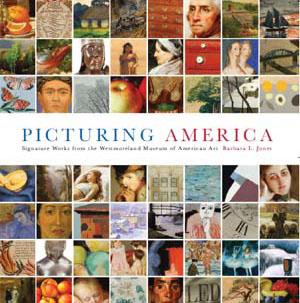 Over the past fifty years, the Westmoreland Museum of American Art, in Greensburg, Pennsylvania, has assembled a collection of works by significant American artists, concentrating on the mid-18th through the mid-20th centuries. Featuring works by John Singleton Copley, Charles Wilson Peale, and Mary Cassatt, Picturing America showcases the signature works from the museum’s collections, from preeminent American artists of the Hudson River School to modernists such as Milton Avery and Doris Lee.
Barbara Jones, Picturing America: Signature Works from the Westmoreland Museum of American Art (Greensburg, PA: Westmoreland Museum of American Art, 2010), 256 pages, ISBN: 978-0931241376, $45.
Westmoreland Museum of Art Embarks on Expansion
Press release (13 July 2013) from The Westmoreland:
 ◊ ◊ ◊ ◊ ◊
The Westmoreland Museum of American Art broke ground Friday [12 July 2013] to celebrate and begin the expansion and renovation of The Future Westmoreland. Ennead Architects of New York City and LaQuatra Bonci Associates: Landscape Architecture of Pittsburgh are working with the museum to create a new experience for visitors including a brand new wing, renovation of the existing building to have LEED silver certification, and a complete re-design of the grounds.
Pennsylvania’s First Lady Susan Corbett, Chairwoman of PA Council on the Arts, was a guest speaker at Friday’s ceremony, “The Westmoreland Museum of American Art has served as a cultural asset to downtown Greensburg and Southwestern Pennsylvania since its establishment in 1959, ” said Corbett, “The renovation and expansion of the museum will provide both visitors and residents with new ways of experiencing our American heritage.” (more…)
Call for Papers | HBA Young Scholar Session at CAA, 2014
Historians of British Art Young Scholar Session
College Art Association, Chicago, 12–15 February 2014
Proposals due by 15 August 2013
The Historians of British Art, a CAA-affiliated society, seeks papers for an upcoming mini-session of work by emerging scholars to be held during the HBA Business Meeting at CAA in Chicago (February 12–15, 2014). Current or recent graduate students are invited to submit proposals (if a Ph.D. recipient, the degree must have been earned within the past three years). Papers may address any topic related to British art, architecture, and visual culture and should be limited to fifteen minutes. This is an opportunity for informal presentations of new or ongoing research followed by open discussion.
To submit a paper for consideration, please send the following items to Jongwoo Jeremy Kim, HBA 2nd Vice President, at jongwoo.kim@louisville.edu: (1) a one page abstract; (2) a C.V. (limited to two pages).; and (3) a brief cover letter explaining interest in the field. The deadline for submission is August 15, 2013. Upon selection, each presenter will be requested to join HBA if not already a member.
Marking the 225th Anniversary of Gainsborough’s Death
When Valerie Hedquist, who’s finishing a book on the reception history of Gainsborough’s Blue Boy, recently pointed out to me that today will mark the 225th anniversary of Gainsborough’s death, I was happy to invite her to contribute a posting, even happier that she agreed. And thus here, for a brief moment, she leads us alongside the painter’s coffin towards Kew . . . –CH
◊ ◊ ◊ ◊ ◊
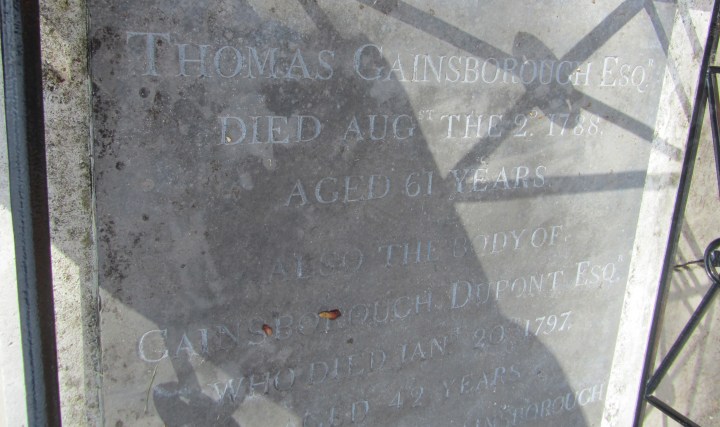
Born in 1727, Thomas Gainsborough fell ill in April 1788 and died of cancer several months later on Saturday, 2 August — 225 years ago today.
According to newspaper accounts, his death brought together “some of the most brilliant characters of the age.” Among the fifteen “few select friends” named in the obituary notice of the Whitehall Evening Post was Jonathan Buttall, regarded until recently as the subject of The Blue Boy. Along with men with connections to art, music, and theater, Buttall joined the procession of black-shrouded mourners traveling with the Gainsborough one last time as they accompanied his casket from the artist’s Pall Mall home westward to his burial plot at the Kew Green churchyard of St. Anne’s. While these individuals lived and worked in diverse London neighborhoods, their residences mostly concentrated in and around the artistic center of Soho, in contrast to the upscale West End, where Gainsborough had resided since 1774.
Who were these mourners? The surgeon and anatomist John Hunter and his neighbor, Sir Joshua; Thomas Linley and the playwright Richard Brinsley Sheridan; the American Benjamin West and the Swedish-born Scot, Sir William Chambers; the ‘father of English watercolour’ Paul Sandby; the wax portraitist Isaac Gosset and the stipple engraver Francesco Bartolozzi; the miniaturists Samuel Cotes and Jeremiah Meyer; the brother-in-law of the critic and newspaper publisher Sir Henry Bate Dudley, William Pearce; and Gainsborough’s nephew, Gainsborough Dupont, who, according to recent work by Susan Sloman, may be the actual sitter for Blue Boy.* Writing in his diary, Joseph Farington claimed it was Pearce at the artist’s bedside when he spoke his last words: “Vandyck was right.”
◊ ◊ ◊ ◊ ◊
* The most complete argument is made in Susan Sloman, “Gainsborough’s Blue Boy,” The Burlington Magazine 155 (April 2013): 231-37. Also see, Sloman, “ ’A Divine Countenance’: Gainsborough’s Portrait of His Nephew Rediscovered,” The Burlington Magazine 146 (May 2004), 319-22; and Sloman, in the exhibition catalogue Van Dyck in Britain, ed. by Karen Hearn (London: Tate Publishing, 2009).
82nd & Fifth | Mascarade à la Grecque
The latest installment of The Met’s 82nd & Fifth:
◊ ◊ ◊ ◊ ◊
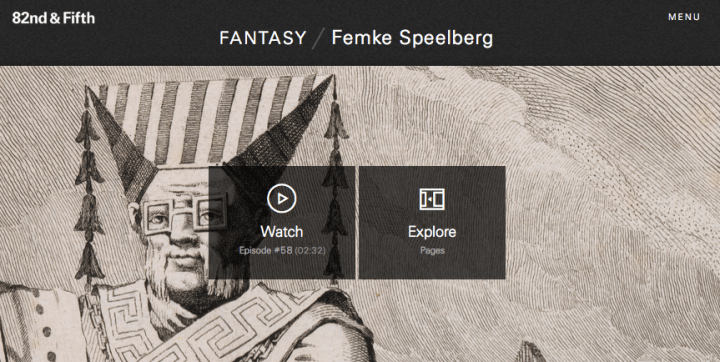
In “Fantasy” (episode #58), Femke Speelberg addresses the Mascarade à la Grecque; Suite des Vases; and [Cheminées], a series of eight etchings designed by Ennemond Alexandre Petitot, and etched and published by Benigno Bossi (1771, 1764).










leave a comment