New Book | A Taste for China
From Cambridge UP:
Eugenia Zuroski Jenkins, A Taste for China: English Subjectivity and the Prehistory of Orientalism (New York: Cambridge University Press, 2013), 304 pages, ISBN: 978-0199950980, $74.
 Challenging existing narratives of the relationship between China and Europe, this study establishes how modern English identity evolved through strategies of identifying with rather than against China. Through an examination of England’s obsession with Chinese objects throughout the long eighteenth century, A Taste for China argues that chinoiserie in literature and material culture played a central role in shaping emergent conceptions of taste and subjectivity.
Informed by sources as diverse as the writings of John Locke, Alexander Pope, and Mary Wortley Montagu, Zuroski Jenkins begins with a consideration of how literature transported cosmopolitan commercial practices into a model of individual and collective identity. She then extends her argument to the vibrant world of Restoration comedy-most notably the controversial The Country Wife by William Wycherley-where Chinese objects are systematically associated with questionable tastes and behaviors. Subsequent chapters draw on Defoe, Pope, and Swift to explore how adventure fiction and satirical poetry use chinoiserie to construct, question, and reimagine the dynamic relationship between people and things. The second half of the eighteenth century sees a marked shift as English subjects anxiously seek to separate themselves from Chinese objects. A reading of texts including Aphra Behn’s Oroonoko and Jonas Hanway’s Essay on Tea shows that the enthrallment with chinoiserie does not disappear, but is rewritten as an aristocratic perversion in midcentury literature that prefigures modern sexuality. Ultimately, at the century’s end, it is nearly disavowed altogether, which is evinced in works like Charlotte Lennox’s The Female Quixote and Jane Austen’s Northanger Abbey.
Eugenia Jenkins is Assistant Professor of English and Cultural Studies at McMaster University.
◊ ◊ ◊ ◊ ◊
C O N T E N T S
Introduction: ‘China’ and The Prehistory of Orientalism
1. The Cosmopolitan Nation, ‘Where Order in Variety We See’
2. The Chinese Touchstone of the Tasteful Imagination
3. Defoe’s Trinkets: Fiction’s Spectral Traffic
4. ‘Nature to Advantage Drest’: The Poetry of Subjectivity
5. How Chinese Things Became Oriental
6. Disenchanting China: Orientalism and the English Novel
Afterword: Rethinking Modern Taste
Call for Papers | Georgian Pleasures
From Bath Spa University:
Georgian Pleasures
Holburne Museum, Bath, 12–13 September 2013
Proposals due by 30 April 2013
Pleasure is the object, duty and the goal of all rational creatures.
–Voltaire
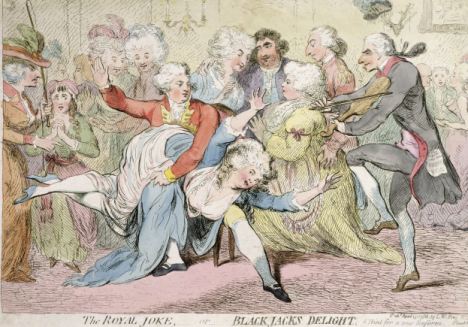 This interdisciplinary two-day conference jointly sponsored by takes the diversity of the experience of Georgian Pleasures as its theme and invites new and established academics, period performers and musicians to come together for a lively cross-disciplinary conversation exploring the conceptualization and practice of pleasure globally in the long eighteenth century. Georgian pleasures were myriad. Some were exclusive — specific to certain classes, ages or genders —others were inclusive and/or overlapping. High life or low life, licit or illicit, private or public, domestic or commercial — there were pleasures to suit all tastes and circumstances. This conference aims to explore what it was that people of the period enjoyed and what we, as academics, re-enactors and period performers, can learn about society and culture from a better appreciation of pleasure, Georgian-style. The conference will take place in Bath’s recently refurbished Holburne Museum, itself the centre-piece of Sydney Gardens, the last of Bath’s famous Georgian Pleasure Gardens.
We welcome proposals (approx. 200 words) for individual papers or individual/group performances. Panels of three papers with chair and commentator are also welcome. All proposals should be sent to the Centre for History and Culture at Bath Spa University (email historyandculture.bsu@gmail.com) by 30th April, 2013.
Potential themes include:
- Alehouses to Almacks: the pleasures of high / low life
- Urban and rustic: the pleasures of location
- Leisure, pleasure and consumption: the delights of the spa
- Female and male: gender and pleasure
- Pleasures of the imagination: music, theatre, opera & the arts
- Dangerous and illicit pleasures
- Continental pleasures
- Spas
Conference sponsors:
Centre for History & Culture, Bath Spa University: Dr Roberta Anderson, Dr Elaine Chalus, Dr Matthew Spring
Regional History Centre, University of the West of England: Dr Steve Poole
For further information, contact historyandculture.bsu@gmail.com
Darby English to Lead Clark’s Research and Academic Program
Press release (24 April 2013) from The Clark:
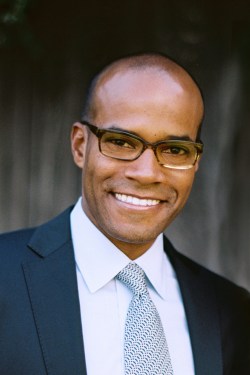 The Sterling and Francine Clark Art Institute today announced the appointment of Darby English, associate professor in the Department of Art History at the University of Chicago, to serve as the next Starr Director of the Research and Academic Program (RAP). English will lead the program’s international agenda of intellectual events and collaborations and will oversee the Clark’s library and its active residential scholars’ program, all based on the Institute’s 140-acre campus.
“Darby English brings a dynamic perspective to the work of the Clark’s Research and Academic Program, rooted in his knowledge of the field of art history—both its traditions and its new critical perspectives,” said Michael Conforti, director of the Clark. “He will build upon the Clark’s extraordinary record of accomplishment achieved during Michael Ann Holly’s fourteen years as director.”
In June 2012, Michael Ann Holly announced plans to conclude her tenure as Starr Director in the summer of 2013. Holly is widely recognized for her leadership in conceptualizing and pioneering RAP’s international series of programs and events. She will remain active in numerous Clark programs and activities in Williamstown and New York.
“The Clark is both a meeting ground and a forum for exchange and debate,” said English. “The Research and Academic Program is fueled by the international scholars who come to Williamstown as Fellows and as participants in its scholarly programs and by its many collaborations with academic programs across the world. I couldn’t be more thrilled by this opportunity to enhance the Clark’s long-established reputation for intellectual leadership in the field.”
Dr. English graduated from Williams College in 1996 with a degree in art history and philosophy and earned a doctorate in visual and cultural studies from the University of Rochester in 2002. He has served on the University of Chicago’s faculty since 2003, teaching modern and contemporary art and cultural studies. He served as the assistant director of the Research and Academic Program from 1999 through 2003. (more…)
Call for Papers | Prisons of Stone, Word, and Flesh
Prisons of Stone, Word, and Flesh: Medieval and Early Modern Captivity, ca. 400-1800
Brown University, Providence, Rhode Island, 21 February 2014
Proposals due by 1 November 2013
We invite submissions for a one-day interdisciplinary symposium to take place at Brown University on February 21, 2014, hosted by the Cogut Center for the Humanities and sponsored by the Department of French Studies, the Department of Comparative Literature, the Medieval Studies Program, and the Department of History. Our theme will be “Prisons of Stone, Word, and Flesh: Medieval and Early Modern Captivity.” Professor Adam Kosto (History, Columbia University), author of Hostages in the Middle Ages (Oxford University Press, 2012), will serve as the keynote speaker.
If, following the thought of Michel Foucault and others, the prison is an essentially modern invention, how can we best conceptualize captivity in the time beforehand? Historical records of the medieval and early modern period (roughly 400-1800 AD) offer countless examples of human bondage, including the capture and detention of prisoners of war and the voluntary submission of hostages, as well as evolving forms of punitive incarceration. During the same time, art and literature are replete with depictions of imprisonment, often employed as a master metaphor for concepts like erotic love or mankind’s enslavement to the Devil and the body. Being held against their will even seems to have been something of a rite of passage for numerous medieval and early modern authors (such as Marco Polo, François Villon, Charles d’Orléans, Thomas Malory, and Cervantes) who found in various forms of captivity the time and inspiration necessary to create some of the most enduring works of western literature.
Submissions are sought from graduate students, faculty members, and other scholars in fields including—but not limited to—history, literature, languages, philosophy, religious studies, art and architectural history, and music. Particularly welcome are submissions which offer new methodological or theoretical approaches to issues of medieval and early modern captivity, or which examine the relationship of captivity to cultural production and/or intercultural exchange. Papers should be no more than twenty minutes in length and should be in English. Please send a 250-word abstract, along with brief contact information, to John Moreau, Mellon Postdoctoral Fellow in French Studies and Comparative Literature, at John_Moreau@Brown.edu. The submission deadline is November 1, 2013.
Slow Down and Look for the 4th Annual Slow Art Day

◊ ◊ ◊ ◊ ◊
From ARTInfo:
Kyle Chayka, “Slow Art Day Fights Visual Grazing With a Deep Dive into Museums,” ARTInfo (17 August 2012).
A 2001 study showed that visitors to the Metropolitan Museum looked at individual works of art for an average of just 17 seconds at a time, a visual habit called ‘grazing’. Even the most iconic artworks in the world can’t seem to hold our attention: The Louvre discovered that visitors look at the Mona Lisa for just 15 seconds on average [link to James Elkins,”How Long Does It Take to Look at a Painting,” The Huffington Post (6 November 2010).] In the age of the moving image and endlessly updated World Wide Web, works of art in more traditional media don’t get the focus they deserve. Slow Art Day, a three-year-old initiative currently ramping up for its 2013 event, is looking to change all that with an orchestrated long art-viewing session at museums around the world.
The full article is available here»
Conference | London and the Emergence of a European Art Market
From The National Gallery:
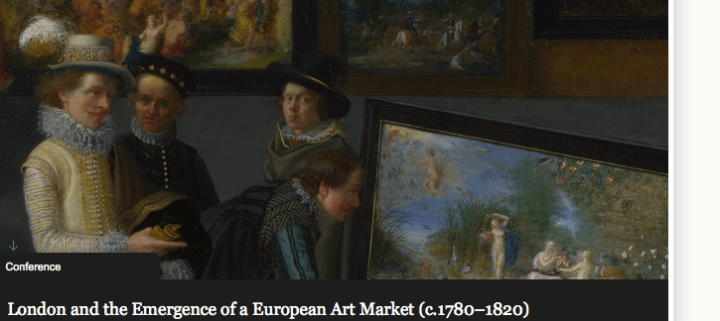
London and the Emergence of a European Art Market, c.1780–1820
The National Gallery, London, 21-22 June 2013
 ◊ ◊ ◊ ◊ ◊
The French Revolution and the ensuing Napoleonic Wars instigated a sweeping redistribution of art throughout Europe. Large volumes of valuable objects – often entire collections, from monasteries, churches, and palaces – were widely dispersed via auction and private treaty sales. Networks of agents provided the infrastructure for the circulation of art works and sales information across borders, which promoted a flourishing international art market.
This two-day conference seeks to examine the role of London in this developing market by shedding new light on the mechanisms of the art trade that connected major European centres around 1800. Scholars from a range of disciplines and countries will discuss broad research questions such as:
• Did the long-term effects of the political turmoil in France alter the existing networks of dealers and connoisseurs?
• What would have been the motivations to ship art works to distant cities?
• How sophisticated was the auction catalogue as economic tool and literary genre in various countries?
• Is it really possible to talk about a European art market or were there still relatively independent local markets?
◊ ◊ ◊ ◊ ◊
F R I D A Y , 2 1 J U N E 2 0 1 3
10.00 Registration
10.30 Nicholas Penny (The National Gallery), Welcome and introduction
10.35 Christian Huemer (Getty Research Institute, Los Angeles) and Maximilian Schich (University of Texas, Dallas), What’s in the data? Visualising the Getty Provenance Index®
Session 1: Collections
Moderator: Adriana Turpin (Institut d’Etudes Supérieures des Arts / University of Warwick)
11.00 Camilla Murgia (Université de Neuchâtel), Collecting patterns for London: From private museums to commercial art galleries
11.25 Break with refreshments
11.45 Wendy Wassyng Roworth (University of Rhode Island), Angelica Kauffman: The acquisition and dispersal of an artist’s collection, 1782–1825
12.10 Elodie Goëssant (Université Paris-Sorbonne IV), A surprising art auction: The George Watson-Taylor sale in 1823
12.35 Discussion
1.00 Lunch break
Session 2: Agents
Moderator: Gail Feigenbaum (Getty Research Institute, Los Angeles)
2.00 Julia Armstrong-Totten (Independent Scholar, Los Angeles), From jack-of-all-trades to professional: The development of the early modern picture dealer in 18th-century London
2.25 Sarah Bakkali (Université Paris X Nanterre), The Trumbull sale of 1797: Players in the Paris-London art market during the French Revolution
2.50 Carole Blumenfeld (Palais Fesch-Musée des Beaux-arts d’Ajaccio), Pierre-Joseph Lafontaine (1758-1835) and the formation of European private collections
3.15 Break with refreshments
3.45 Maria Celeste Cola (Sapienza Università di Roma), Thomas Hope and Gioacchino Marini: Roman agent ‘de’ signori inglesi’
4.10 Ana Maria García Fernández (Universidad de Oviedo), Spanish art dealers in the United Kingdom
4.35 Discussion
◊ ◊ ◊ ◊ ◊
S A T U R D A Y , 2 2 J U N E 2 0 1 3
10.00 Registration
10.30 Thomas W. Gaehtgens (Getty Research Institute), Welcome and introduction
Session 3: Information
Moderator: Hans Van Miegroet (Duke University)
10.35 David Ekserdjian (University of Leicester), William Buchanan’s Memoirs of Painting (1824) and his observations on the art trade during the Napoleonic period
11.00 Bénédicte Miyamoto (Université Paris Sorbonne-Nouvelle), British buying patterns at auction sales, 1780–1800: Did the influx of European art have an impact on the British public’s preferences?
11.25 Break with refreshments
11.45 Steven Adams (University of Hertfordshire), ‘Noising things abroad’: Sales catalogues and the construction of value in the early 19th-century art market
12.10 Rebecca Lyons (Christie’s Education, London / University of Glasgow), Marketing and selling the collection of Welbore Ellis Agar in 1806
12.35 Discussion
1.00 Lunch break
Session 4: Artworks
Moderator: Susanna Avery-Quash (The National Gallery)
2.00 Hans Van Miegroet (Duke University) and Dries Lyna (Radboud University Nijmegen), International art dealer networks and triangular arbitrage between Paris, Amsterdam and London
2.25 Guido Guerzoni (Università Luigi Bocconi, Milan), Italian exports of works of art to the United Kingdom
2.50 Peter Carpreau (M – Museum Leuven), The Getty Provenance Index® under examination: The taste for 17th-century Dutch and Flemish painting in London (1780–1820)
3.15 Break with refreshments
3.45 Olivier Bonfait (Université de Bourgogne, Dijon), London around 1800: An international art trade or a globalised art market?
4.10 Discussion
4.30 Roundtable
Moderator: Nicholas Penny (The National Gallery)
Thomas W. Gaehtgens (Getty Research Institute)
Guido Guerzoni (Università Luigi Bocconi, Milan)
Patrick Michel (Université Lille 3)
Michael North (Universität Greifswald)
British Sales 1780–1800: The Rise of the London Art Market
From The National Gallery:
The National Gallery has completed a collaborative project with the Getty Research Institute, Los Angeles, to augment records about British art sales in the crucial decades from 1780 to 1800
Overview
 The disruptions caused by the French Revolution had a huge effect on the redistribution of art throughout Europe during the late 18th century. Countless important art collections, including the famous Orléans collection, were dispersed in auction sales. Since many of these auctions took place in Britain’s capital city, London developed into a major import market and soon established itself as the hub of the international art trade.
The Getty Research Institute has been conducting research into European art sales for the past 25 years, notably in relation to art sales catalogues from major cities in Great Britain, France, Germany, Belgium, the Netherlands, and Scandinavia from 1650 to 1840. The Institute has been making its findings available on the Getty Provenance Index®.
In relation to British art sales, it concentrated earlier research into early 19th-century British records. By comparison, little attention was ever focussed on late 18th-century British auction records. This big gap in knowledge prevented meaningful analysis into the art markets of Great Britain, into the continuing lives of dispersed French collections, and – due to the interconnectedness of national art markets – into the development of cultural networks throughout Europe.
In order to rectify the situation, the National Gallery and the Getty Research Institute forged a collaboration from October 2009 to August 2012. The aim of this jointly-funded project was to discover all extant British sale catalogues – in London and across the UK – and to enter them into the Index, thus significantly augmenting the coverage of one of the most powerful and important tools for scholars researching art markets and collecting practices.
British art sales catalogues
The research project, ‘British Sales 1780-1800’, has successfully added over 67,000 records from 1,408 British art auction catalogues to the Getty database: 29,000 records from the 1780s and a further 38,000 records from the 1790s. The database now contains almost 80% of known British art sales catalogues in public collections for the period.
Explore British art sales on the Getty Provenance Index®
The research
The research team worked with many institutions in the UK and abroad to find and then consult and photograph relevant holdings of catalogues from the period. Among the important archives and libraries in London, data was input from annotated auction catalogues held by the Wallace Collection, the British Library, the British Museum, the Victoria & Albert Museum, the Courtauld Institute and the National Archives at Kew, as well as from the National Gallery’s own substantial holdings of historic sales catalogues.
In addition, the team sourced catalogues from numerous regional UK record offices, local archives and university collections, including the Barber Institute of Fine Arts, Birmingham; the Fitzwilliam Museum, Cambridge; and the Ashmolean Museum and Bodleian Library, Oxford. Furthermore, the researchers forged close links with various foreign institutions, notably the Bibliothèque Nationale de France in Paris.
Outcomes
The British Sales research project has resulted in expanded coverage of British materials in the Index®. These tools will allow researchers to track patterns of taste in order to understand better cultural transfers, and to explore more fully the power of art markets. Furthermore, generating new knowledge about the history of the art market will allow greater interdisciplinary exchange among scholars from a variety of fields, including art history, economics, and cultural studies.
To highlight some of the fruits of the collaboration between the National Gallery and the Getty Research Institute, as well as to promote further research in the field, the two institutions are organising a scholarly symposium at the National Gallery on 21–22 June 2013: London and the Emergence of a European Art Market (c. 1780-1820). The theme of the conference will be the European art market of the later 18th century, and in particular, the ways that the market operated at both national and international levels as well as its impact on the history of collecting and taste in public and private spheres.
Happy Arbor Day
I posted notice of this collection last September, but I’m reposting it in honor of National Arbor Day. From SVEC (formerly Studies on Voltaire and the Eighteenth Century), available from the Voltaire Foundation:
Laura Auricchio, Elizabeth Heckendorn Cook and Giulia Pacini, eds., Invaluable Trees: Cultures of Nature, 1660-1830 — SVEC 2012:08 (Oxford: Voltaire Foundation, 2012), 360 pages, ISBN 9780729410489, £65 / €95 / $110.
 Trees and tree products have long been central to human life and culture, taking on intensified significance during the long eighteenth century. In this interdisciplinary volume, contributors trace changes in early modern theories of resource management and ecology across European and North American landscapes, and show how different and sometimes contradictory practices were caught up in shifting conceptions of nature, social identity, physical health and moral wellbeing.
◊ ◊ ◊ ◊ ◊
C O N T E N T S
Introduction
• Laura Auricchio — Elizabeth Heckendorn Cook and Giulia Pacini, Invaluable trees
I. Arboreal Lives
• Hamish Graham — ‘Alone in the forest’? Trees, charcoal and charcoal burners in eighteenth-century France
• J. L. Caradonna — Conservationism avant la lettre,? Public essay competitions on forestry and deforestation in eighteenth-century France
• Paula Young Lee — Land, logs and liberty: the Revolutionary expansion of the Muséum d’histoire naturelle during the Terror
• Peter Mcphee — ‘Cette anarchie dévastatrice’: the légende noire of the French Revolution
• Paul Elliott — Erasmus Darwin’s trees
• Giulia Pacini — At home with their trees: arboreal beings in the eighteenth-century French imaginary
II. Strategic Trees
• Elizabeth Heckendorn Cook — The vocal stump: the politics of tree-felling in Swift’s ‘On cutting down the old thorn at Market Hill’
• Michael Guenther — Tapping nature’s bounty: science and sugar maples in the age of improvement
• Meredith Martin — Bourbon renewal at Rambouillet
• Susan Taylor-Leduc — Assessing the value of fruit trees in the marquis de Fontanes’s poem Le Verger
• Elizabeth Hyde — Arboreal negotiations, or William Livingston’s American perspective on the cultural politics of trees in the Atlantic world
• Lisa Ford — The ‘naturalisation’ of François André Michaux’s North American sylva: patriotism in early American natural history
III. Arboreal Enlightenments
• Tom Williamson — The management of trees and woods in eighteenth-century England
• Steven King — The healing tree
• Nicolle Jordan — ‘I writ these lines on the body of the tree’: Jane Barker’s arboreal poetics
• Waltraud Maierhofer — Goethe and forestry
• Paula R. Backscheider — Disputed value: women and the trees they loved
• Aaron S. Allen — ‘Fatto di Fiemme’: Stradivari’s violins and the musical trees of the Paneveggio
Summaries
Bibliography
Index
◊ ◊ ◊ ◊ ◊
Laura Auricchio is Associate Professor of Art History and Chair of Humanities at The New School in New York. Her current research addresses Franco-American cultural exchanges in the Age of Revolution.
Elizabeth Heckendorn Cook is Associate Professor of English at the University of California, Santa Barbara. She studies the history of environmental ethics and early modern representations of trees and forests.
Giulia Pacini is Associate Professor of French at The College of William & Mary. Her current research focuses on the political and material significance of trees in early modern France.
Conference | Objects in Motion in the Early Modern World
I posted notice of this two-day conference in February, but here I’ve included the full program, and what a program! In addition to the really interesting papers, the breakout sessions look like immense fun. -CH
From The Getty:
Objects in Motion in the Early Modern World
The Getty Center, Los Angeles, 10-11 May 2013
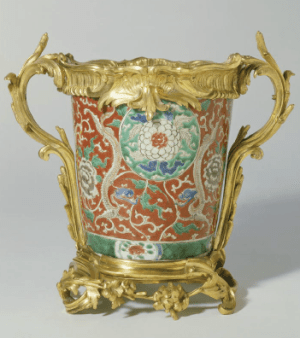
Mounted Vase, Chinese porcelain ca. 1662–1722, French mounts, ca. 1745–49. J. Paul Getty Museum (79.DI.121.1)
The Getty Research Institute and the USC-Huntington Early Modern Studies Institute are co-sponsoring a two-day conference, “Objects in Motion in the Early Modern World,” on Friday, May 10 and Saturday, May 11, 2013, at the Getty Center in Los Angeles, California.
An international group of scholars will examine the circulation of objects across regions and cultures in the early modern period (1500-1800), addressing the ways in which mobility led to new meanings, uses, and interpretations. Break-out sessions will invite the audience to consider these questions as we examine objects from the Getty’s collections. A closing roundtable will provide an opportunity to discuss the methodological and theoretical potential of this line of inquiry for the study and teaching of art history. The symposium is organized by Daniela Bleichmar (University of Southern California), Meredith Martin (Wellesley College), and Joanne Pillsbury (Getty Research Institute).
Admission is free. Separate reservations are required for each
day of the conference.
◊ ◊ ◊ ◊ ◊
F R I D A Y , 1 0 M A Y 2 0 1 3
8:30 Coffee and Pastries
9:30 Welcome, Andrew Perchuk (Getty Research Institute) and Peter Mancall (USC-Huntington Early Modern Studies Institute)
9:35 Introductory Remarks, Daniela Bleichmar (University of Southern California) and Meredith Martin (Wellesley College)
9:45 Session 1 — Moderator: Joanne Pillsbury (Getty Research Institute)
• “The Itinerant Lives of Mexican Codices,” Daniela Bleichmar (University of Southern California)
• “Trading in the Senses: Exotica On and Off the Early Modern Dutch Marketplace,” Claudia Swan (Northwestern University)
11:15 Coffee Break
11:30 Session 2 — Moderator: Alka Patel (University of California, Irvine)
• “Diana Transformed: The Case of the Diana Automaton,” Jessica Keating (University of Southern California)
• “Translating, Transporting, and Transforming Mughal History: An Illustrated French Translation of the ‘Ain-i Akbari,” Chanchal Dadlani (Wake Forest University)
1:00 Lunch
2:00 Breakout Sessions
Lacquer Without Borders led by Arlen Heginbotham, Conservator, J. Paul Getty Museum
This tour through the Museum galleries focuses on examples of Chinese and Japanese lacquer that have been incorporated into French decorative arts and addresses the worldwide exchange of aesthetics, raw materials, and finished goods associated with the lacquer trade.
VOILA—How Science Can Help Establish a Community of Asian Lacquer Researchers, led by Michael Schilling, Senior Scientist, Getty Conservation Institute
Ever wondered why scientists study cultural heritage? This tour of the Organic Materials Laboratory at the Getty Conservation Institute illustrates the role of science in uncovering the mysteries of Asian lacquer, the topic of a recent workshop for conservators and scientists hosted by the Institute.
Looking East: Rubens’s Encounter with Asia, led by Stephanie Schrader, Curator, J. Paul Getty Museum
This exhibition tells an intriguing story about early trade between Europe and Asia, the trafficking of Asian slaves, a shipwreck, the role of Jesuit missionaries in the East, and an unusual hat. Featuring a masterpiece from the Getty collection, Man in Korean Costume, the exhibition includes important scholarship that illuminates unexplored facets of Peter Paul Rubens’s much-celebrated career.
An Evolving Understanding of the Object via Art History and Science: La Roldana’s San Ginés, led by Maite Alvarez, Project Specialist, and Jane Bassett and Brian Considine, Conservators, J. Paul Getty Museum
In the early modern period, materials such as pigments, woods, and dyes traveled across the globe. Scientific advances have enabled these global materials to be more clearly identified; in fact, material identification has became such a part of art history that larger questions are often missed: How do we come to the conclusions we come to? How do we bring out true knowledge rather than conjecture? What are the implications and what is at stake? This session examines Spanish artist La Roldana’s polychrome wood sculpture San Ginés and her use of New World materials like cochineal, indigo, and cedar. An interdisciplinary team of scholars arrived at a new understanding of this work through the combined application of art history and science.
From Military Campaigns to Museum Collections, led by Louis Marchesano, Curator, and Peter Bonfitto, Senior Project Management Coordinator, Getty Research Institute
Napoleon’s military expedition in Egypt was a monumental failure, but it provided both the French and the English an opportunity to seize the country’s riches. This session presents a variety of publications related to the military campaign, including the multivolume Description de l’Égypte (1809–28), auction catalogs, and museum publications.
Imperial Impressions: Chinese Engravings and French Models, led by Marcia Reed, Chief Curator, Getty Research Institute
Rare prints from the Getty Research Institute’s collections demonstrate the evolution of China’s cultural exchange with Europe during the Qing Dynasty.
Facing East: The Western View of Islam in Early Modern Europe, led by David Brafman, Curator, Getty Research Institute
The Getty Research Institute’s rare books and manuscripts from the Renaissance to the Enlightenment display the evolving knowledge of Islamic art and culture in early modern Europe.
Untold Stories: Collecting and Transforming Medieval Manuscripts, led by Elizabeth Morrison, Curator, J. Paul Getty Museum
For hundreds of years, manuscripts have been bought and sold, hidden and displayed, preserved and rearranged, loved and forgotten, cut into pieces, hung on the wall, and glued into albums. Drawn from the Getty Museum’s permanent collection and featuring several outside loans, this exhibition reveals how manuscripts have been refashioned both conceptually and physically and explores the long and eventful history of these books before their arrival at the Museum.
3:15 Session 3 — Moderator: Stephen Little (Los Angeles County Museum of Art)
• “Mirror Reflections: Louis XIV, Phra Narai, and the Material Culture of Kingship,” Meredith Martin (Wellesley College)
• “Coins for Candles: Asian Commodities and the Visual Culture of Spanish America,” Dana Leibsohn (Smith College)
4:45 Reception
◊ ◊ ◊ ◊ ◊
S A T U R D A Y , 1 1 M A Y 20 1 3
8:30 Coffee and Pastries
9:30 Session 4 — Moderator: Charlene Villaseñor Black (University of California, Los Angeles)
• “From the Rue Saint-Jacques to the Paraguayan Outback: The Itinerant lives of Rococo Decorative Prints in Eighteenth-Century South America,” Gauvin Alexander Bailey (Queen’s University, Ontario, Canada)
• “Monumentality in Motion: A Mughal Audience Tent in Late Eighteenth-Century Jodhpur,” Zirwat Chowdhury (Center for 17th- and 18th-Century Studies, University of California, Los Angeles)
11:00 Coffee Break
11:15 Session 5 — Moderator: Polly Roberts (University of California, Los Angeles)
• “Porcelain Objects and Mercantile Aesthetics: Trading Culture in Coastal East Africa,” Sandy Prita Meier (University of Illinois, Urbana-Champaign)
• “Chairs, Writing Tables, and Chests: On the Postures of Commercial Documentation in the Early Modern Indian Ocean,” Nancy Um (SUNY–Binghamton)
12:45 Lunch
2:00 Session 6 — Moderator: Sean Roberts (University of Southern California)
• “Classicizing the New: The Publication of the History of the New World (Tarih ül-Hind il garbi el-müsemma bi-Hadis-i nev),” Avinoam Shalem (Institut für Kunstgeschichte, Munich)
• “Technology in Paradise,” Mary Sheriff (University of North Carolina at Chapel Hill)
3:30 Coffee Break
3:45 Closing Roundtable Discussion
5:15 Closing Reception
Call for Papers | London and the Americas, 1492-1812
Society of Early Americanists | London and the Americas, 1492-1812
Kingston University 17-19 July 2014
Proposals due by 1 September 2013
 This thematic interdisciplinary conference of the Society of Early Americanists will examine London’s connections with the Americas in the colonial era. It will focus on the role that Europe’s largest urban center played in the structuring of an Atlantic world inscribed, amidst both war and peace, by networks of trade, travel, religion, kinship, cultural identification, captivity, slavery, and governance. At the same time, participants will consider how the Americas in particular shaped the geography, both actual and metaphorical, of early modern London (that is, the cities of London and Westminster), influencing its practices, hierarchies, infrastructures, modes of representation, arrangements of space, and movements of peoples. The focus will thus be on London as both recipient and source of transmission and interaction, connected imaginatively and actually with American regions under the control of other European powers as well as with its own colonies.
Hosted by the School of Humanities at Kingston University London, the conference will take place on the University’s campus in South West London, a 25-minute train ride from central London and a short bus ride from Heathrow Airport. Housing options will include university dormitories as well as a diverse array of local hotels.
Proposals are welcome for individual papers or complete panels. Innovative panel formats are welcome along with traditional trios of 20-minute papers. Please send 250 word proposals by October 1, 2013, to: sea14london@gmail.com
Program Committee:
Kristina Bross, Purdue University, co-chair
Laura Stevens, University of Tulsa, co-chair
Eve Tavor Bannet, University of Oklahoma
George Boudreau, Pennsylvania State University Harrisburg
Brycchan Carey, Kingston University
Jonathan Field, Clemson University
Christopher Loar, University of California Davis
Oliver Scheiding, University of Mainz










leave a comment