Exhibition | Daily Pleasures: French Ceramics
From LACMA:
Daily Pleasures: French Ceramics from the MaryLou Boone Collection
Los Angeles County Museum of Art, 6 October 2012 — 31 March 2013
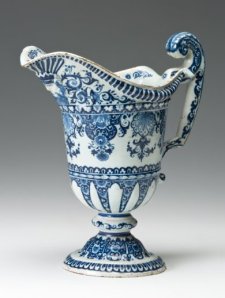
Ewer, c. 1700, Rouen, France, Earthenware with tin glaze and enamel (grand feu faïence), 11 x 11 in. LACMA, Gift of MaryLou and George Boone in honor of the museum’s twenty-fifth anniversary, M.2010.51.1, Photo © Susan Einstein.
Long-time LACMA benefactor MaryLou Boone has amassed the West Coast’s finest collection of French faience and soft-paste porcelain, 25 pieces of which she gave to LACMA in 2010. (Although originally made to emulate hard-paste porcelain imported into Europe from Asia, faience and soft-paste porcelain ultimately became distinctive and sought-after ceramics in their own right.)
The exhibition comprises over 130 pieces from the foremost manufactories of the era, representing myriad aesthetic influences, as well as advances in technology and the rhythms of domestic life. The collection includes wares for dining and taking tea, for storing the many toiletries necessary for a stylish appearance, and for preparing mixtures that comforted in time of sickness. Inextricably intertwined with every day duties and diversions, these objects provide a unique view of French life and culture.
The accompanying exhibition catalogue, Daily Pleasures: French Ceramics from the MaryLou Boone Collection, includes more than 145 entries of French faience and porcelain from the collection, as well as essays about the collector and 17th and 18th-century French ceramics.
◊ ◊ ◊ ◊ ◊
From ACC Distribution:
Elizabeth Williams and Meredith Chilton, Daily Pleasures French Ceramics from the MaryLou Boone Collection (Los Angeles: Los Angeles County Museum of Art, 2012), 392 pages, ISBN: 9780875872155, $75.
 MaryLou Boone’s collection of French ceramics spans the reigns of some of France’s most fascinating kings, from Louis XIII to Louis XVI, yet the collection is not one of royal vases and princely gifts but, rather, of wares for dining and taking tea, of porcelain frivolities, and of ceramics for the sickroom and the pharmacy. Mrs. Boone – a collector, scholar, and donor – has amassed the West Coast’s finest collection of 17th and 18th-century French faience and soft-paste porcelain, objects that provide a unique view of French life and culture. Emphasizing the aesthetics French ceramics and also its functionality, the catalogue comprises over 130 collection entries, as well as essays on the collector, ceramics in 17th-18th century France, French faience and its makers and French porcelain and its makers. Although originally created to emulate Asian porcelain, faïence and soft-paste porcelain ultimately became distinctive and sought-after ceramics in their own right.
C O N T E N T S
• Michael Govan and John Murdoch — Foreword
• Elizabeth Williams — Introduction
• Map of Manufactories
• Victoria Kastner — MaryLou Boone: The Accidental Collector
• Meredith Chilton — The Pleasures of Life: Ceramics in Seventeenth- and Eighteenth-Century France
• Antoinette Faÿ-Hallé — French Faience from Its Origins to the Nineteenth Century
• Antoinette Faÿ-Hallé — Faience Manufactory Histories
• Faience Catalogue
• Meredith Chilton — Porcelain Production in Seventeenth- and Eighteenth-Century France
• Meredith Chilton — Porcelain Manufactory Histories
• Porcelain Catalogue
• Marks Appendix
• Glossary
• Selected Bibliography
• Illustration Credits
• Index
Meredith Chilton is an independent art historian and was the founding curator of the Gardiner Museum of Ceramic Art in Toronto from 1983 to 2004. She has curated many exhibitions, published extensively and lectured internationally. Antoinette Faÿ-Hallé is Conservateur général honoraire du Patrimoine and Ancien directeur du musée national de Céramique, Sèvres where she worked as both a conservator and director. She has organized many ceramic and glass exhibitions and written extensively on the history of ceramics. Catherine Hess is Chief Curator of European Art at The Huntington Art Collections in San Marino, California. She is responsible for a collection particularly strong in Renaissance bronzes, 18th-Century French decorative arts, and 18th-Century British portraiture. Victoria Kastner, the Historian at Hearst Castle, has published several books and holds graduate degrees in architectural history and museum management. Elizabeth A. Williams is the Marilyn B. and Calvin B. Gross Assistant Curator of the Decorative Arts and Design department at the Los Angeles County Museum of Art.
New Title | J. B. Fischer von Erlach: Architecture as Theater
From Yale UP:
Esther Gordon Dotson and Mark Richard Ashton, J. B. Fischer von Erlach: Architecture as Theater in the Baroque Era (New Haven: Yale University Press, 2012), 184 pages, ISBN: 9780300166682, $75.
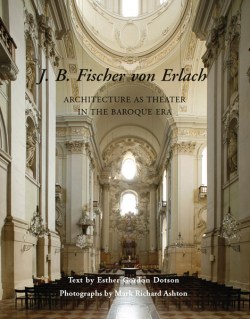 Though little known in the English-speaking world, Johann Bernhard Fischer von Erlach (1656-1723) was one of the most important and influential European baroque architects. The buildings that he designed for the emperor of Austria and his courtiers reveal an element of theatricality—an element that author Esther Gordon Dotson probes in this attractive volume.
In his architectural designs, Fischer incorporated devices from ceremonial pageantry and scene design, controlled lighting effects, and a sense of dramatic progression in approaching and moving through a building. Dotson identifies these various elements in her close reading of Fischer’s structures, and splendid new photographs, taken by Mark Richard Ashton, bring them to life on the printed page. The author also delves into Fischer’s past and his writings to explain the impact his awareness of architectural history, his early employment by designers of street-festival pageants and his relationships with others involved in such staged productions had upon his architectural designs. Dotson guides readers in discovering the theatrical qualities in Fischer’s buildings, illuminating their conceptual liveliness, variety, drama, and enduring beauty.
At the time of her death in October 2009, Esther Gordon Dotson was professor emerita in the Department of the History of Art at Cornell University. Mark Richard Ashton is an independent scholar and photographer in Ithaca, New York.
Display | Citizens of the World: David Hume and Allan Ramsay
On this day, August 10th, of 1784 Allan Ramsay died at the age of 70; October 2013 marks the tercentennial of his birth. From the Scottish National Portrait Gallery:
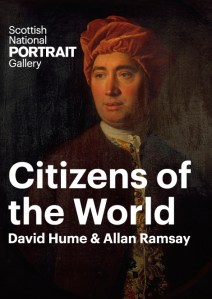 Citizens of the World: David Hume and Allan Ramsay
Scottish National Portrait Gallery, Edinburgh, 1 December 2011 — 31 December 2015
Scotland made a remarkable contribution to the European Enlightenment of the eighteenth century with many of her citizens contributing to the ferment of ideas and shifts in attitude which transformed the world. Two Scots, David Hume, the great philosopher, and Allan Ramsay, the outstanding painter, were at the centre of this cultural and intellectual revolution. This display explores their world, their friends, their families and their patrons.
Exhibition | Stories in Sterling: Four Centuries of Silver in New York
From the New-York Historical Society:
Stories in Sterling: Four Centuries of Silver in New York
New-York Historical Society Museum & Library, 4 May — 2 September 2012

Brandywine bowl (brandewijnkom), silver, ca. 1700 (New-York Historical Society) — Brandywine bowls are traditionally associated with the Dutch New York ritual of the kindermaal, a celebratory feast held in honor of a mother and her newborn child within ten days of the birth. The guests, predominantly female, feasted on sweet cakes and communally sipped a potent brew of brandy and raisins from a bowl such as this.
Stories in Sterling: Four Centuries of Silver in New York, highlights the histories of 150 notable examples of silver from the New-York Historical Society’s collection. Made across the span of four centuries, the objects in the exhibition tell a diversity of stories: many speak to individual accomplishment and family pride, while a few have unsettling ties or backgrounds. The silver, ranging from simple spoons to extravagant trophies, culled from a trove of over 3,000 objects, includes powerful eyewitness artifacts linked to significant moments in the history of New York and the United States.
Stories in Sterling interprets these compelling objects within a cultural context, focusing on the men and women that made, used, and treasured these objects. The exhibition is organized thematically and addresses issues of silver patronage, usage of objects, rituals of presentation and the meanings of silver as they evolved over time. The exhibition will be enriched by a judicious selection of paintings, prints, photographs, manuscripts, furniture and other documents that illuminate the silver, help bring to life the individuals who acquired it and illustrate the physical context in which it was used.
Objects in the exhibition span the sixteenth through the twentieth centuries, with a concentration on silver of the eighteenth and nineteenth centuries. While the majority of objects were made in New York, some were crafted as far afield as England, the Netherlands, France, as well as China, Jamaica, and Argentina. All of the silver is firmly connected through its ownership to New York, highlighting the cosmopolitan nature of the city as early as the seventeenth century. For instance, the examples of Dutch silver brought to New York by early settlers, as well as the many imports from England, help chart cultural shifts, taste, and stylistic influence in colonial America and the early years of the nation.
◊ ◊ ◊ ◊ ◊
From the publisher:
Margaret K. Hofer with Debra Schmidt Bach, Stories in Sterling Four Centuries of Silver in New York (London: Giles, 2012), 352 pages, ISBN: 9781904832652, $70.
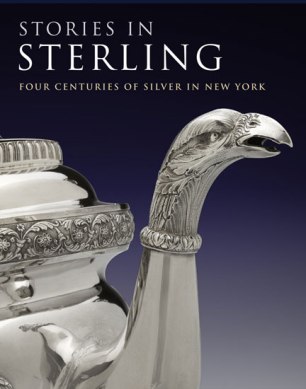 Stories in Sterling is the first comprehensive survey of the New-York Historical Society’s superb collection of early American silver, one of the finest in the United States. It features the full range of silver works, from masterpieces like the 1772 salver by New York City silversmith Lewis Fueter, to the simpler, but no less significant teapot made for the Schuyler family by the Albany silversmith Kiliaen Van Rensselaer in 1695 – one of the earliest teapots made in New York.
Seven chapters consider silver from a range of perspectives: its reflection of the multiethnic character of colonial New York; the impact of industrialization on its manufacture and consumption; its role in honouring public achievement or marking rites of passage; and, finally, its ability to express its owners’ social standing. With a wealth of related objects and original documents, Stories in Sterling is a vital reference tool for for scholars, collectors and enthusiasts of American silver and culture. It features extensive and superbly illustrated entries
with full dimensions, makers’ marks and weights in troy ounces,
and an appendix and checklist.
Margaret K. Hofer is curator of Decorative Arts at the New-York Historical Society, where she has organized numerous exhibitions, including A New Light on Tiffany (2007), which she co-authored. Debra Schmidt Bach, associate curator at the New-York Historical Society organized the exhibition The Grateful Dead: Now Playing at the New-York Historical Society,(2010). Kenneth Ames is professor of American Decorative Arts and Material Culture of the 18th and 19th-centuries at the Bard Graduate Center, New York. His publications include Beyond Necessity: Art in the Folk Tradition; Death in the Dining Room and Other Tales of Victorian Culture (1995). David Barquist is curator of American Decorative Arts at Philadelphia Museum of Art, and a scholar on colonial New York silver. He is the author of Myer Myers Jewish Silversmith in Colonial New York (2001).
Call for Papers | Inter-Culture 1400-1850: Art, Artists, and Migration
INTER-CULTURE 1400–1850: Art, Artists, and Migration
Liverpool Hope University (Creative Campus), 5-6 April 2013
Panel Proposals due by 1 October 2012
While major exhibitions, such as Migrations (January–August 2012) at Tate Britain, address the impact of migration on the cultural heritage and artistic production in a particular country, the conference seeks to investigate further this exciting topic by discussing thematically the latest research of international scholars. Instead of focusing on the 20th and 21st centuries and the strong consequences migration caused in modern and postmodern societies, we intend to look back and explore the effects of migration on art and artists in Europe and beyond before, during and shortly after the Industrial Revolution.
Why have artists left their comfort zone, travelled to faraway places and adapted to new living conditions when only very few had a noteworthy impact on local artistic production, such as Hans Holbein the Younger at Henry VIII’s court or El Greco, who is the prime example for intercultural artistic exchange in early modern times? How important was national identity for the artists and also for the reception of their work? What are the differences and parallels between pre- and post-Industrial Revolution migration of artists?
The conference seeks to encourage an inter-disciplinary dialogue and also invites papers from adjacent subjects that have a strong connection to the topic. Early career scholars are particularly invited to submit a proposal. Proposals can, but do not have to, relate to one of the following suggested themes:
•Perceptions of the artist (old and new society)
• New environments and influences on artistic practice
• Cultural confrontations
• Self-chosen emigration/immigration
• Forced emigration/immigration
• The returned artist
Conference papers will be presented within thematic units and shall not exceed 20 minutes, followed by a 10 minute discussion. All speakers will get free accommodation on the campus of Liverpool Hope University. Please send your proposal of no more than 500 words (with name, institution, address, phone number and email address) to:
Dr Kathrin Wagner
Liverpool Hope University, Creative Campus
The Cornerstone
17 Shaw Street
Liverpool L6 1HP — U.K.
inter-culture@hope.ac.uk
Exhibition | Migrations: Journeys into British Art
From Tate Britain:
Migrations: Journeys into British Art
Tate Britain, London, 31 January — 12 August 2012

Benjamin West, Pylades and Orestes Brought as Victims before Iphigenia, 1766 (London: Tate), N00126
This exhibition explores British art through the theme of migration from 1500 to the present day, reflecting the remit of Tate Britain Collection displays. From the sixteenth- and seventeenth-century Flemish and Dutch landscape and still-life painters who came to Britain in search of new patrons, through moments of political and religious unrest, to Britain’s current position within the global landscape, the exhibition reveals how British art has been fundamentally shaped by successive waves of migration. Cutting a swathe through 500 years of history, and tracing not only the movement of artists but also the circulation of visual languages and ideas, this exhibition includes works by artists from Lely, Kneller, Kauffman to Sargent, Epstein, Mondrian, Bomberg, Bowling andthe Black Audio Film Collective as well as recent work by
contemporary artists.
◊ ◊ ◊ ◊ ◊
From the Tate Shop:
Lizzie Carey-Thomas, Migrations: Journeys into British Art (London: Tate, 2012), 128 pages, ISBN: 9781849760072, £15.
 With contributions by John Akomfrah, Tim Batchelor, Sonia Boyce, Emma Chambers, T.J. Demos, Kodwo Eshun, Leyla Fakhr, Paul Goodwin, Nigel Goose, Karen Hearn, David Medalla, Lena Mohamed, Panikos Panayi and Wolfgang Tillmans.
This book offers a unique perspective on the history of British art, charting how it has been shaped by successive waves of migration. It cuts a swathe through five hundred years of history and traces not only the movement of artists themselves, but also the circulation of art and ideas, from the hugely influential arrival of Northern European artists such as Anthony van Dyke in the sixteenth and seventeenth centuries to the influence of Italy and the development of neoclassicism on eighteenth-century artists such as Benjamin West, and on to the broad cultural interchange of the Victorian era. James McNeill Whistler and John Singer Sargent were two of many artists who moved between Britain, France and the United States in the nineteenth century. In the early twentieth century, David Bomberg and Mark Gertler were among the group of second-generation Jewish artists who played a considerable role in the establishment of British modernism. The rise of fascism in the 1930s, causing artists such as Oskar Kokoschka and Kurt Schwitters to flee to Britain, foreshadowed the explosion of a multicultural diaspora. Several generations of artists have since explored what it means to be both ‘black’ and ‘British’, and contemporary artists continue to investigate the meaning of identity today.
Generously illustrated, and including artist interviews and texts by leading curators and art critics, this illuminating book tells a previously hidden but vital story in the shaping of British art and culture.
HBA Travel Award for Graduate Students
Historians of British Travel Award
Proposals due by 15 September 2012
The award is designated for a graduate student member of HBA who will be presenting a paper on British art or visual culture at an academic conference in 2013. The award of $750 is intended to offset travel costs.
To apply, send a letter of request, a copy of the letter of acceptance from the organizer of the conference session, an abstract of the paper to be presented, a budget of estimated expenses (noting what items may be covered by other resources), and a CV to Renate Dohmen, Prize Committee Chair, HBA, brd4231@louisiana.edu. The deadline is September 15, 2012.
New Title | The Breathless Zoo
An exceptional title, an exceptional cover. For the latter, credit goes to Karen Knorr; the photograph, “Corridor,” is from her Fables series (2007). From Penn State UP:
◊ ◊ ◊ ◊ ◊
Rachel Poliquin, The Breathless Zoo: Taxidermy and the Cultures of Longing (University Park: Penn State University Press, 2012), 272 pages, ISBN: 9780271053721, $35.
 From sixteenth-century cabinets of wonders to contemporary animal art, The Breathless Zoo: Taxidermy and the Cultures of Longing examines the cultural and poetic history of preserving animals in lively postures. But why would anyone want to preserve an animal, and what is this animal-thing now? Rachel Poliquin suggests that taxidermy is entwined with the enduring human longing to find meaning with and within the natural world. Her study draws out the longings at the heart of taxidermy—the longing for wonder, beauty, spectacle, order, narrative, allegory, and remembrance. In so doing, The Breathless Zooexplores the animal spectacles desired by particular communities, human assumptions of superiority, the yearnings for hidden truths within animal form, and the loneliness and longing that haunt our strange human existence, being both within and apart from nature.
Rachel Poliquin is a writer and curator engaged with the cultural and poetic history of the natural world. She has curated taxidermy exhibits for the Museum of Vancouver and the Beaty Biodiversity Museum at the University of British Columbia. Poliquin is the author of ravishingbeasts.com, a website dedicated to exploring the cultural history of taxidermy.
August 2012 Issue of ‘Past & Present’
In the latest issue of Past and Present (August 2012), Michael Sonenscher responds to a recent article by William H. Sewell, “The Empire of Fashion and the Rise of Capitalism in Eighteenth-Century France,” Past and Present 206 (February 2010): 81-120. Sewell then weighs in with his own reply (access to full texts will require institutional subscriptions).
◊ ◊ ◊ ◊ ◊
Michael Sonenscher, “Debate: The Empire of Fashion and the Rise of Capitalism in Eighteenth-Century France,” Past and Present 216 (2012): 247-58.
[Full Text] [PDF]
 ‘Fashionable consumption’, Bill Sewell writes, ‘played a constitutive role in the development of French capitalism not only in the eighteenth century but also over the long term’. The claim goes with the grain of the many recent publications on eighteenth-century French trade and manufacturing industry that Sewell has expertly synthesized. But two further aspects of his article invite fuller comment. The first is an examination of the relationship between fashionable consumption and capitalist development that involves a modified version of Marx’s concept of surplus value. The second is a suggestion about the bearing of this fashion-oriented characterization of French capitalism on the subject of the origins and attributes of the French Revolution. Together they add up to an ambitious argument about the history of consumption as the way to overcome the neglect of social and economic considerations that, according to Sewell, has been one of the effects of the revisionist historiography of the French Revolution. . . .
◊ ◊ ◊ ◊ ◊
William H. Sewell, “Reply to Michael Sonenscher,” Past and Present 216 (2012): 259-67.
[Full Text] [PDF]
I would like to thank Michael Sonenscher for his learned and respectful comments on my article. In his comments he has filled out an aspect of the topic of ‘fashion’s empire’ that I made no sustained effort to cover in my own essay: varying contemporary opinions about the economics of fashion and about fashion’s relationship to France’s monarchical and aristocratic constitution. However, I think that his reflections on these eighteenth-century (or, in the case of Jean-Baptiste Say, early nineteenth-century) arguments about fashion have little bearing on what I take to be the central points of my essay. These are: (1) that fashion played a central role in French (and European) capitalist development in the eighteenth century; (2) that the dynamism of the fashion sector was based to a significant extent on harnessing the desires and labour of consumers; and (3) that certain consequences of the rise of fashion in eighteenth-century France ‘were … conducive to notions of equality of the sort specified in the Declaration of the Rights of Man and Citizen in 1789’ and were therefore ‘a key source’ of the French Revolution’s ‘epochal political and cultural transformations’. . .
Exhibition | Watercolours at Gainsborough’s House
From Gainsborough’s House:
Drawings and Watercolours from a Private Collection 1700-1840
Gainsborough’s House, Sudbury, Suffolk, 30 June – 29 September 2012
Curated by Huon Mallalieu
 The main exhibition at Gainsborough’s House for 2012 is a selection of British watercolours from a distinguished private collection in East Anglia. Formed during the 1950s and 1960s the extensive collection from which this selection of some 70 examples has been made by guest curator Huon Mallalieu, is one of the last remaining in private hands from the golden age of connoisseurship in British watercolours.
The exhibition concentrates on Thomas Gainsborough’s contemporaries and includes works by famous artists (J.M.W. Turner, Paul Sandby, J.R. Cozens, Thomas Rowlandson, Francis Towne), as well as items by important forerunners, lesser known practitioners, and amateurs of varying skill. The selection is thematic with an emphasis on topography beginning in East Anglia and moving outwards to London across the English Channel to mainland Europe, and then over the oceans to America, India and China.










 Enfilade
leave a comment