July 2012 Issue of the Journal of the History of Collections
The following selection of articles from the current issue address the eighteenth century (access to full texts will require institutional subscriptions).
◊ ◊ ◊ ◊ ◊
Journal of the History of Collections 24 (July 2012)
A R T I C L E S
 Thomas Ketelsen and Christien Melzer, “The Gottfried Wagner Collection in Leipzig: Insights into a Middle-Class Private Collection of c. 1700,” pp. 199-218.
[Abstract] [Full Text] [PDF]
Cristiano Giometti, “‘Per accompagnare l’antico’: The Restoration of Ancient Sculpture in Early Eighteenth-Century Rome,” pp. 219-30.
[Abstract] [Full Text] [PDF]
David A. Wisner, “French Neo-Classical Artists and Their Collections,” pp. 231-42.
[Abstract] [Full Text] [PDF]
B O O K R E V I E W S
Nicholas Tromans, “Review of Spanish Art in Britain and Ireland, 1750-1920: Studies in Reception in Memory of Enriqueta Harris Frankfort, edited by Nigel Glendinning and Hilary Macartney (2010),” pp. 276-77.
[Full Text] [PDF]
Walking Tour of London’s Coffehouses
From Unreal City Audio:
Tour of London’s Coffeehouses with Matthew Green
Unreal City Audio: London Walking Tours, Next tour is 28 July 2012
 Join actors, musicians, and Dr Matthew Green for a caffeinated tour of London’s original – and best – coffeehouses: from the City’s warren of medieval streets, through St Paul’s Churchyard, down historic Fleet Street, and into the cobbled courtyards of the Temple. Free shots of black and gritty coffee, brewed after the 18th-century fashion, included.
The streets of London are awash with chain coffee shops. But they are a dismal incarnation of London’s historic coffee culture: a heady brew of wit, wisdom, innovation…and crucified crocodiles.
London’s love affair with coffee can be traced back 350 years to a muddy churchyard in the heart of the City of London. Dr Green will meet you in this churchyard for it was here, in 1652, that a Greek visionary with a twirly moustache and shocking English accent first sold a foul-looking liquid to the public. Coffee would transform the face of the metropolis forever, spawning more than 3,000 coffeehouses, triggering a media boom, scientific discoveries, literary excellence, freedom of speech, dolphin dissections, and imperial triumphs. It was coffee, not tea, that built the British Empire.
Learn about the meteoric rise of the coffeehouses in the 17th century as you weave past their original sites on Cornhill, Cheapside, St Paul’s and Fleet Street; jolt as actors in period costume leap out performing real debates that raged around their candlelit tables hundreds of years ago; hear Dr Green tell stories of the kaleidoscopic activities that went on inside their walls: from dolphin dissections at the Grecian Coffeehouse to lethal duels over Latin grammar at Tom’s; from slave auctions at Garraway’s to ventriloquism and viper decapitations at John’s.
Marvel at a world where you could begin a conversation with anyone you liked simply by asking for the latest news; feel a tinge of nostalgia for this lost world of social conviviality as you gaze through the windows of the cloned coffeehouses that have usurped the City.
◊ ◊ ◊ ◊ ◊
The route (from a previous tour) is available here»
Call for Papers | Additional HBA Session at CAA 2013
In addition to the regular session chaired by Julie Codell on ‘Parallel Lines Converging: Art, Design, and Fashion Histories’, the Historians of British Art is sponsoring a 90-minute session on ‘British Visual Culture and the Levant’ at the annual meeting of the College Art Association in New York, 13-16 February 2013. Whereas the deadline for proposals for regular sessions was May 4, the due date for this panel is not until September 1. Moreover, as an additional, short session, not subject to the regular CAA purview, neither CAA membership nor CAA conference registration is required for speakers or for those attending the panel. All participants are, however, required to be members of HBA. Please direct any questions to the chairs, Eleanor Hughes and Christine Riding. -CH
◊ ◊ ◊ ◊ ◊
CAA 2013 | HBA Affiliate Session: British Visual Culture and the Levant, 1600-1830
New York, 13-16 February 2013
Proposals due by 1 September 2012
This panel aims to address a variety of ways in which interactions between Britain and the Levant were reflected in contemporary visual and material culture during the two centuries before professional artists such as John Frederick Lewis and David Roberts began traveling to Egypt and the Holy Land in search of subject matter. The Levant is here defined as the countries of the eastern Mediterranean–roughly corresponding to present-day Greece, Turkey, Syria, Lebanon, Iraq, Israel, Jordan, Egypt, and Libya–which for much of the period fell under the control of the Ottoman Empire. We welcome papers addressing a wide range of topics, including illustrated travel accounts, the exchange of commodities and customs, scholarly expeditions and the rediscovery of classical and biblical sites, the reception and use of middle-eastern imagery by British artists, and the geo-political importance of the region as mediated in visual representations, as well as those that might address broader questions relating to imperialism and orientalism.
Please submit a CV and a 250-word abstract to Eleanor Hughes (eleanor.hughes@yale.edu) and Christine Riding (criding@nmm.ac.uk).
Exhibition | Prints at the Frick in Pittsburgh
From the Frick Art & Historical Center:
In the English Manner: Mezzotint Portraits
Frick Art & Historical Center, Pittsburgh, 16 June — 2 September 2012
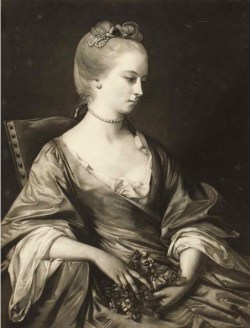
Edward Fisher, after Sir Joshua Reynolds, Miss Jacob alias Miss Roberts alias Mrs. Glynn, 1762. Published 1762 by Johnathan Spilsbury. Mezzotint (Pittsburgh: Frick Art & Historical Center)
The temporary exhibition galleries at the Frick is home to three simultaneous exhibitions of prints this summer. Thirty-five etchings by 17th-century master Jacques Callot and his followers form the cornerstone of our summer look at printmaking. Together, the three exhibitions span more than 200 years and provide a look at three different centuries as observed by artists working with different techniques and for different purposes, yet all illustrating the importance of the printmaker in recording, publishing and disseminating a distinct view of the world. . . .
While Callot’s work gives us a look at a slice of 17th-century life and subject matter, a selection of fine 18th-century English mezzotints purchased by Henry Clay Frick in the early twentieth century provides a fascinating look at who-was-who in eighteenth-century England. The majority of these mezzotints are of fashionable society figures whose appeal has endured for collectors. English portraiture in particular was extremely popular with American collectors in the early 20th century. A collection of portraits evoked an appreciation of history and continuity, while conjuring images of a gracious lifestyle to which America’s newly rich aspired. Frick’s mezzotints, purchased from one of his regular dealers, Knoedler & Co, were hung at both his New York residence and his summer home in Massachusetts.
Mezzotint is a printmaking process that dates to the seventeenth century. It quickly gained prominence as the preferred method for creating reproductions of famous paintings. Used with particular success to make reproductive prints of portraits by Thomas Gainsborough (1727–1788), Sir Joshua Reynolds (1723–1792), John Hoppner (1758–1810), and Sir Thomas Lawrence (1769–1830), the process became so popular in 18th-century England that the technique is sometimes referred to as “the English manner.” Mezzotint as a form was prized for its ability to imitate the tonal properties of painting.
The technique begins with a copper plate that is “rocked” over its entire surface. This rocking, done with a sharp, toothed instrument, creates a surface covered with tiny metallic burs which hold the ink—a completely rocked plate prints a rich velvety black. The image is created by flattening the burs, and creating smooth areas in the copper; the smoother or more polished the plate, the lighter the area prints. Even without the use of colors, a mezzotint has incredible depth and richness of tone, which in the hands of a skilled printmaker, creates a painterly feel.
The 13 prints included in this exhibition are almost all of fashionable ladies, some from a series by Valentine Green (1739-1813) published in 1780, Beauties of the Present Age, which featured Green’s mezzotints made after Reynolds’ portraits. An etcher, mezzotint, and aquatint artist, Green was one of the most celebrated and prolific British printmakers of the late eighteenth century. He produced nearly 400 plates in his distinguished career, which included an appointment as Royal Engraver to King George III.
Henry Clay Frick owned a number of significant oil on canvas examples of eighteenth-century portraiture; Yet, Frick and his peers also prized the works of the masters of the mezzotint—artists like Valentine Green and John Raphael Smith (1752–1812) who could take on a Gainsborough or a Reynolds and translate its power into print.
Exhibition | Drawings from the Christian and Isabelle Adrien Collection
Didier Rykner reviewed the exhibition for The Art Tribune in May (with an English version available). From the museum’s website:
Une Collection Particulière: Les Dessins de la Collection Christian et Isabelle Adrien
Le Musée des Beaux-Arts de Rennes, 21 March — 26 August 2012
 Le musée des Beaux-Arts de Rennes présentera, à partir du 21 mars, les plus belles feuilles de la collection de dessins de Christian et Isabelle Adrien. Au hasard des rencontres, à la lumière de quelques intuitions fulgurantes, M. Adrien a inlassablement cherché et étudié, tout au long de sa vie, les feuilles dessinées par les grands maîtres du passé. C’est à Rennes que ce collectionneur d’origine bretonne invite aujourd’hui le public à venir partager sa passion pour le dessin ancien. La découverte de près de quatre-vingt dessins français (La Hyre, Poussin, Boucher), italiens (Bandinelli, Salviati, Carraci) et nordiques (Bloemaert, Rubens), dont beaucoup sont encore inédits, marquera l’un des temps fort de la Semaine du dessin 2012 et de la programmation culturelle rennaise du printemps et de l’été prochain. Le catalogue de l’exposition, qui rassemble les notices des plus grands spécialistes de
chaque artiste, est dirigé par Monsieur Rosenberg, de l’Académie française.
◊ ◊ ◊ ◊ ◊
Catalogue: Francis Ribemont and Pierre Rosenberg, Dessins de la collection Christian et Isabelle Adrien (Paris: Editions Chaudun, Musée des beaux-arts de Rennes, 2012), 207 pages, ISBN: 9782350391281, $77.50. [Available from ArtBooks.com]
CAA Joins JSTOR Register & Read Program
As noted at CAA News (2 July 2012):
 CAA has joined JSTOR’s new Register & Read program, which offers free, read-online access to a wide-range of academic journals to independent scholars and researchers. The service is designed to make scholarship available to those not affiliated with a subscribing institution by allowing them to register for a MyJSTOR account.
CAA is pleased to contribute the full back run of The Art Bulletin and Art Journal, through 2008, to an expanding, eclectic list that includes BOMB Magazine, Film Quarterly, Modern Law Review, and American Journal of Sociology. All articles from The Art Bulletin and Art Journal during this time will be available for individuals to read and, in some instances, to download and purchase as a PDF file.
Since JSTOR launched Register & Read in January 2012, approximately forty publishers have contributed material from seventy-seven journals to the beta site. The user-friendly program mimics the experience of a library by allowing visitors to store up to three articles on a virtual shelf for two weeks before exchanging items. Feedback is key to improving the borrowing service that Register & Read provides. JSTOR plans to perfect the functionality of the program and enlarge its scope to meet the unique research needs of the scholarly community.
Conference | Emblems of Nationhood: Britishness 1707-1901
From St Andrews:
Emblems of Nationhood: Britishness 1707–1901, A Multidisciplinary Conference
University of St Andrews, 10-12 August 2012
 National identity is a central point of enquiry that is repeatedly called upon in contemporary social and political rhetoric. Our conference, Emblems of Nationhood, 1707–1901, will address the roots of this theme by discussing depictions of Britain and Britishness in literature, philosophy, and art between the Act of Union in 1707 and the death of Queen Victoria in 1901. Over the course of this multidisciplinary conference, we aim to explore how expressions of nationalism have moulded both critical perspectives on national identity and their creative products.
Discussing emblems of nationhood in 2012 is a fitting way to mark the twentieth anniversary of Linda Colley’s seminal account of Britishness, Britons: Forging the Nation, and coincides with the Queen’s Diamond Jubilee. Several broad questions could potentially be explored in the course of the conference: What did Britishness mean in the eighteenth and nineteenth centuries, and how was it represented and perceived? To what extent is nationalism tied with military events and empire building? How “British” was Britain before the launch of the Empire? How did concepts of nationalism enter the public consciousness, both within the British Isles and abroad? What is the impact of artistic and cultural depictions of Britain and Britishness in domestic and international contexts? How can these historical ideas of Britishness enhance our contemporary understanding of the concepts of nationalism and national identity?
Speakers include: Colin Kidd, Emma Major, Linda Colley, and Calum Colvin
Details on the full programme and registration are available at the conference website.
Exhibition | Messerschmidt and Modernity
Press release (16 April 2012) from The Getty:
◊ ◊ ◊ ◊ ◊
Messerschmidt and Modernity
The J. Paul Getty Museum, Getty Center, Los Angeles, 24 July — 14 October 2012

The Getty Celebrates the Modern and Contemporary Legacy of Franz Xaver Messerschmidt’s Distinctive Character Heads
◊ ◊ ◊ ◊ ◊

Ken Gonzales-Day, Untitled (Franz Xaver Messerschmidt, The Vexed Man, The J. Paul Getty Museum, Los Angeles, CA), 2008. Light jet print. Courtesy of Ken Gonzales-Day and Fred Torres Collaborations, N.Y.C. © Ken Gonzales-Day
The intriguing series of heads that are collectively known as Character Heads, created by the German Baroque artist Franz Xaver Messerschmidt (1736–1783) during the last 13 years of his life, have become increasingly popular with the general public through a series of recent exhibitions and books devoted to these expressive works. Furthermore, the sculptures, depicting various states of emotion and expression, have also captured the imaginations of generations of artists—especially during the 20th and 21st centuries.
Messerschmidt and Modernity, on view at the J. Paul Getty Museum from July 24 through October 14, 2012, is the first exhibition to explore the contemporary legacy of these surprisingly modern-looking sculptures, which were carved in alabaster, or cast in a lead or tin alloy. Along with Messerschmidt’s works, the exhibition will feature a selection of modern and contemporary works of art that testify to the lasting impact of these astonishing heads. Eight Character Heads will be exhibited—among them the Getty’s own Vexed Man— along with a newly discovered reduced variation of a now-lost Character Head known as A Cheeky Nitpicky Mocker, which has never before been exhibited publicly. Contemporary artists featured in the exhibition include Tony Bevan, Tony Cragg, Ken Gonzales-Day, Bruce Nauman, Pierre Picot, Arnulf Rainer, Cindy Sherman, and Emily Young.
“Messerschmidt’s Character Heads have appealed to audiences since they were first produced. They were especially popular in turn-of-the-century Vienna and subsequently inspired modern artists of the 20th century,” explains Antonia Boström, senior curator of sculpture and decorative arts at the J. Paul Getty Museum. “Now, this unparalleled series of sculptures is enjoying a renewed popularity—not only fascinating to museum audiences and scholars, but compelling for contemporary artists.”
The exhibition demonstrates how Messerschmidt’s heads are linked to the 18th and 19th centuries’ fascination with expression and the “passions,” as well as with the pseudosciences of physiognomy and pathognomy. It also traces how this series has influenced the work of artists in fin-de-siècle Vienna and contemporary artists in Austria, Great Britain, and the United States.
Messerschmidt
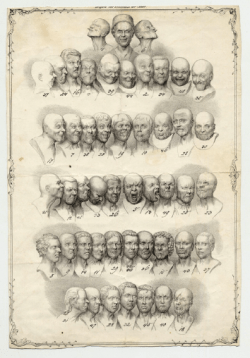
Matthias Rudolph Toma, Messerschmidt’s ‘Character Heads’, 1839. Lithograph. Courtesy of the Museum of Fine Arts, Budapest.
The German-born Messerschmidt led a successful career in Vienna in the mid-18th century, receiving many important commissions from the Habsburg empress Maria Theresa and her consort, Francis Stephen of Lorraine. Messerschmidt’s circumstances changed dramatically around 1770 when he began to show signs of mental instability, leading to the loss of prestigious commissions and conflicts with colleagues and friends. He eventually left Vienna and, in 1777, he settled in Pressburg (now Bratislava), and remained there until his death in 1783, focusing obsessively on the production of the heads as well as more conventional portraits. Messerschmidt called the dozens of heads he created between 1770 and 1783 Kopfstücke (head pieces) and intended them to represent the full range of human expressions, which he believed there are sixty-four. In 1793, ten years after his death, the heads were exhibited at the Citizen’s Hospital in Vienna, when, despite their misrepresentation, they also received the often incongruous titles by which they are still referred to today. They were only referred to as “Character Heads” after Messerschmidt’s death.
Just Rescued from Drowning belongs to a group of alabaster Character Heads probably depicting the same man, but differentiated by the arrangement of the hair. The title suggests that he has just been submerged in water, and his lank hair (or a wig) hangs down over his forehead, but the hairstyle may actually reflect those featured on Gothic sculptures of southern Germany, which would have been familiar to Messerschmidt from his youth.
Another head on view, The Ill-Humored Man, belongs to a group of middle-aged bald men within the series of Character Heads. The man’s tightly squeezed eyes and the flat strip covering his mouth contribute to a strong sense of alienation and interiority and we sense his extreme discomfort. The object covering the mouth may relate to the magnets that the German physician Franz Anton Mesmer (1734–1815) applied to patients during his therapeutic sessions. They formed part of his “animal magnetism” theory that a universal magnetic fluid coursing through the human body could be manipulated by magnets for curative purposes. Mesmer and Messerschmidt were known to be friends and these experimental procedures were of great interest to the artist.
The French artist Joseph Ducreux (1735–1802) was a contemporary of Messerschmidt, and as a painter at the court in Vienna he was probably familiar with his sculpture. Like Messerschmidt, Ducreux was interested in the pseudoscience of physiognomy, and his Self-Portrait, Yawning (by 1783, Getty Museum’s permanent collection) is an example of his experiments with the expressive possibilities of portraiture.
Some forty-nine of the sixty-nine heads Messerschmidt created are accounted for today. A lithograph on view in the exhibition has been a key element in reconstructing the series of Messerschmidt’s heads. Created by Matthias Rudolph Toma after a drawing by Josef Hasslwander, this print (from Budapest) depicts forty-nine of the heads and was made four years after the heads were publicly exhibited in 1835 by their then-owner, Josef Jüttner.
The psychological theme of Messerschmidt’s sculptures and their uncompromising aesthetic colored their public reception in Vienna. After his death and throughout the early 19th century the Character Heads were viewed as oddities and exhibited in Vienna for popular entertainment. Over time, this perception changed and by the end of the 19th century the heads were seen as useful examples of expression and emotion for art students to copy, and for students of anatomy and psychology to study. Some of the heads found their way into art-school storerooms in Vienna, while others were collected both by preeminent medical professionals and by art collectors. By the turn of the century the Character Heads found favor with Vienna’s Jewish cultural elite, which supported avantgarde art movements such as the Viennese Secession and the Wiener Werkstätte, and also had links to Sigmund Freud. Their interests in unconventional contemporary art and the science of psychiatry combined to create a new culture of support for Messerschmidt’s heads in Vienna.
Modernity and Beyond
The works created since 1900 on view in the exhibition represent a wide range of responses to the Character Heads. Modern and contemporary artists have been drawn to Messerschmidt’s heads for their perceived departure from the confines of academic convention. But it is also the combination of a reductive style, refined modeling and carving,
and exaggerated expression that make these sculptures resonate with modern audiences. By the early 20th century, Messerschmidt’s heads were well known in Vienna, and prized by collectors and artists as distinctive and affecting works of art. Anton Josef Trčka’s renowned 1914 portrait photograph of Egon Schiele (1890–1918) reflects the visual and psychological impact of Messerschmidt’s grimacing heads. The camera focuses closely on the artist’s head and hands; his anxious expression and interlocked fingers hint at his angst-ridden mood.
Contemporary artists such as Arnulf Rainer (b. 1929) and Tony Bevan (b. 1951) directly quote Messerschmidt’s sculptures, while others, including Bruce Nauman (b. 1941) and Cindy Sherman (b. 1954), incorporate their body, human expression, and self-portraiture into their work in a way that prompts comparison with Messerschmidt. The sculptures of Tony Cragg (b. 1949) and Emily Young (b. 1951) are more indirectly related, though the sculptors’ grounding in a figurative tradition and their exploration of the material’s expressive potential can be paralleled in Messerschmidt’s works. The juxtaposition of works from different time periods in this section of the exhibition illustrates the psychological power that Messerschmidt’s Character Heads continue to have for the contemporary viewer.
Expression Lab
The final gallery of the exhibition is designed to encourage visitors to consider and respond to Messerschmidt’s sculptures and the contemporary works focused on expression. The gallery is installed with mirrors, art reproductions, and an interactive “photo booth” for those who wish to actively explore and record their own facial expressions. For example, Rainer practiced “pulling faces” in the mirror, performing and documenting a series of contorted expressions as a means of investigating his own image. Using mirrors, visitors will be able to try these exercises themselves. In the photo booth, participants will be invited to replicate the intense facial expression of the Vexed Man or other character heads, or to invent an expression of their own choosing. Visitors may then share their photo on video screens in the gallery. A related video will be shown and reference books will be on hand for those who wish to learn more about Messerschmidt and expression, and about the other artists represented in the exhibition.
An audio tour, narrated by Boström and guest contributor Professor Eric Kandel, a Nobel-prize winning neuroscientist and author of The Age of Insight: The Quest to Understand the Unconscious in Art, Mind, and Brain, from Vienna 1900 to the Present, will accompany the exhibition. Messerschmidt and Modernity will also be accompanied by a richly illustrated book of the same name, written by Antonia Boström and published by Getty Publications.
◊ ◊ ◊ ◊ ◊
From the Getty Store:
Antonia Boström, Messerschmidt and Modernity (Los Angeles: Getty Publications, 2012), 80 pages, ISBN: 9780892369744, $20.
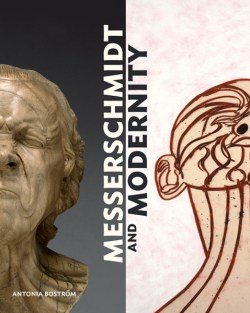 An astonishing group of sixty-nine “Character Heads” by German sculptor Franz Xaver Messerschmidt (1736–1783) has fascinated viewers, artists, and collectors for more than two centuries. The heads, carved in alabaster or cast in lead or tin alloy, were conceived outside the norm of conventional portrait sculpture and explore the furthest limits of human expression. Since their first exposure to the public in 1793, artists, including Egon Schiele (1890–1918), Francis Bacon (1909–1992), Arnulf Rainer (born 1929), and, more recently, Tony Cragg (born 1949) and Tony Bevan (born 1951), have responded to their over- whelming visual power.
Lavishly illustrated, Messerschmidt and Modernity presents remarkable works created by and inspired by Messerschmidt, an artist both of and ahead of his time. The Character Heads situate the artist’s work squarely within the eighteenth-century European Enlightenment, with its focus on expression and emotion. Yet their uncompromising style stands in sharp contrast to the florid Baroque style of Messerschmidt’s earlier sculptures for the court of Empress Maria Theresa of Austria. With their strict frontality and narrow silhouettes, the Character Heads appear to contemporary eyes as having been conceived in a “modern” aesthetic. Their position at the apparent limits of rational art have made them compelling to successive generations of artists working in a variety of media. An exhibition of the same name will be on view at the Getty Center from July 24 through October 14, 2012.
Antonia Boström is senior curator of sculpture and decorative arts at the J. Paul Getty Museum and the editor of The Fran and Ray Stark Collection of 20th-Century Sculpture in the J. Paul Getty Museum (Getty, 2008).
Happy Bastille Day
Commentary from The Onion:
“I Think I’d Make A Pretty Good HBO Show,” The Onion (19 June 2012)
By 18th-Century France
 I don’t think I’m talking out of turn here when I say that, as far as historical eras are concerned, I am probably one of the richest and most exciting periods in Western history. That’s not me bragging; it’s just a generally accepted truth at this point. After all, not every century of a nation’s past can boast successive international wars, a radical intellectual movement, and a bloody revolution, but I’ve got all of that and then some. In fact, one would be pretty hard-pressed to find a period more compelling and ripe for gripping drama than myself.
Which is why, when you think about it, it’s pretty crazy there hasn’t been an HBO original series about me about by now. Something like 40,000 people were beheaded during me, for God’s sake. Put that into a made-for-TV drama that weaves a rich tapestry of historical narrative with gritty tales of intrigue, murder, and sex, and I’m pretty much an untapped gold mine of programming, right?
I know, I know, everyone and their mother thinks they have a great idea for a cable television show, but stick with me on this one. Between sprawling aristocratic estates juxtaposed with sordid underworlds and political upheaval driven by ambitious but flawed political figures, I can deliver the full HBO package. You want elegant costumes? Check. Candelabras? Check. Beautiful women with moles? Check and check. I’m packed full of cool stuff. You could slot me in on, say, Sunday nights at nine and probably get a 2.5 Nielsen rating, easy. . .
The full article is available here»
Exhibition | Canaletto and Guardi
From the Musée Jacquemart-André:
Canaletto – Guardi: The Two Masters of Venice
Musée Jacquemart-André, Paris, 14 September 2012 — 14 January 2013
Curated by Bożena Anna Kowalczyk

Canaletto, San Geremia and the Entrance to Cannaregio, ca. 1726-27
London, The Royal Collection, © HM Queen Elizabeth II 2012
◊ ◊ ◊ ◊ ◊
In the 18th century, Venice and its timeless charm became the subject of choice for painters known as the Vedutisti. Their views of Venice quickly spread across Europe, making the Veduta the most collected and one of the most loved genres among the public to this day. Thanks to some generous loans, the Jacquemart-André Museum is now devoting an exhibition to the Veduta for the first time in France, a genre of painting epitomised by Canaletto and Guardi. It is a very under-represented artistic genre in French public and private collections, which makes this exhibition at the Jacquemart-André Museum, Canaletto – Guardi: The Two Masters of Venice, a must-see event, from 14 September 2012 to 14 January 2013. Curated by Bożena Anna Kowalczyk, the focus is on spreading an artistic movement born at the dawn of the 18th century, which was mainly collected by wealthy Italian, British and German collectors.
The exhibition gives pride of place to Canaletto, the cornerstone of the genre, showcasing more than twenty-five of the master’s essential works from the most prestigious museums and collections, while identifying the artist’s place at the heart of the great Veduta artistic movement. His works resonate with those of Gaspar van Wittel, Luca Carlevarijs, Michele Marieschi, Bernardo Bellotto and Francesco Guardi, who was the last master to succeed in immortalising the charm and elegance of the Venetian 18th century. That is why the Jacquemart-André Museum will display about twenty of his works. The exhibition also lays the stress on capricci: striking scenes of an imaginary Venice, painted by Canaletto, Guardi and Bellotto. Some of these canvases have never been displayed in a temporary exhibition before.
Caneletto
The undisputed master of the Veduta, Giovanni Antonio Canal, known as Canaletto (Venice 1697-1768) made his mark on his century by immortalising the various faces of the Venice of his time in his canvases, including streets and piazzas, canals and views over the lagoon, daily life and festival days. Canaletto was a theatre painter in his youth, and succeeded in bringing together an expert sense of composition, a perfectly mastered technique of perspective, and attractive lighting effects.
Guardi
The exhibition takes place on the three-hundredth birthday of Francesco Guardi (1712-1793), and unites more than twenty of his works, rarely exhibited in France. It highlights his links with his older master Canaletto, both considered the most accomplished Vedutisti. For the first time, the Canaletto drawings that the young Guardi admired in Venice are now displayed opposite the Guardi canvases that they inspired. Their works exude a different awareness of perspective and atmospheric effects. While Canaletto’s approach is more rational, Guardi’s paintings also highlight his imagination and awareness, as well as the unique character that he carefully crafted for each scene. Guardi’s works are typified by warm colours and vibrant light, exalting the beauty of Serenissima and unveiling the charm of a fragile and declining Venice.
The Vedutisti
Whether they preceded or followed Canaletto, each of the great Vedutisti displayed at the exhibition brings an individual richness in vision and technique. Gaspar van Wittel (1652/3 – 1736) set the trend for views of Venice by carefully depicting spectacular settings on each canvas, where the buildings contrast with the transparency, movement and reflections of the water. In his wake, Luca Carlevarijs (1663-1730) portrayed a festive Venice, to the rhythm of foreign ambassadors’ grandiose welcomes as they arrived at the Doge’s Palace. Michele Marieschi (1710-1743), from almost the same generation as Canaletto, was his skilled rival. His preference for unexpected viewing angles sets him apart. Following Canaletto’s considerable success, his nephew, Bernardo Bellotto (1722-1780), trained at the master’s school, casting Venetian landscapes in a colder and silvery light, and often utilising innovative compositions. Belletto led to the spread of the Venitian veduta in Europe and became a major protagonist of this genre during the second half of the 18th century.
The Capricci
Although the Vedutisti sought to depict 18th-century Venice in every detail, it is little-known that they also devoted a considerable portion of their works to inventing an imaginary, fantasy Venice, through the capriccio genre. Concern with reality is abandoned in favour of dreaming up reimagined, rustic or unsettling scenes. These spectacular views, created by Canaletto, Guardi or Bellotto, will be examined in detail in the exhibition.
Exceptional Loans
In order to reunite more than fifty key works, more than twenty of which have never been displayed outside their museums of origin, the Jacquemart-André Museum has received support from the largest European and American museums, who helped to make the exhibition a reality through their exceptional loans. These include the London National Gallery, the British Royal Collection, the Thyssen-Bornemisza Museum in Madrid, the Louvre Museum in Paris, the New York Frick Collection, the Parma National Gallery, the Budapest Museum of Fine Arts, and more.
The Royal Collection
The British Crown possesses the largest collection of Canaletto paintings and drawings. Almost all of them were commissioned to Canaletto by Joseph Smith, the British consul at Venice from 1744, who then sold his collection to George III, King of England. Dr. Bozena Anna Kowalczyk, general curator of the exhibition at the Jacquemart-André Museum, studied this prestigious Canaletto collection in great detail and was granted a loan of eight of Canaletto’s exceptional works, which will be displayed for the first time in Paris. Some of these have never been shown in public outside Windsor Castle or the Queen’s Gallery in Buckingham Palace.
Exhibition Curators
Dr. Bożena Anna Kowalczyk is a renowned authority in paintings of views, and she has been at the centre of studies conducted over the last few years. She decided to focus on Canaletto and Bellotto at the University Ca’ Foscari of Venice, while writing her doctoral thesis on “Il Bellotto italiano” (1993-1996). Her work has fundamentally altered critical analysis of the two artists’ works, and she was the source of many discoveries regarding Canaletto’s works, making her an acclaimed specialist among researchers of the period. She knows also very well Michele Marieschi’s and Francesco Guardi’s work and is the main Bernardo Bellotto specialist (1722-1780), whose general catalogue she is preparing.
Exhibitions previously curated or co-curated by Dr. Bożena Anna Kowalczyk:
– Bernardo Bellotto 1722-1780, Venice, Museo Correr, 2001
– Canaletto prima maniera, Venice, Fondazione Giorgio Cini, 2001
– Canaletto: il trionfo della veduta, Rome, Palazzo Giustiniani, 2005
– Canaletto e Bellotto: l’arte della veduta, Turin, Palazzo Bricherasio, 2008
Associate curator of the exhibition: Mr. Nicolas Sainte Fare Garnot, Jacquemart-André Museum curator
◊ ◊ ◊ ◊ ◊
Note (added 29 August 2012) — See Robert O’Byrne’s piece (24 August 2012) on the exhibition for Apollo Magazine.










leave a comment