ASECS Proposals Due Next Week
2012 American Society for Eighteenth-Century Studies Conference
San Antonio, Texas, 22-25 March 2012
Proposals due by 15 September 2011 — Next Thursday!
The 2012 ASECS conference takes place in San Antonio at the Hyatt Regency Riverwalk, 22-25 March. Along with our annual luncheon and business meeting, HECAA will be represented by two panels chaired by Christopher Johns, Heidi Strobel, Amber Ludwig, and Melissa Hyde and Heidi Kraus.
◊ ◊ ◊ ◊ ◊
Exoticisms: Global Commodity Exchange in the Long Eighteenth Century (Historians of Eighteenth-Century Art and Architecture)
Christopher Johns, Heidi Strobel, and Amber Ludwig, for Strobel: Dept. of Archaeology and Art History, 1800 Lincoln Ave., U. of Evansville, Evansville, IN, 47722; Tel: (812) 746-9711; Fax: (812) 488-2430; E-mail: hs40@evansville.edu
Global commodity exchange radically altered European culture in the long eighteenth century. Exoticisms became fundamental to understanding colonization and routes of international exchange, as well as iconographic and stylistic transformations in the arts. Each paper proposal should define exoticism, its geographical parameters, and its unique and unfamiliar qualities. The role of material culture, decorative arts, and prints in defining and developing the idea(s) of exoticism(s) is of particular interest. Interdisciplinary approaches are welcome and encouraged.
◊ ◊ ◊ ◊ ◊
New Scholar’s Open Session (Historians of Eighteenth-Century Art and Architecture)
Melissa Hyde, University of Florida and Heidi Kraus, University of Iowa; Tel: (Hyde) (352) 273 3057; E-mail: mhyde@ufl.edu AND heidiekraus@yahoo.com
This panel, sponsored by the Historians of Eighteenth-Century Art and Architecture, seeks papers that deal with any aspect of visual art and culture, or architecture. It is open to graduate students (priority will be given to those who are ABD) or who have received the Ph.D. in the past 5 years.
◊ ◊ ◊ ◊ ◊
There are numerous other panels that should prove interesting for art and architectural historians. A full list of panels is available at the ASECS website, but a couple of dozen are included here»
Meet Our New Intern: Amanda Strasik
I’m glad to report that the Enfilade internship program is off to a fabulous start. Freya Gowrley did a brilliant job getting things rolling, and she now passes the baton on to Amanda Strasik. Welcome, Amanda! -CH
◊ ◊ ◊ ◊ ◊
Note (added 21 October 2022) — The full postings for interns have been archived offline.
Five Eighteenth-Century Exhibitions at McMaster University
From The McMaster Museum of Art in Hamilton, Ontario:
This fall, explore 18th-century art and its ongoing influence in five concurrent exhibitions of historical and contemporary art. Rising to the Occasion is mounted in conjunction with and as a complement to the McMaster University John Douglas Taylor Conference The Immaterial Eighteen Century, October 27-29.
◊ ◊ ◊ ◊ ◊
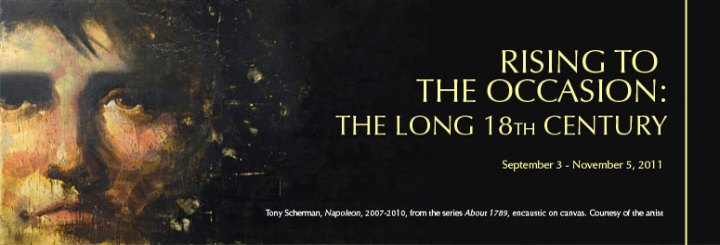
Rising to the Occasion: The Long 18th Century
The McMaster Museum of Art, Hamilton, Ontario, 3 September — 5 November 2011
Rising to the Occasion: The Long 18th Century is the governing title for exhibition-episodes that explore facets of culture and society in the 18th century—ideas, rather than attempts to tell the story of art as history. But art has a value in a historical reckoning—it does rise to the occasion, and allows both a mirror and lens perspective.
The choice of exhibition works interweaves the historical and the contemporary in order to open up different discussions—the legacies of the 18th century—enlightenment, empiricism, revolution and innovation and the instability of these ideas, as they speak to our unstable time. The keynote episode is borrowed directly from the title of Rebecca Belmore’s Rising to the Occasion. The original occasion was Belmore’s response to the Duke and Duchess of York’s official visit to Canada in 1987; she cobbled together and wore a hybrid-material dress in the manner and style of the 19th century. The new context is the inclusion of John Verelst’s so-described “Four Indian Kings” paintingswhich were commissioned by Queen Anne in 1710. The now disembodied Belmore dress as object-artifact has a resonance with Jean-Antoine Houdon’s 1767 life-sized plaster flayed figure—sculpted to show the body muscles—and in turn George Romney’s portrait with an écorché figure.
Paintings by Jean-Joseph Taillasson and Angelica Kauffmann, draw their subject matter from the classical world to send messages to their “18th-century present.” Taillasson’s audience was the new social order of post-Revolutionary France; for Kauffmann, a subject that could appeal to the heroic—in the wake of the first “global” Seven Years War—and her metatext on the role of women. A contemporary counterpoint is Tony Scherman’s monumental Napoleon painting, from his About 1789 series, which Scherman describes as a forensic portrait. Likewise, John Massey’s 1985 photo-collage serigraph Versailles is another forensic moment and constructed embodiment; an arm of collaged gold that cannot rise, gripped by the arm of the artist. Angela Grauerholz’s black and white photograph Voltaire’s Study (Voltaire was one of the great writer and humanists of the 18th century) has a subtle counterpoint in Taillasson’s painting, as Jiri Ladocha’s suite of Voltaire portraits have with the Houdon figure. Ladocha worked with a mould from Houdon’s Voltaire portrait bust, reconstructed as if it were a Cubist vision—the deep past, the historical modern, and the present.
◊ ◊ ◊ ◊ ◊

Jinny Yu and Don Andrus: Cadenza
The McMaster Museum of Art, Hamilton, Ontario, 3 September — 5 November 2011
Cadenza is a collaborative artist project. Jinny Yu and Don Andrus agreed upon the starting point, an early, major mural The Brazen Serpent, by Giovanni Battista Tiepolo (Italian, 1696-1770), and to work to the original dimensions, 164 x 1365 cm. The Brazen Serpent, is based on a biblical story of Moses and commissioned for the SS. Cosma e Damiano church in Venice. As a consequence of Napoleon’s invasion of Italy in 1797, and the suppression of the church, the mural was removed and taken to Castelfranco, 40 km away. It was left rolled up until the end of the 19th century when it was reinstalled at the Galleria dell’Accademia in Venice, a museum dedicated to Venetian painting from the Byzantine era to the 18th century.
The why of Tiepolo, and this mural, is different for the two artists. For Jinny Yu—working with oil on aluminium panels and a grisaille (monochromatic) technique—it was the condition of the work, the striations and loss of painting that occurred during its history, that opened up “modern questions.”
Yu wrote:
I am fascinated by the pictorial tension that is present due to the co-existence of illusional space Tiepolo created and the cracks on the surface of the painting left by years of bad conservation. I “express” these cracks on the surface of my work to emphasize a receding space—to explore the boundary between illusion and reality in painting.
For Andrus, it was the challenge of working figuratively, and at the same time, understanding and admiring Tiepolo’s contribution as one of the great colourists of the 18th century. He decided to “extract” twelve heads/portraits from the Tiepolo mural, but based eleven of them on individuals on Prince Edward Island—the twelfth is Jinny Yu. As he also commented on the importance and value in mining art history as if a geological undertaking, thereby revealing something below the surface.
The title Cadenza is apt, a term in music referring to improvisations within a scored piece of music. It was chosen as a reference to their intention in creating their own particular variation on Tiepolo’s mural.
◊ ◊ ◊ ◊ ◊

A Glimpse of China in the 18th Century
The McMaster Museum of Art, Hamilton, Ontario, 23 August 2011 — 7 January 2012
Curated by Angela Sheng
The 18th century in China witnessed the reign periods of three important Manchu emperors of the last imperial Qing (pronounced as ch’ing) dynasty (1644-1911): Emperor Kangxi (r. 1662-1722), Emperor Yongzheng (r. 1723-1735), and Emperor Qianlong (r. 1736-1795). Both Emperor Kangxi and his grandson, Emperor Qianlong, were intensely interested in other cultures. They emulated the scholarly elite of the Han majority whom they ruled, for example, composing poems and writing them in calligraphy and displaying them in many forms. Similarly, they showed much curiosity about the west. During these three prosperous reigns, the arts flourished at court with far-reaching implications for innovation. In this exhibition, with works from the McMaster Museum of Art, and private collections, we present a mere glimpse of the rippling effects as contrast to that which highlighted the 18th century in the West.
◊ ◊ ◊ ◊ ◊

The ‘Floating’ Urbanities of Utamaro and Hogarth: Pictures for Women?
The McMaster Museum of Art, Hamilton, Ontario, 23 August 2011 — 7 January 2012
Curated by Mark A. Cheetham
The famous printmakers and painters William Hogarth (1697-1764) and Kitagawa Utamaro (c.1753-1806) lived worlds apart. What little Hogarth knew of Asian art fell under the broad heading of Chinoiserie: lacquer, porcelain, and figurines popular in Britain since the East India Company traded out of Hirado, Japan c.1613-23. As late as the Great Exhibition of 1851 in London—almost a century after Hogarth’s death—the specific qualities of Japanese art remained officially a subset of Chinese achievement. Utamaro was equally unaware of European art.
Art historians like to see verifiable aesthetic influence of the sort Japanese art so powerfully exercised on British artists beginning in the 1860s. That wasn’t the relationship between Utamaro and Hogarth, but their remoteness can free us to consider connections other than those of cause and effect. Hogarth and Utamaro were strategically involved with the thriving commerce in prints in their respective metropolises and societies. Both struggled against competition and state censorship. We can also witness the unstable vicissitudes of two of the 18th century’s most vibrant visual cultures in these artists’ signature trade in images of women.
Both artists offered the many viewers of their prints infinitely intricate typologies of women and their activities. Hogarth mirrored the shifting social sands of London through endless anecdote. Utamaro construed Edo’s visual culture of women more simply and subtly but with no less purpose. Seeing this work together, we may productively reverse common opinion that would contrast Utamaro’s connoisseurial appreciation of women with Hogarth’s overt moralizing.
◊ ◊ ◊ ◊ ◊

First Contact? Artists of the Cook Voyages
The McMaster Museum of Art, Hamilton, Ontario, 26 August 2011 — 7 January 2012
As Australian art historian Bernard Smith wrote, the three voyages of Captain Cook (between 1768 and 1780) greatly enhanced the economic and political power of Europe in the Pacific, and added appreciably to a body of knowledge in the areas of botany, meteorology and a “nascent science of ethnography.”
The Cook voyages were not the absolute first contact, but they represented the first encyclopaedic and rigorous scientific exploration and documentation of the Pacific Rim and Antipodes. To this end, Cook was astute in enlisting professional artists to record plants, land, “effects” and people, and placed unprecedented demands on their skills and inventive responses, underscored by the instructions he gave; “to observe the Genius, Temper and Disposition…of the Natives and Inhabitants.” While this visual record is rarely considered within art history, Smith argued forcefully that it made a significant contribution to European empiricism of the 18th century. He proposed that it characterized a new respect and appreciation for drawing in the 18th century.
First Contact? is drawn from the collections of the Library and Archives Canada and the Art Gallery of Greater Victoria, including 2nd and 3rd voyage drawings by artists William Hodges and John Webber, and related works by Nathaniel Dance, James Basire, John Keyse Shirwin, and William Woollett. A complement component, from the McMaster Museum of Art collection, are works on paper by François Boucher, John Flaxman, Thomas Gainsborough, James Jeffreys and Giovanni Battista Tiepolo.
New Director Appointed at Versailles
As reported at ArtInfo (2 September 2011) . . .

Jean-Jacques Aillagon, Photo from his blog (click to visit)
Jean-Jacques Aillagon, the Versailles director who introduced contemporary art into the sanctum of the château, will leave his post on September 30. Faced with mandatory retirement as he turns 65, he wrote in a letter to the palace’s staff that “I will depart our establishment with the regret of leaving you.” Aillagon had hoped that a special dispensation would allow him to serve at least through the end of his current appointment in 2013. But Wednesday French president Nicolas Sarkozy appointed 57-year-old journalist Catherine Pégard to replace him as head of Versailles. . . .
The full article is available here»
◊ ◊ ◊ ◊ ◊
Whereas Aillagon was seen by some as provocative for his inclusion of work by Jeff Koons and Takashi Murakami at Versailles, Sarkozy’s new pick brings its own controversy. As reported at Art Media Agency (30 August 2011) . . .
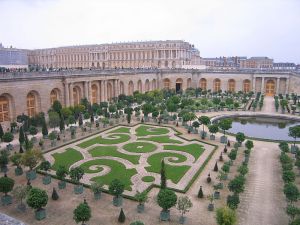
Versailles (Wikimedia Commons)
The French newspaper Libération has announced today the appointment of Catherine Pégard as President of Versailles. . . . The art world is sad to see the former director retire, who was shocked to see that Catherine Pégard would replace him. She has no university titles, experience or particular predispositions in order to direct such a prestigious museum as the Château de Versailles. She has worked as a political journalist, mostly at the Point, and more importantly, was nominated counsellor to the French president in 2007. Since 2008, she was in charge of his political entourage. . . .
The full AMA article is available here»
Call for Papers: Graduate Student Symposium at Yale
Call for Papers from the YCBA:

Art, Agency, Empire: India in Global Contexts — Graduate Student Symposium
Yale Center for British Art, New Haven, 11 February 2012
Proposals due by 31 October 2011
I enquired of monuments and ruins, I questioned the Vedas whose pages count their existence by thousands of years…. And then did India appear to me in all the living power of originality. —Louis Jacolliot (1869)
The objective of this one-day graduate student symposium is to work against earlier paradigms by asserting the existence of multiple forms of agency—artistic, cultural, political—in India from about 1600 to Independence and beyond. The symposium also aims to examine visual and cultural exchanges between India and the rest of the world, with special (but not exclusive) reference to Britain and the British Empire. We welcome papers discussing the broadest range of visual materials, from architecture and material culture through representations in various media, and proposing interpretations that may engage with questions of agency, artistic identity, power, and politics. We aim to complicate canonical categories such as the “Company School,” “Mughal Miniature,” “British Art” and “British India,” “Swadeshi,” and even “diaspora” by critiquing methodologies currently employed in researching, interrogating, and evaluating materials from this place and time.
This symposium is informed by the recent proliferation of projects on India’s visual and material culture, including two exhibitions opening at the Yale Center for British Art in the fall of 2011: Johan Zoffany RA: Society Observed, which includes a substantial section devoted to the works the artist produced during his residence in India, between 1783 and 1789; and Adapting the Eye: An Archive of the British in India, 1770–1830, which concentrates on the complex networks of British and Indian artists, patrons, and scholars in the late eighteenth and early nineteenth centuries. Art, Agency, Empire: India in Global Contexts explores how, in a postcolonial period, it has become increasingly pressing to reevaluate India as a site of multifarious cultural (indeed intercultural) production, which has provoked global responses across media. Topics may include, but are not limited to:
- colonizing, Independence, and postcolonial contexts
- construction of identities
- spaces of India: maps, landscapes, cityscapes, panoramas
- architecture: exterior and interior
- monuments and monumentality
- popular print, graphic satire, illustrated books
- art as document/document as art
- bodies of evidence: collections, compilations, physical bodies
- methodological innovations
- caretaking sources: conservation, preservation, digitization
We invite proposals for 25-minute papers on this theme from graduate students working in any discipline. Special consideration will be given to papers examining the topic in relation to the British involvement in India. Cross-disciplinary and comparative studies are particularly welcome. Please e-mail abstracts of no more than 300 words by October 31, 2011 to lars.kokkonen@yale.edu, Lars Kokkonen, Postdoctoral Research Associate Research Department Yale Center for British Art. Travel funds for speakers are available upon application.
Exhibition: ‘Adapting the Eye: An Archive of the British in India’
From the YCBA:
Adapting the Eye: An Archive of the British in India, 1770-1830
Yale Center for British Art, New Haven, 11 October — 31 December 2011
Curated by Holly Shaffer with Gillian Forrester
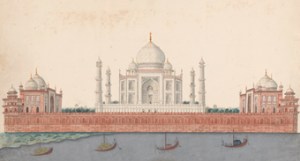 Organized to complement the Center’s major exhibition on Johan Zoffany, who spent six productive years in India, Adapting the Eye explores the complex and multifaceted networks of British and Indian professional and amateur artists, patrons, and scholars in British India in the later eighteenth and early nineteenth centuries, and their drive to create and organize knowledge for both aesthetic and political purposes. Selected from the Center’s rich holdings, the exhibition includes a diverse range of objects from both high art and popular culture, including albums, scrapbooks, prints, paintings, miniatures, and sculpture, demonstrating how collecting practices and artistic patronage in India during that period constituted a complex intersection of culture and power.
The starting point and central focus of the exhibition is a remarkable and little-known archive in the Center’s collection assembled by Charles Warre Malet and the British artist James Wales. Warre Malet was the East India Company’s Resident in Pune between 1785 and 1798. He and Wales commissioned over a hundred works on paper by British and Indian artists, which are included in the archive together with extensive manuscript material and vivid sketches of landscape, architectural sites, scenes from everyday life, and diplomatic ceremonial events. An extensive selection of drawings from the archive, complemented by other works from the collections, provides a unique window into central India at a critical historical moment. A pivotal figure in this rich cultural interchange was the highly accomplished Indian draftsman and sculptor Gangaram Tambat, who drew on both indigenous and European artistic conventions; his remarkable hybrid drawings are juxtaposed with works by British artists, including William Hodges, William and Thomas Daniell, Robert Mabon, and James Wales.
BGC Study Day: Conserving Hats
From the BGC:
Study Day: The Conservation of Historic Hats
Bard Graduate Center, New York, 14 October 2011

Henry Pickering, "Portrait of Eleanor Frances Dixie, daughter of Wolstan Dixie, 4th Baronet," 1753 (Nottingham City Museums & Galleries)
This study day introduces rate examples of headwear from the collection of the Metropolitan Museum of Art including: Tudor flat caps, a straw hat purported to be a gift from Henry VIII, and hats by Philip Treacy. Textile conservator Chris Paulocik will discuss the conservation and storage of these unique objects. After lunch at the BGC, artist and textile historian Edward Maeder will demonstrate the construction of selected hats from the eighteenth through twentieth centtury. Participants will learn stitching techniques using straw, ribbons, floral decoration and feathers.
Chris Paulocik is a textile conservator at the Metropolitan Museum of Art.
Edward Maeder is an artist, textile historian, and former curator of costumes and textiles at the Los Angeles County Museum of Art.
$130 Adult / $100 Students and Seniors — Registration fee includes a supply kit.
This Year’s Seminar Series at the BGC
The Bard Graduate Center’s 2011-2012 Seminar Series looks especially promising. The following is a selection of eighteenth-century topics, while the full program is available here
◊ ◊ ◊ ◊ ◊
Bard Graduate Center Seminar Series
New York, 2011-2012

Bard Graduate Center, West 86 Street, New York, NY. Photo: Wikimedia Commons
October 11
Florian Knothe (Curator of European Glass, Corning Museum of Glass)
Beyond the Old Silk Road: International Influences in Glassmaking in the 18th and 19th Centuries
October 25
Sylvain Cordier (Independent Scholar)
Bellangé, Ebénistes à Paris: A History of Taste in Early Nineteenth-Century France
February 22
Robert Stein (Museum Information Systems, Indianapolis Museum of Art)
Conversation and Collaboration: Strategies to Cultivate Meaningful Engagement with Cultural Audiences
February 28
Kristel Smentek (Architecture, MIT)
Encountering Asia in Eighteenth-Century France
March 13
Sussan Babaie (Art History, Ludwig-Maximilians University, Munich)
Nadir Shah’s Delhi Loot and the Eighteenth-Century Exotics of Empire
April 3
Kimberly Chrisman-Campbell (Independent Curator)
When Fashion Set Sail: Maritime Modes in Pre-Revolutionary France
New Titles from The Getty
Elena Phipps, Looking at Textiles: A Guide to Technical Terms (Los Angeles: Getty Publications, January 2012), 112 pages, ISBN: 9781606060803, $18.95.
 Textiles have been made and used by every culture throughout history. However diverse—whether an ancient Egyptian mummy wrapping, a Turkish carpet, an Italian velvet, or an American quilt—all textiles have basic elements in common. They are made of fibers, constructed into forms, and patterned and colored in ways that follow certain principles.
Looking at Textiles serves as a guide to the fundamentals of the materials and techniques used to create textiles. The selected technical terms explain what textiles are, how they are made, and what they are made of, and include definitions of terms relating to fibers, dyes, looms and weaving, and patterning processes. The many illustrations, including macro- and microscale photographs of a range of ancient and historic museum textiles, demonstrate the features described in the text.
Elena Phipps was a textile conservator at the Metropolitan Museum of Art for over thirty years. She has published numerous scholarly works on textile materials, techniques, and culture, including The Colonial Andes: Tapestries and Silverwork, 1530–1830 (Metropolitan Museum of Art, 2004), which was awarded both the Alfred H. Barr, Jr., Award (College Art Association) and the Mitchell Prize for best exhibition catalogue.
◊ ◊ ◊ ◊ ◊
Johann Joachim Winckelmann, introduction, translation, and commentary by Carol C. Mattusch, Letter and Report on the Discoveries at Herculaneum (Los Angeles: Getty Publications, January 2011), 240 pages, ISBN: 9781606060896, $50.
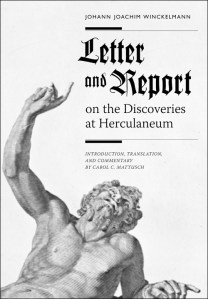 This new translation brings to light early scientific archaeology and the study of Herculaneum and Pompeii as observed by the erudite and acerbic art historian Johann Joachim Winckelmann (1717–1768). His Letter, published in German in 1762, displays his knowledge of geology, ancient literature, and art while offering a scathing critique of the Spanish Bourbon excavations around the Bay of Naples and of the officials involved. He further discusses these topics in his equally controversial Report of 1764.
The introduction describes the context in which these texts were written, identifies various politicians, academics, and collectors, and elucidates topics of particular interest to Winckelmann, from artifacts to local customs to the contents of ancient papyri. The illustrations, particularly those from the Bourbon publication—Le Antichità di Ercolano (1757–92)—illuminate how these monuments influenced contemporary perceptions of the ancient world.
Johann Joachim Winckelmann was a groundbreaking Prussian art historian and author of History of Ancient Art (1764). Carol C. Mattusch is Mathy Professor of Art History at George Mason University in Fairfax, Virginia, and author of The Villa dei Papiri at Herculaneum: Life and Afterlife of a Sculpture Collection (Getty Publications, 2005), which won the Charles Rufus Morey Book Award.
◊ ◊ ◊ ◊ ◊
Lance Mayer and Gay Myers, American Painters on Technique: The Colonial Period to 1860 (Los Angeles: Getty Publications, October 2011), 260 pages, ISBN: 9781606060773, $50.00
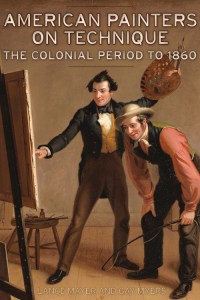 This is the first comprehensive study of an important but largely unknown part of the history of American art: the materials and techniques used by American painters. Based on extensive research, including artists’ recipe books, letters, journals, and painting manuals, much previously unpublished, the authors have also drawn on their many years as conservators of paintings for museums and collectors.
Information is provided on the methods of painters such as Benjamin West, Gilbert Stuart, Washington Allston, Thomas Sully, Thomas Cole, and William Sidney Mount. Topics include the quest for the “secrets” of the Old Masters; how artists saw their paintings changing over time; the application of “toning” layers; and the evolving self-confidence of American experimenters and innovators.
The book will be of interest to curators, art historians, painters, and conservators and will form the basis for future research on American painting techniques. At a time of discovering new approaches to art history, the story of how paintings were made parallels the better known histories about how styles changed and how paintings were commissioned, exhibited, and sold.
Lance Mayer and Gay Myers work at the Lyman Allyn Art Museum in New London, Connecticut, and as independent conservators.
Exhibition: ‘Luminous Paper, British Watercolors and Drawings’
From a Getty press release:
Luminous Paper: British Watercolors and Drawings
At the J. Paul Getty Museum, Getty Center, Los Angeles, 19 July — 23 October 2011
Curated by Julian Brooks

Thomas Girtin, "Durham Cathedral and Castle," ca. 1800 watercolor over pencil heightened with gum Arabic (Los Angeles: The J. Paul Getty Museum)
Watercolor is one of the most challenging artistic techniques—capable of extraordinary luminosity but often resistant to control. Luminous Paper: British Watercolors and Drawings presents more than 25 works of the 1700s and 1800s by some of the greatest masters of the medium, many on view for the first time.
Featuring the work of some of the most famous British artists, including J.M.W. Turner, William Blake, and Samuel Palmer, this exhibition reveals their multifaceted innovations in the field of drawing and watercolor painting. From Turner’s use of his thumbprint to roughen the texture of wash in a whirling seascape, to the reflected and re-reflected light built in layers by John Sell Cotman, the medium of watercolor was transformed beyond recognition. Other artists experimented with novel subject matter or new modes of representation, playing important roles in the development of European drawing and watercolor painting.
“Key works have been added to the Getty’s collection in the last few years as part of an ongoing initiative to build our holdings of British drawings and watercolors to better represent the wider European tradition,” said Associate Curator Julian Brooks, who curated the exhibition. “Many of these works have been recently acquired and we’re thrilled to be publicly displaying them for the first time in generations.”
Among the recent acquisitions is Durham Cathedral and Castle (about 1800) by Thomas Girtin, a dramatic view of a medieval cathedral and castle set on a rocky outcrop above the water, amid the moving light of a bright, cloudy sky. Girtin died of tuberculosis at the age of 27, two years after making this drawing. His rival J.M.W. Turner is reputed to have said “Had poor Tom lived, I would have starved.” Another is View of the Church of Our Lady of Hanswijk, Mechelen (1831) by Thomas Shotter Boys, a central figure in Anglo-French artistic exchange of the period, and one of the most sophisticated practitioners of watercolor. He excelled in capturing effects of atmosphere and mood. (more…)










leave a comment