New Book | Native Nations: A Millennium in North America
From Penguin Random House:
Kathleen DuVal, Native Nations: A Millennium in North America (New York: Random House, 2024), 752 pages, ISBN: 978-0525511038, $38.
 Finalist for the Cundill History Prize
Long before the colonization of North America, Indigenous Americans built diverse civilizations and adapted to a changing world in ways that reverberated globally. And, as award-winning historian Kathleen DuVal vividly recounts, when Europeans did arrive, no civilization came to a halt because of a few wandering explorers, even when the strangers came well armed.
A millennium ago, North American cities rivaled urban centers around the world in size. Then, following a period of climate change and instability, numerous smaller nations emerged, moving away from rather than toward urbanization. From this urban past, egalitarian government structures, diplomacy, and complex economies spread across North America. So, when Europeans showed up in the sixteenth century, they encountered societies they did not understand—those having developed differently from their own—and whose power they often underestimated.
For centuries afterward, Indigenous people maintained an upper hand and used Europeans in pursuit of their own interests. In Native Nations, we see how Mohawks closely controlled trade with the Dutch—and influenced global markets—and how Quapaws manipulated French colonists. Power dynamics shifted after the American Revolution, but Indigenous people continued to command much of the continent’s land and resources. Shawnee brothers Tecumseh and Tenskwatawa forged new alliances and encouraged a controversial new definition of Native identity to attempt to wall off U.S. ambitions. The Cherokees created institutions to assert their sovereignty on the global stage, and the Kiowas used their power in the west to regulate the passage of white settlers across their territory.
In this important addition to the growing tradition of North American history centered on Indigenous nations, Kathleen DuVal shows how the definitions of power and means of exerting it shifted over time, but the sovereignty and influence of Native peoples remained a constant—and will continue far into the future.
Kathleen DuVal is a professor of history at the University of North Carolina at Chapel Hill, where she teaches early American and American Indian history. Her previous work includes Independence Lost, which was a finalist for the George Washington Prize, and The Native Ground: Indians and Colonists in the Heart of the Continent. She is a coauthor of Give Me Liberty! and coeditor of Interpreting a Continent: Voices from Colonial America.
Exhibition | Colonial Crossings: The Spanish Americas

Unidentified workshop, Cuzco, Peru, Our Lady of the Rosary of Chiquinquirá with Female Donor, late 17th–early 18th century, oil and gold on canvas (Collection of Carl & Marilynn Thoma, 2013.046; photo by Jamie Stukenberg).
◊ ◊ ◊ ◊ ◊
Now on view at Cornell’s Johnson Museum of Art:
Colonial Crossings: Art, Identity, and Belief in the Spanish Americas
Johnson Museum of Art, Cornell University, Ithaca, New York, 20 July 2024 — 15 December 2024
Curated by Andrew Weislogel and Ananda Cohen-Aponte, with students in the course Colonial Connectivities: Curating the Arts of the Spanish Americas
The artworks featured in this exhibition span more than three hundred years of history, five thousand miles of territory, and two oceans, introducing the rich artistic traditions of Mexico, Venezuela, Colombia, Ecuador, Peru, Bolivia, Cuba, Puerto Rico, and the Philippines during the period of Spanish colonial rule (approximately 1492–1830).
This first exhibition of colonial Latin American art at Cornell considers the profound impact of colonization, evangelization, and the transatlantic slave trade in the visual culture of the Spanish empire, while also manifesting the creative agency and resilience of Indigenous, Black, and mixed-race artists during a tumultuous historical period bookended by conquest and revolution.
At first glance, these religious images, portraits, and luxury goods might seem to uphold colonial structures that suggest a one-way flow of power from Europe to the Americas. Yet closer consideration of these artists’ identities, materials, techniques, and subjects reveals compelling stories about the global crossings of people, commodities, and ideas in the creation of new visual languages in the Spanish Americas. These artworks testify to entangled cultural landscapes—from paintings of the Virgin Mary with ties to sacred sites of her apparition, to lacquer furniture bearing the visual stamp of trade with East Asia, they embody a plurality of cultural, material, and religious meanings.
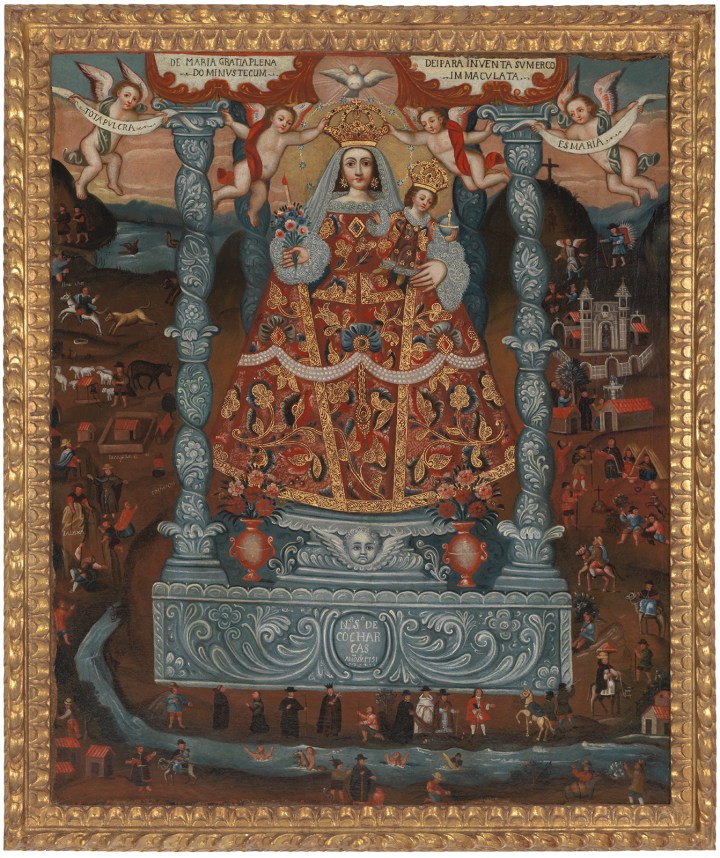
Unidentified workshop, Peru, Our Lady of Cocharcas, 1751, oiil and gold on canvas (Collection of Carl & Marilynn Thoma, 2011.040; photo by Jamie Stukenberg).
Colonial Crossings was curated by Dr. Andrew C. Weislogel, Seymour R. Askin, Jr. ’47 Curator of Earlier European and American Art at the Museum, and Dr. Ananda Cohen-Aponte, Associate Professor of the History of Art & Visual Studies, and the students in Colonial Connectivities: Curating the Arts of the Spanish Americas (ARTH 4166/6166):
Osiel Aldaba ’26
Miguel Barrera ’24
Daniel Dixon ’24
Juliana Fagua Arias, PhD student
Miche Flores, PhD student
Isa Goico ’24
Sara Handerhan ’24
Emily Hernandez ’25
Ashley Koca ’25
Maximilian Leston ’26
Maria Mendoza Blanco ’26
Lena Sow, PhD student
Nicholas Vega ’26
We are grateful to lenders Carl and Marilynn Thoma, the Denver Museum of Art, the Hispanic Society of America, and the Division of Rare and Manuscript Collections, Cornell University Library; and to David Ni ’24, the 2023 Nancy Horton Bartels ’48 Scholar for Collections, for organizational support.

Unidentified artist, Quito, Ecuador, Noah’s Ark, detail, late 18th century, oil on canvas (Collection of Carl & Marilynn Thoma, 2000.004).
◊ ◊ ◊ ◊ ◊
The Johnson Museum will also present this symposium:
Symposium | Reimagining the Américas: New Perspectives on Spanish Colonial Art
Online and in-person, Saturday, 9 November 2024
At this free symposium, presented in conjunction with the exhibition, established scholars whose work encompasses a variety of regions and approaches to colonial Latin American art history will offer new methodologies, seeking to expand the boundaries of this visual culture. Presentations will explore the exhibition’s thematic emphases on materiality and sacredness, hybridity and cross-cultural exchange, colonial constructions of race, and recovering art histories marked by silence and erasure.
• Time-Warping the Museum: Temporal Juxtapositions in Displays of Spanish Colonial Art — Lucia Abramovich, Museum of Fine Arts, Boston
• Framing Miracles for a New World: The Oval — Jennifer Baez, University of Washington
• Trent as Compass: Directions, Circuits, and Crossings of the Visual and Canonical in Spanish America — Cristina Cruz González, Oklahoma State University
• Splendor and Iridescence: Pearls in the Art of the Spanish Americas — Mónica Dominguez Torres, University of Delaware
• ‘Your Plenteous Grandeur Resides in You’: Asian Luxury in Spanish American Domestic Interiors — Juliana Fagua Arias, Cornell University
• Supplicant Africans: From Baptizands to Emblems of Abolition —Elena FitzPatrick Sifford, Muhlenberg College
• Voices of Influence: Exploring Power Dynamics in the Conservation of Musical Heritage in Colonial Latin America — Patricia García Gil, Cornell University
• Invisible Soldiers and Constant Servants: The Pre-Hispanic Roots of the Andean Cult of Angels — Maya Stanfield-Mazzi, University of Florida
A schedule will be posted soon. Please email eas8@cornell.edu to register in advance for in-person attendance. Click here to join the webinar.
Call for Papers | Global Material Culture and the Body, BSECS 2025 Panel
From HECAA:
Panel | Global Material Culture and the Body
British Society for Eighteenth-Century Studies Conference, Pembroke College, Oxford, 8–10 January 2025
Panel organized by Chloe Wigston Smith
Proposals for this session due by 18 October 2024
 Jointly supported by the Historians of Eighteenth-Century Art and Architecture and the University of York’s Center for Eighteenth Century Studies, this panel aims to foster interdisciplinary conversations about the relations between global material culture and the body, in keeping with the theme of the 54th annual BSECS conference, Bodies and Embodiment. Papers might focus on the body’s physical proximity to examples of global material culture, whether in the form of clothes, accessories, cosmetics, and domestic furnishings (and more); the body’s haptic experience of global objects, through making, production, handling, and consumption; and / or the representation of the body and bodies on specific objects. Papers might focus on a wide range of print, visual, and material sources, including ceramics, drawings, watercolours, handiwork, woodwork, etc, and / or the broad range of materials in the period, such as cotton, indigo, or silver. Submissions from early career scholars are especially encouraged. Please submit abstracts of no more than 350 words along with a short (1 page) CV to Chloe Wigston Smith at chloe.wigstonsmith@york.ac.uk.
Please note that selected presenters will need to become members of BSECS to register for the conference. Or BSECS honors ASECS memberships, so if you are an ASECS member you will not need to join BSECS.
Conference | The Window as Protagonist

Eric Ravilious, Beachy Head Lighthouse (Belle Tout), 1939, pencil and watercolour on paper (Christie’s Images / Bridgeman Images).
◊ ◊ ◊ ◊ ◊
From the Mellon Centre:
The Window as Protagonist in British Architecture and Visual Culture
Online and in-person, Paul Mellon Centre and The Warburg Institute, London, 21–22 November 2024
Organized by Rebecca Tropp
This two-day conference will explore the multifaceted, multi-purpose nature of the window as protagonist, with an emphasis on its place in British architecture and visual culture, broadly conceived. A range of interdisciplinary papers presented by international scholars will provide a platform for dynamic and engaging discourse that forefronts the cultural and social significance of the window in its many guises as object, as boundary, as frame, and as mediator.
More information is available here»
t h u r s d a y , 2 1 n o v e m b e r
Paul Mellon Centre
Panel 1 | Visions of Light
• Benet Ge (student, Williams College) — Looked Through: Edward Orme’s Transparent Prints and Masculinizing Georgian Windows, remote
• Francesca Strobino (independent) — The Window as a Test Object: W.H.F. Talbot’s Early Photographic Experiments with Latticed Patterns, remote
• Victoria Hepburn (postdoctoral associate, Yale Center for British Art) — A ‘Luminous Framework’ but not ‘Glass of a Modern Kind’: William Bell Scott’s Painted Windows for the Ceramic Gallery at the South Kensington Museum, remote
Panel 2 | Social Relations
• Shaona Barik (assistant professor of English literature at Visva-Bharati, Santiniketan, India) — Health, Hygiene, Sanitation in Colonial Bengal: Case Study of Windows, 1860–1920, remote
• Albie Fay (writer) — Through the Broken Glass: The Window as a Symbol of Social Unrest in Britain and Northern Ireland
• Ellie Brown (PhD candidate, University of Warwick) — The Window as a Frame and Boundary in the Shopping Centre
f r i d a y , 2 2 n o v e m b e r
The Warburg Institute
Panel 1 | The Art of Display: From Museums to Shop Windows
• Laura Harris (Senior Research Fellow, University of Southampton) — Art Gallery Windows
• Naomi Polonsky (assistant curator, House and Collection, Kettle’s Yard) — ‘The Vision of the Mind’: Windows In and Out of Art at Kettle’s Yard
• Alexandra Ault (Lead Curator of Manuscripts, 1601–1850, British Library) — Re-glazing the Print Shop Window: The Impact of Glass Technology on the Commercial Display of Fine Art Prints, ca. 1850–1900
• Birgitta Huse (social anthropologist, independent researcher) — More Than a Glimpse ‘In Passing’: Reflecting on Shop Windows as Provocateurs between Art, Commerce, and Cultural Traditions
Panel 2 | Architectural Manipulation
• Steven Lauritano (lecturer in architectural history, Leiden University) — Windows of Learning: Robert Adam, William Henry Playfair, and the Old College, University of Edinburgh
• Rebecca Tropp (archivist, Crosby Moran Hall and former Research and Events Convener at the Paul Mellon Centre) — Windows and the Picturesque
Panel 3 | Transparency and Materiality
• Alice Mercier (PhD researcher, University of Westminster) — Photographic Looking before Photographs: Watching through Windows in the Early-mid Nineteenth Century, remote
• Ruth Ezra (lecturer in art history, University of St Andrews) — Muscovy Glass, from Fenestration to Demonstration
• Deborah Schultz (senior lecturer in art history, Regent’s University London) — The Window as a Lens in the Work of Anna Barriball
Panel 4 | Cinematic and Literary Horrors
• Vajdon Sohaili (assistant professor of art history and contemporary culture, Nova Scotia College of Art and Design University) — Glass, Darkly: Equivocal Windows and the Architectural Paratext in Don’t Look Now
• Francesca Saggini (professor in English literature at the Università della Tuscia) — The Horror at the Window
Berger Prize Shortlist, 2024
From the press release for the shortlist, as shared on 15 September; the winner will be announced 15 November.
 The Walpole Society has recently announced the shortlist for the Berger Prize, the most prestigious book prize for art history, including a major publication on Gwen John, one of the most significant British women artists of the 20th century, and a book which explores the role that art played in destabilising the legitimacy of the one of the most powerful corporations in history: the East India Company.
A lifetime of knowledge is gifted to the reader in Steven Brindle’s monumental Architecture in Britain and Ireland 1530–1830 (Paul Mellon Centre). From its brilliant opening introduction this magisterial overview sets the national architectural story alight and the reader is struck by the scale and the sweep of history that Brindle handles with consummate skill, revealing a lifetime of practical and scholarly expertise in the field. This book will become an essential handbook and a classic study for future generations of scholars.
In her critical biography, Gwen John: Art and Life in London and Paris (Thames & Hudson), Alicia Foster deftly dismantles the various myths surrounding John and ensures that she regains her full artistic stature; the author asks important theoretical questions about the status of a self-portrait and the artist-model relationship in the nineteenth and twentieth centuries. Enriched by over 240 reproductions of paintings and contemporary photographs and through many excerpts of letters, the reader is immersed in the artist’s deeply personal aesthetic world.
Richly researched and beautifully written, Laura Freeman charts the story of one of the most fascinating figures of mid-century British art, the curator, patron and museum maker, Jim Ede. Ways of Life: Jim Ede and the Kettle’s Yard Artists (Penguin, Jonathan Cape), brings Ede’s Cambridge house to life, offering fresh insights into its familiar collection of paintings, sculptures and pebbles. Based on meticulous research, Freeman populates her narrative with a fascinating cast of characters from Henri Gaudier-Brzeska to T.E. Lawrence.
 Highlighting an area which is gaining momentum and interest for scholars as well as collectors, Alun Graves’s Studio Ceramics (Thames & Hudson / V&A) presents the state of the national collection of Studio Ceramics and will have international impact. The exemplary writing, photography and design make this the unmissable reference work on the subject.
The complex world of post-colonial scholarship is nimbly traversed for a modern audience by Tom Young in Unmaking the East India Company: British Art and Political Reform in Colonial India, c.1813–58 (Paul Mellon Centre). This revelatory book explores how the visual culture of members of the East India Company prompted significant structural change. Fresh material is explored from a compelling new angle, charting the ways in which new artistic forms and practices presaged shifts in the governance of the Company and its relationship with the people it governed. This is a dazzling and erudite intervention that will define the discipline for future generations.
The Berger Prize is the most prestigious award in art history, offering the largest cash prize in the field: £5,000 is awarded to the winner and £500 to each of the shortlisted authors. Named in honour of the late William B. Berger, whose collection of British art is on display at the Denver Art Museum in his native Colorado, the award was founded in 2001 by the Berger Collection Educational Trust (BCET) and The British Art Journal. This year, for the first time, The Walpole Society, which promotes the study of Britain’s art history, has partnered with the BCET to deliver the prize, which celebrates brilliant writing and scholarship about the arts and architecture of the United Kingdom.
Lecture | Black Genius: The Extraordinary Portrait of Francis Williams
From the V&A:
Fara Dabhoiwala | Black Genius: Science, Race, and the Extraordinary Portrait of Francis Williams
Online and in-person, Victoria & Albert Museum, London, 16 October 2024, 7pm (2pm ET)

Unidentified painter, Portrait of Francis Williams of Jamaica, ca. 1740, oil on canvas, 76 × 64 cm (London: V&A).
Join historian Fara Dabhoiwala for the captivating story behind one of the V&A’s most fascinating portraits.
In 1928, the V&A acquired a previously unknown portrait. It shows the Black Jamaican polymath Francis Williams (c. 1690–1762), dressed in a wig, surrounded by books and scientific instruments. In all of the previous history of Western art, there is no other image like this: a man who had been born into slavery, shown as a gentleman and scholar. The museum presumed it was a satire—but who had made it, when, where, and why, has remained a puzzle ever since. Join Fara Dabhoiwala as he reveals the astonishing story of the painting’s true meaning, its connections to the greatest scientists of the Enlightenment—and Francis Williams’s extraordinary message to posterity. This talk will be streamed on Zoom, and all ticketholders will receive a link to view the morning of the event.
The talk is in association with the London Review of Books.
Lecture | Jean-Baptiste Boiston (1734–1814): Sculpteur ornemaniste
Upcoming at the Institut culturel italien de Paris:
Brice Leibundgut et Maxime Georges Métraux | Jean-Baptiste Boiston (1734–1814): Sculpteur ornemaniste de l’hôtel de Gallifet
Institut culturel italien de Paris / Istituto Italiano di Cultura di Parigi, 24 October 2024, 6.30pm
Né en 1734 à Morteau, dans le Doubs, Jean-Baptiste Boiston est un sculpteur ornemaniste de premier plan durant la seconde moitié du XVIIIe siècle. Il est principalement actif à Paris de 1760 à 1792, avant d’émigrer au moment de la Révolution. En 1814, au lendemain de la Restauration, il revient s’établir dans la capitale française où il s’éteint cette même année. Cette conférence se propose d’étudier son œuvre et d’inventorier sa production connue à ce jour. Les créations de Jean-Baptiste Boiston sont principalement à destination de nombreux hôtels particuliers parisiens, mais aussi au service du prince de Condé (Palais Bourbon, château de Chantilly). Ses différents chantiers auprès de l’architecte Étienne François Legrand feront l’objet d’une analyse détaillée, au premier rang desquels le chantier de l’hôtel de Galliffet, actuel Institut culturel italien de Paris. Cette conférence sera l’occasion de plonger dans l’univers de cet entrepreneur en ornements sous le règne de Louis XVI, de découvrir son métier et ses spécificités, mais aussi d’évoquer sa relation avec l’Italie.
Brice Leibundgut, historien de l’art, trésorier et administrateur de la Société de l’Histoire de l’Art français, spécialiste de l’art en Franche-Comté, expert UFE de trois peintres de cette région : Gustave Courtois, Dagnan-Bouveret, Robert Fernier.
Maxime Georges Métraux, historien de l’art, membre de l’équipe de la galerie Hubert Duchemin et chargé d’enseignement à l’université Paris 1 Panthéon-Sorbonne, administrateur de la Société de l’Histoire de l’Art français.
Online Talk | Rachel Jacobs on Ornament Prints at the Cooper Hewitt
From the Cooper Hewitt:
Rachel Jacobs | A Dictionary of Ornament: Highlights from Cooper Hewitt’s Print Collection
Online (via Zoom), 24 October 2024, 1.00pm ET
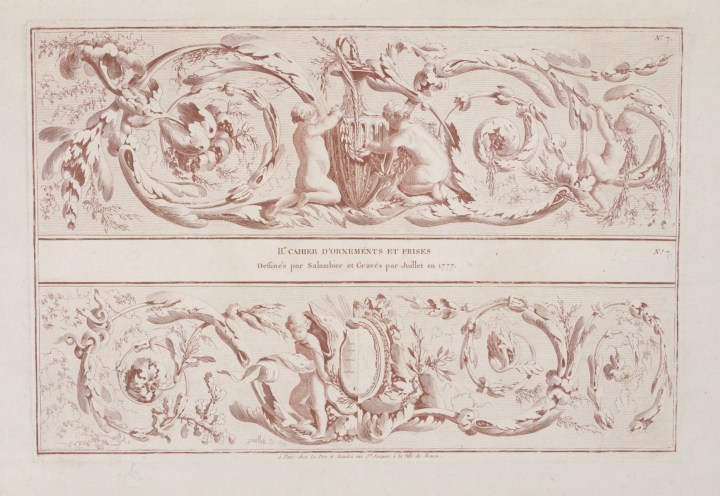
Title page and Frieze Designs, plate 7 from IIe Cahier d’Ornements et Frises (2nd Book of Ornaments and Friezes), 1777; Jacques Juillet after Henri Sallembier, published by Le Père et Avaulez (Paris); etching and engraving in red ink on laid paper (Cooper Hewitt).
Join Cooper Hewitt for an illustrated talk exploring the Decloux collection of ornament and architecture prints. The museum is home to the premier collection of ornament prints in the United States, consisting of over 13,000 European prints from the 16th to the 19th centuries. The lecture will include highlights from the collection by some of the most celebrated artists and designers of the period, as well a discovery of more hidden treasures by many forgotten or lesser-known artists and printmakers.
Ornament prints were produced with the purpose of illustrating designs, patterns, or motifs of decorative ornament for use by craftsman and applicable to all aspects of applied arts from ceramic vases to furniture, from wall paneling to wrought-iron gates. This illustrated talk will introduce the Decloux collection of ornament and architecture prints by exploring the language of ornament. How do these printmakers and publishers describe and title their works? What are the most common terms and motifs found in this broad genre and why? And how do these two-dimensional intaglio prints translate to real three-dimensional objects and interiors?
The talk is free with registration. It will also be recorded and posted on Cooper Hewitt’s YouTube channel within two weeks.
Rachel Jacobs is an independent curator specializing in French 17th-and 18th-century books and prints, based in Toronto, Canada. Since 2021, she is the Remote Senior Research Cataloguer for the Decloux collection of ornament and architecture prints in the Department of Drawings, Prints, and Graphic Design at Cooper Hewitt, Smithsonian Design Museum. She was previously Curator of Books and Manuscripts at Waddesdon Manor (Rothschild Collections) National Trust in England, where she continues to work remotely part-time. She has curated several exhibitions at Waddesdon Manor including most recently Alice’s Wonderlands: Life, Collections, and Legacy of Alice de Rothschild (1847–1922) (2022–23, co-curated).
Caitlin Condell is the associate curator and head of the Department of Drawings, Prints, and Graphic Design at Cooper Hewitt, Smithsonian Design Museum, New York, where she oversees a collection of nearly 147,000 works on paper dating from the 14th century to the present. She has organized and contributed to numerous exhibitions and publications. Prior to joining the Smithsonian, Condell held positions at the Massachusetts Museum of Contemporary Art and The Museum of Modern Art.
Research Lunch | London’s Periodical Architecture, 1700–1750
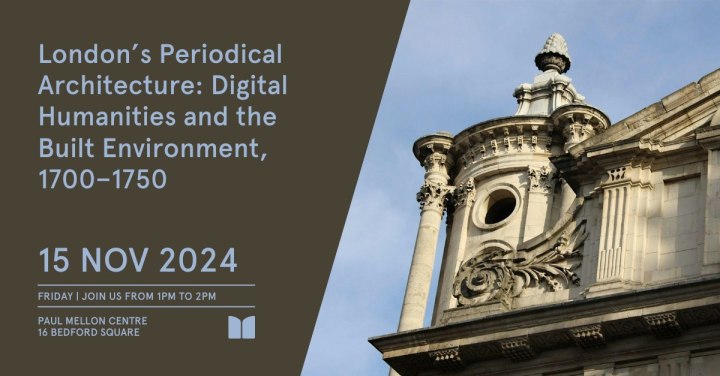
Thomas Archer, St John Smith Square, London, completed in 1728
(Photo: © Matthew Lloyd Roberts)
◊ ◊ ◊ ◊ ◊
Next month at the Mellon Centre:
Matthew Lloyd Roberts | London’s Periodical Architecture: Digital Humanities and the Built Environment, 1700–1750
Paul Mellon Centre, London, 15 November 2024, 1pm
In recent years, large-scale digitisation of early modern periodicals has revolutionised the searchability of collections of ephemeral print culture. Enabled by optical character recognition technology, this shift has transformed the way scholars use databases of primary material, introducing new quantitative approaches to these vast collections. However, this shift also poses epistemological questions within new digital humanities frameworks. The paper will explore this shift by presenting material newly discovered by these methods relating to church building in London in the first half of the eighteenth century. Firstly, looking at the way that the work of the New Churches Commission was represented and debated by the politically factional newspaper culture in the first years of Hanoverian rule, and then recognising the effect this discourse may have had in shaping the way that people experienced the city. By incorporating periodical culture as an important context of the work of the Commission, for the first time this study proposes a substantive media and reception history of these iconic buildings of the English Baroque.
Furthermore, this paper will consider the explosion of architectural publishing in the periodical press of the mid-1730s, in the context of James Ralph’s Critical Review, examining the way that architectural practitioners such as John James were increasingly forced to foray into periodical culture to defend their expertise and reputations. These events will be read towards the political and social meanings of church building and church restoration, and the growing anxiety about the need to disambiguate the meanings of the built environment to the urban public in an age of print culture.
Matthew Lloyd Roberts is a history of art PhD candidate at Downing College, Cambridge and member of the Ax:son Johnson Centre for the Study of Classical Architecture. His PhD research is concerned with the cultural reception of the changing built environment of England in the seventeenth and eighteenth centuries. He studied ancient and modern history at Keble College, Oxford and has an MA in architectural history from the Bartlett, UCL. Complementing his academic work, he is also interested in disseminating academic research to broader audiences and produces and hosts two podcasts concerned with architectural history and culture, the independent About Buildings and Cities and the official podcast of the Society of Architectural Historians of Great Britain. His architectural criticism has also appeared in Tribune (magazine), The New Statesman, and The Critic, and he leads architectural walking tours for a variety of organisations including Open City.
Conference | Sacred Silver in Southeast Europe, 15th–19th Centuries
From ArtHist.net and the conference website:
Southeast European Silversmithing: Artisans, Donors, and Piety in the Early Modern Period
Sofia, Bulgaria, 17–18 October 2024
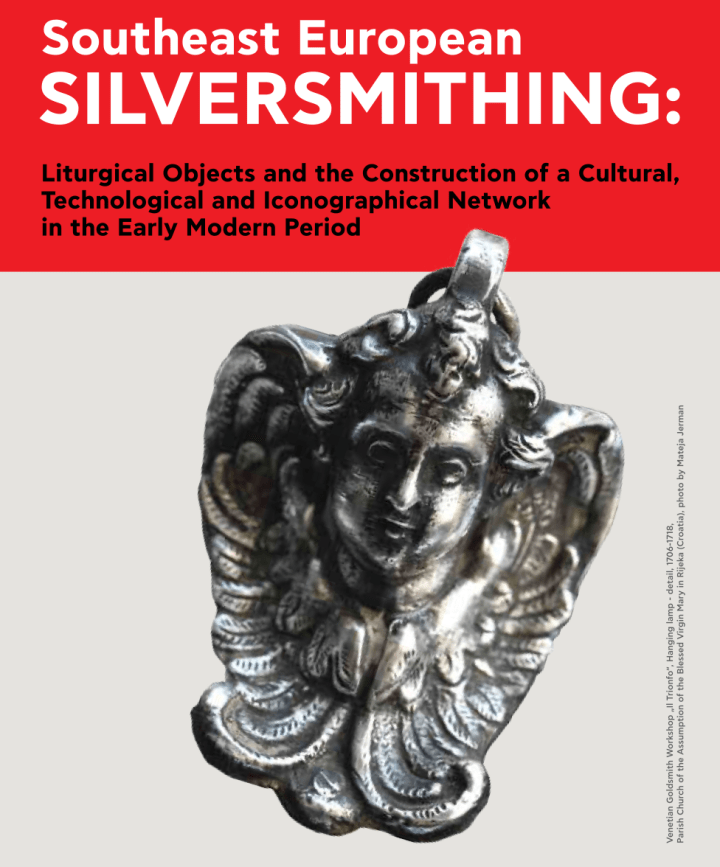 The international conference Southeast European Silversmithing: Artisans, Donors, and the Concept of Piety during the Early Modern Period will gather specialists studying sacral silver objects from the early modern period who, through their research, contribute to the field of applied arts with religious use. The scientific forum will enable the presentation of sacral silver objects still unpublished and unknown to the academic community. It will stimulate the comparative analysis of silversmiths’ works in wide geographic regions, which will also help improve the methodological means of their interpretation. A more meticulous approach to this field will represent a valuable contribution to art historical scholarship and a more comprehensive understanding of the visual culture of the early modern period.
Twenty-six specialists from prestigious organisations, universities, and cultural institutions from Austria, Armenia, Bulgaria, Greece, Italy, the Netherlands, Romania, the USA, Serbia, and Hungary will discuss issues related to the production and circulation of liturgical objects, as well as their role in shaping the pious image of the faithful in Southeastern Europe between the 15th and 19th centuries. The conference is organised within the framework of the project Liturgical Objects in the Context of Silversmiths’ Art during the Ottoman Period (Based on Materials from the Diocese of Plovdiv), funded by the Bulgarian National Science Fund, Ministry of Education and Science of the Republic of Bulgaria (contract No. КП-06-М80/2/7.12.2023).
Academic Committee
• Darina Boykina, PhD, Institute of Art Studies, Bulgarian Academy of Sciences, Bulgaria
• Mateja Jerman, PhD, Ministry of Culture and Media of the Republic of Croatia and Faculty of Humanities and Social Sciences, University of Rijeka, Croatia
• Vuk Dautović, PhD, University of Belgrade, Serbia
t h u r s d a y , 1 7 o c t o b e r
Institute of Ethnology and Folklore Studies with Ethnographic Museum, Bulgarian Academy of Sciences
9.30 Registration
10.00 Welcome
10.15 Constructing Piety
Chair: Vuk Dautović
• Dimitris Liakos — Constructing the Pious Image in Southeastern Europe at the Turn of an Era: Valuable Objects as Gifts to Athonite Monasteries from the 15th to the 16th Century
• Miljana Matić — Monks as Authors and Donors of Applied Art Objects (15th–17th Centuries) from the Serbian Orthodox Church Museum Collection
• Darina Boykina — Artisans’ Patronage: The Case of the Guild of Silversmiths in Tatar Pazardzhik during the Early Modern Period
11.30 Coffee Break
11.50 Personal and Collective Patronage
Chair: Teodor Lucian Lechintan
• Nikolaos Mertzimekis — The Silver Cover of the Gospel of Tsar Alexei Mikhailovich (1645–1676) in the Sacristy of the Iviron Monastery
• Paschalis Androudis — On a Pair of Candlesticks from the Metropolitan Church of Kastoria, 1708
• Nicoleta Bădilă — Donors’ Portraits from the Silver Liturgical Fans from Wallachia
• Nona Petkova — Examples of Faith and Community Belonging: Eucharistic Chalices from the National Church Museum of History and Archaeology in Sofia
13.30 Lunch
15.00 Influential Objects: Appearance and Morphology
Chair: Livia Stoenescu
• Mila Santova — Once Again about the Gospel Covers from the Teteven Monastery of Prophet Elijah (Teteven Gospel Covers from 1675)
• Georgi Parpulov — Two Romanian Ciboria at the Sinai Monastery
• Mariam Vardanyan — Innovative Tendencies in the Art of Armenian Book Binding: Myrophores Gospels Bindings
16.15 Coffee Break
16:30 Silver Objects as Emissary: Circulation, Diplomacy, and Gifts
Chair: Paschalis Androudis
• Mateja Jerman — Goldsmiths’ Works as Gifts to Our Lady of Trsat (Croatia)
• Milena Ulčar — Collective Patronage of St. Tryphon’s Head Reliquary in Venetian Kotor
• Arijana Koprčina — Gifts of Bishop Emerik Esterházy to Zagreb (Arch)diocese
• Francesca Stopper — La Serenissima and the Papal States: Liturgical Objects as Diplomatic Gifts in the 18th Century
f r i d a y , 1 8 o c t o b e r
Institute of Art Studies, Bulgarian Academy of Sciences
9.30 Patrons and Silversmith Creating Visual Culture
Chair: Darina Boykina
• Dragoş Năstăsoiu — Cross-confessional Artistic Negotiation: Transylvanian Saxon Silversmith Masters and Their Orthodox Patrons in 14th to 17th-Century Wallachia and Moldavia
• Teodor Lucian Lechintan — On Some Early Modern Silver Revetments of Romanian Icons: Donors, Techniques, Horizons
• Vuk Dautović — Silver Votive Offerings of 19th-Century Serbian Rulers: Shaping Church Visual Culture and their Role in Changing Cultural Models
10.45 Coffee Break
11.00 Silversmithing Centers and Production of the Liturgical Object
Chair: Mila Santova
• Stavroula Sdrolia, Paschalis Androudis — 17th-Century Goldsmiths’ Enamelled Production in Thessaly
• Barbara Kamler-Wild — Silversmithing in Vienna in the Golden Age of Empress Maria Theresia
• Livia Stoenescu — To Be Worth a Potosí: Mines, Wealth, and Global Crafting of Silver Liturgical Objects in Early Modernity
12.15 Coffee Break
12.30 Silver Embodying Sanctity
Chair: Milena Ulčar
• Konstantinos Dolmas — Like a Second Skin: The Head-Reliquary of St. Kliment of Ohrid
• Simeon Tonchev — The Reliquary from the Church ‘Mother of God the Fountain of Life’ in Svilengrad and Its Context
13.20 Lunch
15.00 Imagery and Iconography
Chair: Mateja Jerman
• Anna Mária Nyárádi — Images Between the Latin and Greek Worlds. Prints and Book Illustrations as Models for Gospel Covers
• Iglika Mishkova — Bread Stamps
• Carmen Tănăsoiu — Behold the Lamb of God: About a Certain Iconographic Type Found on Diskoi from the Collection of the National Museum of Art of Romania
• Ruth Bryant — Analyzing the Torah Shield: Understanding the Abundance of Animal Imagery through the Zohar
16.45 Closing Remarks










 Enfilade
leave a comment