Exhibition | Paper and Light
Opening in October at The Getty:
Paper and Light
J. Paul Getty Museum, Los Angeles, 15 October 2024 — 19 January 2025
 Artists have for centuries explored the interaction of paper and light. This exhibition of drawings charts some of the innovative ways in which the two media were creatively used together. Works include the Museum’s extraordinary 12-foot-long transparency by Carmontelle—essentially an 18th-century motion picture—which will be shown lit from behind as originally intended. Drawings by more contemporary artists including Vija Celmins will join sheets by Tiepolo, Delacroix, Seurat, and Manet to portray the themes of translucency and the representation of light.
Julian Brooks and Michelle Sullivan, Paper and Light: Luminous Drawings (Los Angeles: J. Paul Getty Museum, 2024), 112 pages, ISBN 978-1606069301, $25.
The treatment of light and shadow is one of the building blocks of drawing. From techniques such as highlights and reserves, to material selection and the creation of translucent tracing paper, to the use of light as a medium for viewing artworks, artists for hundreds of years have found innovative and dazzling ways to create light on a sheet of paper. This publication examines the central relationship between paper and light in the world of drawings in western European art from the Renaissance to the twentieth century. Focusing on drawings from the collection of the J. Paul Getty Museum, as well as works from the British Museum, Musée du Louvre, and others, and featuring masterful works by such artists as Parmigianino, Leonardo da Vinci, Nicolas Poussin, Odilon Redon, Edgar Degas, and Georges Seurat, Paper and Light will entice readers to look longer and more closely at drawings, deriving an even deeper appreciation for the skill and labor that went into them.
Julian Brooks is senior curator and head of the Department of Drawings at the J. Paul Getty Museum. Michelle Sullivan is associate conservator of drawings at the J. Paul Getty Museum.
New Book | The Mobile Image from Watteau to Boucher
From Getty Publications:
David Pullins, The Mobile Image from Watteau to Boucher (Los Angeles: Getty Research Institute, 2024), 208 pages, ISBN: 978-1606068885, $60.
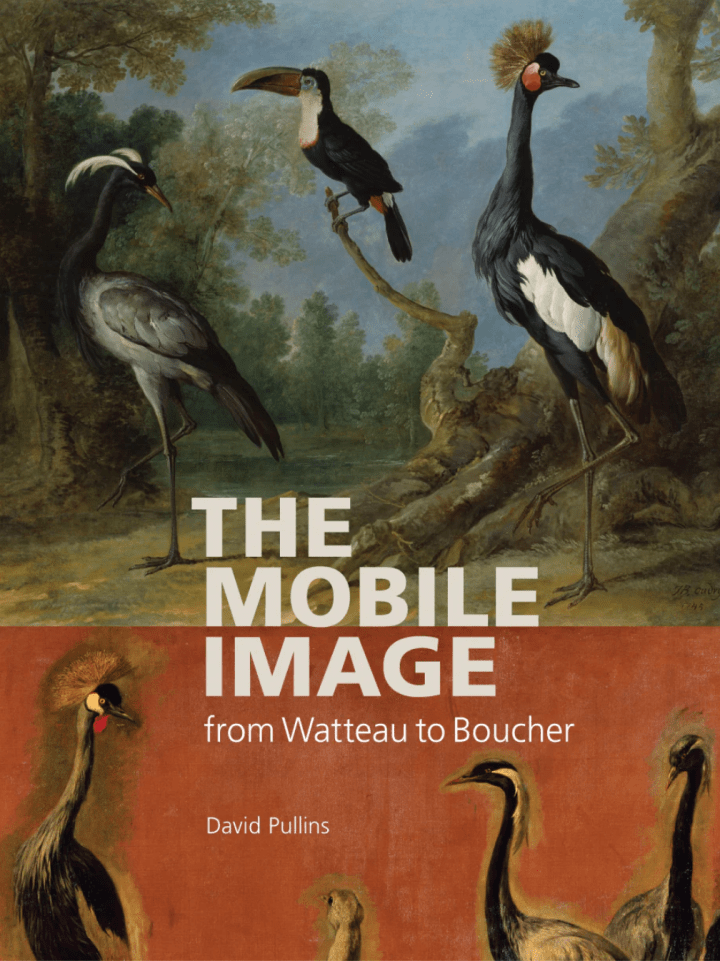 Reframing long-held assumptions about what distinguishes fine from decorative art, this innovative study explores a mode of making, seeing, and thinking that slices across eighteenth-century visual culture.
This book provides a new way of thinking about eighteenth-century French art and visual culture by prioritizing production over reception. Abandoning the ideologically driven discourse that distinguished fine from decorative art between the 1690s and 1770s, The Mobile Image reveals how the two have been inextricably bound from the earliest stages of artistic instruction through the daily life of painters’ workshops. In this study, author David Pullins defines artisanal and artistic means of learning, seeing, and making through a system of ‘mobile images’: motifs that were effectively engineered for mobility and designed never to be definitive, always awaiting replication and circulation. He examines the careers of Antoine Watteau, Jean-Baptiste Oudry, and François Boucher, situating them against a much broader cast of actors—such as printmakers, publishers, anonymous studio assistants, and architects, among others—to place eighteenth-century painting within a wider context of media and making.
David Pullins is Jayne Wrightsman Curator at the Metropolitan Museum of Art, where he is responsible for seventeenth-and eighteenth-century French, Italian, and Spanish painting.
New Book | Claude III Audran, Arbiter of the French Arabesque
From Amsterdam UP:
Barbara Laux, Claude III Audran, Arbiter of the French Arabesque (Amsterdam: Amsterdam University Press, 2024), 252 pages, ISBN: 978-9463729284, €129 / $147.
 Claude III Audran, Arbiter of the French Arabesque is the first substantial biographical study of Claude III Audran, a late 17th- and early 18th-century master of ornament and a proponent of cutting-edge design who took inspiration from contemporary sources. This work investigates Audran’s accomplishments and the factors that impacted the longevity and arc of his successful career, taking into consideration the contextual variables that influenced and shaped his work. Audran’s achievements bridge an important period with the eclipse of the Guild Maîtrise and the rise of the Académie royale. Audran subcontracted young artists, such as Watteau, Lancret, and Desportes, in order to circumvent restrictions on guild practice enacted by the crown. Looking at his commissions not only reveals the elite taste of his patrons, including Louis XIV, but also Audran’s ability to use elements from popular culture to animate his arabesques, which created hallmarks of rococo interior design.
Barbara Laux is an independent researcher and is currently Senior Curatorial Assistant at the Yale Center for British Art. She earned an MA in the History of Decorative Arts and in Art History prior to her PhD at the Graduate Center, City University of New York.
c o n t e n t s
Acknowledgments
Introduction
1 Biography of Claude III Audran (1658–1734)
2 The French Arabesque as an Art Form, Audran as Master Ornamentalist and His Initial Commissioned Works
3 Claude III Audran and Jean de La Fontaine’s Fables: Maintaining the Social Hierarchy
4 Attracting New Patrons in the Eighteenth Century
5 Claude III Audran’s Competitors and His Legacies
Illustrations
Appendix
Bibliography
Index
Conference | Placing China at the Courts of Europe, 1700–1800
From the conference programme:
Placing China at the Courts of Europe, 1700–1800
Historischer Gasthof ‘Zum Eichenkranz’, Oranienbaum-Wörlitz, 5–6 September 2024
Organized by Lukas Nickel and Anette Froesch
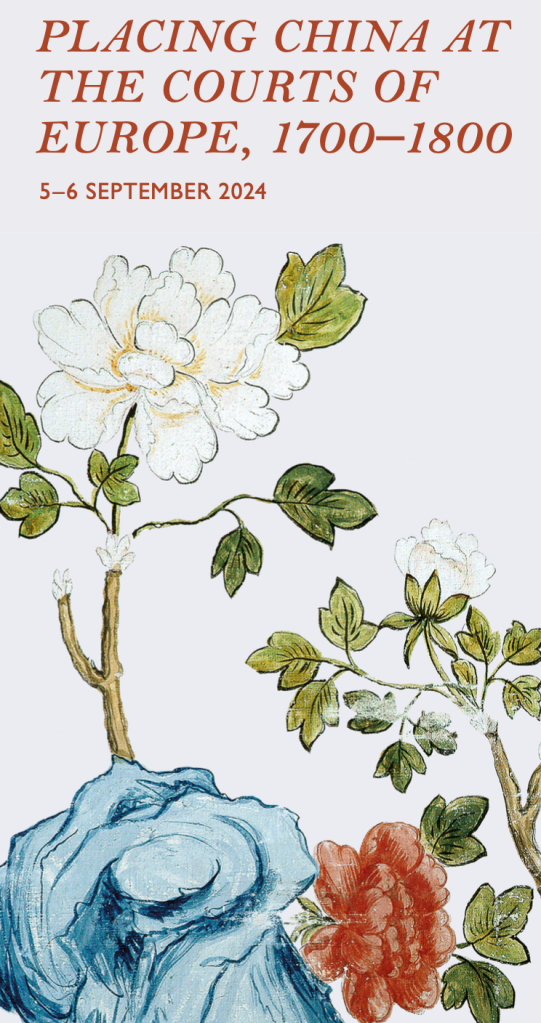 When Leopold III Frederick Franz, Duke of Anhalt-Dessau (1740–1817), added Chinese-inspired state rooms, a pagoda, a tea house, and bridges to his sprawling garden realm, he followed a practise widely employed at courts of the German states, Austria, and across Europe. Chinoiserie was of such importance that it was used by his political allies as well as rivals, by conservative and progressive rulers, and in both Protestant and Catholic settings. While the centrality of China to elite representation of the time has been noted often, so-far its significance remains opaque. The conference, a collaboration between the Kulturstiftung Dessau-Wörlitz and the Institute of Art History, University of Vienna, aims at investigating the intentions and rationales behind the inclusion of Chinese-inspired spaces, structures, and designs into programs of representation at European courts during the 18th century.
Open to the public, the conference will be conducted in English. The fee (including catering and excursions) is €35. Registration should be sent to julia.cahnbley@gartenreich.de by 25 August 2024. Organizers plan to publish the proceedings in 2025.
t h u r s d a y , 5 s e p t e m b e r
9.30 Welcome — Harald Meller (Kulturstiftung Dessau-Wörlitz)
9.45 Greetings — Lukas Nickel (Universität Wien) and Anette Froesch (Kulturstiftung Dessau-Wörlitz)
10.15 Opening Lecture | Lukas Nickel — The Many Chinas in 18th-Century Europe
11.00 Coffee break
11.30 Stéphane Castelluccio (Centre André-Chastel) — France and China: Between Fascination and Reserve
12.00 Emile de Bruijn (National Trust) — Placing China in England: Chinese-Style Interiors and Furnishings in 18th-Century English Country Houses
12.30 Discussion
13.00 Lunch break
14.00 Anette Froesch — ‘As if he had been in Beijing all his life’: The Chinese-Style Interiors and Gardens of Prince Leopold III Friedrich Franz von Anhalt-Dessau
14.30 Cordula Bischoff (Technische Universität Dresden) — Think Big: Augustus the Strong and His Collections of Asiatica
15.00 Coffee break
15.30 Constantijn Johannes Leliveld (Berlin) — Prussian Pioneers: Shaping European Perceptions of China in the 18th Century
16.00 Maria Cinta Krahe Noblett (Universidad Autónoma de Madrid) — Placing Chinese Art during the Reign of Queen Elisabeth Farnese of Spain (r. 1714–1746)
16.30 Discussion
17.00 Excursion to Schloss Wörlitz
f r i d a y , 6 s e p t e m b e r
8.30 Excursion to Schloss and Park Oranienbaum
10.30 Coffee break
11.00 Elfriede Iby (Schloss Schönbrunn) — Chinoiserie in Schönbrunn Palace
11.30 Gyorgyi Fajcsák (Ferenc Hopp Museum of Asiatic Arts, Hungary) — Gardens in the Esterházy Palace: Chinoiserie Murals at Eszterháza/Fertöd
12.00 Filip Suchomel (Univerzita Karlova) — Oriental Interiors in Czech Aristocratic, Ecclesiastical, and Bourgeois Residences in the 18th and 19th Centuries
12.30 Discussion
13.00 Lunch break
14.00 Luca Malvicino (Castello Reale di Govone) — Chinese Wallpapers: A New Decorative Fashion and a Representation of Status in the Kingdom of Sardinia
14.30 Denise Gubitosi (Universität Wien) — Nel Gusto Cinese: The Wallpapers in the Chinese Rooms of the Castello di Racconigi
15.00 Kristel Smentek (Massachusetts Institute of Technology) — Mixed Messages: Images of China and Court Politics in Late 18th-Century France
15.30 Discussion
16.00 Concluding Remarks — Lukas Nickel
Exhibition | The Paradox of Pearls
Opening next month at The Walpole Library:
The Paradox of Pearls: Accessorizing Identities in the Eighteenth Century
The Lewis Walpole Library, Farmington, CT, 27 September 2024 — 31 January 2025
Curated by Laura Engel
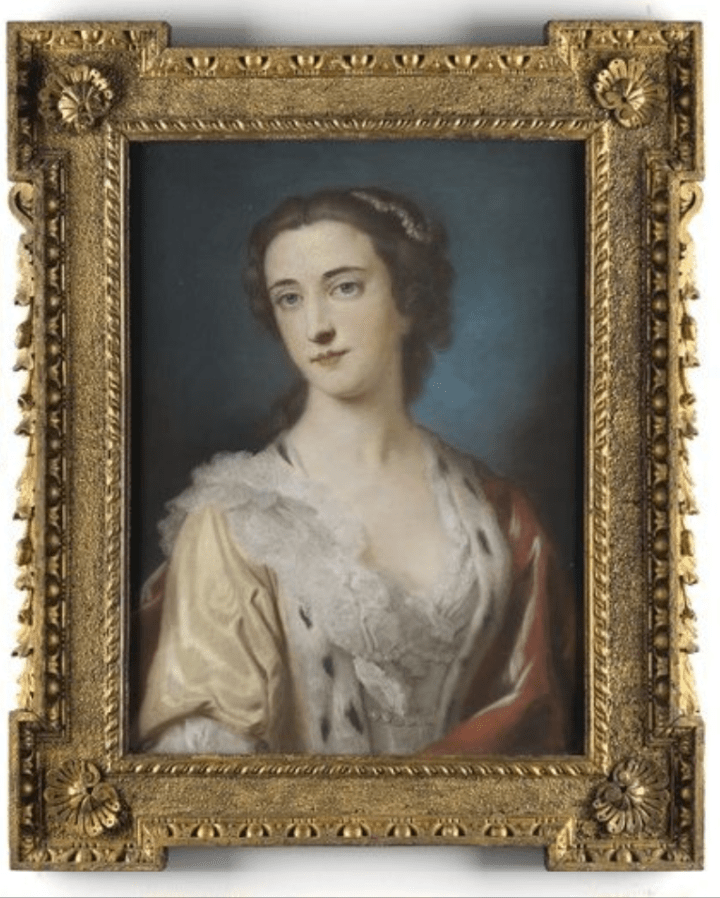
William Hoare, Portrait of Maria Walpole, ca. 1742, pastel on paper (The Lewis Walpole Library, Yale University, LWL Ptg. 152).
Pearls figure prominently in pictures of celebrated and imagined figures across the eighteenth century. Adorning royalty, celebrities, servants, and in fashion plates, the mysterious, opaque, and gleaming white accessory aligns with the mutable, seductive, and threatening emergence of new forms of identity. Worn as jewelry, as embellishments to the body and dress, or embedded in the settings of precious objects—pearls accessorize, highlight, colonize, and perform. As one of the most sought-after commodities of the early modern colonial enterprise, a precious jewel tied to bondage and violence, pearls have a baroque and complex history. Drawing from materials in the Lewis Walpole Library this exhibition will explore the ‘paradox of pearls’ by considering how the varied and often contradictory meanings of this jewel appear in period images and the ways in which practices from the past connect us to the powerful presence of pearls today. The exhibition is curated by Professor Laura Engel of Duquesne University.
◊ ◊ ◊ ◊ ◊
Curator Talk with Laura Engel
The Lewis Walpole Library, 16 November 2024, 2pm
From Queen Elizabeth I to Harry Styles, the legacy of pearls is a story about self-fashioning. Pearls feature prominently in many pictures of celebrated figures from the past. Worn as jewelry—as embellishments of the body and apparel, or embedded in the settings of precious objects—pearls illuminate ideas about beauty, power, and style. Drawing upon materials in the Lewis Walpole Library, this talk considers how the varied and often contradictory meanings of this jewel were represented in period images and the ways in which practices from the past connect us to the enduring presence of pearls today. Space is limited, and advance registration through the Farmington Libraries site is required. Registration link forthcoming.
New Book | Pearls for the Crown
From Penn State UP:
Mónica Domínguez Torres, Pearls for the Crown: Art, Nature, and Race in the Age of Spanish Expansion (University Park: The Pennsylvania State University Press, 2024), 218 pages, ISBN: 978-0271096810, $100. Also available as an ebook.

In the age of European expansion, pearls became potent symbols of imperial supremacy. Pearls for the Crown demonstrates how European art legitimated racialized hierarchies and inequitable notions about humanity and nature that still hold sway today.
When Christopher Columbus encountered pristine pearl beds in southern Caribbean waters in 1498, he procured the first source of New World wealth for the Spanish Crown, but he also established an alternative path to an industry that had remained outside European control for centuries. Centering her study on a selection of key artworks tied to the pearl industry, Monica Dominguez Torres examines the interplay of materiality, labor, race, and power that drove artistic production in the early modern period. Spanish colonizers exploited the expertise and forced labor of Native American and African workers to establish pearling centers along the coasts of South and Central America, disrupting the environmental and demographic dynamics of their overseas territories. Drawing from postcolonial theory, material culture studies, and ecocriticism, Domínguez Torres demonstrates how, through use of the pearl, European courtly art articulated ideas about imperial expansion, European superiority, and control over nature, all of which played key roles in the political circles surrounding the Spanish Crown. This highly anticipated interdisciplinary study will be welcomed by scholars of art history, the history of colonial Latin America, and ecocriticism in the context of the Spanish colonies.
Mónica Domínguez Torres is Professor of Art History with a joint appointment in Latin American and Iberian Studies at the University of Delaware.
New Book | The Muse of History: The Ancient Greeks
From Penguin Books and Harvard UP’s Belknap Press:
Oswyn Murray, The Muse of History: The Ancient Greeks from the Enlightenment to the Present (Cambridge: Belknap Press, 2024), 528 pages, ISBN: 978-0674297456, £30 / $38.
 The study of ancient Greece has been central to Western conceptions of history since the Renaissance. The Muse of History traces the shifting patterns of this preoccupation in the last three centuries, in which successive generations have reinterpreted the Greeks in the light of their contemporary worlds. Thus, in the eighteenth century, the conflict between Athens and Sparta became a touchstone in the development of republicanism, and in the nineteenth, Athens came to represent the democratic ideal. Amid the ideological conflicts of the twentieth century, the Greeks were imagined in an age of suffering, inspiring defenses against nationalism, Nazism, communism, and capitalism.
Oswyn Murray is an emeritus Fellow of Balliol College, University of Oxford, and a leading scholar of the ancient world. He has written widely translated books including Early Greece and The Symposion: Drinking Greek Style and is the coeditor of The Oxford History of the Classical World.
c o n t e n t s
Part One | The Muse of History
Introduction: Past and Present
The Republic of Letters
1 The Western Traditions of Ancient History
2 Enlightenment Greece: Sparta versus Athens
3 Ireland Invents Greek History: The Lost Historian John Gast
4 The Philhellenes and Marathon
Radical History
5 The Contested Reign of Mitford
6 Romantic History in Britain and Europe
7 Utilitarian History: Mill and Grote
The Triumph of Germany
8 Hegel, Niebuhr, and Critical History
9 Burckhardt and Cultural History
10 The Archaic Age
11 The Problem of Socrates
12 In Search of the Key to All Mythologies
Part Two | The Angel of History
The Crisis of the Republic of Letters
13 The Repentance of Gilbert Murray
14 Saving Civilization: The Warburg Institute and the SPSL
15 Momigliano on Peace and Liberty
16 Momigliano in England
The School of Paris
17 Fernand Braudel and the Mediterranean
18 The ‘École de Paris’
Unfnished Business
19 Dark Times: The Cold War and the Triumph of Capitalism 391
20 The Crisis of Theory in History
Acknowledgements
Notes
List of Illustrations
Index
Exhibition | Olympus on the Lake: Canova, Thorvaldsen, Hayez
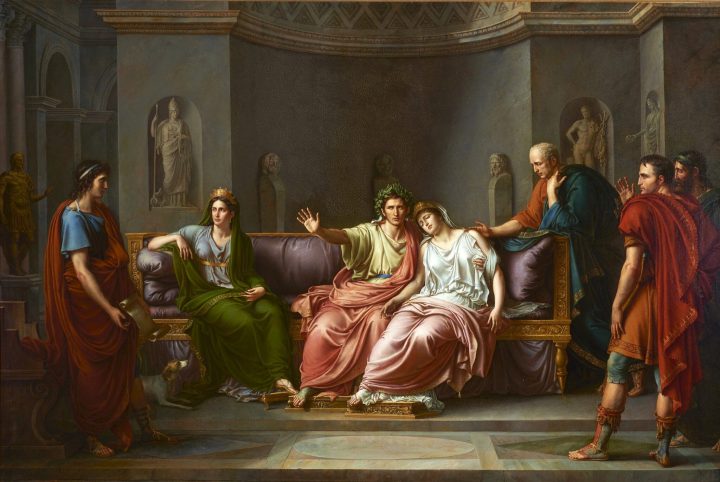
Jean-Baptiste Joseph Wicar, Virgil Reading the Sixth Canto of the Aeneid, 1818–21, oil on canvas
(Tremezzo: Museo di Villa Carlotta)
◊ ◊ ◊ ◊ ◊
Now on view at Villa Carlotta (with an English description available here) . . .
Olympus on the Lake: Canova, Thorvaldsen, Hayez, and the Treasures of the Sommariva Collection
Villa Carlotta, Tremezzo (on Lake Como), 22 June – 30 September 2024
Abile politico e potente braccio destro di Napoleone a Milano, Giovanni Battista Sommariva (1762–1826) è stato uno dei maggiori e più celebri collezionisti tra l’Impero e la Restaurazione. Approfittando di quei tempi di rapidi e radicali cambiamenti, nel 1802—quando si interruppe la sua breve ma fulminante carriera—era ormai riuscito a costruirsi una immensa fortuna.
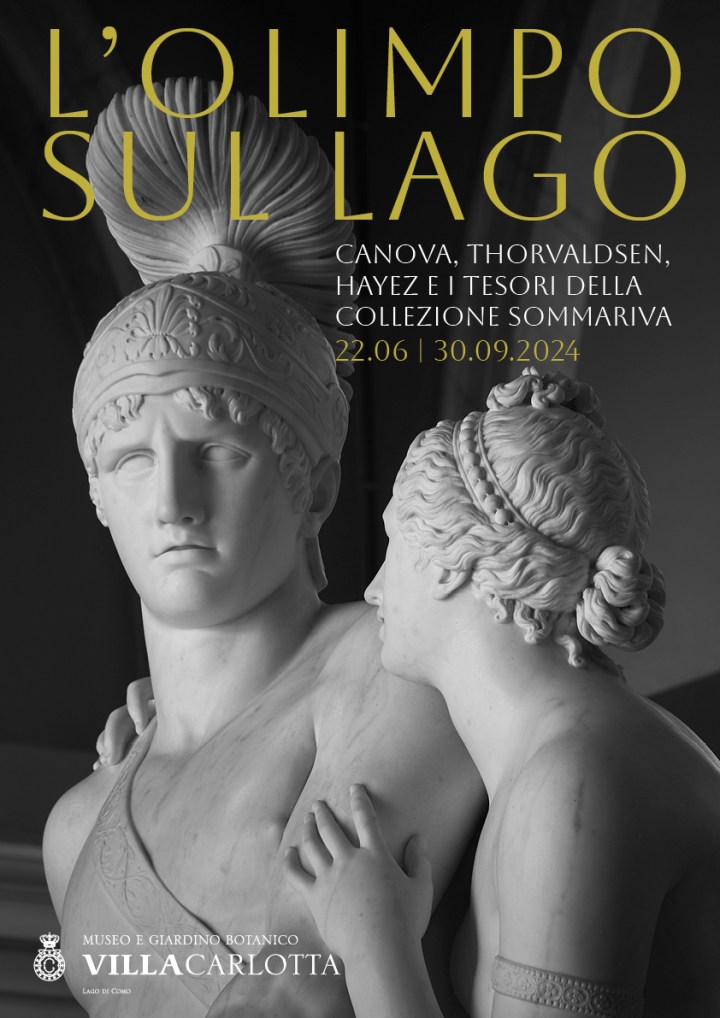 La sua leggendaria raccolta era una delle più importanti dell’epoca, insieme a quelle dei familiari di Napoleone, in particolare dell’imperatrice Josephine. Divisa tra il suo palazzo a Parigi, in uno dei quartieri più alla moda della città, e la villa di Tremezzo sul Lago di Como (oggi Villa Carlotta), vantava dipinti antichi e capolavori dei maggiori artisti dell’epoca—David, Prud’hon, Girodet, Wicar, Appiani, Bossi, Hayez—oltre a una infinità di preziosi oggetti d’arte. Soprattutto per la presenza a Villa Sommariva delle opere di Canova e degli splendidi marmi di Thorvaldsen, accorrevano viaggiatori da tutto il mondo, tra cui personaggi illustri come Stendhal, Lady Morgan, Flaubert. Attraverso una selezione delle opere più famose di quella straordinaria collezione—sculture, dipinti, stampe, gioielli e miniature—Villa Carlotta celebra un magnifico protagonista della propria storia e un grande mecenate di statura europea.
Per tutta la durata della mostra L’Olimpo sul lago, è possibile visitare presso il Museo del Paesaggio del Lago di Como (Tremezzina) l’esposizione Paesaggio sublime: Il Lago di Como all’epoca di Giovanni Battista Sommariva (1801–1826) che esporrà incisioni, tempere e acquerelli della prima a metà del XIX secolo con il proposito di evocare l’aspetto del lago e dei suoi borghi al tempo di Giovanni Battista Sommariva.
Fernando Mazzocca, Maria Angela Previtera, and Elena Lissoni, eds., L’Olimpo sul lago: Canova, Thorvaldsen, Hayez e i tesori della Collezione Sommariva (Milan: Silvana Editoriale, 2024), 352 pages, ISBN 978-8836658336, €35.
Exhibition | Belle da Costa Greene: A Librarian’s Legacy
Opening in October at The Morgan:
Belle da Costa Greene: A Librarian’s Legacy
The Morgan Library & Museum, New York, 25 October 2024 — 4 May 2025
Organized by Philip Palmer and Erica Ciallela
 The incredible story of the first director of the Morgan Library: a visionary Black woman who walked confidently in an early 20th-century man’s world of wealth and privilege
To mark the 2024 centenary of its life as a public institution, the Morgan Library & Museum will present a major exhibition devoted to the life and career of its inaugural director, Belle da Costa Greene (1879–1950). Widely recognized as an authority on illuminated manuscripts and deeply respected as a cultural heritage executive, Greene was one of the most prominent librarians in American history.
She was the daughter of Genevieve Ida Fleet Greener (1849–1941) and Richard T. Greener (1844–1922), the first Black graduate of Harvard College, and was at birth known by a different name: Belle Marion Greener. After her parents separated in the 1890s, her mother changed the family surname to Greene, Belle and her brother adopted variations of the middle name da Costa, and the family began to pass as White in a racist and segregated America.
Greene is well known for the instrumental role she played in building the exceptional collection of rare books and manuscripts formed by American financier J. Pierpont Morgan, who hired her as his personal librarian in 1905. After Morgan’s death in 1913, Greene continued as the librarian of his son and heir, J.P. Morgan Jr., who would transform his father’s Library into a public institution in 1924. But her career as director of what was then known as the Pierpont Morgan Library―a leadership role she held for twenty-four years―is less well understood, as are aspects of her education, private collecting, and dense social and professional networks.
The exhibition will trace Greene’s storied life, from her roots in a predominantly Black community in Washington, D.C., to her distinguished career at the helm of one of the world’s great research libraries. Through extraordinary objects―from medieval manuscripts and rare printed books to archival records and portraits―the exhibition will demonstrate the confidence and savvy Greene brought to her roles as librarian, scholar, curator, and cultural executive, and honor her enduring legacy.
This exhibition is organized by Philip Palmer, Robert H. Taylor Curator and Department Head of Literary and Historical Manuscripts, and Erica Ciallela, Exhibition Project Curator.
Erica Ciallela and Philip Palmer, eds., Belle da Costa Greene: A Librarian’s Legacy (New York: DelMonico Books, 2024), 304 pages, ISBN: 978-1636811352, $50. With a foreword by Colin Bailey, an afterword by Tamar Evangelestia-Dougherty, and contributions by Araceli Bremauntz-Enriquez, Julia Charles-Linen, Erica Ciallela, Rhonda Evans, Anne-Marie Eze, Daria Rose Foner, Jiemi Gao, Juliana Amorim Goskes, Gail Levin, Philip Palmer, Deborah Parker, and Deborah Willis.
New Book | J. Pierpont Morgan’s Library
From Scala:
Colin Bailey, Barry Bergdoll, Andrew Dolkart, Daria Rose Foner, Christine Nelson, and Brian Regan, J. Pierpont Morgan’s Library: Building the Bookman’s Paradise (London: Scala Arts Publishers, 2023), 256 pages, ISBN: 978-1785513992, £35 / $50.
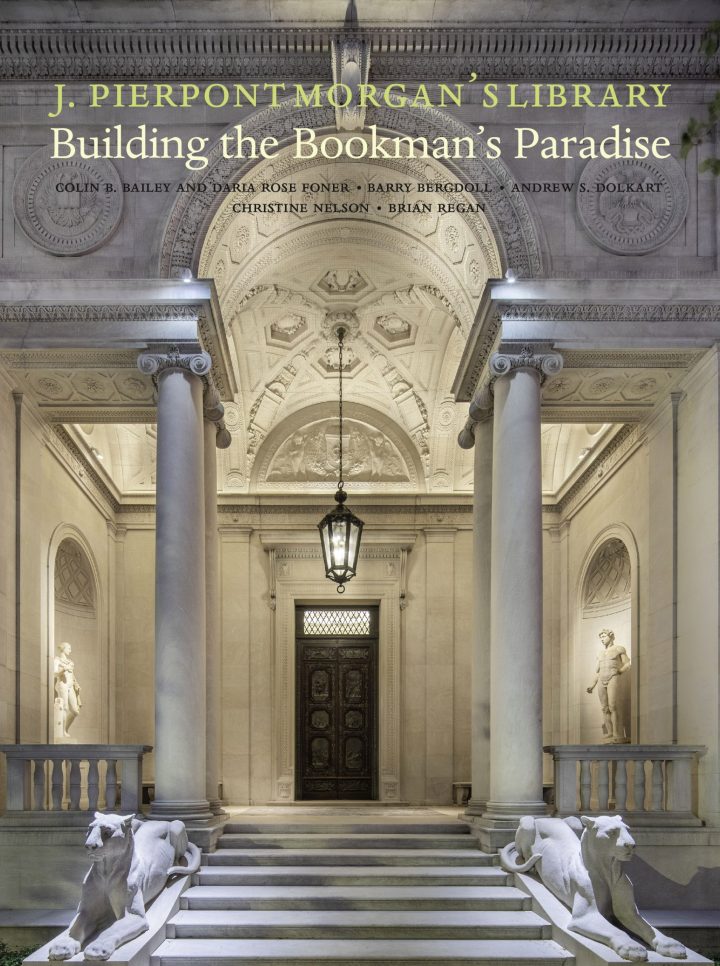 This beautifully illustrated book celebrates the first-ever restoration of the exterior of J. Pierpont Morgan’s Library—the historic heart of the Morgan Library & Museum.
Morgan’s Library has stood as a significant cultural landmark ever since it was commissioned by J. Pierpont Morgan for personal use at the start of the twentieth century. Its transition to a public institution in the twenties has lent to an even greater flood of admiration and patronage, by both local and international audiences. The elegant design by Charles Follen McKim stands as one of the finest examples of neoclassical architecture in the United States, significant for its distinctive Italian Renaissance style and its opulent interior period rooms. The site has been designated both a National Historic Landmark and a New York City landmark, and it is listed on the National Register of Historic Places. The book, following on the heels of the completed restoration, will punctuate this latest milestone in the building’s storied history.
Colin B. Bailey, Director of the Morgan Library & Museum, is a specialist in eighteenth-century French art.
Barry Bergdoll is the Meyer Schapiro Professor of Art History at Columbia University and the former chief curator in the Department of Architecture and Design at the Museum of Modern Art, New York.
Andrew Dolkart is a professor of historic preservation at the Columbia University Graduate School of Architecture, Planning and Preservation.
Daria Rose Foner is the former Research Associate to the Director of the Morgan Library & Museum and is now with the Old Masters Department at Sotheby’s, New York.
Christine Nelson is the former Drue Heinz Curator of Literary and Historical Manuscripts, The Morgan Library & Museum, now Fellowships Manager, the Library Company of Philadelphia.
Brian Regan is the architectural advisor to the Morgan Library & Museum.










 Enfilade
leave a comment