Washington at Auction, Part II
 At the website of The Art Newspaper, Helen Stoilas notes that:
A portrait of George Washington reportedly by Gilbert Stuart, the most famous portraitist of early American presidents, is going up for auction. The painting hung untouched in the home of an upstate New York family for generations and has been estimated to fetch between $200,000-$300,000 when it goes up for sale 27 March at Cottone Auctions of Geneseo, New York.
For the rest of the article, click here»
Was this Washington’s Yorktown Map? — At This Price One Hopes So
In the March digital edition of Fine Books & Collections, Ian McKay reports on some auction highlights, including this map from the Revolutionary War, which sold for $1.15 million.

Manuscript Plan of the Battle of Yorktown, auctioned by James Julia of Fairfield, Maine
What was to become the most expensive American map ever sold at auction was entered for sale without reserve and initially given a wide-open estimate of just $5,000 to $50,000 in this Maine sale. Showing the disposition of the besieged British troops and the combined American and French forces at Yorktown, it was executed on or around October 29, 1781, ten days after the final, unconditional surrender by the British commander, Lord Cornwallis, to George Washington. The drawing up of the map was overseen if not directly accomplished by Lieutenant Colonel Jean Baptiste Gouvion, who in 1777 had been one of a group of French military engineers transferred to the American forces following a direct request from the Continental Congress. He was present at that critical battle. A larger version of the map exists in the National Archives, but there is now speculation that its map may have been one drawn up for the Continental Congress and that the smaller and much better preserved example offered in New England may have been Washington’s own. And if not Washington’s own, at least that of his aide-de-camp, Tobias Lear, who handled a lot of his commander’s papers and through whose family it had passed down. . . .
For the full article, click here»
Sartorial Choices Part II
Several weeks ago Enfilade included a reference to the fashion blog, Academichic. Readers who found it interesting, might enjoy this interview at Already Pretty, where the participants unpack their thinking on the importance of clothing within academia.

Theater and Painting
From the website of the Musée d’Orsay:
De la scène au tableau / From Stage to Painting
Musée Cantini, Marseille, 6 October 2009 — 3 January 2010
Museo di Arte Moderna e Contemporanea, Rovereto, 6 February — 23 May 2010
Art Gallery of Ontario, Toronto, 19 June — 26 September 2010

"De la scène au tableau" (Flammarion, 2009) ISBN: 9782081236912
David, Delacroix, Hayez, Degas, Gustave Moreau, Toulouse-Lautrec, Vuillard . . . all these painters shared a passion for the performing arts. What role did the theatre and the opera play in the artistic production of these great masters and in developing the composition of their paintings? To what extent did their art influence future developments in stage design?
Ranging from the Neoclassicism of David to the experimental work of the scenographer and stage director Adolphe Appia, this exhibition highlights the direct influence of the theatre, or the more subtle effect of theatricality, on painting. Conversely, it also demonstrates how the great movements in the history of art influenced the theatre and opened it up to the 20th century.
However, there is another story, that of the movement towards the dematerialisation of the image (a specific feature of Modernism) which is presented in Marseille through almost two hundred works from prestigious institutions and collections around the world, including a collection of drawings and paintings by Daumier, Degas, Toulouse-Lautrec and Cabanel, on special loan from the Musée d’Orsay.
◊ ◊ ◊ ◊ ◊
The description perhaps downplays the role of the eighteenth-century for the exhibition, though the following review by Didier Rykner posted at The Art Tribune suggests there may be a bit more here for dix-huitièmistes.
The goal of the exhibition organized at the Musée Cantini is to understand the relationship between theatre and painting from the second half of the 18th century to the early 20th . . . Two paintings by Louis-Jean-François Lagrenée . . . prove very early on – halfway through the 18th century – the progressive change towards Neoclassicism, particularly Horace after Slapping his Sister from the Musée des Beaux-Arts in Rouen. While David is represented by well-known canvases (his copy of Girodet’s The Oath of the Horaces, recently seen at the Louvre, and his reception piece for the Ecole des Beaux-Arts), the two works from Bordeaux by Pierre-Narcisse Guérin and the very beautiful Marcus Curtius Dentatus Refusing the Gifts from the Samnites by Pierre Peyron, held at the Musée des Beaux-Arts in Marseille, are admirable. As is often the case in this type of exhibition, the most pleasant surprises come from the lesser-known paintings, discovered a new thanks to excellent restorations.
For the full review, click here»
Sandby Conference in London
Paul Sandby and the Geographies of Eighteenth-Century Art
Paul Mellon Centre, London, 18-19 March 2010
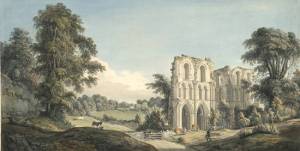
Paul Sandby, "Roche Abbey, Yorkshire," c.1770s. Watercolour over graphite, 300 x 588 mm. Royal Academy of Arts, London. Photo © Royal Academy of Arts/Slingsby
This conference, to be held at the Paul Mellon Centre for Studies in British Art, will address issues arising from the exhibition Paul Sandby: Picturing Britain (Nottingham Castle Museum and Art Gallery, 25 July-18 October 2009; National Gallery of Scotland, Edinburgh, 7 November 2009-7 February 2010; Royal Academy of Arts, London, 13 March-13 June 2010). Organised by Nottingham Castle Museum and Art Gallery, this is the first exhibition to bring together drawings, paintings and prints by this important, if neglected, artist, spanning his long career, and from all the major public collections of his works. In addressing Sandby’s vast and versatile body of work, in its figurative as well as topographical aspects, the exhibition explores how the artist portrayed the character of landscape throughout Britain, and indeed contributed to envisioning the country as a nation state from the cementing of the Act of Union with Scotland, after the failure of the 1745 Jacobite Rebellion, to the wars with revolutionary and Napoleonic France at the century’s end. Through extensive tours, initially as a military draughtsman and then as a professional artist, Sandby pioneered the artistic depiction of landscape in Scotland and Wales, and searched out new sites throughout England. His art is arguably unrivalled among that of his contemporaries in its portrayal of the appearance and meaning of a range of subjects, rural and urban, modern and historical, in a country experiencing rapid social and commercial development.
Thursday 18 March, Royal Academy of Arts
6:30 Private view of the exhibition, Paul Sandby: Picturing Britain, led by John Bonehill (Curator of Paul Sandby: Picturing Britain and Lecturer in Art History, University of Glasgow), followed by a wine reception.
Friday 19 March, The Paul Mellon Centre
9:40 Welcome by Brian Allen (Director of Studies, The Paul Mellon Centre)
9:45 Morning Session introduced and chaired by Kim Sloan (Curator, Department of Prints and Drawings, British Museum)
9:50 Keynote address by Bruce Robertson (Professor of Art History, University of California-Santa Barbara), “Paul Sandby: Father of English Watercolour?”
10:30 Timothy Wilcox (Independent Scholar), “‘Burying the Hatchet’: Paul Sandby at Luton Park”
11:40 Finola O’Kane (Lecturer in Architecture, University College Dublin), “’A Genuine Idea of the Face of the Kingdom’? Jonathan Fisher and Paul Sandby’s portrait of Ireland within the frame of Great Britain”
12:20 John Barrell (Professor of English, Centre for Eighteenth Century Studies, University of York), “A Common in Wales: Edward Pugh, the Pastoral, and Progress”
2:15 Afternoon session introduced and chaired by Shearer West (Director of Research, Arts and Humanities Research Council)
2:20 Gillian Forrester (Curator of Prints and Drawings, Yale Center for British Art), “‘No Joke Like a True Joke’? ‘Twelve London Cries done from the Life’”
3:00 Nick Grindle (Teaching Fellow, Department of Art History, University College London), “Living in London and Windsor: The Sandby Brothers’ Residences, c.1752-1809”
4:10 Carolyn Anderson (Ph.D. candidate, School of Geography, University of Edinburgh), “’The Art of Depicting with a Soldier’s Eye’: The Military Mapping of Eighteenth-Century Scotland”
4:50 Stephen Daniels (Professor of Cultural Geography, University of Nottingham), “‘Great Balls of Fire’: Representing the Remarkable Meteor of 18th August 1783”
5:30 Panel and audience discussion chaired by Sam Smiles (Emeritus Professor of Art History, University of Plymouth)
6:15 Wine reception
Protection in the Eighteenth Century
 As recently noted on the website of Amadeus Mozart, various examples of eighteenth-century prophylactics have been recreated and are now available from Dr. Roberts. Details can be found at his site, Tempus Fugit: An Account of the Activities & Adventures of a Gentleman Physician.
These are reproductions of the offerings of Mrs. Phillips in her shop at Orange Court in London. She designed them from sheep or goat’s gut, pickled, scented and delicately fashioned on glass moulds by the hands of the proprietress herself. I will be providing the standard “Baudruches fines,” and for the more cautious customers, the “Superfine Double” which was made from two superimposed and gummed caecums, the blind end of a sheep’s bigger gut. They are to be Five dollars a piece. Contact me straight away to place your order before they run out!
Johan Zoffany’s 1779 Self Portrait in the National Gallery at Parma includes a pair of such sheaths [see William Pressly, “Genius Unveiled: The Self-Portraits of Johan Zoffany,” Art Bulletin 69 (March 1987): 88-101.] Any other relevant examples come to mind?
Accessing Auction Catalogs
As noted by Jason Kelly at H-Albion (and then picked up on C-18L), JSTOR is piloting an online storage bank of auction catalogs, currently ranging from the eighteenth to twentieth centuries. The following description comes from the beta site:
JSTOR is collaborating with the Frick Collection and the Metropolitan Museum of Art in a pilot project funded by The Andrew W. Mellon Foundation to understand how auction catalogs can be best preserved for the long-term and made most easily accessible for scholarly use. Auction catalogs are vital for provenance research as well as for the study of art markets and the history of collecting.
This prototype site is open to the public through June 2010. If you are interested in this content and the importance to art research, we encourage you to try the site and take the brief survey linked below. In June, we will evaluate use of the content and the feedback we have received in order to help determine the future of the resource.
For more information, click here» And by all means, feel free to chime in with observations here in the ‘Comments’ section.
Eighteenth-Century Religion between History and Art History
Recently added to caa.reviews:
Nigel Aston, Art and Religion in Eighteenth-Century Europe (London: Reaktion Books, 2009), 320 pages, ISBN: 9781861893772, $45.
Reviewed by Michael Yonan, University of Missouri–Columbia; posted 25 February 2010.
. . . Among crossdisciplinary connections, perhaps none is so elusive, so fraught with traps, as the boundary between history and art history. It is a boundary all the more striking for its invisibility. Art historians typically assume that they are partaking in historical study, that the tools they bring to cultural artifacts from the past illuminate an understanding comparable to that of their historian colleagues. All the greater their surprise, then, when they attend a history seminar or delve into historical journals and discover that their colleagues actually speak a different language and reach sometimes strikingly unfamiliar conclusions. Confusion and misunderstanding can happen in the opposite direction, too. Historians create knowledge about the past typically from texts, and it can seem a small step to translate that knowledge to images and spaces, visual constructions that likewise are products of the past and which ostensibly engage the same concerns. Nigel Aston recognizes the divide between his discipline, history, and art history and notes their differences in the introduction to his book “Art and Religion in Eighteenth-Century Europe.” He begins by registering his own interdisciplinarity, but reminds his readers that as a historian he brings a disciplinary perspective to the material at hand. That material is this period’s plentiful religious art, and he adds that in being fascinated by it he has been more or less alone among Anglo-American scholars. Certainly he is correct in noting that religious imagery desperately requires additional study and greater emphasis in our growing discourse on eighteenth-century art. . . .
For the full review, click here»
Stephen Bury Named New Librarian at the Frick
From a Frick press release:
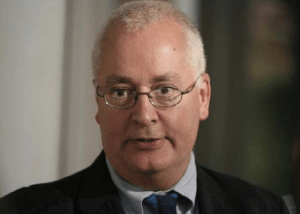 The Frick Collection is pleased to announce the appointment of Dr. Stephen J. Bury to the post of Andrew W. Mellon Chief Librarian at the Frick Art Reference Library. For the past ten years, he has been at the British Library, the national library of the United Kingdom, and one of the world’s greatest research institutions, where he is a Deputy Director and Head of European and American Collections, as well as Maps, Music, and Philatelic Collections. Previously, Dr. Bury was Head of Learning Resources at the Chelsea College of Art & Design, London. Comments Anne Poulet, Director of The Frick Collection, “Dr. Bury brings to this leadership position an exceptional dual perspective. He is both an art historian― who understands first hand the needs of those who teach, research, and curate―as well as an internationally regarded librarian. An active participant on numerous professional commissions as well as dynamic division head of the British Library, he is a great strategic thinker in a rapidly changing field. Stephen Bury has developed a keen understanding in areas of mutual interest to the Frick, among them digitization, collection sharing, storage, and encouraging greater use of new technologies by staff. Furthermore, the nature of the collections he oversees at the British Library, being both European and American, dovetails beautifully with the scope of our holdings and initiatives. With his arrival in May, we know that the Frick Art Reference Library will benefit greatly from Dr. Bury’s insights as well as from the broad connections he has developed through years of highly engaged service and scholarship.”
Adds Dr. Bury, “The Frick Art Reference Library is internationally well-regarded, not just for its rich resources, but for the very proactive approach the institution has taken in light of the changing universe of libraries and the needs of the audiences they serve. The Frick has played a notable role in exploring such important ventures as digitization and collection sharing, and we are of like mind that the future of libraries is an exciting one. I am thrilled to have the opportunity to lead the remarkably talented staff at this venerable research center. At the same time, the post represents a wonderfully appealing opportunity for me to return to an art historical focus, that area of study being at the core of my academic background.” (more…)
Call for Papers: Circulation of Knowledge
France, Great Britain, Ireland:
Cultural Transfers & the Circulation of Knowledge in the Age of Enlightenment
University of Limerick, 25-26 June 2010
Proposals due by 29 March 2010
In 2008 the Eighteenth-Century Ireland Society, the British Society for Eighteenth Century Studies, and La Société Française d’Étude du Dix-Huitième siècle launched a joint research programme on cultural transfers between their three countries in the Enlightenment period. This initiative has resulted in conferences at L’Université Paris Diderot – Paris VII (in 2008) and the University of York (in 2009).
The third of these conferences will be hosted by the Eighteenth-Century Ireland Society and will take place at the University of Limerick, Ireland, from 25 to 26 June 2010. The conference will run in parallel with the Eighteenth-Century Ireland Society’s annual conference. Proposals for twenty-minute papers are invited for papers (in Irish, English or French) on the theme of the conference, but particularly on
- the individuals and groups involved in transfers, who could be called the ‘importers’ or ‘purveyors’ of foreign ideas and who acted as cultural intermediaries; these may include politicians, diplomats, travellers, savants, authors, artists, booksellers
- the transfer of cultural items – books, newspapers, works of art, and other objects – and their impact
- the transfer of literary, philosophical, political or aesthetic models in processes of cultural legitimisation
- transfer processes through imitation, translation or adaptation
- the effect of such transfers on the construction of national identities throughout the century: the invention of a past, a language, or a national history; it could be interesting to examine transfers in relation to mutual power play, wars and imperialist ambitions.
Postgraduate students are particularly encouraged to offer papers. Proposals should be submitted (preferably by email) to the conference organiser (david.fleming@ul.ie) before Friday, 29 March 2010. Proposals should include the title of the paper and a 250-word abstract. Prospective speakers will be notified of a decision by 30 April 2010.










 Enfilade
leave a comment