Revolutionary War Museum to Be Built in Philadelphia
As reported by Joann Loviglio for the Associated Press (10 September 2010) . . .

Independence Hall, Philadelphia (Photo by Dan Smith, Wikimedia Commons)
A spot for a Revolutionary War museum has finally been chosen after 11 years of planning and bureaucratic squabbling — about three years longer than it took the Colonies to win independence. Under an agreement that becomes official Friday, the National Park Service will hand over a site near Philadelphia’s Independence Hall, Liberty Bell and other landmarks to the American Revolution Center. In exchange, the Revolution Center will turn over 78 acres in Valley Forge to the National Park Service. Center officials say their project will be the first national museum dedicated to the Revolution. It will rotate its collection of thousands of 18th-century objects, artifacts and manuscripts and will offer programs, classes and lectures on the War for Independence. . . .
The full article is available here» An editorial from The Philadelphia Inquirer describes it as “revolutionary win-win.”
Reviewed: ‘The Pygmalion Effect’
Recently added to caa.reviews:
Victor I. Stoichita, The Pygmalion Effect: From Ovid to Hitchcock, translated from the French by Alison Anderson (Chicago: University of Chicago Press, 2008), 232 pages, ISBN: 9780226775210, $45.
Reviewed by Alison Syme, Department of Art, University of Toronto; posted 26 August 2010.
In ‘The Pygmalion Effect’ Victor Stoichita makes the astonishing claim that there is a libidinal component to mimetic production. Western art history—taken here to be a history of mimesis, of copies—has a dark, disavowed, erotic heart: the simulacrum. The simulacrum differs from the copy in that it is magical rather than mimetic, invites touch rather than merely looking, and is autonomous rather than merely derived from a model; Pygmalion’s statue is its founding myth. Arguing that “the simulacrum was not completely banished by Platonism” (3), Stoichita explores the “reverberations” (5) of the Pygmalion myth through Western art, paying close attention to shifts in iconography, animating tropes, and materials. Unsurprisingly he finds echoes of the work of one great male artist after another (van Eyck, Leonardo, Raphael, Michelangelo, etc.) in the work of lesser artists in a triumphal tale of the legacy of original creation. The author’s contention that “the ‘evolution’ of the Pygmalion Effect duplicates, in a significant way, the path taken by various methods for simulating movement, or even life” (6), while hardly new (this idea has been explored in the work of Kenneth Gross, Hillel Schwartz, Michael Cole, and Allison Muri, for example), is certainly borne out by the examples he uses. But Stoichita does not deliver on his claim that he is concerned “with the ‘imaginary woman’ and her place in a phallocentric universe” (6). . .
Chapter 5, “The Nervous Statue,” is devoted to the eighteenth century, a period “haunted” by the Pygmalion myth (111), which is explored in dance, literature, painting, and sculpture. Rather than the blush or the pulse, which had hitherto dominated Pygmalionian iconography, in the Enlightenment the statue’s power of movement becomes the key proof of life. The statue moves and even dances. Stoichita argues that its steps must be considered “in dialectical relation” to the plinth (113), for the sculpted works depicting the Pygmalion myth that appear are faced with a challenge unique to the medium: how can animate, inanimate, and becoming-animate figures be differentiated in sculpture? Falconet solved the problem with a double plinth. The contemporary understanding of the nervous system also informs representations of the myth. Louis Lagrenée’s 1770s paintings emphasize the characters’ actions and reactions—their responsiveness to physical stimuli and the circulation of vital energy through a network of touch and sight—which create “a veritable interaction” (143). Later, Girodet’s 1819 ‘Pygmalion in Love with His Statue’ takes “the idea of a network of energies already authoritatively suggested by someone like Lagrenée” (151) and extends it to the idea of magnetism: the importance of touch gives way to the idea of mesmeric fluids. Such changes in the representation of the myth reflect the materialism of the age, but religious iconography does not vanish from the scene: following Rousseau’s conflation of “artistic creation and religious adoration” (120) . . . .
For the full review, click here» (CAA membership required)
Enlightenment Art in China
It’s interesting to see the politics of the Enlightenment play out two centuries later. From the the Staatliche Kunstsammlungen Dresden:
Art of the Enlightenment
National Museum of China, Beijing, 1 March 2011 — 31 March 2012
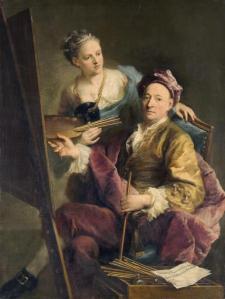
Georg Desmarées "The Artist with His Daughter, Antonia," 1750-1774 © Bayerische Staatsgemäldesammlungen München
The Staatliche Museen zu Berlin, the Staatliche Kunstsammlungen Dresden, and the Bayerische Staatsgemäldesammlungen Munich are to collaborate in presenting the largest exhibition on European art from the Enlightenment period ever to go on show in Asia. In the spring of 2011 the three museums will be exhibiting more than 350 works of art in an area covering 2,700 square metrers at the National Museum of China. The focus will be on major works of art which demonstrate the great ideas of this period, their influence on the fine arts and the history of their reception from the artistic revolutions of the 18th century down to the present day.
The exhibition presents the image world of a period on the threshold of modernity, the ideas of which are of programmatic significance for art today. Paintings, drawings, prints, costumes, furniture and spatial art, sculptures and books will bring all the various facets of the Enlightenment period and its reception history to life for a Chinese audience. Among the masterpieces on display will be works by Watteau, Boucher, Pesne, Piranesi, Chodowiecki, Hogarth and Goya, thus illustrating the wide range of works and the themes which informed the culture of this era, from the Ancien Régime to the Modern period.
The catalogue, which will be published in Chinese and English, will present the latest research findings concerning the art of the Enlightenment and other aspects of this period. This joint exhibition is being financed primarily by the German Foreign Office. It marks the high point of the programme of German-Chinese cultural exchange that was agreed in 2005.
The exhibition Art of the Enlightenment at the National Museum of China will be on display for 18 months. The National Museum on Tiananmen Square in Beijing is currently being refurbished and expanded according to plans drawn up by the Hamburg firm of architects Gerkan, Marg and Partners (gmp). When completed, it will have a total floor area of approximately 200,000 square metres. With its redesigned building, the museum is intended to become a centre for the world’s cultures, a venue in which outstanding guest exhibitions from all over the world will be presented.
◊ ◊ ◊ ◊ ◊
One hint of the politics at work surrounding the exhibition (at least on the German side) can be gleaned from the efforts of Stiftung Mercator (for information on the group, see below) . . .
Stiftung Mercator is currently planning a series of events to officially accompany the “Art in Enlightenment” exhibition which is to be shown in the National Museum of China in Beijing in 2011. In cooperation with the Berlin State Museums, the Dresden State Art Collections, the Bavarian State Painting Collections in Munich and the Federal Foreign Office, Stiftung Mercator will be organizing a series of events entitled “Enlightenment in Dialogue” within the framework of the National Museum of China exhibition “The Art in Enlightenment” in Beijing.
The events will comprise a number of dialogue blocks which will continue for the entire duration of the exhibition. The dialogue blocks will take place in parallel to the exhibition, addressing various facets of a contemporary examination of the subject of enlightenment. Each dialogue consists of a lecture and a panel discussion.
The objective of the series of events is to perceive enlightenment as part of a universal “global heritage of ideas” and to stimulate an open dialogue on the importance of enlightenment in modern times. Stiftung Mercator wishes to bring together Chinese and European scholars, writers and artists and, in particular, to highlight the value of enlightenment for key questions relating to identity and the future.
As described on the foundation’s website:
Stiftung Mercator is one of the largest private foundations in Germany. It pursues clearly defined objectives in its thematic clusters of integration, climate change and arts education and it achieves these objectives with a combination of socio-political advocacy and practical work. Stiftung Mercator implements its own projects and supports external projects in its centres for science and humanities, education and international affairs. It takes an entrepreneurial, professional and international approach to its work.
◊ ◊ ◊ ◊ ◊
This recap comes from ArtDaily.com (note added 1 April 2012) . . .
With a joint ceremony on March 25th 2012, Cornelia Pieper, Minister of State in the Foreign Office, and Zhao Shaohua, Deputy Minister of Culture for the People’s Republic of China, officially concluded the exhibition The Art of the Enlightenment at the National Museum of China. For the past year the exhibition has been on view in Beijing. So far, more than 450,000 visitors have attended. . . .
The full article is available here»
Exhibition: Qianlong and the Forbidden City in the Eighteenth Century
The history of the Peabody Essex Museum, as summarized on the museum’s website, is itself interesting for scholars of the eighteenth century —
The roots of the Peabody Essex Museum date to the 1799 founding of the East India Marine Society, an organization of Salem captains and supercargoes who had sailed beyond either the Cape of Good Hope or Cape Horn. The society’s charter included a provision for the establishment of a “cabinet of natural and artificial curiosities,” which is what we today would call a museum. Society members brought to Salem a diverse collection of objects from the northwest coast of America, Asia, Africa, Oceania, India and elsewhere. By 1825, the society moved into its own building, East India Marine Hall, which today contains the original display cases and some of the very first objects collected.
All the more so with this fall’s exhibition, explained here in a press release from PEM (thanks once again to Courtney Barnes of Style Court for her coverage) . . .
The Emperor’s Private Paradise: Treasures from the Forbidden City
Peabody Essex Museum, Salem, MA, 14 September 2010 — 9 January 2011
Metropolitan Museum of Art, New York, 31 January — 1 May 2011
Milwaukee Art Museum, 11 June — 11 September 2011
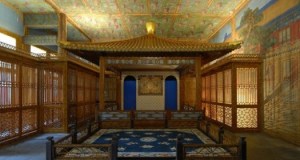 When the last emperor of China, Puyi, left the Forbidden City in 1924, the doors closed on a secluded compound of pavilions and gardens deep within the palace. Filled with exquisite objects personally commissioned by the 18th-century Qianlong (pronounced chee’en lohng) emperor for his personal enjoyment, the complex of lavish buildings and exquisite landscaping lay dormant for decades. Now for the first time, 90 objects of ceremony and leisure – murals, paintings, furniture, architectural and garden components, jades and cloisonné – will be on view at the Peabody Essex Museum (PEM) in Salem, Massachusetts. The Emperor’s Private Paradise: Treasures from the Forbidden City will reveal the contemplative life and refined vision of one of history’s most influential rulers with artworks from one of the most magnificent places in the world.
A model of international cooperation, the exhibition was organized by the Peabody Essex Museum in partnership with the Palace Museum, Beijing, and in cooperation with World Monuments Fund (WMF). “This is the first time that the Palace Museum has authorized such a large-scale and comprehensive traveling exhibition of original historic cultural heritage objects and interiors, all of which represent the apex of the Qianlong period,” said Zheng Xianmiao, Director of the Palace Museum, Beijing. . . .
A Garden of Elegant Repose
A jewel in the immense Forbidden City complex, the Qianlong Garden had remained untouched for more than 230 years when in 2001 the Palace Museum and WMF began the restoration of the 27 buildings, pavilions and outdoor elements including ancient trees and rockeries. Built when China was the largest and most prosperous nation in the world, the garden complex was part of the emperor’s ambitious commission undertaken in anticipation of his retirement. Buddhist shrines, open-air gazebos, sitting rooms, libraries, theaters, and gardens were interspersed with bamboo groves and other natural arrangements. In the garden’s worlds within worlds, the Qianlong emperor would retreat from affairs of state and meditate in closeted niches, write poetry, study the classics, and delight in his collection and artistic creations.
“The Qianlong Garden project is the centerpiece of our conservation work in China. World Monuments Fund is honored to be part of both the history and the future of this important site, and delighted to be working with the Peabody Essex Museum and bringing the Qianlong Garden to a public audience,” said Bonnie Burnham, President of World Monuments Fund.
The Emperor’s Private Paradise includes a film and other interactive elements highlighting the conservation process undertaken by the Palace Museum and WMF, as well as the gifted artisans who restored the objects and architecture to their original condition. A computerized walk-through will offer visitors a vicarious experience of one of the principal structures, the Juanqinzhai building, conservation of which has just been completed. Museum-goers will be able to try their hand at calligraphy with a touch station that will lead them through the brush strokes.
An Emperor of Exceptional Influence
Reigning from 1736 to 1796, the Qianlong emperor led China to sweeping administrative, military, and cultural achievements while far surpassing European monarchs of his day in wealth and power. As the fourth emperor of the Qing (pronounced ching) dynasty to rule China, his 60-year reign spanned the American and French Revolutions, and the reigns of a veritable parade of Georges, Fredericks, and Catherines of Europe. The Qianlong emperor was a multi-faceted monarch – an aggressive military conqueror of vast territories and a passionate patron of the arts. Many of our impressions of imperial China’s splendor date from the 18th century and owe much to the tastes, fashions, and style of the Qianlong court. While incorporating classic Chinese design features such as elements of nature and expressions of Confucian morality, the Qianlong emperor also added new concepts from European painting styles. His desire to innovate within the Chinese aesthetic touched the objects, architecture, and landscapes that he commissioned, transforming what we recognize as Chinese art.
Objects of Imperial Contemplation
The artworks crafted for the Qianlong emperor echoed and supported his dedication to Buddhist spiritual pursuits, Confucian morals, love of literature and reverence for nature. “Visitors to this exhibition will be invited to walk through our galleries the way the Qianlong emperor would have strolled through his rooms and gardens. Around each corner are opportunities to encounter objects of beauty and exceptional craftsmanship,” said Nancy Berliner, exhibition curator and curator of Chinese art at the Peabody Essex Museum. . . .
China and the Peabody Essex Museum
PEM’s relationship with China extends nearly to the Qianlong emperor’s reign and is the longest of any museum in North America. Dating to the close of the 18th century, PEM’s holdings in Chinese art and Asian export art represent some of this country’s first efforts to reach outward and establish mutually enriching, lasting exchanges with other nations.
The Emperor’s Private Paradise is the next step in PEM’s ongoing commitment to bringing new discoveries in Chinese art and architecture to the public. Yin Yu Tang, an 18th-century merchant’s house acquired by the museum in 2003, is the jewel of the museum’s collection and the only example of historic vernacular Chinese architecture in North America. The building was meticulously dismantled at its original site in southeastern Anhui province and re-constructed piece by piece at the museum in Salem. Yin Yu Tang remains a great source of pride for the museum, a deep and abiding connection to China and a rare trove of living scholarship.
Small Show at the V&A: Fashion Plates and Fashion Satire
From the V&A:
Fashion Fantasies: Fashion Plates & Fashion Satire, 1775-1925
Victoria & Albert Museum, London, 21 June 2010 — January 2011

Robert Dighton, "May," from the series "Allegorical Representations of the Months," watercolour, bodycolour and ink on paper, ca. 1785 (London: V&A, Museum No. E37 - 1947)
This display juxtaposes two genres of print that fantasise fashion on paper: fashion plates and graphic social satire. The fashion plate communicated changes in fashion but also encouraged viewers to engage with a luxurious fantasy. At the same time fashionable dress was subject to imaginative distortions in the hands of graphic satirists interested in exposing social foibles. From the oversize wigs of the 1770s to the short skirts and fur stoles of the 1920s, the display charts the dialogue between fashion plate and fashion satire.
V&A Goes Underground: Plan to Expand under Boilerhouse Yard
From the V&A:
Architectural Studies for the V&A
Victoria & Albert Museum, London, 21 June — 19 September 2010
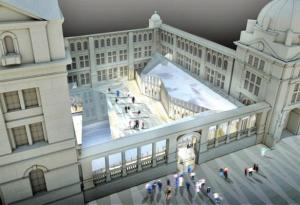
Proposal from Francisco Mangado (Mangado + Asociados)
Eight internationally renowned architects present concept designs for a hypothetical redevelopment of the V&A’s Boilerhouse Yard. The designs, comprising architectural models and plans respond to a brief to create temporary exhibition space below ground and a courtyard at street level off Exhibition Road. The participating practices are:
Jamie Fobert Architects
Tony Fretton Architects Ltd.
Heneghan Peng Architects
Amanda Levete Architects
Francisco Mangado (Mangado + Asociados)
The Office for Metropolitan Architecture (OMA)
Sutherland Hussey Architects
Snøhetta
◊ ◊ ◊ ◊ ◊
As reported by Jay Merrick in The Independent (14 July 2010) . . .
The last time the Victoria and Albert Museum tried to build an extension, the design was likened to an exploding cardboard box and sparked an eight-year battle for approval and funding which ended in a resounding no. The episode must have left a bad taste in the mouth as, once Daniel Libeskind’s Spiral design crashed and burned spectacularly after being denied Heritage Lottery funding, the extension was never mentioned again.
Until now. The museum’s project and design director, Moira Gemmill, has revealed that the V&A will hold a design competition this autumn for a major extension on the very site where the bitterly controversial £70m Spiral was intended to go. But there seems little chance that the V&A will risk anything that is architecturally radical; the Spiral may be history, but it still casts a long and very dark shadow.
That eight-year nightmare ended on 16 September 2004 when the V&A’s director, Mark Jones, was forced to concede that the Spiral odyssey had turned into the architectural equivalent of Monty Python’s dead parrot sketch. The scheme was to have been built on the V&A’s Boilerhouse Yard site, a shambles of offices and plant rooms that lies behind the classical screen along Exhibition Road, designed by Aston Webb in 1891. . . .
The V&A now wants the polar opposite of the upwardly exploding, five-storey Spiral – a flat piazza on the same level as Exhibition Road, with 1500 square metres of new exhibition space beneath it. Costing £30m at most, it will carry less than half the Spiral’s price-tag and, much more significantly, will unlock the second 10-year phase of the V&A’s FuturePlan development strategy.
“We want to create a new semi-public space,” said Ms Gemmill. “The new piazza needs to be absolutely beautifully designed. It can be a place for temporary art, or all sorts of activity” . . . .
The full article is available here»
Reynolds Conference in Geneva
Sir Joshua Reynolds: What’s New?
Université de Lausanne / Musée d’art et d’histoire de Genève, 16-18 September 2010
Colloque Internation organisé par Jan Blanc (Université de Genève) et Pascal Griener (Université de Neuchâtel)
Ce colloque est le premier événement scientifique organisé en Suisse autour de la carrière, de l’œuvre et de l’univers de Sir Joshua Reynolds (1723-1792). Il est aussi l’un des premiers, depuis la dernière grande exposition rétrospective consacré au premier Président de la Royal Academy, à Londres et à Paris (1986), à faire le point des recherches et des travaux les plus récents sur le peintre et son temps. Dans le cadre d’un lieu de rencontres et d’échanges entre les chercheurs et le grand public, il s’agira de permettre aux spécialistes confirmés ainsi qu’aux jeunes chercheurs de se rencontrer, de comparer leurs analyses et de croiser leurs réflexions autour d’un peintre autour duquel de nombreuses questions restent en suspens ou discutées.
Thursday, 16 September 2010
2:00 Jan Blanc et Pascal Griener, Accueil – Ouverture
R E Y N O L D S E N S O C I É T É
2:30 Bénédicte Miyamoto-Pavot, Reynolds en contexte: l’acquisition des arts en Grande-Bretagne au XVIIIe siècle
3:00 David Spurr, Authorial gestures: Reynolds’ literary portraits
Discussion – Pause
4:00 Frédéric Ogée, Hogarth et Reynolds
4:30 Christopher Martin Vogtherr, The Hertford family painting by Reynolds: A case study in British collecting patterns
Discussion – Pause
5:30 Georges Starobinski, Esprit d’enfance et ton pastoral: un contrepoint musical aux fancies de Joshua Reynolds
Discussion
Fin de la première journée
Friday, 17 September 2010
R E Y N O L D S E N P R A T I Q U E S
9:00 Giovanna Perini, Reynolds in Rome: Notes from the New York and family sketchbooks
9:30 Donato Esposito, Drawn to drawings: Reynolds and the drawn line
10:00 Rica Jones, «Some new stratagem of painting the face all red or all blue or all purple at the first sitting» : Reynolds and the world of portraiture in the 1740s
Discussion – Pause
11:00 Colin Harrison, Reynolds in miniature
11:30 Martin Postle, «New light on an old war horse » : Reynolds’s equestrian portrait of Lord Ligonier
12:00 Cristina S. Martinez, Reynolds and Ramsay: On Tradition, the Nation and the Law
Discussion – Déjeuner
R E Y N O L D S E N T H É O R I E S
2:00 Une table ronde avec Olivier Knechciak et Patrick Vincent, Reynolds, Blake, Wordsworth: Reynolds romantique?
Discussion – Pause
3:30 Iris Wenderholm, The President as reader: Sir Joshua Reynolds and his library
4:00 Elisabeth Martichou, Reynolds and Abbé Du Bos: Towards art criticism?
Discussion – Pause
5:00 James A. W. Heffernan, History, portraiture, landscape: The unruly trio of Reynolds’ Discourses
5:30 Iris Wien, Joshua Reynolds: Myths and metaphors
Discussion
Saturday, 18 September 2010
L É G E N D E S E T S U R V I V A N C E S
10:00 Renate Prochno, Reynolds and Gainsborough: The creation of a legend
10:30 Karen Junod, « A Picture of the Mind » : Biography, Portraiture, and Edmund Malone’s An Account of the Life and Writings of the Author Sir Joshua Reynolds (1797)
Discussion – Pause
11:30 Sam Smiles, Turner’s debt to Reynolds
12:00 Camilla Murgia, Du modèle à l’anti-modèle: la perception de la théorie artistique de Reynolds chez les Préraphaélites
Discussion
The program is available here as a PDF file.
Call for Papers: Joseph Banks and the British Empire
Exploring Empire: Sir Joseph Banks, India, and the ‘Great Pacific Ocean’:
Science, Travel, Trade, Literature, and Culture, 1768–1820
National Maritime Museum, Greenwich (London), 24-25 June 2011
Proposals due 1 November 2010
Plenary speakers: Professor Simon Schaffer (University of Cambridge) and Dr Jeremy Coote (Pitt Rivers Museum, University of Oxford)
In 1768, Sir Joseph Banks sailed around the world with Captain Cook and in doing so inaugurated a new era in British exploration, empire and science. As a botanist, man of science, adviser of the monarch and of ministers, and as President of the Royal Society, Banks became a central figure in the expansion in discovery and settlement that took place in the Indo-Pacific region from 1768 to 1820. Through his correspondence with fellow men of science and with government agents, Banks promoted the exchange of knowledge about flora, fauna and human cultures new to Europeans. He was a prime mover in the development of natural philosophy, ethnology, collecting and its global organization, travel and exploration, the publication and illustration of natural history and other mission findings, the development of knowledge within the eighteenth-century Republic of Letters, imperial policy making and the practical uses of science by the state. He planned, for instance, the colonization of Australia and shaped the extension of British imperial influence through India and Polynesia. His activities brought Britons into contact with peoples, countries, plants and animals previously unknown to them, and this contact had major effects on indigenous societies and ecosystems. It also stimulated major cultural interest at home, and this is apparent in the new, Romantic, turn in literature and visual art, whether in Shelley’s Frankenstein, Byron’s The Island, Southey’s The Curse of Kehama and in the paintings of Pacific mission artists Hodges and Westall. (more…)
‘Empires of the Imagination’ — British Politics, War, and the Arts
Apollo Magazine’s book competition:
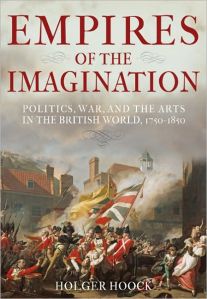 We are pleased to announce that our new competition prize is Empires of the Imagination, Politics, War, and the Arts in the British World, 1750–1850 by Holger Hoock (Profile Books, £30). Over the course of the century after 1750, Britain evolved from a substantial international power into a global superpower and a leading cultural force in Europe. Empires of the Imagination illuminates the manifold ways in which the cultures of power were interwoven in this period of dramatic change. Drawing on a broad range of textual sources and material culture, Hoock combines scholarly analysis with a lively narrative style to revise our understanding of the cultural role of the Hanoverian and early Victorian British state. For your chance to win simply answer the following question and submit your details below before midday on 16th September 2010:
In which Cathedral is Sir Joshua Reynolds buried?
◊ ◊ ◊ ◊ ◊
Maya Jasanoff reviewed Empires of the Imagination for The Guardian back in March. Jacob Glicklich provides a scholarly response at Reviews in History.
Portrait Miniatures in Milwaukee
From the Milwaukee Art Museum:
Intimate Images of Love and Loss: Portrait Miniatures
Milwaukee Art Museum, 8 July — 31 October 2010
Curated by Catherine Sawinski

John Barry, "A Young Girl," ca. 1790 (Milwaukee Art Museum)
The portrait miniatures featured in Intimate Images of Love and Loss are from continental Europe, Britain, and America, and were drawn from the Museum’s Collection and a number of Milwaukee-area collections. The small-scale portraits, most measuring less than three inches tall, are painted on ivory and set within beautifully made cases of glass and metal. The more than sixty objects in the exhibition, now on display as works of art, were once highly personal possessions that were held and worn. Miniatures developed from illustrations in medieval illuminated manuscripts. The word “miniature” derives from the Latin word miniare, meaning “to paint with red lead,” which was one of the techniques used to color manuscripts. Eventually, these illustrations within the text were viewed as small paintings, and were produced independent of the manuscripts. The word “miniature” to mean something small came later.
The portrait miniature emerged in the sixteenth century when nobles used them as gifts to make political alliances. With the rise of the middle class and the tendency towards sentimentality in the late eighteenth century, the demand for portrait miniatures skyrocketed. Their small scale reflects their domestic and private role. Commonly worn as jewelry, they were also displayed on the wall of the home as a type of “family album.” Often miniatures were framed with arrangements of hair from the one portrayed to strengthen the personal connection or as a remembrance of a deceased loved one.










 Enfilade
leave a comment