Wellcome Library Acquires Portrait of French Surgeon, Imbert-Delonnes
Yes, that’s a 28-pound testicular tumor on the table — extracted by this surgeon from the body of the father (at least nominally the father) of Eugène Delacroix. Press release from the Wellcome:
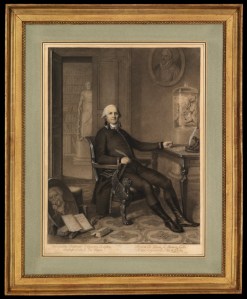
Pierre Chasselat, "Portrait of the French Surgeon Ange-Bernard Imbert-Delonnes," ca. 1800 (London: Wellcome Library)
The Wellcome Library in London has added to its collection of drawings with the acquisition of a magnificent portrait drawing of the French surgeon Ange-Bernard Imbert-Delonnes (1747-1818) by Pierre Chasselat – a portrait with a distinctive feature. The drawing is unusual in that in addition to its more conventional features, the minutely detailed interior includes, on the right, a gruesome souvenir of Imbert Delonnes’s proudest achievement: a gigantic testicular tumour (sarcocele) which – in a controversial operation – Imbert-Delonnes removed from Charles-François Delacroix, the French foreign minister.
The drawing in black chalk is signed by the artist and dated L’an 8 (year 8 in the French Revolutionary calendar, meaning 1799-1800). The portrait itself, and the identity of the man portrayed, were discovered by the firm of Didier Aaron, from whom the drawing has been purchased by the Wellcome Library with the aid of grants from the MLA/V&A Purchase Grant Fund and the Art Fund.
The drawing is both a work of art and a historical document. In accordance with Imbert-Delonnes’s self-image, it shows him sitting in a lordly pose in a fashionable interior at the dawn of the Empire period. In his professional life, he was a fearless and forceful surgeon who made his name in the French Army serving under Napoleon at the battle of Marengo (1800). In the drawing, he is holding his pen as if putting the finishing touches to a manuscript of the Progress of the Art of Healing. The operation on Delacroix proceeded despite seven of his eight medical advisers counselling against touching the tumour, which weighed some 28 pounds.
The seemingly incongruous display of excised body-parts on a plinth in an elegant interior makes the drawing a vivid witness to the sensibility of the surgical elite of the time – and the sarcocele has its own subplot. Its unwilling owner, Charles-François Delacroix, was nominally the father of the painter Eugène Delacroix, although he was almost certainly not his biological father, owing to this very tumour. Eugène Delacroix’s biological father was reputed to be Charles-François Delacroix’s successor as French foreign minister, Charles Maurice de Talleyrand, to whom Eugène bore a strong physical resemblance. (more…)
Exhibition: The Captain Kidd Story
Pirates: The Captain Kidd Story
Museum of London Docklands, 20 May — 30 October 2011
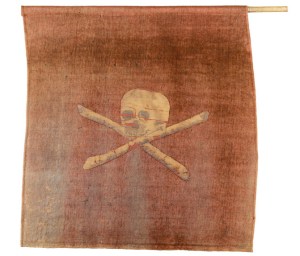 Focusing on the legendary privateer turned pirate, Captain Kidd, this exhibition reveals the surprising truth of how London’s corrupt political activities were entrenched in piracy. The launch date also coincides with the anniversary of Captain Kidd’s execution on 23 May 1701 in Wapping. From cannons and hidden treasure maps to female pirates and gibbet cages, the exhibition will explore the myths and mysteries surrounding common perceptions of pirates. 17th- and 18th-century English society will also be explored, looking at gruesome ritual executions and the greed and manipulation of the infamous East India Company. Over 170 objects will be displayed, including:
• Kidd’s last letter with the promise of hidden treasure
• A real pirate flag, the Admiralty Marshall’s Silver Oar and a gibbet cage
• A Vivienne Westwood outfit from her seminal 1981 ‘Pirates’ collection
• An original 1724 edition of Captain Johnson’s History of the Pyrates
• An early 18th-century cannon
• Images of the Quedah Merchant ship wreck, the vessel that was captured by Scottish privateer, William “Captain” Kidd on January 30, 1698. On May 23, Indiana University will place a dedication plaque on the actual shipwreck.
◊ ◊ ◊ ◊ ◊
From an IU press release (13 December 2007) . . .
Indiana University discovers 1699 Captain Kidd Shipwreck
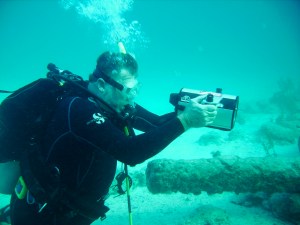
IU marine protection authority Charles Beeker examines possible wreckage from Capt. Kidd's Quedagh Merchant. Photo courtesy of Indiana University
Resting in less than 10 feet of Caribbean seawater, the wreckage of Quedagh Merchant, the ship abandoned by the scandalous 17th-century pirate Captain William Kidd as he raced to New York in an ill-fated attempt to clear his name, has escaped discovery — until now. An underwater archaeology team from Indiana University announced on 13 December 2007 the discovery of the remnants. IU marine protection authority Charles Beeker said his team has been licensed to study the wreckage and to convert the site into an underwater preserve, where it will be accessible to the public.
Beeker, director of Academic Diving and Underwater Science Programs in IU Bloomington’s School of Health, Physical Education and Recreation, said it is remarkable that the wreck has remained undiscovered all these years given its location, just 70 feet off the coast of Catalina Island in the Dominican Republic, and because it has been sought actively by treasure hunters. “I’ve been on literally thousands of shipwrecks in my career,” Beeker said. “This is one of the first sites I’ve been on where I haven’t seen any looting. We’ve got a shipwreck in crystal clear, pristine water that’s amazingly untouched. We want to keep it that way, so we made the announcement now to ensure the site’s protection from looters.” (more…)
Reviewed: ‘Baroque: Style in the Age of Magnificence’
Recently added to caa.reviews:
Michael Snodin and Nigel Llewellyn, eds., Baroque: Style in the Age of Magnificence 1620–1800, exhibition catalogue (London: V&A Publishing, 2009), 372 pages, ISBN: 9781851775583, $85.
Reviewed by Matthew Knox Averett, Creighton University; posted 29 April 2011.
‘Baroque 09’ was a yearlong series of cultural events in the United Kingdom that celebrated the era’s art, music and culture. The Victoria and Albert Museum participated with the well-received exhibition, ‘Baroque 1620–1800: Style in the Age of Magnificence‘, which ran from April 4 to July 19, 2009. Michael Snodin and Nigel Llewellyn’s volume of the same name serves as the catalogue for the exhibition. The book is more than this, however, as the catalogue itself comprises only twenty-eight pages located toward the back of the book. The preceding three hundred pages attempt to reconstruct the Baroque and present it to a wide audience. Making sense of the Baroque is a difficult challenge, but for the
most part the authors have succeeded. . .
The full review is available here» (CAA membership required)
New House Museum in Amsterdam: Het Grachtenhuis
The seventeenth century in the Netherlands — the ‘Dutch Golden Age’ — overshadows the history of the United Provinces in the eighteenth century, and it’s easy to forget that the built environment of a city like Amsterdam continued to play a vital role in international politics. The opening this past April of Het Grachtenhuis (The Canal House Museum) offers a useful reminder. As noted at Holland’s official website:
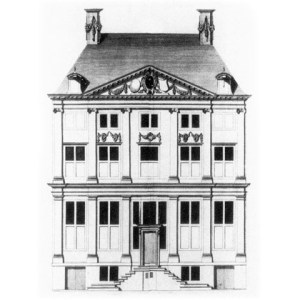 Het Grachtenhuis is a 17th-century mansion located at Herengracht 386 in Amsterdam, designed by Philips Vingboons, the most famous Dutch architect in the Golden Age. The owner of this home was the banker Jan Willink, who gathered the loans that President John Adams used to build New York City and help win the War of Independence against the British. President Adams visited to this canal house in Holland to collect the loans that totaled 29 million Dutch florins (the Dutch currency at the time) from Mr. Willink several times, and used the Dutch funds to establish the foundation for the independence of the United States. John Adams, co-author of the Declaration of Independence and later president of the United States of America, lived in Amsterdam on the nearby Keizersgracht between 1780 and 1782.
The house is now used to introduce visitors to the history of the canals over the past 400 years. Since 1613 marks the year when this extraordinary ring canal expansion began, we’re likely to hear much more in the coming months.
London Shh . . . small historic houses
 Thanks to Alicia Weisberg-Roberts who draws our attention to London Shh. . . “a tiny museum association of tiny house museums, mostly Georgian in theme or fabric.” From the association’s website:
London Shh… is a collection of the city’s hidden-gems; small historic houses which tell the stories of fascinating and famous former residents. Tucked away down intriguing streets and alleys, off the beaten tourist track you will find some of the city’s best kept secrets. London Shh… formed in 2008 with a view to encourage more people to discover and enjoy these beautiful houses. To step through one of our front doors is to be transported back in time and experience first-hand the places which famous names from Freud to Franklin chose to call home. So come and visit us and get closer to the people whose innovations and actions changed the world we live in. All the houses are independent registered charities and generate their own income through exciting programmes of exhibitions, events and more.
◊ ◊ ◊ ◊ ◊
In addition to coordinating digital access for the properties, the association’s site also provides a single point of access for upcoming events. On May 19, for instance, at the Handel House Museum
Jennifer Bennett (baroque violin) and Dan Tidhar (harpsichord) will explore the evolution of the sonata in the 18th century starting with J.S. Bach via his son C.P.E. Bach and ending with Mozart.
And on May 23, at the Benjamin Franklin House,
Dr Allan, historian of the Royal Society of Arts (RSA) and Honorary President of the William Shipley Group for RSA History, will highlight the friendship between Franklin and RSA Founder William Shipley and his family. For over fifty years, Dr. Allan has lectured and written extensively on aspects of the Society’s history, including the Benjamin Franklin connection, and he remains involved in its affairs.
◊ ◊ ◊ ◊ ◊
The houses currently represented include:
- Freud Museum London
- Benjamin Franklin House
- Kelmscott House
- Dr Johnson’s House
- Handel House Museum
- Burgh House & Hampstead Museum
- Emery Walker House
- Wesley House
- Keats House
Job Listing: Chief Curator for the Columbia Museum of Art, SC
The Columbia Museum of Art has a wonderful Kress collection of Renaissance art but also some excellent examples of eighteenth-century painting, including works by Canaletto, Guardi, Sebastiano Ricci, Crespi, Boucher, Nattier, Romney and Reynolds, as well as decorative arts, including Meissenware, Wedgwood, and furniture objects.

Employment Opportunity: Chief Curator
Columbia Museum of Art, Columbia, South Carolina
The Columbia Museum of Art is the premier international art museum in South Carolina with a commitment to exhibiting art from around the world. The collection ranges from antiquity to the present day with a focus on European, American, modern and contemporary, and Asian art. A large gift from the Samuel H. Kress Foundation formed the nucleus of an important permanent collection of more than 6,000 objects of fine and decorative arts across a broad range of centuries and media. The Museum is in a modern 128,000 square foot facility that opened in 1998 and is a captivating architectural building with 25 galleries, designed by George Sexton Associates of Washington, D.C., with art studios, a 160-seat auditorium, a library, and museum shop. Significant undeveloped space is earmarked for future gallery expansion. The Museum has an annual budget of $3.7 million and a full-time staff of 32. It serves as the cultural anchor of a newly revitalized downtown – blocks from the State Capitol and the historic campus of the University of South Carolina. Columbia is South Carolina’s largest city and the center of culture, government, education, and commerce. It is centrally located and within a two-hour drive of the Blue Ridge Mountains, and the beaches and historic sites of Charleston and coastal South Carolina.
The Columbia Museum of Art seeks a creative and energetic professional for the position of Chief Curator to direct a dynamic and diverse exhibition program and to further develop the depth and quality of the permanent collection. The chief curator plays a leadership role in shaping the department’s vision and philosophy and should have a successful record of exhibition and collection development and strong contacts with colleagues, scholars, collectors, and dealers. The ideal candidate will be able to take the museum to the next level in terms of quality exhibitions, audience engagement, and status in the museum community. This position reports to the Executive Director and is an integral member of the senior management team. The person supervises five full-time staff members. The Chief Curator organizes special exhibitions; monitors the safety and proper care of the collections; leads the curatorial team in the planning of temporary and permanent gallery exhibitions and installations; participates in fundraising endeavors; recommends acquisitions to the Director and Collections Committee; cultivates museum donors; and participates in education programs. This position must also work collaboratively with other departments in the development of museum-wide projects. The successful candidate will thrive in a team atmosphere, is a ‘people person,’ and can easily communicate and build excellent relationships with a variety of people, including staff, donors, artists, volunteers, and the general public. (more…)
Opening this Weekend: Hepworth Wakefield Gallery in Yorkshire
The new Hepworth Wakefield Gallery opens this weekend (21 May 2010). As described at the museum’s website:
This stunning building, designed by the award-winning David Chipperfield Architects, will be a place to explore art, architecture and your imagination. With over 1,600 square metres of light-filled gallery spaces, The Hepworth Wakefield will be the largest purpose-built exhibition space outside London. The gallery will bring together work from Wakefield’s art collection, exhibitions by contemporary artists and rarely seen works by Barbara Hepworth, one of the 20th century’s most important artists who was born and grew up in Wakefield.

Other recent projects by David Chipperfield include the Turner Contemporary in Margate and renovations of the Neues Museum in Berlin and the St Louis Art Museum. While the twentieth-century collections are sure to be the focus of the Hepworth Wakefield’s opening, the Gott Collection is also finally getting its due:
An important attraction for visitors will be the rarely seen Gott Collection, gifted to the City’s art collection in 1930. The Gott Collection was assembled in the 19th century by John Gott (1830-1906), Vicar of Leeds and later Bishop of Truro, and his father William (1797-1863), a wool merchant. It was presented to Wakefield Art Gallery in 1930 by Frank Green, a Yorkshire industrialist and philanthropist. The bound 10-volume collection includes 1,200 images, consisting of 65 watercolours, 315 drawings, 749 prints (including hand-coloured prints and one albumen print) and 50 double-sided letterpress pages from a book. It is arguably the finest surviving collection in the region, with over 200 Yorkshire villages, towns and cities depicted within its pages. Through funding by the Esmée Fairbairn Foundation this unique resource including maps, topographical drawings and watercolours will be made publicly accessible. Collectively they show how Yorkshire has long been a place of artistic inspiration. . .
Forthcoming Title: ‘Fragonard and the Fantasy Figure’
Coming this December, as noted at Ashgate:
Melissa Percival, Fragonard and the Fantasy Figure: Painting the Imagination (Aldershot: Ashgate, 2011), 304 pages, ISBN: 9781409401377, $124.95.
A fresh interpretation of the group of Fragonard’s paintings known as the “figures de fantaisie,” Fragonard and the Fantasy Figure: Painting the Imagination reconnects the fantasy figures with neglected visual traditions in European art, and firmly situates them within the cultural and aesthetic contexts of eighteenth-century France. Previously discussed in connection with portraiture, this study relocates Fragonard’s paintings within a tradition of fantasy figures, where resemblance was ignored or downplayed. The book defines Fragonard as a painter of the imagination, and foregrounds the imaginary at a time when Enlightenment rationalism and classical aesthetics contrived to delimit the imagination. The book unravels scholarly writing on these Fragonard paintings, and examines the history of the fantasy figure from early modern Europe to eighteenth-century France. Emerging from this background is a view of Fragonard turning away from the academically sanctioned “invention,” towards more playful variants of the imaginary: fantasy and caprice. Melissa Percival demonstrates how fantasy figures engage both artists and viewers, allowing artists to unleash their imaginations through displays of virtuosity, and viewers to use their imagination to explore the paintings’ unusual juxtapositions and humour.
Contents: Introduction; Fact and fantasy: demystifying Fragonard’s fantasy figures; The fantasy figure in European painting; Fragonard, ‘pasticheur inspiré’; Departures from resemblance; Fictional identities; Fantaisie and caprice; Conclusion; Bibliography; Index.
Melissa Percival is Senior Lecturer in French at the University of Exeter, UK
◊ ◊ ◊ ◊ ◊
In this smartly written, thoroughly researched work, Fragonard and the Fantasy Figure, Melissa Percival explodes the myth that Fragonard’s fantasy figures are dazzling but impenetrable images; she offers instead a wide range of interpretive perspectives that provides the ground for a renewed appreciation of these works. In a book that is a model of scholarly clarity, Percival has made a valuable contribution to Fragonard studies.
–Julie-Anne Plax, University of Arizona
Collecting and the Art Market in Venice and Rome
This round table has been organized by Nathalie Volle et Chantal Georgel. From the INHA:
Collectionnisme et marché de l’art à Venise et à Rome au XVIIIème siècle
Institut national d’histoire de l’art, Paris, 17 May 2011
Table ronde autour des livres de Paolo Coen (Il mercato dei quadri a Roma nel Diciottesimo secolo, la domanda, la offerta e la circolazione delle opere in un grande centro artistico europeo), et de Stefania Mason (Il collezionismo d’arte a Venezia. Il Settecento). Participants: Paolo Coen, Stefania Mason, Daniela Gallo, Nathalie Volle.
◊ ◊ ◊ ◊ ◊
Linda Borean, Stefania Mason, eds. Il collezionismo d’arte a Venezia. Il Settecento (Venice: Marsilio, 2009), 432 pages, ISBN: 9788831799263, €35.
 Questa pubblicazione, la terza di una collana specificatamente dedicata al collezionismo artistico a Venezia in età moderna, prende in esame il Settecento, il secolo definito della “gloria” di Venezia, particolarmente ricco e articolato per l’evoluzione del gusto e degli orientamenti del fenomeno, con elementi di continuità e altri di contrasto con l’epoca che lo precede. Composto da saggi tematici che illuminano tipologie di opere, aspetti e problemi del commercio artistico (anche in connessione con le conseguenze delle soppressioni delle corporazioni religiose), presenze forestiere di artisti, collezionisti e agenti, casi-studio di raccolte particolarmente significative per i loro proprietari (una casata di antica nobiltà e un facoltoso imprenditore della manifattura del tabacco) e la loro formazione, il volume è completato da un corpus di oltre quaranta voci biografiche su raccoglitori, mercanti, agenti, diplomatici e critici che hanno assunto un ruolo determinante nello sviluppo del collezionismo nel Settecento veneziano: accanto a personalità in parte conosciute, ne compaiono numerose altre dal profilo sinora indefinito nonostante la loro rilevanza nel panorama del tempo. Un’appendice di documenti inediti offre un campione rappresentativo delle diverse tipologie di fonti archivistiche disponibili, da quelle “classiche” quali inventari, testamenti e carteggi, ad altre prodotte da precise contingenze storiche, ad esempio i saccheggi compiuti nei palazzi veneziani nel 1797.
◊ ◊ ◊ ◊ ◊
Paolo Coen, Il Mercato Dei Quadri a Roma nel Diciottesimo Secolo: La Domanda, l’Offerta e la Circolazione delle Opere in un Grande Centro Artistico Europeo, 2 vols (Florence: Leo S. Olschki Editore, 2010), 816 pages, ISBN: 9788822258953), €80.
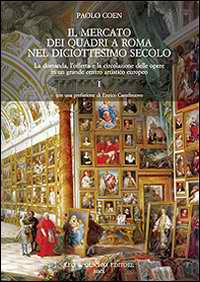 Il binomio arte-denaro, oggi persino ovvio, esisteva anche in passato, sebbene attraverso forme e meccanismi in parte differenti. Tradizionalmente uno dei centri del mercato pittorico fu Roma, meta prediletta di artisti e viaggiatori provenienti da ogni parte del globo. Il libro ricostruisce questo complesso fenomeno individuando un momento chiave nel diciottesimo secolo, quando la città, anche sulla scia del Grand Tour, vede ancor più aumentare il suo peso nei sistemi artistici d’Europa.
Call for Essays: Collected Volume on Solo Shows
Alternative Venues: Artists’ Solo Shows and Other Exhibits beyond the Academy and the Salon, 1700-2000
Abstracts due by 1 December 2011
I am putting together a volume of essays devoted to the subject of single-artist, thematic, and single-object exhibitions from the eighteenth century through the twentieth, organized and displayed outside of academic jurisdiction, in most cases by the artist her/himself. It is tentatively called Alternative Venues. Essays will explore the functions, meanings, organizational and visual structures, and/or successes/failures of artists’ solo shows (e.g., Courbet’s Pavilion of Realism), exhibitions of thematically unified work by a single artist (e.g., Fuseli’s Milton Gallery), and displays of single art objects (e.g., David’s Intervention of the Sabine Women). It is my hope that the collection as a whole will highlight the innovation and modernity of such exhibitions, while perhaps setting their motivations and functions into relief against similar displays in the contemporary art world, where the solo show is the benchmark of artistic success for the living artist. Publishing interest has already been expressed by a very reputable press, famed for such volumes of art historical essays. Please send a CV and 3-5 page abstract by December 1, 2011 to Andrew Graciano, Associate Chair and Graduate Director, Department of Art, University of South Carolina, 1615 Senate Street, Columbia, SC 29208; or by email at graciano@mailbox.sc.edu.
Participants will be notified in January 2012. Full drafts of accepted essays are due by March 2012. Projected publication date is early to mid 2013.










 Enfilade
leave a comment