International Museum Day & European Night of Museums
Press release from the IMD:
International Museum Day – Museum and Memory: Objects Tell Your Story
18 May 2011
 On and around 18 May, museums worldwide will celebrate International Museum Day. Established in 1977 by the International Council of Museums, more than 30,000 museums in around 100 countries will hold special activities on this occasion. In 2011, the theme of International Museum Day is Museum and Memory. Through the objects they store, museums collect stories and convey the memory of our communities. These objects are the expressions of our natural and cultural heritage. Many of them are fragile, some endangered and they need special care and conservation. International Museum Day 2011 will be an occasion for visitors to discover and rediscover individual and collective memory. . . .
The conservation and transmission of collective memory is a preoccupation for other heritage players, beyond the museum community. For this reason, for the first time ever, the International Council of Museums has initiated close institutional partnerships with other organisations that feel concerned by these questions and share ICOM’s preoccupation for the preservation of memory: the UNESCO “Memory of the World” programme, the Co-ordinating council of Audiovisual Archives Associations (CCAAA), the International Council on Archives (ICA), the International Council on Monuments and Sites (ICOMOS) and the International Federation of Library Associations and Institutions (IFLA). In addition, ICOM will be a patron of the European Night of Museums on 14 May, 2011 for the first time since the event was launched. . . .
◊ ◊ ◊ ◊ ◊
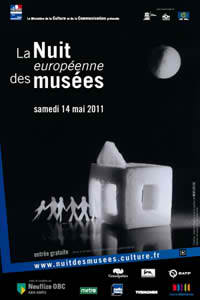 The European Night of Museums / La Nuit Européenne des Musées
14 May 2011
The European Night of Museums was created in 2005 by the French Ministry of Culture and Communication. During a late-night opening, visitors can discover, for free, museums’ collections and all the special events organised for the festival. The Night of Museums aims to make museums more accessible to the general public and in particular to a new younger public and to federate a network of European museums around a common festive and friendly event. In 2010, more than 3,000 European museums in 40 different countries participated in the Night of Museums.
Additional information is available here»
Fellowship in Urban Cultural History
RCUCH Flaherty Visiting Fellowship in Urban Cultural History
University of Massachusetts Boston, Spring 2012
Applications due by 1 September 2011
The Research Center for Urban Cultural History at the University of Massachusetts Boston is offering a 3-4 week short-term visiting fellowship for Spring 2012. The RCUCH Flaherty Visiting Fellow will pursue a research project pertaining to urban cultural history; the project must be interdisciplinary, and be focused on the cultural history of cities, urban life, urban networks, urban materials or urban experience. We define urban cultural history broadly; projects treating pre-urban sites as well as contemporary situations fall within the fellowship’s parameters. The sole condition of the fellowship is that during the fellowship period the Fellow offer a seminar talk for the RCUCH Faculty Seminar group on work-in-progress related to the research project. The RCUCH invites applications, giving preference to scholars at associate professor rank or above. (more…)
James Cuno Named President and CEO of the Getty Trust
Press release from the Getty:
 The Board of Trustees of the J. Paul Getty Trust announced today that James Cuno, recognized both nationally and internationally as a noted museum leader and scholar and an accomplished leader in the field of the visual arts, has been named president and CEO of the J. Paul Getty Trust. Dr. Cuno, who comes to the Getty after serving as president and Eloise W. Martin Director of the Art Institute of Chicago since 2004, will assume his position August 1.
Prior to directing the Art Institute of Chicago, one of the world’s leading encyclopedic art museums, where in 2009 he presided over the opening of the museum’s Modern Wing, Dr. Cuno was the director and professor of the Courtauld Institute of Art, University of London, from 2003-2004; the Elizabeth and John Moors Cabot Director of the Harvard University Art Museums and professor of the history of art and architecture at Harvard from 1991 to 2003; director of the Hood Museum of Art, Dartmouth College, from 1989-1991; director of the Grunwald Center for the Graphic Arts, UCLA, from 1986-1989; and assistant professor of art, Vassar College, from 1983-1986. Dr. Cuno, 60, received his A.M. and Ph.D. in the History of Art from Harvard in 1980 and 1985, respectively; an M.A. in the History of Art from the University of Oregon in 1978; and a B.A. in History from Willamette University in 1973. A Fellow of the American Academy of Arts and Sciences, Dr. Cuno is a prolific author and lecturer on museums and cultural policy. His most recent book, Museums Matter: In Praise of the Encyclopedic Museum, will be published by the University of Chicago Press later this fall.
Mark S. Siegel, chair of the Getty’s Board of Trustees said, “Jim’s background as a scholar and arts leader, and as a proven executive at major arts institutions in the United States and Great Britain, made him an ideal candidate to lead the J. Paul Getty Trust. The Getty operates locally through its highly regarded Museums at the Getty Center and at the Getty Villa, and globally through the work of its four programs. The Getty needs a leader with an understanding of all aspects of the visual arts, who is known and respected around the world for intellectual curiosity and achievement. But the Getty also needs an experienced executive who has the managerial and strategic skills needed to lead a complex organization. Jim’s proven record gives our Board confidence that he, working with our outstanding management team, will be able to lead the Getty to ever greater accomplishments.” (more…)
Exhibition: Works from the V&A in Seoul
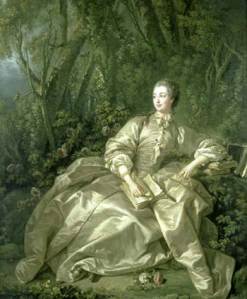
François Boucher, "Marquise de Pompadour," 1758 ©Victoria and Albert Museum / V&A Images
From the museum’s website:
Princely Treasures: European Masterpieces 1600-1800
National Museum of Korea, Seoul, 3 May — 28 August 2011
The exhibition Princely Treasures: European Masterpieces 1600-1800 from the Victoria and Albert Museum, presents 160 selected masterpieces from the collection of the V&A in London. The highlights of the collection include the Marquise de Pompadour by François Boucher and other works of art reflecting life in European courts between the 17th and 18th centuries.
In the May Issue of ‘Apollo’: From the Landsdowne Collection
From Apollo:
Elizabeth Angelicoussis, “Diomedes and Diskobolus,” Apollo Magazine (May 2011)
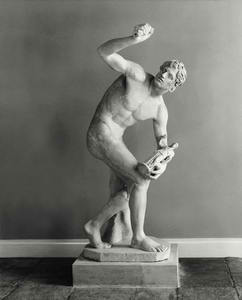 Among the collection of classical sculpture belonging to the 1st Marquess of Lansdowne was a Roman copy of a lost bronze of Diskobolus by the Greek sculptor Myron. Excavated by the dealer Gavin Hamilton in 1774, the marble’s fascinating story has much to reveal about late 18th-century.
. . . It is hoped that this article’s examination of this particular distinctive Lansdowne sculpture and its interesting history will stimulate awareness in a new book, developed by this author in conjunction with Ian Jenkins, Senior Curator of Greek and Roman Antiquities at the British Museum and Daniella Ben-Arie, co-curator of the 2008 Thomas Hope exhibition at the Victoria and Albert Museum. The book aims to rediscover, examine, photograph and interpret the once coherent group of Lansdowne sculptures that is now widely dispersed across the globe. . . .
A brief bit of online searching for details regarding the new book turned up nothing, though presumably we will hear more in the coming months. -CH
Exhibition and Symposium: Early American Maps and Prints
From The Colonial Williamsburg Foundation:
More than Meets the Eye: Maps and Prints of Early America
DeWitt Wallace Decorative Arts Museum, Williamsburg, VA, 26 March 2011 — April 2012
 The exhibition features 35 maps, portraits, and other graphic images that invite the viewer to look more deeply into the subtle messages delivered by artisans depicting America. Maps, in particular, were regarded as scientific and authoritative documents, imparting a perception of power and control over the environment. As such, they also became important tools for swaying public opinion. The factors that motivated the production of individual maps often become apparent through close scrutiny of their decorative features and the information their creators chose to include–or omit.
In addition to objects from the Colonial Williamsburg collections, the exhibition includes an outstanding documentary source for the 1920s restoration of the historic town—the “Frenchman’s” map, loaned by the College of William and Mary. The Connecticut Historical Society has also kindly agreed to loan their copy of Abel Buell’s A NEW and correct Map of the
UNITED STATES of AMERICA, the first map of the thirteen states to be
published after the Congress of the Confederation ratified the treaty on
January 14, 1784.
◊ ◊ ◊ ◊ ◊
Symposium: More than Meets the Eye: Maps and Prints of Early America
DeWitt Wallace Decorative Arts Museum, Williamsburg, VA, 16-18 October 2011
In conjunction with the exhibition, Colonial Williamsburg will sponsor a symposium from October 16-18, 2011 that will feature lectures focusing on the men who created these objects, how they assembled and disseminated their information, and the factors that motivated them to create powerful and influential images. Speakers will include Philip Burden, Paul Cohen, Louis De Vorsey, Matthew Edney, William Gartner, and Henry Taliaferro. The conference begins with an opening reception Sunday evening followed by two days of lectures, Monday and Tuesday. A complete conference agenda will be posted as soon as it is available.
Call for Papers: Universities Art Association of Canada (UAAC/AAUC)
The 2011 annual conference for the Universities Art Association of Canada (UAAC/AAUC) will be hosted by Carleton University in Ottawa, Ontario, from Thursday, October 27th, to Saturday, October 29th. The following list of sessions suggests the possibilities for eighteenth-century papers. A one-page proposal and CV should be sent to the session chair by May 15. Presenters must become members of UAAC. For more information and the full call for papers (including the French), please visit the conference website.
◊ ◊ ◊ ◊ ◊
Drawings from the Fifteenth Century to the Present Day
Chairs: Jen Diorio and Janina M. Knight, 2jmk1@queensu.ca
This session calls for papers that explore topics relating to the important role of drawing in art and architecture. Papers can discuss the role of the drawing as a preparatory step in the artistic process, or how a drawing can be created and exist as a work of art in its own right. How can drawings aid art historians in understanding the true intentions of artists and architects? How can drawings be used to reveal otherwise unknown aspects of an artist’s working process? In what ways can drawings enlighten us as to the meaning of particular works of art or architectural designs? We invite submissions that discuss the role of drawing in European art and architecture from the fifteenth century to the present day.
◊ ◊ ◊ ◊ ◊
“The Barbarous Gaudy Goût”: Encounters between East and West in Early Modern Art
Chairs: Je Eric Weichel, 6ejw@queensu.ca, and Allison Fisher, 1anf@queensu.ca
In 1749, Elizabeth Montagu wrote “we must all seek the barbarous gaudy goût of the Chinese; and fat-headed Pagods and shaking Mandarins bear the prize from the finest works of antiquity.” Montagu’s satirical description of chinoiserie is one of the most famous commentaries on the process of aesthetic and artistic contact between Asia and Europe. This session seeks papers reflecting the cultural communication between East Asia and Western Europe in a range of diverse media, including ceramics, painting, textiles, pattern and lacquer. We are specifically interested in the dialogue between China and Japan and Britain, France and Italy from the fourteenth to the nineteenth centuries. Subjects could include: activities of the East India Company or the VOC, chinoiseries, textile trade and conservation, landscape design, architecture, tea drinking and ceremonies, consumption of exotic commodities, food history, portraiture, costume history, mission work, archaeological investigations, and Impressionist japonisme.
◊ ◊ ◊ ◊ ◊
The Global Baroque in Postcolonial Perspective
Chairs: Stephanie Dickey and Gauvin Alexander Bailey, dickeys@queensu.ca
This session seeks papers concerned with visual and material culture around the world in the period ca. 1580- 1750. In this era of colonial and economic expansion, artists and architects frequently traveled outside their home countries for work or inspiration, while paintings and prints functioned as internationally-traded commodities. We are especially interested in case studies that explore the creative dynamic produced by interactions between artists, artworks, and/or consumers of art from divergent cultures. This might include intersections both within the European continent (e.g., Netherlandish artists in Rome or Prague) and between Europe and the wider world (e.g., French architecture in Quebec, European artists in Asia or the Ottoman Empire, etc.).
◊ ◊ ◊ ◊ ◊
Landscape of Ruins
Chairs: Karla McManus, karla.mcmanus@gmail.com, and Luke Nicholson, ld_nicho@alcor.concordia.ca
The ruin is a charged concept, evoking both wreckage and the possibility of renewal. In architectural and landscape painting, drawing and printmaking, the ruin has a long history as an emblem of civilization’s decay, the sublime possibilities of destruction, and a warning against hubris. More recently, ruination has returned to envision the future collapse of contemporary civilization, brought on by ecological, cultural or political disaster. Time-based technologies, such as photography, video and film, have emerged as central in the representation of ruination today. Proposals are invited on any aspect of the landscapes of ruin, in any medium and historical period.
◊ ◊ ◊ ◊ ◊
The Signature of the Artist
Chairs: Franziska Gottwald and David de Witt, franziskagottwald@googlemail.com
Signatures of artists have been known since Antiquity, and are often found as name, monogram, or symbol. In the Renaissance, many signatures were written in Latin and sometimes expanded into an assertion of the artist’s intellectual and manual work. But such inscriptions are not the only kind of authorial signature to be identified in art. The artist’s typified style of painting or etching can also serve as a signature. This panel seeks papers that discuss the different meanings of “signature” from a range of periods and contexts, and addresses questions such as: artistic commentary, self-representation, and the aesthetics of the signature of the artist.
◊ ◊ ◊ ◊ ◊
Prints and Cross-Cultural Encounters, 1600-1850
Chair: Stéphane Roy, stephane_roy@carleton.ca
In recent years, “globalization” has coloured the historian’s practice, leading scholars to widen their scope in order to get a more comprehensive look at modern and early modern societies. Evidence of cross-cultural connections seems indeed to abound, from the propagation of Caravaggio’s style through the paintings of foreign artists to the use of printed text to disseminate ideas during the Enlightenment. But perhaps no other medium can better testify to the vigour of cultural exchanges than printmaking itself. As works of portable dimension, prints had the natural ability of connecting cultures, shaping and fashioning ideas; they could also be reinterpreted and given new meanings in different cultural environments. Preliminary evidence indicates that interactions between European (and, later, North-American) printmakers resulted in cultural transfers that have not been without consequences on the shaping of national identities. Just as with literature and political theory (areas enriched and transformed by “international” dialogue), the effects of cosmopolitism were equally felt in the world of visual arts. Measuring those effects, however, has yet to be done. How did these elements of intercultural connections translate into visual terms? Are there indications pointing to the existence of a common iconographical lexicon based on shared values or ideals? Does the practice of printmaking itself challenge the long-standing tradition of “national schools”?
By using the print medium as a prime vehicle for cross-cultural encounters, this panel welcomes proposals in both English and French dealing with the following issues: circulation of prints in different national contexts; visual recycling of specific visual motifs; existence of recurring themes and common visual codes; advertisement of foreign prints in newspapers; role of print sellers as cross-cultural intermediaries; artists travel and correspondence; development of national styles using “foreign” engraving techniques; dissemination of painters’ work in different national contexts; international art trade; and representation of otherness in prints.
Conference: Theories and Things, New Directions for the Decorative Arts
With Julie Ramos, I am organizing a study day at the Institut national d’histoire de l’art (INHA) featuring the research of upcoming junior scholars on new directions in the decorative arts. The event will cover several centuries and artistic mediums that intersect with material culture, ornament, objects, and materiality. For Enfilade readers, there will be some excellent presentations on eighteenth-century art, notably by Delphine Burlot, Elisa Foster, Anne Perrin Khelissa, and Boris Gibhardt. If you will be in Paris in early June, I hope to see you there. – JF.
◊ ◊ ◊ ◊ ◊
Des Théories et des choses: nouvelles orientations dans l’étude des arts décoratifs
Institut national d’histoire de l’art, Paris, 6 June 2011
La « culture matérielle », notion globalisante bien que problématique, permet de rapprocher de nombreuses disciplines savantes, des études américaines aux Visual Studies, en passant par l’anthropologie, la philosophie, l’architecture, l’histoire de l’art, l’histoire et la littérature. Elle se manifeste notamment de manière implicite dans nombre de projets menés actuellement, par exemple dans le thème de la prochaine conférence du CIHA (Comité International d’Histoire d’Art) en 2012, The Challenge of the Object, ainsi que dans la future exposition Paris: Life and Luxury au Getty Institute de Los Angeles, qui prévoit l’exposition des objets dans un intérieur parisien reconstitué. Cette actualité est l’occasion d’interroger la manière dont les objets sont traités, comparés et évalués. La tendance à une normalisation et à une naturalisation des termes par le discours de l’histoire de l’art invitent à de nouvelles analyses et clarifications. Cette journée d’études se propose d’examiner pourquoi et comment les théories de la “culture matérielle” sont presque devenues synonymes d’étude des arts décoratifs, en cela toutes périodes et techniques de fabrication confondues. Elle a pour objectif de présenter les travaux de jeunes chercheurs (doctorants et post-doctorants) de différentes spécialités portant sur des objets de la culture matérielle. Il s’agira d’ouvrir ainsi des perspectives nuancées et critiques pour l’étude de ce champ, engageant des questions d’historiographie, d’histoire de l’art, de philosophie et d’esthétique. En remettant en jeu l’identité de l’objet autant que la conception de sa matérialité, cette journée entend redonner une dimension critique aux théories de la culture matérielle et explorer leurs apports à l’histoire de l’art. Contact: jennifer.ferng@inha.fr
◊ ◊ ◊ ◊ ◊
1: La culture matérielle
Modération: Julie Ramos (INHA)
9h30 – 9h50: Anne PERRIN KHELISSA (Centre allemand d’histoire de l’art)
Le statut juridique des objets du décor à Gênes au XVIIIe siècle. Une question posée à l’histoire de la culture matérielle nobiliaire
9h50 – 10h10: Jennifer FERNG (MIT / INHA)
Les états révolutionnaires d’échange: L’économie matérielle ou la transformation de l’ornement et de la monnaie
10h10 – 10h30: Damien DELILLE (Université François Rabelais de Tours / INHA)
“Les arts de la personnalité”: costume symboliste et critique du dandy fin de siècle
10h30 – 11h00: Discussion
11h00 – 11h15: Pause (more…)
For the Season of Fashion and Horses
The following piece, “Hats, Horses, and History,” by Kimberly Chrisman-Campbell on the conjunction of sartorial and equestrian displays at Longchamp appears at WornThrough — as posted by Heather Vaughan. Thanks to Kimberly for passing it along . . . -CH.
◊ ◊ ◊ ◊ ◊
I’m pleased to be able to share with you, this guest post by Dr. Kimberly Chrisman-Campbell. She is an independent fashion and textile historian and occasional contributor to WornThrough. Her work on eighteenth- and nineteenth-century French fashion has also appeared in Costume, Textile History, PieceWork, and Dress, as well as in several books and exhibition catalogs, most recently Paris: Life & Luxury in the Eighteenth Century (Getty Publications, May 17, 2011).
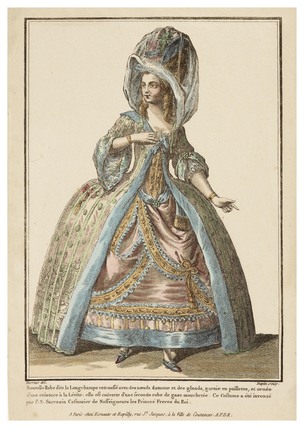
Nouvelle Robe dite la Longchamps retroussee avec des noeuds damour et des galands: 1779, Gallerie des Modes, Desrais, Dupin, via Museum of London.
Before Philip Treacy and Stephen Jones, before Royal Ascot and the Kentucky Derby, and even before the sport of horseracing itself, there was the promenade de Longchamp, a three-day spectacle of fashion and horseflesh. The modern-day romance between outlandish hats and world-class horsemanship has its roots in this eighteenth-century Parisian ritual, as does the American tradition of the “Easter Parade.”
About four miles from central Paris, in the Bois de Boulogne, lay the medieval village of Longchamp. Since 1256, it had been home to a convent that served as a popular destination for pilgrims for hundreds of years before the phenomenon known as the promenade de Longchamp began in the late seventeenth century.
The promenade was not an authorized religious pilgrimage, but a spontaneous, secular one, taking place on the Wednesday, Thursday, and Friday before Easter—the final days of Lent. Musical members of high society began to make the annual trip to Longchamp in the seventeenth century, drawn by the convent’s sung Holy Week services. By the mid-1700s, the sleepy village in the woods had become the epicenter of French society,
if only for a few days each year. . . .
The full article (including a reading list) is available here»
Study Days on Theatricality in French Painting
From Le blog de APAHAU:
Le Tableau et la Scène. Peinture et mise en scène du répertoire héroïque dans la première moitié du XVIIIe siècle autour des figures des Coypel
Musée des Beaux-Arts de Nantes, 16-17 May 2011
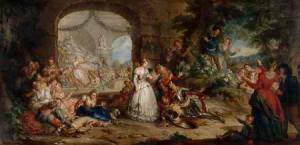 Que la Cléopâtre avalant le poison de Charles- Antoine Coypel, ou le Portrait de Mademoiselle Clairon en Médée de Carle Vanloo, soient empreints dʼun imaginaire lié au théâtre, semble une évidence. Mais la formulation positive de leur « théâtralité » pose question. Trop souvent réduite à une qualité seulement sensible, désignant toute recherche ostentatoire de lʼeffet (la grandiloquence des mouvements, lʼexacerbation des sentiments ou encore la pompe des décors), la « théâtralité » se déplace au contraire dans le paysage historique en fonction dʼidées et dʼexpériences concrètes relatives aux arts dramatiques. Elle peut dès lors être repérée, et même définie par lʼexamen du théâtre lui-même, dans son authentique perspective du XVIIIe siècle – à travers lʼétude de sa dramaturgie, de ses décors et de son espace scénique, du jeu ou du costume de ses acteurs… (more…)










 Enfilade
leave a comment