Call for Essays: Material Culture and Gender
Enlightened Objects: Essays on Material Culture and Gender in Eighteenth-Century Europe
Edited by Jennifer Germann and Heidi Strobel
Proposals due by November 2011
 We are developing an anthology called Enlightened Objects: Essays on Material Culture and Gender in Eighteenth-Century Europe, under consideration for the Ashgate series, The Histories of Material Culture and Collecting, 1700-1950, edited by Michael Yonan. The volume addresses the relationship between gender and material culture in order to examine the creation of gendered identities in relation to material objects. We are seeking proposals that consider a broad array of objects including, but not limited to, furniture, paintings, sculpture, clothing/textiles, and jewelry, produced by both amateur and professional artists.
Are you working on any projects that relate to our proposed volume? We welcome submissions from a variety of fields such as anthropology, history, sociology, museum studies, studio art, art history, and other areas of study. If you are interested, we will send more detailed information about submitting an abstract.
Jennifer Germann (Ithaca College), jgermann@ithaca.edu
Heidi Strobel (University of Evansville), hs40@evansville.edu
Historical Paint, Part III
As we wrap up this small series on historical paint, the following books might be useful for further reading:
◊ ◊ ◊ ◊ ◊
Ian Bristow, Architectural Colour in British Interiors, 1615-1840 (New Haven: Yale University Press, 1996), 288 pages, ISBN: 9780300038668, $150.
 Paint is ephemeral: it fades and discolors and is obliterated by succeeding phases of redecoration. Until recently, this has presented a significant obstacle in researching the architectural colours used in British interiors of earlier centuries but, in this study, Ian C. Bristow combines information from documentary sources with data obtained from the technical investigation of significant interiors by important architects of the period. He has thus been able to establish a coherent outline of true historical practice, which hs here presented for the first time.
Bristow contrasts the noble interiors of Inigo Jones with more intimate spaces of the period. He then sets the succeeding drabness adopted in many rooms in the second half of the seventeenth century against the era’s taste for marbling, graining, and imitation Japan. Moving on to consider the eighteenth century, he shows how the new foundation established by the Palladians came to provide the basis for the lively use of colour by Robert Adam and his contemporaries. Finally he examines how the development of colour theory in the early nineteenth century superseded eighteenth-century ideas and, combined with the Regency taste for the exotic, led to an entirely new outlook, much of which has lasted to the present day. Bristow’s book is an essential complement to more conventional architectural studies of form and space and a key text for students of all aspects of the historic interior.
◊ ◊ ◊ ◊ ◊
Ian Bristow, Interior Housepainting Colours and Technology, 1615-1840 (New Haven: Yale University Press, 1996), 288 pages, ISBN: 9780300038675.
 The study of historic architectural colour is a developing field, with information greatly in demand by all those with an interest in the redecoration of historic interiors. In this volume, Ian C. Bristow describes the techniques and materials used in interiors by early housepainters, providing comprehensive coverage for architects, historians, interior decorators, and others with a more general leaning to the topic.
Bristow points out the differences between painting materials used for fine art as opposed to house painting. Drawing on English and French sources, he discusses the pigments used; the oils, resins, solvents, and water-based media involved; the way these were applied; techniques for imitating various architectural materials in paint; and the mixing of colours. A glossary of contemporary color names is illustrated by samples showing some of the tints obtainable, while marbles and timbers to which references have been found are listed and reproduced. This study will be of interest to all working in the
field of historic paintwork.
Historical Paint, Part II
For anyone especially interested in yesterday’s interview of Patrick Baty by Courtney Barnes, you might have a look at the website of The Traditional Paint Forum. In addition to publishing a journal and a newsletter entitled Smudge (reason alone to learn more!), the TPF hosts an annual workshop/conference. This year’s took place in May at the newly restored Strawberry Hill. Talks addressed topics such as ‘Historic, Exotic and Imported Pigments’, ‘Modern Manufacturing Methods and the Appearance of Paint’, ‘Raw Earth to Pigments: Vernacular Paints’, and ‘The Impact of Artificial Light on the Historic Interior’. From the TPF website:
◊ ◊ ◊ ◊ ◊
 The Traditional Paint Forum (TPF) is interested in the influences, personalities and circumstances that gave rise to particular decorative schemes in an architectural context. But, very importantly, we also believe the only way informed judgements can be made about the significance and future of existing or lost schemes is to also understand what materials were used to create them and how they were executed. The why is not the whole story … how can be just as vital!
The holistic nature of the organisation is perhaps best reflected in its Annual Workshop/Conference where the papers given on the architectural and historical significance of particular decorative schemes are given greater depth by contributions on: paint-analysis; conservation techniques; cleaning and redecoration. This is usually supplemented by practical demonstrations of the original techniques and materials used and possible new alternative paint materials that might be worth considering.
The Annual Conference is reinforced by an annual journal containing articles on a disparate number of topics, but often including papers delivered at the conference, and a newsletter, Smudge. The TPF have also organised some very successful Technical Days (‘Paint Day’) which give an introductory overview to traditional paint technology and, through popular demand, have been repeated on a number of occasions in different United Kingdom locations.
Historical Paint, Interview with Color Consultant Patrick Baty
As we seem to become increasingly detached from the materiality of paint (at least in many quarters), there’s a tendency to view the substance of eighteenth-century paint anachronistically, ignoring the tangibility and the finite possibilities of these historical mixtures. As a corrective, Enfilade contributor Courtney Barnes (author of her own ever-interesting blog, Style Court) offers the following insightful interview with leading color consultant Patrick Baty. As soon becomes clear, Baty is a vocal champion of the understated ‘common colors’ — creams and various stone colors — and, not surprisingly, he has previously raised questions over some of John Fowler’s most expressive restoration projects (one thinks of the famous yellow walls of the staircase at Sudbury Hall). The interview is full of fascinating links, and I think there’s plenty here to satisfy the full range of Enfilade readers. My warm thanks to both Patrick and Courtney for their participation. -CH.
◊ ◊ ◊ ◊ ◊
The Color Field: A Look at Paint Then and Now with Historian Patrick Baty
By Courtney Barnes
 Pouring over bolts of sumptuously embroidered fabric, shopping for colorful ribbons, planting a garden—these activities I recall seeing portrayed in various period films. But characters discussing house paint? This seems much less familiar. Mr. Blandings Builds His Dream House provides one notable movie example, with Mrs. Blandings (played by Myrna Loy) describing her desired hues in a famous paint-related scene. The emphasis of the 1948 comedy is, however, on shaping the present, not conjuring the past. And yet, we know that people living in the eighteenth and nineteenth centuries were themselves very interested in color.
In her book, The Creation of Color in Eighteenth-Century Europe, Sarah Lowengard emphasizes the wide-ranging appeal: “Throughout the eighteenth century, people from all social and economic backgrounds thought about color, experimented with color, and offered their own notions of how to explain it, how
to use it, and how to improve it.”
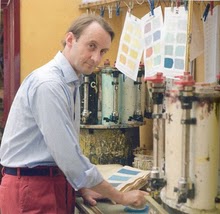 A stroll through any twenty-first-century home-and-garden center or a glance at the array of decorating tomes on the shelves of your local bookstore, suggests that the same holds true for us today. Few people grasp the subjective allure and associations of color as fully as Patrick Baty, a London-based historic paint consultant and owner of the shop Papers and Paints.
PB: Certainly when many customers start to describe colors to me it often takes a while to appreciate what they are actually looking for. Indeed, rather like the color that I am often asked for—French chateau shutter blue—perhaps the name is purely an idea that encompasses a certain combination of light, texture,
and an indeterminate range of hues that is in the eye of the beholder alone.
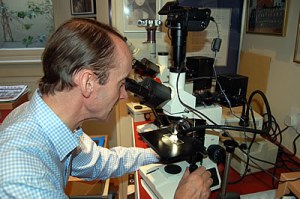 In advising heritage organizations such as English Heritage or the National Trust, analyzing paint to solve an architectural puzzle, or working with a homeowner interested in determining the original colors of her old walls, Baty must piece together more concrete bits of evidence. Drawing upon his expertise as a historian along with a basic bag of forensic tools (above all, paint samples and microscopy) he works to uncover a building’s decorative evolution from past to present.
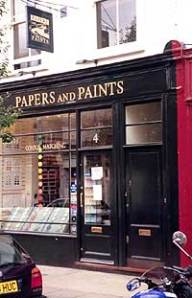 Descended from artists and a respected paint specialist, Baty has color in his genes. Beginning his professional life as an officer in the British Army, he decided in the early 1980s to join his father, Robert Baty, at the family shop, ultimately taking the helm of Papers and Paints in 1990. Already, the several-decades-old small business in Chelsea had a well-established reputation for color matching. The son came on the scene just as paint mania gripped England—special decorative effects including various glazing techniques were becoming all the rage.
Immersed more deeply in this complex world of paint, Baty found his curiosity growing about a much earlier color explosion, paint in the eighteenth century – to the point, in fact, that he earned an academic degree focused on the ‘colormen’ of the past. Combining his historical knowledge with hands-on professional expertise, Baty was soon regularly to be found in the field, climbing and crouching in all sorts of historical locations as he gathered his vital samples of paint (along the way, he’s
also published a couple of dozen articles and contributed to five books).
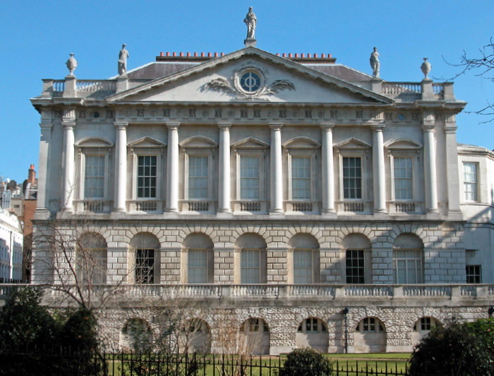
With Catherine Hassall, Baty completed the paint analysis of the Painted Room at Spencer House, finding that the walls were originally paler than the colors used in the 1980s refurbishment.
As of 2011, Baty’s broad consulting portfolio includes houses, palaces and other structures in the United Kingdom and United States. To name a handful: Kensington Palace, Queen Charlotte’s Cottage at Kew, London’s Tower Bridge, Blenheim Palace, Headfort House (Ireland), Calke Abbey, Spencer House, the Richard Bennehan House (at Stagville, near Durham, North Carolina), and the jewel-box-like Khadambi Asalache House in South London. In 2007, Papers and Paints received a Royal Warrant of Appointment to Her Majesty The Queen.
During Baty’s thirty-year career, there have been important shifts in the understanding of eighteenth- and early nineteenth-century color. In particular, evidence that highly saturated colors were in vogue has led to changes at famous historic sites. Due to a recently revealed, much-buzzed-about restoration at Monticello, it’s much more widely known, for instance, that Thomas Jefferson selected for his own dining room walls in 1815 a then-cutting-edge (and extremely costly) chrome-yellow. Monticello curator Susan Stein tells design journalist Mitchell Owens (writing for Elle Decor in July 2010) that Jefferson selected the eye-popping hue just six years after it was developed in France, and press materials note that the egg-yoke-like yellow would have cost Jefferson $5 per gallon, more than 33-times the price of white lead paint. Until 2010, modern school children touring Monticello saw a muted, post-Jefferson blue.
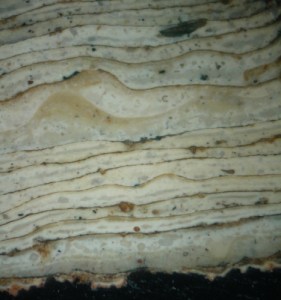
Paint sample showing the lowest (earliest) fifteen color schemes, from a house in Queen Anne's Gate, Westminster. It can be seen immediately that white or off-white (“pale stone colour” in eighteenth century painters’ terminology) was employed on nearly every occasion.
 Thinking about Jefferson’s luminous yellow, as well as George Washington’s intimate verdigris-green dining room at Mount Vernon, I asked Baty about the era’s lively, saturated hues. He was quick to point out that not everyone lived with such vivid walls. Clear, intense colors, underscores Sarah Lowengard, were in high demand but difficult and typically expensive to produce. At the same time, intentionally drab shades had fans among the fashionable set as well (interestingly, Jefferson lived with unpainted plaster walls before the costly yellow went up). Baty cautions us against imagining most walls as jewel-like, noting that in some instances
they tended to be more colorful than the ‘mock historic’ colors offered by some of the well-known paint companies (sadly, our view as to what is authentic has been much distorted by the rash of these ranges that have appeared over the last twenty years)… I would certainly say that a small collection of colors tended to be seen more than any other. These were known as the Common Colors and were cheap and applied in all sorts of houses throughout the century: Cream color, Lead color, Pearl color, Stone color, Wainscot / Oak color, White. It may surprise you to hear that the most commonly used type of color in the past was that described as Stone. This encompassed the warm, honey-colored sandstones to the greyer limestones. The use of color was much more limited than one might believe.
And where would one go to buy paint centuries ago?
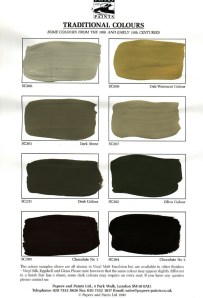 PB: In eighteenth-century London, ready-mixed paint would have been bought from a colorman, such as Alexander Emerton “at the Bell over against Arundel Street near St Clement’s Church in the Strand, London.” The original pricelist from the 1730s survives, and from this we learn that he was selling the Common Colors at 4d per Yard, but extraordinary colors, such as Olive Colors and Prussian blue, were offered at 8d per Yard. Greens, however, were sold at 12d per Yard. The everyday Common Colors continued unchanged through to the twentieth century. As new (successful) pigments were introduced they were adopted and the range of colors used widened.
Baty takes issue with today’s commercial ranges of paint, tweaked to suit current fashion or reinterpreted to appear aged and then inaccurately marketed as historical rather than labeled with what he views would be a more appropriate tagline such as “loosely inspired by.”
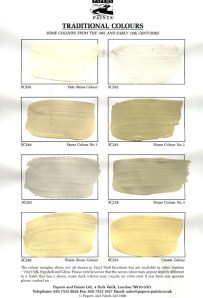
By contrast, his own company is known for two ranges with specific links to the past: Papers and Paints’ Historical line, originally released in 1988, consists of 112 colors based directly on those used in the applied arts (like porcelain and tapestry) while the Traditional range is made up primarily of colors matched to the earliest known set of paint sample cards prepared by a house painter for a client in 1807 (while doing academic research, Baty struck gold with the discovery of these cards in the archives of a Scottish house destroyed by fire.) Years ago, Baty and his wife spent their evenings hand-painting color cards for the first paint range; today at Papers and Paints, hand-painted sets are still available for purchase.
So, we have a better picture of what paint looked like centuries ago; how long was it expected to last?
PB: On the inside of a building there was no reason for a paint not to last for very many years. Indeed, I have worked in buildings where paint from the second half of the eighteenth century survives. On the exterior of a building it was understood that paint had a finite life. A well-known quote of 1774 illustrates this well:
The third year the gloss is gone…in the fourth if you rub the painting with your finger, it will come off like so much dust.
Modern exterior-grade paint may last ten years before needing renewal.
Whilst one can match eighteenth-century paint colors nowadays, legislation and developments in pigment technology mean that paints are compounded in a very different manner. Lead-based paint tends to retain the impression of the brush and doesn’t flow out in the way that a modern oil-based paint does. A water-based distemper can still be made up in the traditional manner, but the number of tradesmen who can do so is small.
Baty also says there is a widespread misconception that eighteenth- and early nineteenth-century paints were invariably environmentally friendly and ‘pure’ when, in fact, arsenic and lead were used in their production.
Is it possible to compare what it cost to paint a room in the eighteenth century with expenses now?
PB: This is a very complicated business as not only has the type of paint changed but inflation has played havoc with the price comparison of similar products. Working from a set of prices and the coverage rate of everyday oil paints in 1770 I was able to show that the cost of the paint for painting an average-sized room in 2002 was about the same – within a Pound or two. The cost for a room 12’x12’x8’ worked out at about £43-£45. It has since gone up another 20%, but that is largely as a result of recent EU legislation. The cost of carrying out the work was controlled in the eighteenth century by the Guild system in London and had remained remarkably stable for many years. It is less easy to obtain quotes for painting a room nowadays.
How closely was the industry tied to the fine art tradition of painting?
PB: The two branches of the industry were closely related as they were to other wielders of a brush. By the latter half of the seventeenth century, the London-based Painters-Stainers’ Company regarded themselves as consisting of four main groups: the Arms Painters, House Painters, Leather Gilders and Picture Makers. Many of the pigments were identical, although the more expensive and certainly the more fugitive ones saw less use by the housepainter.
Just as it can be a let down when, as civilians, we learn that spies don’t actually use certain high-tech tools shown in popular movies, Baty has sometimes encountered surprise when describing his methods:
PB: Although new techniques will no doubt help, the basics are fairly low-tech. I remember shocking an audience at Williamsburg some years ago when asked about medium analysis. They wanted to know what equipment I used. I said that context and optical examination generally told me what I needed to know. I can see whether a paint was an oil paint and, understanding how paints were made and used, in most cases this means linseed oil was the medium.
In a similar vein, I was asked by the conservation scientists at one museum what their findings meant. They could virtually tell me the Atomic Number of the components in a particular eighteenth-century paint layer but didn’t know what it was saying to them. I knew from a study of early source material that white lead with black and a little Prussian blue and red oxide usually indicated a Pearl Color. I also knew that this sort of color saw use in the kind of room being examined and, most importantly, what kind of color it was.
The key thing is to read as much as possible, whether technical works, histories or books on historic design and decoration. It is important to understand who these people were who chose the decoration, what they were trying to achieve and then to know how the paint would have been mixed and applied…One thing that strikes me when I meet other people working in the field is that most have stopped reading and learning. I have now been doing this for over 25 years, but still I am picking up new facts that help me gain a clearer understanding of what I see when I examine a room.
And for anyone wondering, Baty himself is quite fond of that paint selection scene in Mr. Blandings Builds His Dream House. I can only hope for the day when I see Georgians on the big screen weighing the costs of chrome yellow against the deeply satisfying array of common stone colors.
Follow Us to the Eighteenth Century
Note from the Editor

Palladian Bridge, Prior Park, 1755 (Photo Stephen McKay, Wikimedia Commons)
I’m happy to report that the internship program is off to a terrific start! Now in the final weeks of her two-month position, Freya Gowrley has done a fabulous job, pointing out new resources, keeping tabs on other sites, and putting together posts of her own.
In addition, Freya has single-handedly guided us into the realm of social media. I know, many of you are wondering what took so long! I’m completely to blame for the delay, but finally Enfilade is available via Twitter and Facebook.
As you may have already noticed, at the bottom of each posting, there’s now a +Share button: with a couple of clicks, you can send postings to your email account, your LinkedIn page, or your own Twitter feed. So if you use any of these resources, add us as we meet your needs. Friend us, Like us, Tweet us. Follow us to the eighteenth century. -CH


Exhibition: Pictorial Embroideries at Boston’s MFA
From the MFA:

Embroideries of Colonial Boston: Pictorial Embroideries
Museum of Fine Arts, Boston, 2 April — 28 August 2011
The embroideries of colonial Boston girls and women have long been treasured family possessions and are now much sought after by collectors. The charm and craftsmanship of the Adam and Eve samplers, pastoral pictures with leaping stags and galloping hunters, as well as crewelwork bed hangings and delicately embroidered baby caps bring to mind a warm domesticity; however, as a group they also reveal much about the lives of Boston women and their role within colonial society.
During the eighteenth century, many Boston families schooled their daughters in a range of female accomplishments including dancing, deportment, music, painting on glass, and, of course, needlework. In advanced needlework lessons, girls first worked samplers but then quickly passed on to the more decorative embroidered pictures, overmantels, and coats of arms. These pictorial embroideries became cherished family possessions and served as symbols of the family’s prosperity and gentility. This exhibition will explore the pictorial embroideries popular in eighteenth-century Boston and include examples of the pastoral works probably imported from London as well as examples drawn by talented Boston teachers, engravers, and upholsterers. While tent stitch pictures embroidered with wool and silk predominated, some girls embroidered in silk on silk. This form became more popular in the third quarter of the eighteenth century and is associated with the teacher and milliner Elizabeth Murray, whose portrait by Copley will be featured in the show. Her protégés, Janet Day and the Cummings sisters, continued the tradition, and exceptional work by their students survives. Loans from several museum and private collections in New England and the mid-Atlantic will be featured in the show.
Exhibition: Art and Finance in Europe
As we’re now bombarded with bleak financial news, I’m not sure if the timing of this Brussels exhibition is perfect or unfortunate (‘La fête est bientôt finie’). Press release for the exhibition:
◊ ◊ ◊ ◊ ◊
Art et Finance en Europe, Nouvel éclairage porté sur des chefs-d’œuvre du XVIIIe siècle
Musées royaux des Beaux-Arts de Belgique, Brussels, 29 April — 4 September 2011

Peeter Snijers (Anvers 1681 – 1752), Le mois de mai (La constellation des Gémaux)
Cette année, dans le cadre de la série des expositions d’oeuvres provenant de nos collections et se rapportant à des thèmes économiques et financiers, nous abordons le XVIIIe siècle. Cette exposition, résultant, une fois encore, d’une fructueuse collaboration avec l’EAPB (European Association of Public Banks), est particulière à plus d’un titre. Elle offre au public une occasion de refaire connaissance avec un certain nombre de fleurons de la collection longtemps placés en réserve, faute de place. Parmi eux, figurent, en nombre significatif, des dons et des legs permettant de rendre hommage aux généreux donateurs : Les Amis des Musées royaux des Beaux-Arts de Bruxelles ; Mme Fernand Saliez-Bautier ; M Léon Mancino ; M. et Mme Émile Tournay-Solvay ; Mme Jean-Jacques Scheemaecker, née Sophie-Pauline van Stalle ; la Douairière De Grez ; M. Frédéric de Villers Masbourg d’Esclaye. Les oeuvres d’art datant du Siècle des Lumières furent, en effet, toujours très appréciées par l’amateur d’art éclairé. Elles sont maintenant présentées, dans le décor adéquat des deux salons rococo, dans le Balat, entre les salles de la donation du Dr et Mme Frans Heulens-Van der Meiren et la salle du néoclassicisme. La combinaison de peintures avec des dessins et sculptures appartenant, eux aussi, à nos collections et datant de la même époque, constitue également une première.
Au XVIIIe siècle, le centre de gravité de la finance se déplace de la Bourse d’Amsterdam vers celle de Londres. Cette évolution concorde avec la domination croissante du Royaume-Uni sur les mers du globe et avec l’avènement de la révolution industrielle. Celle-ci bénéficie du grand progrès enregistré par la science et la technique sous l’impulsion des Lumières. Les idées éclairées des philosophes eurent, cependant, pour conséquence la plus radicale, la Révolution française de 1789. Celle-ci bouleversa totalement l’ordre social. Et avec elle, s’effondrèrent les privilèges, notamment financiers, conférés par le seul droit de naissance, qui étaient si caractéristiques de l’Ancien Régime.
Beaucoup d’oeuvres d’art du XVIIIe siècle datent d’avant la révolution de 1789 et appartiennent à une époque pendant laquelle la vie de la cour de France déterminait, dans toute l’Europe, le savoir-faire et le savoir-vivre (qui ne sont pas pour rien des termes français). Ce fut aussi l’ère où la jeunesse dorée, sans soucis financiers, ne devant pas travailler pour gagner sa vie, complétait sa formation par un Grand Tour joignant les sommets de l’art européen et de la culture antique pour aboutir à Rome. À la vérité, le raffinement de cour bien connu du XVIIIe siècle trouve son écho dans les objets exposés. Mais, en sourdine, vont résonner des bruits toujours plus sinistres. La fête est bientôt finie.
Pour Louis XVI et Marie-Antoinette se dessine l’échafaud. Et lorsque, la dernière année du siècle, Hubert Robert peint ses galanteries, ce n’est plus lui, mais ceux qui ont investi dans la machine à vapeur, qui ont assuré leur avenir et le capitalisme du XIXe siècle.
-Joost Vander Auwera
◊ ◊ ◊ ◊ ◊
English gloss from Eventful:
The fourth Art and Finance in Europe exhibition will concentrate on the 18th century and is convened, in the frame of the Hungarian Presidency of the Council of the European Union, under the patronage of László Andor, Member of the European Commission and Tamás Fellegi, Hungarian Minister of National Development. The exhibition Art and Finance in Europe-18th Century Masterworks in a New Light is composed of some 20 major works from the RMFAB collection. The exhibition comprises masterpieces by, amongst others, Franceso Guardi, Benjami Wolff, Léonard Defrance, Hubert Robert, Joseph Vernet and Sir Joshua Reynolds. Leading art experts, Michel Draguet, Joost Vander Auwera (CVs in annex) have lent their expertise in support of the exhibition. The exhibition is part of a sequence which started in 2008 as a joint initiative between EAPB and RMFB. This year the exhibition exceptionally exposes, in addition to paintings, also drawings and sculptures. Henning Schoppmann Secretary General of the European Association of Public Banks, described the exhibition as “a wonderful opportunity to discover how art and money have been intrinsically connected throughout the centuries and how finance has inspired art, one of the most compelling beauties of life.”
Motion Pictures in the Eighteenth Century
Earlier this summer, Sotheby’s offered a rare set of five landscape transparencies by Carmontelle (many of you will remember the 2006 exhibition at The Getty of related materials). Estimated to fetch £350,000-500,000, the paintings, in fact, did not sell. Press release from 1 July 2011:
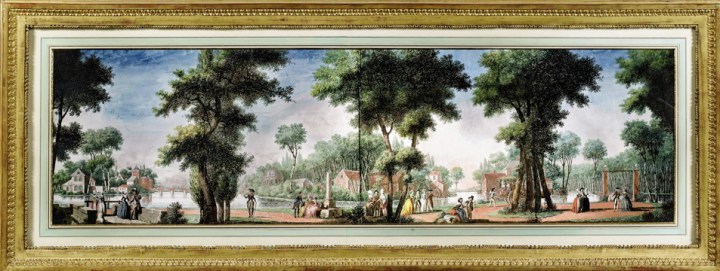
Louis Carrogis called Carmontelle, Set of five landscape transparencies, from the "Campagnes de France," gouache and watercolour; one on six joined sheets of paper, and two others on four joined sheets, all with various minor additional strips at the edges (Photo: Sotheby's)
◊ ◊ ◊ ◊ ◊
Sotheby’s London Sale of Old Master and British Drawings [Sale L11040] on July 7th and 8th 2011 will present for sale a range of important drawings from the 16th to the 19th centuries. In addition to works by artists Hans Bol, Jacopo Ligozzi, Joseph Mallord William Turner and John Constable, a remarkable highlight of the sale is a set of five astonishingly original landscape transparencies From The ‘Campagnes de France’ by Louis Carrogis called Carmontelle (1717-1806), estimated at £350,000-500,000 [Lot 111]. Commenting on the forthcoming sale, Gregory Rubinstein, Worldwide Head of Sotheby’s Old Master Drawings Department said, “We are extremely pleased to be offering these remarkably rare transparencies which not only offer a contemporary account of the French aristocracy during the final years of the ancien régime, but also represent an important step in the journey towards the emergence of perhaps the most influential art form of the 20th century – the motion picture.”
These five landscape transparencies are extremely rare examples of a highly original, but today almost unknown, art form that Carmontelle himself invented, and with which he utterly captivated the French aristocracy during the final years of the ancien régime. Originally, these landscapes, painted on translucent paper, would have formed part of a single, hugely long panoramic landscape, which would have been rolled up, to be viewed by being wound through
a backlit viewing box, as a proto-cinematic theatrical event. As the scene unfolded, frame by frame, Carmontelle would provide an entertaining commentary, complete with a description of the events depicted and much imagined dialogue between the protagonists, as well as music and a variety of other sound effects. These panoramic transparencies were conceived as a continuous narrative of a single trip through the landscapes, parks and gardens of the areas on the outskirts of Paris where the artist’s aristocratic audience had their country retreats. Between 1783 and 1790, Carmontelle made nine such enormous transparencies, which he collectively titled Campagnes de France ornées de ses jardins pittoresques appelés jardins anglais. Of the initial series of nine transparencies dating from 1783 and 1792, it appears that none survive complete, and indeed relatively little survives at all. The largest surviving section, in a private collection, measures 20m in length, while the Musée Condé, Chantilly, has a section measuring 12.6m in length, and the Getty Museum, Los Angeles has another measuring 3.77m in length. The five sections now offered for sale are the only other recorded survivals from these crucial works.
Both in their technical originality and in their remarkable blurring of the boundaries between art, theatre and spectacle, these remarkable landscapes embody the essence of the spirit of the Enlightenment. They are also very moving documents of the last days of the French ancien régime, as they owe not only their subject matter but their very existence to the extraordinary privilege and leisure of the aristocracy in the years leading up to the Revolution. But their significance is not only in relation to their own time. The fact that so few examples of this remarkable precursor of the cinematic film have survived make the present works all the more significant. Over a period of twenty years Carmontelle made 12 rolls, of which only 1 or 2 remain. . . .
Art Market: Buyers Lose Their Taste for 18th-Century Art and Furniture?
This interesting article by Souren Melikian on the state of the art market appeared a couple of week ago in The New York Times (22 July 2011). Whether the vogue for the eighteenth century is in fact waning, it makes for a compelling read. The article also includes some lovely examples of decorative arts from the period (a full list of images from the Lyons Demesne auction, with sale prices, is available here) -FG
◊ ◊ ◊ ◊ ◊

Lyons Demesne House, County Kildare, Ireland, 1785-1797, acquired by Tony Ryan in 1996
Last week, 450 works ranging from furniture to paintings and sculpture that had adorned Lyons Demesne, the Irish Georgian house restored at vast expense by the late Tony Ryan, who founded Ryanair, were dispersed at Christie’s to great fanfare [Sale 8012].
The fine catalog did justice to the mansion in County Kildare designed in 1797 by Oliver Grace for the wealthy businessman Nicholas Lawless. The son of a rich Dublin draper, Lawless further expanded his financial position by marrying the heiress of a brewer, Margaret Browne, and was made a peer. As the 1st Baron Cloncurry, Lawless acknowledged this costly promotion by writing to the Viceroy: “If I have obtained any honours, they have cost me their full value.”
His son Valentine was more pugnacious. He joined the Society of United Irishmen set up in 1791 to fight against the Act of Union with Great Britain and was incarcerated in the Tower of London following the 1798 uprising but was released in 1801, the year of the Act of Union. Whereupon, the 2nd Baron Cloncurry redirected his energy toward the embellishment of Lyons Demesne and embarked on a wild art-buying spree in Italy. Among his purchases were the granite columns from the Golden House of Nero, which had been re-employed in the Palazzo Farnese and now support the portico at Lyons.
Past history fired up Mr. Ryan. Having saved the grand mansion from ruin in the most ambitious program of restoration ever undertaken privately in Irish history, according to Hugh Montgomery-Massingberd, who tells the story in “Great Houses of Ireland,” the businessman proceeded to furnish it at top speed. Christie’s made the most of the Lyons Demesne motif — house sales traditionally gave furniture and other objects a halo that substantially enhanced their commercial value.
While the July 14 sale went remarkably well, with 90 percent of the lots finding takers, it also underlined the decline of the traditional furniture and decorations beloved by members of the Western upper class until the late 20th century. Good 18th-century furniture that does not belong in the superlative museum category did not fare well. . . .
Read the rest of the article here»
Call for Papers: The Florida State Graduate Symposium
The Florida State University Art History Graduate Symposium
Tallahassee, 4-5 November 2011
Proposals due by 29 August 2011
Keynote Speaker: John T. Paoletti, Kenan Professor of the Humanities, Emeritus and Professor of Art History, Wesleyan University
The Art History faculty and graduate students of The Florida State University invite students working toward an MA or a PhD to submit abstracts of papers for presentation at the 29th Annual Art History Graduate Student Symposium. Paper sessions will begin on Friday afternoon, November 4, and continue through Saturday, November 5, with each paper followed by critical discussion. Symposium papers may come from any area of the history of art and architecture. Papers will then be considered for inclusion in Athanor, a nationally-distributed journal published by the Department of Art History and the FSU College of Visual Arts, Theatre & Dance.
The deadline for receipt of abstracts (maximum 500 words) is 29 August 2011. Please indicate the title of the talk, graduate level, and whether the subject originated in thesis or dissertation research. Send the abstract either as a printout or an email attachment to: Dr. Lynn Jones, Symposium Coordinator, lajones@fsu.edu.










 Enfilade
leave a comment