Call for Applications | Getty 2013-14: Connecting Seas
From the Getty:
Getty Scholars Program — Connecting Seas: Cultural and Artistic Exchange
Getty Research Institute, Los Angeles, 2013-14
Applications due by 1 November 2012
 Water has long been a significant means for the movement of goods and people. Sophisticated networks, at a variety of scales, were established in antiquity around the Mediterranean and the Black Seas, and later in the Atlantic, Indian, and Pacific Oceans. Together with sporadic and accidental encounters, these networks fostered commerce in raw materials and finished objects, along with the exchange of ideas and cultural concepts. Far from being barriers, seas and oceans were vital links connecting cultures. The 2013–2014 academic year at the Getty Research Institute and Getty Villa will be devoted to exploring the art-historical impact of maritime transport.
How has the desire for specific commodities from overseas shaped social, political, and religious institutions? How has the introduction of foreign materials and ideas transformed local artistic traditions, and what novel forms and practices have developed from trade and other exchanges, both systematic and informal? What role do the objects born of these interactions have in enhancing cultural understandings or perpetuating misunderstandings? How has the rapidly accelerating pace of exchange in recent years influenced cross-cultural developments? The goal of this research theme is to explore how bodies of water have served, and continue to facilitate, a rich and complex interchange in the visual arts.
The Getty Research Institute and the Getty Villa invite proposals focusing on artistic exchange and the transmission of knowledge across bodies of water from ancient times to the present day. Scholars actively engaged in studying the role of artists, patrons, priests, merchants, and explorers in oceanic exchange are encouraged to apply, and projects focusing on the Pacific are particularly welcome.
Recent Reviews Posted at BSECS
Recent reviews at BSECS:
A Will of Their Own: Judith Sargent Murray and Women of Achievement in the Early Republic
Location: National Portrait Gallery, Washington, DC
Event Date: August 2012
Reviewed By: Linda Troost, Washington & Jefferson College
A pantheon presenting the female face of the Early American Republic.
Playing, Learning, Flirting: Printed Board Games from Eighteenth-Century France
Location: Waddesdon Manor, Aylesbury
Event Date: July 2012
Reviewed By: Jennifer Thorp, New College, Oxford
The long eighteenth century, as told via the revealing medium of the board game.
Pieces of Wedgwood
Location: State Library of New South Wales, Sydney
Event Date: July 2012
Reviewed By: Mark de Vitis, University of Sydney & National Art School, Sydney
A compact but illuminating reminder of Wedgwood’s Australian connection.
Physionotraces: galerie de portraits, de la Révolution à l’Empire
Location: Musée des Arts Décoratifs, Paris
Event Date: July 2012
Reviewed By: Dr Kate Grandjouan, The Courtauld Institute of Art
A diminutive yet potent display tracing the development of a revolutionary form of portraiture.
The English Prize: The Capture of the Westmorland
Location: The Ashmolean Museum, Oxford
Event Date: June 2012
Reviewed By: Carly Collier, University of Warwick
This exciting exhibition about a defining event in Grand Tour history delivers the treasures of thorough archival research.
Jane Austen’s Bookshop – An Exhibition
Location: Chawton House Library, Alton, Hampshire
Event Date: June 2012
Reviewed By: Judyta Frodyma, University of Oxford
Chawton House charms with an exhibition that brings the thriving network of eighteenth-century regional print culture back to life.
The Comte de Vaudreuil: Courtier and Collector
Location: National Gallery, London
Event Date: June 2012
Reviewed By: Francesca Whitlum-Cooper, The Courtauld Institute of Art
A tiny exhibition with big potential, offering an innovative glimpse into eighteenth-century collecting practices.
New Title | Transculturation in British Art, 1770–1930
From Ashgate:
Julie F. Codell, ed., Transculturation in British Art, 1770–1930 (Aldershot: Ashgate, 2012), 314 pages, ISBN: 9781409409779, $120.
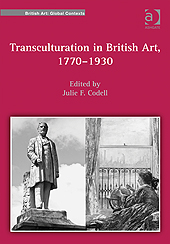 Examining colonial art through the lens of transculturation, the essays in this collection assess painting, sculpture, photography, illustration and architecture from 1770 to 1930 to map these art works’ complex and unresolved meanings illuminated by the concept of transculturation. Authors explore works in which transculturation itself was being defined, formed, negotiated, and represented in the British Empire and in countries subject to British influence (the Congo Free State, Japan, Turkey) through cross-cultural encounters of two kinds: works created in the colonies subject over time to colonial and to postcolonial spectators’ receptions, and copies or multiples of works that traveled across space located in several colonies or between a colony and the metropole, thus subject to multiple cultural interpretations.
Essays in Transculturation in British Art, 1770–1930 argue that, due to art’s fundamental nature as spatial, art can illuminate imperial transculturation sites of border cultures and contact zones that go far beyond hybridities of national cultural traditions or conventions. Transcultural works generate new cultural and imperial values. Authors posit that visual culture can suggest nuances and implications for transculturation, a word used in many other humanities and social science disciplines, to give this word a visual dimension.
Exhibition | Significant Objects: The Spell of Still Life
From the Norton Simon:
Significant Objects: The Spell of Still Life
Norton Simon Museum, Pasadena, 20 July 2012 — 21 January 2013
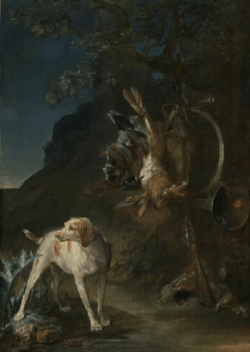
Jean-Baptiste Siméon Chardin, Dog and Game, 1730 (Norton Simon Museum)
The classical definition of a still life—a work of art depicting inanimate, typically commonplace objects that are either natural (food, flowers or game) or man-made (glasses, books, vases and other collectibles)—conveys little about the rich associations inherent to this genre. In the academic tradition of Western art, still life occupied the lowest position in the hierarchy of the arts, which recognized history painting, portraiture and landscape painting as superior. It was disparaged critically and theoretically as mere copying that lacked artistic imagination and placed no intellectual demands on the viewer. Significant Objects: The Spell of Still Life posits that nothing could be further from the truth for this category of art, which hovers between mimesis and symbolism, and in which artistic skill and fantasy are tantamount to its success. Drawing on the spectacular resources of the Norton Simon collections, the exhibition explores the wealth of aesthetic and conceptual artistic strategies that challenge the shortsighted view of still life as simply an art of imitation. It also underscores why the still life continues to be an important vehicle of expression.
Significant Objects examines the genre from four perspectives designed to tease out the import of the still life, to identify the rich associational value of time, place or circumstance, and to encourage meaningful encounters with the objects.
The first section, Depiction & Desire, looks at the still life as a barometer of wonder and of the impulse to collect and display. Exacting portrayals of individual flowers or cubist abstractions that seize on the sensual elements of color, texture and weight are illustrative of the passion to capture, document and celebrate material pleasures and possessions through the counterfeit of the visual image. Virtuosity considers the exercise of skill and the mastery of technique as a means to create illusion and objects of imaginative, complex beauty. Still lifes rendered in oil, pastel, wood and various printing processes invite scrutiny as to how artists make the difficult look easy and where the boundaries lie between technical expertise and artistry. Decoding the Still Life approaches these arrangements as coded with meaning and allegory. From the popular and moralizing symbols embedded in 17th-century fruit and flower paintings to the political and personal meanings insinuated by 19th- and 20th-century artists, these implied secrets bring a mysterious resonance to the compositions and underscore their capacity to communicate intellectual insights. Finally, Still Life off the Table takes a liberal view of the genre, looking at radical variations that can be considered still-life related. Abstractions, assemblage and the deconstruction of the tabletop arrangement show how the genre stretches beyond the conventions of its historically conservative nature and yet is malleable enough to remain a vital instrument for provocative, contemporary innovations.
Still life occupies a special place in the Norton Simon Museum, with singular examples in a variety of media, including paintings, prints and photographs. Mr. Simon acquired his first still life in 1955. From that moment on, the genre maintained his attention much as any other he pursued, if it met his criteria for quality, rarity and beauty. Though cautious about revealing his favorite objects in the collection, Simon admitted a deep fondness for Paul Cézanne’s Tulips in a Vase, 1888–90, which is presented in the exhibition. Also included are stellar examples by the genre’s greatest practitioners: Jan Brueghel, Rembrandt and Francisco de Zurbarán, from the 17th century; Jean-Baptiste Siméon Chardin, Gustave Courbet, Henri Fantin-Latour and Vincent van Gogh, from the 18th and 19th centuries; and Pablo Picasso, Richard Diebenkorn, Imogen Cunningham, Edward Weston and George Herms, from the 20th century.
Internship | NPG in London
As noted at BARS:
Internship at the National Portrait Gallery, London
Applications due by 12 August 2012
The National Portrait Gallery is seeking to appoint an intern for six months with a proven interest in portraiture to gain experience in general curatorial work and research across a number of projects. The main focus of the internship will be on the 18th-Century Collections but an interest in the portraiture of other periods is desirable. Tasks may include answering public enquiries, scoping out ideas for the annual redisplay of Regency miniatures, research towards a forthcoming display on World War Two and the RAF at Beningbrough Hall, Yorkshire and research support towards an academic study of portrait print collecting and extra-illustration in eighteenth-century Britain. As a large part of the internship will involve research in libraries and archives in London, it would be an advantage to have completed an MA or be engaged in a programme of PhD study. The intern will be supervised by the 18th Century Curator and Assistant Curator, 18th Century.
Hours: 1 day (8 hours) per week for six months to be agreed with the curator
Travel Expenses: Travel costs of up to ten pounds (£10) per week can be claimed
Ideally we would like candidates to be available for a 6-month period.
Qualifications and Experience
• Good general knowledge of British art history and/or history
• A proven interest in the eighteenth century and a reasonable understanding of portraiture as a genre
• The internship would ideally suit those candidates who have completed an Art History or History MA or are engaged in a programme of PhD study who have an interest in pursuing museum work
Skills and Attributes
• Ideal candidates will need to have a flexible approach and be prepared to contribute to a number of different projects
• Candidates will also need to be able to demonstrate a careful approach and attention to detail
• Excellent written English is an essential requirement
Please send your CV and a covering letter either by e-mailing: curatorialoffice@npg.org.uk or by writing to: Emily Burns, Curatorial Office, National Portrait Gallery, 2 St Martin’s Place, London WC2H 0HE. Closing date for returned applications: 9.00am Monday, 13 August 2012. Interviews will take place in the week beginning 20 August 2012.
New Title and Exhibition | New York Rising
From ACC Distribution:
Valerie Paley, New York Rising: New York and the Founding of the United States (London: Scala Publishers, 2012), 64 pages, ISBN: 9781857597769, $10.
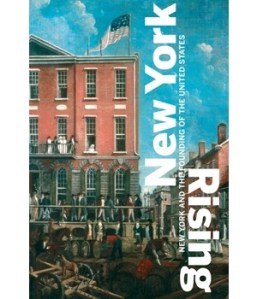 Published in conjunction with the opening of the New-York Historical Society’s newly installed permanent gallery, New York Rising: New York and the Founding of the United States seeks to capture this nascent moment in America’s history. Featuring paintings, sculpture, historical documents and other fascinating artefacts, this fully illustrated book details important moments in both the history of New York and of the United States. These include the occupation of New York by the British Army during the Revolutionary War; the city’s role as marketplace and centre of commerce; the inauguration of George Washington as first President of the United States; the politically-charged duel fought by Alexander Hamilton and Aaron Burr; and the establishment of the New-York Historical Society. Associations are made between the paintings and the objects in the exhibition that set in context these events and the individuals who shaped and were shaped by
them.
Valerie Paley is Historian for Special Projects at the New-York Historical Society.
◊ ◊ ◊ ◊ ◊
Call for Papers | Foreign Courtiers at the Bourbon Court, 1594-1789
As noted at The Society for Court Studies:
The Centre de Recherche du Château de Versailles is organizing a series of three workshops on Courtisans étrangers à la cour des Bourbons, 1594-1789 (Foreign courtiers at the Bourbon court, 1594-1789), coordinated by Jean-François Dubost, professor at the Université Paris-Est Créteil. The deadline for the first study day on Identités étrangères à la cour de France au temps des Bourbons was July 1, but there’s still time to apply for the second and third days.
◊ ◊ ◊ ◊ ◊
From the Centre de Recherche du Château de Versailles:
Courtisans étrangers à la cour des Bourbons, 1594-1789
Le Centre de recherche du château de Versailles, 14 December 2012, 12 April 2013, and Fall 2013
Proposals due, respectively, by 1 July 2012, 1 December 2012, and 5 April 2013

Le pavillon de Jussieu dans le domaine de Trianon, lieu de travail de l’équipe du Centre de recherche. © Château de Versailles / Christian Milet
Le Centre de recherche du château de Versailles a lancé un programme de recherche intitulé « Les étrangers à la cour de France au temps des Bourbons (1594-1789). Intégration, apports, suspicions », coordonné sur le plan scientifique par Jean-François Dubost, professeur à l’université Paris-Est Créteil Val de Marne, et conduit en collaboration avec les partenaires du Centre.
Ce programme a pour objectif d’appréhender les différentes formes de la présence étrangère à la cour de France et, ce faisant, de construire un objet d’étude transversal – puisque la notion même d’étranger introduit une catégorisation bipolaire des individus traversant tous les statuts sociaux, entre ceux qui sont sujets du roi de France et les autres, propre à mettre en évidence des phénomènes que l’adoption d’un point de vue strictement franco-français ne révèle pas nécessairement.
Organisé autour de deux axes thématiques principaux, le programme s’attache, dans son premier axe consacré aux « Courtisans étrangers », à l’étude de tous les étrangers qui, à un moment donné de leur carrière curiale, ont joui d’une position définie à la cour de France, soit par intégration dans les Maisons royales et princières françaises, soit par l’obtention du statut de « pensionnaire du roi », soit encore en étant, à la cour de France, au service de princes ou d’États étrangers.
L’étude de ces courtisans étrangers à la cour des Bourbons sera déclinée autour de trois thématiques qui font chacune l’objet d’un appel à contributions, appels destinés à préparer l’organisation de trois journées d’études conçues comme ateliers de recherche fermés, organisées au Centre de recherche du château de Versailles, et faisant intervenir chacune de 6 à 7 contributeurs.
Les contributions retenues feront l’objet d’une publication, soit dans le Bulletin du Centre, soit dans les volumes imprimés qui présenteront la synthèse des travaux conduits dans le cadre du programme « Les étrangers à la cour de France au temps des Bourbons (1594-1789). Intégration, apports, suspicions ». . . . (more…)
Exhibition | Daily Pleasures: French Ceramics
From LACMA:
Daily Pleasures: French Ceramics from the MaryLou Boone Collection
Los Angeles County Museum of Art, 6 October 2012 — 31 March 2013
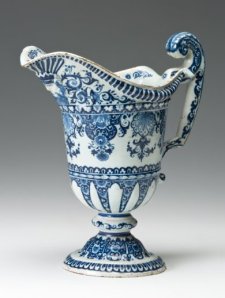
Ewer, c. 1700, Rouen, France, Earthenware with tin glaze and enamel (grand feu faïence), 11 x 11 in. LACMA, Gift of MaryLou and George Boone in honor of the museum’s twenty-fifth anniversary, M.2010.51.1, Photo © Susan Einstein.
Long-time LACMA benefactor MaryLou Boone has amassed the West Coast’s finest collection of French faience and soft-paste porcelain, 25 pieces of which she gave to LACMA in 2010. (Although originally made to emulate hard-paste porcelain imported into Europe from Asia, faience and soft-paste porcelain ultimately became distinctive and sought-after ceramics in their own right.)
The exhibition comprises over 130 pieces from the foremost manufactories of the era, representing myriad aesthetic influences, as well as advances in technology and the rhythms of domestic life. The collection includes wares for dining and taking tea, for storing the many toiletries necessary for a stylish appearance, and for preparing mixtures that comforted in time of sickness. Inextricably intertwined with every day duties and diversions, these objects provide a unique view of French life and culture.
The accompanying exhibition catalogue, Daily Pleasures: French Ceramics from the MaryLou Boone Collection, includes more than 145 entries of French faience and porcelain from the collection, as well as essays about the collector and 17th and 18th-century French ceramics.
◊ ◊ ◊ ◊ ◊
From ACC Distribution:
Elizabeth Williams and Meredith Chilton, Daily Pleasures French Ceramics from the MaryLou Boone Collection (Los Angeles: Los Angeles County Museum of Art, 2012), 392 pages, ISBN: 9780875872155, $75.
 MaryLou Boone’s collection of French ceramics spans the reigns of some of France’s most fascinating kings, from Louis XIII to Louis XVI, yet the collection is not one of royal vases and princely gifts but, rather, of wares for dining and taking tea, of porcelain frivolities, and of ceramics for the sickroom and the pharmacy. Mrs. Boone – a collector, scholar, and donor – has amassed the West Coast’s finest collection of 17th and 18th-century French faience and soft-paste porcelain, objects that provide a unique view of French life and culture. Emphasizing the aesthetics French ceramics and also its functionality, the catalogue comprises over 130 collection entries, as well as essays on the collector, ceramics in 17th-18th century France, French faience and its makers and French porcelain and its makers. Although originally created to emulate Asian porcelain, faïence and soft-paste porcelain ultimately became distinctive and sought-after ceramics in their own right.
C O N T E N T S
• Michael Govan and John Murdoch — Foreword
• Elizabeth Williams — Introduction
• Map of Manufactories
• Victoria Kastner — MaryLou Boone: The Accidental Collector
• Meredith Chilton — The Pleasures of Life: Ceramics in Seventeenth- and Eighteenth-Century France
• Antoinette Faÿ-Hallé — French Faience from Its Origins to the Nineteenth Century
• Antoinette Faÿ-Hallé — Faience Manufactory Histories
• Faience Catalogue
• Meredith Chilton — Porcelain Production in Seventeenth- and Eighteenth-Century France
• Meredith Chilton — Porcelain Manufactory Histories
• Porcelain Catalogue
• Marks Appendix
• Glossary
• Selected Bibliography
• Illustration Credits
• Index
Meredith Chilton is an independent art historian and was the founding curator of the Gardiner Museum of Ceramic Art in Toronto from 1983 to 2004. She has curated many exhibitions, published extensively and lectured internationally. Antoinette Faÿ-Hallé is Conservateur général honoraire du Patrimoine and Ancien directeur du musée national de Céramique, Sèvres where she worked as both a conservator and director. She has organized many ceramic and glass exhibitions and written extensively on the history of ceramics. Catherine Hess is Chief Curator of European Art at The Huntington Art Collections in San Marino, California. She is responsible for a collection particularly strong in Renaissance bronzes, 18th-Century French decorative arts, and 18th-Century British portraiture. Victoria Kastner, the Historian at Hearst Castle, has published several books and holds graduate degrees in architectural history and museum management. Elizabeth A. Williams is the Marilyn B. and Calvin B. Gross Assistant Curator of the Decorative Arts and Design department at the Los Angeles County Museum of Art.
New Title | J. B. Fischer von Erlach: Architecture as Theater
From Yale UP:
Esther Gordon Dotson and Mark Richard Ashton, J. B. Fischer von Erlach: Architecture as Theater in the Baroque Era (New Haven: Yale University Press, 2012), 184 pages, ISBN: 9780300166682, $75.
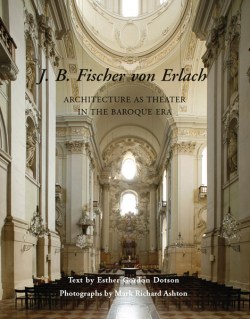 Though little known in the English-speaking world, Johann Bernhard Fischer von Erlach (1656-1723) was one of the most important and influential European baroque architects. The buildings that he designed for the emperor of Austria and his courtiers reveal an element of theatricality—an element that author Esther Gordon Dotson probes in this attractive volume.
In his architectural designs, Fischer incorporated devices from ceremonial pageantry and scene design, controlled lighting effects, and a sense of dramatic progression in approaching and moving through a building. Dotson identifies these various elements in her close reading of Fischer’s structures, and splendid new photographs, taken by Mark Richard Ashton, bring them to life on the printed page. The author also delves into Fischer’s past and his writings to explain the impact his awareness of architectural history, his early employment by designers of street-festival pageants and his relationships with others involved in such staged productions had upon his architectural designs. Dotson guides readers in discovering the theatrical qualities in Fischer’s buildings, illuminating their conceptual liveliness, variety, drama, and enduring beauty.
At the time of her death in October 2009, Esther Gordon Dotson was professor emerita in the Department of the History of Art at Cornell University. Mark Richard Ashton is an independent scholar and photographer in Ithaca, New York.
Display | Citizens of the World: David Hume and Allan Ramsay
On this day, August 10th, of 1784 Allan Ramsay died at the age of 70; October 2013 marks the tercentennial of his birth. From the Scottish National Portrait Gallery:
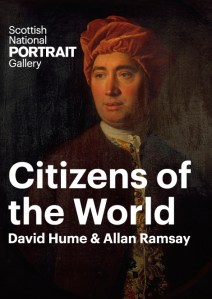 Citizens of the World: David Hume and Allan Ramsay
Scottish National Portrait Gallery, Edinburgh, 1 December 2011 — 31 December 2015
Scotland made a remarkable contribution to the European Enlightenment of the eighteenth century with many of her citizens contributing to the ferment of ideas and shifts in attitude which transformed the world. Two Scots, David Hume, the great philosopher, and Allan Ramsay, the outstanding painter, were at the centre of this cultural and intellectual revolution. This display explores their world, their friends, their families and their patrons.










 Enfilade
leave a comment