Supporting HECAA: Dues and Contributions via PayPal
From the President
After some remarkable digital wrangling by our treasurer, Jennifer Germann, we are once again able to receive HECAA dues via PayPal! So, if you’re a regular reader, please consider making a contribution to the Historians of Eighteenth-Century Art & Architecture. The organization needs your financial support to pursue its mission, an important part of which includes modest grants for graduate students through the Vidal and Wiebenson Awards. For current members, now is a good time to send in your dues for 2013 (just $20/$5 for graduate students), and if you didn’t pay dues for 2012, please consider making an additional contribution (also easily done via PayPal). You may also pay by mailing Jennifer a check, as directed on the membership page.
Anyone interested in the eighteenth century is welcome as a HECAA member. So if you’re reading, consider joining!
— Michael Yonan
Display | 700th Anniversary of Edward III
While hardly an obvious inclusion for Enfilade, this small exhibition at Windsor includes several eighteenth-century sources. The coat of arms of Edward on display, for instance, comes from the sketchbook of Henry Emlyn (1729-1815), the architect and supervisor of George III’s restoration of the chapel (SGC M.172). John Anstis’s 1724 Black Book, or Register of the Order (SGC RBK DL.13 volume I) is also on view. These and similar items serve as reminders of the historiographical and antiquarian importance of the period. -CH
◊ ◊ ◊ ◊ ◊
From the College of St George:
King Edward III Anniversary
St George’s Chapel, Windsor, 19 June 2012 — 3 January 2013

St George’s Chapel, Windsor Castle
◊ ◊ ◊ ◊ ◊
2012 marks the 700th anniversary of the birth of Edward III at Windsor Castle. Born on 13 November 1312, the first son of Edward II and Isabella of France, Edward III became King of England at the age of fourteen, in January 1327, on the abdication of his father.
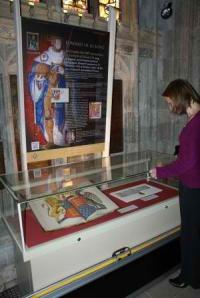 His reign, lasting fifty years, was dominated by war with Scotland and France, which has led to him being chiefly remembered as a warrior. However, it also saw great building projects, the evolution of the English parliament, the establishment of English as the official language and the longest period of domestic peace in Medieval England. Edward III had a long and close relationship with Windsor. Having been born in the Castle, he was baptised here on 16 November 1312, in St Edward’s Chapel, built by his ancestor Henry III in around 1240 and subsequently rededicated by Edward III to St Mary the Virgin, St George the Martyr and St Edward the Confessor. Several of his children were born at Windsor, and it was here that his Queen Consort, Philippa, died in 1369.
In commemoration of the 70oth anniversary of Edward III’s birth at Windsor, an exhibition of documents, rare books and artefacts from the St George’s Chapel Archives and Chapter Library will be on display in the South Quire Aisle of the
Chapel from 19 June 2012 to 3 January 2013.
The four exhibition cases and explanatory panels cover the following themes:
• Edward III as King
• Edward III and Windsor
• Edward III and St George’s Chapel
• Edward III and the Order of the Garter
Together they illustrate key aspects of the life of this great English king and explore his relationship with Windsor, which he was to make the spiritual home of his new chivalric order, the Order of the Garter, founded here in or shortly before 1348.
Exhibition | Almost Real Art: A Satirical Archaeology of the RA
From the Royal Academy:
Almost Real Art: A Satirical Archaeology of the RA Collections and Library
Royal Academy of Arts, London, 1 November 2012 — 17 February 2013

Mark Hampson, The Remarkably Talented Thomas Gainsborough, 2012, mixed media © Mark Hampson
Since 2010, artist Mark Hampson has been working ‘in residence’ at the Royal Academy and from his studio in Kent on a collaboration with the RA Collections, Library and Archives. Exploring the RA’s holdings during this two-year period, he has created a satirically inspired ‘archaeological’ response to its complexities of information and histories. The resulting work exploits and distorts the ‘official’ biography of the RA, corrupting the apparent facts to produce newly imagined narratives that are rooted in the lives and works of some of the great artists who have been connected with the Academy.
Hampson’s imaginings take concrete form in a series of mock-historical artworks combining image and text, made in collaboration with commercial sign-makers. Alongside these, the artist offers up alternative versions of art societies, unions and academies that encourage us to ask why places like the RA exist, how its history has shaped it, and how different it might have been had it been subjected to other influences and ideas. Registering the enormous impact that individual personalities have had on the institution, he explores the clichéd image of the Romantic artist as eccentric, obsessive and self-mythologising. Throughout, however, Hampson’s satire is balanced by a deep affection for the institution and those who have made it, a feeling which has only grown the deeper he has probed its history.
Bringing together high and folk art, the fairground and the museum, history and anachronism, fact and fakery, Hampson has produced what he describes with characteristic ambiguity as ‘almost real art’.
Artist’s Talks
Tuesday 4 December 2012
Tuesday 5 February 2013
Mark Hampson gives an informal introduction to his work.
Meet at 3:30 pm in the Tennant Gallery. Free with an exhibition ticket.
Call for Papers | American Association for Italian Studies Conference
The complete Call for Papers is available at the conference website:
American Association for Italian Studies
University of Oregon, Eugene, 11-14 April 2013
Proposals due by 15 November 2012
We are pleased to invite you to join the forthcoming 2013 AAIS Conference that will be hosted by the Department of Romance Languages at the University of Oregon in Eugene, OR on April 11–14, 2013. The AAIS (American Association of Italian Studies) gathers scholars and intellectuals who conduct research in Italian literature and more broadly contribute to the study of the different aspects of Italian society and artistic production, including its influence on other cultures.
We envision next year’s conference as an opportunity for a stimulating and fruitful exchange of ideas and expertise that will span not only the different periods of Italian literature, but also related areas of scholarship such as art, art history, history, philosophy, music, photography, etc. We look forward to seeing you next April. For more information on the American Association for Italian Studies, please visit the AAIS website.
Conference | National Trust Libraries: Mobility and Exchange
National Trust Libraries: Mobility and Exchange in Great House Collections
Gonville and Caius College, Cambridge, 1 February 2013
Hosted by the University of Cambridge Centre for Material Texts
This one-day event will take as its starting point the recent opening to wider research of a number of significant great house private libraries in the United Kingdom, thanks to the on-going cataloguing work being undertaken by the National Trust. Papers and discussion will treat themes including the migration of books and ideas in and out of libraries; communities of the library (how ‘private’ was a private library?); libraries as repositories of cultural history. Attendance is free, but registration is required. Please contact Dunstan Roberts (dcdr2@cam.ac.uk) or Abigail Brundin (asb17@cam.ac.uk) for more information.
◊ ◊ ◊ ◊ ◊
Some background from the Centre for Material Texts at Cambridge:
National Trust Libraries: Pilot Project at Belton House, Lincolnshire
The National Trust owns and manages over 150 properties in the UK that contain collections of books, the majority still housed in the buildings where they were assembled and read by their original owners. Between forty and fifty of the libraries in National Trust properties have been described as being of ‘major national significance’ (Purcell and Shenton, 2005), constituting an unparalleled resource for the study of the history of private book ownership in the United Kingdom. The process of cataloguing the major libraries is ongoing, and the results are being made available to researchers on the COPAC Catalogue as they become available. This pilot study showcases the research potential of these exciting collections, which form an important part of our national cultural heritage.
The study investigates the place of Italian books in an English great house, Belton House in Lincolnshire. Belton houses the Trust’s second largest library (over 11,000 titles), assembled by successive generations of the Brownlow family, and the collection has now been fully catalogued. 229 works are in Italian, published between 1500 and 1800, across a variety of genres and subjects. Analysis of the Italian holdings will form the basis for two themed workshops. The first, to be hosted by the CMT in Cambridge in the summer of 2012, will explore the curatorship of great house libraries, in discussion with the curators themselves. The second, to be held at Belton early in 2013, will explore the theme of cultural mobility in the early modern library, considering the social, cultural and intellectual histories of continental books in English collections. An exhibition of Italian books will be held at Belton, displaying the connections between book and place for a general audience.
The PI for this project is Abigail Brundin (Department of Italian). The RA is Dunstan Roberts.
Update (15 June 2012): The AHRC has just awarded us a Research Networking Grant in relation to this project… more information to follow.
Call for Papers | The Paris Fine Art Salon, 1791-1881
From the University of Exeter:
The Paris Fine Art Salon, 1791-1881
University of Exeter, 4-6 September 2013
Proposals due by 25 January 2013
Keynote speakers: Susan Siegfried (University of Michigan), Pierre Vaisse (University of Geneva), and Richard Wrigley (University of Nottingham)
The Paris Fine Art Salon dominated French artistic life throughout the nineteenth century. Organised by the State, and usually lasting between two and three months, the Salon was an annual or biennial showcase for the contemporary visual arts and a conspicuous manifestation of French artistic hegemony. It provided artists with the most important opportunity available to present their work to the public, attract a clientele, launch and sustain a career, and compete for state honours and prizes, and public and private buyers and commissions. For the public it was a huge social and cultural event, attracting hundreds of thousands of visitors from across Europe and beyond.
The conference will coincide with the completion of a three-year, AHRC–funded project, entitled Painting for the Salon? The French State, Artists and Academy, 1830-1852. The participants in the project, Professor James Kearns (Principal Investigator), Dr Alister Mill (Research Fellow) and Harriet Griffiths (doctoral candidate) will each present elements of their research at the beginning of the second day, which will be devoted to the period 1830-1852. The first day will be devoted to the period 1791-1830, the third to 1852-1881.
We invite proposals for papers which explore issues and ideas centred around the Paris Salon as an artistic and cultural event in the period 1791-1881. Areas that may be considered include the Salon’s importance for the careers of the exhibiting artists, its relationship to other exhibition spaces in Paris and the provinces, its management by the State, the shifting role of the Académie des Beaux-arts and/or the Salon jury, viewing conditions in the Salon, the impact of changes in Salon management on such issues as participation rates and stylistic innovation, and the exhibition’s significance as a social as well as artistic event. Please email James Kearns at J.Kearns@exeter.ac.uk with a title and 150-word abstract of your proposed 20/25-minute paper by 25 January 2013.
Conference papers to be delivered in either English or French.
Exhibition | White Gold: Meissen Porcelain
I’m afraid this one almost slipped by without notice, though you still have two months to see it. From The Frick:
White Gold: Highlights from the Arnhold Collection of Meissen Porcelain
The Frick Collection, New York, 13 December 2011 — 6 January 2013

Teapot, Meissen porcelain, c.1729–31, The Arnhold Collection; photograph: Maggie Nimkin
New Portico Gallery Opens with Presentation of Sculpture and Selections from an Important Promised Gift of Meissen Porcelain from Henry H. Arnhold
Since December 13, visitors to The Frick Collection have been able to enjoy a new gallery — the first major addition to the museum’s display spaces in nearly thirty-five years. The inspiration for this initiative, which involves the enclosure of the portico in the Fifth Avenue Garden, comes from the intention of museum founder Henry Clay Frick (1849–1919) to build an addition to his 1914 mansion for his growing Collection of sculpture. The project was postponed in 1917 following the United States entry into World War I, and Mr. Frick died before it could be resumed. In recent years, the institution has placed greater focus on sculpture through critically acclaimed exhibitions and several key acquisitions, while also evaluating the effectiveness of the display and lighting of such objects. Another area of increased focus has been the decorative arts. When talks began with renowned porcelain collector Henry H. Arnhold about a promised gift, the idea to create a gallery both for sculpture and the decorative arts was revisited. The architecture firm Aedas developed a plan to integrate the outdoor garden portico into the fabric of the museum, and groundbreaking occurred last winter. Aedas, formerly known as Davis Brody Bond Aedas, is one of the leading practices in the United States engaged in a range of museum and landmark structure commissions.
The Portico Gallery for Decorative Arts and Sculpture opened in late December with an inaugural exhibition of works drawn from Henry Arnhold’s promised gift of 131 examples of Meissen porcelain from the early years of this Royal Manufactory’s production. . . White Gold: Highlights from the Arnhold Collection of Meissen Porcelain will feature approximately seventy of these objects, presented along with a group of eighteenth-century sculptures by Jean-Antoine Houdon (1740–1828). Among the latter works is the full-length terracotta Diana the Huntress, a signature work at the Frick that returns to view having been recently cleaned and treated. It finds a permanent home in the new portico gallery, while the ongoing display of other sculptures and ceramics will rotate periodically.
Fellowships | Residential Awards at the Yale Center for British Art
Visiting Scholar Awards, 2013-14
Yale Center for British Art, New Haven
Applications due by 4 January 2013
The Yale Center for British Art offers short-term residential awards to scholars undertaking research related to British art. The awards are intended to enable scholars working in any discipline, including history, the history of art, literature, and other fields related to British visual and material culture, to study the Center’s collections of paintings, sculptures, drawings, prints, rare books, and manuscripts, as well as primary and secondary reference materials.
Awards are offered at both postdoctoral (or equivalent) and pre-doctoral levels. Postdoctoral awards may be held between one to four months. While all applications are given equal consideration, we are encouraging of stays of two or more months. Pre-doctoral awards may be held from one to two months and are intended for graduate students writing dissertations in the field of British art. Applicants from North America must be ABD to qualify.
One award per annum is reserved for a member of the American Society for Eighteenth-Century Studies. In addition, scholars may apply to the Huntington Library, San Marino, California, and the Delaware Art Museum, Wilmington, Delaware, for awards in the same year; every effort will be made to offer consecutive dates.
The closing date for awards is January 4, 2013. Applicants should complete the online application and upload a cover letter, a curriculum vitae, and a statement of no more than 2,000 words (single-spaced) outlining the proposed research project and the preferred months of tenure. Applicants should provide a title for their research project and place their full name on each page of the application. Two confidential letters of recommendation should be emailed to Research (ycba.visitingscholars@yale.edu) under separate cover by the same deadline.
More information is available here»
◊ ◊ ◊ ◊ ◊
This fall’s visiting scholars:
Caroline Good
PhD Candidate, University of York and Tate Britain
Caroline Good’s research project is entitled, “Two Cultures: English Writers on Art and the Making of a National School, 1658–1719.” Good intends to provide an intensively researched and historically specific perspective on the theory and early historiography of British art between 1658 and 1719 through the written accounts of English art that were produced in these years. The Center’s collection contains the rare books and manuscripts that form the backbone of her thesis, from William Sanderson’s Graphice (1658) to Jonathan Richardson’s Two Discourses (1719).
Rivke Jaffe
Lecturer, Leiden University
Rivke Jaffe is researching the aesthetics of pollution in the context of Victorian-era sanitary reform in Kingston, Jamaica. Her project will explore how Victorian ideologies of cleanliness mapped onto the urban Caribbean, and how they articulated post-emancipation hopes and fears. Jaffe will use her time at the Center to access the historical and visual sources on pollution, disease, and sanitary reform in the British Empire, such as the Center’s extensive collection of illustrated periodicals, maps, prints, and drawings. Jaffe’s research will culminate in a chapter in the publication tentatively titled “Victorian Jamaica,” and a historical chapter in a larger monograph entiteld “Concrete Jungles: Environmentalism, Urban Space, and the Politics of Difference.”
Stephanie O’Rourke
PhD Candidate, Columbia University
Stephanie O’Rourke will spend her time at the Center researching for her project, “Impressed upon the Countenance: Fuseli and the Physiognomic Body.” Her project revisits the relationship between Henry Fuseli and Johann Lavater, who collaborated in the production of numerous French and English editions of Lavater’s seminal text on physiognomy, “Physiognomische Fragmente” in the 1780s. Through this project, O’Rourke seeks to contribute to contemporary scholarship and its compelling reevaluation of Fuseli’s work by revisiting the role of physiognomy in terms of the spectatorial body. O’Rourke’s work will involve a detailed examination of Lavater’s multivolume text as well as the Center’s materials on Henry Fuseli, Horace Walpole, physiognomy, and the display and reception of painting at the Royal Academy.
Morna O’Neill
Assistant Professor of Eighteenth and Nineteenth-Century European Art, Wake Forest University
Morna O’Neill’s project, “This Place: Attributing the Inscription of ‘English Landscape Scenery,’” seeks to re-examine John Constable’s collaboration with David Lucas known as “English Landscape Scenery” (1830–32) in light of her discovery of the source of the Latin verse included on the frontispiece. O’Neill’s attribution of the Latin inscription to Constable’s print series prompts a reconsideration of his goals for “English Landscape Scenery,” as well as for his larger project and formation of his artistic identity. O’Neill will research the specific and broader questions raised by the allusions to William Camden’s Britannia and Alexander Neckam’s poetry using the Center’s extensive collection of Constable-related material.
Celina Fox
Independent scholar and museums advisor
On the basis of previous research, Celina Fox conjectures that tours of northern Europe, which extended beyond the realms of improvement and amusement to serve professional ends, were more pragmatic in their core purpose than tours to Italy and the Mediterranean. Fox’s project will be to explore the material at the Center relating to the Northern Grand Tour—British travellers to the Low Countries, Germany, the Habsburg Empire, Switzerland, Poland, Russia, and Scandinavia—from the seventeenth to the nineteenth century. Fox will spend her time at the Center studying its collection of manuscript travel journals, watercolor albums, drawings, and prints of the tourists of Northern Europe who travelled from the seventeenth century to the nineteenth century. In addition, Fox will benefit from consulting resources at the Lewis Walpole Library and the Beinecke Rare Book and Manuscript Library.
Grace Brockington
Lecturer in History of Art, University of Bristol
Grace Brockington’s scholarship concerns Vanessa Bell (1876–1961), an artist of international stature who operated at the forefront of the British avant-garde. Historians have failed to give an adequate account of her critical, cosmopolitan practice, accepting at face value her portrayal as a Bloomsbury bohemian on the one hand, and as a withdrawn, even inarticulate artist on the other. Brockington’s study of Bell is based on a close examination of her work and its visual references; her work is a reaction against the prevailing biographical approach and a response to Bell’s own practice of talking about art in the gallery. As a visiting scholar at the Center, Brockington will examine the collection of works by Bell (including drawings, paintings, and manuscript letters) in relation to the larger holdings of British art. She will also study the work of associated modern artists such as Duncan Grant and Walter Sickert as well as the eighteenth-century Conversation Piece, a genre which Bell reinvented in her group portraits of 1912–13 (e.g., Conversation at Asheham House, 1912).
Matthew Craske
Reader in History of Art, Oxford Brookes University
Dr. Matthew Craske visits the Center as the Andrew W. Mellon Foundation Senior Visiting Scholar, to undertake research on the employment of images in churches in the English Protestant tradition, focusing on St. Margaret’s Church, Westminster. He will also work on his book-length project, Wright of Derby: The Art of Friendship, which is supported by a Senior Research Fellowship from the Paul Mellon Centre for Studies in British Art. Andrew W. Mellon Senior Visiting Scholars are invited to spend two months at the Center, pursuing their research and participating in the intellectual life of the Center and Yale University.
Kathleen Wilson
Professor of History and Cultural Analysis and Theory, State University of New York at Stony Brook
Kathleen Wilson will be working on a book project entitled “Strolling Players of Empire: Theatre, Culture and Modernity in the English Provinces, 1700-1820,” which considers the role of theater and performance of difference in provincial and colonial towns.
Cora Gilroy-Ware
PhD Candidate, University of Bristol and Tate Britain
Cora Gilroy-Ware will conduct research on a project entitled, “Thomas Stothard and Henry Howard: In Search of Grace and Elegance,” related to her doctoral dissertation, “The Classical Nude in Romantic Britiain.”
Molly Duggins
PhD Candidate, University of Sydney
Molly Duggins will explore the visual discourse on seaweed in the Center’s Rare Books and Manuscripts collections for a project entitled “From Scientific Specimen to Civilising Medium: Seaweed and the Art of Arrangement in Nineteenth-Century British Visual Culture.”
Exhibition | Coaches from Versailles on View at Arras
From the exhibition website:
Roulez Carrosses! Le Château de Versailles à Arras
Musée des Beaux-Arts, Arras, 17 March 2012 — 10 November 2013
Curated by Béatrix Saule, Jean-Louis Libourel, and Hélène Delalex
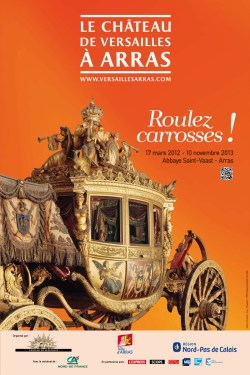 Roulez Carrosses!, the inaugural exhibition of the partnership signed in 2011 between the Château de Versailles, the City of Arras and the Nord-Pas-de-Calais Region, is a landmark event. It is the first French exhibition to be devoted to horse-drawn vehicles. Berlin coaches, royal and imperial carriages from the Versailles collection have all taken the road for Arras, to be admired here until November 2013. The Musée des Beaux-Arts is thus hosting paintings, sculptures, sledges, sedan chairs, horse harnesses and several outstanding carriages such as the coaches of Napoleon I’s marriage procession, Charles X’s coronation coach or the impressive funeral hearse of Louis XVIII. From Louis XIV to the Third Republic, these little-known vehicles will offer a journey through the History of France. Chronologically displayed over 1,000 m², these works are set against a backdrop of innovative scenography combining reconstructions, activities, immersion and multimedia. The exhibition provides an opportunity to discover Versailles and its collections whilst at the same time highlighting the historical links between Arras and the former residence of kings. It will also provide an insight into the operation
and evolution of horse-drawn vehicles.
Curatorship
Béatrix Saule, Director of the Musée National des châteaux de Versailles et de Trianon
Jean-Louis Libourel, Honorary Chief Curator of Heritage
Hélène Delalex, Heritage Conservation Manager at the Château de Versailles
◊ ◊ ◊ ◊ ◊
As Didier Rykner judges in his review for The Art Tribune (24 September 2012) . . .

Sedan Chair for the King’s House Versailles, Musée national des châteaux de Versailles et de Trianon Photo : RMNGP/G. Blot
Even if it is much longer than the usual three-month period, this is a true exhibition, not a lineup of works; it is accompanied by a beautiful scholarly catalogue on a subject which is not often studied; it does not replace the display of the permanent collections as the exhibition rooms occupy the space acquired at the Saint-Vast Abbey; it does not deprive visitors going to the lending museum from seeing major works there since the Musée des carrosses (a rather exaggerated term given the usual presentation conditions) is rarely open to the public; and, above all, it will result in enduring benefits for the coach collection as well as for the Musée des Beaux-Arts itself. . . .
The museum staging by Frédéric Beauclair is very well done. Paintings, sculptures and drawings round out the presentation of the carriages illustrating their use, the way they functioned and the context in which they were produced. Visitors will also discover some little-known works. . . .
The full review is available here»
◊ ◊ ◊ ◊ ◊
Eight short videos accompany the exhibition:
◊ ◊ ◊ ◊ ◊
From the Château de Versailles bookshop:
Béatrix Saule, ed., Roulez Carrosses! Le Château de Versailles à Arras (Paris: Skira Flammarion, 2012), 256 pages, ISBN: 9782081278172, 40€.
 Roulez carrosses! is the first exhibition in France devoted to horse-drawn coaches and carriages and, in this case, historical examples, all totally luxurious in every detail and all different: carriages for the outings of the children of Louis XVI, a sumptuous berline for the wedding of Napoleon I, the hearse of Louis XVIII, the coronation coach of Charles X, etc. Other outstanding masterpieces from the collections of Versailles accompany them: a series of paintings by Van der Meulen, major royal portraits, or unique vehicles like these fantasy sledges in which Louis XV and then Marie-Antoinette were pulled over the snow-covered walks of the park of Versailles. This book describes episodes from the political history of the palace, dynastic events and customs of the court, narrated and commented on here by eminent historians. Fans of handsome horse-drawn vehicles will discover the grand coaches for ceremonial occasions – from the “modern coach” invented in the reign of Louis XIV to the coaches for state ceremonies of the presidents of the Republic – along with their technical innovations, the refinement of their accessories and the extreme lavishness of their ornamentation, at a time when the art of French coach-building was at its apogee.
Call for Papers | Exotic Goods in France and the U.S., 1700-2000
In the spring at NYU’s Center for International Research in the Humanities and Social Sciences:
Objects From Abroad: The Life of Exotic Goods in France and the United States
New York University, 25 April 2013
Proposals due by 31 December 2012
The development of material studies and consumption studies, of anthropology of the material world and the material culture of art history shows growing interest for the material dimension of pictures and goods. This perspective calls attention to the physical and social life of things. In this sense, our conference looks to analyse the production of goods and their transformation, in connection with their various uses and contexts. A historiography focusing on the construction of international spaces and exchanges through the movements of things, goods, merchandises and artworks is currently on its way.
This conference would like to concentrate on the goods imported in France and the United States between the 18th and the 20th century, and their existence within their new environment: business or tourist trips, where the exotic objects were collected and gathered in private spaces; scientific expeditions, where “anthropological” artefacts were collected for Western museums. What kind of things and goods were brought back to New York City, Paris, and the other American and French cities – and through cities of many countries – between the 18th and the 20th century? How were they exhibited, put on display, but also converted and updated? We wish to interrogate the life and “career” of goods, their collection and their circulation, as well as the way in which goods acted upon reception societies. What was the impact of these objects on ways to consume, to live, to dress, to create? What about the processes of translation and interpretation that accompanies such uses and appropriation?
Exchanges between Europe and United States were heavy and significant but they are seldom analysed. Therefore they needs to be carefully examined. At the same time, paying attention to these goods is also a way to repopulate these worlds with different actors. Collectors, but also ethnographers, dealers, painters, soldiers: they were all inventing, marketing and consuming these singular things. From this angle, these goods become boundary objects that mobilized and gathered different communities – scientific, commercial, artistic, etc. Around the actors lie various spaces: we would like to observe the large scale movements but also micro-movements and circulations, and also how these goods were set up and displayed in museums as well as in houses. In this sense, this conference tries to link social practices and representations, visual and material cultures, private and public spaces.
Four directions, all connected, could be explored during this conference:
1. Uses and re-uses
Processes of decontextualisation and recontextualisation (collection, re-use, reparation) will focus our attention. How are the objects sold, exposed, reterritorialized? When bought, how are they used? And, when necessary, how are they repaired or redesigned? Rebuilt and recomposed? Through a series of case studies, it may be useful to follow certain objects from the merchant’s shop to the individual interiors, or from the private space to the museum, looking carefully at the hands and
gestures that welcome and transform the goods.
2. Witnesses and souvenirs
Some objects, such as travel souvenirs, have a special memorial function. What kind of memory do they keep? What are they witnessing? How do they tell us an emotion, a narrative, a story or a part of history? This reflection can also be extended to the issue of fake and authenticity, or of hyper-reality, by studying life-casts, prints, or, in some cases, photography.
3. Actors and markets
Objects are taken as part of a chain involving various actors and consumers that need to be identified. Who are the people involved in these exchanges and what are their roles in the invention of these objects? In their updating and marketing? What are the specific issues, circuits and contours of these markets? How do the different actors and consumers use these objects to develop various identities?
4. Fictions and identities
The fourth axis will focus on fiction, disguise, game, and more generally on fictional use. Joanna Sofaer has already shown how the use and representation of some exotic accessories build identities. How do dresses, dishes or accessories related to tobacco, for instance, work on the identity of their owner? How are these objects mobilized and used in the artworld, in private or public spaces, theater plays or paintings?
Paper abstracts (maximum 300 words) and a short bio (maximum 100 words) should be submitted to Noemie Etienne (noemie.etienne@unige.ch) and Manuel Charpy (manuel.charpy@wanadoo.fr) by December 31, 2012.










 Enfilade
leave a comment