Call for Papers | Political Portraiture in the United States and France
Political Portraiture in the United States and France
during the Revolutionary and Federal Eras, ca. 1776–1814
National Portrait Gallery, Washington, D.C., 25–26 September 2014
Proposals due by 15 November 2013
Organized by Todd Larkin and Brandon Brame Fortune
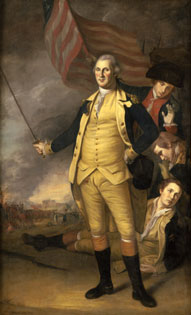
Charles Wilson Peale, Washington at the Battle of Princeton (Princeton)
In August 1814 British troops under General Robert Ross sacked Washington, D.C., and burned the Capitol, together with some splendid state portraits of Louis XVI and Marie-Antoinette, the French monarchy’s gift to the American Congress some thirty years earlier. The approaching bicentennial of this event will provide scholars of the United States and France a rare occasion to meet and share expertise on aspects of late eighteenth- to early nineteenth-century portraiture.
The premise of this conference is that in the period between the War of Independence and the War of 1812 the United States maintained a complicated political alliance with France, which had an impact on patterns of cultural representation and consumption on both sides of the Atlantic. The transition from monarchical to republican forms of government was accompanied by a shift from aristocrats to citizens as the primary patrons, subjects, and viewers of portraits. Yet portraits of American and French heads of state, delegates, and families often reveal an uneasy integration of traditional aristocratic forms and new republican values.
The first half of the conference, titled “Dialect[ic]s of Diplomacy,” will treat with single-person portraits (and portrait pairs) that suggest an individual invested with high status, extraordinary power, martial strength, or diplomatic duty on behalf of the nation; the second half of the conference, “Representative Bodies,” will examine group portraits that suggest a shared commitment to collective governance, family harmony, or equitable representation within the nation. How effective were state portraits in promoting the authority of a hereditary monarch, group portraits in promoting the authority of an elected assembly? To what extent did American artists reference or adapt the paintings and prints of French artists, and vice versa? What formal arrangements and symbolic repertories were invented to invest politicians, merchants, and workers with ideals of “patriotism” and “republicanism”?
This line of inquiry is meant to challenge or complicate persistent claims that the United States remained culturally dependent on Great Britain throughout the period, that its portraits reflect a kind of “Anglo-American synthesis.” Although the British flooded North America with royal paintings and celebrity prints in the general expectation that these would encourage fidelity to the Crown and taste for English goods, the French deployed images of sovereigns, ministers, and generals more precisely to seal diplomatic agreements, to celebrate military victories, and to rally public support. Indeed, so appealing were French productions that American artists freely borrowed from them to commemorate the first Presidents of the United States.
There will be six sessions, each lasting approximately two hours and consisting of three to four participants.
Part One: Dialect[ic]s of Diplomacy
1. State Portraits in the United States and France. Chair: Olivier Bonfait, Professeur d’histoire de l’art moderne, Université de Bourgogne, olivier.bonfait@inha.fr
This session will address the fabrication, iconography, and function of specific state or ceremonial portraits from the late eighteenth through the early nineteenth century, in America and France. At issue is whether the genre can be said to have shed its Baroque charge of providing an efficient “body metaphor” to reinforce a sovereign’s “absolute” power, dominion, favor, or concord, and to have embraced an Enlightenment application as a sign of virtue, dynamism, heroism, or even constitutionalism. Scholars have long held that the American and French revolutions marked a decisive political break with royal or colonial governments of the past, and that this can be evidenced in new portrait trends, in the transition from Allan Ramsay’s George III in Robes of State (1760) to Charles Willson Peale’s George Washington at the Battle of Princeton (1779), and from Antoine-François Callet’s Louis XVI in Robes of State (1780) to Jacques-Louis David’s Napoleon Bonaparte at the Saint-Bernard Pass (1800). Are these pre- and post-revolutionary traditions as polarized as they seem, or do they have a measure of formal and conceptual continuity?
2. The Portrait Copy, Painted and Printed. Chair: Xavier Salmon, Conservateur général des musées de France, Château de Fontainebleau, xavier.salmon@chateaudefontainebleau.fr
This session will explain how painted and printed copies of official portraits were produced, marketed, and consumed. In France, the Cabinet des tableaux du roi (or King’s picture atelier) at Versailles prepared replicas to be dispatched to the Austrian emperor, the Swedish king, and the American Congress; at the same time, many academic artists furnished copies directly from their own ateliers. Images of royalty were also disseminated throughout Europe and North America via high quality reproductive engravings; Pierre-Eugène de Simitière left a fairly good record of prints (including Pierre-Imbert Drevet’s Louis Le Grand, 1710) purchased in America during the Revolutionary Period. As an extension of P. Staiti’s and M. Lovell’s analyses of the impact of imported British prints on American colonial portraits, this section will assess the impact of French prints on American portrait compositions of the 1790s, including Gilbert Stuart’s George Washington (1796), which in turn served as a model for lithographs of Thomas Jefferson and James Madison (1805, 1810).
3. The Portrait as a Diplomatic Gift. Chair: Brandon Brame Fortune, Chief Curator, National Portrait Gallery, Washington, D.C., FortuneB@si.edu
This session will examine the tradition of official gift exchange between heads of state, ministers plenipotentiary, and diplomats. Large-scale portraits were the most visible manifestations of this custom: in a letter of June 1779, the United States Congress formally requested from Louis XVI portraits of himself and his consort for their council chamber, a request that was gratified after the signing of peace articles in 1783 with the dispatch of atelier copies of Antoine-François Callet’s Louis XVI and Elisabeth Vigée Le Brun’s Marie-Antoinette to Philadelphia; in his accounts of July 1779, Charles Willson Peale logged completion of a replica of George Washington at the Battle of Princeton for the French ambassador, Conrad Alexandre Gérard, who remitted it to the King of France upon his return to Versailles in 1780. There were small-scale tributes as well: Louis XVI recognized the exertions of American diplomats by bestowing tabatières (portrait-mounted, diamond-studded snuffboxes) and boetes à portrait (diamond-encircled portrait medallions) on Silas Deane, Arthur Lee, John Laurens, and Benjamin Franklin between 1778 and1785, and framed engravings on George Washington and Thomas Jefferson around 1790–91.
Part Two: Representative Bodies
4. Republicanism and the Politician’s Portrait. Chair: Philippe Bordes, Professeur d’histoire de l’art moderne, Université de Lyon 2-LARHRA, philippe.bordes@univ-lyon2.fr
This session will explore portrait formats, iconography, and styles most appropriate for conveying insurgent and republican ideals. In the United States experimentation with old and new conceptions held sway. The multi-figure compositions of Robert Edge Pine and Edward Savage’s Congress Voting for Independence (begun after 1784) and John Trumbull’s Signing of the Declaration of Independence (begun in 1787) attempt to represent national sovereignty vested in a collective body of men. Initiatives were more diverse but less conclusive in France due to the rapid turnover in regimes: from 1789 printmakers and painters were free to portray everything from Louis XVI accepting the Constitution in 1790 to his trial before the National Convention for acts of treason in 1792; the harsh republicanism that prevailed in 1793–94 rejected official portraiture as an appropriation of the will of the people; from 1796 artists compelled to evoke Bonaparte’s military exploits gave them a strong political resonance.
5. Patriotism and the Family Portrait. Chair: Amy Freund, Associate Professor of the History of Art, Texas Christian University, a.freund@tcu.edu
This session will examine how the family unit was portrayed in the United States and France during a period of transition from monarchy to republic (and, in the case of France, from republic to Empire). Possible topics of discussion include: the notion of a “first family” in images such as Elisabeth Vigée Le Brun’s Marie-Antoinette and Her Children (1787) and Edward Savage’s George and Martha Washington, Their Grandchildren and Black Servant (1789–96); the issue of familial allegiance to the nation, as in Charles Willson Peale’s Robert Goldsborough and Family (1789), which incorporates a bust of Washington, and Charles-Paul Landon’s Comte Pierre-Jean de Bourcet and Family (1791), which incorporates effigies of Louis XVI and Marie-Antoinette; and the uses of the family as a model of citizenship and the state, as in François-André Vincent’s Agriculture (1798). How was the family portrait affected by references to the modes of history or genre painting? How did it reinforce or challenge traditional gender, racial, and class hierarchies? Did family portraiture promote political participation and social unity, or did it valorize private life at the expense of the public sphere?
6. The “Face” and “Body” of Paris, Philadelphia, New York, and Washington: Splendor and Squalor, Leisure and Labor in the Early Modern Metropolis. Chair: Margaretta Lovell, Professor of the History of Art, University of California, mmlovell@berkeley.edu
In the late eighteenth- to early nineteenth-century, Paris, Philadelphia, New York, and Washington, D.C., were large or rapidly expanding cities, hosts to national legislatures, foreign legations, and scores of diplomats, businessmen, and tourists, but they were also sites of unimaginable poverty, crime, and misery for thousands of anonymous workers. This session will attempt to “map” and to “illustrate” the cityscape and its inhabitants in a way that distinguishes government from business districts, stately residences from laboring quarters. With regard to Philadelphia, images include the anonymous “Clarkson-Biddle” Map of Philadelphia (1762) and John L. Krimmel’s Fourth of July in Centre Square (1810–12) and Election Day in Philadelphia (1816); letters and journals provide impressions of everything from parades in celebration of allied victories to riots in protest of un(der)paid laborers and troops.
The conference will take place in the Nan Tucker McEvoy Auditorium of the Donald W. Reynolds Center for American Art and Portraiture at the Smithsonian Institution, Washington, D.C., on 25–26 September 2014. The event co-organizers, Todd Larkin and Brandon Brame Fortune, encourage participation from American and French scholars from university, museum, or archival backgrounds who can illuminate patronage motivations, artistic approaches, and interpretive challenges to promoting political identities during a time of momentous change. The Terra Foundation of American Art, in partnership with the Montana State University Alumni Foundation and the National Portrait Gallery, are pleased to support this international event.
Please send a 450-word abstract and 2-page curriculum vitae to the appropriate session chairperson by 15 November 2013. Your abstract should identify the title of the paper, articulate a central issue or problem, and explain the sources and/or methods that will be used to address it. Your curriculum vitae should include the university where you obtained your advanced degree, your major research area(s) and representative publication(s), and your current institutional affiliation and rank. The session chairs will respond to your proposal by 15 December 2013. All other inquiries about the conference, program, and publicity may be directed to: Todd Larkin, School of Art—Department of Art History, 213 Haynes Hall, Montana State University, Bozeman MT 59714, (406) 994-2720, tlarkin@montana.edu.










 Enfilade
leave a comment